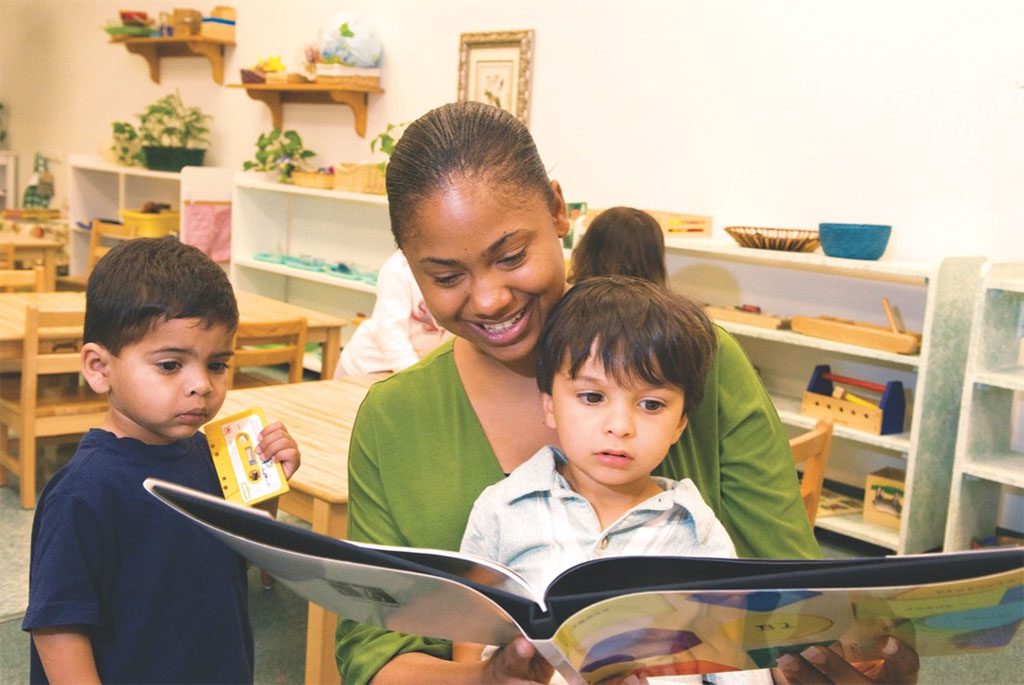
The room is lovely. A large window looks out onto a set of gardens. The hardwood floors glisten, and the room is painted in soft, neutral colors. The palate of the room is simple: child-sized furniture, bookshelves, tables, and work areas. In a corner of the room is a soft, comfortable children’s chair with pillows and picture books placed nearby. Lining the walls around the chair, at the eye level of a toddler, beautiful photographs of children from around the world are displayed. Images of families, scenes of play, of life at home, and life in community settings evoke a richness of culture and language. There is a library area of the classroom, where there is another toddler-sized, living-room style chair, several floor cushions, a thick carpet, and several shelves and baskets of books arranged attractively at child height.
On this morning, several children are sitting, listening to a story read by one of the two guides who co-teach in the classroom. The story is read with animation and respect, paced so each child can see the pictures before the page is turned. During the story, the children repeat words back to the reader.
They intermittently reach out and touch the pages of the book. Several times, one of the children names objects from the illustrations and photographs that accompany the text on the book pages. When the child does so, the other children imitate her by naming the same objects and by reaching out to the pages. Another child reaches out to help to turn the page, saying, “I turn the page.” The other two children imitate this as well, repeating, “Turn the page.” Once the story is finished, and the directress leaves the area to assist another child, the children each go to the shelf and select a book. One sits on the chair, while the other two sit on floor cushions. The children were observed turning their books from front to back, upside and downside, looking at covers and spine, talking to themselves while they did so.
The children were displaying a keen interest in sensory experiences, order, language, and complex social behaviors within this literacy experience, as is evident from the following additional observation.
One child turned the pages and named objects from the photographs on the pages. He turned the pages to the very end, then back to the front, and resumed naming items from the pages, touching some of them and talking to them before turning the page again. Another child, a little girl, seated on a floor cushion, talked softly to herself about a picture on a page in simple two-word phrases: ”Happy girl”; “Little baby”; “Mommy, mommy.” A third child put her book down within several seconds of sitting down with it and then came to stand by the child sitting in the chair, looking at the pictures and repeating words aloud.
The children were joined by another child, who sat by the child seated on the floor cushion. The child on the cushion said, “I read to you,” and began turning pages quickly, but did not repeat a story aloud. She paused to touch a picture and looked at children near her, then moved to another page. One child rose and walked to a teacher, gained her attention, and said, “Read book?” taking her hand and pulling her towards the reading area. The teacher smiled quietly and followed, asking the child to select a book.
The child looked at a basket and took out the book on top, a story with illustrations about a zoo. The teacher sat on the floor and began to read to the child. The other children in the reading area left their books and sat near the teacher. She changed her position so she could face the children and show them pictures as she read. The children listened, repeating words from the story, primarily the animal names, including: lion, monkey, and tiger. Once finished, the teacher selected another book, a picture book of animals, where the pages held two to three words and a photograph of the animal. The words had a sing-song quality about them, and the photographic images were large and colorful. Once the teacher began reading, the group was joined by another child. The little ones were sitting, repeating the phrases almost in unison for each page. The children looked deeply at the pictures and said words or phrases aloud, such as: “Oh, no!”; “Cute!”; “Mine!”; “Soft baby!”; and “Roar!”
Once the book was finished, a child reached out for the book, and it was given to him. While the other two children rose to join a group of children at a puzzle, the child with the book turned the pages, repeating some of the same phrases and words as before, taking time to study the pictures, naming the animals, and touching or petting them. If he touched the mouth of an animal with sharp teeth, he would say: “Ouch!”
This scene was repeated over multiple observations in this toddler classroom at a Montessori preschool. Daily, the children could be observed engaging in other early literacy behaviors: talking about images in poster-sized photographs of children and families; looking at pictures of their own families and talking about the photographs; and labeling objects softly to themselves, as they manipulated them. Language use and exploration was abundant.
As the children engaged with books, several specific trends were observed. First, the children repeated words in two- to three-word segments, as spoken by the teacher. Then, the children would whisper or say these words (or some of these words), as they later looked at the books independently. Second, the children were attentive as to how the teacher held the book, turned the pages, and pointed to the pictures. When a book was being read aloud, the toddlers would try to help turn pages and would also reach out to touch the pictures on the pages.
When the children were sitting independently with the book(s) later, their behavior suggested an imitation of how the teacher read the book: attention to looking at the front and back cover; attention to turning pages one at a time; and attention to touching the pictures (modeling back to the observer). Third, the children interacted verbally with books that contained photographs on a more consistent level than when the books contained only drawings. The children would talk to the pictures, name objects in the foreground and background, and would touch or pet the pictures, often speaking to them. Fourth, if an adult began to read to an individual child or to a pair of children, more children joined the small group on their own accord. Fifth, if one child walked to an empty reading area and took a book from the shelf and sat with the book, within minutes one or more children joined the first child to share the book or to take their own book from a shelf or basket.
These behaviors suggest the following for toddlers in preschool settings, where books and other literacy materials are purposefully and readily available:
- Toddlers may be able to imitate concepts about print skills when modeled by an adult;
- Books with photographs may allow toddlers to engage more fully with the book versus books with only drawings;
- Toddlers repeat words and phrases from books with sing-song and rhyming patterns; and
- Toddlers observe one another’s play and work and will readily join others or parallel play with others in a variety of activities, including engaging with books.
These observations support the role of literacy in a toddler classroom to enhance the child’s development across the sensitive periods. A classroom that mindfully creates a literate environment for very young children is one that offers materials and events to educate and delight the child as she engages with sounds, words, phrases, and images appropriate to her developmental level.
In order to support early literacy, a directress may wish to implement some of these suggestions to infuse print and other opportunities in the early education Montessori classroom:
Montessori Leadership / 2013 / p 15