 Storytime provides many extraordinary benefits for children and is often a classroom favorite, while we as educators are pleased to watch children develop their imagination, vocabulary, and reading skills. Perhaps, the most memorable aspect of story time is the way that the atmosphere in the classroom softens as silence and excitement arise and a warm sense of togetherness is created.
There are many reasons for this atmosphere shifting. In part, we invoke the mysterious worlds of imagination, mystery, and adventure but (more seldom discussed), we do it while shifting the role and rank of your relationship with the children.
Let me unpack this a little. Many times in your day, you will be the authority figure who tells the children what they can and can’t do. This rank is far more dominant in traditional public-school environments than in Montessori, but it is unavoidable, no matter how child-centered the teaching attitude aspires to be. The typical posture that matches this moment is ‘face-to-face’ or ‘front-to-front,’ and the teacher is usually taller or higher than the students. In these moments, we can say that “the teacher has rank over the children.”
This posture and rank changes during story time. If you were at home with your own children, you’d climb on the sofa together and snuggle ‘side-by-side.’ Although this is a little different in the classroom environment, much of the energetic shift is the same. You are no longer the authority that tells the children what to do or not to do. Now you become their ally and companion in adventure, entering the mystical world of the story ‘side-by-side.’
Each time you traverse the threshold from the classroom into the imaginary world created by the author and illustrator, your young audience can encounter the adventures of the character as if it were their own. As the children slip into the skin of the characters, they will experience all of the ups and downs that the characters face a visceral internal experience.
Think of the gasps of “oh no” that issue from little mouths when the hero of the story gets stuck, and they don’t yet know what will happen! These jaw-dropping moments of suspended expectation are the stuff of which great movies are made. These anticipatory occurrences are also a powerful step in creating a teaching moment. Sharing the suspense as a fellow journeyman rather than an authoritative figure, you are in a special position to meaningfully communicate with your children. You can discuss the story’s plot, characters, story meaning, and other story elements so that they will truly accept what they are learning without the barrier of possible judgment if they get it wrong. Just as peers often have a special influence on our children, you will also be especially influential because you are walking through the story with them rather than impressing it upon them in a dominant role.
A well-written storybook also provides the perfect vehicle to take advantage of this embodiment and character identification, using the literary elements of conflict and resolution to deliver the reader to an internalized lesson. As the reader, you can lead the young listener/reader through the character’s moment of struggle to a victorious conclusion, instilling in the children the road-map or blueprint to their own victory when they face a similar situation.
Story character dilemmas and their resolutions provide valuable life lessons.
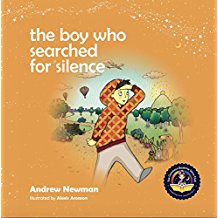
Take, for example, the leading character in The Boy Who Searched for Silence. He goes in search of silence because he has heard it is a beautiful thing. Unfortunately, his world is less wonderful. He “struggles with the noises of everyday life.” This line from the story is intentionally crafted to create resonance with the reader, who may feel the same way. Both the reader and listener follow the boy through his quest as he visits false hope, anger, and despair. The boy’s postures are playfully illustrated and are very familiar to any teacher, parent, or child.
As the story unfolds with each reading, you and your class can join the boy when he ‘falls right into silence.’ We can feel him ‘alive’ in us. So, the next time you are supporting a child who is struggling with the problematic noises of life, there is a remedy, ready and installed, learned from the story that you shared together, made more memorable because of the shared experience of learning the lesson in the safety and shelter of your nurturing presence. Now you have a new vocabulary to engage the social-emotional challenge that life presents. You can say, “Let’s fall inwards into silence, as the boy did in that story.”
The Conscious Bedtime Stories collection, which includes The Boy Who Searched for Silence, is purpose-built to create a special dynamic – a time for settling in together, even sharing some breathing to help bring reader and listener into the present moment and to enjoy a short but meaningful tale. Together, at the end of each story, there is even a segment to help relate the purpose of the story to real life for both reader and listener. More than just a story, Conscious Bedtime Stories are experiential and designed to bring reader and child closer together.
Maria Montessori wrote, “The child builds his inmost self out of the deeply held impressions he receives.” As teachers, you are modeling these impressions all the time through your own demeanor in the school. How you relate with the children, and in front of the children, will be absorbed into their inner world. Your kindness will grow their kindness, and a good book with a well-crafted
storyline and characters will leave a deep meaningful impression.
Storytime is more than merely an opportunity to read a story; it is a time for building memories, for enhancing communication, for sharing together, and a time when key life lessons can be presented in a safe and open atmosphere. Don’t miss out on the considerable benefits of storytime—today! ′
Andrew Newman has followed his deep longing for connection and his passion for spiritual development in a 12-year-long study of healing. He is a graduate of the Barbara Brennan School of Healing and a qualified Non-Dual Kabbalistic healer.
His portfolio of work alongside his therapy practice includes— publishing over 2500 donated poems as the PoemCatcher; volunteer coordination for Habitat for Humanity in South Africa; directing Edinburgh’s Festival of Spirituality and Peace.
Andrew believes that the last 20 minutes of every day are precious. The Conscious Bedtime Story Club is a culmination of all of these areas of experience, intended to bring parent and child into a deeper connection and spiritual union with each other.
ML/September 2018/pg 10