 Life on St. Croix often means having the ability to discern need from want. For example, you may want to include a strawberry in tomorrow’s seed lesson, but you may need to wait a week until any grocery store offers them. You may want to display materials in an expertly, hand-crafted seagrass basket, but may need to be prepared that the basket may not survive the Caribbean’s insistent humidity or Saharan dust, and you will often find anoles or geckos, an occasional millipede attempting to set up residence in your basket.
St. Croix’s community offers us the beauty of living intentionally; of deciding what matters most, which values we are willing to work for and which conveniences we are willing to live without. The truth is that everything we do here is about the people.
This has become especially clear to me through Hurricanes Irma and Maria.
At St. Croix Montessori, there’s the constant hum of generators in the background. Our hilltop schoolyard now offers a clear panoramic view of Christiansted Harbor and Buck Island. Our daily habits include a new set of responsibilities: stocking gasoline for the generator; oil changes; power strips and monitoring surges; identifying which foods can last on ice or overnight in an unpowered refrigerator; unexpected traffic delays and supply shortages; and a great deal more text messaging because phone calls often don’t go through and Internet is temperamental.
And then there’s normalization: Our beautiful, sunny classrooms continue to welcome primary and elementary children and their families each day. The children walk past flowering jasmine on their way to their classrooms. They cheerfully wear sun hats as they cut flowers. We observe the 3-hour work period and practice meditation in the afternoons. We laugh, learn, and practice peaceful conflict resolution, much as we did before. Except now, we have an intense bond of having shared life before and after the hurricanes.
The school was open for five days before our first Category 5 Hurricane, Irma, came. Families breathed a heavy sigh of relief when we emerged to find St. Croix battered but stable. In fact, for twelve days we walked around saying our blessings and considering how fortunate we were to have just enough infrastructure to offer emergency relief to our St. Thomas and St. John neighbors. We gratefully took the help of families to clean debris, return furniture and materials to their locations, and prepare for re-opening on September 11th. The St. Croix Montessori children shared stories of Irma, offered their own belongings as donations for displaced families, and crafted cards for the children on St. Thomas and St. John, who had lost their homes and schools. Our students discussed various ways they could fundraise and host supply drives. On Friday the 15th, we baked muffins for relief workers.
And then Maria came.
In retrospect, I think many of us were still holding onto the adrenaline of having been spared the worst of Irma. We didn’t really mind that our stores’ shelves had been emptied of hurricane supplies for nearly two weeks or consider that our island had sent its spare tarps, gas cans, chainsaws, and coolers 45 miles north to St. Thomas and St. John. After all, we still had many items packed and sealed. The sandbags were still wet. It was fresh in our minds of how we could more effectively move furniture, store supplies, seal windows and doors; and we had the comfort of knowing we were “all in it together.”
On Monday, September 18th, we shuttered the school, removed technology to the homes we assumed to be safest, handed out emergency lists to each staff and board member, knowing that it would be at least 24 hours until we could communicate with anyone beyond the walls of our homes.
The teachers, staff, and I made a pact:
First: Take care of yourself, your family, and home.
Second: Assuming it was safe to leave our neighborhoods, we would meet back at school on Friday, 30 minutes after the curfew
lifted.
That evening the texts came in from various friends, family members, and neighbors. We listened to the governor’s radio address to confirm the rumors from fact.
Some families had been offered privately chartered emergency flights to the states. EDC businesses and federal departments evacuated employees and their families to various cities.
The relief agencies from Puerto Rico were returning to their island to prepare for the hurricane.
The airport was closed. The power grid was off. Cellular service was unavailable.
All Virgin Island emergency responders were to return home and stay inside until further notice. The radio was our sole source of information for several hours until static was all we heard; we later learned the station had lost its roof.
EXPERIENCING A HURRICANE
It is the sound of the wind that everyone mentions.
There is also heaving as the ceiling raises and falls against the beams. The crash of trees and other objects against shuttered windows, glass, wires, cars; and there is the water spraying in through cracks you didn’t realize existed or, worse, through ripped open walls, windows, and exposed roof.
Then, it is dark and silent. No tree frogs. No crickets. No birds. Not a sound. A heaviness in the air, an unexpected cool after being locked inside.
When our community cleared the main roads enough to allow vehicles through, we had a curfew of four hours to seek out ice, gas, cellular service, and to learn the fates of our homes, families, friends, schools, and neighborhoods.
Driving to the school, I felt that sense of dread and cautious optimism. Two staff members hadn’t checked in to say they were safe, and I hadn’t heard back from over half of the 23 families.
St. Croix Montessori is located closer to Christiansted. Its main building sitting atop a hill and at the bottom, there is an office trailer waiting to be constructed into our library, office, and nurse’s area. The hallmark of our school for the past 12 years of casa (primary), lower, and upper elementary have been our trees.
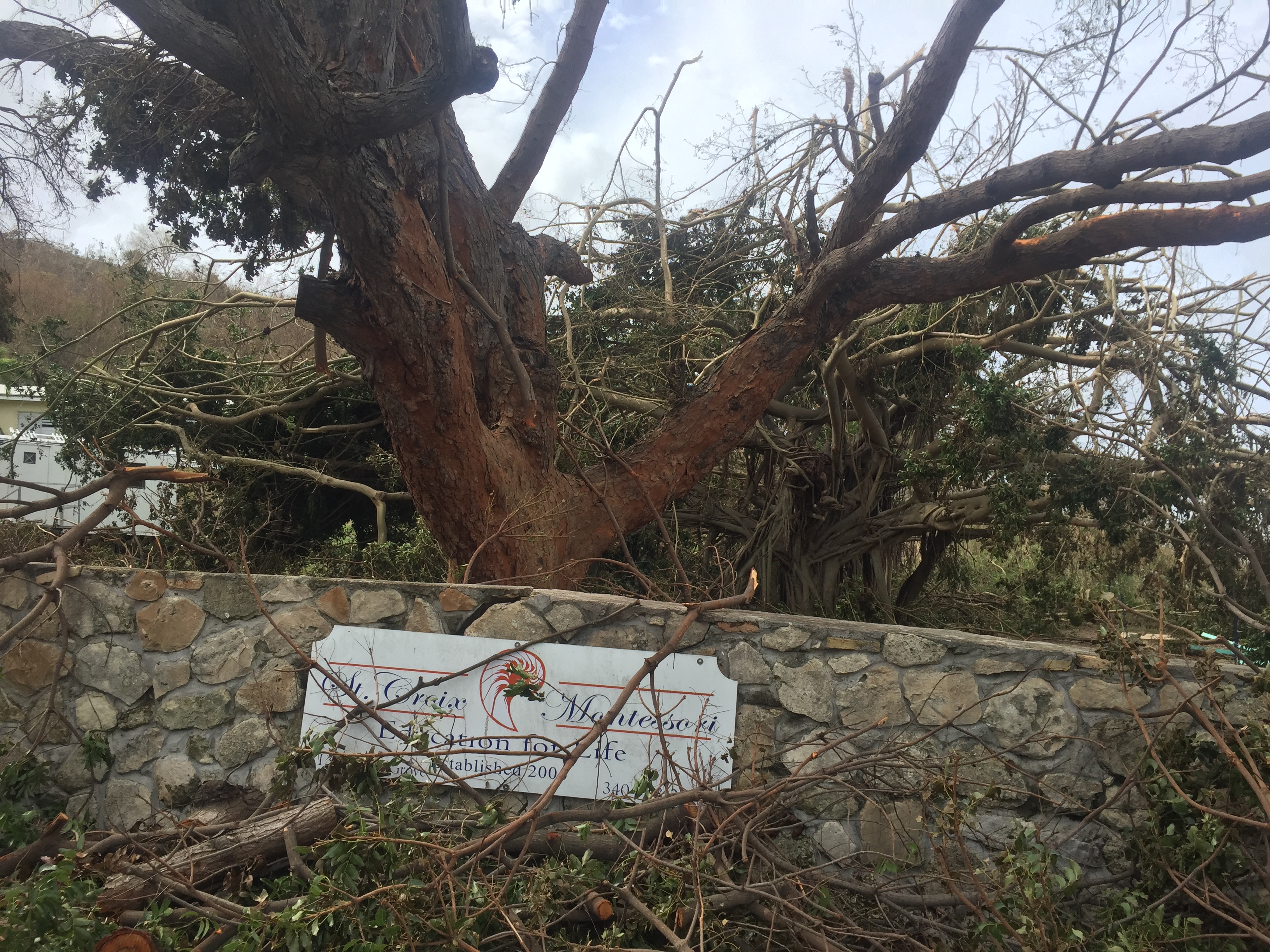
Our trees—luscious, green, sturdy. and winding trees have helped children learn to climb, swing, hang, and have shaded us as we listened to elders share Afro-Caribbean tales. Those ancient, deep-rooted trees existed through Danish sugar plantations, USVI Emancipation Day, and the transfer of our islands from Denmark into a US Territory. Our beloved trees have always welcomed, inspired, and awed families.
Beyond the perimeter of our trees, we found heaping, twisted mass of branches and car hoods from a nearby mechanic’s lot wrapped around broken palms. Past torn wires, mahogany, tan-tan, and mango trunks strewn across pieces of fencing, gutters, and galvanized steel, was our beautiful school.
Those incredible trees saved our school.
A half-dozen rugs and several pieces of furniture soaked through, but our roof and our walls were intact. And that gave us all hope.
As Dr. Maria Montessori said, “The school is a society.” St. Croix Montessori’s clean-up brought together more than 30 people, ages 5 to 75. We faced an incredible list of unknowns and challenges, but we were determined to show up and try our best.
“I came to show our kids how much we care about them and our Montessori family, to model hard work and determination in a crisis. To teach my kids that during a traumatic time, it is empowering to be helpful,” a parent shared. “And simply because we have so much love for the school.”
Parents brought gloves, water, assorted tools, garbage bags, rags, and snacks. Children collected smaller pieces of debris, swept water, leaves, and dirt from their classroom porches and rooms. We scrubbed, sawed, hauled, sweated, laughed, cried, and celebrated our community together. We were united in the possibility of moving forward.
“It was the first glimmer of normalcy,” a parent recalled, “the first time we emerged from our home… we needed to know that we could return to some form of our life before the storm.”
Eight days after Maria, I slipped while clearing a tree’s broken branches and fell 2.5 feet onto my ankle. “Ms. Stina,” a child asked when he discovered me under a pile of brush, “Why are you just sitting on the ground?”
As Head of School, I am used to wearing many hats at once, and I live by the philosophy of “it takes a village.” My injury forced me to remain on crutches for weeks and to actively put my own self-care as a priority in the hurricane-recovery process.
“This is a good thing,” a long-time parent and board member counseled. “We all need to do this right now. More than ever, we need to see one another, to make sure our friends are safe, to focus on rebuilding, and we want to help because we know that our children will return to a place they love.” She handed me an ice pack as she added, “You are focused on making sure the school lasts for many years. That starts with self-care.”
We took each day as it came. A parent donated a mini generator. Another parent, who had been evacuated to the states, used her Internet and cell access to coordinate text-message alerts to families, post-FacebookTM, and website updates, and to prepare a suitcase of emergency and art supplies. We gathered enough extension cords and portable fans to open our doors on Monday, October 2nd for three hours. When we discovered a broken water supply line the morning of our re-opening, four families collaborated to get it restored.
“I can’t describe how incredible it was for [St. Croix Montessori] to open so soon after Maria when so many schools and places were closed, and there was no clear sense of what was happening on the island,” a parent recently described. “It meant everything to have this form of normalcy. To help my child —and myself—process what happened, see friends, even if some had moved, and to have that sense of community and health.”
Students re-discovered one another’s company and found relief in finding their classrooms beautiful and whole. They celebrated the arrival of each person. Through art, poetry, circle, and storytelling they learned each other’s experiences and how their lives had changed. They expressed feelings of fear, excitement, curiosity, and hope, and practiced supporting one another.
We learned that the beauty of being in a Montessori school is that we are uniquely prepared for supporting one another after a crisis. We are prepared to consider the whole person; we are focused on supporting every aspect of our community’s growth. Our teachers, parents, staff, and children are practiced in the art of stepping back and observing. A daily practice of meditation and yoga soothed our minds and bodies. The children re-planted seeds and discovered flowers that were blooming on a Hibiscus tree.
“May I have this flower?” one Casa child asked his teacher.
“No, we each need a flower,” another child stated.
The teacher asked whether we should display the Hibiscus in the classroom, for all the students to enjoy.
“No,” the first child stated. “I like this flower and we should leave this one because all of the flowers at my house blew away.”
BEAUTY INSPIRES A CHILD
The beauty of Maria has been that in the weeks that followed, we have been better people. Maybe because we were focused on the most basic of Maslow’s hierarchy of needs, but all the noise and insecurities before the hurricane were wiped from our minds. As a community, we have been gracious, more likely to share our homes, food, vehicles, and time. We’ve been patient with one another and with our children. Our children, their parents, and our school have learned how to look at our world through a new lens.
We’ve turned off our screens. We’ve formed teams to carry the responsibilities of moving our island forward. We’ve discovered how to spend time together and how to grieve the changes in our lives. We’ve realized that despite feeling isolated at times, we are in fact very close to the rest of the world. That support inspires greater hope, builds our self-determination, and ensures that the children of St. Croix Montessori exist in an incredible community.
Tomorrow’s Child / January 2018 / p 7