The future of montessori teacher education

The future of montessori teacher education
new school


If Montessori education is to remain strong in the century ahead, the single most critical factor will be the preparation of the adults who guide the children. Buildings may change. Technology will evolve. But everything depends on the quality of the human being in front of the child—the prepared adult who leads with calmness, compassion, and understanding.

Maria Montessori saw teacher preparation as both a scientific and a spiritual process. It is not only about knowing how to present lessons but about transforming how we see children and ourselves. The adult learner must cultivate patience, humility, and faith in the child’s potential—what Montessori called “the inner preparation.”

That remains at the heart of every authentic training program, no matter where or how it is delivered.


The Landscape of Montessori Teacher Education

Montessori teacher education today is extraordinarily diverse.

The Association Montessori Internationale (AMI), founded by Maria Montessori herself, continues to represent the most traditional approach, usually through full-time year-long programs or two-summer intensive courses followed by a practicum year.

The American Montessori Society (AMS) and the Montessori Accreditation Council for Teacher Education (MACTE) have also shaped the modern landscape, promoting high standards for curriculum, practicum supervision, and faculty preparation.

Alongside these, many respected organizations have broadened access to authentic Montessori education: MEPI (Montessori Educational Programs International), the IMC (International Montessori Council), IAPM (International Association of Progressive Montessorians), Pan American Montessori Society, MCI (Montessori Centre International in London), and MWEI (Montessori World Educational Institute), among others.

The Center for Guided Montessori Studies (CGMS)—an IMC-affiliated program—pioneered the blended, low-residency format now widely emulated. Together, these organizations represent a global movement that continues to evolve while remaining true to Montessori’s enduring principles.


The Traditional and University-Based Models

For decades, Montessori teacher training has been offered in deeply immersive, in-person programs lasting from nine months to two years. These full-time courses immerse the adult learner in Montessori philosophy, child development, and the practice of using materials. Observation and daily mentorship are constant.

Many of these programs are now university-affiliated, allowing students to earn both Montessori certification and academic credit toward a degree. Loyola University Maryland and Sarasota University—the first fully accredited Montessori university—are among the best-known in the United States. Several other universities accept MACTE-accredited coursework toward completion of a B.A., M.A., or M.Ed.

Other traditional programs, especially within AMI and AMS, follow a summer-intensive model: one or two full summers of coursework followed by a year-long supervised practicum. These programs enable working educators to train while remaining active in their schools.

The strength of all in-person formats is immersion. Adult learners live and breathe Montessori—observing classrooms, handling every material, and internalizing the calm rhythm and precision that give the method its grace.


The Practicum: Where Theory Becomes Wisdom

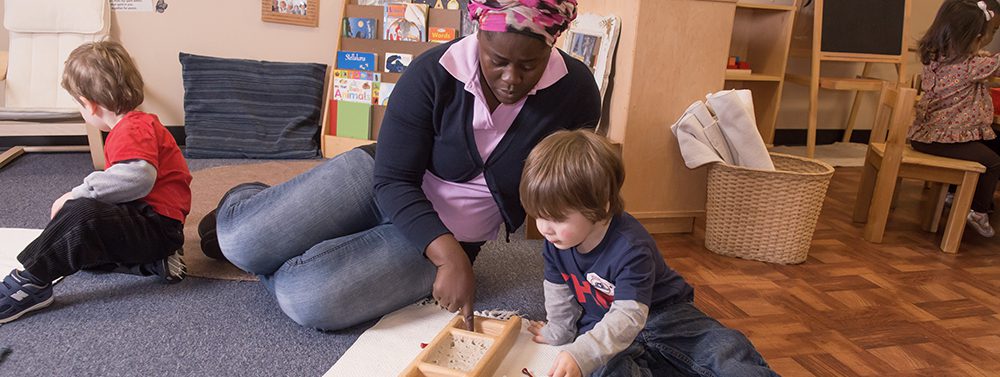
The practicum year is where Montessori training becomes real. Under the guidance of a certified, experienced Montessori mentor in a functioning classroom, the trainee learns how to balance freedom and order, maintain calm through chaos, and recognize the moment when intervention helps—or hinders—a child’s independence.

A supervised practicum provides modeling, coaching, and accountability. The mentor teacher sets the tone, guiding the intern through observation, reflection, and gradual assumption of leadership.

By contrast, a self-directed practicum—where a trainee leads a class independently with only occasional supervision—rarely provides enough support unless additional mentoring is built in by the school or the training center. Without steady observation and feedback, the subtleties of authentic Montessori practice can be easily lost.

Because the practicum is so essential, most schools that sponsor new teachers for training make sure that consistent support is provided. Many will underwrite tuition in exchange for a multi-year teaching commitment—often five years—ensuring both stability for the school and meaningful experience for the teacher.


Blended and Low-Residency Models

The advent of the blended-learning model, first championed by CGMS, has transformed Montessori teacher preparation. Combining streaming video lectures, filmed classroom observations, recorded lesson presentations, and live interactive seminars, this approach allows adult learners to study from anywhere while maintaining depth and rigor.

In-person residencies provide the tactile and relational side of learning—practicing with materials, role-playing lessons, and receiving individualized feedback. The practicum year completes the circle, with regular video conferences, observation reports, and visits from supervising faculty.

When CGMS introduced this approach, it was controversial. Many in the Montessori world doubted that online formats could replicate the transformational experience of traditional training. Yet, over time—and especially during the pandemic—nearly every training center found itself turning to hybrid or fully online instruction out of necessity.

What began as an experiment became a revelation: well-designed blended programs could be rigorous, relational, and remarkably effective.

Today, blended formats are offered not only by CGMS and IMC but also by AMS, MEPI, and other programs worldwide. The key is balance—preserving depth of practice, strong mentorship, and philosophical integrity while expanding access for adult learners who cannot leave their jobs or families for extended periods.


The Core Curriculum: Preparing the Whole Adult

Every authentic Montessori teacher education program, whether traditional or blended, includes a comprehensive course of study that mirrors the holistic nature of child development. Core areas include:

  • Montessori Philosophy and Human Development — understanding the purpose of education as the self-construction of the person
  • Observation and Documentation — learning to watch with neutrality, to record what one sees, and to interpret through a developmental lens
  • Environmental Design — preparing physical and psychological spaces that foster independence, beauty, and peace
  • Curriculum and Material Mastery — not only how to present lessons, but how they interconnect across the curriculum and across age levels
  • Peace Education — nurturing empathy, conflict resolution, and moral awareness appropriate to the child’s stage of development
  • Diversity, Equity, and Inclusion — building classrooms that honor difference and reflect the cultures and languages of the families they serve
  • Supporting Diverse Learners — meeting the needs of neurodivergent children and those with physical or emotional challenges through individualized strategies
  • Family Communication and Engagement — explaining Montessori principles clearly to parents and sharing each child’s social, emotional, and academic growth
  • Collaboration and Teamwork — functioning as part of a teaching team and cultivating shared leadership
  • Classroom Leadership and Management — maintaining structure and grace, fostering responsibility through calm authority rather than control
  • Assessment and Record-Keeping — documenting progress through observation and narrative reports rather than grades or tests
  • Professional Ethics and Self-Care — managing stress, maintaining balance, and sustaining one’s joy and purpose

These studies, coupled with practice and reflection, prepare adults not only to teach but to lead—to build communities of peace and purpose.


The Range of Programs and the Question of Depth

Montessori teacher preparation now spans a wide continuum of models and intensity. Programs such as AMI, AMS, IMC, MEPI, and MCI require extensive coursework, supervised practicums, and ongoing evaluation to ensure consistency and depth. Their graduates are generally well prepared to assume responsibility for a Montessori classroom immediately upon certification.

Alongside these are other study options, such as NAMC (North American Montessori Center), Pan American, and various regional or online programs that are not MACTE-accredited. These initiatives have played a meaningful role in introducing Montessori philosophy and methodology to a global audience, particularly in regions where accredited training centers are inaccessible.

However, while such programs can inspire and inform, they should not be mistaken for full professional preparation. Graduates often emerge with a solid conceptual grasp of Montessori ideas but without the intensive practicum experience, guided supervision, and mentorship required to internalize the method at a professional level.

Montessori teaching is not simply a curriculum—it is a craft learned through observation, modeling, and reflective practice under the guidance of a trained and experienced mentor.

This is why MACTE accreditation has become so important. MACTE’s standards ensure that programs balance rigorous theory, practical experience, and mentorship. Accreditation gives schools, parents, and trainees confidence that the diploma represents a comprehensive, high-quality preparation for leading a classroom.

At the same time, it’s worth recognizing that programs like NAMC and others have provided valuable access points—often helping aspiring educators discover Montessori and later pursue more in-depth, accredited training. In this sense, they can serve as entryways rather than endpoints.

Ultimately, what matters most is integrity, mentorship, and the commitment to true transformation. The deepest Montessori preparation—whether through AMI, AMS, MEPI, IMC, or another accredited organization—produces adults who do not simply know Montessori but become Montessori in their way of seeing and serving the child.


Technology, AI, and the Next Frontier

Technology will continue to influence teacher education in ways Maria Montessori could never have imagined. Artificial intelligence, when used wisely, can become a valuable assistant—never a replacement—to teachers and trainers.

AI-powered tools may help adult learners analyze classroom observations, recognize behavioral patterns, and strengthen objectivity. Virtual reality may soon allow trainees to “step inside” a simulated Montessori classroom, observe lessons at work, or practice presentations in an environment that responds to their timing and tone.

Within schools, AI could also lighten the load of paperwork that so often pulls teachers away from children. It can assist with tracking attendance and lesson records, documenting children’s work choices, and even generating progress summaries based on teacher observations—always under human review. It can help organize communications with parents, reminding teachers to share milestones or schedule conferences.

Properly used, AI should never replace human intuition or the daily art of observation. Instead, it can support teachers by freeing them from repetitive administrative tasks so they can spend more time doing what truly matters: watching, guiding, and connecting with children.

Used ethically, transparently, and with respect for privacy, such technologies can enhance Montessori education rather than threaten it—allowing teachers to focus on human relationships while still meeting the increasing demands of documentation and accountability.


The Human Dimension

Behind all the structures and acronyms lies a deeply human story. People choose to become Montessori educators out of love—love of children, of learning, of peace. Yet the journey is demanding. Training requires time, money, and emotional stamina, and compensation in early childhood education remains modest.

Recognizing these realities, many schools now sponsor their own teachers through training, covering tuition in exchange for a commitment to remain with the school for several years—often five. This partnership benefits both sides: the school gains continuity and depth, and the teacher gains mentorship, a sense of belonging, and a secure start to their Montessori career.

Ultimately, the work of the Montessori teacher is not learned solely from manuals. It is learned through guidance, reflection, and the quiet shaping of character over time.


Looking Ahead

The future of Montessori teacher preparation depends on holding two truths at once: that Montessori training must remain a journey of transformation—not just information—and that adults learn in many different ways.

Whether one studies at an AMI center in Amsterdam, an AMS-affiliated university program in Boston, a MEPI or IMC center in North Carolina, MCI in London, or through a blended online program like CGMS, the goal is the same: to prepare adults who can observe with humility, lead with kindness, and create classrooms where children grow in independence, confidence, and peace.

Technology may open new doors—but transformation still happens person to person, heart to heart, hand to hand.

If Montessori teacher education continues to honor that sacred relationship while embracing innovation, it will continue to form the kind of teachers the world most needs: grounded, compassionate human beings who believe in the limitless potential of every child—and who know how to help it unfold.


 

How Much Does It Really Cost to Start a Montessori School?

How Much Does It Really Cost to Start a Montessori School?

new school


Budgeting, Funding, and Financial Planning for Your Dream

by Tim Seldin, Montessori Foundation

Once you’ve clarified your vision, confirmed your licensing or private-school pathway, and begun looking for the right property, the next big question usually looms large:

“How much money will it take to open our Montessori school—and where will it come from?”

The honest answer is: it depends. The total investment varies dramatically based on your location, facility size, and the level of the program you plan to serve. But with thoughtful planning, phased growth, and a clear vision, it’s entirely possible to launch a sustainable Montessori school without overextending yourself.

1. Start with Your Vision and Scale

Your educational vision drives your startup budget. Before running any numbers, define the scope of your initial launch and your plan for growth. Are you opening:

  • A small early-childhood program with one or two classrooms (ages 18 months–6 years)?

  • A full elementary program serving ages 6–12?

  • A complete school community that extends through middle or even high school?

Each level adds layers of complexity—larger facilities, specialized classrooms and materials, certified teachers, and more diverse operational needs.

For example:

  • A two-classroom preschool might start with 60–75 students.

  • A K–6 elementary program often stabilizes around 120–150 students.

  • A K–8 or K–12 school typically reaches 200–300 students to be fully sustainable.

It’s often wiser to begin modestly and expand in well-planned phases rather than overbuild and struggle to fill classrooms.

2. The Major Categories of Startup Costs

When the Montessori Foundation helps founders prepare feasibility studies, we divide costs into three broad phases:

A. Pre-Opening Costs

These are the groundwork expenses that occur before you open your doors:

  • Legal formation, consulting, and incorporation fees

  • Licensing or private-school approval applications

  • Architectural design, site surveys, and permitting

  • Branding, logo, and website design

  • Marketing, admissions, and promotional materials

  • Deposits on rent, insurance, and utilities

Expect this stage to range from $25,000–$100,000, depending on how much professional assistance you engage and the size of your vision.

B. Facility and Equipment Costs

This is where most of your capital will go. The cost depends heavily on your region, the condition of your site, and the size of your program.


Category Typical Range
Leasehold improvements (renovation, paint, lighting, flooring) $100–$200 per sq. ft.
New construction (if applicable) $250–$400+ per sq. ft.
Outdoor learning environment / playground $75,000–$200,000
Classroom furniture and furnishings $15,000–$35,000 per classroom
Montessori materials (complete set) $12,000–$25,000 per classroom
Adolescent labs, art/science/tech spaces $25,000–$100,000+
Safety, security, signage, IT infrastructure $15,000–$50,000


For a modest three-classroom preschool or lower-elementary facility of 4,000–5,000 square feet, total startup costs may range from $350,000 to $600,000.
A larger K–8 or K–12 campus with specialized spaces (labs, library, arts, athletics) may require $1–2 million or more in total capital investment.

C. Working Capital (Cash for the First 3–6 Months)

Even after you open, you’ll need reserves to support operations while enrollment grows. Plan for at least three to six months of operating expenses, including:

  • Payroll and benefits

  • Rent or mortgage payments

  • Utilities, insurance, and maintenance

  • Educational materials and supplies

  • Marketing and admissions follow-up

For a program with 100–150 students, this typically means $150,000–$300,000 in working capital.

3. Sample Startup Budgets by School Type

Type of Program Capacity Estimated Startup Range (U.S.)
Home-based or micro Montessori school 10–20 students $40,000–$80,000
Leased early-childhood center 40–60 students $200,000–$400,000
Preschool & Elementary (leased space) 75–120 students $400,000–$800,000
Purchased or renovated facility (K–8) 120–180 students $700,000–$1.2 million
New construction or full campus (K–12) 200–300 students $1.5–$3 million+

These ranges include furnishings, materials, and modest working capital but exclude the cost of land purchases.

4. Funding Options

Launching a school often involves creative combinations of personal investment, community support, and financing. Common avenues include:

Personal Savings or Home Equity

Many founders use personal assets or family funding.

  • Advantage: Full control; no debt or investor oversight.

  • Risk: High personal exposure—consult a financial advisor before committing retirement or home equity funds.

Bank or SBA Loans

The U.S. Small Business Administration offers loans well-suited to schools:

  • SBA Microloan: Up to $50,000 for startup costs.

  • SBA 7(a) Loan: Up to $5 million for real estate or major investment.
    To qualify, you’ll need:

  • A detailed business plan and financial projections

  • Strong credit and some collateral

  • Demonstrated management experience in education

Private Investors or Partners

Some schools begin with local businesspeople, philanthropists, or parent investors. These equity partnerships can relieve early cash-flow strain but require clear agreements about ownership, governance, and long-term exit plans.

Community Development and Grants

Explore:

  • Local or regional economic development funds for revitalizing property

  • Nonprofit, educational, or faith-based grants

  • State incentives for workforce or early learning expansion
    The Montessori Foundation can advise on approaching donors or community foundations to support scholarships, facilities, or sustainability funds.

Tuition Prepayment and Founding Family Pledges

Many schools invite early families to contribute through pre-enrollment deposits, founding family pledges, or community crowdfunding. Be transparent about how funds will be held and used.

5. Creating a Sound Financial Plan

Before spending a dollar, build a clear, living financial model that includes:

  • Startup cost summary (renovations, furnishings, materials, soft costs)

  • Monthly operating budget (staff, benefits, rent, insurance, marketing)

  • Projected tuition revenue (based on realistic ramp-up and attrition)

  • Cash flow forecasts for 24–36 months

  • Break-even analysis (minimum enrollment to sustain operations)

The Montessori Foundation often assists new schools in preparing feasibility studies and financial projections aligned with realistic enrollment growth.

6. Balancing Quality and Cost

Starting small doesn’t mean compromising quality—it means prioritizing essentials:

  • Invest first in trained Montessori educators and a beautiful, complete environment.

  • Purchase high-quality Montessori materials gradually but strategically.

  • Delay non-essentials like large administrative offices or expensive landscaping until you’re financially stable.

Children flourish in simple, orderly spaces guided by dedicated teachers—more than they ever would in a lavish facility with exhausted staff and tight budgets.

7. Tuition Strategy and Long-Term Sustainability

Set tuition that reflects your quality and covers true operating costs.

  • Research your market: Compare tuition in nearby Montessori and independent schools.

  • Avoid underpricing: Schools that start too low often struggle later to cover payroll and maintenance.

  • Plan ahead: Include modest annual tuition increases to track inflation.

Also consider:

  • Financial aid or scholarship strategies (if aligned with your mission)

  • Capital reserve goals (for equipment, vehicles, and long-term maintenance)

  • Endowment planning for sustainability

A financially stable school can invest in its people, maintain facilities, and weather economic downturns—ensuring continuity for the children and families you serve.

8. A Realistic Timeline

From your first idea to your ribbon-cutting day, most new Montessori schools take 9–18 months to open.

Typical Sequence:

  1. Feasibility study and market analysis – 1–2 months

  2. Business plan and financial model – 1–2 months

  3. Site search, lease, or purchase – 2–4 months

  4. Design, permitting, and renovation – 4–6 months

  5. Staffing and admissions – 2–3 months

  6. Soft opening and stabilization – ongoing

The more time you devote to planning, the smoother your first year will be.

9. Common Financial Mistakes to Avoid

  • Underestimating how long it takes to reach full enrollment

  • Assuming tuition deposits will cover payroll or construction

  • Paying too much rent for your market’s tuition potential

  • Neglecting marketing during your first year

  • Failing to budget for insurance, taxes, or deferred maintenance

Remember: your school is both a mission and a business. Sound financial planning safeguards your mission and ensures you can continue to serve families for decades to come.

10. Summing this up

Opening a Montessori school—whether it’s for toddlers, elementary students, or adolescents—is among the most rewarding journeys an educator can undertake. It requires courage, patience, and a balance of heart and pragmatism.

The Montessori Foundation has guided hundreds of school founders worldwide through budgeting, financing, and long-term strategic planning. We can help you refine your vision, evaluate feasibility, and plan for sustainable growth at every stage—from your first spreadsheet to your first graduating class.

Learn more or request guidance at Montessori.org.

Employee Off-Duty Conduct: The Tightrope Walk Every Private School Head Knows

Employee Off-Duty Conduct: The Tightrope Walk Every Private School Head Knows

at home


(First, a disclaimer: This article draws from public court records, state employment laws, and my many years leading independent and Montessori schools. It is not legal advice. Employment law varies dramatically between jurisdictions, and private schools operate under different rules than public districts. Before writing policies or taking disciplinary action, consult an employment attorney in your state.)


A few years ago, I got a call that every school head dreads. A parent had discovered their child’s teacher posting inflammatory political content on social media—complete with profanity-laced rants. “She represents our school,” the parent insisted. “How can you let her stay?”

I’ve fielded dozens of calls like this over the years. Each one forces the same uncomfortable question: Where does our authority end and our employees’ privacy begin?

Private schools run on trust. Parents don’t just pay us to teach their children—they’re buying into our values, our community, our promise to keep their kids safe. That trust can evaporate overnight when a staff member’s weekend choices make Monday morning headlines.

The challenge has gotten thornier. Twenty years ago, what teachers did off campus mostly stayed off campus. Now, a single Instagram story can reach hundreds of school families before breakfast.

But here’s what many school leaders miss: private employers actually have more latitude than public schools when it comes to off-duty conduct. Public school cases make headlines because they involve constitutional issues that don’t apply to us. The trade-off? When we overstep, we face different—and sometimes costlier—consequences.

The Legal Landscape (It’s Messier Than You Think)

About a dozen states have passed “lifestyle protection” laws that limit when employers can discipline workers for legal off-duty behavior. Colorado’s law is typical: employers can’t take action unless they can prove the conduct affects legitimate business interests.

What counts as “legitimate business interests” for schools? Student safety, obviously. Compliance with licensing requirements. Protection from significant reputational damage that threatens enrollment or operations.

What doesn’t count? A parent’s general disapproval of a teacher’s political views. Discomfort with an employee’s legal recreational activities. Personal grudges disguised as professional concerns.

I learned this the hard way fifteen years ago. An staff member’s ex-husband called to report she was “living in sin” with her boyfriend. Three families demanded immediate action. Our attorney’s response was blunt: “Fire her for this, and you’ll be writing a settlement check.”

Real-World Scenarios (From My Files)

The Social Media Activist: A beloved teacher posted photos from a weekend protest, including one where she was arrested (charges later dropped). Parents split into camps—some demanding her resignation, others organizing support rallies.

The decision: The school kept her. The arrest was for peaceful civil disobedience, she wasn’t representing the school, and her classroom performance remained excellent. We did have a private conversation about social media boundaries.

The Side Hustle Gone Wrong: The art teacher at one of the schools that we mentor worked evenings at a local wine bar. A video surfaced of him joking with customers about “babysitting rich kids all day.” Three families immediately called for meetings.

The decision: This one required action. While the job itself was fine, his public comments about our students crossed a line. We used it as a coaching opportunity rather than termination, and he’s been more careful since.

The Viral Video: A preschool aide appeared in a TikTok video at a house party, drink in hand, with music containing explicit lyrics playing in the background. The video was shared in parent WhatsApp groups within hours.

The decision: No action. She was off duty, engaging in legal adult behavior, and nothing in the video suggested poor judgment around children. We reminded all staff about privacy settings, but that’s where it ended.

An Example of What Your Employee Handbook Might Say


Skip the legal jargon. Your staff needs to understand expectations, not decode contract language. Here’s one framework:

Our Approach to Off-Duty Conduct

We hired you for your professionalism, and that doesn’t disappear when you leave campus. We also respect that you have a life outside these walls.

Most of what you do on your own time is exactly that—your own business. We won’t monitor your social media, judge your political views, or police your legal recreational choices.

However, some off-duty conduct can affect our school community:

  • Criminal behavior, especially anything involving harm to children
  • Public statements that breach student or family confidentiality
  • Actions that directly undermine safety protocols or educational practices
  • Conduct that significantly damages community trust in our mission

If concerns arise, we’ll speak with you privately before making any decisions. Our goal is understanding and support, not punishment.

Remember: this policy works both ways. Just as we respect your privacy, we ask that you consider how your public actions might reflect on the school community we’ve built together.


When Problems Land on Your Desk

Don’t react immediately. The parent calling at 7 AM in a rage rarely represents the whole community’s view.

Start with questions: Is the conduct illegal? Is it happening on school property or during school events? Has it actually affected the workplace, or are we dealing with personal disapproval?

Document everything, but investigate carefully. I once spent two weeks fielding complaints about a teacher’s “inappropriate Facebook posts” before discovering the screenshots were from a satirical account with a similar name.

Talk to the employee before talking to parents. You might learn the viral video was taken out of context, or that the “criminal charges” were actually a resolved misunderstanding. People deserve the chance to explain themselves.

The Conversation That Changes Everything

Three years ago, a school with which we worked hired a phenomenal middle school science teacher. During her interview, the school was transparent about its expectations: “We’re a visible institution in this community. Your professional reputation and ours are connected, whether we like it or not.”

She appreciated the honesty. When she later faced a custody dispute that made local news, she proactively let the Head of School know what was happening and how she planned to handle it. That transparency made all the difference.

The best policy in the world can’t replace clear communication about expectations from day one.

The Balancing Act

Many off-duty “problems” aren’t really about the conduct itself. They’re about communication, community anxiety, or parents projecting their own fears onto school employees.

Your job isn’t to create perfect people. It’s to hire good people and support them when they face normal human challenges.

Sometimes that means standing behind a teacher when a few vocal parents demand action. Sometimes it means having difficult conversations about professional boundaries. Most often, it means helping your community understand that school employees are real people with complex lives.

The schools that get this right don’t have fewer problems—they have better relationships with their staff and stronger trust from families who appreciate thoughtful, measured leadership.

Tim Seldin has led independent and Montessori schools for over thirty years and serves as a senior consultant with the Montessori Foundation. He consults with school leaders nationwide on employment issues and organizational development.

Montessori at Home — How to Bring Montessori Principles into Your Daily Life

Montessori at Home — How to Bring Montessori Principles into Your Daily Life

at home


When your child is enrolled in a Montessori program, their learning doesn’t begin and end at the classroom door. One of the most wonderful aspects of the Montessori approach is that its principles can be seamlessly extended into your home — enhancing your child’s independence, curiosity, and capacity for growth in everyday life.

Parents often ask us, “How can I support my child’s Montessori education at home?” The good news is that you don’t need to replicate the classroom or buy expensive materials to foster a Montessori mindset at home. Instead, you can adapt your environment, interactions, and routines to reflect the same respect for your child’s development that we practice at school.

In this article, we’ll explore how you can integrate Montessori principles into your home life — from creating a prepared environment to adopting communication strategies and offering activities that align with your child’s developmental needs.


What Does It Mean to “Bring Montessori Home”?

At its core, Montessori at home means:

  • Creating a child-friendly environment where your child can be independent.

  • Fostering responsibility and participation in daily tasks.

  • Encouraging curiosity and exploration with meaningful, real-world experiences.

  • Respecting your child’s developmental stages and pacing.

You don’t need a fully stocked Montessori classroom at home — rather, it’s about adopting a philosophy of respect, patience, and empowerment in how you structure your home and interact with your child.


Step 1: Preparing the Home Environment

A prepared environment is foundational in Montessori — it allows the child to move, explore, and learn independently.

Make Your Home Accessible

  • Entryway: Install low hooks for coats and bags. Place a basket for shoes where your child can reach them.

  • Kitchen: Dedicate a lower shelf or cabinet for child-accessible snacks, plates, and utensils. Include a small pitcher for pouring water.

  • Bathroom: Provide a step stool for reaching the sink, and store child-friendly toiletries (toothbrush, hairbrush) within reach.

  • Bedroom: Use low shelves for books and toys. Encourage your child to participate in dressing by arranging clothes within easy reach.

Simplify and Organize

Children concentrate better when they are not overwhelmed by clutter. Keep materials organized in baskets or trays, limiting options to 6-8 choices at a time. Rotate toys periodically to maintain interest.

Resource Recommendation:

Montessori Services offers practical tools for home, including child-sized brooms, mops, and kitchen tools.


Step 2: Involve Your Child in Practical Life

Everyday tasks offer valuable learning opportunities. Invite your child to participate in:

  • Meal preparation: Washing vegetables, stirring batter, spreading butter.

  • Setting the table: Count utensils, place napkins.

  • Cleaning: Wiping spills, dusting, sweeping.

  • Laundry: Sorting by color, matching socks, folding small items.

These activities build fine motor skills, sequencing, concentration, and independence.

Pro Tip: Invest in a Learning Tower or kitchen helper stool (brands like Guidecraft or Little Partners) so your child can safely reach countertops.


Step 3: Foster Independence

Let your child do what they are capable of — even if it’s not done perfectly.

  • Encourage them to dress themselves.

  • Let them serve their own water or snack.

  • Teach them how to zip a jacket or button a shirt.

Mistakes are part of learning. Be patient, and resist the urge to step in too quickly.


Step 4: Provide Hands-On, Real Experiences

Montessori values real tools and experiences over pretend versions. Instead of a plastic toy kitchen, invite your child to use real (child-sized) tools to prepare food. Instead of fake gardening kits, let them plant real seeds and care for a garden.

This approach fosters authentic learning and skill development.

Suggested Activities:

  • Gardening: Digging, planting, watering.

  • Cooking: Measuring, mixing, serving.

  • Nature walks: Observing animals, collecting leaves or stones.

  • Art: Drawing, painting, clay modeling.

Books to Inspire:

  • “The Garden, the Curtain, and the Cross” for faith-based families looking to integrate gardening and storytelling.

  • “The Little Gardener” by Emily Hughes — a beautifully illustrated book to encourage a love of nature.

Step 5: Cultivate Concentration

Allow your child uninterrupted time to play, explore, or work. Avoid overscheduling and minimize background distractions like TV or tablets during playtime.

If your child is engaged in building, drawing, or reading, avoid interrupting. This respect for concentration fosters deeper focus and patience.


Step 6: Use Montessori Communication Strategies

How we speak to children shapes their sense of self. Montessori encourages:

  • Respectful language: Speak politely and at eye level.

  • Offering choices: “Would you like to wear the blue shirt or the red one?”

  • Descriptive feedback: Instead of “Good job,” say “You carried your glass so carefully!”

  • Active listening: Validate feelings, even when setting limits. “I see you’re upset because you wanted more time to play. Let’s talk about it together.”

Parenting Resource:

“How to Talk So Little Kids Will Listen” by Joanna Faber & Julie King offers practical communication tools aligned with Montessori respect-based principles.


Step 7: Encourage Responsibility and Contribution

Children want to feel needed and useful. Assign age-appropriate responsibilities:

  • Watering plants

  • Feeding pets

  • Tidying play areas

  • Carrying groceries (small bags)

These tasks build a sense of belonging and competence.


Step 8: Set Up a Reading Corner

Create a cozy, accessible reading space with a small chair, soft lighting, and a basket of books. Rotate the books periodically.

Recommended Books for Montessori Homes:

  • “The Very Hungry Caterpillar” by Eric Carle — teaches sequencing and counting.

  • “The Snowy Day” by Ezra Jack Keats — beautiful storytelling about the wonders of a simple day.

  • “What’s Inside?” by Jeanne Ashbé — encourages curiosity about everyday objects.

Step 9: Model Grace and Courtesy

Social skills are a core part of Montessori. Model:

  • Saying “please” and “thank you.”

  • Greeting others warmly.

  • Apologizing sincerely when appropriate.

Role-play these interactions with your child to practice.


Step 10: Observe Without Interfering

Observation is a critical Montessori tool. Watch how your child uses their environment:

  • What activities do they repeat?

  • Are they drawn to movement, language, or hands-on tasks?

  • What frustrates them?

Use your observations to adjust the home environment or introduce new challenges.


Reflection for Parents

  • Is my home environment supporting my child’s independence?

  • Am I giving my child enough time for uninterrupted exploration?

  • How can I incorporate more real-life experiences into our daily life?

Recommended Resources for Deeper Learning

  • “The Montessori Toddler” by Simone Davies — a comprehensive, parent-friendly guide.

  • “Montessori from the Start” by Paula Polk Lillard — focuses on birth to age 3 but applicable beyond.

  • Montessori Services: Practical tools and materials for home use.

Montessori isn’t just an education system — it’s a way of life. By bringing Montessori principles into your home, you reinforce your child’s growth in confidence, curiosity, independence, and respect.

Start small: choose one or two areas to adapt this month, whether it’s creating a child-friendly kitchen space or building a morning routine with choice and autonomy. The changes you make will send a powerful message to your child:

“You are capable. You are respected. And your contributions matter.”

If you’d like personalized suggestions for creating a Montessori-friendly home tailored to your child’s current interests and age, please don’t hesitate to reach out to your child’s guide. We’re always here to help support your parenting journey.

Montessori School Marketing playbook

Montessori School Marketing playbook

marketing


Filling Empty Seats with Heart and Hustle: A Proven Playbook for Montessori Schools

From the Montessori Foundation — Helping Schools Thrive Since 1992

For more than three decades, we at the Montessori Foundation have helped schools across the country respond to enrollment challenges. Even the strongest schools can see interest slip when the local landscape changes. In the past few years we’ve seen multiple forces combine:

  • Declining birth rates mean fewer three-year-olds entering school.

  • Free public preschool and Transitional Kindergarten programs have expanded dramatically in many states.

  • State scholarships such as Florida’s new $8,000 per child vouchers have made private schools more affordable but also shifted families’ expectations.

  • Magnet and charter schools are proliferating, drawing off older children.

  • Micro-schools — small parent-run or teacher-run pods — are popping up, especially among families dissatisfied with public options.

This is the new normal. It’s not a reason to panic. It’s a reason to be more intentional about showing families what makes Montessori worth choosing and to be creative about how we reach them.

Show Families the Montessori Difference

The first job is to make Montessori visible and understandable. Families often know only the name. Show them:

  • Post 30-second “day in the life” videos. Think: a five-year-old guiding a three-year-old through pouring water, a child preparing their own snack, a teacher quietly observing.

  • Use clear, parent-friendly language on your website: “Our three-year-olds pour their own drinks, help younger classmates, and develop quiet confidence.”

  • Make it easy to act. A “Schedule a Tour” button should be on every page.

When families see the classroom experience and can imagine their child there, the conversation about tuition shifts from price to value.

Let Your Parents Do the Talking

Nothing beats a happy parent. Recruit a small group of families as ambassadors:

  • Give them yard signs with QR codes linking to your tour page.

  • Provide simple talking points about what makes your school special.

  • Send handwritten thank-you notes when they bring in a referral.

  • Hold a “bring a friend” afternoon where current families invite a friend and their child to visit or play.

This works because trust travels through personal networks. At one school we worked with, half of all new tours in a two-month period came from parent ambassadors alone.

Meet Families Where They Already Are

Digital ads are helpful but rarely enough on their own. Combine them with being physically visible:

  • Mini Montessori Pop-Ups. Bring a couple of iconic materials to a farmers’ market, library, or park. Let children pour water, sort objects, or explore a bead bar.

  • Sidewalk Chalk Days. Draw hopscotch grids and uplifting messages near playgrounds with your school name and QR code subtly included.

  • Flash Micro-Workshops. Offer a 20-minute “Montessori at Home” tip session at a library or coffee shop. Hand out small cards with your contact information.

  • Partner Visits. Walk into nearby coffee shops, pediatricians’ offices, gyms, and realtors with attractive flyers and a “welcome bag.” Realtors especially like knowing about great schools for incoming families.

We’ve seen schools pick up 10–15 new tour requests within days of doing a simple pop-up event like this.

Be Bold and Memorable

Sometimes a joyful, slightly unconventional event breaks through better than any ad:

  • Little Scientists Parade. Children (with parents) wear aprons or mini lab coats and walk around the block with magnifying glasses, handing out seed packets or bookmarks.

  • Free Coffee on the Corner. Once a week for a month, staff hand out free coffee and muffins at a busy intersection with a friendly banner: “Ask Us About Montessori.”

  • Give-Back Day. Host a community toy or clothing swap in your parking lot. It positions your school as a hub of generosity and brings new families to your campus.

  • Eye-Catching Banners. A simple, colorful banner on your fence or near a commuter route with real children’s faces and a strong headline can remind locals you’re there.

These “guerrilla” tactics create stories people remember. A parent may tell a friend, “Did you see that Montessori school handing out free coffee?” That word-of-mouth spreads faster than you think.

Make Events Worth Attending

Parents are busy. Offer experiences that feel genuinely valuable:

  • Breakfast with Montessori. Prospective parents sample your breakfast program and then see the morning work cycle.

  • Montessori for a Morning. Invite non-enrolled children for a 90-minute session with parents nearby, then hold a short Q&A.

  • Parent Education Nights. Offer a short talk (“Why the Kindergarten Year Matters”) combined with a tour.

Follow up the same day with a personal phone call or text. A warm, timely response can double your conversion rate compared to waiting a few days.

Build Urgency Without Losing Integrity

Montessori families value honesty. A gentle but clear incentive—like waiving the application fee for those who enroll by a certain date—creates momentum without undermining your credibility. Think of it as a thank-you for deciding quickly, not a gimmick.

Organizing Your Campaign Step by Step

Many schools scatter these efforts without a plan. Treat it as a 90-day campaign. Here’s a simple roadmap:

Days 1–30: Build the Engine.

  • Refresh your website and tour pages.

  • Recruit your parent ambassadors and distribute yard signs.

  • Schedule your first pop-ups and “Breakfast with Montessori.”

  • Turn on local geo-targeted ads.

Days 31–60: Go Loud and Local.

  • Run your chalk-art day and free coffee corner.

  • Pitch a story to a neighborhood blog or newsletter.

  • Post a short classroom video weekly.

  • Hold your first “Montessori for a Morning.”

Days 61–90: Optimize and Scale.

  • Add your Little Scientists Parade or community swap.

  • Check your numbers: How many event attendees booked tours? How many tours became applications? How many applications became enrollments?

Tracking Progress Without Jargon

You don’t need fancy dashboards or business jargon. Just count three things:

  • Event → Tour. Of everyone who came to an event, how many booked a tour?

  • Tour → Application. Of everyone who toured, how many applied?

  • Application → Enrollment. Of everyone who applied, how many enrolled?

If you’re unsure what’s normal, here’s a good target: about one-third to one-half of event attendees should book a tour, and about half of those who tour should apply. If your numbers are lower, focus on your visit experience and your follow-up calls. These simple counts show you where to improve.

Don’t Forget What Happens Inside the School

Retention is the best marketing of all. Parents who feel connected, informed, and respected are your greatest advocates. Invest in staff training, clear communication, and parent partnerships so your current families are delighted. Satisfied parents talk—and their enthusiasm fills your pipeline faster than any ad.

Putting It All Together

Schools that thrive don’t necessarily have big budgets; they have a clear story, consistent outreach, and warm follow-up. When you combine Montessori’s distinctive strengths with creative community engagement—yard signs, pop-ups, parades, free coffee stands—you create excitement that fills your open seats and reinforces your reputation as a joyful, trustworthy place for children to grow.

With a clear plan, a little boldness, and a lot of heart, your Montessori school can stand out, win attention, and turn curiosity into a waiting list.

Checklist for Your Marketing Team

  • Create or refresh your website with clear visuals and “Schedule a Tour” buttons.

  • Recruit 5–10 parent ambassadors; give them yard signs and referral cards.

  • Schedule at least two community pop-ups in the next 30 days.

  • Plan a “Breakfast with Montessori” and a “Montessori for a Morning” event.

  • Set up chalk-art day, free coffee corner, Little Scientists Parade, and/or community swap.

  • Personally visit local businesses and realtors with flyers.

  • Pitch a story to a neighborhood blog or parent newsletter.

  • Track event → tour, tour → application, application → enrollment.

  • Follow up with every prospect the same day by phone or text.

  • Continue investing in parent satisfaction and staff training to build retention.

Final Thought

At the Montessori Foundation we’ve seen these ideas work in schools large and small. They’re not about gimmicks—they’re about warmth, visibility, and consistency. Montessori is one of the most compelling educational approaches ever devised. When families can see it, touch it, and hear about it from people they trust, they respond. You don’t have to spend a fortune; you just have to make it easy for them to find you, meet you, and imagine their child in your care.

Supporting neurodivergent Staff members

Supporting neurodivergent Staff members

parents at home


Disclaimer: I am not an attorney. The information in this article is based on publicly available sources and reflects my best understanding of current law and best practices. It should not be considered legal advice. For guidance on your school’s specific policies or employment situations, please consult a qualified attorney experienced in employment law and disability rights.

In schools built on the values of community, respect, and human development, inclusion isn’t just a checkbox—it’s a commitment. But when it comes to supporting neurodivergent adults—teachers, staff, and administrators alike—many school leaders aren’t sure how to proceed. This article explores what neurodivergence means in the workplace, what legal responsibilities may apply under U.S. law, and what practical steps schools can take to create a supportive environment for all members of their team.

What Does “Neurodivergent” Mean?

The term neurodivergent refers to individuals whose neurological development or cognitive functioning differs from the so-called “neurotypical” pattern. This includes—but isn’t limited to—those with:

  • Autism Spectrum Disorder (ASD)

  • Attention-Deficit/Hyperactivity Disorder (ADHD)

  • Dyslexia, dyscalculia, and other learning differences

  • Tourette’s Syndrome

  • Obsessive-Compulsive Disorder (OCD)

  • Sensory Processing Disorder

Neurodivergence isn’t something to be fixed—it’s a different way of processing, thinking, feeling, and interacting. Many neurodivergent individuals bring exceptional strengths to the workplace, such as deep focus, creativity, problem-solving, empathy, and innovative thinking.

Researchers estimate that 15–20% of the global population is neurodivergent, which means it’s not rare. Chances are high that your school already includes neurodivergent team members—whether they’ve disclosed it or not.

Understanding the Legal Landscape: The ADA and Workplace Rights

In the United States, the Americans with Disabilities Act (ADA) is the primary law that protects employees with disabilities, including many forms of neurodivergence. While interpretations can vary and specific applications depend on context, here are general principles that may apply to schools:

  • Reasonable accommodations must be offered to qualified employees with disabilities, unless doing so would cause undue hardship to the employer.

  • Employers are expected to engage in an “interactive process”—a collaborative discussion to determine what supports might help an employee succeed.

  • Discrimination, harassment, or adverse treatment of someone because of a disability—or because they requested accommodations—is prohibited.

It’s a common misconception that only visible or physical disabilities are protected. In fact, many cognitive and sensory conditions are covered when they substantially limit one or more major life activities, including concentration, communication, or learning.

Please note: These general principles are offered for informational purposes only. Always consult with legal counsel before developing policies or addressing specific employee concerns.

The Interactive Process: A Collaborative Conversation

When an employee discloses a neurodivergent condition or requests support, the school’s obligation typically includes engaging in a flexible, good-faith conversation to explore what’s needed. This is known as the interactive process.

Here’s what that process often looks like:

  • The conversation is private and respectful.

  • The goal is not to verify the diagnosis but to understand what would help the employee perform the job effectively.

  • Accommodations can be simple and inexpensive—such as flexible scheduling, task management tools, or alternative communication methods.

Example: A Montessori guide with ADHD may benefit from visual planning tools, a reduced number of required meetings, or reminders in writing after verbal updates. These supports may allow them to contribute more fully without burdening the team.

Creating a Culture of Inclusion (Not Just Compliance)

True inclusion goes beyond legal compliance. Neurodivergent employees often face subtle, unspoken barriers:

  • Sensory overwhelm from chaotic or loud environments

  • Misinterpretations of communication style (e.g., perceived rudeness or disinterest)

  • Pressure to “mask” or behave neurotypically

  • Fatigue from social navigation and unaccommodated challenges

As leaders, we can take proactive steps to ensure that our school environments are welcoming to a diversity of minds—not just personalities.

Practical Inclusion Strategies for Schools

Strategy Why It Helps
Share agendas in advance Gives time to process and prepare
Offer alternative communication options Supports different expressive styles
Designate quiet workspaces Reduces sensory overload
Normalize individual work rhythms Supports executive function differences
Check in privately and regularly Builds trust and safety

These steps don’t require policy overhauls. Often, small, thoughtful changes can have a profound impact.

Pitfalls to Avoid

Even well-intentioned leaders can make mistakes that undermine trust or violate legal protections. Some common pitfalls include:

  • Requiring a formal diagnosis before offering flexibility

  • Making assumptions about what someone “should” be able to do

  • Failing to maintain confidentiality

  • Dismissing or downplaying accommodation requests

  • Framing differences as performance issues without exploration

Instead of asking, “What’s wrong?”, shift the question to “What would help you thrive?”

Real-Life Insight

Consider the example of “Luis,” an Upper Elementary teacher who often appeared withdrawn during faculty meetings and missed internal deadlines. Once he felt safe disclosing his autism diagnosis, his school adjusted how feedback was delivered (written first, then discussed) and allowed him to work on long-term projects in a quieter space.

Within months, Luis’s performance soared—and so did his confidence. His classroom became one of the most calm, creative, and high-functioning in the school.

When people feel safe being themselves, they show up more fully—and your school community is better for it.

Why It Matters for Montessori and Independent Schools

Montessori principles call us to respect the individual, honor diversity, and cultivate human potential. These values apply not only to children—but also to the adults we work with every day.

By supporting neurodivergent educators and staff:

  • We reduce burnout and foster retention.

  • We model the inclusive values we teach.

  • We benefit from the unique gifts of each team member.

  • We create space for true belonging—not just “fitting in.”

Resources to Explore

If you’d like to learn more or begin reviewing your school’s practices, here are a few helpful starting points:

  • Job Accommodation Network (JAN)https://askjan.org
    A free resource with examples of accommodations and ADA guidance.

  • Neurodiversity in the Workplacehttps://ndworkplace.org
    Focuses on recruiting and retaining neurodivergent talent.

  • “Divergent Mind” by Jenara Nerenberg
    A powerful look at adult neurodivergence, especially among women.

  • The Neurodivergent Teacher (blog & social media)
    Real-life insights from an educator who shares her journey with ADHD and autism.

Final Thoughts

At their best, schools are communities where people grow—not just students, but adults as well. As leaders, our responsibility is not to mold everyone into the same shape, but to create an environment where different minds can flourish.

Neurodivergent team members have always been in our schools. Let’s be the kind of leaders who see them, support them, and value what they bring.

Inclusion isn’t charity. It’s wisdom.

Montessori 101: What every parent should know as we begin the year

Montessori 101: What every parent should know as we begin the year

parents at home

What Every Parent Should Know as We Begin the Year

Dear Parents,

Welcome — or welcome back — to another exciting year at our Montessori School! Whether you are just beginning your journey with us or returning with a child who’s blossomed in our environment, we want to start by offering you a thorough, thoughtful introduction to Montessori education.

Understanding the Montessori approach will help you better appreciate what your child is experiencing in the classroom — and, perhaps more importantly, how you can support that growth at home. So, let’s dive into the essence of Montessori and what every parent should know to make the most of these formative years.

Who Was Maria Montessori?

Before we discuss the method, it helps to know about the visionary behind it. Dr. Maria Montessori was an Italian physician, scientist, and educator — notably one of Italy’s first female doctors. In the early 1900s, through her work with children from disadvantaged backgrounds, she observed that young children learned best when allowed to explore, manipulate materials, and learn independently.

These observations became the foundation of her revolutionary educational approach, which has now flourished worldwide for over a century.

The Core Principles of Montessori Education

At its heart, Montessori education is based on deep respect for the child as a capable, curious, and independent learner. Here are some of the foundational principles we follow:

1. The Prepared Environment

Montessori classrooms are carefully designed environments that invite exploration. Materials are arranged logically on open shelves; everything is child-sized, and spaces are organized to foster both independence and focus.

You’ll notice our classrooms are warm, orderly, and beautiful — a stark contrast to overstimulating or cluttered play spaces.

At Home Tip:

  • Create child-friendly spaces by adding low shelves for books and toys.
  • Use baskets to organize materials, so everything has a place.
  • Choose natural materials (like wood, fabric, or metal) over plastic when possible.

One excellent resource is Lovevery’s play kits, which provide Montessori-inspired, age-appropriate materials for home use. For furniture, brands like Sprout Kids and Monti Kids offer modular, child-sized tables, chairs, and shelves specifically designed for Montessori-style homes.

2. Freedom Within Limits

In a Montessori classroom, children are free to choose their activities, but within the boundaries of respect for others and the environment. This balance cultivates decision-making, autonomy, and a natural sense of discipline.

At home, you can mirror this by:

  • Offering choices within limits: “Would you like to wear the red shirt or the blue one?”
  • Allowing your child to choose the sequence of tasks: “Would you like to brush your teeth before or after we read a story?”

3. Hands-On Learning with Concrete Materials

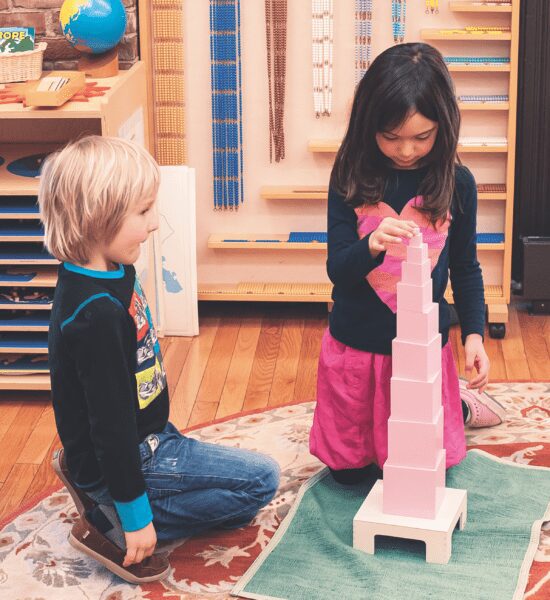
pink tower

Montessori materials are designed to teach abstract concepts through tangible experiences. For example, the Golden Beads introduce the decimal system by letting children physically manipulate units, tens, hundreds, and thousands.

Other classic Montessori materials include:

  • The Pink Tower: for visual discrimination and spatial awareness.
  • Sandpaper Letters: for learning letter shapes and sounds through tactile experience.
  • Number Rods: for understanding quantities and numerical relationships.

Many of these materials are available from reputable suppliers like Nienhuis Montessori or Alison’s Montessori. For parents seeking home versions, Montessori Outlet offers practical alternatives.

4. Mixed-Age Classrooms

Our classrooms include children spanning three years (e.g., 3-6-year-olds together). This structure allows:

  • Younger children to learn by observing older peers.
  • Older children to reinforce their knowledge by teaching others.
  • Every child to progress at their own pace without artificial grade levels.

You’ll notice that as your child progresses, they not only gain academic skills but also leadership abilities and social maturity.

5. The Role of the Montessori Guide

Rather than a traditional teacher who lectures, the Montessori guide carefully observes each child, introducing new lessons when the child shows readiness and interest. This personalized approach ensures that learning is child-driven, rather than dictated by adult timelines.

In Montessori, your child’s guide is constantly assessing not just academic progress but also emotional and social growth — often through observation rather than testing.

Keeping Respect at the Center—Even in Emotional Storms

Keeping Respect at the Center—Even in Emotional Storms

tantrum

Tantrums, sibling rivalry, emotional overwhelm—these are real, and they’re hard. Any parent of a toddler or preschooler knows the sting of a grocery store meltdown or the tension of a fight between young siblings over the same toy for the third time that morning. These are not easy moments. But they’re also not unusual. In fact, they are an expected part of early childhood development.

Montessori offers a powerful reminder: your child is not giving you a hard time—they’re having a hard time. There’s a world of difference between the two. When we remember this, we can meet our children with empathy and respect, even when emotions run high. Respect doesn’t mean giving in or becoming permissive. It means staying calm, offering connection, and holding boundaries with love.

Imagine a three-year-old who just lost it because her banana broke in half. She’s crying, she’s screaming, and maybe even kicking the floor. It’s tempting to snap back or try to fix it immediately—perhaps by offering a new banana or telling her to calm down. But Montessori teaches us to pause. To observe. To consider what’s really happening. The child isn’t being difficult—she’s experiencing a loss of control. She had an expectation, and it didn’t go the way she imagined. In that moment, she needs understanding, not correction.

What might respect look like here? A parent could kneel down to the child’s level, take a breath, and say softly, “I see you’re really upset about the banana. You wanted it to stay whole. It’s hard when things don’t go the way we hoped.” They don’t need to fix the banana. They don’t need to distract. They just need to be present, to acknowledge the feeling, and allow space for the storm to pass.

Montessori classrooms operate on this same principle. Guides don’t scold children for feeling big emotions. Instead, they offer support through calm presence and consistent expectations. They model self-regulation by remaining grounded themselves. And they help children learn to express what they feel in ways that build connection rather than rupture.

At home, this can be more difficult, especially when we’re tired, stressed, or overwhelmed ourselves. But it’s in these moments that Montessori can be most transformative. When we keep respect at the center of our parenting, we begin to see that discipline isn’t about control. It’s about guidance. It’s about helping children develop the tools to handle their emotions with growing maturity.

Consider a moment of sibling rivalry. One child grabs a toy, the other hits. You’re in the kitchen, trying to finish dinner. It’s easy to yell. But what would respect look like here? Perhaps it’s taking both children aside and calmly stating, “I see you both want to use this toy. Hitting hurts. We need to find another way.” Maybe you offer each child a turn with a timer, or help them come up with a new game to play together. The goal isn’t punishment—it’s connection, learning, and repair.

Children learn emotional regulation by watching us. If we yell, they learn to yell. If we shut down, they learn to do the same. But if we breathe, stay calm, and treat them with dignity even when they’re dysregulated, they begin to absorb those tools too. Over time, the child who once screamed over a broken banana may learn to take a deep breath and say, “I’m mad.” And that is a victory worth celebrating.

It’s important to acknowledge that respect takes practice. We won’t always get it right. We’ll lose our tempers, raise our voices, or say something we regret. But Montessori isn’t about perfection. It’s about awareness, reflection, and growth—for adults as much as for children. Every hard moment is an opportunity to model grace, to reconnect, and to repair.

For parents considering or already enrolled in Montessori schools, this approach to discipline might feel different from what they experienced growing up. It may even feel unfamiliar or challenging at first. But it is one of the most powerful gifts we can give our children. When a child knows they are respected, even in their hardest moments, they begin to build a deep, inner sense of worth. They learn that they can struggle and still be loved. That they can make mistakes and still belong. And from that place, true growth begins.

So in the midst of the chaos, when your child is flailing or your patience is running thin, take a breath. Remember: your child is not giving you a hard time. They’re having a Mhard time. And when we meet them with respect, we teach them something essential—not just about behavior, but about love

Ask Ms. Montessori Practical Wisdom for Parents

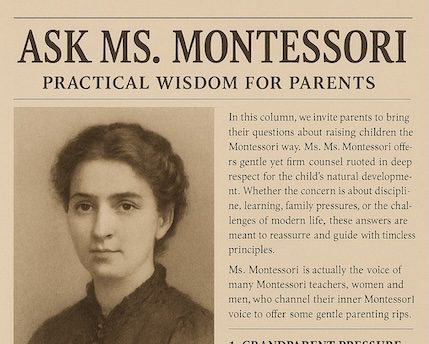
In this column, we invite parents to bring their questions about raising children the Montessori way. Ms. Montessori offers gentle yet firm counsel rooted in deep respect for the child’s natural development. Whether the concern is about discipline, learning, family pressures, or the challenges of modern life, these answers are meant to reassure and guide with timeless principles.

Ms. Montessori believed that every child carries within them the blueprint of their own growth, and that the role of adults is not to mold them by force, but to prepare an environment in which their fullest potential may unfold. Her replies aim to honor that vision while giving parents practical strategies they can use today.

Ms. Montessori is actually the voice of many Montessori teachers, women and men, who channel their inner Montessori voice to offer some gentle parenting tips.

Grandparent Pressure

Dear Ms. Montessori, my mother insists that my three-year-old should already be learning to read. She continues to buy flashcards and drill him when she visits. I don’t want to offend her, but I feel this isn’t right. How do I handle it? – Conflicted Daughter


Dear Conflicted, your mother’s eagerness stems from love, but her methods reflect a misunderstanding of the natural development of young children. At three years of age, your son is in a “sensitive period” for language development. During this period, the child absorbs the spoken word, the rhythms of conversation, and the joy of storytelling effortlessly. He learns in the way he learns to walk—by living, imitating, and joyfully repeating what he sees and hears around him.

The danger of flashcards and drills is that they ask the child to perform before a solid foundation has been built. Reading must grow out of the child’s own inner readiness, not from an adult’s insistence. If we compel a child to recite what he does not yet understand, we replace joy with anxiety. Worse still, the child may come to believe that learning is about pleasing adults rather than discovering truth for himself.
How then can you respond with kindness to your mother while protecting your child? Begin by acknowledging her intention: “I see how much you want to help him.” Then gently explain: “Right now, he is preparing for reading through conversation, singing, and listening to stories. When the time comes, he will learn with enthusiasm.” If she can visit his classroom, the experience will speak louder than any words. She will see children joyfully tracing letters in sand, building words with movable alphabets, and reading with delight—not under pressure, but out of inner discovery. Ms. Montessori

You may also guide her energy into more fruitful channels. Invite her to read aloud to him, to sing songs from her childhood, or to tell him stories of the family. These activities are not only precious in their own right, but they nourish the very faculties that will enable him to read naturally in due time.

Never forget: the task of the parent is to safeguard the child’s freedom to grow according to his inner plan. To resist pressure—whether from grandparents, neighbors, or society at large—is often the most loving thing we can do. When we trust the child’s rhythm, we allow him to become a reader not by compulsion, but by joy. – Ms. Montessori

Ask Ms. Montessori – Playdate Problems

Ask Ms. Montessori – Playdate Problems

hiring teachers

Ask Ms. Montessori Practical Wisdom for Parents

In this column, we invite parents to bring their questions about raising children the Montessori way. Ms. Montessori offers gentle yet firm counsel rooted in deep respect for the child’s natural development. Whether the concern is about discipline, learning, family pressures, or the challenges of modern life, these answers are meant to reassure and guide with timeless principles.

Ms. Montessori believes that every child carries within them the blueprint of their own growth, and that the role of adults is not to mold them by force, but to prepare an environment in which their fullest potential may unfold. Her replies aim to honor that vision while giving parents practical strategies they can use today.

Ms. Montessori is actually the voice of many Montessori teachers, women and men, who channel their inner Montessori voice to offer some gentle parenting tips.

Playdate Problems

Dear Ms. Montessori,

My daughter’s friend’s parents let the children watch a lot of television and play with tablets. When my daughter visits, she comes home cranky and asking for more screen time. Should I forbid her from going?  – Uncertain in Orlando

Dear Uncertain, the home environment is a powerful influence. When your daughter enters another household, she enters another culture—one with its own customs, rhythms, and values. It is natural that she returns asking for what she has seen there. Yet this does not mean you must sever the friendship. The child’s social life is also an important part of her growth, and she learns resilience by encountering differences.

The key is not prohibition, but preparation. Explain to your daughter calmly: “In our home, we have chosen different ways to spend our time.” Do not speak with criticism of the other family. Children understand the concepts of fairness and kindness; they also recognize that families do not need to be identical.

At the same time, invite the children to your own home as often as possible. Prepare activities that captivate their hands and minds—baking bread, painting, planting seeds, or simply playing outside. Even children accustomed to screens respond to the joy of engaging in meaningful activities. They may discover that it is more satisfying to knead dough or build a fort than to passively watch a glowing screen.

When she does visit the other home, set a boundary in advance: “You may watch a little, but when you return, we will return to our usual rhythm.” By maintaining consistency, you provide her with a sense of security. Over time, she will begin to notice the difference in how she feels. You may ask, “How did you feel after the television? How did you feel after we baked together?” Reflection awakens the child’s own awareness of what is wholesome.

We must remember that children are drawn to life, to activity, to authentic experiences. Screens provide an imitation of life, but their appeal fades when a child is regularly offered the joy of real doing. Your task is to create an environment so rich and inviting that she need not crave the artificial. By holding your ground with gentleness and by offering true alternatives, you will help your daughter not only navigate this friendship but also grow in strength of character, knowing that she can love her friend while remaining faithful to the values of her own home. – Ms. Montessori

Stickers and Silence: Why the “Silence Game ” Isn’t About Rewards

Stickers and Silence: Why the “Silence Game ” Isn’t About Rewards

hiring teachers


Last week, a school administrator confided her frustration about a situation many of us have seen. One of her assistants said she “just loves” when a teacher plays the Silence Game. In this version, when the children become noisy, the teacher calls the Silence Game to help them calm down — but then rewards each silent child with a sticker.

At first glance, this might look like a creative classroom management strategy: noise → silence → reward. But in a Montessori classroom, this picture is troubling for a few reasons.

The Real Purpose of the Silence Game 

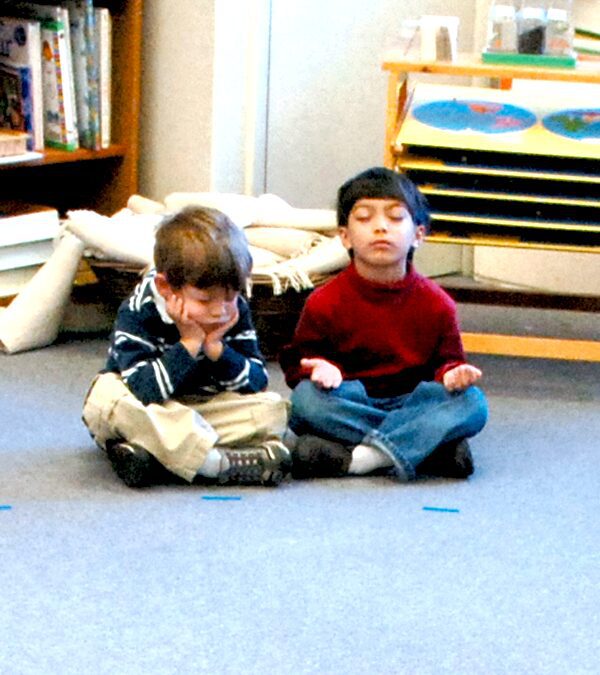
Dr. Montessori created the Silence Game as an exercise in self-mastery and joyful discovery, not as a behavior-control tactic. Children are invited to create silence together — a state of stillness, concentration, and awareness. This is not “Simon Says” with a bribe at the end.

The game is most powerful when:

  • It’s presented as a privilege and a shared experience, not a punishment or an emergency brake for noise.

  • It taps into children’s natural curiosity (“Can we be so still we hear a bird outside?”) rather than their compliance.

  • It becomes a moment of collective mindfulness that children help co-create.

When played this way, the Silence Game builds self-regulation, inner discipline, and a sense of community. Children feel the intrinsic satisfaction of calmness and control — and that’s the whole point.

Why Rewards Undermine the Goal

Giving stickers for silence sends the opposite message. It turns an experience of inner discovery into an external transaction. Instead of practicing self-control for its own sake, children learn: “Be quiet and you’ll get a prize.” Over time, this undermines intrinsic motivation, making the game far less effective.

Montessori education is built on the principle that children develop self-discipline through freedom within limits, purposeful activity, and respect for the environment. When we add extrinsic rewards, we teach children to rely on someone else’s approval rather than building their own inner compass.

Classroom Management vs. Child Development

It’s understandable why teachers reach for tools like stickers — they’re simple, quick, and often seem to “work.” But in Montessori our goal is to support development. The Silence Game isn’t a shortcut to quiet; it’s a tool for cultivating concentration and communal grace.

A more authentic approach might look like this:

  • Invite the children to gather for the Silence Game at a neutral time, not as a reaction to noise.

  • Make it playful: dim the lights slightly, sit together, whisper, “Let’s see if we can hear the clock ticking.”

  • Allow the silence to emerge organically, without dangling a reward.

  • Reflect briefly afterwards: “Did you notice how peaceful it felt? What sounds did you hear?”

This keeps the activity aligned with its Montessori roots — emphasizing self-discovery over compliance.

The Deeper Value of Silence

The Silence Game has a profound place in Montessori education. It can:

  • Strengthen concentration and impulse control.

  • Heighten sensory awareness (“I can hear my heartbeat!”).

  • Create a sense of unity (“We made the silence together!”).

  • Offer children a moment of calm and wonder in a busy day.

When done well, it’s a magical experience children cherish. Many Montessori graduates remember the Silence Game decades later as a high point of their classroom life.

Bottom Line

Using the Silence Game as a behavior-management tool with stickers misses its essential purpose. Montessori classrooms thrive on intrinsic motivation, mutual respect, and self-discipline — not prizes for compliance. By honoring the true spirit of the Silence Game, we help children discover the satisfaction of calmness, focus, and community from within.

Ask Ms. Montessori Practical Wisdom for Parents

In this column, we invite parents to bring their questions about raising children the Montessori way. Ms. Montessori offers gentle yet firm counsel rooted in deep respect for the child’s natural development. Whether the concern is about discipline, learning, family pressures, or the challenges of modern life, these answers are meant to reassure and guide with timeless principles.

Ms. Montessori believed that every child carries within them the blueprint of their own growth, and that the role of adults is not to mold them by force, but to prepare an environment in which their fullest potential may unfold. Her replies aim to honor that vision while giving parents practical strategies they can use today.

Ms. Montessori is actually the voice of many Montessori teachers, women and men, who channel their inner Montessori voice to offer some gentle parenting tips.

Grandparent Pressure

Dear Ms. Montessori, my mother insists that my three-year-old should already be learning to read. She continues to buy flashcards and drill him when she visits. I don’t want to offend her, but I feel this isn’t right. How do I handle it? – Conflicted Daughter


Dear Conflicted, your mother’s eagerness stems from love, but her methods reflect a misunderstanding of the natural development of young children. At three years of age, your son is in a “sensitive period” for language development. During this period, the child absorbs the spoken word, the rhythms of conversation, and the joy of storytelling effortlessly. He learns in the way he learns to walk—by living, imitating, and joyfully repeating what he sees and hears around him.

The danger of flashcards and drills is that they ask the child to perform before a solid foundation has been built. Reading must grow out of the child’s own inner readiness, not from an adult’s insistence. If we compel a child to recite what he does not yet understand, we replace joy with anxiety. Worse still, the child may come to believe that learning is about pleasing adults rather than discovering truth for himself.
How then can you respond with kindness to your mother while protecting your child? Begin by acknowledging her intention: “I see how much you want to help him.” Then gently explain: “Right now, he is preparing for reading through conversation, singing, and listening to stories. When the time comes, he will learn with enthusiasm.” If she can visit his classroom, the experience will speak louder than any words. She will see children joyfully tracing letters in sand, building words with movable alphabets, and reading with delight—not under pressure, but out of inner discovery. Ms. Montessori

You may also guide her energy into more fruitful channels. Invite her to read aloud to him, to sing songs from her childhood, or to tell him stories of the family. These activities are not only precious in their own right, but they nourish the very faculties that will enable him to read naturally in due time.

Never forget: the task of the parent is to safeguard the child’s freedom to grow according to his inner plan. To resist pressure—whether from grandparents, neighbors, or society at large—is often the most loving thing we can do. When we trust the child’s rhythm, we allow him to become a reader not by compulsion, but by joy. – Ms. Montessori

Why all Schools should implement mastery progress-based report schemes

Why all Schools should implement mastery progress-based report schemes

hiring teachers


Years ago, when I first sat down with a group of eighth graders in a traditional private school to talk about grades, one boy said something that stayed with me: “I feel like my grades are a race I’m losing — even when I’ve learned more than I did last year.” That’s the moment it hit me again how the traditional grading system can distort learning. Letter grades and percentages compress a child’s effort, growth, and curiosity into a single symbol. They make it easy to measure compliance but harder to measure progress.

More schools today are moving toward mastery-based learning and progress reporting — and with good reason. These approaches give families a fuller, clearer picture of what students know and can do. They honor the process of learning, not just the end result, and they invite students to take real ownership of their education.

Moving Beyond One-Size-Fits-All Grading

Think of a classroom where a student struggles for weeks with fractions, while another is already ready for algebra. In a traditional system, the first student gets a C and the second an A, and both move on at the same time. In a mastery-based classroom, the first student keeps working with support until mastery is demonstrated, while the second moves ahead as soon as he’s ready.

A teacher at a small K–8 school put it this way: “It’s like teaching children to swim. You wouldn’t keep a child in the shallow end forever because of their birthday, and you wouldn’t send a non-swimmer into the deep end because of their age. You watch, you coach, you measure progress, and you let them advance when they’re ready.”

Why Progress Reports Beat Letter Grades

Instead of static grades, progress reports give parents a window into their child’s actual learning. One parent I spoke with said, “I used to dread report cards. Now I look forward to them. I can see exactly what skills my daughter has mastered, what she’s working on, and what support she needs.” Teachers find them equally useful for planning instruction and sparking meaningful conversations.

Levels of Mastery — A Continuum, Not a Checkbox

Too often we frame mastery as binary — “has mastered” or “has not mastered.” But learning is rarely that simple. The International Baccalaureate (IB), for example, uses levels of achievement to reflect a continuum of understanding.

A middle school teacher in our network likes to map skills to Bloom’s Taxonomy. She’ll tell her students, “You’re solidly at the ‘apply’ level on this math concept. Let’s aim for ‘analyze’ next.” Students can see themselves moving up the ladder — remembering, understanding, applying, analyzing, evaluating, creating — which reframes mastery as a journey, not a hurdle.

Portfolios: Bringing Learning to Life

Progress reports tell a story with words. Portfolios show it with evidence. They’re living archives of authentic student work — and they look different at each stage of development.

  • Kindergarten–3rd Grade: Portfolios might hold drawings, early math activities, first stories, photographs of practical life work, and teacher notes documenting reading or presentations. I once watched a 6-year-old proudly flip through her portfolio, pointing out how her handwriting had “grown up.”
  • 4th–6th Grade: Students can showcase multi-step projects, science experiments, essays, goal-setting sheets, and even peer feedback. A fifth grader at one of our schools told his parents at a conference, “This is the project where I learned to keep going even when it didn’t work the first time.”
  • Secondary Level: Older students can build a record of research papers, capstone projects, leadership experiences, community service, and creative work. Some even lead their own portfolio conferences, presenting their growth to parents and teachers with confidence.

Narrative Progress Reports — Telling the Story of Learning

Narrative reports take progress reporting a step further. Instead of ticking boxes or filling in charts, teachers write a brief narrative covering academic progress, work habits, and social-emotional growth.

Done well, these reports don’t have to be overwhelming. One high school team uses a simple template: an opening paragraph, strengths, areas for growth, and next steps. They also invite students to write their own reflections, which both enriches the report and saves teacher time. “I was skeptical at first,” one teacher admitted. “But once I started writing evidence-based statements instead of trying to sum up everything, it actually became easier — and more meaningful.”

Implementation Tips

Making the shift doesn’t require an overnight revolution. Begin by setting clear learning standards and competencies. Train your staff in mastery-based practices. Develop or adopt tools to track mastery and student work. Communicate changes early and often to families and stakeholders. Pilot in one grade or subject area, gather feedback, and expand gradually.

The Payoff

Schools that make this shift often see immediate changes. Parent-teacher conferences become more productive. Students become more engaged because they understand where they’re headed and what they’ve achieved. Teachers can target interventions more precisely.

One principal summed it up perfectly: “For the first time, our conversations with parents are about learning — not about defending grades.”

A Call to Action

If you’re a school leader or educator, now is the time to start the conversation with your team. Explore tools and resources that support mastery and progress reporting. Plan a pilot, gather feedback, and commit to a timeline. Above all, involve your students and families in the process.

The shift from traditional grades to mastery and progress reporting isn’t just a change in paperwork. It’s a cultural transformation toward deeper, more personalized learning — one that can rekindle joy in teaching and learning alike.

Ask Ms. Montessori Practical Wisdom for Parents

In this column, we invite parents to bring their questions about raising children the Montessori way. Ms. Montessori offers gentle yet firm counsel rooted in deep respect for the child’s natural development. Whether the concern is about discipline, learning, family pressures, or the challenges of modern life, these answers are meant to reassure and guide with timeless principles.


Ms. Montessori believed that every child carries within them the blueprint of their own growth, and that the role of adults is not to mold them by force, but to prepare an environment in which their fullest potential may unfold. Her replies aim to honor that vision while giving parents practical strategies they can use today.

Ms. Montessori is actually the voice of many Montessori teachers, women and men, who channel their inner Montessori voice to offer some gentle parenting tips.

Grandparent Pressure

Dear Ms. Montessori, my mother insists that my three-year-old should already be learning to read. She continues to buy flashcards and drill him when she visits. I don’t want to offend her, but I feel this isn’t right. How do I handle it? – Conflicted Daughter


Dear Conflicted, your mother’s eagerness stems from love, but her methods reflect a misunderstanding of the natural development of young children. At three years of age, your son is in a “sensitive period” for language development. During this period, the child absorbs the spoken word, the rhythms of conversation, and the joy of storytelling effortlessly. He learns in the way he learns to walk—by living, imitating, and joyfully repeating what he sees and hears around him.

The danger of flashcards and drills is that they ask the child to perform before a solid foundation has been built. Reading must grow out of the child’s own inner readiness, not from an adult’s insistence. If we compel a child to recite what he does not yet understand, we replace joy with anxiety. Worse still, the child may come to believe that learning is about pleasing adults rather than discovering truth for himself.
How then can you respond with kindness to your mother while protecting your child? Begin by acknowledging her intention: “I see how much you want to help him.” Then gently explain: “Right now, he is preparing for reading through conversation, singing, and listening to stories. When the time comes, he will learn with enthusiasm.” If she can visit his classroom, the experience will speak louder than any words. She will see children joyfully tracing letters in sand, building words with movable alphabets, and reading with delight—not under pressure, but out of inner discovery. Ms. Montessori

You may also guide her energy into more fruitful channels. Invite her to read aloud to him, to sing songs from her childhood, or to tell him stories of the family. These activities are not only precious in their own right, but they nourish the very faculties that will enable him to read naturally in due time.

Never forget: the task of the parent is to safeguard the child’s freedom to grow according to his inner plan. To resist pressure—whether from grandparents, neighbors, or society at large—is often the most loving thing we can do. When we trust the child’s rhythm, we allow him to become a reader not by compulsion, but by joy. – Ms. Montessori

New Mexico’s Big Bet on Free Child Care—What It Means for Montessori Programs

New Mexico’s Big Bet on Free Child Care—What It Means for Montessori Programs

hiring teachers


On November 1, 2025, child care will be free or highly subsidized for every family in New Mexico, regardless of income. Governor Michelle Lujan Grisham’s decision to remove income limits, end copayments, and boost reimbursement rates is a major shift in public policy. Centers that pay their entry-level staff at least $18 an hour and offer 10 hours of care a day, five days a week, will qualify for extra incentives. The program is funded through the state’s Land Grant Permanent Fund and Early Childhood Trust Fund, built over the years from oil, gas, and investment income.

For many families, this is life-changing. KOB-TV in Albuquerque spoke with parents who said the savings would help them afford everything from holidays and vacations to a long-awaited down payment on a house. One parent summed it up simply: “Everybody deserves to be able to keep working and not cut as much out of their budget for child care.”

Providers, however, see both opportunity and challenge. Ruth Porta, owner of La Esperanza Child Development Centers, said, “They deserve that help … but how is this going to be sustainable?” Natalie Aragon of ABQ Childcare is already “hiring at least one to two people per classroom” to handle the expected surge. Their comments reflect what many of us in the field are thinking: this is bold, but it needs careful execution.

To understand how this plays out at ground level, I spoke with my friend and colleague Sheila Griffin, who runs Leap Montessori School in New Mexico. Sheila is excited for families but realistic about what the policy does and doesn’t cover.

For preschoolers, tuition will be fully funded. For elementary-age children, the state covers before- and after-school care but not the entire school day. At her school, that means families still pay a couple of hundred dollars a month — a significant reduction, but not completely free. For schools with higher tuition, the remaining gap would be larger.

Sheila is passionate about preserving the authenticity of Montessori. Some worry that quality systems like New Mexico’s FOCUS framework will force schools to compromise. She’s found the opposite. By making only minor, respectful adjustments — such as adding a simple storytelling tray to meet a literacy benchmark — she’s been able to maintain full Montessori fidelity.

She’s also learned to be strategic with state Pre-K funding. Taking a large number of Pre-K seats can squeeze kindergarten enrollment, weakening the three-year primary cycle at the heart of Montessori. She solved it by starting a small multi-age elementary class for ready five-year-olds—her advice: guard your three-year cycle and plan.

When asked if universal free child care threatens private providers, Sheila didn’t hesitate: “Absolutely not.” She believes the state intends to raise the floor for everyone, not undercut private schools. With stable reimbursement and higher pay for teachers, she sees a stronger future for early childhood educators.


What’s Covered at a Glance

Age Group Coverage Family Out-of-Pocket (Leap Montessori Example)
Birth–Kindergarten Full tuition covered (licensed providers) $0
Elementary (Grades 1–6) Before- & after-school care covered; instructional day not covered About $200–$300/month

Funding flows directly to the school, not the parent. Programs must be licensed and registered with ECECD to qualify. For schools, that means a predictable stream of public support, a chance to serve more families, and the resources to improve staff pay.

Still, challenges remain. State reimbursements may not fully cover the higher costs of Montessori programs, quality standards will require some adaptation, and competition for qualified teachers will almost certainly grow. Knowing this in advance helps schools plan wisely and stay ahead.


If you run a Montessori school in New Mexico, here are a few steps to consider:

  • Engage early. Ensure your schedule and licensing align with reimbursable hours.
  • Budget with real numbers. Model tuition and reimbursement scenarios using actual state rates.
  • Protect the three-year cycle. Don’t overcommit Pre-K slots at the expense of kindergarten continuity.
  • Recruit ahead of demand. Build a salary scale and invest in professional development to attract and keep staff.
  • Communicate clearly with families. Celebrate the savings, but be honest about what’s covered and what’s not. Highlight what makes your Montessori program distinct.

Other states are watching New Mexico closely. The state can do this now because it has built an endowment-style funding engine over the years; others will need a different path, whether dedicated revenue, phased rollouts, or public-private partnerships. But the essentials — stable funding, quality systems that respect program identity, a separate agency focused on early childhood, and true partnership with community providers — can be replicated anywhere.

As Montessori educators, we’ve always believed early childhood education is a public good. New Mexico is testing what it looks like to fund that belief at scale. Sheila’s experience convinces me that, if we stay engaged, protect fidelity, and plan intelligently, this moment can widen access and strengthen the work we cherish.


On November 1, 2025, child care will be free or highly subsidized for every family in New Mexico, regardless of income. Governor Michelle Lujan Grisham’s decision to remove income limits, end copayments, and boost reimbursement rates is a major shift in public policy. Centers that pay their entry-level staff at least $18 an hour and offer 10 hours of care a day, five days a week, will qualify for extra incentives. The program is funded through the state’s Land Grant Permanent Fund and Early Childhood Trust Fund, built over the years from oil, gas, and investment income.

For many families, this is life-changing. KOB-TV in Albuquerque spoke with parents who said the savings would help them afford everything from holidays and vacations to a long-awaited down payment on a house. One parent summed it up simply: “Everybody deserves to be able to keep working and not cut as much out of their budget for child care.”

Providers, however, see both opportunity and challenge. Ruth Porta, owner of La Esperanza Child Development Centers, said, “They deserve that help … but how is this going to be sustainable?” Natalie Aragon of ABQ Childcare is already “hiring at least one to two people per classroom” to handle the expected surge. Their comments reflect what many of us in the field are thinking: this is bold, but it needs careful execution.

To understand how this plays out at ground level, I spoke with my friend and colleague Sheila Griffin, who runs Leap Montessori School in New Mexico. Sheila is excited for families but realistic about what the policy does and doesn’t cover.

For preschoolers, tuition will be fully funded. For elementary-age children, the state covers before- and after-school care but not the entire school day. At her school, that means families still pay a couple of hundred dollars a month — a significant reduction, but not completely free. For schools with higher tuition, the remaining gap would be larger.

Sheila is passionate about preserving the authenticity of Montessori. Some worry that quality systems like New Mexico’s FOCUS framework will force schools to compromise. She’s found the opposite. By making only minor, respectful adjustments — such as adding a simple storytelling tray to meet a literacy benchmark — she’s been able to maintain full Montessori fidelity.

She’s also learned to be strategic with state Pre-K funding. Taking a large number of Pre-K seats can squeeze kindergarten enrollment, weakening the three-year primary cycle at the heart of Montessori. She solved it by starting a small multi-age elementary class for ready five-year-olds—her advice: guard your three-year cycle and plan.

When asked if universal free child care threatens private providers, Sheila didn’t hesitate: “Absolutely not.” She believes the state intends to raise the floor for everyone, not undercut private schools. With stable reimbursement and higher pay for teachers, she sees a stronger future for early childhood educators.


What’s Covered at a Glance

Age Group Coverage Family Out-of-Pocket (Leap Montessori Example)
Birth–Kindergarten Full tuition covered (licensed providers) $0
Elementary (Grades 1–6) Before- & after-school care covered; instructional day not covered About $200–$300/month

Funding flows directly to the school, not the parent. Programs must be licensed and registered with ECECD to qualify. For schools, that means a predictable stream of public support, a chance to serve more families, and the resources to improve staff pay.

Still, challenges remain. State reimbursements may not fully cover the higher costs of Montessori programs, quality standards will require some adaptation, and competition for qualified teachers will almost certainly grow. Knowing this in advance helps schools plan wisely and stay ahead.


If you run a Montessori school in New Mexico, here are a few steps to consider:

  • Engage early. Ensure your schedule and licensing align with reimbursable hours.
  • Budget with real numbers. Model tuition and reimbursement scenarios using actual state rates.
  • Protect the three-year cycle. Don’t overcommit Pre-K slots at the expense of kindergarten continuity.
  • Recruit ahead of demand. Build a salary scale and invest in professional development to attract and keep staff.
  • Communicate clearly with families. Celebrate the savings, but be honest about what’s covered and what’s not. Highlight what makes your Montessori program distinct.

Other states are watching New Mexico closely. The state can do this now because it has built an endowment-style funding engine over the years; others will need a different path, whether dedicated revenue, phased rollouts, or public-private partnerships. But the essentials — stable funding, quality systems that respect program identity, a separate agency focused on early childhood, and true partnership with community providers — can be replicated anywhere.

As Montessori educators, we’ve always believed early childhood education is a public good. New Mexico is testing what it looks like to fund that belief at scale. Sheila’s experience convinces me that, if we stay engaged, protect fidelity, and plan intelligently, this moment can widen access and strengthen the work we cherish.


Ask Ms. Montessori – Playdate Problems

Ask Ms. Montessori – Grandparent pressure

hiring teachers

Ask Ms. Montessori Practical Wisdom for Parents

In this column, we invite parents to bring their questions about raising children the Montessori way. Ms. Montessori offers gentle yet firm counsel rooted in deep respect for the child’s natural development. Whether the concern is about discipline, learning, family pressures, or the challenges of modern life, these answers are meant to reassure and guide with timeless principles.


Ms. Montessori believed that every child carries within them the blueprint of their own growth, and that the role of adults is not to mold them by force, but to prepare an environment in which their fullest potential may unfold. Her replies aim to honor that vision while giving parents practical strategies they can use today.

Ms. Montessori is actually the voice of many Montessori teachers, women and men, who channel their inner Montessori voice to offer some gentle parenting tips.

Grandparent Pressure

Dear Ms. Montessori, my mother insists that my three-year-old should already be learning to read. She continues to buy flashcards and drill him when she visits. I don’t want to offend her, but I feel this isn’t right. How do I handle it? – Conflicted Daughter


Dear Conflicted, your mother’s eagerness stems from love, but her methods reflect a misunderstanding of the natural development of young children. At three years of age, your son is in a “sensitive period” for language development. During this period, the child absorbs the spoken word, the rhythms of conversation, and the joy of storytelling effortlessly. He learns in the way he learns to walk—by living, imitating, and joyfully repeating what he sees and hears around him.

The danger of flashcards and drills is that they ask the child to perform before a solid foundation has been built. Reading must grow out of the child’s own inner readiness, not from an adult’s insistence. If we compel a child to recite what he does not yet understand, we replace joy with anxiety. Worse still, the child may come to believe that learning is about pleasing adults rather than discovering truth for himself.
How then can you respond with kindness to your mother while protecting your child? Begin by acknowledging her intention: “I see how much you want to help him.” Then gently explain: “Right now, he is preparing for reading through conversation, singing, and listening to stories. When the time comes, he will learn with enthusiasm.” If she can visit his classroom, the experience will speak louder than any words. She will see children joyfully tracing letters in sand, building words with movable alphabets, and reading with delight—not under pressure, but out of inner discovery. Ms. Montessori

You may also guide her energy into more fruitful channels. Invite her to read aloud to him, to sing songs from her childhood, or to tell him stories of the family. These activities are not only precious in their own right, but they nourish the very faculties that will enable him to read naturally in due time.

Never forget: the task of the parent is to safeguard the child’s freedom to grow according to his inner plan. To resist pressure—whether from grandparents, neighbors, or society at large—is often the most loving thing we can do. When we trust the child’s rhythm, we allow him to become a reader not by compulsion, but by joy. – Ms. Montessori

Hiring and Retaining Teachers in Today’s Competitive Preschool Market

Hiring and Retaining Teachers in Today’s Competitive Preschool Market

hiring teachers

1907-2025 Welcome to the 119th Montessori School Year!

If you’ve tried to hire a preschool teacher in America in the last year or so, you know it’s not easy. Great early childhood educators are in high demand—and in short supply. And even when you manage to hire someone wonderful, keeping them can be just as difficult.

Low wages, burnout, and competition from better-paying industries have pushed many talented educators out of early childhood altogether. As school leaders, we find ourselves navigating a tough reality: the mission we believe in is only as sustainable as the team we can build and retain.

But there is hope—and there are strategies that work. This article is meant to serve as a practical guide for school owners and directors across Florida who are determined to build stable, joyful, mission-driven teams—even in a competitive market.

The Realities We’re Facing

I live in Florida, where this is a state-wide challenge, but we’re not alone in our staffing crisis; we’re feeling it intensely. Early childhood teachers are leaving the field for better pay and more predictable hours. Many work two jobs. Some leave mid-year, overwhelmed and under-resourced.

A Wall Street Journal feature by Anne Tergesen and Veronica Dagher laid it out clearly: child care centers are facing a national workforce emergency. The article points to five areas of systemic breakdown—but also offers several forward-looking solutions that are worth our attention.

Why Retention Matters More Than Ever

When a teacher leaves, it disrupts far more than the schedule. Children lose the sense of consistency that’s foundational to trust and emotional development. Remaining staff absorb the stress and often begin thinking about leaving, too. Parents grow uneasy. The learning community suffers.

The cost of turnover isn’t just financial—it’s cultural.

What You Can Do: Six Strategies That Make a Real Difference

Here’s what the most resilient programs are doing to attract and retain great educators in a high-pressure environment.

1. Build a Culture of Respect and Belonging

Educators stay where they feel seen and supported. According to Teaching Strategies’ national survey, over 60% of teachers cite a respectful workplace as the top reason they would stay in a role long-term.

This doesn’t cost money—but it does require leadership. Be visible. Listen actively. Say thank you often. Create space for input and ideas. Celebrate small wins. And above all, make sure your teachers know their work matters.

2. Provide Competitive Compensation (and Creative Benefits)

We all know the financial limits of running a preschool. But the Wall Street Journal article reminds us that compensation isn’t just about the hourly wage—it’s about the whole package. Some programs are thinking creatively:

  • Offering paid professional development days
  • Giving staff discounted or free child care
  • Providing stipends for classroom materials
  • Offering extra paid days off around holidays or birthdays
  • Contributing to healthcare stipends or mental health wellness plans

You may not be able to offer everything—but even a few thoughtful perks show that you value your team and are invested in their well-being.

3. Offer Flexibility Where You Can

One of the Journal‘s key points was that burnout is driving many educators away—not just low pay. Long hours, little planning time, and a lack of schedule control all contribute.

Consider:

  • Job sharing or part-time roles
  • Floaters to give lead teachers breaks
  • Weekly planning time built into the schedule
  • A clear PTO policy that’s actually respected

Small adjustments to how time is used can make a big difference in retention.

4. Create Career Pathways

Another insight from the WSJ article: many states and school systems are beginning to offer tuition-free CDA and fast-track credentialing programs. Why? Because when early educators see a future in the field, they stay longer.

Connect with your local community college or workforce board. Offer to host practicum students. Support your assistants in getting their credentials. Celebrate professional milestones publicly. Build a culture where teachers grow with you—not outgrow you.

5. Build a Mentorship Model

Don’t let new teachers feel like they’re on their own. Create a system where new hires are paired with experienced mentors. Hold monthly reflection circles. Check in regularly. Sometimes a single conversation can prevent a resignation.

Strong teams don’t just form—they’re nurtured.

6. Invest in Tools That Help Teachers Succeed

Teachers are more likely to stay when they have what they need to do their job well. That includes a high-quality curriculum, practical assessment tools, and streamlined communication systems.

Avoid overloading them with disconnected apps or disorganized systems. Streamline, simplify, and ensure your tools support—not hinder—the classroom day’s flow.

BTW: I consult with a few software providers. If you run a childcare center, I warmly encourage you to look into Illumine (https://illumine.app/). It is new to America, but strikes me as being much more powerful and user-friendly than other ECE software that I have found. If you run a Montessori school, I warmly recommend the Montessori Growth Suite, which is the best match that I have found for our schools (https://www.montessoricompass.com/growth-suite/).

A Sample Retention Rhythm You Can Adopt

If you’re looking to build retention habits into your leadership rhythm, try this:

Weekly:

  • Check in with your team informally—how are they really doing?

Monthly:

  • Offer one hour of paid planning time or peer sharing.
  • Recognize staff contributions publicly—in meetings, emails, or parent newsletters.

Quarterly:

  • Hold a one-on-one review focused on support, not evaluation.
  • Ask for feedback on what would help them thrive.

Annually:

  • Conduct a formal survey on satisfaction and workplace culture.
  • Revisit compensation and consider where you can improve—even incrementally.

Wrapping Up

Yes, the market is tough. Yes, there are factors outside of your control. But there are also many things within your reach.

Hiring and retaining teachers in today’s Florida preschool landscape starts with building a school culture that respects educators, supports their growth, and treats them as the professionals they are.

And as the Wall Street Journal put it, the future of early education will depend on how we reimagine our approach—not just with funding, but with leadership and care.

Here’s a Sample Staff Retention Survey that you can use with your preschool team. It’s written in a clear, respectful tone and structured to gather meaningful feedback while reinforcing a culture of listening and professionalism.

Staff Retention & Satisfaction Survey

Confidential – Your feedback helps us build a better place to work

Please take a few minutes to reflect on your experience at our school. Your honest input will help us understand what we’re doing well and where we can grow.

Your Name (optional): _______________________________ Your Position: _______________________________ Length of time at the school: _______________________________


1. Overall Satisfaction

1.1 On a scale of 1 to 5, how satisfied are you working at this school? (1 = Very Unsatisfied, 5 = Very Satisfied) ☐ 1 ☐ 2 ☐ 3 ☐ 4 ☐ 5

1.2 What do you enjoy most about working here?


1.3 What frustrates you or makes your job harder than it needs to be?


2. Work Environment & Culture

2.1 I feel respected and valued by… (Check all that apply) ☐ My direct supervisor ☐ School leadership ☐ My fellow team members ☐ Families ☐ Not sure

2.2 I feel comfortable giving feedback or raising concerns. ☐ Always ☐ Usually ☐ Sometimes ☐ Rarely ☐ Never

2.3 I feel part of a collaborative team. ☐ Strongly agree ☐ Agree ☐ Neutral ☐ Disagree ☐ Strongly disagree

2.4 If you could improve one thing about our team culture, what would it be?


3. Compensation & Workload

3.1 I feel my compensation is fair for the responsibilities of my role. ☐ Strongly agree ☐ Agree ☐ Neutral ☐ Disagree ☐ Strongly disagree

3.2 The workload I carry is… ☐ Very manageable ☐ Manageable ☐ Sometimes overwhelming ☐ Frequently overwhelming

3.3 What type of support would make your work easier or more sustainable?


4. Growth & Development

4.1 I have opportunities for professional growth at this school. ☐ Strongly agree ☐ Agree ☐ Neutral ☐ Disagree ☐ Strongly disagree

4.2 I would be interested in: ☐ Earning a credential (CDA, FCCPC, etc.) ☐ Attending workshops or conferences ☐ Mentoring a new teacher ☐ Having a mentor or coach ☐ Leading a project or initiative ☐ None at this time

4.3 What would help you grow in your role?


5. Retention & Intentions

5.1 I see myself continuing to work here… ☐ Next school year ☐ For at least 2 more years ☐ For the foreseeable future ☐ I’m unsure ☐ I’m actively considering leaving

5.2 If you’re considering leaving, what factors are influencing your decision?


6. Final Thoughts

6.1 What’s one thing we’re doing well that you’d like us to keep doing?


6.2 What’s one thing we could do better to support our staff?


Thank you for taking the time to complete this survey. Your voice matters.

The Art of Holding Difficult Conversations: Leading with Clarity and Compassion

The Art of Holding Difficult Conversations: Leading with Clarity and Compassion

Montessori Growth Suite

1907-2025 Welcome to the 119th Montessori School Year!

NOTE: I would like to acknowledge my colleague, Jonathan Wolf, with whom I have taught courses and presented on this topic. His wisdom inspired much of what we have to share. 


Every school leader has faced that moment: the knock on the office door, the email asking for a meeting, or the parent who catches your arm at pick-up and says, “Do you have a minute?” Often, what follows isn’t a quick chat at all, but a difficult conversation—one that carries the weight of a child’s future, a family’s fears, or the delicate balance of trust between home and school.

I remember a father who once sat across from me, arms crossed tightly, eyes narrowed, as I tried to explain that his daughter was struggling socially and academically. His words came sharp and defensive: “Are you saying my child isn’t smart enough?” It would have been easy to respond in kind, but in that moment, I had to remind myself: this isn’t about winning an argument—it’s about helping a child. What that father needed most wasn’t more data or sharper reasoning. He needed to know that we were on his side.

That’s what these conversations are really about. They aren’t just about problems; they’re about leadership.


Why These Conversations Matter

Every Montessori leader eventually has to step into these spaces:

  • Conversations about neurodiversity or developmental differences

  • Talking through disciplinary issues

  • Helping parents process their child’s academic or social struggles

  • Addressing resistance or outright denial

Handled poorly, these conversations can erode trust. But approached with clarity and compassion, they can strengthen partnerships and open new doors for children.


Quick Tips for School Leaders

  • Don’t let the first call home be about bad news—share positives regularly.

  • Choose the right time and place; never have these talks on the run.

  • Enter with curiosity, not conclusions.

  • End with clear agreements and follow-up dates.


Preparing Your Heart and Mind

The real preparation for these conversations begins inside of us. Before meeting with a parent, pause and ask:

  • What emotions does this situation stir up for me?

  • Am I approaching with openness or judgment?

  • What outcome do I truly want for this child and family?

Parents pick up on our energy. If we carry frustration, they feel it. But when we arrive with empathy and steadiness, we make space for real dialogue.


The Importance of Trust Before Trouble

One teacher I worked with made it her habit to email parents every Friday afternoon with one small snapshot: a funny story, a kind act, or a proud achievement. These weren’t long notes, but they added up. Months later, when a sensitive issue arose, those parents already trusted her voice.

Trust is built in those small deposits. When it’s there, the hard conversations can begin on solid ground.


Language That Builds Bridges

  • Instead of: “Your child is disruptive.”

  • Try: “We’ve noticed some behaviors that seem to be getting in the way of her learning.”

  • Instead of: “You need to fix this at home.”

  • Try: “What have you noticed at home? Let’s look at this together.”

A Framework That Works

  1. Start with affirmation and shared purpose.
    Open by affirming the child: “We all care deeply about Sam, and we want him to feel successful and confident here.”
  2. Ask, listen, ask again.
    Begin with open-ended questions, listen deeply, then ask clarifying follow-ups. This shows respect and genuine curiosity.
  3. Explore, don’t diagnose.
    Frame the challenge as a shared puzzle, not a verdict. Admit what you don’t yet know, and invite parents’ insights.
  4. Try “Feel–Felt–Found.”
    When parents are defensive: “I understand how you feel. Other parents have felt the same way. What we’ve found is…”
  5. Know when to pause.
    If emotions boil over, suggest reconvening later. Protecting the relationship matters more than pushing through.
  6. End with clarity.
    Summarize agreements, document responsibilities, set follow-up dates, and provide resources.


Sidebar: Reflection Prompts for Leaders

  • What conversations make you most uncomfortable? Why?

  • How do your own experiences as a parent or teacher shape your reactions?

  • When was a time you left a conversation feeling proud of how you handled it? What made the difference?

A Montessori Lens on Leadership

Maria Montessori once wrote, “Purify your heart and render it burning with charity.” For me, that is the essence of school leadership.

These conversations aren’t interruptions to the “real work.” They are the real work. When we model honesty joined with compassion, we show parents and children alike that dignity and respect matter as much as academics.


Walking Away Stronger

That father I mentioned at the beginning? Months later, after his daughter had made great progress, he came back into my office. This time, his arms weren’t crossed. He leaned forward and said quietly, “Thank you for not giving up on us.”

That’s the lasting power of these conversations. When we lead them with honesty, courage, and compassion, we not only resolve immediate issues—we strengthen the bonds that hold our communities together.

So, the next time your stomach tightens before a parent meeting, remember this: you are not just managing conflict. You are leading with love. And that, in the end, is the heart of Montessori leadership.

A Parent’s Guide to Observing in a Montessori Classroom

A Parent’s Guide to Observing in a Montessori Classroom

Montessori Growth Suite

1907-2025 Welcome to the 119th Montessori School Year!


One of the most meaningful ways to understand your child’s Montessori experience is to come and see it for yourself. Montessori classrooms are carefully designed learning communities, and when parents sit quietly and watch, they often gain a new appreciation for their child’s day-to-day world.

At our school, we invite—and encourage—you to observe. Visiting with open eyes and a calm presence helps you see what makes Montessori unique, and it deepens your connection to your child’s education.

When to Visit

Observations are most helpful once the class has settled into its routines. During the very first weeks of school, children are adjusting to new rhythms, new classmates, and a new environment. For that reason, most schools ask parents to hold off until those sensitive early weeks are over.

When you are ready to schedule a visit, please reach out to your child’s teacher. Advance notice allows the class to prepare for a smooth experience and ensures the teacher won’t feel pressured to interrupt lessons to talk with you.

When you arrive, sign in at the office to receive a visitor’s badge and an observation form. This helps us keep the school secure and provides a simple guide on what to look for during your time in the classroom.

How to Observe

When you enter, the teacher will direct you to a chair set aside for visitors. We’d like to ask you to remain seated and quiet so the children can stay focused on their work without distraction. Think of yourself as a gentle presence in the room—like a guest at a concert who is there to listen and take it in.

Patient observation often reveals far more than you expect. At first, you may notice the layout of the shelves, the calm hum of activity, or the way children move about the room with quiet purpose. On later visits, you’ll begin to pick up the subtle details that make Montessori learning so powerful.

What to Look For

Here are a few areas you might focus on:

  • The Environment
    How is the classroom organized? Notice the shelves, materials, and child-sized furniture. Everything is arranged to invite independence and exploration.

  • The Role of the Teacher
    Watch how adults interact with the children. Do they guide gently, offer lessons one-on-one, or step back to allow independence? You may notice moments of discipline handled calmly and respectfully.

  • The Children at Work
    You can focus on a child other than your own for at least half an hour. How does she choose her activities? How deeply does she concentrate? What happens when she completes her work?

  • The Materials
    Please take a look at which Montessori materials children are drawn to. Each material is designed with a built-in control of error, so children can discover and correct mistakes on their own. Can you spot a child quietly self-correcting?

  • Peer Learning
    See how younger children learn from older classmates, and how older ones gain confidence by mentoring younger friends. These subtle exchanges are one of the great strengths of the multi-age classroom.

Why It Matters

Observation is not only about watching children; it’s also about discovering the deeper philosophy behind Montessori. You’ll see a classroom where independence, concentration, and curiosity are nurtured. You may even find yourself wishing you could join in!

By sitting quietly and noticing the details, you’ll gain new insight into how your child learns, how the teacher guides, and how the environment itself supports growth.

So, when you have the chance, take a seat in the visitor’s chair. Be patient. Watch closely. You’ll walk away with a richer understanding of your child’s world—and perhaps a renewed sense of wonder yourself.

Montessori Classroom Observation Form

Visitor Name: _____________________________________
Date: _________________________
Classroom/Level: __________________________________

Thank you for observing today! Please take a few quiet notes while you sit in the classroom. This form is designed to help you focus on what makes Montessori unique. You are welcome to keep it for yourself or share it with the school.

1. The Classroom Environment

  • How is the room arranged?

  • What do you notice about the shelves, materials, and furnishings?

  • Does the space feel calm and inviting?

Notes:


2. Children at Work

  • What do you notice about how children choose and use their work?

  • Do they concentrate for long periods?

  • Do you see them self-correcting or working together?

Notes:


3. Teacher Interactions

  • How do the adults speak with the children?

  • Did you notice a teacher presenting a lesson?

  • How is guidance or discipline handled?

Notes:


4. Montessori Materials

  • Which materials did you see being used?

  • What concepts or skills did they isolate?

  • Did you notice children teaching or modeling for one another?

Notes:


5. Community Life

  • How do younger and older children interact?

  • What do you notice about respect, independence, or collaboration?

Notes:


6. Reflections

  • What surprised you about what you saw?

  • What questions or insights do you take away from this visit?

Notes:


Optional: Feedback for the School

Why Child Care Is So Expensive — and What Montessori Educators Can Do About It

Why Child Care Is So Expensive — and What Montessori Educators Can Do About It

Montessori Growth Suite

1907-2025 Welcome to the 119th Montessori School Year!


Inspired by Jordan McGillis, “Why child care costs so much — and how to fix it,” The Washington Post, August 18, 2025: https://www.washingtonpost.com/opinions/2025/08/18/childcare-cost-nannies-economy-labor/

Summary for Montessori Leaders

High-quality early childhood education (ECE) is structurally expensive because it is people-intensive, time-intensive, and resistant to automation. Prices are rising faster than inflation due to the Baumol cost disease, compliance expansion, facilities costs, and a shrinking domestic pipeline of qualified educators. Broad subsidies can shift who pays but often impose regulatory frameworks that conflict with Montessori principles (flexibility, mixed‑age groupings, uninterrupted work cycles). Sustainable affordability requires: (1) enlarging the educator workforce (including visas and apprenticeships), (2) right‑sizing credential rules to recognize Montessori pathways, (3) smart public co‑investment that protects pedagogical autonomy, and (4) stronger school‑level talent and finance strategies.

1) Why All Child Care Is Expensive (and getting more so)

People, not widgets. All child-care and early childhood education, including Montessori programs, depend on the presence of trained adults who observe, prepare, and connect with children when needed. Unlike traditional settings that assume a lower adult‑child ratio is always better, Montessori intentionally cultivates peer learning and independence. Guides must balance giving lessons, making space for autonomy, and investing time in children who need deeper connection. That still requires adequate staffing, not to overwhelm guides but to ensure they can observe, build relationships, and prepare the environment.

Baumol cost disease. When productivity rises in other sectors (software, manufacturing), wages increase economy‑wide. ECE productivity is intentionally flat—one adult can responsibly guide only so many children in a classroom community—so programs must raise pay to keep educators from leaving for higher‑paying fields.

Regulatory creep. Over time, well‑meant rules add paperwork, training hours, inspections, and record‑keeping. Each requirement may be reasonable; the cumulative cost is substantial, and the burden falls heaviest on small schools.

Facilities and insurance. Child‑sized fixtures, outdoor spaces, ADA compliance, security, and severe‑weather standards drive capital and operating costs. Premiums and deductibles have risen sharply in many regions.

Benefits and turnover. Inadequate salaries and benefits produce churn. Turnover creates hiring costs, onboarding time, and lost continuity for children—all of which are expensive and educationally harmful.

Montessori specifics. True mixed‑age communities, real materials, and uninterrupted three‑hour work cycles require prepared staff and ample space. You can cut corners, but you won’t have Montessori.

2) Why do so few Americans choose early childhood careers

  • Compensation gap. Talented assistants can earn more in retail, health tech, or HR within a year. Lead guides often lack parity with K–12 teachers (and lack pensions/tenure).
  • Status and career ladders. ECE is viewed as “babysitting” in the U.S. Clear advancement (assistant → associate guide → lead guide → program lead) is rare outside strong Montessori networks.
  • Burnout risk. Demanding emotional labor with limited prep time, limited planning coverage, and scarce subs.
  • Credential barriers. One‑size‑fits‑all degree mandates can exclude excellent practitioners and undervalue rigorous Montessori credentials (AMI, AMS, IMC, etc.). Coursework costs and time deter candidates.
  • Friction costs. Background checks, fingerprinting, first‑aid, TB tests, food‑handler cards—each necessary, all time‑consuming. Without centralized onboarding support, good candidates drop out.

Implication for Montessori leaders: Without a bigger pipeline and better work design, tuition will keep climbing to maintain quality.

3) Subsidies: help with access, but watch the strings

Public funding can increase access, stabilize wages, and reduce family burden. But when dollars are tied to compliance frameworks that prioritize narrow inputs (seat time, scripted curricula, testing, short blocks), Montessori’s essential features—freedom within limits, individualized pacing, mixed ages, and long work cycles—are at risk. The goal is smart subsidies: fund outcomes and core quality elements while preserving pedagogical autonomy and multiple program models.

4) System‑level ideas that actually improve affordability

Drawing on McGillis’s piece and lessons from ECE research:

  1. Expand legal pathways for caregivers and teachers.
  2. Apprenticeships and paid residencies.
  3. Right‑size credential rules.
  4. Tiered program options with safety as the non‑negotiable.
  5. Shared‑services alliances.
  6. Targeted public co‑investment.

5) What Montessori schools can do now (a practical playbook)

Talent pipeline

  • Partner with local colleges and workforce boards to create Montessori assistant pipelines; host paid practicums.
  • “Grow‑your‑own” scholarships for assistants to earn Montessori diplomas; add service commitments.
  • Create compensation ladders tied to observable competencies (presentations mastered, classroom management, parent partnership) with transparent pay bands.
  • Build a regional substitute consortium and shared calendar of observation days.
  • Offer predictable planning time and classroom coverage; reduce burnout.

Finance and pricing

  • Cost every classroom using zero‑based budgeting (salaries & benefits, relief staff, materials refresh, PD, admin allocation, facilities, insurance). Price tuition to cover true cost plus strategic reserves.
  • Diversify revenue: extended day, summer Montessori, parent education, space rentals (when mission‑consistent), philanthropic scholarships.
  • Be radically transparent with parents: publish what tuition funds (wages/benefits %, PD %, materials %, financial aid %). Transparency builds trust.

Operations and program integrity

  • Protect the long extended work cycle; schedule specialists and pull‑outs after core work periods.
  • Keep class sizes at Montessori‑appropriate ranges and invest in assistant training; this is cheaper than chronic turnover.
  • Use tech only to reduce admin friction (enrollment, billing, parent comms), not to fragment the work cycle.

Parent partnership

  • Offer recurring parent education: observation days, short “why we do it this way” videos, and Q&As on mixed ages, independence, and freedom within limits.
  • Provide a clear comparison of Montessori vs. conventional daycare requirements and why Montessori looks different—and costs what it does.

Data and outcomes

  • Track and share: child attendance, concentration indicators (normalized work blocks), executive function rubrics, retention to K/Elementary, and alumni narratives. Funders and parents respond to outcomes, not slogans.

6) Talking points you can use with boards and parents

  • “You’re paying for people.” Quality ECE is a professional service, not a product. The largest line item is wages and benefits, and that’s appropriate.
  • “Montessori encourages independence.” Our classrooms are designed so children learn from each other as well as adults. Ratios matter less than well‑trained guides who know when to step in and when to step back.
  • “Montessori is prevention.” Strong early executive function reduces later remediation and behavior costs.
  • “We welcome smart public support.” We support funding that preserves mixed‑age communities, long work cycles, and Montessori credentials.

Selected references & further reading

(Representative sources you can cite in parent education, grant writing, and board work.)

  • Jordan McGillis (2025). Why child care costs so much — and how to fix it. The Washington Post (op‑ed).
  • William J. Baumol & William G. Bowen (1966). Performing Arts: The Economic Dilemma (origin of the cost disease concept; widely applied to labor‑intensive services like ECE).
  • James J. Heckman & colleagues (2006–2019). Research on returns to early childhood investment and the “Heckman curve.” See Heckman’s synthesis papers and policy briefs.
  • Angeline S. Lillard & Nicole Else‑Quest (2006). “Evaluating Montessori Education.” Science, 313(5795), 1893–1894.
  • Angeline S. Lillard (2017, 2021). Peer‑reviewed studies and meta‑analyses on Montessori outcomes (executive function, academic and social benefits).
  • National Institute for Early Education Research (NIEER). The State of Preschool annual reports.
  • OECD (various years). Starting Strong reports on ECE systems and workforce.
  • District of Columbia OSSE (2016 onward). Early childhood credentialing regulations and subsequent commentary/litigation; debates on degree mandates for child‑care workers.
  • Child Care Aware of America. Annual data on child‑care supply, deserts, and affordability.

Closing thought

Montessori can—and should—help lead the national conversation about affordability. Our task is twofold: tell the truth about why great care and education cost what they do, and build smarter systems that expand the educator workforce while protecting the essence of Montessori. If we do both, more families will be able to choose the environment we know changes lives.

The Courage To Be a Montessori Parent

The Courage To Be a Montessori Parent

mom and child


By Joyce St. Giermaine

  • Montessori is great for little children but that’s it!
  • Montessori is warm and fuzzy. Children enjoy it, but the real world isn’t warm and fuzzy. They have to grow up sometime.
  • I’m worried that Montessori shelters my child from life.
  • Your children are still in Montessori. You should be thinking about their future. You do want them to go to college, don’t you?

As a Montessori parent, you’ve probably heard many statements like those above, and you can probably add a few of your own. These remarks often are expressed by parents to other parents. Sometimes they come from well-meaning relatives, co-workers, neighbors, and just about anybody who knows you have a child in a Montessori school. When it comes to Montessori, it seems that everyone has an opinion.

When my children first started Montessori many years ago, I heard the statement “It takes courage to be a Montessori parent.” I used to believe that it took courage because Montessori was an experimental program to which I was offering the use of my children as guinea pigs. As I became better informed, I quickly discovered this was not the case. Montessori has actually been around for over one hundred years and has been proven successful in many different educational environments throughout the world.

So what does it mean “It takes courage?” Maybe it’s because Montessori tends to encourage children to think for themselves and articulate their own opinions. This is all wonderful, but as a parent, there are moments when it would be a whole lot easier to deal with a six-year-old who blindly and obediently accepts your explanation for why you don’t want to create a recycling center right in the middle of your kitchen or a four-year-old who announces that she knows where hamburger really comes from and she’s never going to eat it or any other animal ever again, period!

That must be it, I thought. It takes courage to live with these self-actualized, intelligent little creatures that have been encouraged by Montessori to think logically and express their opinions. I stuck with this understanding of the “courage” statement for a number of years. As a parent of two children who grew up in a Montessori school for ten years, I’ve got a million examples of a Montessori mother’s courage in action, but that’s the subject of another article.

As my children got older, I came to understand the courage statement in a whole different light. About the time that my children hit kindergarten, I found myself constantly defending my choice to keep my children in Montessori through the elementary years. The opinions of relatives were the most difficult and the hardest to discount because they came from people who were legitimately concerned about their grandchildren, or nieces and nephews. A case in point. My husband went to a New England boarding school, followed by Yale, followed by medical school at Columbia. He later topped it off by obtaining a law degree. Observing his grandson working with little beads while lying flat on his belly during a visit to the school, it was clear from the bemused expression on my father-in-law’s face that Grampa Dan not only had doubts about Montessori, he also had doubts about us as parents.

The pressure can be enormous. There were many times when we were very tempted to walk away from Montessori and put our children into the capable hands of a more traditional school. After all, we turned out all right. Or did we?

Speaking only from my own personal experience, I question how we as a society have come to define “success.” Is a child who grows up to become a doctor or a lawyer any more successful than a carpenter or a musician or a teacher or a homemaker? Do well-intended parents unconsciously push their children into status careers that send out all the right messages that we as a society have come to accept as the true measure of success.

Does it matter to us that our child grows up to be happy with her choice in careers, that she has a sense of fulfillment every day that she goes to work, that she approaches each day of her adult life with the same enthusiasm and eagerness to grow that she experienced as a child in the Montessori classroom, that she is able to accept the challenges that life has to offer and has the ability to adapt to new ideas and technology, that she understands that whatever gifts of intelligence and ability she possesses they are truly gifts and that others have other abilities and gifts that are different from her own? If we as parents can answer yes to these questions, then I believe our children are well placed in a Montessori environment for as long as we are able to keep them there.

In designing the cover, we tried to find a provocative, and indeed a shocking way, to visually portray the question: Does Montessori prepare children for the real world? The cover has a great deal of personal significance to me for three reasons. First, the boy in the picture is my son. I can assure you he does not look like that in real life (see insert). Second, it is the first and possibly only time I have ever succeeded in getting him into a tie and jacket long enough to have a picture taken (my mother will be so happy). Third, and most importantly, as a young adult, I chose a career in law for all the wrong reasons.

I believed that becoming a lawyer would give me prestige and wealth. What it gave me that I hadn’t counted on was an ulcer and the nagging feeling that I should be doing something else with my life. Please don’t get me wrong. I don’t dislike lawyers (or tasseled loafers) — even trial lawyers are ok with me as long as I don’t have to join them in the courtroom. There is nothing wrong with the law, medicine, teaching, carpentry, or anything else as long as it is what is right for the individual.

If the answer to the question of whether or not Montessori prepares children for the real world is to be judged by whether or not great percentages of Montessori students will go on to a professional career, then the answer is maybe. If the answer to the question is to be judged by whether or not Montessori prepares children for life, the answer is an unequivocal yes.

As a parent, I have very high expectations for my children from Montessori. I expect them to be well prepared academically so that they will be able to follow their dreams wherever that may take them, but I hope that they will be able to continue making the responsible choices I see them make every day in their classrooms, I hope that they will be able to retain the love of learning and creativity that hasn’t been driven out of them by a system that is so intent upon conformity that it places individuality at grave risk.

I care about academics, but I know that my children will get them from any good school, Montessori or otherwise. For me, the true value of Montessori goes beyond academics. When I look at my own children, I see behavior patterns that are different from my own at their age. I feel very comfortable that Montessori prepares children for the real world. In an interview, David Kahn once remarked, “Montessori is the real world. It’s the dichotomy that’s false.” When you think about it, there’s a lot of sense behind that statement.

I often wish I could have had a Montessori experience as a child. Things might have turned out differently. For one thing, I could have saved all that money on law school, but then I really do believe that all learning experiences have value. Maybe a bit of Montessori did rub off on me after all. At the age of 35, I quit the practice of law and I’m now doing something I find much more fulfilling, something I probably should have done in the beginning if I had not tried so hard to jam my round-pegged personality into a square professional hole.

When I announced that I wasn’t going to practice law anymore, the initial overwhelming response was, “What do you mean you’re not going to practice law anymore. How do you think you’re going to survive in the real world without a profession?” Sound familiar?

More than anything, I hope that we as parents will have the courage to recognize and continue to support the human values and life lessons that our children are learning in their Montessori classrooms every day. As for my children growing up to pursue some kind of yuppie career, that’s ok as long as it’s right for them. Our world could probably use a lot more Montessori lawyers, politicians, and doctors who understand that there’s more to life than being book smart. Above all, though, I think that as parents and educators we must never accept the premise that our objective must be to teach children to survive life. Better we should help them learn to celebrate it!