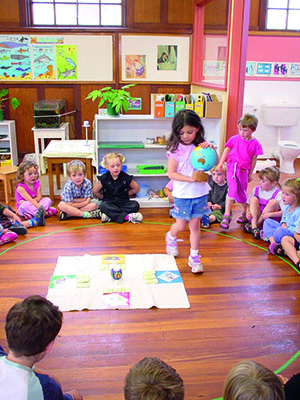
Every year in Montessori classrooms all over the world, young children celebrate their birthdays by walking around a candle with a globe in their hands, symbolic of the passages around the sun that the children have made during their lives. As these Montessori children get older, their stories get longer, and for many, after ten years of walks around the sun, birthdays become something more than a celebration of completed years. In our classroom, each child writes a small note or message with a compliment or wish for the birthday person and places it into a bag. At the end of the day, the child whose birthday we are celebrating gets to take the bag home.
As birthdays take on different meaning for older children, children’s roles in the birthdays of their peers evolve as well. Birthdays are an opportunity to spend extra time together, a time to celebrate friendship, enjoy a cake or treat of some sort, and a chance to tell a friend something that might not otherwise be shared, such as why they are a great friend.
The work of the Upper Elementary, and Secondary Montessori students is different than that of a child in the Children’s House or even Lower Elementary Program. These students, either experiencing or entering adolescence, are compelled to be part of society. They no longer desire to be the sole recipient of attention; they want to be the planners and the implementors. These children want to feel that their work is meaningful and appreciated. These are the reasons that Montessori adolescent programs are designed this way.
With this in mind, the birthdays of teachers become an opportunity for students to plan and create experiences for both the teacher as well as the other students. As a teacher, I spend around forty hours a week with my Upper Elementary students, and a very important part of our relationship is based upon a friendship that transcends the
traditional role of teacher. As the children get older, they want not only a teacher but a friend, a confidant, a mentor, someone to provide the tools they will need as they enter adolescence in their path to adulthood.
Recently, I celebrated another of my birthdays with some students – our third birthday together. This year, I discussed my plans for my birthday with my students, who adamantly told me that I was NOT getting anything from them. Little did I know that they had planned, with the help of some of their parents, a small but very lovely birthday celebration for me. They did the work. It was an opportunity to share their appreciation.
As a former Montessori student, I don’t have a single memory of celebrating a teacher’s birthday; however, now that I am on the other end, I cannot express enough how great an experience it is for me to receive positive feedback about my role in the lives of my students, but more importantly, it is so nice to see the joy in the children that they had the opportunity to do something nice for their teacher.
Tomorrow’s Child / November 2012 / p. 20