Hitch your wagon to a star — Emerson “Twinkle, twinkle, little star, How I wonder what you are.”
 The words above were the opening lines of Jane Taylor’s classic work The Star (1806). Famous today as a nursery rhyme and song, Taylor’s timeless poem refers to the twinkling stars high above us. Fascinating stars also can come to life in the Montessori classroom, bringing new and creative shapes to the geometry work in the elementary level.
The drawer of polygons in the Montessori Geometry Cabinet contains six figures, ranging from the five-sided pentagon to the decagon, containing ten sides. These figures are not the only polygons in the Geometry Cabinet, but they are the regular polygons that can serve as the most significant sources of our interesting stars. They represent the launching pad of our stellar adventure.
What are the Stars?
The star figures are formally named star polygons. They are shapes, such as the stars on the American flag or the Star of David. Stars have interested mathematicians for centuries, ever since a 14th century British archbishop, Thomas Bradwardine, became the first mathematician to study star polygons. (O’Connor & Robertson, 2000)
Star polygons are actually a special variety of concave polygons. Concave polygons have one or more angles (called dent angles) that appear to have been pushed or dented in. This can produce the classic star shape.
Regular star polygons are also equilateral and equiangular. This means that all of their sides are equal in length and that the angles pointing out (point angles) are all the same size. They are based on regular polygons such as those in the geometry cabinet.
Creating the Stars
There are three main methods for making star polygons, based on the regular polygons in the geometry cabinet. The easiest approach is to simply attach an equilateral or isosceles triangle onto each side of the base polygon. This method may not result in regular star polygons, but it does create fascinating and exciting star figures. It also has the distinct advantage of being able to build stars on triangles and squares. Children will discover that although this method does produce interesting figures, they may not always be stars. For example, in the Triangular Box of the Montessori Constructive Triangles the children set three equilateral triangles on the sides of a base triangle. This only makes a bigger equilateral triangle, not a star.
Extending the Sides
The second way to create star polygons is to extend the sides, a procedure that anyone can use, including the youngest children. The famous astronomer, Johannes Kepler described this method in 1619, calling the approach stellation. (Inchbald, 2010)
Trace a polygon, such as the regular pentagon. Using a straightedge, simply draw line segments that extend the sides of the polygon until they intersect. If using a pentagon, this will create a five-pointed star figure, or pentagram. Be aware that the pentagram will be quite large, the largest of the star figures. This method of creating stars will require a sizeable sheet of paper. It would be a fun problem for the children to try to solve: Why does the pentagon make the largest star of the polygons?
Any polygon of five or more sides in the geometry cabinet can be made into a star with this stellation technique, all the way up to ten pointed stars, creating a beautiful collection. Going beyond the Geometry Cabinet involves creating polygons of eleven or more sides. Older elementary children enjoy creating the many-sided polygons and then stellating these figures.
Building inside a Polygon
The third method of stellation creates star polygons inside a regular base polygon. Connecting the vertices or points of a polygon in a regular and methodical way will reveal the star. Use a polygon from the Geometry Cabinet, such as the seven-sided heptagon. Trace it, then connect one vertex to another, non-adjacent vertex, meaning that the link may not be one of the sides of the polygon.
Possibilities include connecting every second vertex, every third vertex, or other regular patterns of connection.
For example, connect every other vertex, and continue connecting vertices until you reach the original starting point vertex again. This creates a seven-pointed star, or heptagram, inside the base heptagon.
The 19th century mathematician, Ludwig Schläfli, developed a system of notating how these stars are created, called the Schläfli symbol. (O’Connor and Robertson, 2007) This symbol takes a form such as {7/2}, in which the first digit, 7, represents the number of sides in the base polygon. Since we used a heptagon with seven sides, that number is 7. The second number, 2, indicates that every second vertex was connected.
The heptagon could also generate a second star. We could join every third vertex, for example, giving the Schläfli symbol {7/3}. By connecting these vertices, a new and much more sharply pointed heptagram is created.
Upper elementary children in particular enjoy using the Schläfli symbols. They often use them as a sort of plan of work, as in, “I wonder if we could take an nonagon and join every fourth vertex?” That would be the Schläfli symbol {9,4}. This stellation pattern really does work and generates a beautiful star polygon.
This work can lead to a lengthy, exciting, and very productive form of guided discovery in which the children research, often by trial and error, what combinations will produce star polygons and what will not. Sometimes, other unexpected figures are created.
Upper elementary children usually discover that the stellation will work if the two digits in the Schläfli symbol are relatively prime. This means that the two digits share no common factors other than one1. If they are both divisible by a whole number other than one, a star polygon will not be formed. For example, attempting to make a star polygon with the Schläfli symbol {8,4} will not work because the two digits are both divisible by two and by four. As a result, this figure in an octagon will not form a star polygon.
Of course, there is no requirement to stop the drawing, experimentation, and research with the figures in the Geometry Cabinet. Working with base polygons with more than ten sides will create very interesting and striking star figures.
Inscribing the Star
Inscribing it in another figure, such as a circle or polygon, can enhance the design of the star. Children can use a compass to draw a circumference around the star just touching each of the point angles. This is called a circumscribing circle. It is often traditionally shown connected with a star as in this simple version of the traditional Seal of Solomon. This symbol supposedly dates back to the legendary signet ring of the ancient King Solomon.
Star figures may also be inscribed in polygons. By simply connecting the vertices (tips) of the point angles a polygon is created, similar to the one that is at the center of the star. Extending the sides of this polygon creates yet another star. This process can go on as long as there is interest – and paper!
Tiled Stars
The work with star polygons can extend to the development of patterns as well as experiments with tiling and tessellation. Joseph Myers (2004) has devoted considerable study to the mathematics of tiling stars as well as assembling very interesting star patterns. An easy entry into patterning with stars is to build additional polygons around the original base polygon and star. As an example, Figure 11 shows a six-pointed hexagram based on a hexagon. This has been extended with six additional hexagons. This pattern could continue indefinitely. The children will note that the hexagons tile perfectly.
Experimenting with other polygons to create tiled stars is very interesting. For example, the children will become aware that the pentagram, tiled with five additional pentagons, does not tile perfectly producing gaps.
In contrast, the eight-pointed star, tiled with eight additional octagons, creates a set of overlaps. Each of these eight overlapping shapes is a diamond shaped rhombus, emerging from the dent angles of the star.
Handicrafts and Arts
Star polygons have a rich heritage in folk arts and as symbols. In the Pennsylvania Dutch country around Lancaster county, geometric designs called hex signs are very well known. “Sometime in the mid 19th-century, folk artists began to transform the old geometric designs by enlarging them and painting them on barns. These designs would get the name Hex Signs in the 1920s.” (Fermanis, n.d. 1) These signs often use a star polygon motif. An interesting classroom project could not only involve geometry, but also research, geography, history, and art involving this traditional craft.
Quilting is another traditional craft that frequently incorporates star polygon themes. Stars in many variations are so popular as elements in quilts that entire quilt shows are devoted to the display of the star quilts. An interesting resource on making star quilts is Carol Doak’s book, 50 Fabulous Paper Pieced Stars (2000).
Creating star quilts, or wicahpi sina, has been significant in some northern plains Native American cultures since the late 1800s. (Neumann, 2003) “Missionaries introduced quilting to Native American girls at boarding schools in the late 1800s. After returning home, the girls applied traditional geometric patterns learned from beadwork and buffalo-hide designs to quilting. This particular art form features an eight-point star…” (Neumann, 2003, p. 231) 3
Star quilts are rich with symbols in native cultures with special significance for both the colors and the star shape. “The interdisciplinary nature of these star quilts introduces students to the cultural, social, and artistic importance that they contain, along with rich mathematical ideas.” (Neuman, 2003, p. 231)
Classroom projects involving quilting, including Native American quilting, are innumerable, ranging from attending a quilting show, to studying quilts historically as well as contemporary quilts, to actually producing a star quilt. Applied geometry is at the heart of quilting.
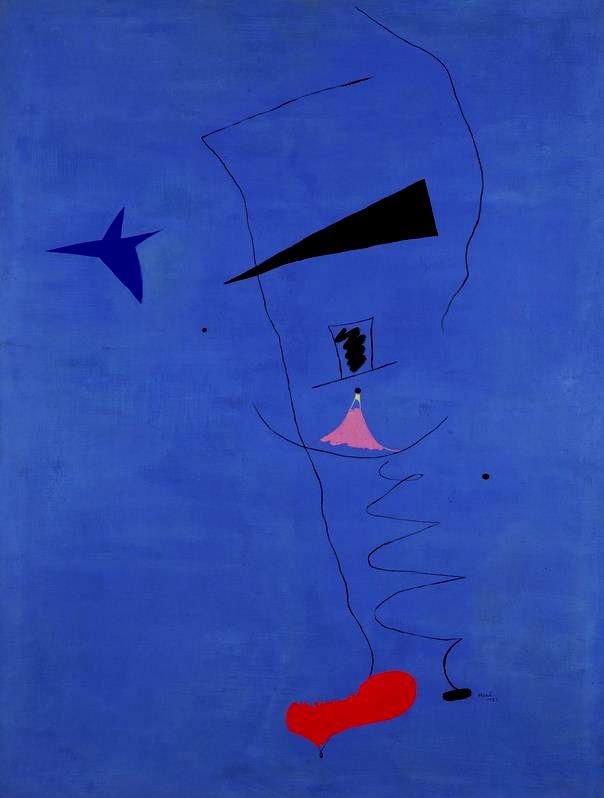
Stars form the basis of many artistic and design pieces. They frequently appear with planets or moons, giving an astronomical or astrological impression. A few very interesting examples are Stars and Clouds by Kari (Karin Cates). Tranquility by Lon Stoops, Star by Priska Wettstein, Star Abstract by Marlene Ford, Barn Star with Round Wreath by Linda Spivey, L’etoile Bleu (pictured above) by Joan Miró, many pieces by Baruch Nachshon, and many examples in Islamic art. These are only a very few of many pieces of art of a variety of genres. In Montessori elementary schools, the art classes or instruction frequently mirrors the other academic content. Stars in art would be an excellent artistic complement to the study of star polygons.
Symbols
Stars have been used (and still are used) as symbols for religions, national symbols, as well as occult and mysterious symbols. One of the best known of these is the five-pointed star that appears on the flag of the United States. The five-pointed star is actually so popular as a symbol that it can be seen on the flags of 35 different nations. Other stars appear on the flags of many nations, such as the four-pointed (Aruba), six-pointed (Croatia, Israel, Burundi, Slovenia), seven pointed (Australia, Jordan), eight-pointed (Azerbaijan), twelve-pointed (Nauru) and fourteen-pointed (Malaysia). Geography can clearly be linked with geometry through the stars.
Religious Symbols
Stars are very commonly used as religious symbols. The regular pentagram was recognized by the Pythagoreans, usually displayed point down. Some people today see that same symbol as an occult sign. The five-pointed pentacle is a pentagram inscribed in a circle, which serves as a symbol for Wicca. A five-pointed star is also a part of the star and crescent emblem often associated with Islam, although not as an official symbol. A special five-pointed star is associated with the Druze faith.
Other stars have some significant religious symbolism. The six-pointed Star of David or Magen David is a symbol of Judaism. The eight-pointed star known as the Rub el Hizb is an unofficial Muslim symbol quite similar to the Hindu Star of Lakshmi. The Bahá’í faith is represented by a nine-pointed star.
The United States Department of Veterans Affairs approves six various star symbols as emblems of belief to be placed upon U.S. government headstones. They represent Judaism, Bahá’í, Islam, Seicho-No-Ie, Wicca, and the Messianic Jewish faiths. These tombstones of fallen service members may display these star symbols at Arlington and other national cemeteries.
In the Classroom
Montessori elementary classes can introduce work on star polygons at any level. Early work involving the creation of stars is appropriate for first-year students. Advanced work, applying tiling as well as research-based study of the Schläfli symbol, is ideal for upper elementary students. Engaging cultural studies at all levels can include fine art, folk arts, and handicrafts. Additional study would include the star as symbols for nations, flags, military symbols, stars in myth and folklore, religious symbols, and more.
The study of star polygons is an incredible unifying theme for integrative study. It brings together mathematics, culture and cultures, the arts, and research. This celestial topic belongs in every Montessori classroom.
Bibliography
Answers Corporation. (2011). What is the definition of dent angle in a star polygon? Retrieved from http://wiki.answers.com/Q/What_is_the_definition_of_dent_angle_in_a_star_polygon
Coxeter, H.S.M. (1969). Introduction to Geometry, 2nd ed. Hoboken, NJ: John Wiley and Sons.
Doak, C. (2000). 50 Fabulous Paper Pieced Stars. Woodinville, WA: Martingale & Co.
Emerson R. W. (1862, April) American Civilization. The Atlantic Magazine.
Fermanis A. B. (n.d.). Pennsylvania Dutch
Hex Signs. Retrieved from: http://freepages.genealogy.rootsweb.ancestry.com/~aferm/pennsylvania/hex.htm
HME Publishing. (2006). Symbol 28:24. Retrieved from http://www.symbols.com/encyclopedia/28/2824.html
Inchbald, G. (2010.). Stellation and facetting – a brief history. Retrieved from http://www.steelpillow.com/polyhedra/StelFacet/history.html
Israel Ministry of Foreign Affairs. (1999). King Solomon’s Seal. Retrieved from http://www.mfa.gov.il/MFA/MFAArchive/1990_1999/1999/2/King%20Solomon-s%20Seal
Lemon, J. and Clark, S. (2011, March). Tying Quilts to Montessori Math and Geometry. Retrieved from: http://www.wou.edu/~burtonl/courses/math394/projects/Quilts_Montessori_Math.pdf
McDowell, M. L. and Dewhurst, C.K., (eds.) (1997). To Honor and Comfort: Native Quilting Traditions. Santa Fe, NM: Museum of New Mexico Press.
Muller E. (1938). Star polygons: Revealing cosmic laws. Present Age, Vol.3. #4.
Myers J. (2004, March). Tiling with Regular Star Polygons, Eureka 56, 20–27.
Neumann, M. D. (2003, December). The Mathematics of Native American Star Quilts. Mathematics Teaching in the Middle School. Volume 9, Issue 4, pp. 230-236.
O’Connor, J. J. and Robertson, E. F. (2000). Thomas Bradwardine. Retrieved from http://www-history.mcs.st-andrews.ac.uk/Biographies/Bradwardine.html
O’Connor, J. J. and Robertson, E. F. (2007). Ludwig Schläfli. Retrieved from http://www-history.mcs.st-andrews.ac.uk/Biographies/Schlafli.html
Taylor, J. (1849, original in 1806). The Star, in Rhymes for the Nursery. Philadelphia: George S. Appleton.
U.S. Department of Veterans Affairs. (2011). Available Emblems of Belief for Placement on Government Headstones and Markers. Retrieved from http://www.cem.va.gov/cem/hm/hmemb.asp
Weisstein, Eric W. (2011). Star Polygon. From Math World–A Wolfram Web Resource. Retrieved from: http://mathworld.wolfram.com/StarPolygon.html
Yoder, D. and Graves T.E. (2000). Hex Signs: Pennsylvania Dutch Barn Symbols & Their Meaning 2nd Ed. Mechanicsburg, PA: Stackpole Books.
Zook, C. (2011). Jacob Zook Hex Signs. Retrieved from http://www.hexsigns.com/pages/frontpage
Motessori Leadership / 2013 / p 22