by Tim Seldin | Mathematics, MFA, TC February 2023
If you are not a Montessori teacher, what you see when you visit your child’s classroom will be very, shall we say, interesting.
In every issue of Tomorrow’s Child, we usually describe a few of the hundreds of Montessori lessons and learning materials, their purpose, and how they support the learning process.
This is only part of the Montessori materials and curriculum. Consider this like Montessori ‘Cliff Notes.’
Montessori children work with hands-on learning materials that make abstract concepts clear and concrete. This allows young students to develop a clear inner image of concepts in mathematics, such as, How big is one thousand? This approach makes sense to children.
For example, let’s consider the decimal system, which forms the basis of mathematics: units, tens, hundreds, and thousands. Most small children need help understanding or operating with quantities larger than twenty. They can’t normally conceive of the size of a hundred, thousand, or million, much less the idea that a thousand is equal to ten hundred squares or one hundred ten bars.
Montessori overcame this obstacle by developing a concrete model to represent the decimal system.
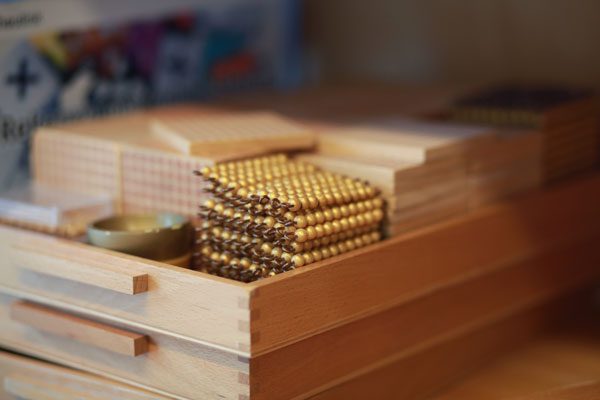
Single one-centimeter beads represent units; a unit of ten is made up of a bar of ten beads strung together; hundreds are squares made up of 10 ten-bars; and thousands are cubes made up of ten hundred squares. From this foundation, all the operations in mathematics become clear and concrete.
As the children construct their number, they decide how many units they want in their number, find the card showing that quantity, and place it in the upper righthand corner of their workspace.
Next, they go to the bank, or central collection of golden bead material in the room and gather that number of unit beads that corresponds with the number card selected. This process is repeated with the tens, hundreds, and thousands.
The second quantity is constructed in the same way, after which the two are combined in the process we call addition.
Beginning with the units, the children count the combined quantities to determine the result of adding the two together. If the result is nine or less, they find the large number card representing the answer. If their addition has resulted in a quantity of ten beads or more, the children stop at the count of ten and carry them to the bank to exchange them for a ten bar: ten units equal one unit of ten. This process is repeated with tens, hundreds, and thousands.
Many parents and teachers think that, while the Montessori math materials are appropriate for children during preschool and kindergarten, children shouldn’t need these artificial toys or crutches when they go to the elementary grades. This needs to be clarified.
Elementary-age children rarely think abstractly, but schools often teach math as abstract concepts or steps to be practiced and learned, often without real understanding. Everything that is not connected to their own concrete experience is a mystery. Montessori’s objective is to use concrete mathematical material to help children develop an inner picture of mathematics that will last a lifetime.
by Cheryl Allen | Mathematics, MFA, Montessori Education, TC May 2022, Tomorrow's Child
by The Montessori Foundation Staff | Infant, Infant-Toddler (0 to 3), Lower Elementary (6-9), Mathematics, Montessori Curriculum, Montessori Education, Montessori Teachers, Practical Life, Primary (3-6), School Leadership, Science, Sensitive Periods, Sensorial, Upper Elementary (9-12)
This is a very useful document developed by the Montessori Foundation and included for IMC member reference. An even more robust version of this scope and sequence has been aligned to the Common Core State Standards and is exclusively available as part of Montessori Compass, an excellent Montessori student record keeping solution (
www.montessoricompass.com)
Download File
[pdf-embedder url="https://stage.montessori.org/wp-content/uploads/2023/07/Montessori-Curriculum-Scope-and-Sequence-Science.pdf"]
by Sharon Caldwell | Mathematics, Montessori Education, Online Learning
This is a first step to begin to identify good resources for online learning in Montessori settings.
Digital technology must not be thought of as something which replaces the conventional materials and modes of interaction, but as something that enhances the possibilities of exploring and enhancing exploration of the learning generated by Montessori “keys”.
I am interested in exploring further applications and adding to this resource – please feel free to email me at sharoncaldwell@montessori.org if you would like to further explore these ideas or share new resources you may find. It would also be great to get some feedback from a Montessori perspective as to how these resources are used and received by children in authentic Montessori contexts.
Some interesting links.
Maths Maps: A New Collaborative Project
Google Earth Resources for the Classroom
by Tim Seldin | Adolescence, Early Adolescence (12-15), Later Adolescence (15-18), Lower Elementary (6-9), Mathematics, MFA, Montessori Education, Montessori Materials, Montessori Teachers, Primary (3-6), Upper Elementary (9-12)
The Challenge of Mathematics
We use mathematics in almost every aspect of our everyday lives. As Dr. Montessori would often point out, much of our civilization is based upon mathematics. Science and technology depends upon mathematical calculations. Computers are totally mathematical devices. Businesses, research, and governmental agencies all rely upon the collection and interpretation of data and statistics. Art and music have direct connections to math. Despite its importance and many attempts at educational reform, mathematics continues to be a subject that many students find difficult.
Dr. Montessori observed that reason so many students struggle with math stems from the way it has traditionally been taught.
Numbers are symbols that help us to think about things, just as words do. When taught by workbook, text, and blackboard, math is almost totally abstract. Students who learn math by rote memory often have a fragile understanding and little or no ability to put their skills to use in everyday life. Learning comes much more easily when they work with concrete educational materials that graphically show what is taking place in a given mathematical process.
The study of math can become a fascinating occupation if it is begun at an early age and taught with hands-on experience and concrete materials to make abstract concepts clear.
Montessori’s Concrete Approach to Math
Beginning in the early childhood years, Montessori students use hands-on learning materials that make abstract concepts clear and concrete. Working with these fascinating educational tools, they can literally see and explore what is going on as each math process unfolds before their eyes. This approach to teaching mathematics offers a clear and logical strategy for helping students understand and develop a sound foundation in mathematics and geometry.
At the Children House level, children as young as three and four are form their first concepts of quantity and number symbols, and go on to enthusiastically explore the decimal system and arithmetical operations like addition and subtraction with materials such as the Golden Beads. The goal is to provide a concrete representation of a abstract idea, such as carrying forward when we add numbers greater than nine, which allows children to develop a clear inner image of mathematical concepts, such as how big is a thousand, what is meant by the ‘hundreds’ column, and what is taking place when we divide one number by another. This is consistent with everything that we know from research about the way young children think and learn.
Yes, mastering many math concepts will also require a certain degree of raw practice and, even in Montessori, students eventually have to memorize their math facts, but the process is greatly facilitated by helping them to develop a much more concrete grasp of the process at work. And yes, even in Montessori, some children will find math to be easy, while others may find it to be more challenging. The great strength of the Montessori approach is its ability to individualize to meet children’s different learning styles, pace of development, interests, and basic needs.
“Unified” Math
The Montessori math curriculum is based on the European tradition of “Unified Math,” which has only recently been discovered by leading American educators. Unified Math introduces elementary students to the study of the fundamentals of algebra, geometry, logic, and statistics along with the principles of arithmetic. This study continues over the years, weaving together subjects that traditional schools normally ignore until the secondary grades.
In operations concerned with measurement, geometry shows them how to perform their calculations. In operations concerned with figures, algebra gives a system of still more abstract symbols by means of which more complicated relationships can be comprehended. The calculations of area and volume, of squares and square roots are examples in which algebra, arithmetic, and geometry are all involved. For Montessori students, arithmetic, algebra, and plane and solid geometry have never been arbitrarily separated. Four- and five-year-old Montessori children can name geometric forms that most adults wouldn’t recognize.
Montessori mathematics includes a careful study of the practical application of mathematics in everyday life, such as measurement, handling finances, making economic comparisons, or in gathering data and statistical analyses.
The Elementary Years
Many parents and teachers think that the Montessori math materials are all very well for children under six, but when they go on to the elementary grades students shouldn’t need these artificial ‘toys’ or ‘crutches’. This represents an unfortunate misunderstanding of how children this age think and learn. Until a child can think at a high level of abstraction, which rarely occurs before early adolescence, he depends upon concrete experience and practice over a number of years before mathematical concepts begin to take firm root in his mind.
During the elementary years children almost never possess the capacity to think abstractly. Everything is either based on concrete experience or is “magic and mystery.” Math by its very nature is abstract. Montessori math uses the concrete mathematical material to help the child develop an inner picture of mathematics that will last a lifetime.
Naturally the child can’t depend on the materials forever. Can you see your child at age sixteen walking in to take the SATs carrying the Golden Beads? Dr. Montessori compared them to an airport runway which provides a smooth surface on which the plane can roll faster and faster until its built up enough speed to fly. The entire purpose of the Montessori Math curriculum is to make the abstract concrete, until the child can close her eyes and visualize mathematical processes at work. Step by step, the materials become less concrete and more symbolic. Step by step, the child is challenged to demonstrate her understanding by teaching what she’s learned to younger children, which also tends to reinforce and clarify the tutor’s grasp on the subject as much as teach something to the one being tutored.
Elementary Montessori students continue to gain hands-on experience by applying math in a wide range of projects, activities, and challenges, such as graphing the daily temperature and computing the average for each month, or adjusting the quantities called for in a recipe for a larger number of people. Because children love to work outdoors, teachers try to prepare tasks that use the school grounds whenever possible. For example, using simple geometry, children can determine the height of a tree or measure the dimensions of the buildings. They prepare scale drawings, calculate area and volume, construct three-dimensional geometric models, and build scale models of historical devices and structures.
Summary
It has often been said that either we find mathematics elegant in its logic, or terribly confusing. Our goal is at least to avoid the latter, and attempt to lead as many students as possible to discover that the first is indeed correct.
The Red and Blue Rods are the young child’s first introduction to Mathematics. These rods have the same dimensions as the Red Rods found in the Sensorial area of the Montessori classroom. Here, however, the rods are painted in alternating patterns of red and blue to distinguish their length in segments of one tenth of a meter (a decimeter). The first rod is one decimeter long and is just painted red. The second is two decimeters long, and is divided into two segments, one red and one blue. This continues through all ten rods.
As with the Red Rods, the children arrange the Red and Blue Number Rods into a stair from largest to smallest. Then they count each alternating colored segment. One of the insights that children begin to get from working with the rods is the nature of addition and the concept that two numbers can add to another. For example, when the children place the “one” number rod at the end of the “two” rod, they create a new rod that is the same length as the “three” rod just above. They explore similar relationships with all of the numbers 1 to 10. For example, they discover that the “four” and the “six” together are the same length as the “ten”.
Montessori found that young children find it difficult in the beginning to grasp the concepts of numbers by counting separate objects. While they can learn to “count” by rote, reciting the sequence of numbers from one to ten, most cannot easily grasp the difference between one quantity and another when looking at more than three or four objects. It’s almost as if they are thinking: “One, two, three….Many!” This is easily avoided by allowing children to visualize the concept of numbers and quantity by using this series of segmented rods of increasing length in the beginning, rather than trying to teach them to count sets of separate objects.
The children also use the sandpaper numerals to label each number rod. These tablets are designed and used in the same way as the Sandpaper Letters described in the section on Language Arts above.
The Spindle Boxes provide a nicely structured way for young children to make the next step in coming to understand the concepts of number and quantity. The material is made up of two wooden boxes which are divided into ten compartments, each labeled with the numerals from zero through nine. In a separate box or basket are forty-five wooden spindles used for counting. The exercises calls for the child to count out the correct number of spindles to go in each compartment: one, two, three…all the way to nine. Naturally the compartment labeled “0” is left empty, teaching the child at a very early age the concept of zero as an empty set. If the child has counted correctly there will not be any spindles left over when she fills up the compartment labeled “9”.
The Number Cards and Counters: After considerable experience with the more structured introductions to number and quantity created by the Red and Blue Number Rods and the Spindle Boxes, the child is finally ready to tackle the task of associating cards on which the numerals have been printed and objects to count.
The child begins by arranging the numeral cards in order from 1 to 10 Then she begin to count out the appropriate number of counters, placing them in parallel rows of two after the number one. Obviously, even numbers end with an even number of counters in the bottom row; odd numbers only have one. This begins to focus the child’s attention on the concept of odd and even numbers.
The Golden Beads: An Introduction to the Decimal System: Dr. Montessori developed a wonderful educational material to concretely illustrate the nature of the decimal system and its basic operations called the Golden Beads. The name comes from the beautiful color used for the enamel finish on this set of one centimeter diameter glass beads.
A single bead by itself represents a “unit of one”. Thus the quantity five would be represented by a collection of five unit beads.
Ten unit beads strung together on a length of wire represents a “unit of ten.” Three ten bars collected together actually consists of thirty unit beads, or three “tens”. The children quickly discover that ten unit beads is exactly the same as one ten-bar. They also begin to count not only the individual unit beads, but by units of ten: “ten, twenty, thirty…one hundred.”
Ten ten-bead bars naturally equals the quantity one hundred. Units of one hundred are made-up of ten ten-bead bars laid side by side to form a square, and wired together as a unit.
Ten hundred squares stacked one on top of the other form a square containing a thousand unit beads. They are permanently wired together to form the thousand cube.
Using these concrete materials, even very young children can build and work with great numbers. In a typical early lesson with the Golden Beads, the teacher might challenge the child to “Bring me three thousands, five hundreds, six tens, and one unit.” While they will also work with prepared problem cards, children often enjoy thinking up numbers for themselves..
The Number Cards: This special set of number cards is used to help the children learn to read numbers up to 9,999. Used to label the units, tens, hundreds, and thousands columns in which the Golden Beads are laid out, they help the children to begin to understand the concept of the hierarchy of the decimal quantities and how we borrow and exchange from the next column in mathematics operations. Notice how the size of the cards and the color coding to represent units, tens, hundreds, and thousands, makes it easy for children to understand how large quantities are written out from left to right, and worked with in vertical columns.
The Bank Game: The Bank is a name given to a collection of Golden bead materials, which should include enough units, ten bars, hundred squares, and thousand cubes to allow several children to each create large numbers.
In one of the first exercises, the children explore the equivalencies of the decimal system. They learn that ten units can be exchanged at the bank for a ten bar, and that a ten bar can be exchanged for ten units. They also find that ten tens can be exchanged for a hundred square, ten hundreds for a thousand, and that each can in turn be broken down into its equivalent in the smaller quantity.
Using the Golden Bead material, the children can build two or more large numbers and add them together. By going through the steps of addition in this very concrete manner, the children a clear impression about what addition means. They also come to understand the process of exchanging, as they count the new quantities in each of the columns, and trade in groups of ten units for one ten bar which they place in the tens columns, ten bars for one hundred, and ten hundreds for one thousand.
Once they understand how to add with the Golden Beads, Montessori children begin to use them to multiply, subtract, and divide. For example, to divide the quality 3,333 by three, a child would set out three wooden skittles, and, beginning with the largest quantity, in this case the thousand cubes, he gives one thousand to each skittle. He continues on with the hundreds, tens, and units. If the child were challenged to divide this same quantity by four, he would begin by exchanging the 3 thousands for 30 hundred squares, which he would distribute equally. After placing 6 thousands beneath each of the 3 skittles, he exchanges the remaining 2 hundreds for 20 ten bars. This process of exchanging continues until the final answer is derived.
The Short Bead Stair: Using the Golden Bead material, the child see the numbers one through nine represented as individual units. But, as we mentioned above, although the child can count the beads one at a time, it takes many years before most children can recognize and really understand the idea of numbers greater than three except by one to one correspondence. To help the child truly begin to grasp the idea of quantities from two through nine, Dr. Montessori prepared a set of colored glass beads, one centimeter in diameter, in which each quantity is represented by the appropriate number of individual beads wired together as a bar with a specific, easily recognizable color. In this material, a one is represented by a single red bead, a two by two green beads strung together, the quantity three by three pink beads, and so on, up through the ten golden beads that represent a unit of ten.
The children work with the Short Bead Stair for many years, using them to add and subtract, exchange, borrow, explore multiples, and many other arithmetic processes. For example, to multiply 9 by 8, the children would lay out 8 nine-bars or 9 eight-bars. By counting the result, they can check their work.
The Teens and Tens Boards: This material is made up of two different sets of boards used by the child to explore the nature of quantities and numbers greater than nine. Each set consists of two boards, which are laid in a vertical row. The two boards are divided into nine sections, each of which is fitted with a thin frame into which the children can slide wooden cards on which the numbers 1 through 9 have been printed. Numbers have also been printed on the surface of the board, spaced so that when the cards are slid into the frame they will cover up one of the two digits.
On the Teens Boards, the number 10 is printed in the nine spaces created by the frames. The children arrange the number cards from 1 to 9 in order, and slide them into the frames, creating the numbers 11, 12, 13..and so on through 19. Using the “Ten Bead Bars” and the Short Bead Stair material described above, the children lay out the numbers 11 through 19 concretely. For example, the number eighteen would be formed by placing one ten bar in the tens column and one brown eight bar in the unit column. This gives them a very clear picture of how the teens are formed and written: ten and one is eleven, ten and two is twelve, etc.
On the Tens Boards, the numbers 10, 20, 30, 40 through 90 are printed in the nine spaces created by the frames. They use the individual number cards to form numbers in the tens, such as 53, 24, 79, etc. and use the Golden Bead tens and unit beads to build their concrete representations along side.
The Hundred Board challenges the young child who can count aloud from one to one hundred to lay out the numerals in the same sequence. The Board is a square divided into ten rows with ten small squares along each row. The children work with a set of one hundred wooden tiles that are labeled from 1 through 100. They spread them out on the rug, arrange them in numerical order, and place them, one tile at a time, on the Hundred Board, working from the upper left corner along each row to the right, down to next row, and so on until complete. When they are comfortable with this, they attempt the same exercise by filling in the squares on a blank chart drawn to duplicate the surface of the hundred board.
The Hundred and Thousand Chain: Another way that the children practice their counting and develop an increasingly clear concept of how big is a hundred and a thousand, is the working with the chains. These are long chains created by connecting 10 ten bars together to form a chain 100 beads long, or in the case of the thousand chain, by connection 100 ten bars together to form a chain of 1,000. The children lay the chains out, duplicating them by creating a second line of individual ten bars. At the far end, they place the hundred square or thousand cube, as appropriate. When working with the Thousand Chain, they also set out hundred squares after every 10 ten bars along the chain, representing that the next hundred has been crossed. In another exercise, they work with number cards printed with the numbers 1 to 100 or 1 to 1,000 counting by tens. The children sort them in order and place them along the chain. They tend to be quite impressed when they first see the Thousand Chain laid out across the classroom floor.
The Squaring and Cubing Material: Following the same concept, the Squaring and Cubing Material introduces the child to the concept of skip counting by ones, twos, three, fours, etc., through tens. Each chain is constructed by connecting multiples of the short bead stair, using the same color scheme that the children learned before: red units, green two bead bars, pink three bead bar, etc. The material also introduces the children to the concept of the squares and cubes of the numbers one through ten. There are two chains for each number: one set representing the squares of the numbers one through ten, and the other representing the cubes. Thus, the square of five is shown as a chain of five bead bars (the square of 5=25), and the cube as a chain of twenty-five five bead bars (five cubed=125).
(NOTE; photo close up of squares and cubes 1-10 laid side by side) The material also includes a set of bead bars connected to show the squares and cubes of the numbers as actual squares and cubes. The children use the bead chains to skip count, working with number arrows similar to those used with the Hundreds and Thousand Chains.
The Fraction Material: As the children become more and more comfortable with the Golden Beads, they eventually begin to ask whether there is anything smaller than the unit. The Fraction Skittles, and many experiences in the classroom, gradually introduce them to the concept of a quarter, half, and whole. The Fraction Circles take this concept much further. It is a set of ten metal frames into which are set ten circles, one left intact, one divided into two parts, another into thirds, fourths, fifths through tenths.
The children learn the terminology, how to write fractions out as figures, and begin to explore first the concepts of equivalence (2/4 = 1/2) and basic operations with fractions (1/2 + 2/4=1).
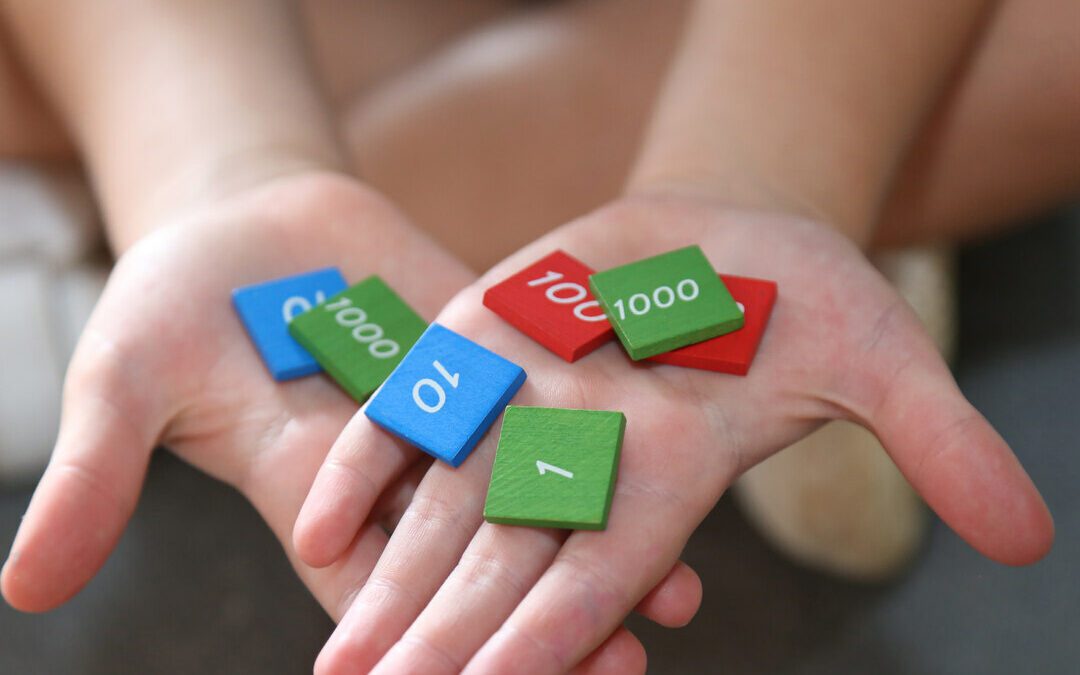
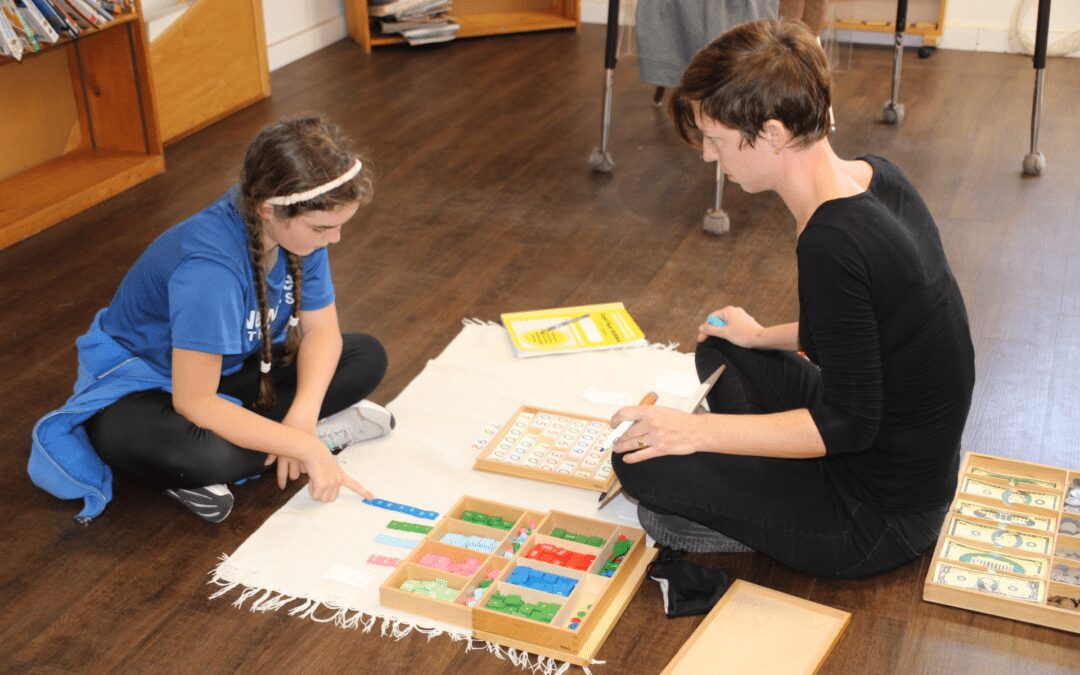
The Stamp Game represents the first step on the Second Plane of Abstraction in the Montessori Math curriculum. Where in the First Plane, the Golden Beads and Colored Bead Bars concretely represented quantities as three dimensional objects, the materials used in the second plane are much more abstract. At this level they are essentially tokens, symbolic counters identical in size and differing only in color and in how they are labeled, but which represent different quantities. The Stamp Game is a box containing little wooden tiles (originally Montessori used paper squares that looked like postage stamps). Some are colored green and labeled “1” to show that they are units. Some are colored blue and labeled “10” to show that each represents a set of ten units. Some are colored red and labeled “100”, and the last set is colored green and labeled “1,000” to show that each represents a unit of 1,000 units.
The children use the Stamps just like they did the Golden Beads, laying out quantities using the symbolic tokens and adding them together, subtracting, multiply, and dividing. By this level, the children are normally writing their work out on paper and using the Stamps to help them visualize the process. For example, to subtract 822 from 1,000, the child would create four rows of stamps, beginning on the left with the thousands, then the hundreds, the tens, and the units. In to the top row she would place a single thousand stamp in the thousand column. Below, she would place nothing in the thousand column, eight hundreds stamps in the hundred column, two ten stamps in the tens column, and two units in the unit column. Beginning with the units, the child seeks to take two stamps away from the quantity above in that column. Since the column is empty, she turns to the row to the left (the tens), which is also empty. Eventually she finds that her only choice is to exchange the one thousand stamp for 10 hundreds, which she places in the tens column. Now she exchange one of the hundreds for 10 tens, which she places in the tens column. Finally, she is ready to borrow from the tens column to solve her problem. She exchanges one ten from the tens column and exchanges it for 10 units and places them in the unit column in the top row. From this ten, she takes away two, leaving 8 units. This process continues, until she finds that her top row contains the correct answer: no thousands, 2 hundreds, 8 tens, and 8 units ( 1,000 – 822 = 288).
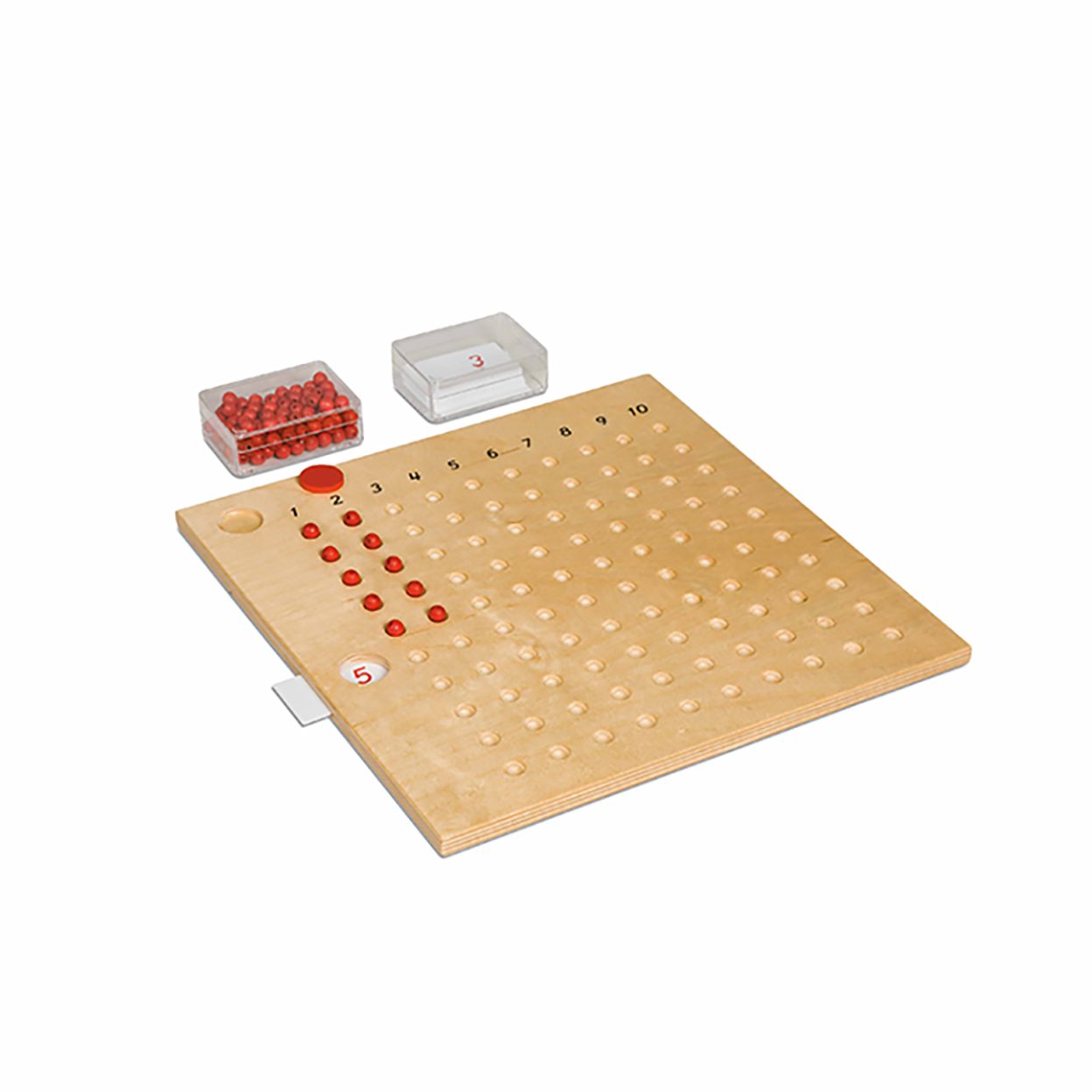
The Short Multiplication offers another pathway to abstraction the child lays out individual unit beads on a board organized into nine rows of nine shallow holes. The child lays out the beads in rows, for example 4 * 8 would be four rows of eight beads per row.
The Division Board is similar, except that here each vertical column of shallow holes represents one equal share, where a quantity is divided into two or more groups. The child places one small skittle at the top of each column to mark the number of shares that will be in her divisor; to divide 24 by 6, she begins by placing 6 skittles along the top. Then she counts out the number of beads that she wants to divide and begins to distribute them, placing one bead in each hole from the top left to right and then down a row, until she finally has shared her quantity equally among the vertical columns. Any beads left over are her “remainder.”
The passage to abstraction: By this stage the children are recording their work on paper, although many won’t be able to solve the same problems if asked to work with paper and pencil alone without the visual aid of the Montessori materials..
Montessori uses a wide range of parallel materials and exercises to help the child extend his knowledge and gradually memorize the basic math facts that every one of us is expected to know. As parents, you will eventually begin to hear about materials with odd names like the Snake Game, the Addition and Subtraction Strip Boards, the Negative Snake Game.
Space doesn’t allow us to describe every one of the Montessori Math materials, but your child would probably be delighted to introduce them to you.
Children work on mastering their addition facts with the Addition Strip Board.
There are also an involved series of Memorization Charts and associated exercises that help the children in their final stages of mastering the addition, subtraction, multiplication, and division charts. The young fellow in this picture is working on memorizing his subtraction facts, exploring the combinations when the numbers 1 to 18 are subtracted from one another.
When the children have begun to show that they are ready for still more abstract exercises, they’re introduced to another series of math materials at the next plane of abstraction.
For example, the Bead Frames (or abacus) challenge the child to solve problems in a slightly more abstract process. The Short Bead Frame (shown) allows the child to work with quantities up to 9,999. The Long Bead Frame uses quantities as large as 9,999,999.
The Long Division Material (Racks and Tubes) allows the children to solve complex problems in long division. Its not unusual for elementary students to work through problems using numbers much larger than a trillion.
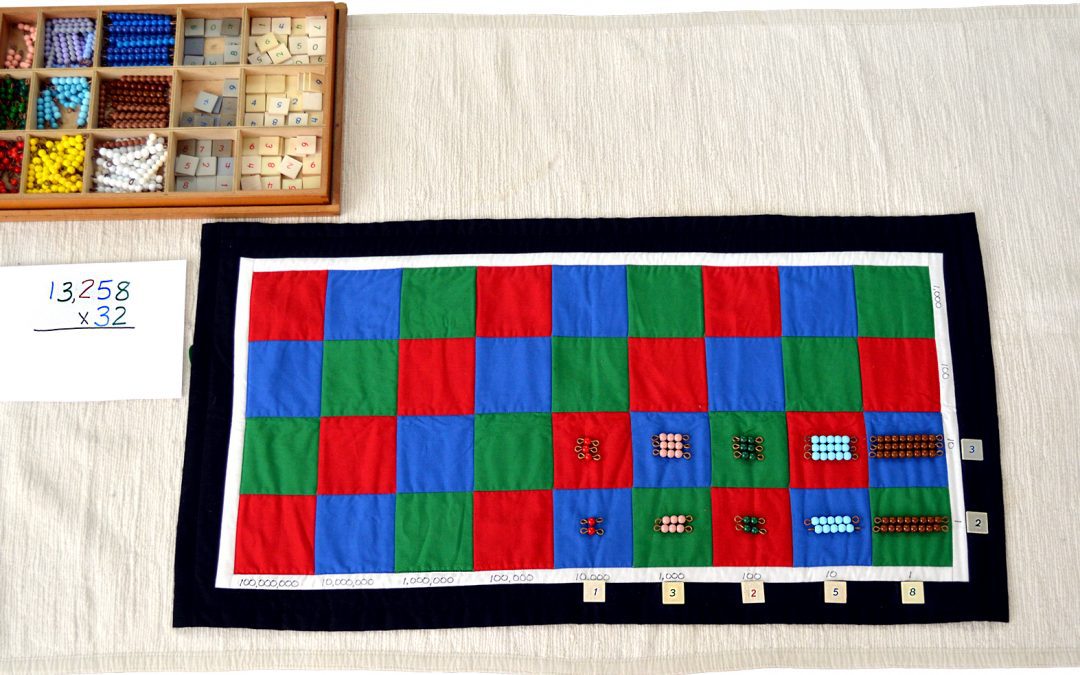
The Multiplication Checkerboard is still another more advanced material that introduces Long Multiplication.
(Slide: girl with geometry sticks) Geometry continues on from its early introduction in the Sensorial curriculum into the elementary level. This young lady is exploring angle and the construction of different geometric figures.
(Slide child with geometry definition cards) At the elementary level, the children move on beyond learning the names of geometric figures to mastering the definitions as well. they also begin to construct geometric forms with protractor and compass.
by The Montessori Foundation Staff | Brain Development, Lower Elementary (6-9), Mathematics, Montessori Curriculum, Montessori Education, Montessori Teachers, Primary (3-6), School Leadership, Upper Elementary (9-12)
[pdf-embedder url="https://stage.montessori.org/wp-content/uploads/2023/07/Sample-Mathematics-Curriculum-Scope-Sequence-Age-3-to-12-1.pdf"]
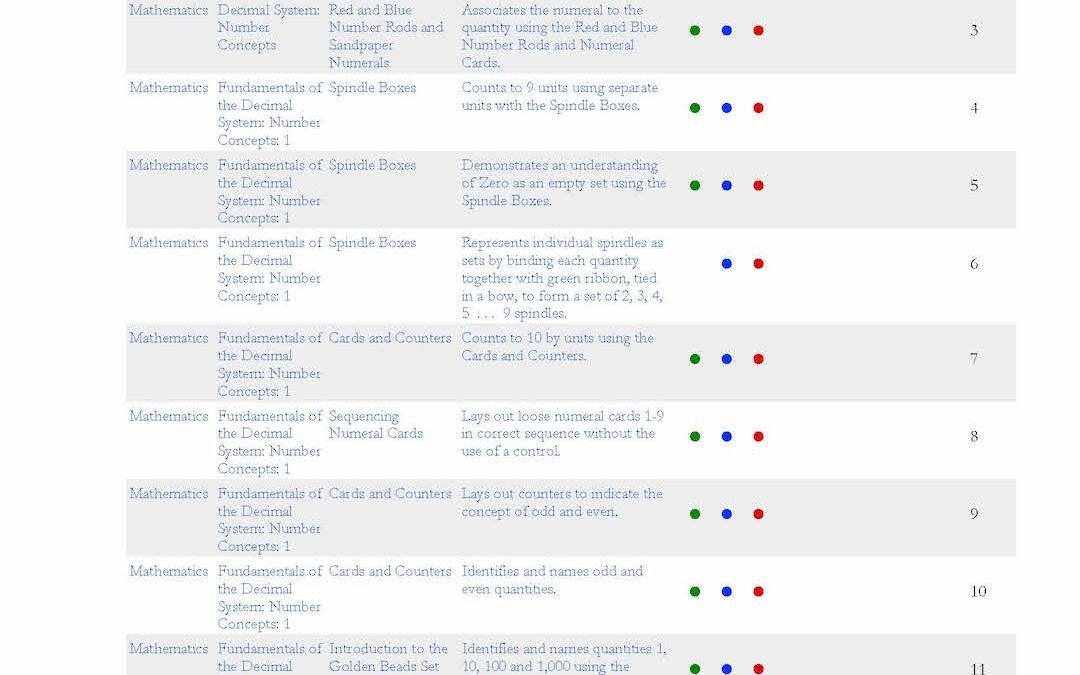
This is a static image of the Montessori Foundation’s mathematics curriculum scope and sequence database, available from our publications center.
We have an even more comprehensive version that has been fully aligned to the Common Core State Standards as part of the Montessori Compass student record keeping and parent communication software solution: www.montessoricompass.com
by Lorna McGrath | Brain Development, Family Resources, Language & Reading, Mathematics, Montessori Parenting, Reading, Webinars / MFA
So many parents worry that their children will forget everything they have learned during the school year with so much time off during the summer. Some may be even more concerned than ever because of the accommodations we have had to make in our schools because of the pandemic. Cheryl Allen, Jon Wolff, and Lorna McGrath will share ways to view summer activities through a Montessori lens, spotlighting how children continue to develop physically, socially, emotionally, and intellectually while using what they have learned in the classroom in all aspects of their lives during the summer break.
by Christoph Simon, Ph.D & Christine M. A. Lapierre, Ph.D. | Mathematics, MFA, Science
Christoph: I am a physics professor, so I was naturally interested in trying to teach science and math to my twin boys as early as possible. My wife has a PhD in physics, too, so she shared this interest. I didn’t just want to transmit content knowledge, although that is definitely important to me, but also the scientific way of thinking. I will elaborate on that in the examples below. I feel that science provides a unique, often interesting (and even fun), perspective on the world, and I wouldn’t want my children to miss out on that.
My efforts in this respect were significantly enriched by my discussions with Christine, who is an experienced Montessori early childhood teacher. Our conversations started with a fortuitous encounter in a campus parking lot several years ago and have continued ever since. Thanks to my professional background, I was also able to make suggestions for themes and concepts to incorporate into a Montessori classroom.
Christine: I am a Montessori early childhood teacher, and I was really interested in how Christoph could integrate science into his everyday activities at home. I shared with him how Montessori classrooms honor Maria Montessori’s deep belief that science, as well as mathematics, are core areas of learning for young children. I learned from Christoph new concepts in science that can be a basis for any Montessori parent and Montessori classroom.
Christoph: Overall, the most striking discovery for me has been how ready children really are for scientific knowledge and concepts, even at a very early age. For example, when they were three and a half years old, I explained to them how the earth goes around the sun, while also rotating around its axis, which causes day and night. I used fruit (an apple and a mandarin) to demonstrate. To my surprise and delight, they understood this perfectly and were very happy to demonstrate it multiple times later on.
Christine: The solar system is a standard topic in Montessori preschools. It was great to see how Christoph was able to introduce it to his children. Parents are encouraged to teach the solar system, with the sun and the planets, to their children using objects that they can find at home. They can also show their children pictures of the planets, discussing with them how they are different from each other.
Christoph: I talked with my children early on about seemingly more advanced topics too. For example, we talked about how all matter is made out of atoms, and how these atoms form larger structures called molecules. They were interested in drawing simple molecules, such as water and oxygen, and even more complicated ones such as the different kinds of sugar.
Christine: Atoms and molecules are somewhat new concepts for the Montessori early childhood classroom. Yet, they are foundational to science. The way in which Christoph explained it to his children can be an example for all of us, whether parent or teacher, and we can teach it with confidence.
Christoph: My children were very interested to learn that heat is the disorderly movement of these atoms and molecules. We discussed phase transitions, such as freezing/melting and evaporation/condensation from this perspective. For example, freezing means that the water molecules arrange themselves in an orderly fashion, while evaporation means that they fly apart. This is fun to act out. For a solid, the children sit in an orderly arrangement. For a liquid, they move around but stay close to each other. For a gas, the children run all around the room.
Christine: A Montessori parent can conduct an experiment with children to teach phase transition using simple materials. You would use an ice cube to show that water can be a solid, a cup of water to show how water is a liquid, and a water kettle that boils water, releasing water vapor, to show that water can also be a gas.
Christoph: When our boys were about five, my wife and I were inspired to make counting beads for them by what I had seen in a Montessori classroom. We made single beads, rows of ten (stuck together), and squares of a hundred. This was the time when they started to get a weekly allowance and wanted to figure out what toys they would be able to afford. They quickly became really proficient at doing these calculations with the beads. This example really demonstrated the importance of motivation to me. It also showed that they were completely capable of learning practical mathematics when given appropriate tools.
Christine: The Golden Beads are a wonderful math material to use with children. As Christoph mentioned, parents can make their own basic ones at home. They can work with their children on everyday activities requiring math, such as counting how many toys the children have, how many different building blocks they have, and what ages they are.
Christoph: There were many opportunities to talk about the scientific mindset. Also around age five, a friend of theirs claimed that he could run faster than a car. They wanted to know how they could decide if that was really true. I suggested asking him to show them. They did that, but he responded that he had done it only once. After some discussion, they concluded that it was probably not true.
In the language of science, we would say that if a result is not reproducible, then it is probably not valid. This (and similar experiences with them) makes me think that the scientific way of thinking is really quite natural for kids, and they just need a moderate amount of encouragement and guidance to develop it consciously. My main contribution was the suggestion to ask for a demonstration, i.e. basically to do an experiment. I think that they not only did that for this particular instance, but they also remembered it as a good general principle when faced with (maybe dubious) claims.
Christine: We can all learn from Christoph about how to introduce the scientific mindset to children. Parents who are courageous to do so, can follow Christoph’s line of thinking. Once parents begin to introduce scientific concepts and to do experiments with their children, they will be inspired to do more with science. As Maria Montessori discovered, children are natural scientists.
Christoph: As they grow older, we talk about increasingly sophisticated topics, for example the concept of probability. In 2018, when they were almost seven, we spent a fair amount of time watching the soccer World Cup. Before a game, we would talk about what we thought was the chance that team A (say Germany) would beat team B (say South Korea). For example, we might decide that the chance was 80 percent in this case because Germany is usually a really strong team. But then, in the game, something unexpected might happen: South Korea might score the first goal. We would talk about how that changed our estimate for the probability of winning, and we might agree that now the probabilities were more like 50/50. Another goal by South Korea might convince us to make another update to our probability estimate, maybe 80 percent in favor of South Korea now. Then, as the game time ran out, our estimate of the probability of South Korea winning would become closer and closer to 100 percent, until it reached 100 percent (certainty) at the final whistle. These concepts (a priori probabilities and updates to probabilities based on new information) are sometimes thought of as quite advanced. But they also seem to be quite natural for the human mind. At least these two seven-year-olds had no difficulty with them at all, when there was a real-life and fun example such as an exciting soccer game.
Christine: While the mention of probabilities may make a parent reticent to talk about it with their children, Christoph demonstrates how his children grasped the concept very quickly in the discussions about soccer. Taking a topic that is close to the children, such as sports, can enhance their understanding of how we come to conclusions about everyday life.
We can all learn from Christoph about how to introduce the scientific mindset to children. Parents, who are courageous to do so, can follow Christoph’s line of thinking.
Christoph: I realize that different parents and teachers will have different comfort levels introducing and discussing concepts such as these. From my experience, I would say that at least one doesn’t have to worry about the children; they seem to be ready. It is also OK to still learn things oneself. They have now reached an age where I often can’t answer their questions perfectly, without some support (say some specifics about black holes, to give a recent example). I think the fact that I also still have to learn new things is a good lesson for them. Sometimes, in simpler cases, we might look up the answer together. There are times I will get back to them after having organized my answer a bit. I am also learning a lot from them now, such as all kinds of facts about animals on land and in the sea.
My wife and I really liked what we learned from Christine about Montessori schools, and we decided to enroll our boys in one starting with lower elementary (first grade). I am happy to report that they are thriving there. They do quite complex projects, sometimes alone, sometimes in teams, on a wide range of topics (outer space, different animals, but also ancient Rome etc.). They are learning lots of great skills, such as organizing their time, working constructively with others, and presenting their results to their peers. As an academic, I feel that they are already developing many of the skills that are essential for graduate students later on. But I am sure that the same skills are also valuable for many other careers. Most importantly, they are excited about learning new things every day.
Christine: We hope that from this dialogue interested parents can see how they can introduce more science and mathematics to their children at home, in support of what they are learning at school.
Christoph: This has been a lot of fun. The more my kids responded positively to these ideas, the more I was motivated to introduce new concepts to them in concrete ways.
Christine: It can be thrilling to learn something new and then teach it to your children. In essence, you are learning alongside them. ¢
Tomorrow’s Child / October 2019 /pg. 18
by Punum Bhatia Ph.D | Maria Montessori, Mathematics, Montessori Education, Montessori students, Planes of Development, Primary (3-6), Sensitive Periods, Sensorial, The International Montessori Council
The first essential for the child’s development is concentration. It lays the whole basis for his character and social behavior”
Dr. Maria Montessori (1870-1952) believed that children have an inner directive for their optimum self-construction and that concentration was the key to their natural development. This was perhaps one of her major contributions to the world: that if protected and nurtured, the child’s inner guide will lead to the development of the child’s full potential. She asked those working in her schools for close observations of the children’s behavior and it was Signorina Maccheroni in Rome that first provided specific information concerning the way in which the
children were working:
“The child keeps still for a while, and then chooses some task he finds easy, such as arranging the colors in gradation; he continues working at this for a time, but not for very long; he passes on to some more complicated task, such as that of composing words with the moveable letters, and perseveres with this for a long time (about half an hour). At this stage he ceases working, walks about the room, and appears calm; to a superficial observer, he would seem to show signs of fatigue. But after a few minutes, he undertakes some much more difficult work, and becomes so deeply absorbed in this that he shows us that he has reached the acme of his activity…When this work is finished, his activity comes to an end in all serenity; he contemplates his handiwork for a long time, then approaches the teacher, and begins to confide in her…The appearance of the child is that of a person who is rested, satisfied, and uplifted” (Montessori, 1917/1965, p. 97).
Many years of observation convinced Montessori that the work of the child and the formation of the personality occur during periods of intense concentration, which she called “polarization of attention” (Montessori, 1917/1965, p. 68). She observed that children deeply engaged and fully concentrating on a task at hand were transformed and “showed extraordinary spiritual qualities, recalling the phenomena of higher consciousness” (Montessori, 1917/1965, p. 68). A work cycle of three hours allows the child adequate time to become involved in his/her work, to observe and then become significantly engaged in an activity. “There is a vital urge to the completeness of action, and if the cycle of this urge is broken, it shows in deviations from normality and lack of purpose”
(Montessori, 1948/1967, p. 57).
The work cycle represents one of Montessori’s earliest observations about children’s development that, left uninterrupted, children would process through a regular and predictable pattern of engagement. She was able to document this in graphs, such as the one below, which shows a child advancing towards order.
Each day the children at Montessori Casa International engage in a prolonged, uninterrupted work cycle. Through this period they engage in a variety of activities, from practical life and sensorial to culture and math. Sometimes they work alone, at other times with a group of children and sometimes with the teacher. The pace of the classroom matches the developmental needs of the children when the schedule allows for three-hours of uninterrupted time in the prepared environment.
Anita (name has been changed) is in her first year in the primary classroom. She has recently moved to Colorado with her family and speaks both Russian and English. She enters the classroom, puts her lunch away in the refrigerator, and washes her hands as is customary for the children in the school. She joins a group of children receiving a lesson on the felt board of The Very Hungry Caterpillar. Her body is calm and she listens carefully to the teacher. Ten minutes pass and she starts to scream for no apparent reason. The teacher reminds her that she is in the classroom and should use her ‘inside voice.’
At 8:11 am, she leaves the group and starts to walk around the classroom. She bothers another child who is working on his own. The teacher intervenes and asks for her help in folding napkins. Anita folds napkins for two minutes and wanders away, but the teacher finds her and brings her back to her work. After a couple of minutes, Anita leaves her work again and drifts off, watching a child do a puzzle on The Very Hungry Caterpillar. The teacher follows her and reminds Anita that her work is not complete. Anita returns to the rug and finishes folding all the napkins. She rolls up the rug and puts it away.
It is 8:19 am and Anita watches another child working on a puzzle. She does not talk to the child and neither does she try to join the work. She stands next to the table watching the child put the pieces together. At 8:25 am, when the puzzle is back on the shelf, Anita takes it out and works with it. She is calm, quiet, and focused. In between, she tells a story to herself. She is not disturbing anyone else. At 8:33 am, she puts the puzzle back on the shelf and walks around the classroom.
Anita goes into the practical life area and chooses a pouring work. She is playing with the materials when another child on the table tells her this is not funny. Anita spills the colored rice on the tray and remarks about the other child, “She’s distracting me.” She cleans up the rice, puts the tray back on the shelf and takes out another pouring work. She is inattentive, talking with friends, looking around and playing with the work. It is 8:41 am when she cleans up and tells another child on the table, “Can I do that after you?” She works with another child and this time, she is focused. At one point, she goes up to a teacher and asks for help. Soon after she cleans up.
At 8:50 am she goes to a teacher and asks for her help with the listening station. She looks at the book as she listens to the story but is only there for three minutes. She says to another child, “It’s now your turn” and walks away. She does not go far. She takes out the bells and works quietly on her own for a couple of minutes. Soon after, she loses her focus and talks to friends close by. At 8:58 am she cleans up and walks around the classroom.
At 9 am, she is back in the practical life area working with opening and closing bottles. She talks to herself as she works but is not doing the work as the teachers have shown her. At 9:02 am, she cleans up and goes and sits next to another child who is working. She distracts the child by crawling under the table. The child tells Anita, “This is my work.” Anita asks her if she can watch and she is told “yes” but not to talk. Anita continues to distract the other child, playing with her work, laughing, and jumping up and down in her chair. She slips off her chair and says, “I’m ok” whilst laughing. She moves away from the area, goes to another part of the classroom, where she observes the growing caterpillars.
A teacher approaches her and asks if she would like to work with her. It is now 9:10 am. They return to the practical life area and Anita receives a lesson on opening and closing nuts and bolts. She watches the teacher who is giving the lesson with slow, isolated movements. Another child working on the same table, who dropped something that made a loud noise, does not distract her. When it is her turn to do the work, she begins confidently. However, the nut is stuck and she seeks the help of her teacher. Anita continues to work with the material. She is somewhat distracted but completes the work, cleans it up, and puts it away. She goes to the silence table. Two minutes later she returns to the practical life shelf and chooses a pouring work. Her body is calm now and her movements are slow as she pours water from one container into two. One minute later, she tells the other children on the table, “I am done.” She cleans up.
At 9:24 am, she goes to the felt board and follows the book carefully as she puts the felt pieces on the board. She is sitting and working quietly. At 9:27 am, she cleans up and walks back to the practical life area. She is distracted and not working. She goes from opening and closing bottles to pouring and transferring and then to the lacing cards. It is 9:44 am and she has found something that interests her. Her body movements are slow. She is quiet and very focused. There are children talking at the table around her, but she does not look up from her work. The caterpillar lacing cards have her full attention. She works with this for ten minutes before she cleans up and puts the materials back on the shelf.
Anita goes to the sensorial shelf and takes out the mystery bags but puts them back right away. She is talking with friends and together they go into the outdoor classroom. It is 10 am. She looks through the binoculars for a couple of minutes and then chooses to take care of plants. She goes with the teacher to get water from the rain barrel and then waters the plants. She is very interested in this work, focused and quiet. There are children talking loudly around her, but she is not distracted. Every time she needs more water, she goes with the teacher to the rain barrel and then continues watering the plants. At
10:14 am she puts her work away and chooses an art project. She is somewhat distracted until she goes to the chalkboard and tries to write her name. Another child shows her how to write a few letters, and when she is able to copy them, she says, “Look, I did it!” She moves on to writing numbers on the chalkboard.
It is 10:45 am and Anita chooses to sweep the outdoor classroom before going back inside and having a snack. At 11 am the chime rings bringing the morning work cycle to a close.
In her first year in the primary classroom, Anita is developing independence and the social responsibility that comes with living within a community. She chooses her own work and completes the cycle of activity. Concentration is beginning to develop as the teachers encourage a positive attitude towards learning. In the second year, they will continue to work on these skills, as well as promote self-confidence, initiative, autonomy, intrinsic motivation, and competence. ′
References
Montessori, M. (1917/1965). Spontaneous activity in education: The advanced Montessori method. New York: Schocken.
Acknowledgements-Shari Zeitler, Guide at
Montessori Casa International
for collecting the data for this observation.
ML/ August 2019/ Pg 34
by Cheryl McCabe-Allen | Book Reviews, Kindergarten, Lower Elementary (6-9), Mathematics, MFA, Montessori Family Life, Upper Elementary (9-12), Webinars / MFA
In this session, “Math Without Workbooks,” Cheryl Allen shares many opportunities for practicing math which are right there in front of us in our everyday lives if we just take advantage of them. Hands-on experiences help children internalize concepts that might otherwise seem difficult to understand or unimportant to them. In addition to great ideas for learning math in fun ways, Cheryl also includes a wonderful list of books for the elementary years that are not only about math but also many of them are quite humorous which children of this age love.
by Natalie Baginski | Kindergarten, Lower Elementary (6-9), Mathematics, Mixed Ages, Montessori Education, Montessori Teachers, Tomorrow's Child, Tomorrow's Child Online Issue, Upper Elementary (9-12)
In Montessori Primary communities the children are referred to as first years, second years, and third years. The children are on a journey that is designed to take three years.
The newest two-and-a-half to three-year-old children are considered first years. The first years have never been in Primary before. Children who complete that first year and return for a second year are considered second years and they usually turn four sometime during the school year. Children who have either completed two years in Primary or are turning five are considered third years.
Depending on local licensing requirements, as well as when birthdays fall, the majority of children who turn five on or after October 1st are considered to be in kindergarten.
Montessori education allows children to build on their knowledge.
Instead of a linear educational plane that moves from a “low level” to a “high level” of understanding, we view the learning experience as a spiral that circles forward and back upon itself, creating growth of new understanding based on experiences of previous understanding. This requires time and repetition and should be guided by a teacher who is Montessori certified by a MACTE or AMI approved training center.
Let’s look at one classroom material as an example.
When a child uses the Hundred Board for the very first time, basic levels of understanding of the concepts of 1–10, 11–20, and groups of ten from 1 to 100 are still developing. Often, just organizing one hundred physical pieces is the most challenging aspect of this work. A child may work on this material twenty times before a basic level of mastery with the 100 number tiles is achieved. Through repetition of counting, the child is solidifying a basic level of comprehension of the order of numbers 1-100, organizing them by 10’s by sight and through vocabulary. Some children do not get to this work in their first year. For those who do, this same work will become more of a challenge in the second year because the child is now moving toward a firm grasp of the concept of 1 to 100 and the organization of the written chart of one hundred units grouped in tens, ten times. Now the child, as early as four or four and a half, is counting, organizing, verbalizing, and manipulating one to one hundred. This child might be ready for the Pythagoras board.
At the same time, this second-year child is also using the bead chains to count to 1,000. The child is also using the bank game number cards and place value units, 10s and 100s and 1000s to build 4 digit numbers. Some children who are still in their second year are able to do the 45 layout of place value from 1 to 1,000 with number cards and quantities.
A Montessori kindergartener may be able to do the following:
Count to 1000 using 1000 beads on a chain. Physically manipulate 1–1000 in proper place value sequences. Lay out the Hundred Board for younger children who are new to the work. Write numbers and equations with a pencil.
Given the child’s interest in and mastery of basic math concepts, a Montessori guide has an opportunity to introduce operations with four-digit numbers, squaring and cubing numbers, and the transfer of concrete math to paper, sometimes resulting in a kindergartener being able to take a piece of paper and write out: 4,568 + 3,431 =
The kindergartener knows to create the first number on the floor with the proper concrete representation of 4,568 using glass beads and wooden place value objects. The child will then ‘add’ 3,431 by bringing over those concrete pieces as well, and then recount them to find a total. As the final product, the children write the following on a piece of paper:
4,568
+3,431
______
7,999
As you can see from this example, the connections and understanding that occur over the course of three years with just a few math materials are profound. This level of skill and understanding far surpass the STEM and state standards for your average kindergartener anywhere in the US.
This is just a glimpse at what is possible for an average child who spends all three years in a Primary program. Not all children will take math this far. Some children might progress heavily in language and art instead. Others might master geography and landforms. Some may surpass their friends with grace, maturity, and emotional and social intelligence. And that is natural. We follow the child.
When five curriculum areas are explored week after week, month after month, for three full years during the 3–6 plane of development, the child has an opportunity to master concepts that are skipped over or rushed in traditional settings. The linear approach to learning that occurs in traditional settings during Pre-K is not only contrary to how children learn but is concerning in the lack of depth with which basic concepts are investigated in early childhood and early elementary school.
The mathematical example cited is academic in nature, but the benefit of the third year extends far and wide.
At the beginning of the first year, a child is new and there can be anxiety and physical challenges. The older children help her out and slowly but surely, she rises to meet each challenge and begins to master some things. Yet, she is still small and driven by a fair amount of impulse. When she returns for the second year, everything is familiar so she does not experience anxiety about school. Instead, she is excited to use her favorite works, is challenged by new works, and starts building deeper connections with friends. For those who return for kindergarten, school is full of joy.
In the third year, children know the rules. They know the beat and tempo of the day. Their teachers ask them for help. They model good behavior and proper use of materials for the little ones. They know they are leaders and their confidence soars. They have answers. They are physically strong. They get lessons other children don’t and they settle into a rhythm.
There is a wealth of research about how Montessori children score better on tests and have more confidence and zest for a challenge, and this body of data is growing. Not to mention, Montessori children have practice being peacemakers. They’ve been talking out frustrations and problems, apologizing sincerely when things have gone wrong, giving people second chances, speaking up for what is right, and taking personal responsibility even when no one is looking. Compassion, patience, and understanding are common. Problem-solving and creative thinking happen spontaneously throughout each day. This is what you can expect in first grade from your Montessori child who spent three years in Primary.
Children who have created a deep relationship with their teachers and friends get to grow through many challenges without the stress and change of starting over with new people each year.
At school, friends and loved ones are always there. School is a safe, predictable place where you are known, you are seen, and you are part of a community. You are loved and you are treated fairly. You learn that when you work hard and take care of yourself, others, and your environment, success is the norm. This strong beginning sets the stage for the child’s relationship with learning and school. The entire model is the foundation for not only the academic progress that puts Montessori children ahead when they get older but their social and emotional progress as human beings. This is all achieved in a stress-free environment. Among young people nationwide, depression and anxiety have been steadily growing since the 1950s, and today, children have more depression and anxiety than was recorded during the Great Depression and the Cold War. In traditional school settings, we have taken away playtime, compromised their budding internal locus of control, and rushed them with tests and checklists through the most formative years of their lives.
If you are in a private school you must consider tuition. If you are in an area where lottery results could set the course of your child’s entire elementary and middle school experience, you must consider securing your space for the long haul. However, when it is possible to remain in your Montessori 3 to 6 community for all three years and you decide to do that, be confident it is a great choice. You can count on observing explosion after explosion of confidence, new skills, new understanding, and mastery in areas we often don’t realize are possible for kindergarteners. This early foundation will reap benefits through grade school, high school, college, and beyond. ′
Natalie Baginski is Head of School at Toddlers on the Hill in Washington D.C. She is a graduate of CGMS at the 3-6 Primary level. She has worked in Montessori classrooms as a teacher for twelve years from toddler through upper elementary and holds a Master’s in Curriculum and Instruction.
Tomorrow’s Child / April 2019 / Pg 10
by Sue Fitzpatrick | Adolescence, Early Adolescence (12-15), Empowerment, Imagination, Later Adolescence (15-18), Lower Elementary (6-9), Mathematics, MFA, Montessori Education, Montessori Middle School, Montessori Secondary / High School, Science, Upper Elementary (9-12), Webinars / MFA, Young Adolescent
In this session Sue Fitzpatrick discusses each of the six interconnected components of STEM that in 2016 the US Department of Education described as key to putting the program into classrooms. She gives actual photos and examples of Montessori students in action for each of the components. Participants will go away with lots more information about STEAM and a better understanding of its goals and how it fits with Montessori.
by Michael Dorer, EdD | Kindergarten, Lower Elementary (6-9), Mathematics, Montessori Education, School Leadership, The International Montessori Council, Upper Elementary (9-12)
In the Montessori program, mathematics is introduced to children as a world of wonder. Properly offered by Montessori guides, mathematical concepts should generate great enthusiasm in children. With just a few numbers at their command, children discover mathematical procedures, algorithms, formulas, and geometrical figures. Mathematics also serves our needs when we need to ask: How much? How many? How large? How far? How fast? or What are the chances? Mathematics is a tool to answer these and many other questions.
Montessori mathematics is complex, divided into two complementary parts: arithmetic and geometry. Like geometry, arithmetic is spread out over the six-year elementary period. In most Montessori teacher albums or teacher manuals, there are literally hundreds of presentations and exercises in arithmetic and geometry. In this article, we will look at the key ideas that underpin arithmetic work throughout the Montessori elementary program, with a particular emphasis on the six-to-nine-year-old level, or lower elementary.
Pre-Math Skills
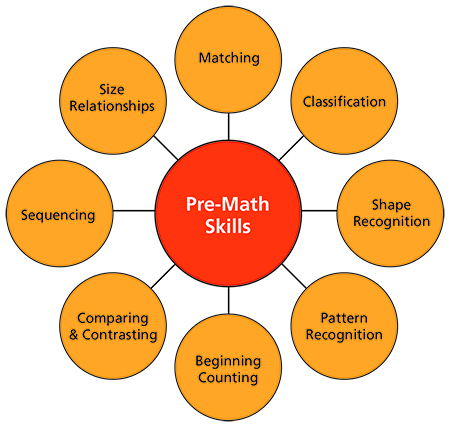
Mathematical thinking, including arithmetic, begins long before the elementary school years. There are several fundamental abilities children need to understand to carry out the basic concepts and operations of elementary arithmetic. These are called pre-math skills. Fundamentally, these skills should be introduced before and during kindergarten. However, they must be reviewed and maintained in the lower elementary class to ensure success with the arithmetic curriculum.
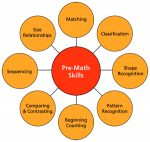
There is considerable overlap among pre-math skills. In learning or practicing any of them, children are likely to be engaging some of the others at the same time. The eight essential pre-math skills are as follows:
Matching. When two (or more) items or amounts are matched, it is called pairing or one-to-one-matching.
Classification. This consists of establishing a set of categories and placing items in the appropriate category. The particular items or objects are unimportant; the mathematical point is the act of classification, or sorting, itself.
Shape Recognition. Although identifying and naming shapes technically lies in the realm of geometry, fluency in these skills leads to better work in arithmetic. This is because naming shapes is a form of classification, and also because arithmetic and geometry overlap significantly.
Pattern Recognition. Pattern recognition is the ability to identify regular arrangements of numbers, shapes, colors, sounds, or other characteristics in objects, words, designs, or arrays.
Pattern recognition is perhaps one of the most important pre-math skills, as well as a continuing mathematical skill. Recognizing patterns is essential in understanding all mathematical systems. It allows us not only to see underlying arrangements or plans but also to expect and predict what is coming.
Comparing and Contrasting. Comparing consists of finding similarities between various objects or items. Contrasting, on the other hand, focuses on identifying differences.
Sequencing. This consists of putting things in order. These may be events that take place over a time period, objects differing in dimensions, levels of sound produced, varieties of texture, or intensities of color, to name a few examples.
Size Relationships. This is a special type of comparison or contrast, focused particularly upon sizes and/or quantities.
Beginning Counting. Considered an early arithmetic skill, as well as a pre-math skill, beginning counting refers to counting from 1 to 10 or from 0 to 10. It includes developing an understanding of the idea of quantity, numerical sequence, value, name, and written numerals.
Even in the early Children’s House years, children are prepared for beginning counting through the Cylinder Blocks, the Pink Tower, the Brown Stairs, and the Red Rods, each constructed in a series of ten. The children absorb the concept of ten as the base of the decimal system. Thus, readiness for more abstract counting is nurtured.
Edouard Seguin, known as the father of special education and a great influence on Dr. Montessori, identified the first real difficulty in formalized arithmetic as counting itself. Seguin realized those very young children counted by merely repeating the names of numbers without understanding the meaning of quantity. When he tried to teach children with special needs, he found that they could not go beyond the unit to think of groups of units. Thus, he developed a set of rods of different lengths, each rod representing a different quantity that could then be given different names. The units were physically bound together to form the groups of numbers 1-10. Montessori adopted Seguin’s Number Rods, and they are still used today as the first Montessori material to introduce beginning counting. They are the first solution to the problem of understanding quantity and its relationship to the number.
Arithmetic Strands
Counting
The first strand of arithmetic is counting itself. Counting includes beginning counting (of numbers from 0 to 10) as well as advanced counting, beyond ten, all the way up to 1,000.
Following beginning counting, arithmetic in lower elementary is divided into four additional main strands or threads. Beginning counting is a prerequisite for all four strands; this is because it introduces and applies the basic concepts of quantity and symbol up through 10. In beginning counting, the number zero is given special attention: The Spindle Box material introduces the concept of zero, defined as the absence of objects, items, amount, or quantity.
Although the four main strands overlap, they each have clearly separated, identifiable aims. The four strands are:
The Hierarchies
Advanced Counting
Memorization of Basic Facts
Fractions and Decimals
The Hierarchies
The hierarchies, the first of the four major strands, is significant both for the fact that it entails a major leap forward for the student and because it is the most significant holistic element in arithmetic.
Dr. Montessori realized that the knowledge of numbers 0-10 was sufficient to take children on to the hundreds, thousands, and beyond. If the units, or ones, can be counted up to nine, so can tens, provided they form a single object, such as a bar of ten beads (known in Montessori parlance as a Ten Bar). Similarly, hundreds can easily be counted if they form a square of 10 Ten Bars (a Hundred Square), and thousands can be best counted in a cube of 10 Hundred Squares (a Thousand Cube). The hierarchical materials that Dr. Montessori created enabled children to work with enormous numbers with very little difficulty—even though the amounts can grow to be high, they are only counted in repeating series of zero to ten. Thus, beginning counting knowledge is sufficient once the children learn the names hundred and thousand. Eventually, by similar means, the value of a million, a billion, and beyond are also presented to the children.
Starting with the Golden Beads and the introduction of hierarchical concepts, the children can explore numbers and number theory up to the value of 9,999. They examine our numerical system and can learn and practice all four arithmetic operations according to the order of operations: addition, multiplication, subtraction, and division (including long division).
The most distinctive element of the hierarchical material is that each place value is color-coded: the unit’s place is green, the ten’s place blue, and the hundred’s place red. Each of these three places is referred to as a category; thus, the colors are called categorical colors. In the Golden Bead material, the categorical colors are introduced and only appear in the number cards that accompany the beads.
A set of three categories is referred to as a hierarchy (in non-Montessori parlance, it is often called a period). Although there are only three categories, hierarchies exist infinitely. The first hierarchy is simple, consisting of ones, tens, and hundreds. After that, is the second hierarchy: the thousands. This hierarchy consists of the units of thousands, the ten-thousands, and hundred-thousands. The next hierarchy is the millions, followed by the fourth hierarchy, the billions. From there, the pattern continues on with each Hierarchy containing three categories, each successively increasing by a power of 10.
After all Golden Beadwork is complete, the Stamp Game is introduced. It is essential to understand that games in Montessori are not to be played. Instead, the word game is used to mean a material or exercise that supplements and follows the primary presentation material. Thus, the Stamp Game is a game because it directly follows and represents the ideas of the initial work: the Golden Beads.
The Stamp Game is directly related to the Golden Beadwork; it is a symbolic representation of it, in fact. Since it is a hierarchical material, it maintains the coding of the categorical colors. The Stamp Game is exceptionally versatile and can be used for all four operations, as well as to explore lowest common multiples, greatest common factors, square roots, and more.
In the lower elementary class, the Stamp Game is used for addition, multiplication, subtraction, and division (including long division). Finally, the Stamp Game introduces a second method of division called group division.
The next hierarchical material is the Dot Board (or Dot Game). The Dot Board is the most abstract material introduced so far since in it each value is simply represented by a colored dot (coded consistently with the categories, of course). The Dot Board is used for addition and multiplication, although it is possible to use it for
subtraction as well.
The next materials are the Small and Large Bead Frames, for which it is important that the children have memorized most of the basic arithmetic facts. The bead frames are most important as multiplication materials, although they’re also frequently used for addition and subtraction.
A third bead frame is referred to as the Golden Bead Frame. This flat bead frame is also aimed most precisely at multiplication, although addition and subtraction are possible on it as well.
The Checkerboard material consists of a multi-colored board displaying an array of square cells coded in the categorical colors. This introduces a geometrical view of multiplication, which can be very intriguing to the children. Like many of the other materials, the Checkerboard is aimed predominately at multiplication, but it can be used for addition and subtraction.
The last hierarchical material for multiplication is called the Bank Game. The Bank Game is entirely symbolic, consisting only of sets of cards with numerals on them. This activity, in which a group of children divide among themselves the roles of banker, cashier, and auditor, roughly simulates a bank and is very popular in the elementary classes.
The final hierarchical material for lower elementary is focused on long division. Known as either the Test Tube Division Material or the Racks and Tubes, it is a complex and fascinating approach to both distributive and group division. This material leads to complete paper-and-pencil division work at a high level.
All of the hierarchical materials are characterized by the green, blue, and red color-coded system; it is this color coding that distinguishes the materials as the hierarchical strand.
To summarize the children’s challenges in arithmetic at this point, the first difficulty is understanding quantity and its relation to the symbol; this is addressed by Seguin’s Number Rods and mastery of beginning counting. The second difficulty is working with large numbers, for which Montessori developed the Golden Beads and the other hierarchical material.
Advanced Counting
Parallel with the hierarchical material, at least up through the end of the Golden Beadwork, is the strand called Advanced Counting. This work introduces children to counting in various ways, including linear and skip counting, up to the number 1000.
Linear counting taught first, refers to counting the numbers one by one in direct sequential order. Later, children can be taught skip counting, whereby they skip certain numbers: counting by two; counting by three; counting by four; etc. The children are also taught both progressive counting—counting up—and regressive counting—counting down or backward. Both progressive and regressive counting are done either linearly or by skipping.
The first materials in this strand are the two sets of boards called the Seguin boards, named for their inventor Edouard Seguin. The first, called the Teens Board, assists children in counting past ten to 19. The second, the Tens Board, follow the same pattern in counting to 99.
Next is the Hundred Chain, a Golden Bead chain of 100 beads made up of 10 Ten Bars (each comprised of 10 Unit Beads). This chain assists children in reviewing the numbers 1-99 and reaching 100. This chain is a concrete, linear way of counting to 100, both progressively and regressively.
The Hundred Board that follows is entirely symbolic—with no concrete quantity—and is a sorting and counting exercise also leading to 100. It includes 100 individual loose wooden squares numbered 1-100. This versatile material allows children to explore patterns, multiples, various counting rules, and even addition and subtraction.
A counting material that is often most attractive to children is the Bead Cabinet (also called the Board of Powers in upper elementary). The Bead Cabinet is notable for its display of beautiful shining bead chains, bead squares, and cubes. While these chains are directly aimed at counting, they also have important connections to geometry, graphing, and number theory. The bead squares and cubes that are a part of this set allow extensions into powers, multiples, squaring, cubing, and even work in other base systems.
The bead material represents an example of an extremely adaptable material. In its many and varied uses, it finds a place in Montessori programs from the Children’s House through both levels of the elementary and even into the
adolescent environment.
Memorization of Basic Facts
The next strand is memorization, which empowers the children to have immediate mental access to the results of the combinations of numbers in all four operations. This frees them from working with concrete material so they can work completely with symbols
and abstraction.
Memorization is an essential skill that must be emphasized in lower elementary. It consists of two important elements: accuracy and speed. The Montessori materials for the memorization of basic facts focus upon accuracy; it is up to the Montessori guide to add the component of speed. The memorization materials are introduced only after the children have completed the work with the Golden Beads and have begun work with the Stamp Game, having at least completed the Stamp Game addition work.
The memorization materials have a different sequence of presentation than the hierarchical materials. The order of presentation for memorization is addition, subtraction, multiplication, and division. This is dictated by the materials; the addition and subtraction materials are similar to each other, as are the multiplication and division materials.
The materials for addition and subtraction memorization both begin with Strip Boards. In both cases, these are followed by Finger Charts and games using beads (although there is only one subtraction game). There are many explorations of addition and subtraction facts.
The materials for multiplication and division both begin with Bead Boards. These are followed by finger charts and a number of games for multiplication.
The multiplication games are extensive and not only review the multiplication facts for memorization but also introduce new material focusing on polynomials. This leads directly to work with powers and roots in upper elementary.
Fractions and Decimals
The fourth and final strand is fractions and decimals. Common (or ordinary fractions) are introduced first through a material consisting of ten metal circles, successively divided into ten equal parts inside a metal frame. The beginning work is actually to compare and measure the various pieces; this is to help children understand the value of fractions, particularly that a fraction is a part of a unit that has been broken or divided. This means that we have a fraction when a part of the frame is empty. If the frame is full, we once again have a whole.
Immediately after the concept of fractions comes the nomenclature of the fractions. This means naming the fractions as well as their parts, the numerator, and denominator. Next, fraction equivalence is presented and explored using metal and plastic circles cut into fractional pieces. Students practice operations of addition and subtraction using the same denominator and multiplication and division of a fraction by a whole number. This work is referred to as level one of fraction work and is offered during both the Children’s House and the lower
elementary years.
The work of fractions continues in the first year and a half of upper elementary as the children work with level two of the fraction curriculum. This consists of introducing the concepts of proper and improper fractions, mixed numbers, lowest common denominators, and greatest common factors. The children learn addition and subtraction with different denominators, but at this level, the denominators are related in that one is a multiple and the other a factor. At this time, guides also introduce multiplication and division of a whole number by a fraction.
The final level of fraction work, level three, involves: addition and subtraction of fractions with any denominator; multiplication and division of fractions by fractions; beginning work with unknowns; and changing fractions to decimals, fractions to angles, and decimals to angles (as well as the reverse of all of these conversions). Concurrently, decimal fractions are also introduced. Like the common fractions, they begin with the value work and nomenclature and then follow the three levels of work with the common fractions. This work will include percentages and money.
Advanced Strands
As children transition into the 9-12 level, or upper elementary, they will engage with three additional strands of arithmetic. Although new enough to merit attention, these strands are, in fact, outgrowths of the arithmetic work begun in the lower elementary class.
These new strands are:
Multiples and Powers
Signed Numbers
Other Topics
Multiples and Powers
Upper elementary arithmetic begins with a reinvestigation of multiplication. This grows out of the earlier work that was done with skip counting as a part of the advanced counting strand and the multiplication games that are a component of memorizing basic facts. In this new work, the emphasis is initially on identifying multiples, then common multiples—leading to the lowest common multiples and greatest common factors. Prime numbers are a part of this study, as is divisibility (essentially the opposite of multiples). This work makes extensive use of the Bead Cabinet (or the Board of Powers), many additional sets of Bead Bars, the Hundred Board, and a variety of charts.
The work with powers begins with exponents and proceeds to applying them to binomials and trinomials, eventually expressed algebraically. Raising numbers to higher powers uses the Power of Two and the Power of Three materials.
By the middle of upper elementary, students learn the opposite of raising numbers to a power: extracting roots. They begin with work on square roots and progress to cubing and cube roots. The Stamp Game, the Montessori Pegboard, the Cubing Material, and the Binomial and Trinomial Cubes are core materials for this work. This work is extensive, culminating with a paper-and-pencil calculation of four-digit (or even larger!) cube roots.
Signed Numbers
The study of signed numbers introduces positive and negative numbers, opening up the complete range of integers. This begins with a simple activity, the Negative Snake Game, but progresses to operations with integers, even extracting the roots of negative numbers.
Other Topics
Certain other topics are offered for enrichment and expansion of the curriculum. Not every Montessori program offers all of these; however, most programs offer at least some of them. Common additional topics include calculation of distance; rate; time; simple and compound interest; and pre-algebra.
Additionally, by the middle of upper elementary, geometry work has increasingly begun to use calculations and to be less descriptive. Thus, there are many places, especially in area, volume, ratio, and proportion, where arithmetic and geometry come together.
Summary
It is important to realize that all the elementary arithmetic work is organized in strands. Even before these strands are introduced, eight pre-math skills are addressed.
The five basic strands originate with beginning counting. After this, students work with the remaining strands of advanced counting, hierarchies, memorization, fractions, and decimals.
In upper elementary, these four strands continue and are supplemented by multiples and powers, signed numbers, and other topics.
Together, the exercises and materials in the arithmetic area represent over 400 exercises and more than 100 unique materials and special supplies. With this complete array of learning materials and presentations, the adult may be challenged (or even overwhelmed) with the effort of presenting it all, while striking the imagination of the children, demonstrating the world of wonder, and maintaining the essential enthusiasm that needs to infuse every lesson. This is why very careful organization and thorough planning of lessons is essential for the elementary guide. Keeping the overall structure in mind, while planning each component, will allow guides to successfully complete an engaging presentation of all key exercises from these strands.
ML/ Feb 2019/ Pg 5
by Tim Seldin | Brain Development, Lower Elementary (6-9), Mathematics, MFA, Mixed Ages, Montessori Education, Tomorrow's Child, Upper Elementary (9-12)
The Multiplication Checkerboard is one of the most popular materials in most elementary Montessori classrooms.
The colorful checkerboard materials are a step up the ladder of abstraction in the Montessori math curriculum.
Think back to your own years in school. Did you ever really understand what is going on in long-multiplication? Oh, you probably memorized your multiplication tables [like 7 x 6 = 42] and learned to solve long multiplication problems on paper [520 x 84], but did anyone ever show you that multiplication is nothing but adding the same number together with a given number of times? 7 X 7 is nothing more than 7 + 7 + 7 + 7 + 7 + 7 + 7.
In their first steps into multiplication, the children will have done similar work with the Golden Beads and Stamp Game. The simple multiplication board is a somewhat more abstract way of helping young children be able to understand short multiplication. Here you can see 5 X 2.
The Multiplication Checkerboard builds on the children’s prior work with the more concrete math materials.
You can see how the material resembles a checkerboard, but there is a clear logic to its design. Along the bottom, beginning on the right, you can see a green square under which the symbol 1 is printed. Next to it, on the left, is a blue square, under which the symbol 10 is printed. Next comes a red square labeled 100, and we begin again with a green square to the left labeled 1000 (units of a thousands). The sequence to the left continues 10,000, 100,000, and 1,000,000. When we go up one row, we begin with a blue square representing units of ten. The sequence continues along that row, building from the right to the left.
The colors green, blue, and red represent the units, tens, and hundreds place values, just as they have been color coded in the earlier materials and number cards. Ten thousand would be blue (in Montessori math, tens are always blue), and a hundred thousand would be red. This consistency in color coding is a great aid in helping children to see the logic in the progression of concepts.
The colored bead bars used to represent the numbers 1 to 9 also use the same color scheme used in earlier exercises to represent the same values as the Bead Bars and Bead Cabinet found in all Montessori classrooms.
In the following photos, let’s see how a child would solve the problem:
13,258
X 32
_____
The multiplican is placed on the bottom, and the multiplier is placed along the side.
In this problem, the multiplican is 13,258, and the multiplier is 32.
On the bottom row, the child builds the multiplican:
In the lowest row (multiplying by units), the child sets out two 8-bead-bars in the lower right green square (units). She then lays out two 5-bead-bars in the blue square to the left (tens). She continues multiplying the multiplican (13,258) by two, placing two 2-bead-bars in the (red) hundreds square, two 3-bead-bars in the (green) thousands square, and two 1-bead-bars in the (blue)
ten-thousand square.
Now she needs to multiply the multiplican (13,258) by three in the next row up that represents multiplication by tens. She places three 8-bead bars in the units square in the second (tens) row, three 5-bead-bars in the (blue) tens square, three 2-bead-bars in the red (hundreds) square to the left, three 3-bead-bars in the (green) thousands square, and three 1-bead-bars in the (blue) ten-thousand square (see Figure 2.)
Now the child begins to carry forward. There are several ways this can be done, but with multiplicans of 4-digits or more, a common short cut is to slide the bead bars in the tens row each one square to the left and then merge them down.
The last step is to exchange bead bars that total a number greater than 9. For example, in Figure 3, we see that the units column totaled 16. Then the child removes the two 8-bead bars, adds 1 to the tens column, and places a 6-bead bar in the units column to represent the remainder.
The tens column now has a total of 35, so the child carries 3 over to the hundreds column to the left and places a 5-bead bar in the tens column to represent the remainder (see Figure 4).
In the hundreds column, we now have 22, so the child carries 2 to the thousands column to the left, and the remainder is 2 (see Figure 5).
Now in the thousand columns, we have 14, so the child carries 1 over to the ten thousand columns and has 4 left (see Figure 6). She continues this process, and arrives at the answer: 13,258 X 32 = 424,256.
Children may solve pre-printed problem cards, think up their own problems, or roll a special dice to come up with new problems to solve at this first level of multiplication. They gradually move up to multiplying large numbers—even up to the millions!
Below is an example of a child solving the problem 214 X 3 =?
She sets up the checkerboard with beads representing the numbers in her problem.
Now the board is ready for her to do some exchanging. We always start with the ‘units’ place, so her first exchange comes with those beads in the green square (see Figure 8).
If she knows that 3 X 4 = 12, she can simply do the exchange.
If she has not yet memorized this answer, then she can count the beads to come up with the answer.
With the checkerboard, the number 12 would be shown with a 1 in the tens place (blue square) and a 2 in the units place (green square). She writes down her work as she goes along to complete the process.
Tomorrow’s Child/ Jan 2019 / Pg 17
.
by Jackie Grundberg | Computers in the Classroom, Imagination, Kindergarten, Lower Elementary (6-9), Mathematics, Montessori Parenting, Primary (3-6), Research, Science, Upper Elementary (9-12), Webinars / MFA
Do you ever question or are asked, “How do STEM and Montessori overlap?” or “Should I choose a STEM or Montessori school for my child?” We’ll take a look at how Montessori incorporates STEM philosophy, and what you can do next.
by Cheryl Allen | Early Adolescence (12-15), Family Resources, Imagination, Kindergarten, Language & Reading, Lower Elementary (6-9), Mathematics, MFA, Montessori Family Life, Montessori Parenting, Practical Life, Primary (3-6), Reading, Upper Elementary (9-12), Video, Webinars / MFA, Writing
Are you wondering how to keep your child not only busy during the summer months when school is out, but also keep her learning? Are you worried that if your child is not enrolled in a summer program called “Little Genius’s” or the Center for Brighter Children that your child will be behind when he returns to school? Or do you just want some good ideas for fun and creativity? Cheryl Allen will offer answers to these questions to help you have an enjoyable and enriching time with your child during the school break.
by Tim Seldin | Brain Development, Early Adolescence (12-15), Infant-Toddler (0 to 3), Kindergarten, Language, Language & Reading, Later Adolescence (15-18), Lower Elementary (6-9), Mathematics, MFA, Montessori Curriculum, Montessori Education, Montessori Family Life, Montessori Middle School, Montessori Secondary / High School, Primary (3-6), Reading, School Leadership, The International Montessori Council, Young Adolescent
by M. J. Rosanova, Ph.D.
The Montessori Bilingual Institute (MOBI) The children are playing outside. I can hear them outside my window. They’re singing and calling out to each other in Japanese. No, our school isn’t located in Japan. InterCultura Montessori is located in Oak Park, Illinois, a suburb of Chicago. Only about fifteen percent of our children are from international families; in the past, it was even fewer. Most of our children come from English-only monolingual families.
InterCultura is a dual-language or two-way immersion school’. Some of the children who come here know no English (or very little English) when they arrive. But all of the children here become bilingual.
At InterCultura, children not only play in Japanese. They learn in Japanese. For the first three years, from as early as 7:00 or 8:00 in the morning until 2:30 in the afternoon, the children are in total immersion environments, that is, the entire range of the normal Montessori curriculum is delivered to the children by Montessori certified native speakers of Japanese.
In our Spanish immersion program, the teachers are from Latin America. When we first founded InterCultura in 1985, all of the teachers had received their Montessori training in Latin America. Now, many of our teachers are immigrants who have found their way to us as assistant teachers and then have taken Montessori training here.
After 2:30 in the afternoon, our Anne Frank Communities convene. Anne Frank was a Montessori child, beginning at the 3-6 level in Frankfurt, Germany. When the family moved to Holland, Anne continued at the elementary level. Anne, of course, was a bilingual child: German and Dutch. She became bilingual through her experiences at home and in her Montessori school.
At InterCultura, the language of the Anne Frank Communities is English. For most of our children, this is native language development time. For those new to English, this is the time for total immersion in English.
About half of the children from our English-only monolingual families attend the Anne Frank Communities. But all of the children who are new to English are required to attend. Some stay ëtil 6:00 p.m. ñ the normal length of a daycare-length day here in Chicago.
By the way, at no time does anyone force any child to speak either in English or Japanese or Spanish. The children talk and talk and talk in whatever language or combination of languages occurs to them. The average child begins to speak spontaneously in the second language (‘L2’, the ‘target language’) after about eight to ten months of full-time attendance. People who don’t speak any English (but who do speak Spanish or Japanese) can understand them by about that point.
Why Total Immersion?
Why total immersion? Well, it all depends on what your goals are. If your goal for your child is ‘useable fluency in the second language, you’d better start early. Current neurological research indicates that the brains of small children have remarkable ‘plasticity’ in comparison with the brains of older children and adults. There is a neurological window of opportunity for language learning early in life which begins to close around eight to ten years of age.
In the past, when knowledge of human development was less available than today, people assumed that a second language was not for preschool but for high school. They presumed that children would master grammar first, and that then fluency would magically appear. Since most children did not have the discipline to study the boring abstractions of grammar until at least fourteen or sixteen years of age, it made no sense to start a foreign language until freshman or junior year of high school.
Even today, there are many very fancy, very expensive high school level programs where after four solid years of daily grammar drill classes almost none of the students can say much more than hello and goodbye and sing a few songs in the second language. Proponents of such programs are quick to point out that their graduates are much more likely to have positive associations with the people and cultures who actually speak the target language. And this is an important and worthy accomplishment, to be sure.
But if useable fluency is your goal, you need to take another route. The research on outcomes overwhelmingly endorses immersion; and the younger the child, the better the outcomes. I’ve taught middle school children (in Montessori), college kids, and adult learners in corporate courses. American children and adults at those ages very seldom become functionally bilingual. One in a hundred may do so; or maybe one in a thousand. But it’s so rare that a statistician would tell you: you may as well say it doesn’t exist. Most of the time you’d be right.
But with small children in total immersion in a developmentally appropriate Montessori environment, barring any grave developmental or emotional problems, it’s startlingly close to one hundred percent. Almost every child becomes functionally bilingual in a total immersion Montessori environment. Or at any rate, since 1985, that’s been our experience at InterCultura Montessori.
Alternatives to Total Immersion
InterCultura is a special Montessori school with a special mission. But not every school needs to undertake a total immersion program. There are various practical reasons why a school might choose not to create an immersion program.
For one thing, it takes a lot of work to identify and recruit qualified Montessorians who are native speakers of the second language. How do you balance the English-speaking faculty with the second language faculty? How do you deal with visas?
If a school decides not to commit to a total immersion program for every child, what other alternatives are open? Should the school offer total immersion not for all of its students, but only for a part of the student body? Some schools may prefer simply to have one or two classrooms within the school devoted to total immersion. And this may be practical in some situations.
But failing that, what else can a school do? There are at least a few other options open to Montessori schools. The language reference person approach, the magic scarf approach, and the language lesson approach can all be found in Montessori settings. Any of them may be appropriate for a given Montessori school if they fit the school’s goals.
The Language Reference Person Model
In some Montessori classrooms, there is one teacher (usually the Montessori-certified lead teacher) who speaks English all the time. And there is a second teacher (usually an assistant teacher with no Montessori training) who is intended to speak Spanish with the children.
If you have several Spanish-speaking immigrant children in your class, and if your goal is to get everyone to speak English, this is a fine model. In some states where ‘transitional bilingual education’ is mandated by the legislature, this approach makes sense. Because of their ability to access Spanish during their time in the classroom, the Spanish-speaking children will continue to grow in Spanish as they begin to acquire English. And because their knowledge of their native language is growing (even though they’re at the disadvantage of having little or none of the usual environmental support that the majority language enjoys), their knowledge of English begins to flourish. To those unaware of the research, it sounds illogical; but actually, more of the home language, used for serious academic purposes at school, means more progress in English.
Unfortunately, very few of the English-speaking children acquire any Spanish in this situation. Most of the children acquire positive attitudes concerning Spanish. Many of them learn how to say hello and good-bye, and sing a few songs. These are worthwhile goals. But it would be difficult to say that the children are learning lots and lots of Spanish.
One of the reasons why the English-speaking children don’t learn much Spanish in this situation is the status of Spanish in the class. Usually, the minority language speaker is the assistant in the class. The children understand clearly that English is the ‘power language’ both in the classroom and in the United States in general. When something important needs to be said, it’s said by the lead teacher in English.
The minority language is often confined to things which are incidental or trivial. Something as important as words of comfort for a hurt child are not likely to be delivered in L2, the second language. If the second language begins to catch on with majority language children at all, it tends to reflect the smaller, more peripheral status that the minority language is given. For many English-speaking children, the minority language just doesn’ t seem very important.
Another, perhaps more critical, reason why English-speaking children don’t learn much Spanish in this situation is simple interpersonal dynamics. If English-speaking preschoolers know that they have a choice of English or Spanish, generally they will choose English, simply because it’s the path of least resistance. They already know English; it doesn’t require them to concentrate or make a special effort.
In addition, they quickly note that, if push comes to shove, they can make even the Spanish-speaking teacher speak English to them. All they have to do is misbehave. The teacher will feel that she has lost control, and will want to scream. Whether she actually does scream or not, the next words out of her mouth are likely to be English. The teacher assumes that with English she is going to regain control.
The children soon learn that they can vary this strategy. In order to avoid time-out or other unpleasant repercussions, they can mask their misbehavior as incomprehension. They can simply ignore the teacher who speaks to them in Spanish, even though a little attention would make the teacher’s message obvious. This strategy will also put the teacher ‘in her place’. She will get desperate, feel out of control, and drop Spanish.
In one Montessori classroom following this model, there are two credentialed co-teachers, one Spanish speaker, one English speaker. Half the children in the class are Spanish speakers; the other half, English. Because of the equality of status between the teachers, and also because of the presence of so many Spanish-speaking children, the situation is more likely to foster interest in Spanish among the English-speaking children. By the end of the first year, two four-year-old English-speaking girls did spontaneously request that Montessori project work be presented to them in Spanish. However, none of the other English-speaking children were so moved.
Perhaps more significantly, none of the Kindergarten-age children were involved. Typically, the Kindergartners in a 3-6 classroom are the leaders whom the younger children follow. This may support goals in which the teachers believe, or it may subvert them. Because the issue of language choice is open in this model, it is open to become the source of much aggravation and disappointment to adults who think that the English-speaking children should be learning some Spanish. Not too many English-speaking American children will learn very much Spanish in this situation.
This is very different from the situation in a total immersion environment where all of the teachers speak the minority language all of the time before the shift into English when the afterschool program begins. In the total immersion environment, there are no power struggles over what language the teacher speaks. If it’s before 2:30, the teachers all speak Spanish all the time.
And the children are fine with that arrangement. The children themselves have developed a relationship with the teacher in which Spanish is an essential element. In a total immersion environment, the children would feel strange to hear the teachers switch into English. The children not only accept but prefer to hear the teachers speaking Spanish.
The ‘Magic Scarf’ Model
Another approach in some Montessori classrooms is the ‘magic scarf’ model. From time to time, the lead teacher dons a special ‘magic scarf’ or some other symbol of the second language and walks about the class greeting the children in the target language. The teacher wears the same symbolic totem during group time when she teaches a phrase or a song in the second language.
Although this method is picturesque and appealing, it is not likely to awaken serious interest or much useable fluency in English-speaking children. Because it is based on a theatrical performance by the teacher rather than a learner-initiated activity, it runs the risk of provoking authority conflicts. Children who feel provoked or merely inconvenienced will not become engaged, and will not learn a great deal of L2.
The ‘magic scarf’ model is an interesting alternative in some situations because it certainly looks like ‘teaching is going on’. Since many parents assume that ‘teaching’ is the same as ‘learning’, many parents may pay extra for Montessori classes where obvious direct teaching is going on. But not too many children will be very interested.
In a total immersion Montessori class children are interested in the second language because they actually use it to accomplish goals which are important to them. Everything from the rules of the classroom to the presentations on the project materials, everything from hello and goodbye to words of comfort when you cry, everything comes to the child in the second language. In that situation, how can a child assume that the second language is not important? How can a child not be interested?
The Language Lesson Approach
For many Montessorians, line time is sacrosanct in a time reserved for songs, greetings, sensory integration work such as line-walking, and perhaps a short presentation featuring one of the traditional project materials. At the 3-6 level, however, line time is not supposed to be ‘group lesson time’ because the children are not ready for passive listening or unassisted abstraction. ‘Group lessons’ in a particular subject area are not officially sanctioned in Montessori before first grade. But many Montessori schools make an exception when it comes to language lessons.
Some of the language lesson approaches are excellent. In Other Words by Alice Renton takes advantage of both line time and Montessori project work. Line time activities are connected to a shelf of project materials which the children can work with even when the second language teacher is not in the classroom. The connection with the project materials and the children’s cycle of spontaneous work is what makes Renton’s materials appropriate for a Montessori classroom. This is essentially different from the ‘magic scarf’ approach which is arbitrary and teacher-centered, and which bears little resemblance to the basic logic of Montessori work with preschoolers.
The style of teaching in Montessori is primarily indirect. The Montessori teacher shows children how to manage project materials, and helps children to focus on the potential of the material. A good Montessori teacher will also help children to reflect on their learning experiences so that the children will begin to understand and make order of what they know.
This is very different from the cycle of declaring information and testing memory which is the centerpiece of ‘direct teaching’ outside Montessori. Devotees of direct teaching emphasize information and product, manipulating learning by rewarding externally with incentives such as candy, happy faces, stickers and frequent (implicitly competitive) grades. Montessorians, on the other hand, tend to prefer internal, intrinsic rewards such as the feeling of competence a child attains when he solves a problem or demonstrates an ability within a context that matters to him.
Most language lessons lean heavily on ‘direct teaching’, and so are somewhat out of step with the Montessori environment. But materials like Renton’s demonstrate that it is possible to come much closer to the spirit of the Montessori environment.
After three years of fifteen or twenty-minute language lessons once or twice a week in a Montessori preschool/Kindergarten setting, it’s reasonable to hope that most children will be able to recognize about three or four dozen words and phrases in the second language. They might be able to spontaneously produce as many as twenty-five percent of them spontaneously.
In addition, they will tend to have positive feelings about the second language and the people who speak it. They will probably recall some of the tunes they’ve learned as well. And they may acquire the ability to produce the sounds of the second language with a high level of accuracy. These are important accomplishments, which merit respect as important goals for Montessori programs.
In a total immersion Montessori environment, on the other hand, children acquire thousands of words within the same period of time. Within less than a calendar year, they begin to make sense to L2 speakers who know no English.
And oddly enough, the higher the quality of Montessori work in the total immersion classroom, the greater the L2 abilities of the children. Unlike the other situations, in the total immersion setting Montessori principles do not need to be bent or compromised. No traditional ‘direct teaching’ is necessary; the second language is embodied in the Montessori work itself.
How Do I Find Out More?
InterCultura has a website, www.intercultura.or, where you’ll find more information and more suggestions. The Montessori Bilingual Institute at InterCultura (MOBI) sponsors a listserv, a kind of group e-mail, for teachers and administrators interested in exploring issues and exchanging ideas.
An entertaining and useful resource for parents and teachers is Growing Up With Two Languages: A Practical Guide by Una Cunningham-Andersson and Staffan Andersson. A wonderful little periodical for families who would like to become bilingual is The Bilingual Family Newsletter, available from Multilingual Matters at www.multilingual-matters.com.
Whether you’re a teacher, administrator or parent, you need to begin by clarifying your goals. There is probably some approach currently in practice in Montessori environments which will help you reach the goals you set, no matter how modest or how ambitious they may be.
Once you have identified your goals, you need to begin making choices concerning program design. The best choices will be the ones that affirm and strengthen Montessori ideals and Montessori practice at your school.
The author, M. J. Rosanova, is executive director of The Montessori Bilingual Institute at InterCultura (MOBI). He holds Montessori teacher certification (AMS), as well as a Ph.D. in social psychology (Yale).
Tomorrw’s Child, Sept, 2000
by Tim Seldin | Archived Issues / Tomorrow's Child, Children with Exceptionalities, Emotional Intelligence (EQ), Executive Functioning, Language & Reading, Mathematics, MFA, Montessori Curriculum, Montessori Education, Montessori students, Peace Education, Re-enrollment, Reading, Science, Sensitive Periods, Tomorrow's Child, Writing
To inspire academic excellence; nurture curiosity, creativity, and imagination; and awaken the human spirit
As children near the end of their kindergarten year in Montessori, many parents struggle with the question of whether or not to keep their children in Montessori for the elementary program.
On the one hand, the typical Montessori five-year-old’s self-confidence and love of learning lead many families to ask: Why tamper with something that is clearly working?
Other parents feel that, since their kindergarten graduate will be moving on to another class one way or the other, next year might be the logical time to make the transition from Montessori.
A major consideration for many families will be the opportunity to save the cost of private school tuition by taking advantage of the local public schools. Some will wonder if a more highly structured and competitive independent school will give their child a better preparation for college.
If you are facing this choice, I encourage you to take a good look at your school’s elementary program. Although you will, of course, want to gain an impression of the teachers, focus your attention on the students themselves. Elementary students are often the best spokespeople for the value of a Montessori education!
There are four aspects of the elementary program:
Academic Excellence
Universal Values
Global Understanding
Service
Inspiring Children To Work Hard and AchieveAcademic Excellence
Let’s begin by being very clear. Montessori is one of the most sophisticated pre-collegiate programs available anywhere in North America. It has been described as the ultimate gifted-and-talented program that is offered to a very wide range of students. However, this doesn’t tell the whole story. What makes Montessori special is its ability to nurture talent without needless competition and stress. In a nutshell, Montessori children never lose the joy of learning.
Montessori is, first and foremost, concerned with a child’s character and emotional development, rather than academics for grades and test scores alone. We inspire children toward academic excellence and nurture the curiosity, creativity, and imagination hidden within every human being.
Many Parents Worry That Montessori Will Not Prepare Their Children For The ‘Real World.’
Hearing that we do not give children letter grades (at least until high school), assign hours of nightly homework, give children weekly tests, or expect students to compete for the highest rank in the class, some parents wonder if we’ve lost our minds! After all, who wants to run the risk that Montessori, which was so charmingly right when they were young, doesn’t work in the elementary years or prepare children for the Real World?
Montessori Elementary Education Is Distinctly Different
First, let’s talk about highly selective programs for ‘gifted’ children.
Montessori demonstrated that intelligence is common among human beings. Most schools assume that giftedness is statistically rare and that, given half a chance, children will accomplish little without external structure, extrinsic rewards, and the fear of being embarrassed.
Many of us attended challenging elementary schools. Do you remember what happened in your highly disciplined classrooms when your teacher left the room? In many cases, it was disorder. What use is it to earn high grades, keep your notebook neat, pass every test, and hate your schoolwork? Many children in many good schools are bored, apathetic, or overwhelmed. They do only what must be done to get along. That is not a sound foundation for a real education. In truly wonderful schools, classrooms are filled with students who retain a sense of wonder, curiosity, and eagerness to learn. Those qualities are the almost universal description of elementary Montessori children.
I find the difference between the way many of us think about gifted children in this country and the attitudes we find abroad quite interesting. Americans unconsciously assume that intellectual ability and scholastic success is inborn, i.e. a child is born with special talents and abilities. Many parents in other countries assume that success is more the result of hard work, self-discipline, and high personal motivation.
In writing this, I don’t mean to suggest that truly gifted children (and adults) can’t be found. They are simply uncommon. What we focus on is the human potential hidden within young children.
Montessori demonstrated that intelligence has many forms and that children learn in different ways at different paces. Anyone who has worked with children knows this is true, but traditional schools normally follow a pre-established curriculum.
Montessori felt it was illogical to dismiss a child who finds it difficult to memorize facts without understanding or to remember what the teacher covers in a lecture. She also understood the powerful connection between a child’s inner emotional life, self-confidence, self-esteem, and the ability to learn.
A Montessori elementary program is based on warmth, kindness, and respect. There is a strong sense of community among the children. The classes are more like little villages, with powerful friendships and a clear sense of group identity. Teachers are normally seen as mentors and friends.
Building Character and Teaching Universal Values
There is an old saying that if you abandon a garden, the weeds will run wild. Abandon a child’s moral and spiritual education, and the weeds of confusion, materialism, self-centeredness, and spiritual emptiness will take hold.
Dr. Montessori observed that the elementary years are a sensitive period for moral reasoning. The elementary program integrates character development and family involvement throughout the curriculum.
The teaching of kindness and courtesy, self-discipline and self-respect, and fundamental values is crucial in a child’s moral development, sense of dignity, and academic success. With proper guidance from parents and educators, children can and will excel.
Montessori Schools Strive to Create Global Understanding
They tend to attract teachers from all over the world.
It is normal to find an international student body in a Montessori school anywhere in the world.
Montessori schools generally teach at least one foreign language and often offer programs in several.
World geography, international cultural studies, and world history are central to the elementary Montessori curriculum.
Elementary Montessori students begin to understand the global economy.
As more Montessori schools develop strong upper elementary and middle school programs, many are beginning to sponsor travel-study programs. Some participate in the Montessori Model United Nations and foreign exchange programs.
Service
Children must be inspired to contribute to the betterment of the world. They often begin with projects that care for the environment: planting trees and flowers; composting garbage; controlling erosion around the campus; recycling; and cleaning up litter and debris in the local community. It is quite common for elementary classes to adopt an acre of rainforest in Costa Rica or work to support an environmental organization, such as the Wildlife Federation.
They will normally progress to projects that provide direct help to the needy. Younger children commonly collect canned goods, clothing, and toys for the homeless or needy families. As they are ready, most Montessori schools will take children out into the community.
As they reach the upper elementary class, Montessori children become quite concerned about issues of social justice and human rights. The rights of the poor, homeless, and hungry are of real concern. Some children will begin to explore the possibilities of supporting causes that are meaningful to them.
Elementary Classes Are Multi-Age Group Communities
Elementary Montessori classes continue to bring children of different age levels together. Classes span three age/grade levels, with the common divisions being ages 6 to 9 (grades 1-3) and ages 9 to 12 (grades 4-6). Some schools may follow a somewhat different scheme of grouping their children.
Elementary Montessori Educators Serve As Mentors, Guides, and Friends
The best elementary Montessori teachers tend to be renaissance men and women; individuals who are equally interested in mathematics, the sciences, the arts, architecture, literature, poetry, psychology, economics, technology, and philosophy. Elementary Montessori teachers are generalists rather than a single subject-matter instructor. They provide a blend of structure to ensure that the ‘basics’ are mastered while encouraging and guiding children to explore topics and ideas that capture their imagination.
The elementary Montessori curriculum is very demanding, and requires teachers to have a broad and thorough education of their own. With lessons that range from the history of mathematics to the physics of flight, mineralogy, chemistry, algebra, geometry, linguistics, and literature, to name just a few, the average teacher would be lost.
But beyond this, elementary Montessori educators need patience, understanding, respect, enthusiasm, and a profound ability to inspire a sense of wonder and imagination. Such teachers are very rare but absolutely magical!
Becoming an elementary Montessori teacher requires almost two years of graduate study and student teaching, and many hours of hard work to gather or create the curriculum materials that constitute a fully authentic elementary Montessori environment.
The Montessori Materials And The Passage To Abstraction
At the elementary level, learning continues to be a hands-on experience, as students learn by trial, error, and discovery.
The advanced elementary Montessori materials move on to more complex and abstract concepts in mathematics, geometry, and pre-algebra. The goal is to lead students away from a dependency on concrete models that visually represent abstract concepts towards the ability to solve problems with pen and paper alone.
Part of this is made possible by the growing child’s brain’s ability to grasp abstractions, but it has been greatly enhanced over the years by countless hours of work with the concrete materials that made the abstract real, and helped him visualize the abstraction.
Similar hands-on Montessori materials help students understand grammar, sentence analysis, geographical facts, and concepts in science.
Three Elements Of The Elementary Montessori Curriculum
1. Mastery of Fundamental Skills and Basic Core Knowledge
Montessori’s international curriculum evolved out of a tradition of academic excellence and offers a rigorous course of study even in the elementary years. Elementary Montessori students explore the realm of mathematics; science and technology; the world of myth; great literature; history; world geography; civics; economics; anthropology; and the basic organization of human societies. Their studies also cover the basics found in the traditional curriculum: the memorization of math facts; spelling lessons; the study of vocabulary, grammar, sentence analysis, creative and expository writing; and research skills.
2. Montessori’s Great Lessons
The Great Lessons are five key areas of interconnected studies traditionally presented to all elementary Montessori students in the form of inspiring stories, related experiences, and research projects.
The Great Lessons include the story of how the world came to be: the development of life on Earth; the story of humankind; the development of language and writing; and the development of mathematics. They are intended to give children a ‘cosmic’ perspective of the Earth and humanity’s (and their own) place within the cosmos.
3. Individually Chosen Research
Elementary students are encouraged to explore topics that capture their imagination. Most former Montessori students look back on this aspect of the elementary program with particular fondness in later years.
Montessori curriculum guides students to become proficient at research and inquiry. Elementary Montessori students rarely use textbooks. The approach is largely based on library research, with children gathering information, assembling reports, teaching what they have learned to their fellows, and assembling portfolios and handmade books of their own. Students are taught how to use reference materials, libraries, and the Internet to gather information and uncover the facts. Their oral presentations and written research reports tend to grow in sophistication and complexity every year.
Is Montessori Opposed To Competition?
No. Dr. Montessori simply observed that competition is an ineffective tool to motivate children to learn and work hard in school.
Traditionally, schools challenge students to compete with each other for grades, class rankings, and special awards. In Montessori schools, students learn to collaborate rather than mindlessly compete. In an atmosphere in which children learn at their own pace and compete only against themselves, they learn to not be afraid of making mistakes. They quickly find that few things in life come easily, and they can try again without fear of embarrassment.
Dr. Montessori, herself an extraordinary student and a very high achiever, was never opposed to competition on principle. Her objection was to using competition to create an artificial motivation to get students to achieve.
Homework, Tests, And Grades
Many parents have heard that Montessori schools do not believe in homework, grades, and tests. This is a misunderstanding. Because Montessori believes in individually paced academic progress and encourages children to explore their interests, rather than simply complete work assigned by their teachers, we don’t assign grades or rank students within each class according to their achievement.
Whenever students voluntarily decide to learn something, they tend to engage in their work with a passion and attention that few students will ever invest in tasks that have been assigned.
Providing Structure: Setting High, But Individually Tailored, Expectations
Montessori children normally work with a written study plan for the day or week. It lists the basic tasks that they need to complete while allowing them to decide how long to spend on each and what order they would like to follow. Beyond these basic individually tailored assignments, children explore topics that capture their interest and imagination, and share them with their classmates.
Montessori children usually don’t think of our assessment techniques as tests so much as challenges. Most elementary teachers will give their students informal, individual oral exams or have the children demonstrate what they have learned by either teaching a lesson to another child or by giving a formal presentation.
Standardized Tests
Montessori educators frequently argue that standardized testing is inaccurate, misleading, and stressful for children. Many feel that standardized tests are unnecessary, since any good teacher who works with the same children for three years and carefully observes their work, knows far more about their progress than a typical paper and pencil test reveals.
However, in our culture, test-taking skills are just another practical life lesson that children need to master. Most Montessori schools regularly give students quizzes on the concepts and skills that they have been studying, and many schools use standardized tests of one sort or another, with students over first grade. Often these may be formative tests that measure each student’s progress over the course of each year, and these will be only part of a comprehensive system of monitoring and documenting learning within the school.
When tests (formal and informal) are used as a feedback loop, at times indicating that a student needs a new lesson and more practice, instead of a mark of shame and failure, then they can be quite useful. Children will face tests throughout their education, and they certainly need to develop good test-taking skills.
Homework
Homework in an elementary Montessori class rarely involves busywork assignments; instead, they are extensions and enrichment of the curriculum. Some classes will allow the children to freely pursue projects that interest them at home, while others prefer to give children a number of optional assignments or challenges. In either case, the Montessori version of homework will rarely be boring and will normally challenge students to think, explore, and pursue tangible projects that give them a sense of satisfaction.
An Integrated Curriculum
Literature, art, music, dance, drama, history, social issues, political science, economics, architecture, science, and the study of technology all complement one another in the elementary curriculum. This integrated approach is one of the elementary Montessori program’s great strengths.
An Exceptional Curriculum In Language Arts And The Humanities
The elementary Montessori language arts program places great stress on the development of strong skills in composition and creative writing. Students are asked to write continuously, emphasizing, at first, the development of an enjoyment of the writing process, rather than the strict use of correct grammar and spelling. However, formal grammar, spelling, and sentence analysis are systematically taught.
Elementary children are normally very interested in words and sentences. They like to parse and analyze; for, in this way, they are clarifying their understanding of the structure of language that they absorbed unconsciously in the primary class. Montessori takes advantage of children’s natural interest and gives them a rich assembly of learning material; for while they study the theory of grammar, spelling, and sentence analysis, they are also perfecting their knowledge of written language.
Creative writing continues to be equally important, and students are encouraged to write and share with others their stories, plays, poetry, and class newspapers.
Finally, and most importantly, the key to the elementary language arts curriculum is the quality of the material Montessori gives children to read. They are introduced, from an early age to first-rate children’s books and fascinating works on science, history, geography, and the arts. Many elementary classes follow the Junior Great Books program, with formal literary studies continuing every year through graduation. By introducing students to the very best literature available for young people, Montessori cultivates a deep love for the world of books.
Unified Mathematics
Montessori math is based on the European “Unified Math” model, which introduces elementary students to the study of the fundamentals of algebra, geometry, logic, and statistics, along with the principles of arithmetic.
Montessori students learn to recognize complex geometric shapes and figures. They learn to define, calculate, and draw all sorts of geometric relationships: angles; polygons; circumference; area; volume; squares and square root, cubes of polynomials, to name just a few. In Montessori, arithmetic, algebra, and geometry are interrelated.
Elementary Montessori students gain hands-on experience by applying math in a wide range of projects, activities, and challenges, such as graphing the daily temperature and computing the average for each month or adjusting the quantities called for in a recipe for a larger number of people. Because children love to work outdoors, we try to prepare tasks that use the school grounds whenever possible.
History And Culture Come Alive In The Elementary Class
One of Montessori’s key objectives is to develop a global perspective, and the study of history and world cultures forms the cornerstone of the curriculum.
Physical geography begins in the elementary program with the study of the formation of the Earth, the emergence of the oceans and atmosphere, and the evolution of life. Students learn about the world’s rivers, lakes, deserts, mountain ranges, and natural resources. Elementary students study the customs, housing, diet, government, industry, arts, history, and dress of countries around the world. They also study the emergence of the first civilizations and the universal needs of humankind. In the upper elementary class, the focus is usually placed on early man, ancient civilizations, and American history.
International studies continue throughout the elementary years, integrating art, music, dance, drama, cooking, geography, literature, and science. The children learn to prepare and enjoy dishes from all over the world. They learn the traditional folk songs and dances in music and explore traditional folk crafts in art. They read traditional folk tales, literature, and reference materials about the cultures under study and prepare reports about them. Units often culminate in marvelous international festivals.
Montessori’s Hands-On Approach to Science
The Montessori science curriculum is focused on the study of life, the laws and structure of the universe, and how humanity has struggled throughout history to put our understanding to practical use.
Much of Montessori science takes place out of doors. Classes grow flowers and vegetables in small gardens. They often raise class pets and sometimes even small farm animals.
Students are encouraged to learn to recognize and name local trees, flowers, birds, and animals.
Older children begin to keep journals of their observations of classroom animals and write poems and stories that attempt to capture the sense of wonder and beauty all around us. Back in the classroom, they pursue their investigations using a wide variety of charts and displays, research materials, and reference books.
More formal elements of biology are taught as well, particularly at the upper elementary levels. Dr. Montessori found that systematic knowledge allows one to discriminate details among species, literally to see on a whole new level; therefore, we introduce the student to the classification of the plant and animal kingdom. The study of the internal and external anatomy of plants and animals likewise gives children a new level of awareness and sensitivity in their observation and study of life. They compare different anatomical systems among species, such as the eyes, teeth, hooves, and claws of various animals.
Elementary students also learn a wide range of important basic concepts of physics and chemistry, such as: the structure of atoms and molecules; the difference between elements and compounds; the chemical composition of familiar compounds; the three states of matter; and chemical and physical change. Students also enjoy doing research about the elements and have a first exposure to the Table of Elements.
Elementary children love to work with scientific apparatus and delight in seeing mixtures change color, testing liquids with litmus paper, experimenting with small electrical circuits, or building models of atomic compounds. Students learn to observe and record what takes place during their experiment. The goal is to teach both the scientific method and techniques for safely working with science equipment.
Foreign Languages
As part of the international studies program, most Montessori schools offer a second language. The primary goal in a foreign language program is to develop conversational skills, vocabulary, the ability to understand basic written information in the second language, and an appreciation for the culture of the countries where the language is spoken.
The Arts Are Integrated Into Every Subject
In Montessori schools, the arts are normally integrated into the rest of the curriculum. They are modes of exploring and expanding lessons that have been introduced in science, history, geography, language arts, and mathematics. For example, students might make a replica of a Grecian vase; study calligraphy and decorative writing; sculpt dinosaurs for science; create dioramas for history; construct geometric designs and solids for math; and express their feelings about a musical composition through painting.
Students participate in singing, dancing, and creative movement with teachers and music specialists. Students’ dramatic productions make other times and cultures come alive.
The ideal elementary Montessori health and physical education program challenges students to develop a personal program of lifelong exercise, recreation, and health management.
The Montessori approach to health and fitness helps children to understand and appreciate how their bodies work and the care and feeding of a healthy human body.
Field trips are often an integral part of elementary Montessori programs. Students take all sorts of trips over the years to planetariums, art galleries, the zoo, museums, and many other destinations. They visit the centers of local government, colleges, hospitals, veterinary clinics, wildlife refuges, libraries, laboratories, factories, and businesses.
Social Skills, Character, And Community Service
The elementary classroom is not only a community of close friends, it is a source of countless life lessons in social skills, everyday courtesy, and ethics. Montessori noted that elementary children not only enjoy each other’s company, they naturally form little social groups of friends, each with its own internal hierarchy and rules of conduct.
The elementary classroom takes advantage of this tendency by operating as a small social community in which children learn to work together, resolve conflicts peacefully, encourage and acknowledge each other, and work as committees to complete complex tasks. Dr. Montessori also noted that the elementary years are a time when children are developing their sense of justice and moral reasoning.
Most classes go beyond simple lessons in grace and courtesy to begin a serious exploration of moral philosophy. It is common to find elementary Montessori students discussing questions, such as: Why are some things considered a sin? What happens to us when we die? Why is it important for the fortunate to lend a hand to the poor? If kindness is so important, what can I do when I am feeling angry?
During the elementary years, Montessori children begin to seriously address the question of aid to the elderly, handicapped, critically ill, and economically disadvantaged. They explore international issues from the perspective of building bridges toward world peace. They study ecology, wildlife preservation, and conservation of natural resources.
Through these and many other efforts, we begin to introduce Montessori children to moral questions in personal relationships to encourage the awakening of their social conscience. n
Tomorrow’s Child/ November 2017/ Pg 18