Tomorrow’s Child, v10 #5 Pages: 27 Date: 2002
by Lisa Wagoner
The Montessori School of Winston-Salem, North Carolina
Is my three-year-old too young to stay in the classroom all day?
Like Old Mother Hubbard with no more room in her shoe, our school was filled with children who had different schedules and locations after our lunchtime. Our school in Winston-Salem, North Carolina had grown to five Primary classrooms; each filled with over twenty children. After lunch, we sometimes resembled an orderly train station, with children going to different rooms based on their napping needs. The five and six year olds remained in their classroom until 3 p.m., experiencing what we called Extended Day, working on the more complex lessons and building upon what they had worked on in the morning.
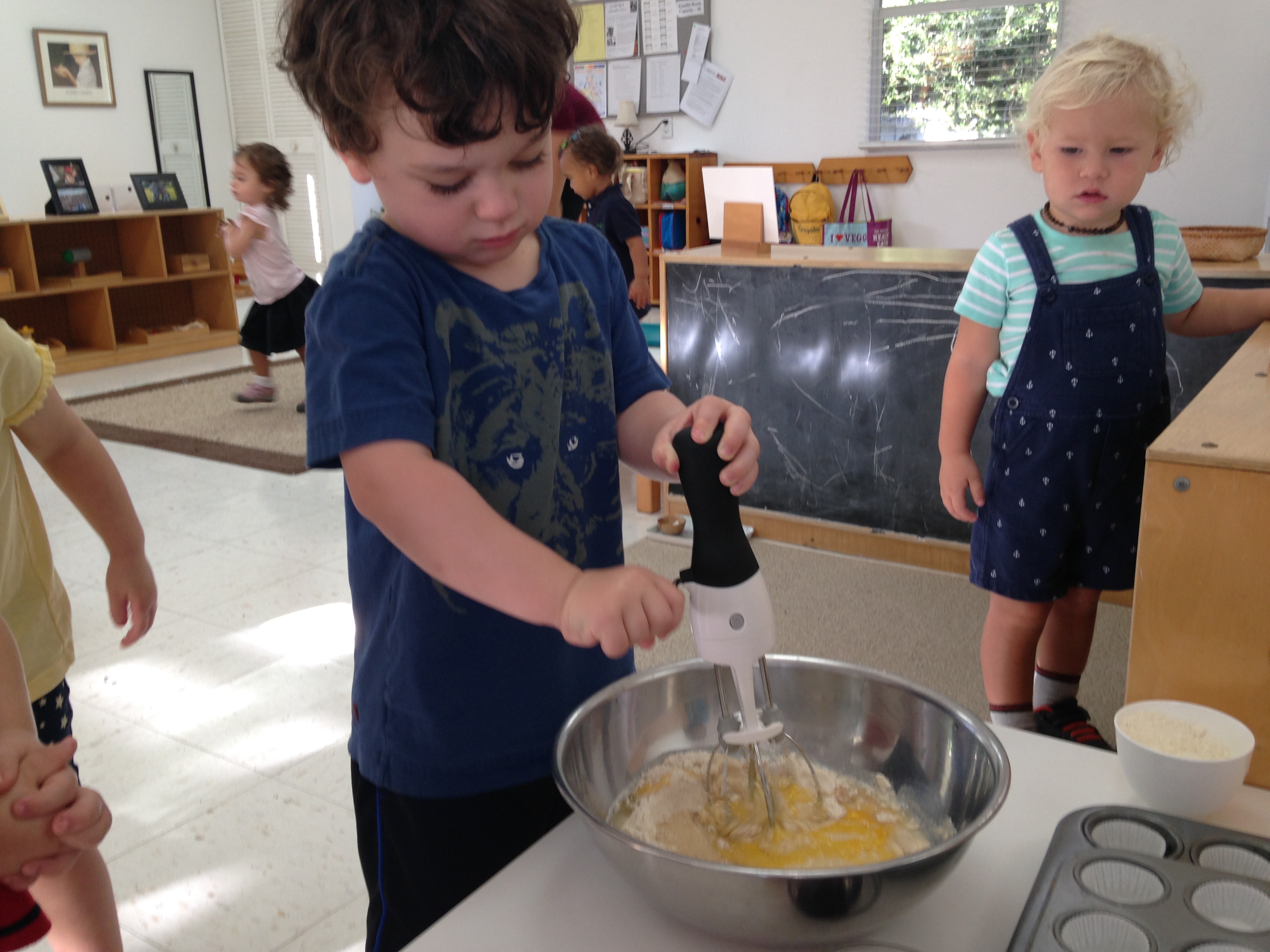
Making Muffins
Photograph by Kristi Antczak
Several times, the children would cry as they left their Montessori teacher and their classroom environment. “Why can’t we stay with you?” could be heard in the hallways as the teachers led them to their next classroom.
The five and six-year-olds in the classroom also felt a loss. While they reveled in being the oldest children in the class, they did not always enjoy having the classroom all to themselves in the afternoon. They missed their younger friends. This kind of afternoon had been our standard operating procedure—how would things change?
“What do Montessori children do all day? Simple. They do what they feel like doing, within the same reasonable limits that define the culture of the classrooms in the morning. When they are hungry, they eat. When tired, they sleep. They may read, write, paint or draw. They may work in the garden, watch the wildlife that surrounds the classrooms, They continue with their math, science, history or geography. They cook, clean, and explore the sensorial materials. They work alone or with a friend as they wish.” Tim Seldin
The time came for planning the next school year—and with it, the knowledge that more children would be joining our classes. Change is hard, but something had to be different. So we asked these questions:
- What are the needs of the majority of our families?
- What would it be like to have the children in our classroom after lunch?
- How long should they stay after lunch?
- What about those children who needed to rest?
- If they slept through the afternoon, what would be the point of staying in the classroom?
- Are three-year-olds ready to stay in the classroom all day?
- Is staying in their classroom until 3 p.m. too long a day for them?
A few months earlier, I had something astounding happen, something that brought tears to my eyes and led to the discussion of All Day Montessori being a possibility at our school. I had my “Extended Day” children in the classroom after lunch. After lunch was eaten, the children normally rested for a bit, reading or relaxing until we began the afternoon work cycle. One of the children had fallen fast asleep, and without my saying a word, the other children got up and began to find work, reminding each other to be quiet, so as not to disturb their sleeping classmate. They did this for over an hour, and I had no problem with that child sleeping for that length of time since she had seemed tired and out of sorts all morning. I marveled at what had transpired. Isn’t this what being in a Montessori classroom was supposed to be about? Real-life situations, caring for others, respect for others, concern about others’ well being?




The Montessori Foundation recommends that “schools organize themselves to provide Montessori all-day programs in the same environment—with Montessori guides—to achieve the level of concentration and educational gains that we read about in Montessori but so rarely see in practice these days.” (Organizing a New Montessori School, p. 143, Montessori Foundation, 2000)
We looked at the needs of the families in our school and found that the majority needed their children to be at our school until 3 p.m. The decision was made to offer a Montessori program from 8:30 p.m. until 3 p.m., with before and after school care offered in addition to that time period. Some children will be going home at noon, but the majority of children will stay and eat lunch, rest, and begin another work cycle until 3 p.m.
At first, some parents were not happy with the schools’ decision to change the program, so we offered an evening question and answer session to discuss their concerns. The Primary teachers discussed their excitement over having the children remain in the classroom after lunch. Some concern was expressed over how the upcoming “Extended Day” students would fit into this new schedule without the tradition of “Extended Day” time in the afternoon. The teachers answered the questions honestly and sincerely, discussing some ideas and plans they were planning to implement. It was a satisfactory meeting for all those involved; several parents commented later that they could tell we had their child’s needs foremost in our decisions, and they were willing to stay in our school and give the program a try.
We believe that an All Day Montessori program should be homelike with the real sense of community that occurs when children really live together within one group that stays all day. Children are challenged to do work with a greater range of choice and fewer pressures of time, including the opportunity for two full work cycles. The all-day Montessori program takes advantage of longer hours, allowing the child to exist at the natural pace very close to that of the home environment.”
It is my hope to share with you our journey as we begin this new program. Another article will be written mid-year to see how we are progressing, and a final one will discuss the overview of our year and how it progressed. Is an All Day program right for your school and the needs of the families? Our staff is firmly committed to this program and strongly believes it will best fulfill the needs of our families.
Join us in our journey, and perhaps you will consider a change to an all-day program for your school as well!
Want new articles before they get published?
Subscribe to our Awesome Newsletter.