 Reflecting on the Montessori concept of “follow the child,” which was the main theme of The Montessori Foundation’s 20th Annual International Conference. I found that it was an invitation to rediscover the child, understand his nature, and encourage him to explore his inner potentials, without interventions to shape him according to our own desires and wishes. Montessori clarified this point when she stated:
The adult has not understood the child or the adolescent and is, therefore, for subjected to continual strife with him. The remedy is not that the adult should learn something intellectually or complete a deficient culture. The adult must find a different starting point. In their dealing with children, adults look upon the child as something empty that is to be filled with their own efforts, as something inert and helpless, for which they do everything, as something lacking an inner guide and in constant need of direction…But if a child has within himself the key to his own personality, these must be delicate powers indeed, and an adult by his untimely interventions can prevent their secret realization (The Secret of Childhood, 1936).
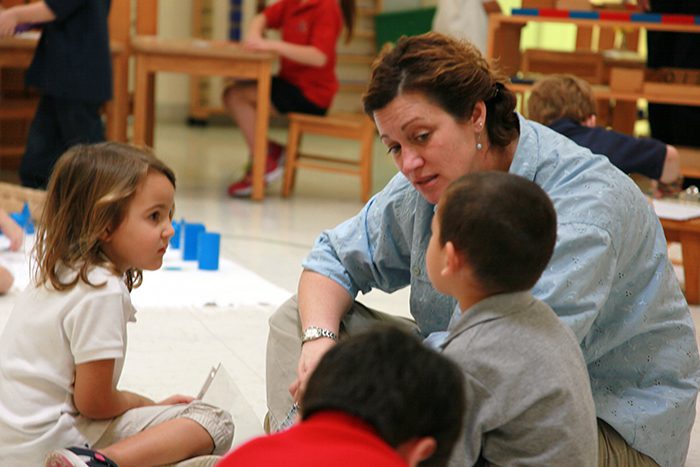
“Follow the child” is an invitation to observe how actively each child interacts with what he/she learns, with the environment, with the materials, with other children, and with adults, including his parents and family, teachers, peers, and the community. Teachers and parents need to observe how the child, through such interactions, communicates, connects, and collaborates to develop physically, cognitively, emotionally, socially, and spiritually. It is in this full development of the child as a whole that the future of humanity lies.
As a matter of fact, learning emerges from interactions. Since the basic principle of the Montessori Method centers on “following the child,” the main concern of a Montessori teacher is how to prepare motivating environments, based on interactions. Educators and parents who believe in Montessori education, always ask themselves, what is the Montessori Method? A good way to learn how the Montessori Method works is to observe a classroom in action.
Montessori Interactive Teaching
Interactive teaching is based on encouraging children to be part of the lesson instead of being passive learners who memorize information. Interactive teaching methodology is learner centered rather than teacher centered, encouraging imagination, creativity, and strengthening critical and creative thinking, problem-solving skills, and emotional and social skills. The Montessori Method is an interactive teaching method to assist children to explore their surroundings using open-ended questions to tap into their ability to wonder, so as to manipulate, innovate, and create. Therefore, Montessori teachers must design stimulating, positive environments that allow children to interact actively while working individually or in groups. Working in groups, children interact socially and culturally, thus acquiring advanced social skills, while absorbing and creating knowledge. Children also manage to develop self-organized and self-directed personalities through interactions. It is through interactions that children increase their learning opportunities.
Tracing interactive teachings can go back to many theorists, including Montessori herself. The cognitive constructivist social learning theories of Vygotsky, Bandura, and the situated theory of Lave are rooted in interactive teaching. As a constructivist herself, Montessori believed that learning means “discovery,” when children learn concepts from working and interacting with materials and people. Children develop self-construction by means of interaction with people and environments. According to Montessori, children who choose freely within a positive environment can act spontaneously for optimal development. Therefore, interactive teaching strategies address the individual need for children to be active in the learning process as children can strengthen their knowledge by interacting with their classmates.
Montessori interactive teaching provides numerous opportunities for children to foster their observational, listening, communication, and interpersonal skills. Therefore, the role of the Montessori teacher is to prepare hands-on materials and group activities that are relevant to the real world. Montessori stressed the importance of providing a nurturing environment to teach social interaction and emotional skills. Montessori believed that “These children have free choice all day long. Life is based on choice, so they learn to make their own decisions. They must decide and choose for themselves all the time. They cannot learn through obedience to the commands of another” (The Child, Society, and the World: Unpublished Speeches and Writings, 1989).
Children need social interactions to develop independently into whole individuals who are capable of making appropriate decisions and expressing themselves creatively. Therefore, the Montessori teacher should be able to design a developmentally responsive, culturally relevant learning environment, i.e., interactive. The main role of the teachers who employ interactive teaching is to let learning happen spontaneously. In such stimulating environments, children discover their human potential. The activities that can enrich the Montessori learning environments include sensorial and practical practice when art is an integral element.
Montessori through Art
Montessori believed that “If we try to think back to the dim and distant past… what is it that helps us reconstruct those times, and to picture the lives of those who lived in them? It is their art… It is thanks to the hand, the companion of the mind, that civilization has arisen” (The Absorbent Mind, 1949). Learning spontaneously can be achieved through art. Art is a language that children should learn.
Actually, the main foundation of Montessori curriculum is artistic, and it is linked to art, in terms of the activities that children use in math, science, culture, geography, botany, and language arts. Such activities associate learning with colors of sounds, letters, and shapes. Children learn to mix colors using a dropper to identify different colors and smells. Children also use primary and secondary colors in motor activities, and they use colors in line and geometric shapes. Children’s activities include the use of art trays and the leaf chalk art. Children use assorted colors in learning about earth, continents, and countries. Children use art in clay and dough activities, and in painting sandpapers to make flowers or alphabet letters. In addition, art is used in Montessori cards for math, language arts, culture, and science, the Montessori pink series, the farm activities, the collage work, the colorful quilts, spice painting, and in making nature paintings.
All these are art-based activities that are immersed in the Montessori curriculum.
In fact, art is woven into Montessori activities. Montessori aimed at encouraging parents and teachers to expose their children to fine art since birth. She also wanted parents and teachers to provide children with famous artists’ works to enhance creativity and a natural appreciation of art. It is through art that children develop a sense of aesthetic value and understand valuable meanings of life and human nature. Art brings not only order and beauty to children’s environment but also gives them opportunities to enjoy their individual expression. Art helps children explore their self-identities. Children develop their skills in mathematics, science, engineering, architecture, and fine arts through enhancing Montessori sensorial and practical life experiences. An example of how Montessori activities resonate in real life is Mohammed Abl’s Tower painting, which resembles the Montessori Pink Tower.
Abla Interactive Method Applied in Montessori Curriculum
Mohamed Abla is the prominent international Egyptian artist, who initiated his interactive art method to help children interact socially in the real world. Abla has used his interactive method with children and adults in Egypt and in Arab countries, such as Kuwait, Bahrain, Dubai, and worldwide in Germany, Norway, Sweden, India, and in Boston, USA. Abla also used his method with children with special needs. Abla’s interactive method is based on using paint. It does not have to be expensive paint so that schools can afford to practice this method regularly. Using plastic wraps as a silhouette, children interact with each other through drawing and painting on the plastic stretched sheets. Children are divided into two groups: the first group stands behind the sheet of plastic to become the models while the second group stands in front of the sheet to become the painters and paint them. Children alternate so the model children become painters and the children painters become models. While the painting session takes place, children introduce themselves to each other and share their ideas, opinions, and stories, which makes this interactive method very effective in helping children acquire social, emotional, and communicative skills spontaneously.
Abla’s interactive method is based on the philosophy that art is life. Abla believes that “we can see others as we see ourselves… Bringing the children and adults together through this interactive art method is a natural way to spread love, compassion, and peace among people.” When implemented at schools, children can use this interactive method in language arts to write stories about their experiences. The wall becomes the script for telling their stories. Children can also sing songs or share poems while painting together on the plastic silhouette. In science, children use the plastic silhouette to play the role of scientists as they play the role of artists, models, and viewers. They can also practice the numerals tables, addition, subtraction, and division while being engaged in painting each other. When children work on social studies activities, including geography, history, and culture, they can wear the costumes of their own cultures; hence, the plastic silhouette becomes a real-life script of the children’s passionate and authentic expressions of their cultural identities.
Abla also used the same silhouette plastic interactive method with teachers at schools to help them relax and renew their energies. Creating a caravan of social interactions, this method helps teachers to enhance engagement with children and their parents. In this relaxing environment, teachers and children enjoy that their paintings tell
their stories.
Abla’s interactive method is compatible with the Montessori environment, since teachers can provide open-ended art activities that help children express themselves freely to discover their abilities and acquire new life skills. Montessori believed that “when a free spirit exists, it has to materialize itself in some form of work and, for this, the hands are needed. Everywhere, we find traces of men’s handwork, and through these we can catch a glimpse of his spirit and the thoughts of his time” (The Absorbent Mind, 1949).
Similarly, Abla believes that art is a way of approaching life, and it cannot be separated from life. Abla explained, “I give children and adults the opportunity to meet in life and be part of what is happening and engage directly to alternate the imaginative with the experience… I give them the opportunity to perceive reality in different contexts, to know the others, and recognize, respect, and love themselves. My method is a form of life and action in the existing reality that occurs as a result of the sequence of relations between individuals and the surrounding world. Children think, reflect, communicate, connect, and create in happiness and joy. I give them the opportunity to celebrate life within, in others, and around themselves.” In other words, one can say that the plastic silhouette becomes social scripts for exploring the perceptions of the other—mentally, emotionally, socially and culturally—while each child discovers his/ her own creativity. As such, this interactive method has many advantages.
Advantages of Abla Interactive Method
The most important advantage of using Abla interactive method at Montessori schools is that it helps children to enhance cognitive and metacognitive abilities. It helps create positive learning environments, where children can demonstrate diligence and positive work ethics while embracing integrity and accountability. Children use their interpersonal and intrapersonal skills to solve problems. It is also a unique way to leverage the strengths of others and support the goals of the community. It is also an effective way to enhance children’s affective skills. It helps children to connect with each other in an interactive manner to reinforce human bondage and values.
Another important outcome of Abla interactive method, which is aligned with Montessori principles, is that it provides a platform for Socratic discussions, which can foster the values of the Montessori community. Moreover, being involved in art sessions can ease the dominance of technology in the lives of children and help in changing disruptive impulses and negative behaviors, as children learn to respect the protocol of taking turns, listening attentively, and supporting their different perspectives.
Abla’s interactive method is didactic and can be used smoothly in Montessori schools. It is a unique way to explore Montessori from the perspective of contemporary art and to deepen our understanding of how to “follow the child” and penetrate into his nature.
Designing dynamic activities that incorporate art helps in increasing children’s imagination. As Montessori stated, “We cannot teach a person to be an artist, but we can help him develop an eye that sees a hand that obeys, and a soul that feels. Imagination does not become great until a person, given the courage and strength, uses it to create. If this does not occur, the imagination addresses itself only to a spirit wandering in emptiness” (The Absorbent Mind, 1949). Without the faculty of imagination, creativity stumbles, and learning becomes imitation and not real or spontaneous. Consequently, children will not be able to grow in healthy and safe environments, where they can develop themselves as whole beings, and our humanity will not be able to progress. Education should not limit itself to transmission of knowledge. As Montessori noted, “Its aim must be to give the necessary aid to human development. This world, marvelous in its power, needs a “new man.” It is, therefore, the life of man and his values that must be considered”(From Childhood to Adolescence, 1987). Interactive teaching is a way to move beyond the confinement of the classroom, helping teachers to become proactive agents for improving their classrooms and schools while children acquire the skills that are necessary to awaken and nurture the proactive human being within, the inner force and spark of life. Indeed, “follow the child because within the child lies the future of humanity.”
Acknowledgment; The author wishes to acknowledge Mr. Mohamed Abla for providing me with the information needed to document his method with research studies in the field of education.
Montessori Leadership / February 2017 / p 25