Recently, Blakely Jayne, my 19-month-old granddaughter came for a visit. My son-in-law brought her down from New York while he visited with his own grandfather, so I pretty much had her to myself for four glorious days. Now that she’s totally mobile and quite verbal, we did many fun activities together. One day, I took her to the NewGate School, which you know is the lab school of The Montessori Foundation.
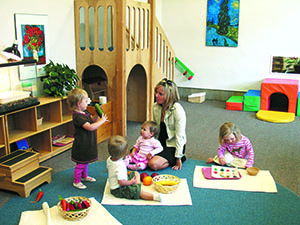
NewGate’s Toddler room is especially designed to meet the needs of the young child. It is simple, clean, organized, and features age-appropriate materials. It is not overly stimulating to any of the senses. The children have freedom of movement to a deck area that, here in Florida, is an extension of the classroom space. Out there, they can work with play dough, bounce on a small trampoline, master the stair climber (up and down), and engage in other activities involving water and paints.
The children are able to make decisions about transitioning from activity to activity and space to space as long as they, too, are respectful of working on their mats and bringing their lessons back to the place from where they took them. Even though Blakely was new to the class (and the youngest child in the room), she soon became comfortable enough to try just about everything, and she made some new friends.
I was simply an observer and, once she warmed up to this new and exciting space, she freely moved about. By the end of the morning, she sat in circle time with Ms. Lauren, the Toddler guide, and the other students. She participated in some song singing, while just delighting in the entire experience.
Because Blakely’s parents do not live within a commutable distance to a Montessori school in their area, I have tried to introduce many of the philosophies and practices into her life in the home environment.
I’ve encouraged them not to overwhelm her play area with ‘stuff.’ Children are easily overwhelmed by too many toys at their disposal, and while we, as parents and caregivers, think the child has a great selection of items to keep them busy for hours, the outcomes are usually not what we hope for. Too many toys and games do not encourage the child to work on any one item for long periods of time. Without a multitude of distractions, toddlers increase their attention spans and mastery of one thing. We want to encourage toddlers to return toys to their rightful spots and help them learn to appreciate and respect what they have.
We take one age-appropriate activity out at a time. I let Blakely explore it for as long or short a time as she wishes, and then it must be returned to its place before we go further. I prepare an outside environment for her that is safe, interesting, and bigger than her inside one, so that she has access to water play, paints, and plants to water. Spills and messes are easily cleaned up, and I set no prejudgments or expectations of what she should accomplish. I let her set the pace and delight in squishing paint between her fingers, even if it never makes it to the paper. A sponge, a table, a small pail of water, and some diluted dish soap kept her busy for almost an hour while she learned to squeeze the sponge, rub a table, wipe up water, and make something shine — all while developing those motor skills. Our screened-in lanai (‘porch’ for you northerners) is surrounded by lots of flowers and plants that attract butterflies and birds of all kinds, so she can get up close and personal while being in a safe environment.
As grandparents, we have the best of both worlds. We get to love unconditionally and spend real quality time with grandchildren. Our tendency is to spoil. It’s so easy to do. For the best outcome I encourage you to observe, engage, and enjoy, which will foster all the great skills that you would hope your grandchildren will get out of their Montessori education. The more you use the philosophy of Montessori when you are with your children or grandchildren, the more they will get out of their Montessori classroom or home-school experience.