
 The first Montessori classroom, or ‘children’s house,’ opened in 1907 in a poor section of Rome. At that time, there were very few objects for the use of the children, i.e. what we now call ‘Montessori materials.’
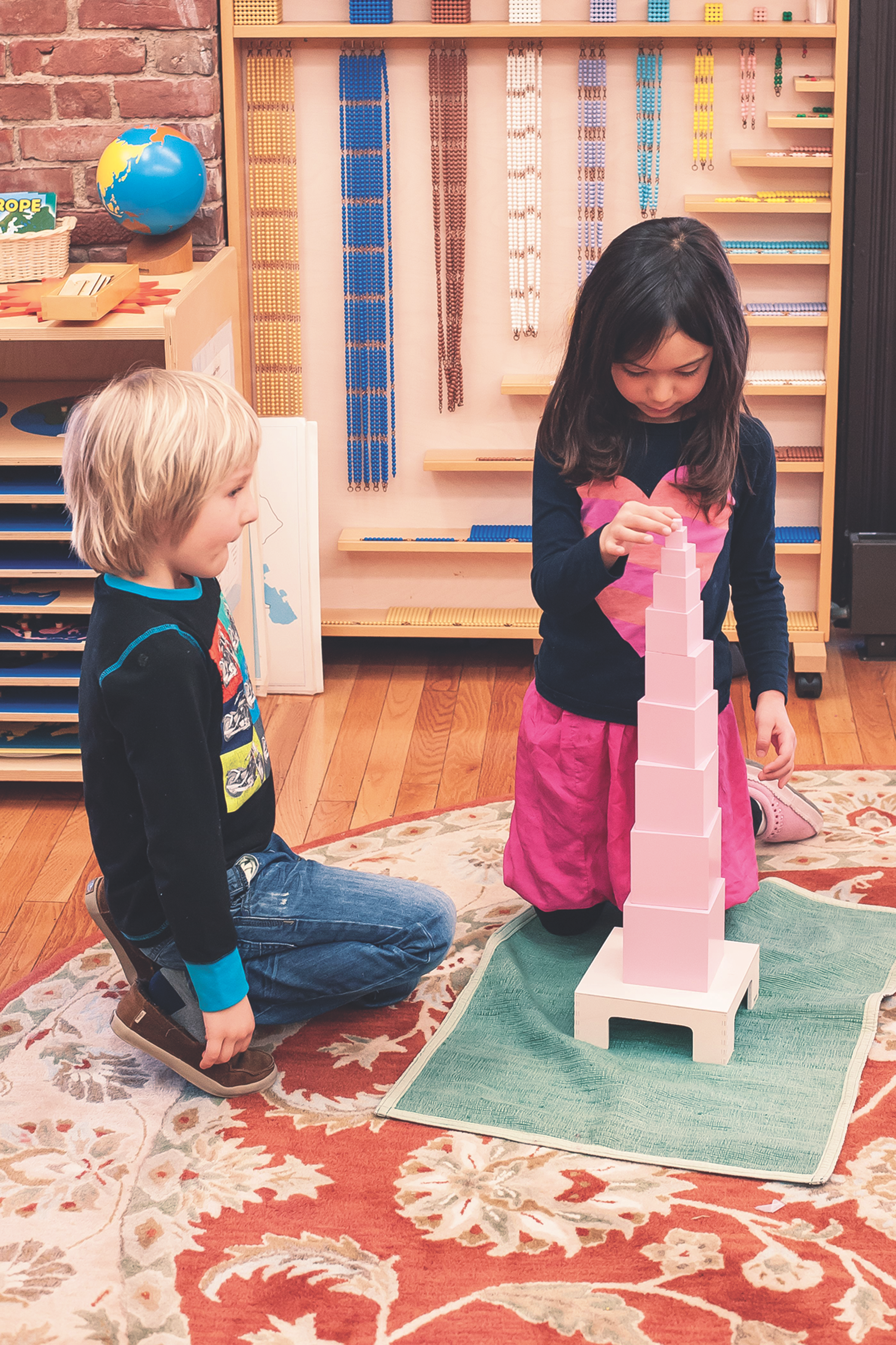
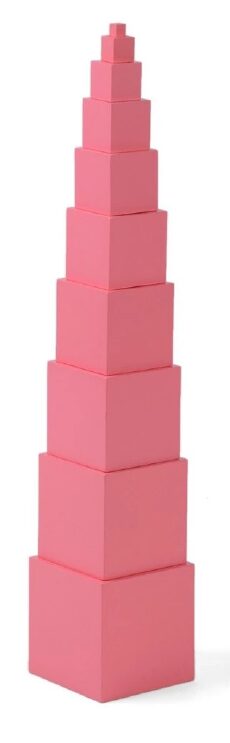
One of the original materials that goes back to that time is one that has now become iconic in all Montessori schools around the world. Called the Pink Tower, this is a set of 10 perfectly milled cubes. They range in size from 10 cm on each edge for the largest cube, all the way down to a simple 1 cm cube. Each one differs by just 1 cm in measurement.
No one really knows for sure why Maria Montessori chose to paint these cubes pink. There are a variety of speculations, but that is all they are.
The Pink Tower belongs in the section of the Montessori classroom called Sensorial. This is an area devoted to the education and development of children’s sense perception. The Pink Tower is a part of the material devoted to the visual sense, sight. Its goal is to help children in discerning size as well as learning vocabulary words associated with size, such as: large, larger, largest, small, smaller, smallest, etc.
This fanciful story imagines the development of the Pink Tower as being semi-magical. I wanted to bring in elements of the famous story of The Elves and the Shoemaker. In this story, I also wanted to utilize poetry, with a component of repetition. If this works, as I hope it will, children will begin to be heard chanting some of the poems that are used in this story. That is my wish at least.
In Montessori schools, the Pink Tower is usually thought of as something appropriate for preschool children, aged 3 to 6. However, there are many uses for it that go well beyond preschool, all the way into upper elementary and perhaps even beyond. One of the references at the end of this book refers to an article I published in Montessori Leadership detailing many of the uses of the Pink Tower. Please see that article for more information and some interesting activities to do with elementary school children (available to members of the International Montessori Council, stage.montessori.org).
Be sure, when telling this story, NOT to mention the Pink Tower in any lead up to the story or in the beginning. Let it unfold as it is in the story, so that the realization that it is the Pink Tower dawns as the story reveals the actual material.
This story was inspired by my grandson Elliott Dorer, aged seven at the time. Elliott has listened to me tell stories for his whole life, so I wasn’t surprised when he came to me one day with a story idea. “How about the Pink Tower?” he said. “It could be a story about the cubes!” That got me started on this story, and I am grateful to Elliott for the germ of an idea.
For this story, let yourself get into a fanciful mood. Try to imagine a small woodworking shop with sawdust on the floor and sunlight streaming in through the windows, illuminating the dust motes dancing in the air. In that room works Taksaka, the elf. This elderly woodworking elf is the main character of my story.
It is my hope that these ten simple chunks of wood, stained or painted pink, can acquire a special cachet in the minds of the children because of some of the images in this story. The Pink Tower really is magical in that it is nothing more than ten simple wooden pieces and, yet, with them, one can do so much. I hope you enjoy this story of the elderly elf Taksaka and his magical piece of wood.
The Magical Wood
 It was a beautiful warm, sunny summer’s morning. Fluffy clouds adorned the sky, and the tiny village was filled with the happy sounds of children at play. In that small village stood a modest woodworking shop, the workplace of the elderly elf Taksaka.
Every day Taksaka worked to create the most magnificent and intricate wooden objects. Working with the finest wood and with the skill and patience only known to elves, Taksaka shaped items of astonishing loveliness.
So, it was with great delight that Taksaka welcomed his friend Elvina, who paid him one of her very infrequent visits. After warm greetings and a steaming cup of meadowsweet tea, Elvina revealed the reason for dropping in.
“Dear Taksaka,” she murmured, “I bring you a gift especially suited to your talents and powers.” With these words, she revealed a package wrapped in rich silken cloth. As it was unwrapped, Elvina explained, “This is a block of the finest beechwood, harvested by elven hands from the depths of the Romanian forests. This is no ordinary wood,” she continued, “for it seems to speak with its beauty.”
Presenting the fine specimen of beechwood to Taksaka, Elvina further intoned, “Please create from it the simplest shape possible, for it cries for purity.”
In the days that followed, Taksaka frequently examined the beautiful specimen. This became a daily habit, even a ritual. Then. one night, while in a dream so deep, Taksaka stirred and moved in his sleep. He was astounded to hear in his mind the voice of the powerful piece of wood speak in sweet and dulcet tones:
Six square faces tell how I must be
Six equal faces will let me see
One face looks to the sky so blue
The second sees ground moist with dew
Another face to the west does gaze
To the east a face sees the sun’s bright rays
The southern face enjoys the warming breeze
The northern face admires the wintry freeze
Six square faces tell how I must be
Six equal faces will let me see.
The next morning Taksaka pondered deeply the meaning of his dream. What could it be telling him? For three nights he heard the voice of the wood and then, with deep delight, he discerned the meaning of the dream and the will of the wood.
Taksaka immediately cleared his workbench and sharpened his tools. With the greatest care, he carved an exquisite piece of splendid wood from the magical block. With careful diligence and precision of movement, the old elf shaped the wood into a perfect shape simple and pure, a shape with six square faces.
Taksaka had created a cube, a simple form of great beauty. With great exactness, he finished it to perfect and ideal proportions.
That night while in a dream so deep, Taksaka stirred and moved in his sleep. Once again, he heard the voice of the wood:
All six faces now smile and beam
For I am now what was a dream.
The next morning Taksaka awoke refreshed and happy. He put the beautiful and magical cube into a safe place where he could gaze upon it at any time. In time the sunny days of summer gave way to the winds of autumn. As the leaves fell, the air turned cooler, letting all elves know that winter would soon visit with its snow and ice. One very chilly night while in a dream so deep, Taksaka stirred and moved in his sleep. Once again, he heard the voice of the cube:
With winter’s blast and icy storm
I need a coat to keep me warm
A lovely coat, well colored I think
My choice will be a coat of pink
For three nights Taksaka heard the voice of the cube and then he determined to fulfill its wishes. He hastened to his workshop and searched high and low until he finally found a container of the most beautiful salmon pink paint. “This must be it,” thought Taksaka. “This will produce a perfect coat of pink.”
Carefully Taksaka covered the little cube with an even coat of pink paint. When he was done, he stood back and admired the glistening pink cube. “You now have your coat of pink,” he told the cube. “Stay warm in your lovely coat.”
The winter passed as it always does, and spring’s warm breezes called to one and all to join with their companions to frolic in the spring air. That night while in a dream so deep, Taksaka stirred and moved in his sleep. Once again, he heard the voice of the cube:
Sixty square faces tell how I must be
Sixty equal faces will let me see
Ten faces look to the sky so blue
Ten more see the ground moist with dew
Ten faces to the west do gaze
To the east, ten faces see the sun’s bright rays
Ten southern faces enjoy the warming breeze
Ten northern faces admire the wintry freeze
Sixty square faces tell how I must be
Sixty equal faces will let me see.
The next day Taksaka again pondered the meaning of his dream. What could it be telling him? For three nights he heard the voice of the cube, and then, with deep delight, he finally discerned the meaning of the dream and the will of the cube.
Taksaka immediately cleared his workbench and sharpened his tools. With the greatest care he carved nine exquisite and splendid pieces of wood from the original magical block, using it up completely. Then the old elf shaped the nine wooden pieces into perfect shapes, each one identical to every other one except that every one was just a little bit larger than the previous one. He had formed nine perfect shapes simple and pure, each shape with six square faces.
The nine shapes that Taksaka had created were perfect cubes that could now join his single pink cube to create a lovely set of ten. Every cube increased in size just a bit, just exactly the dimensions of the smallest cube.
Next Taksaka took out his jar of paint and gave each cube an even coat of pink. They would all be warm and cozy in their new coats. When he was done Taksaka stood back and admired the ten glistening cubes. The first pink cube finally had nine friendly companions with whom it could frolic.
That night while in a dream so deep, Taksaka stirred and moved in his sleep. Once again, he heard the voice of the smallest cube:
My sixty faces now smile and beam
For I am now what was a dream.
But stack me up, make me tall
For I’ll be a tower and stand over all.
The next morning Taksaka awoke refreshed and happy. He carefully stacked the ten perfect pink cubes from largest to smallest. It was a tower – a tower of cubes, all pink. So, it was with great delight that Taksaka welcomed his friend Elvina who again paid him one of her very infrequent visits. After warm greetings and a steaming cup of meadowsweet tea, Taksaka showed Elvina what he had crafted from her magical wood.
“A Pink Tower,” cried Elvina, “It’s a Pink Tower!” And so it was that the tower of pink cubes became known to all as The Pink Tower.
The fame of the Pink Tower spread through the small village and all the people visited to see the wonderful cubes in their coats of pink. Children, especially, were entranced and Taksaka, being a kindly elf, would often let them take all ten cubes to mix them up and then rebuild the tower again and again. Soon the tower’s fame spread far beyond the village, and Taksaka became very busy making more Pink Towers for people to take to their homes and schools.
And thus it is so even today. A Pink Tower can now be found in schools on every continent, all around the world. They offer beautiful memories of that first magical pink tower of cubes.
Of course, you will want to build this wonderful tower yourself. You might be happy to hear that it is said that if you very carefully mix up the cubes and build the Pink Tower with the greatest care, later that night in a dream so deep, you may stir and move in your sleep. If you are very lucky you may then hear these words:
Sixty square faces tell how I must be
Sixty equal faces will let me see
Ten faces look to the sky so blue
Ten more see the ground moist with dew
Ten faces to the west do gaze
To the east, ten faces see the sun’s bright rays
Ten southern faces enjoy the warming breeze
Ten northern faces admire the wintry freeze
Sixty square faces tell how I must be
Sixty equal faces will let me see.