 Flipping the pattern of thinking, so that meal preparation, meal-time, and cleanup are essential lessons in Practical Life and Grace and Courtesy Often, school meals, along with the associated cooking and cleaning, are regarded as an intrusion on the school day. What is required is to flip this pattern of thinking over, to see meal preparation and the washing of dishes as integral to Practical Life and the meal process as an essential exercise in Grace and Courtesy.
Remember that the words ‘Montessori Classroom’ are something of a misnomer that contributes to incorrect thinking about the purpose of the environment. The Montessori prepared environment for children between 3 and 6 was called Casa dei Bambini by Maria Montessori, and the correct translation of this is Children’s Home. The implication is that this is a home-like, rather than a school-like environment.
That applies not only to décor but also to the way the day is arranged (no school or office-like schedules) and the interactions between the people using the space (occupants of a home have a significantly different relationship with the furnishings and other objects than do the occupants of a school room or office).
One of the implications of this way of thinking is that it places meals and eating into a very different focus. In a typical school or workplace, meals intrude on the real business or learning or producing some end-product of commercial value. The Montessori environment is focused on the living human child and the process of growing and developing. This allows us to see mealtimes as an opportunity rather than a problem.
Margot Waltuch, describing La Maison des Enfants in Sèvres, France, between 1933 and 1938, writes that:
“Sometimes at the beginning of the school year, when first meeting the children, it would be enough simply to let them talk. We would listen to music, or we would share some food, or simply go on a little walk and pick wildflowers. Presentations were much shorter and fewer than what are done with a new class today.” (Waltuch, 1996).
Waltuch explains how cooking and eating were integrated into the day:
“Through cooking, children are introduced to a whole new world of sensations: tastes, smells, colors, textures, blending, and changing —all that cooking entails. They are given the opportunity to explore the otherwise forbidden realm of knives and fires. Working with the tools of cooking develops manual dexterity. And, of course, cooking and eating is an occasion for interaction with one another. We had a full-course meal daily. We ate with the children and discussed their experiences in the parks, the museums, their parties, etc. They talked about future events and past events, always making laughter and jokes. The French children were masters of conversation at the table. Also, typically French, was the style of waiting on the table. The eating and talking alone usually took an hour. Introduction of foods and their preparation is still another form of sensory exploration. Noodle-making, bread-making, peeling, cutting, grinding, chopping, slicing, grating, squeezing—these are not only ways of extracting from nature what you need to eat but great builders of hand-eye coordination, sequence, and social life”
(Waltuch, 1996).
To incorporate meals into the day in the way described above requires that the curriculum be re-examined. Mealtimes become not an addition or a necessity but are interwoven into the Practical Life, Sensorial, Math, Language, and Cultural areas of learning.
PRACTICAL LIFE AREA
The Practical Life area includes many activities that help the children learn the basic skills and movements necessary for them to take part in food preparation, table preparation, serving, and cleaning up afterwards. Shelf activities must be carefully analyzed to ensure that they contain real activities that develop real skills, with lots of food-preparation activities. Once children have mastered basic skills (such as: buttering bread, washing, peeling, and chopping fruit and vegetables, mixing, whisking, and so forth), they are able to take part in helping prepare the midday meal.
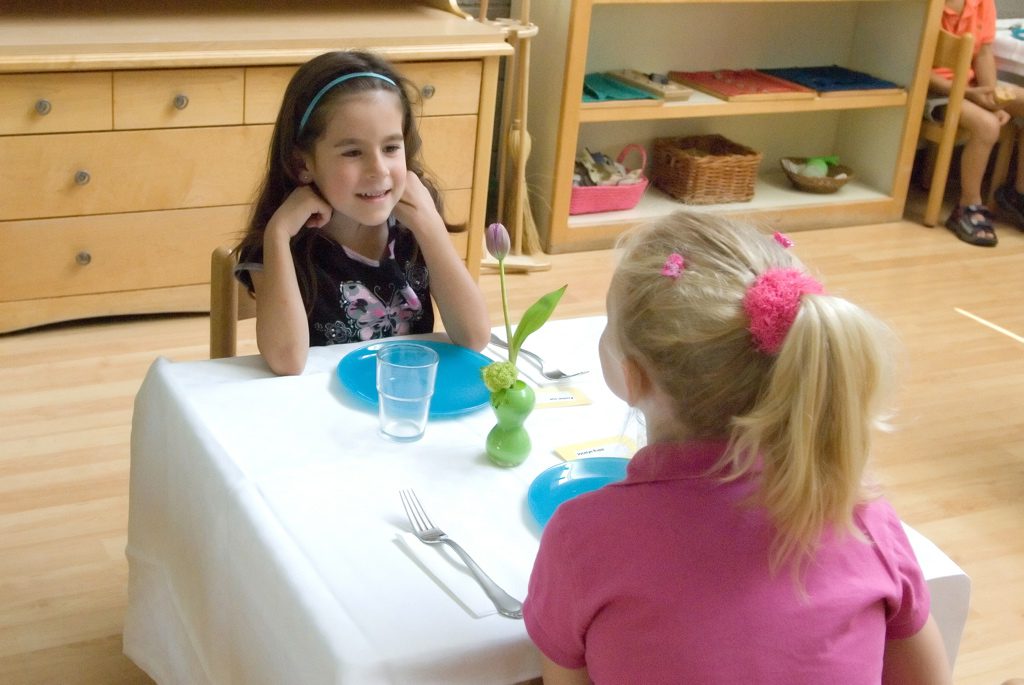
Presentations of carrying tables and chairs allow children to re-arrange the furniture for lunch. Instead of contrived shelf-based table-setting work, children lay the table for lunch. If tablecloths and cloth serviettes are used, this provides a continuous stream of cloths for washing, drying, and ironing (or at the very least, folding) by the children. Controlled washing activities extend into washing the lunch dishes and packing them away.
The children serve the meals. There are a number of ways to do this. Meals can be served buffet style, where children serve their own food; alternatively, bowls can be placed on the table for the children to help themselves. Another option is for a few children to serve as waitstaff, as is described by Waltuch and by Maria Montessori herself:
“Anyone who has watched them setting the table must have passed from one surprise to another. Little four-year-old waiters take the knives, forks, and spoons and distribute them to the different places; they carry trays holding as many as five water glasses, and, finally, they go from table to table, carrying big
tureens full of hot soup” (Montessori, 1912, p. 346).
Not a mistake is made, not a glass is broken, not a drop of soup is spilled. All during the meal, unobtrusive little waiters watch the table assiduously; not a child empties his soup bowl without being offered more; if he is ready for the next course, a waiter briskly carries off his soup bowl. Not a child is forced to ask for more soup, or to announce that he has finished” (Montessori, 1912, p. 349).
Adults eat with the children, which provides an opportunity to model and present a wide range of skills, including: asking for more; offering; passing food; eating politely; excusing oneself courteously; and engaging in appropriate conversation at the meal table.
If you have a garden (or even space for pots of herbs that the children can tend), you can incorporate that into your cooking, but if you can grow lettuce, tomatoes, carrots, etc., then children can plant, harvest, prepare, cook, and eat foods from your garden. This leads perfectly into lessons that would normally be lifeless materials on the cultural shelves.
SENSORIAL, CULTURAL, MATHEMATICS AND LANGUAGE EXTENSIONS
Food preparation and eating provide endless opportunities for children to extend their senses of taste, smell,
texture, color and even sound, which have been refined through working with the Sensorial materials. Take time over food preparation and mealtimes to talk about how each food item tastes. What is the texture? Does the child enjoy (or not enjoy) a particular food or the way it has been prepared?
Have special days during which you research and prepare food from a particular culture and experience the mealtime courtesy that relates to that culture. Talk about the origins of certain foods and link shelf materials, nomenclature cards, and other items in the classroom to the real, concrete experiences the children have had at mealtime. You could even use culture-specific dishes and utensils.
The opportunities to include Math concepts are endless. Begin with simple one-to-one correspondence. For example, you can suggest that a child “Set enough places at the table for everyone in the class” and allow the child to solve the problem. On another day, say “There are two children away today, how many places to you think we will need?” This type of real problem is far better than the contrived ‘problem sums’ found in conventional workbooks. The challenges progress to fractions and ratios. This kind of activity helps children understand the purpose of mathematical operations and encourages them to think mathematically.
ELEMENTARY
At the Elementary level, food preparation and meal planning can be taken to a higher level and integrated into studies related to fundamental human needs, history, science, biology, and so on. Students can research and plan menus, assign tasks, budget, buy ingredients, prepare meals, and even undertake
research that gathers feedback from
other students.
PRACTICALITIES
Besides requiring something of a paradigm shift, the approach to school meals suggested above requires planning and adjustments to your classroom design. Some areas have licensing requirements that make this very difficult, and you may need to negotiate around these limitations. Where you are able to legally cook and eat with the children, it makes sense to take full advantage of the opportunity. It is obviously easier to incorporate this approach into small schools. If you have a larger school, with a full commercial kitchen then you can explore different options.
Schools in Reggio Emilia, Italy, ensure that the kitchen staff is trained to work with the children, and every day children are invited to help with food preparation. Alternatively, a specialized, child-sized kitchen area can be created, and the different classes in the school have the opportunity to use it on a rotational basis. Every situation will be different, but I have no doubt that every school can find ways to introduce these activities for their children to some degree.
TIME ALLOCATION
So how much time do you allow for lunch? My response would be: As long as you need! Preparation can take place the whole morning interspersed with other work. This is doubly true if you ensure that your work cycle is uninterrupted by pull-outs and special lessons and if you limit whole-group activities (such as circle/line-time).
I would argue that sitting down together for a meal is possibly the only whole-group activity that is most indispensible in a Montessori environment. If you are not interrupting the work-cycle with myriad other distractions, there is plenty time to prepare and eat a civilized meal.
All cooking-related activity is Practical Life and, thus, has all the benefits normally attributed to activities of Practical Life. If you take full advantage of all the opportunities offered, you are covering many other curriculum areas as well and can record them as such if you are concerned about documenting ‘standards’ and ‘outcomes.’ This is not a break in the work cycle; it is part of the work cycle, and if meal preparation is planned and executed in such a way that it does not call the whole group away from other work, it can enrich rather than disrupt the more academic program elements. Not all the children are involved in these activities every day, so other work gets done as well.
BIBLIOGRAPHY
- Kahn, D. (1996). All day Montessori: Notes on the history of the experiment. The NAMTA Journal, 21(3), 1–7.
- Montessori, M. (1912). The Montessori method. (A. George, Trans.) (2nd ed.). New York: Frederick A. Stokes. Retrieved from http://digital.library.upenn.edu/women/montessori/method/method.html
- Stephenson, M. (2000). Reminiscences and thoughts about Montessori day care. NAMTA Journal, 25(3), 45–52.
- Verschuur, M. B. (1986). Montessori and daycare: Making a distinction. The NAMTA Journal, 12(1), 66 – 73.
- Verschuur, M. B. (1996). All-day Montessori: Making it work. The NAMTA Journal, 21(3), 57–68.
- Waltuch, M. R. (1996). The casa of Sèvres France. The NAMTA Journal, 21(3), 43–54.
Montessori Leadership / August 2014 / p 13