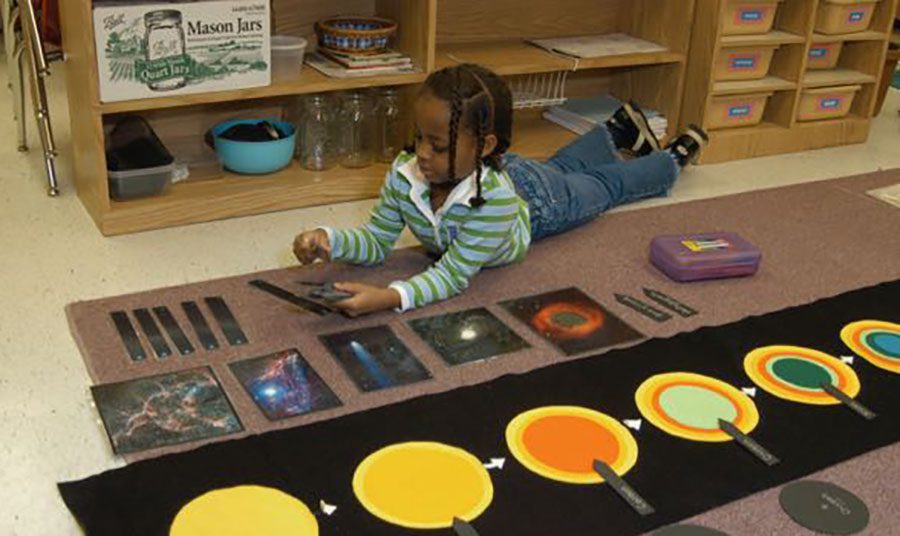
Two five-year-old girls have created the solar system. It is larger than they are, rendered in tempera paint on paper that must be ten feet long. The planets are drawn to scale and painted to match our best photos of the heavenly spheres. The background, the vast emptiness of space between the planets, is painted black. Below each portrait is a report written in a firm cursive script, identifying the planet by name and telling a few interesting facts.
Their work began with a prepared exercise in the classroom. The girls had matched cut out photos of the planets with name cards. They learned to put them in the correct order. You could hear them singing, The family of the sun, the family of the sun, HI HO THE DAIRY OH, the family of the sun….?
Other children in the class went home and told their parents all they were learning about the planets, but in fact, only two children were doing this work.
A Montessori classroom is an extraordinary learning environment which shapes the child who experiences it.
She chose to work on the planets. The act of choosing helps to develop her will, to strengthen her character, to affirm her ability to think for herself, to enable her to identify interests and to pursue them. But her choice is limited to those materials found within the classroom environment. Some choices are more fruitful than others. Studying the Power Rangers is not equivalent to studying the planets.
The very young child repeats an exercise until satisfied with the activity. This builds concentration and lengthens the attention span. Following the sequence of the activity, including the final step of returning the exercise to its proper place in the classroom, builds an orderly mind.
The older child extends an activity until her interest is fulfilled. This requires a commitment to work and focused attention, both built in the earlier years. Order and sequence continue to play a part, not only in organizing the work itself, but within the system of classification of the sciences, geometry, grammar, music and art. The planets have an order; it is an orderly universe. These two five year olds sustained commitment to this study over many days and produced a colossal piece of work. Who says that young children have a short attention span?
Was this art or was it science? The multidisciplinary approach of the Montessori classroom does not make such arbitrary divisions. These girls employed reading, writing, painting and singing to learn about the planets. They made their work such a part of the classroom environment that their classmates learned about the planets, too. And in doing this work they have continued to construct themselves. They have built commitment to work, extended concentration, learned about cooperation, and are beginning to develop a sense of themselves as citizens of the universe. Aren’t we all members of The Family of the Sun??
We want to once again thank John Long and the Post Oak School for allowing us to republish John?s wonderful essays in Tomorrow?s Child and in our online resource collections.