by John Long | Kindergarten, MFA, Montessori Education, Montessori Family Life, Montessori Parenting, Montessori students
The five-year-old walked to the shelf to get a little tray containing six pictures. He brought them back to his work rug where he had a movable alphabet, a box of sorted, individual letters. He also had a card that said “ee” that went with the set of pictures he had chosen. Within five minutes and with very little help he had spelled “jeep”, “beet”, “sweep”, “feet”, “queen” and “tree”.
He was beaming and I shared his enthusiasm. “What are you going to do next?” I asked.
“First I have to put these letters away. Then I’m going to do another set.”
It was 10:00 on the first day of school.
An hour later in another part of the building nineteen middle school students sat in a circle to prepare for their first seminar of the year. They have all read George Orwell’s Animal Farm but today’s discussion was about the seminar itself. One of them said it is important to create a respectful community so that everyone will feel it is safe to speak out.
When asked what kinds of actions would create an unsafe environment, they gave examples of rude comments, rolling eyeballs, expelled breath, and subtle or not so subtle body language. When asked what kinds of behavior would make a good seminar participant, they mentioned active listening, good eye contact, respectful disagreement, giving everyone a chance to speak.
One student said that the problem with good eye contact is that it makes you say more than you want to say. One of her classmates added that she felt the need to explain her comments more thoroughly–and that its hard to do so.
Yes, thinking deeply and clarifying your thoughts is hard work. It is, in fact, one of the prime objectives of the seminar and one of the primary works for the adolescent.
It was 11:00 on the first day of school.
These two moments are so impacted with meaning, so suggestive of the characteristics of Montessori education: materials and activities specifically designed and geared for the needs of the child at different stages of development; the individual within community; the development of the whole person–not just the intellect; spontaneous activity as a means to develop the will, personal initiative, and an attention span that is both long and deep. Joyful commitment to work.
But I want to mention on this first day of school for the children the work of the adults in preparing the environment. For two weeks and more, every teacher and every assistant has labored long hours, Darwin and Manuel have known no rest, administration has proven that support requires flexibility in working with and around the team of construction workers who have scrambled to complete the building project. More than one hundred people have been at work to make this day possible. Thank you every one of you. Thank you.
And just what have we done? The Montessori classroom is an environment of beauty and order and complexity. The first task of the Montessori teacher is to prepare an environment which invites the child to work, which enables the child to work and which is free of obstructions to his work. We have succeeded in creating sixteen classroom environments and several specialized learning spaces. And the children have put them right to work.
We want to once again thank John Long and the Post Oak School for allowing us to republish John’s wonderful essays in Tomorrow’s Child and in our online resource collections.
John Long has been the Head of Post Oak School in Houston, Texas since 1995. His career as an educator began with the United States Peace Corps in Kabul, Afghanistan. In Montessori schools, he worked first as a classroom assistant, and then as a lead teacher in Lower Elementary, Upper Elementary, and Middle School. He has served as head of two large Montessori schools, written for professional journals, spoken at national conferences and workshops, and writes a blog titled Education by Design. He was on the founding faculty of NAMTA’s “Orientation to Adolescent Studies.
by John Long | MFA, Montessori Curriculum, Montessori Education
That was a question asked by an upper elementary student during a class meeting last week. “Why don’t we have grades at Post Oak?” The spirit of the question, and the interested looks from the questioner’s classmates, suggested that this was more of a “Tell-us-about-Dr.-Montessori”-kind-of-question rather than an appeal for a missing entree at the banquet of life.
On the one hand, Dr. Montessori emphasized the significance of internal, intrinsic motivation as the power behind learning—as opposed to external, extrinsic rewards. Young people are hard-wired for learning. Their brains are still in formation for years after they are born and during this period are uniquely receptive to learning. Coupled with this is a spirit, an inner voice, which directs them to learn. We don’t need to manipulate them into learning. We don’t need to reward them or to punish them to make them learn. Come and watch the children in our classes learning for the sheer joy of it.
But why not give them grades? Isn’t that the way the world works? Before answering that question, let me ask, “What is the purpose of grades?”
Is it to make students work? Our students work already. They do not need to be coerced into working.
Is it to make students work harder? When a Montessori student asks, “How much do I have to do?” she will typically be asked in response, “How much can you do?” Consequently, students do far more than teachers could ever require. They will set goals for themselves that are monumental in scope — and then work and work and work to achieve them.
Is it to make students competitive? If by this you mean, “Possessing the skills that enable them to compete,” they develop those skills. If you mean, “willing and able to strive for excellence,” they are and they do. Our graduates’ performance in high school tells us that consistently.
On the other hand, academic competition as it is structured in schools, where one student’s relative success is every other student’s relative failure, where there are individual winners and losers, leads to results in the character of the individual and consequently in the construction of society that Dr. Montessori was trying to help us escape . She said, “Education, as it is commonly regarded, encourages individuals to go their own way and pursue their own personal interests.
School children are taught not to help one another, not to prompt their classmates who don’t know the answers, but to concern themselves only with getting promoted at the end of the year and to win prizes in competition with fellow pupils. And these poor, selfish little creatures find themselves in later life like separate grains of sand in the desert; each one is isolated from his neighbor, and all of them are barren. If a storm comes up, these little human particles possessed of no life-giving spirituality are caught up in the gusts and form a deadly whirlwind.”
Furthermore, grading and academic competition lead to some results that are in the long run antithetical to a truly competitive stance. It has been shown that when students know they are being graded, their creativity declines. If a student knows he is being graded, and if he still cares, he will make choices that are safe choices, He will not take risks. He will not choose a project or an answer that could result in failure.
He will do what he already knows how to do, he will do what he knows will result in a predictable, positive result. In contrast, Thomas Edison said that if you want to increase your creativity, increase your rate of failure. Which individual has a more competitive edge, the one who makes safe, predictable choices, or the one willing to take creative risks?
At The Post Oak School we don’t give grades. We want students to learn because of their own intrinsic desire to do so. We want them to be internally motivated, not externally motivated. We want them to become self-confident, creative risk-takers. And we want them to develop the sensibility that each and every person has value; that each person can succeed; that the success of others is to be celebrated — not that another’s success means my failure; that it is desirable to help others, and to take the time to do so.
Ultimately, our success as individuals is not best measured by our relative standing in society, but in the society itself that we help to create. What did it mean to rise to the top in Nazi Germany?
We want to once again thank John Long and the Post Oak School for allowing us to republish John’s wonderful essays in Tomorrow’s Child and in our online resource collections.
by John Long | Brain Development, Infant-Toddler (0 to 3), MFA, Montessori Family Life, Montessori Parenting
Those babies are so cute! They are carried in by their mothers to the prepared environment beside my office. Of course, this causes me to sometimes drop what I’m doing in order to observe them. I can’t help myself. Ashley Montague wrote in Growing Young that there is an evolutionary advantage to a baby’s cuteness. At a time when the baby is most vulnerable, most dependent on adults for meeting basic needs, we feel compelled to provide that care. It’s hard wired into the adult to do so. This maximizes the chances that each individual infant will survive and, in so doing, provides an evolutionary advantage to the species.
At the same time, each infant has begun that long road to independence so familiar to parents. We see these babies learning to roll over, to creep and to crawl — the initial stages of locomotion that lead to walking, running, climbing trees, riding bikes and eventually driving cars.
Montessori education aims to assist the child in achieving independence. For the young child, this means physical independence. I encountered a three-year-old struggling to put on his jacket. We laid the jacket on the floor. He put both hands into the sleeves, then flipped the jacket over his head. VOILA! Independence.
Of course, independence gained in one area simply opens up new areas to conquer. The drive for independence is strong – it is the life force itself – but is often in conflict with the adult’s need to protect the growing child. Our wisdom is to know that the child must be granted independence appropriate to his age while balancing this with judicious use of, “No, not yet.”
From dependence to independence. Has our child arrived when she has achieved independence? No. Despite the American national ethos, independence is not the highest state of being. Interdependence is the next step. We must come to realize that we can accomplish more by working effectively with others than we can on our own. We must recognize that the needs and desires of the individual must be considered within the context of what is best for the group — while at the same time decisions of the group must consider the needs of each individual. We have a responsibility to each other, to the group and to society as a whole. This is interdependence. It is the third step on the evolutionary ladder: dependence, independence, interdependence.
In myriad ways, Montessori education helps children understand and reach the state of interdependence. One child helps another tie her shoes or serves her an apple slice. Children learn to defer their impulses and to sit together as a group or to make silence as a group. A child asks another to show him how to change fonts on the computer or to find Bosnia in the encyclopedia. Children learn to work together with partners who are not necessarily their best friends. Or they work together to stage an art sale or a bake sale so they can donate the proceeds to the Romanian orphans.
Such children are learning valuable lessons in giving and receiving help. They are learning to work together and to resolve conflicts that might emerge. They are learning to respond with empathy to the needs of others within and beyond their sight, and that they are empowered to do something about it. They are not helpless victims or bystanders.
These are the children Montessori believed could change the world Interdependent children.
We want to once again thank John Long and the Post Oak School for allowing us to republish John’s wonderful essays in Tomorrow’s Child and in our online resource collections.
by John Long | Kindergarten, MFA, Montessori Education, Montessori Parenting
Childhood is a time to have fun. At Post Oak the children are always working. Don’t Montessori children have fun?”
This is a good, honest question that seeks out the nature of early childhood education, in fact, the very nature of childhood.
This question perfectly expresses a mistake we adults often make in thinking about children. It assumes that childhood is a vacation before adulthood. It assumes that recreation is the purpose of childhood.
Nothing could be further from the truth. Creation, not recreation, is the purpose of childhood. The young child is creating herself from the elements of the environment. The human infant enters the world in a woefully undeveloped state. A newborn horse stands and walks before its first day is done; the human child may take more than a year to accomplish the same mobility. Remember your child when she just started to walk. Think of the concentration, the dedication, the willingness to fall and get up and fall and get up again. A child at this stage will wear out even the most adoring parent. Is this a vacation? No, it is work. Joyful work. The work of becoming.
When it comes to the brain, the tasks are numerous and more complex than walking. We are born with the potential of our genetic inheritance, but little more. Intelligence and identity are created by our experiences in the environment. The human infant learns language. He learns culture. He learns attitude and judgment. He learns behavior.
This is the work of infancy and childhood. How do we motivate a child to want to do this? We don’t need to. The motivation comes from within the child. Do we give formal language instruction to an infant? No, she learns to speak through her own efforts to make sense of the language in her environment. A child in a rich language environment, who is spoken to and listened to has a better opportunity to develop greater skills in the use of language.
I met three children outside one of the primary classrooms last week. They were each working on one of the number chains. The first was counting up to 216, the second up to 729, and the third to 1000. The first child was deep in concentration, counting the beads and placing a ticket at the end of each bead bar. The other two, very familiar with the steps of this work, were lightly chatting as they organized the tickets before starting the actual counting.
I asked, “Is this fun?”
“Yes!” they chimed in chorus.
“What do you like about it?” I pressed.
“Counting,” was the reply.
I suppose they could have been playing dress up instead, but it was clear that in their minds counting the bead chains was not only worthwhile, but fun.
We want to once again thank John Long and the Post Oak School for allowing us to republish John’s wonderful essays in Tomorrow’s Child and in our online resource collections.
by John Long | Kindergarten, MFA, Montessori Education
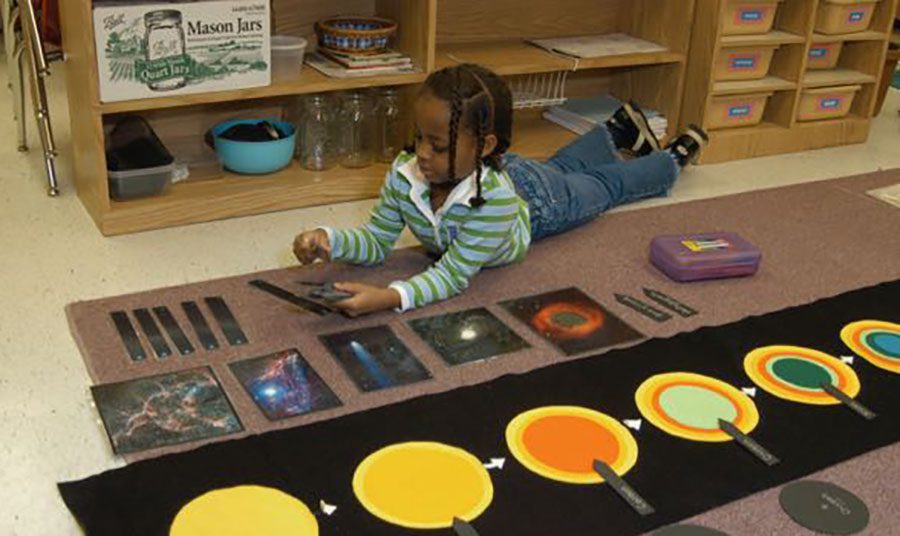
Two five-year-old girls have created the solar system. It is larger than they are, rendered in tempera paint on paper that must be ten feet long. The planets are drawn to scale and painted to match our best photos of the heavenly spheres. The background, the vast emptiness of space between the planets, is painted black. Below each portrait is a report written in a firm cursive script, identifying the planet by name and telling a few interesting facts.
Their work began with a prepared exercise in the classroom. The girls had matched cut out photos of the planets with name cards. They learned to put them in the correct order. You could hear them singing, The family of the sun, the family of the sun, HI HO THE DAIRY OH, the family of the sun….?
Other children in the class went home and told their parents all they were learning about the planets, but in fact, only two children were doing this work.
A Montessori classroom is an extraordinary learning environment which shapes the child who experiences it.
She chose to work on the planets. The act of choosing helps to develop her will, to strengthen her character, to affirm her ability to think for herself, to enable her to identify interests and to pursue them. But her choice is limited to those materials found within the classroom environment. Some choices are more fruitful than others. Studying the Power Rangers is not equivalent to studying the planets.
The very young child repeats an exercise until satisfied with the activity. This builds concentration and lengthens the attention span. Following the sequence of the activity, including the final step of returning the exercise to its proper place in the classroom, builds an orderly mind.
The older child extends an activity until her interest is fulfilled. This requires a commitment to work and focused attention, both built in the earlier years. Order and sequence continue to play a part, not only in organizing the work itself, but within the system of classification of the sciences, geometry, grammar, music and art. The planets have an order; it is an orderly universe. These two five year olds sustained commitment to this study over many days and produced a colossal piece of work. Who says that young children have a short attention span?
Was this art or was it science? The multidisciplinary approach of the Montessori classroom does not make such arbitrary divisions. These girls employed reading, writing, painting and singing to learn about the planets. They made their work such a part of the classroom environment that their classmates learned about the planets, too. And in doing this work they have continued to construct themselves. They have built commitment to work, extended concentration, learned about cooperation, and are beginning to develop a sense of themselves as citizens of the universe. Aren’t we all members of The Family of the Sun??
We want to once again thank John Long and the Post Oak School for allowing us to republish John?s wonderful essays in Tomorrow?s Child and in our online resource collections.
by John Long | Maria Montessori, MFA, Montessori Education, Montessori Graduates
A couple of years ago full page advertisements appeared in glossy magazines featuring photos of famous people wearing khaki pants: “Humphrey Bogart wore khaki,” or “Ernest Hemingway wore khaki.” You get the idea.
Although she was famous, Maria Montessori did not wear khaki.
But that ad campaign came to mind recently when Barbara Walters interviewed Sergey Brin and Larry Page, the co-founders of Google. The pair met at Stanford University when they were students there. Do they attribute their remarkable success to Stanford or to the fact that they are both the sons of college professors? No, they give credit to their Montessori schools.
According to Brin, the Montessori approach instilled in them self-direction and self-motivation, an inclination to challenge the status quo and to do things differently. We at Post Oak recognize these characteristics as common to Montessori children (and adults).
Montessori fosters creativity, self-confidence and an entrepreneurial spirit.
So it was no surprise to learn that Jeff Bezos, founder of Amazon.com, also attended Montessori school. A recent issue of Business Week said this about him: “As a preschooler, Jeffrey P. Bezos displayed an unmatched single-mindedness. By his mother’s account, the young Bezos got so engrossed in the details of activities at his Montessori school that teachers had to pick him up in his chair to move him to new tasks. It’s a trait that goes a long way toward explaining why the company he founded, Amazon.com Inc. (AMZN), has survived to become the most dominant retailer on the Internet….Says Paul Saffo, research director at the think tank The Institute for the Future, ‘Jeff Bezos was the first one to figure out what the power of the Internet was for selling.’”
Actually, we at Post Oak would have allowed young Jeffrey to continue with his work rather than moving him to a new task. We want children to develop concentration and task commitment. We want them to develop a love for work. We want them to have the confidence to take creative risks – to try new approaches to a problem, to invent new ways of doing things. We want them to take initiative; to take on big work; to choose their own tasks; and with guidance, to shape their own learning – not simply to do what is assigned. Such experiences shape Montessori students’ character and their approach to the world.
During the holiday break I got out the Post Oak School Cookbook to look for a recipe. (For those of you who have never seen one, current Post Oak parent Jenny Murphy led a committee several years ago to produce an amazing cookbook of, by and for the school.) Its introduction quotes Julia Child, the author and cook often credited with ending the primacy of the meat and potatoes cuisine in America. In it she says: “Influenced, perhaps, by my early experience at a Montessori school…I am all for encouraging children to work with their hands.”
“Influenced by my early experience at a Montessori school.” Is that the chorus of the creative, culture-changing entrepreneur? I wonder if they wore khaki’s, too?
We want to once again thank John Long and the Post Oak School for allowing us to republish John’s wonderful essays in Tomorrow’s Child and in our online resource collections.
by John Long | MFA, Montessori Education, Primary (3-6), Sensorial
His hands were stretched far apart, but not all the way to the ends of the red rod, the longest one of a graduated set of ten. He walked with the slight wobble of a three year old as he carried the one meter long rod across the classroom. He stopped to wait for two older children to move so that he could maneuver past. He navigated around several rugs that were laid out on the floor to define the work spaces of other children. Finally he came to the shelf where the red rods are kept and he carefully laid down the one he had been carrying. He headed back to his own work rug, walking carefully across the classroom, to get the next rod, and the next one, carrying them one by one until all ten were returned to the proper place on the shelf.
Montessori education is movement education. This young boy was spending a long time moving purposefully from one side of the classroom to the other. The movement was careful and controlled – exactly what is needed by this young boy as he refines both his ambulatory powers and the awareness of his own body in space. Grace and courtesy guide him even as he furthers their development within – the respect for the activity and the space of his classmates guides him around their work rugs (rather than marching across them or leaping over them).
The ten trips back and forth to the shelf indicate that the characteristic of repetition is fully alive in this young one. That he carried suceedingly smaller rods each time gives evidence of his sense of order. The Montessori primary classroom assumes these characteristics in the young child and utilizes them to aid the child in the natural course of development as he builds himself physically and cognitively.
Why ten rods rather than five or nine or twelve? Many of the Montessori sensorial materials, the ones that appeal to the youngest children in the primary classroom, come in sets of ten. As the children work with them, they build up at an unconscious level, a muscular memory of the number ten which is the foundation of our decimal number system. The Montessori materials designed for both direct and indirect purposes.
What about vocabulary enrichment? This young boy will have a powerful sensorial experience of long, longer, longest, short, shorter, shortest – the specific vocabulary tied to this lesson.
Who chose this work? He did, though his teacher had introduced it to him because she knew he was ready for it, in the sensitive period for work with this kind of material. In choosing the work for himself, he is developing the will, his future ability to act, to operate with self-direction. And by the time the last rod had been returned to its place on the shelf and the rug rolled up an returned to its basket, he had work for far longer than most of society dares to expect from a three year old, and at the same time, experienced the beginning, middle and end of completing work. These are lessons that show up as subtle lessons in character development — the kinds of results that lead parents to observe, “Montessori kids are different.”
Yes, they are. And those differences are rooted in the work of the very youngest children – long before obvious academic work begins.
We want to once again thank John Long and the Post Oak School for allowing us to republish John?s wonderful essays in Tomorrow?s Child and in our online resource collections.
by John Long | Later Adolescence (15-18), Lower Elementary (6-9), MFA, Montessori Charter Schools, Montessori Education, Montessori Middle School, Montessori Parenting, Montessori Secondary / High School, Montessori students, Upper Elementary (9-12)
“Oh! A Montessori mother!” responded another woman in the needlepoint class when she heard that the children attend Post Oak School.
Waiting for the other shoe to drop, the Montessori mother asked, “Where does your daughter go to school?” We’ve all been there: the mention of Montessori evokes a response in people. Sometimes we feel pressed to defend that choice for our children’s education. Not everyone understands; not everyone is supportive.
“She’s a senior at Episcopal High School now and doing very well. She started her education at Post Oak School years ago. How long will you keep your children in Montessori?”
Often other adults recognize the power of Montessori education at the primary level – the “pre-school” level – but beyond that? Well then it’s time for real school.
“I suppose they’re lifers,” responded the Montessori mother.
“I wish I’d had the courage to keep them at Post Oak all the way through,” said the other. “We left after the primary years and went to a traditional school. But two years later we still didn’t like what our daughter was getting there, so we enrolled her in another Montessori school. It wasn’t as good as Post Oak, but it was better than where she had been for first and second grades.”
I had that conversation in the front hall at Post Oak last week. Coincidentally, another mother told me today about meeting a new neighbor and one of her three grown children who all attended Post Oak School years ago. They stayed through the elementary years – in those days there was no middle school though they were pleased to hear that Post Oak now goes through 8th grade. The twenty-eight-year old daughter graduated from Harvard and is now an attorney in Washington D.C. Her brother and sister are also successful young adults. These marks of success were reassuring. Even more reassuring was the firm confidence expressed by the Empty Nester that Montessori education had been of tremendous importance in shaping the lives of her children. The daughter noted especially that her independence of mind, her work ethic, her ability to stay with tasks for long periods of time and to bring them to completion with self direction were direct outgrowths of Montessori education.
This is a wonderful follow up to last night?s alumni night, projecting further into the future.
First printed October 22, 1996
We want to once again thank John Long and the Post Oak School for allowing us to republish John?s wonderful essays in Tomorrow?s Child and in our online resource collections.
by John Long | Kindergarten, Mathematics, MFA, Montessori Education, Montessori Family Life, Montessori Parenting, Uncategorized
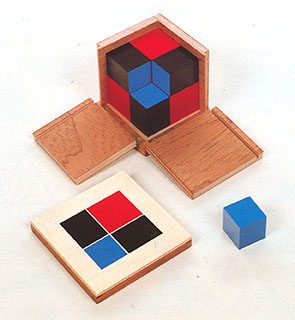
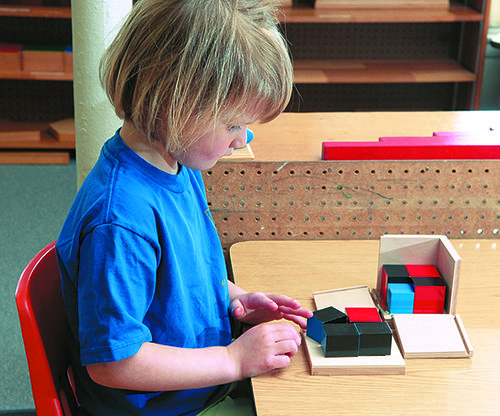
This is a story about eight wooden blocks and a five-year-old girl. The eight wooden blocks are nestled in a hinged wooden box. The five-year-old girl is sitting alone at a small wooden table. She is very good at arithmetic, her teacher tells me, but rarely chooses to work with this kind of spatial, three-dimensional puzzle.
That’s interesting because, in an expression of her mathematical genius, Dr. Montessori developed learning materials integrating arithmetic, geometry, and algebra. It’s also interesting to note that there is a significant body of contemporary research exploring the relationship of spatial ability, mathematical achievement, and gender: 687,000 Google hits.
These eight wooden blocks are called The Binomial Cube because they are a concrete representation of the algebraic binomial (a + b)3, although our five-year-old will not encounter the algebraic presentation until she reaches upper elementary four years from now. The blocks include one small and one large cube and six prisms of two different sizes. You stack them in two layers to form a composite cube. There is one right way to put them together.
I watched as she built the bottom layer of the cube inside the hinged box. She knew it was not right (I could tell from her body language) but even so, she attempted to fold up the sides of the box, checking to see if the blocks fit. They did not, so she tried again. And again. And again.
She turned sideways in her chair and looked across the classroom. She turned back and tried again. Still no better. From the other side of the observation window, I could see her error. I was only six feet away from her. I wanted to reach out and fix it, to show her how to do it, to make her problem go away. At the same time, I knew that to do so, to rescue her, would rob her of the chance to handle it herself. She had been working at this for eight or nine minutes and was stuck. She stopped again, got up, and went to talk to her teacher.
Her teacher came to the table and sat down. Two other children came to watch, holding their hands behind their backs in ‘observation pose.’ The child explained her dilemma. The teacher spoke a few words. One of the two observers, another five-year-old girl, reached out and turned one of the cubes. The sun emerged from behind the clouds. The teacher and the other children watched as she put the fourth piece in place on the bottom layer and quickly put the four blocks in place on the top layer.
She closed the box and put the lid on. It all fit. It was right. She had done it. Herself. With a little help. She looked up and smiled.
Her teacher and the other two children walked away. She opened the box and took out the blocks again. She rebuilt the puzzle. She looked up again and smiled. She walked over to her teacher to report her success and her teacher matched her smile. She went back to the table and took out the blocks again. She rebuilt the puzzle and smiled again. She took out the blocks a fourth time and rebuilt the cube. And a fifth.
Finally, she was done, satisfied for now that she knew how to build this puzzle. She looked around the classroom. Next to her was a friend holding a chart of numbers showing sums. This is work she knows well. Her friend asked her a question, looking at the chart, and she was able to help, showing how to slide her index fingers down and across to find the answer.
She was ready now, so she carried the box back to the shelf and returned it to the place it belonged. She went on to other work.
What did she learn while honing her spatial ability? She chose this work herself and initially experienced frustration. She could have been defeated by that, given in to her negative feelings, and simply avoided that work or anything like it in the future. Instead, she persevered in the face of difficulty. She asked for help when she needed it, and this simply reaffirmed her image of herself as resourceful. She repeated the construction successfully, experiencing the emotional satisfaction that comes from mastering something difficult.
Next time she encounters an intellectual or physical challenge, she will know that she is capable of mastering it. She will know that she has resilience and resourcefulness as well as intelligence at her command. She has advanced the construction of her own brain for a lifetime of success.
We want to once again thank John Long and the Post Oak School for allowing us to republish John’s wonderful essays in Tomorrow’s Child and in our online resource collections.
by John Long | MFA, Montessori Family Life, Montessori Parenting, Montessori students, School Resources, Writing
In The Celebration of Thinking Elliot Eisner, professor of education and art at Stanford University writes,:
We should be concerned about curricula that place a heavy emphasis on limited forms of learning and thinking. When limited forms of learning dominate curricula, they also cultivate a disposition. Following rules and applying algorithms do not match the kinds of problems with which most people must deal in life outside of school. Life’s problems almost always have more than one solution, and they typically require judgment and trade-offs”
Upper elementary students have been working on different kinds of writing, and one day last week their teacher invited them to write an opinion paragraph. Now asking a Montessori student to express an opinion could be described as redundant. Nevertheless, it is good to put that opinion in writing, to capture an otherwise fleeting thought, to give it shape and to refine it. A sixth-grade student, who had been working with a tutor outside of school to learn test-taking skills, spoke up and said, “They are looking for an opening sentence, two or three supporting sentences and a conclusion.”
“Who are they?” asked his teacher.
“The testing people,” answered the student, and then he added, “We have to set a time limit.”
There is something wrong here and I want to see if I can wrestle it to the ground and identify it. It is not that this student was studying with an outside tutor. It is OK that his parents want him to study ‘Test Taking’ as an extra-curricular skill akin to piano lessons or ice skating. That is one way to develop talents beyond what the school can do. No, what makes me uneasy is the student’s certainty that expressing an opinion in writing requires no less than four and no more than five sentences (‘Following rules and applying algorithms’ as Eisner said.) And that the audience one aims to persuade is ‘the testing people.’ For some reason that gives me the creeps.
There is a truth in experimental science that says the act of measuring a phenomenon changes it. I hear it in this eleven-year-old child’s answer. Is he writing to please himself, to know that he can clearly express an idea, to write with power and elegance? Or is he writing to persuade his classmates or, perchance, the headmaster, as a group of his peers have attempted to do by writing a request that the school install a scoreboard in the gym? No, neither, not any of the above. His attention has been diverted to those ephemeral monitors of worth, ‘the testing people.’ And now he wants to impose a time limit. Is it a real deadline, required by the exigencies of life – such as the need to publish this newsletter for Friday morning delivery to the classrooms? No, it is an artificially imposed restriction to simulate what social scientists call a Standardized Strange Situation (in this case, time limits on a standardized test). I fear this child’s vision has been clouded by an evil test genie. (For those of you scoring this opinion paragraph, that is the concluding sentence.)
Eisner continues, “I am painfully aware that the current educational climate for the ideas that I have expressed are not as hospitable as they might be. We do not typically pay much attention to celebrating thinking, or curiosity, or imagination, or creativity in our schools. In addition, we have a strong tendency to want to monitor the quality of schooling by implementing a common program and applying common standards to determine who wins. The results, like the results at the Belmont race track and the Kentucky Derby, are published in the newspapers.”
I roamed the halls in search of thinking or curiosity or imagination or creativity. In one primary classroom five- and six-year-olds were painting portraits of each other. In another, six-year-old Avery had written a story so long she taped pages and pages together to encompass it. The story was about Leonardo da Vinci, and she has painted her own version of the Mona Lisa to illustrate it. I began to feel better.
I drop in on the middle school. They are just launching a study of world religions and have come to the first session with personal written responses to some of the ‘Great Questions. Josh, who is an eighth grader, says that he believes that God created the earth and all of us and that He has a plan for each of us. The group explores the limits of God’s influence in our lives. Is our life preordained, scripted in advance by an omnipotent and omniscient Creator? Or has God placed us in a magnificently prepared environment with free will, to make mistakes in searching for the true way? Brittany, a seventh grader, declares, “If God has planned your whole life and expects you to trust Him, that’s not a very good basis for a relationship, because it means He doesn’t trust you to make decisions you need to make to become what He wants you to be.”
I scrambled to find a pen and paper to jot down notes from this conversation, to capture the subtlety of the argument, the clarity of expression and the bright flame of maturing spirituality. And then I was at peace.
We want to once again thank John Long and the Post Oak School for allowing us to republish John’s wonderful essays in Tomorrow’s Child and in our online resource collections.
by John Long | Family Resources, MFA, Montessori Education, Montessori Family Life, Montessori Parenting
Last week was the first session of “Montessori Talks to Parents,” a series of six meetings. It is but one opportunity from among a rich offering from the parent education committee. I laud their efforts. In trying to respond to your needs, the committee is offering a variety of programs focused on Montessori education, parenting skills, and broader issues of child development. Sessions are being offered during the evening and at different times during the day. Some are directed by school staff, others by parents and others by outside experts.
So I found myself sitting with twenty parents to discuss the prepared environment of the home. There was no lecture – I hope they weren’t disappointed–because we all, as parents, struggle with these issues, and it was much more valuable to hear from each other and to compare notes on the range of responses to universal issues of parenting – all within the context of Montessori thought as presented in a little magazine distributed to participants.
The prepared environment of the home – what does that mean to them? They identified many issues central to child rearing from a Montessori point of view. We talked about “child proofing” a home. Yes, it’s important to prevent children from endangering themselves, so use safety latches on the cupboards containing household chemicals. However, children need to explore in order to learn, and they have a powerful need to belong to the family. So don’t imprison children in playpens.
We talked about Montessori’s recommendation that every room of the house have a “child’s corner” because young children always want to be where you are. We talked about putting up breakables. It was pointed out that children will learn to respect your wishes regarding fragile items–either to handle them gently or to look but not touch–if you take the time to instruct them. Remember, though, that young visitors to your home may not have learned the same lessons. It was also suggested that irreplaceable heirlooms be put away if leaving them out will make you uncomfortable. For less valuable breakables, children learn the lessons of graceful controlled movement when they can see the results of their actions. For this reason, and for their intrinsic beauty, which children do appreciate, it is better to use glass drinking vessels rather than plastic. If it bounces when you drop it, what’s the motivation for being more attentive?
We talked about helping the child to achieve independence. Are your children able to get a snack for themselves? Parents talked about different ways to enable this. Put a low table and chairs in the kitchen, and put containers of healthy snack food on low shelves in the cupboard and refrigerator. We also talked about baby sitters and grandmothers who would rather feed the child than help him feed himself.
At what age can children begin to dress themselves? When can they choose their own clothes? How do you limit their choices? How are their clothes stored? At what age can children begin to wash their own clothes? The variety of answers to these questions gave everyone something to think about. The struggle Kathy and I had to persuade an eighteen year-old of the virtue in learning to do his own laundry would have been vastly relieved had we taught him to do so at six years-old as one mother has done in her house. Montessori said we enslave children when we fail to help them achieve independence.
And what about toys? There were some wonderful responses to why people use low shelves instead of toy boxes. As one person said, “Would you like to have all of your things piled in a big box?” We talked about limiting the number of toys and games on the shelf at any one time. When asked how many was the right number, one parent suggested no more than the child can care for. Another parent has a system of rotating toys between the shelf and the attic so that old favorites seem new when they reappear. Several parents help their children to learn about selflessness and giving by teaching them to donate toys that are in good repair but no longer used to hospitals, shelters or charities.
We laughed; we puzzled over our own conundrums; we asked, “How many of you do this?”; and I hope we deepened our partnership an inch or two more.
We want to once again thank John Long and the Post Oak School for allowing us to republish John’s wonderful essays in Tomorrow’s Child and in our online resource collections.
by John Long | MFA, Montessori Education, Primary (3-6)
It was her second visit in a week. Mrs. Jones described her son as kind and gentle, a truly sweet child, but retiring, even cautious. “Would Post Oak admit him as a five-year-old?” We would consider it.Though we ordinarily admit children at three or younger, some older children do enter successfully.
Until now he has been in a preschool, a fine and friendly place, one where he has been happy. But his counting past ten is uncertain, and he has learned little about the world of letters. An educational psychologist said he needs to be pushed.
“Would you push him? He must be challenged.”
The answer is yes and no.
Yes, our teachers are trained observers who would notice areas of the classroom that he might be avoiding. They would direct him toward work he needed to do. But push him?
No, Push is the wrong word. Our teachers would invite; they would guide; they would entice.
Unfortunately, the materials that prepare a five-year-old to do such amazing work in a Montessori environment were designed with a younger child in mind. It is difficult to take an older child back to these materials so that they choose them spontaneously, willingly, joyfully. And without this work, we lose the concentration and repetition needed to master concepts that prepare for more advanced material.
We walked toward a primary room. Outside the classroom, two five-year-olds had laid out the long ten chain – the thousand chain. They had worked so much with the various mathematical apparatus that they did not need to count the beads. They simply looked at the numeral tickets and placed them at the end of each bead bar: 10, 20, 30…150, 160, 170…890, 900, 910…1000!
We looked into the classroom. Twenty-six children were busily working. The teacher and her assistant were consulting in the middle of the room, as uninterrupted work went on around them.
We saw a three-year-old working on the broad stair – an exercise in sensorial/mathematical sequencing. And we saw a four-year-old working on the tens boards – matching the numerals from one to 99 with a geometrical representation of the number.
We also watched two five-year-olds working on the 100 board – a ten-by-ten grid on which they were laying out numeral tiles up to 100. Actually, they were doing a creative arrangement of the board. Rather than setting out the tiles in standard 1, 2, 3, 4, 5…100 fashion, it was clear that they understood the pattern of the board and the correct location for each tile. So, to challenge themselves, they had laid out 1, 11, 21, 31…91 in the correct places and then 2, 12, 22, 32…92 in their correct places and were now starting in on the 3’s.
There was much more going on in the classroom that Mrs. Jones noted, though I pointed out just the math material in use, because that had been one area of concern for her son.
“This is wonderful,” she said.
“Does it seem that these children are being pushed?” I asked.
“No, so how could my son possibly make up two years of time coming in as a five-year-old?” she asked.
“It would require a high level of initiative and self-direction,” I said.
“I’m afraid we’re two years late,” she said.
Later that same day, a mother phoned. Her child is three. She wants to visit Post Oak as soon as possible. Mrs. Jones told her to call right away.
We want to once again thank John Long and the Post Oak School for allowing us to republish John’s wonderful essays in Tomorrow’s Child and in our online resource collections.
by John Long | MFA, Montessori Education, Montessori Family Life
It is an Odyssey, a true adventure, for the 18-month old child to walk with her teacher through the halls and gardens of Post Oak School to get the mail. The act of walking itself is her focus. It is an accomplishment just getting all the way there and all the way back to the security of her well known home away from home. And on the way she looks up to everyone she meets — both actually and figuratively.
That’s why it is important for the rest of us to model appropriate and respectful behavior — she absorbs all that she sees and hears in the environment.
So began a conversation among the faculty about grace and courtesy, and the glorious challenge of working in a school with children ranging in age from 14 months to 14 years.
When an elementary child, absorbed by joie de vive, runs through the halls with a friend, it is a problem. It is a problem because we don’t want to trample any infants. It is a problem because we don’t want to crash into anyone else. It is a problem because we simply don’t run indoors — except in a gym; and it is a problem because we don’t want to model that behavior and thereby perpetuate it. We do want to model the self control of walking through the school. We do want to model knowing what is appropriate behavior in every time and place.
Faculty acknowledged that the elementary child has grown tremendously in her capacity to move with speed and coordination. She loves to run. But that does not mean it is OK to run through the halls and courtyards of the school.
We encouraged one another to set limits regarding this and other behaviors to do with grace and courtesy whether it involved children from our own classes or those from others. It takes a whole village to raise a single child. In other words, it takes all of us, working together, to establish clear expectations and to follow through on them consistently.
Middle school students were being loud and rowdy in the hall. It was disturbing one of the primary classes and the teacher came out to speak to them. “Please be quieter. Our class is sitting in circle having a lesson.” This request was expressed directly and quietly. And their response was respectful and appropriate. They quieted each other down, recognizing the importance of the work of the younger children, remembering when they had been in that class themselves, recognizing their membership in a community of adults and young people aged 14 months to 14 years.
We want to once again thank John Long and the Post Oak School for allowing us to republish John’s wonderful essays in Tomorrow’s Child and in our online resource collections.
by John Long | Early Adolescence (12-15), Later Adolescence (15-18), MFA, Montessori Education
Post Oak School / Houston, Texas
It could be the motto on his coat of arms—his attitude toward life. In fact, it’s what Post Oak School graduate Darrell DeVera said to explain his wide-ranging activities first at Strake Jesuit High School, then at St. Thomas University. In order to find a niche for himself in a large high school, Darrell joined every club that interested him, including Amnesty International, the Right to Life Club, the East Asian Club and several science clubs. He also played basketball. At St. Thomas, where he is a premed student, he has helped to coordinate retreats for incoming freshmen, is a member of the Oriental Club, plays soccer and the piano. He also continues to serve as a lector in his church.
Darrell pursues his personal interests and talents. That is a Montessori characteristic. He acts on his ethical beliefs through participation in organizations that aim to affect social values. That also is a Montessori characteristic. And he works to build community. That, too, is a Montessori characteristic.
Darrell is both an exceptional young man and a typical Montessori graduate. He speaks with self-confidence, with great commitment to his current activities and future plans, and with great love of his Montessori experience.He remembers his middle school years as the culmination, the time that integrated all that he had previously experienced.In Montessori he built a solid self esteem in a community oriented environment. (more…)
by John Long | Family Resources, MFA, Montessori Education, Montessori Family Life, Montessori Parenting, Montessori students
Paula Polk Lillard begins the Preface of Montessori Today by telling about a chance encounter with a man whose two sons, age nine and eleven, attended a Montessori school in Chicago.
Iasked him how he had come to choose a Montessori education for his children. “It was my wife’s decision,” he said. “I was busy with my work. I left it up to her. In fact, I was not in favor of their staying in Montessori when they reached first grade. I was worried that it was too sheltered an environment. I’ve changed over the years. I’ve become very involved.”
When I asked what he liked about Montessori, he responded that it was the sense of teamwork that the children developed and their self-direction.“They are competitive,” he said. “All kids are, but it is different. They get along so well and they are so confident. They are almost adult-like in their attitudes toward others.They care about the world. They have even gotten me involved in a community-service project for the homeless.” He paused and then said, “I realize that I’m not telling you about Montessori.I’m telling you what my children are like because of going to a Montessori school.”
He then commented about the other children in the neighborhood who were friends of his sons, many of whom attended a fashionable private school with a reputation for high academic achievement. “I don’t mean to bad-mouth these children,” he continued. “They are basically good kids but they are pseudo-sophisticated, even to the point of being smart alecks. I don’t get any sense that they care about doing their best for its own sake.Their focus seems to be on beating others.”
I asked this father if he was worried about his oldest son’s transition to high school, where he would be with these neighborhood children or others like them who had had such a different experience in their early schooling. He answered quickly, “Yes, because I’m afraid that my son will seem eccentric to them. He’s always studying something, looking up the answer to some question of his.” Immediately, however, he reversed himself. “Actually, no. I don’t think it will be a problem because he is so confident. He won’t be bothered by teasing if it comes to that. He gets along with everyone and he is used to being independent. It’s a fear that I have.”
He went on to describe his own early education. He had gone to both public elementary and high school in a district which I recognized as one of the best in the Chicago suburbs. Yet, he said, it had been a lonely experience. “None of my teachers were mentors to me. It was all so cold. Montessori is such a caring way to teach,” he continued.
We want to once again thank John Long and the Post Oak School for allowing us to republish John’s wonderful essays in Tomorrow’s Child and in our online resource collections.
by John Long | MFA, Montessori Education, Montessori Teachers, School Resources
“Teaching is NOT a 9-to-5 profession,” she said, glowering out at the audience of Montessori teachers as if she were speaking to a group of intransigent youngsters. This was Margaret Stephenson thumping the bully pulpit, wheedling and cajoling the choir to practice more often and to sing more sweetly.
Margaret Stephenson was my teacher trainer at the Washington Montessori Institute.It was she Mario Montessori sent to return Montessori education to the United States in 1959 after an absence of thirty years.To this day she is the guardian of Montessori principles, the arbiter, the final voice, the one who challenges easy answers and solutions of convenience. We need Margaret Stephenson and the Association Montessori Internationale (AMI) — but not to tell us that teaching is NOT a 9 to 5 profession.
Teachers in general, Montessori teachers in particular work long past the time the children go home. Their dining room tables are covered with classroom materials in the process of construction. They shop wherever they go for the perfect work rug; or for informative and attractive books about dinosaurs or the history of housing; or for an adult-quality, child-sized rake; or for matching cobalt-blue creamers; or for fossil trilobites, crinoids or petrified wood.
The need to create enriched, orderly and attractive classroom environments replete with handmade teaching materials above and beyond that available from the commercial manufacturers, creates an almost unattainable goal for Montessori teachers. Their career is their mission; they are almost always on duty. They worry about children who are struggling, and when they go to sleep, see them in their dreams.
Montessori teachers have an irrational dedication to their work, so it was not clear to me who Miss.Stephenson was exhorting. Perhaps it was just in case we decided to slack off a little. And of course, this work ethic, professionalism, high sense of idealism all benefit the children. I am proud to be in a profession with such high standards of expectation. And I’m very pleased my own children as they grew up had the opportunity to experience the dedication and love of a number of Montessori teachers.
Montessori teachers as a group (and most especially to me, the faculty at our school, Post Oak Montessori in Houston, Texas) are the finest group of teachers I have ever worked with. Look at their relationship to the children, the classroom environments, the hours they work, and the ongoing commitment to continuing professional development as indicators of excellence.
At each faculty meeting, we begin with comments of thanks and acknowledgment.I recommend it to you.Teaching is hard work.Comments of appreciation and words of encouragement are always in season.
by John Long | Early Adolescence (12-15), Later Adolescence (15-18), MFA, Montessori Education
They rolled their eyes as only two worldly adolescents can do.
“What are you learning now?” they asked while examining the sheet I had tacked to the kitchen wall.
“Your mother and I are learning to speak to the heathen adolescent.” A little humor never hurt in diffusing the intense sincerity of the Long household. In truth, we were participating in another STEP parenting class, a refresher for us. Our first exposure to the approach of Rudolph Dreikurs had truly helped us. Communication with our young sons improved.
Then one day we noticed that the children were gone, leaving in their places two teens. Most parents of adolescents feel that they need a refresher course. Just when you thought you were getting the hang of that parenting job, ZINGO!, the child metamorphoses and you need to relearn the job. And so Kathy and I found ourselves participating in another STEP class. It helped again.
Maybe it helped us because we were doing something—anything—to improve our skills. Maybe it helped our sons because they could see, from the new sheet weekly tacked on the wall, that their parents were interested in communicating with them. But I do think that the skills presented and practiced actually did make a difference in our lives.
Bill Zajic offered a STEP parenting class at Post Oak in the fall. ies. I recommend it to you. Those evening hours are precious, I know, but this is truly an investment that will result in an improved quality of life for you and your children.
by John Long | Early Adolescence (12-15), Later Adolescence (15-18), MFA, Montessori Education
“We missed you last week,” she said. Middle school students had just hurried into the Houston Food Bank, eager to begin their morning of (almost) weekly service work. They smiled sheepishly, pleased by the compliment. It IS a compliment for adolescents to be acknowledged by the adult world, to be given the opportunity to do real work, and to have that contribution recognized.
In our culture, adolescence is a state of artificially extended childhood during a time when young people have the physical capability and the emotional inclinations of adults. They need to know that they are worthy, that they are capable of contributing to society, that their work is valued. And we ordinarily give them almost no chance to make any real effort in this direction.
No wonder that they look forward to this weekly outing.In fact, more than one middle school student is making arrangements to continue her volunteer service during the summer.
“What school are these kids from? They are awesome. “The external evaluators visiting Avance were very impressed by the work of the Post Oak students. “Hi, Joey,” said one of our students to one of the infant children. Joey looked and smiled. His mother beamed to see that this volunteer knew her baby’s name. The examiner was amazed by the level of Spanish our students displayed in speaking to the babies and the parents who came to Avance to study English and general education classes. And she commented about their skill in working with the children, the love they showed and their willingness to pitch in and help out.
Working at Avance is a chance to use Spanish skills learned in school in a real-world situation. But more than this, it is a chance for early adolescents to experience what Montessori called “valorization of the personality” — confirmation from the adult world that they are worthy. Of course, we parents tell them that we love them. We congratulate them for notable performance in school or in extracurricular activities. But these are not adult activities, and that is what they are striving to achieve.
Montessori understood clearly that the adolescent needs to do adult work in order to experience the affirmation that launches them more confidently into their ultimate place in adult life.”Why don’t more schools do this?” asked the woman at the Food Bank. I don’t know.