Many Parents Ask: How Can I Prepare My Child for Starting School?
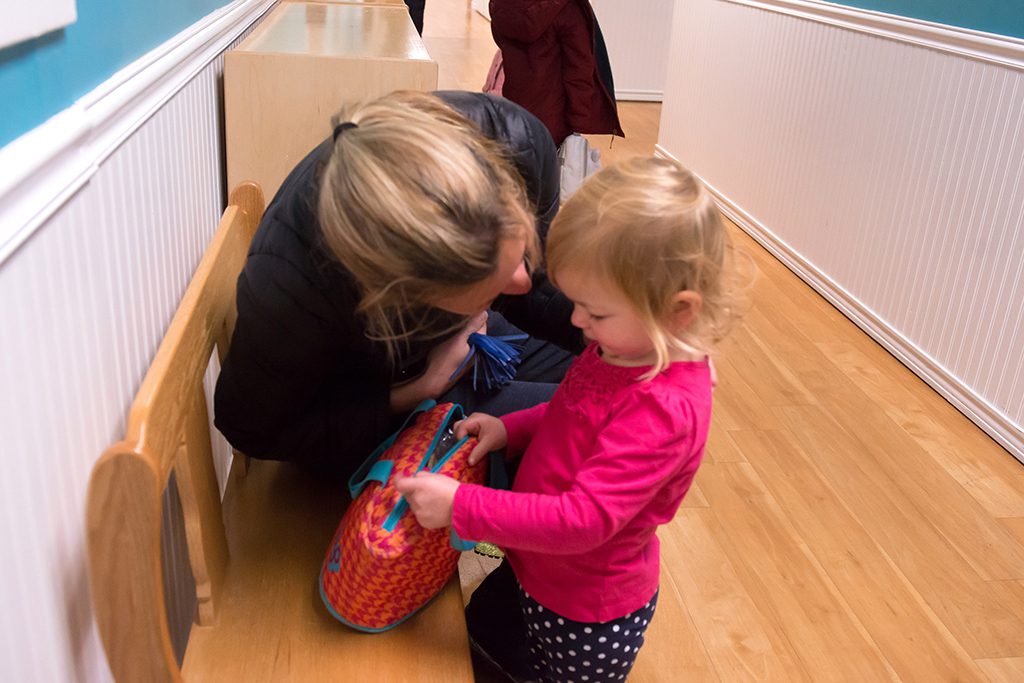
Once you have chosen the school (and do that without bringing your child along on all those preliminary visits, because visits to several schools can be confusing and upsetting to small children), visit together on the day set aside for first visits and talk the experience through later on.
Whenever the subject crops up, chat about the children you saw, what they were doing, when they had their drink and biscuit (cookie), where they went out to play. The child who understands the structure of a morning or day at school is much better equipped than the one thrown into the deep end on the first day with just hazy memories of a visit.
Ask the Directress (teacher/administrator) for the names of the children starting school at the same time, or make contact at the introduction day. Ask someone home to play; one recognizable face can mean so much to a new child.
Try, occasionally, to pass the school when the children are coming out, clutching their art work and greeting their parents after a busy morning or at the end of the day. If you have cared for your child at home by yourself, arrange short separations. Have your child spend a morning with a trusted friend or grandparent. Do your best to ensure that these visits away from you are enjoyable and predictable. As you leave, always say good-bye and return promptly as promised. Your child will learn that separations are for a finite time and always end happily.
Help your child develop the social graces that will enable her to make friends, but also give her practical information. “Here are the coat pegs, where you hang your coat and school bag; this is the book corner where you can sit quietly if you want,” etc. The message is that school will not be a roomful of strangers and unfamiliar equipment but a place lovingly prepared for her use.
Dress your child in easy, comfortable clothes, such as T-shirts, pull-on pants, and shoes with velcro fasteners that she can manage by herself. Consult her about lunch if she is to stay all day, and make that easy for her to manage on her own as well.
Most Montessori schools will set aside some time to orient the new children entering the class. This varies from school to school but may range from one morning to a gradual phasing-in of the new little ones into the class for an hour a day until they feel comfortable.
Here are some typical questions parents have asked over the years.
My son is so attached to his grubby old piece of blanket that I am sure he will want to take it to school. Should I try to wean him off it now that he is growing up?
Growing up happens gradually, not on the day you are first separated from your mom or dad for a whole morning or a day at a time. Wash the blanket and, if permitted by the school, put it cheerfully in his bag and ask him to choose a favorite cuddly toy and book to go along with it. Your child will feel that he is being allowed to exercise control over his new situation and that precious links between home and school are permissible and encouraged. One day soon, he will decide to leave his blanket at home because it gets in the way. Many Montessori schools will ask that favorite items from home be small enough to fit into the child’s cubby. That way, the child will know that his special items are close by and waiting for him at the end of the day.
My daughter was so excited about her new school and sailed in on the first few mornings. Now, it’s Monday and she refuses point blank to go. She says she’s “just tired of it.”
Not tired of it as much as just plain tired. However much a child is prepared for what goes on at her new school, the actual experience can come as a surprise. New routines can be exhausting. She may also be missing some of the cozier aspects of life at home, so try to make time in the morning for a cuddle in bed with a story and a leisurely breakfast. Don’t bombard her with questions about school when she comes home. Let her relax or flop around for a bit, and keep extras like swimming and dance lessons to a minimum in these early days.
If Monday mornings are a hurdle, spend time on Sunday sorting out something to take to school: a flower that has opened in the garden, a postcard from Grandma, a story that she would like to share with her new friends.
My son is very shy with strangers, and I worry that he won’t ask if he needs something. He’s toilet trained at home, but often has accidents at other people’s homes. I’m worried about how he will do when he starts school.
Give this little boy plenty of time to get to know his surroundings, perhaps extra visits to the school before the first day and slow, careful familiarization with the layout of the classroom each morning. On his first day, go with him to the Directress (teacher/guide) and ask where the bathrooms are located. Go find them together, pointing out landmarks along the way. Be sure that the Directress understands your concerns and how you have been helping him prepare for school. Prepare at least one extra set of clothes to leave at school, and give them to your little boy and the Directress so that she can find the right place to store them, just in case he has an accident at school. Having his own clothes to put on is less embarrassing
and upsetting.
I’ve stayed with him for the first few days and gradually taken my leave, but he still screams when I go. He is fine after a few minutes, but it makes me feel upset to leave him and apprehensive when we get ready in the morning.
Like many children, this little boy finds the moment of parting hardest to bear. Perhaps he hasn’t been left with other people much before or has had to put up with an an anxiety-provoking situation for which he was not prepared. Avoid the build-up of tension by chatting to him along the way to school about the dull things that you will be doing while he is away (exaggerate the dreariness), the nice lunch or dinner you will make together when you pick him up, along with your ‘together’ plans for the rest of the day. Talk about one or two enticing things about his new school and the first thing he might do when he arrives. If he mentions something, be sure to pass his comment along to the Directress so she can get him started swiftly. Don’t be afraid to talk about his tears and fears. Acknowledge that you both feel a bit sad to say good-bye but you can both be brave and try not to cry.
I feel I should be allowed to stay with my child for the first week while he gets used to school, but they discourage it. Who is right?
Schools differ on the subject. Some will allow parents to sit in on the first few days as long as they are prepared to keep a very low profile. The aim is to get your child settled in a school environment, which will not include the presence of her parents, so you may be asked to sit in another room, make small excursions to shop, or even stay in your car while your child gets used to the idea that you are close at hand for the time being—but only if needed.
You will almost certainly have been given the chance to see the school for a morning earlier on, and I hope that you will be well-informed about the work of the classroom and principles of Montessori education. Delightful as watching is, parents have to accept that their presence is superfluous and can be an intrusion if they overstay their welcome.
My child has been at school for half a term and doesn’t seem to be learning anything about reading and writing. Some of the pre-prep schools seem to push them much faster, and I worry that he will be at a disadvantage.
Montessori schools do not push children into early success but, rather, lead them to achieve to their utmost potential when they are ready. In the first weeks and months at school, the new Montessori child will be learning how to gain control over his body and mastering Practical Life skills, which will feed his growing sense of independence. Sensorial activities then pave the path to literacy. Readiness comes after sound preparation. If your child is practicing using tweezers, for example, he is strengthening his writing fingers.
Recognizing, sorting, and matching geometric shapes, along with similar tasks, are all essential pre-reading readiness skills. Learning to be silent in the Silence Game develops self-discipline and teaches the young child how to listen. And while your child may not be displaying it at home, Montessori children are learning an amazing vocabulary that serves them beautifully in the years to come. Don’t worry. The Montessori approach to reading, writing, and mathematics is wonderful and highly regarded around the world. Just allow the process to work it out in its own time. Try to be patient and, please, don’t push. It is not how early a child begins to read that is important but how much he loves reading and how thoroughly he grasps the skills that build up to literacy that truly matter.
Tomorrow’s Child/ Sept 2017/pg 7