Self-Construction, Construction, and Reconstruction: The Child, The School, and The World
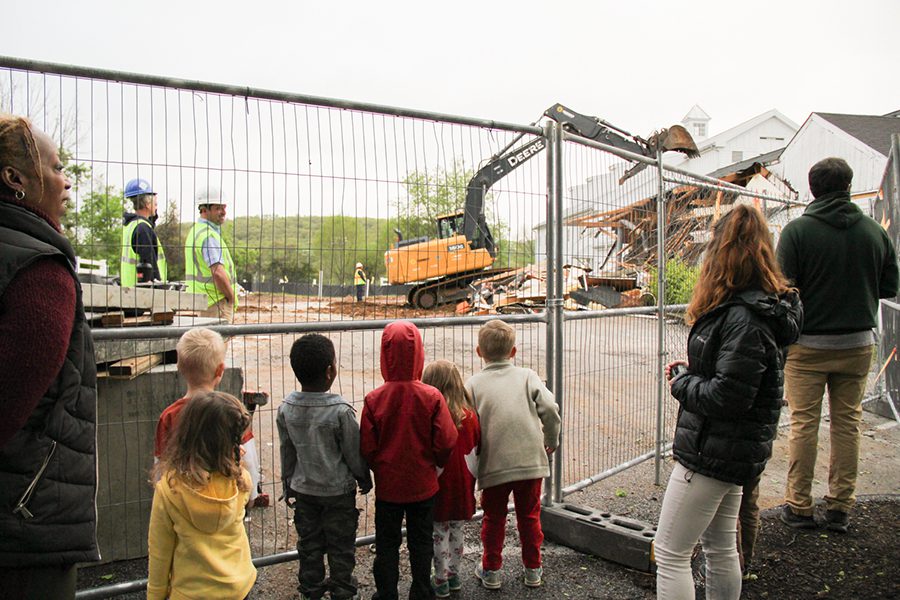
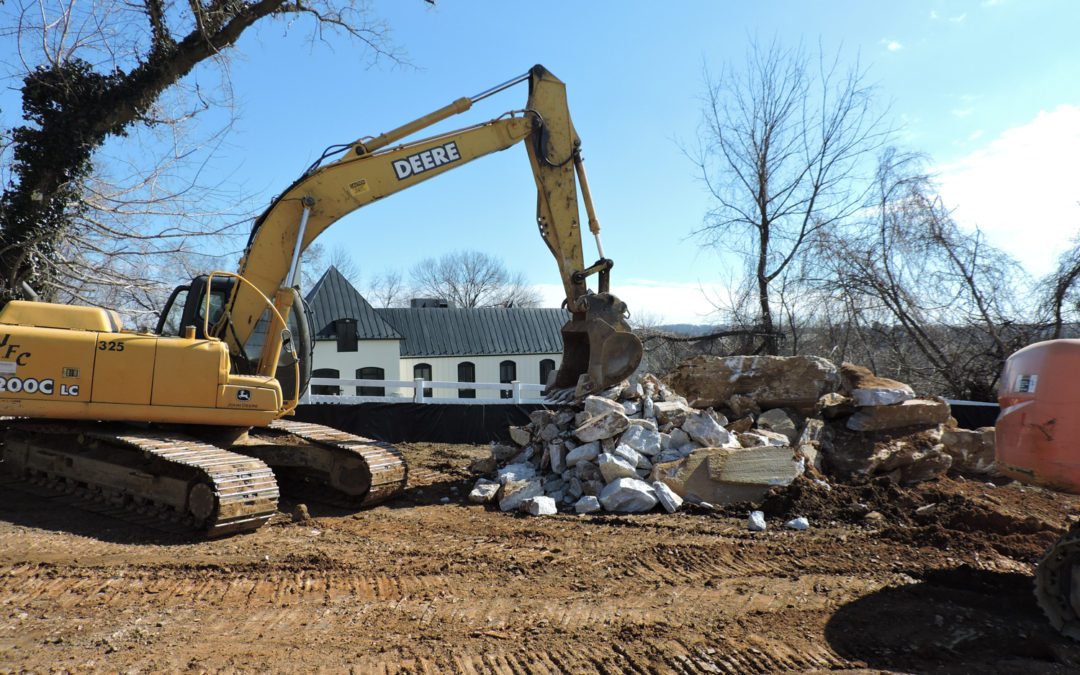
I have been walking the children down to the Wild Area below the soccer field this week, and telling them that right where we are standing, a road is to be built. I point to the existing parking lot, and then to the green gate, and I tell them that the first change they will see is that a big fence will go up. It will separate our playground from this new road. “Today?” they ask. I shake my head and say another quantity that they have never held in their hand: “this month. Sometime in the next few weeks.” Their eyes are excited for me, but this is because they are kind. They cannot know what I am talking about. The 3-6-year-old mind savors the concrete, and this idea of our construction project is still too abstract.
In 1946, Maria Montessori gave a series of lectures in London. It was part of the 28th international training course in the Montessori Method. In the immediate aftermath of the Second World War, she spoke of how education was starting to be seen as an aid to life, the hope for the future of the world. “Yes,” she said, “it seems as though people are, at last, persuaded—the idea is in the air—that it will be necessary to look to children for help if the world is to be made better.”
“We must realize that the child is the builder of the man,” Montessori reminds us. This is quite literal. The child’s work is to construct himself. This is why he is drawn to pour, transfer, dig, and move the objects of his environment back and forth with a palpably purposeful effort. He shovels not to dig a path to his car. He shovels to feel himself move snow.
The child is working to build himself as an adult. We see the child’s growth in glimmers, the same way that the children see the building project. We know that, one day in the future, it will happen, but as of now it’s hard to imagine in reality.
As a Montessori guide, my daily work is to find the greatest opportunities to get out of the way. Montessori teaches us that the adult is all too often the obstacle in the child’s self-construction. If I zip up her coat every day, I teach her that she needs me to do it. If I agree to help her by guiding her hands to the right place and offering to pull down while she pulls up, the seed is planted that one day she will be doing this on her own. But as guides, we are not satisfied with fine- and gross-motor self-construction, zips and snaps and buttons. Nor have we done our job, even as we witness miraculous explosions of learning: children beginning to speak, or write, or read. Montessori meant to shine a light on the construction of individual character. I want to shine a light on the child, who this week waited patiently, with her hand on my shoulder, as I listened to two other children work through a conflict resolution, to ask me, “Can I be the mediator?”
I was the obstacle in her way.
“So there are two plans,” Montessori says, “One is to disseminate knowledge, to follow a syllabus. The other is to look to the life of man and serve it, and in serving it, help humanity. The latter is the only one really worthwhile choice. The purpose of education must be to elevate the individual.” Elevating the individual is stepping out of the way to learn who that person is becoming.
If you are stepping out of the way to let your child zip up his own coat, that is the first step—the brick and mortar. If you are letting the child prove to herself that she can sound out a word rather than asking you what letter comes next, that is the next step, the academic confidence. But that third step is the training of character, of spirit. It is watching as the child becomes the mediator, and the adult—in an act of trust —fades away.
Greenspring Montessori School is located in Lutherville-Timonium, Maryland, US.
Lydia Farmer is a Children’s House Lead Guide at Greenspring Montessori School in Lutherville-Timonium, Maryland. The 55-year-old school has just broken ground on a major renovation project. Lydia has been teaching in Montessori classrooms for ten years and is overjoyed that her 18-month-old son will be starting his Montessori education this spring.
Tomorrow’s Child / May 2017 / p 28