
Montessori Education & Learning in Living Systems
 I have been blessed. Not only have I had the opportunity to find a wonderful approach to education for my children, but I have also discovered an education for myself, after years of searching for meaning and context for my own life. Grateful am I for the chance to ponder the work of Dr. Maria Montessori, the legacy and invitation to discovery I feel she left for each of us to embark upon. Considering the environmental, social and economic issues facing out planet, perhaps her example is ever more pressing for us to draw inspiration from. For me, the adventure has brought me into environments I have only dreamed of on this lush and beautiful planet, but none so complex and odd as that of my own self.
The process of self-discovery and Cosmic Education may be the most valuable experience I have received through the study of Dr. Montessori’s work and The Institute of Educational Studies (TIES) in the Montessori Integrative Learning program. Though painful at times, it has been also exhilarating at others. Through sharing my own journey, I hope to open a space for others seeking transformation and new paths.
It may have been over one hundred years since Montessori education was born, but for me her vision of education still feels like a radical new path into the future. This opportunity of sharing was given to me at the annual American Montessori Society conference, where my thesis, “Montessori Education and Learning in Living Systems,” was recognized as a valuable contribution to the continuing dialogue in the field. This is a great honor for me, especially considering the community of Montessorians that I look to for direction. So, it is, with some hesitation, that I share some snapshots of my adventure.
I began my M.Ed with a desire to explore the value of outdoor environments in a Montessori setting: school gardens, outdoor classrooms, and school kitchens, all practices I have been engaging with for some time. As my studies deepened, however, my interest shifted towards the organization of living systems themselves. This organization, the free flow of spontaneous activity found in nature, became the center of my personal inquiry.
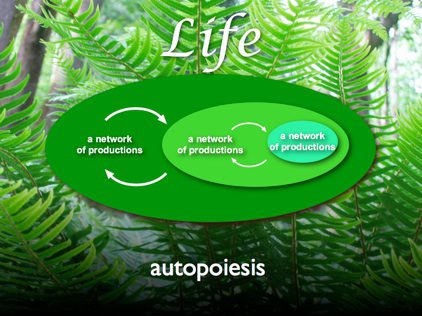
I felt strongly that while outdoor environments are very important in Montessori settings, the way that they are presented and made accessible to a community of learners is of far more importance. I wondered what such environments would feel like, what qualities they would exhibit. Looking at models, such as fractal geometry, chaos theory, and autopoiesis, caused a few key concepts to bubble to the surface for me, including individual autonomy within a unified whole, dialogue, and web-like connectivity. These concepts are what really drew my attention to explore. Taken together, these concepts describe what I call “living systems.”
An explanation of my conception of living systems may be helpful for the context of this work. Living systems may be regarded as “systems that produce themselves in a ceaseless way” and are “at the same time the producer and the product”—autopoietic systems. (Mariotti, 2012) Examples of autopoietic living systems can include simple cells, complex organisms, ecosystems, water and carbon cycles, the earth, the universe, and myself.
In eighteen months at TIES, I studied living systems in two seemingly disparate lands: the arid upper Rio Grande region around Española, New Mexico, and the fertile Mediterranean oasis of Algiers, Algeria. Early into my program, La Tierra Montessori School of the Arts and Sciences, a public charter school, and my five-year volunteer project, was approved in New Mexico. Six months later, my family and I packed for North Africa to help establish a trilingual Montessori school, a project I had worked on for two years. I did not expect that either of these opportunities would bear fruit, let alone both of them. My experiences of environment, culture, society and education in these two settings wove into my work at TIES. I experienced the “Arab spring,” mshimsha fruits, and couscous in the Maghreb. I became familiar with Common Core Standards, federal school law, record drought, and local politics in New Mexico. I also observed the living system of myself in these different, yet connected, environments.
I asked, “Why is there a need for learning in living systems or outdoor education?” and “What is the benefit for such an education in a Montessori context?” I feel the education of children is inextricably connected to the environmental, social and economic climates that affect living systems on Earth today. To face these issues, I asserted that adjusting the very premise of education may be a vital part of the solution for the future of our planet. The kinds of adjustments necessary appeared so monumental and urgent that they may collectively be thought of as a “paradigm shift” and what Thomas Berry (1999) called to “reinvent the human—at the species level” for humanity. (p. 159) Berry, a historian, religious scholar, and ecological advocate, wrote The Great Work: Our Way into the Future. He wrote:
“New achievements in science, technology, industry, commerce, and finance had indeed brought the human community into a new age. Yet those who brought this new historical period into being saw only the bright side of these achievements. They had little comprehension of the devastation they were causing on this continent and throughout the planet, a devastation that finally led to an impasse in our relations with the natural world.” (p. 2-3)
To shift out of the impasse, Berry suggested a need “to carry out the transition from a period when humans would be present to the planet in a mutually beneficial manner.” (p. 3)
This transition could be placed into context “by relating the human venture to the larger destinies of the universe.” (p. 1) In his vision of our “Great Work,” Berry called on educators to utilize the earth as a primary teacher (p. 65) and to build a framework of learning centered on nature:
“In this new context of a viable human mode of being, the primary educator, as well as the primary lawgiver and the primary healer, would be the natural world itself. The integral earth community would be a self-educating community within the context of a self-educating universe.” (p. 64)
Given the complex challenges we face on Earth today, I feel there is a pressing need for learning in living systems. But why Montessori? It was clear to me that Montessori education can clearly provide context of a viable human mode of being. I believe Dr. Montessori designed an approach oriented to support the patterns, processes, and structure of living systems. For me, this begins with Cosmic Education. She wrote, “The universe is an imposing reality and an answer to all questions” (p. 5) and, “The child’s intelligence becomes whole and complete because of the vision of the whole that has been presented to [her], and [the child’s] interest spreads to all, for all are linked and have their place in the universe on which [her] mind is centered.” (p. 6)
The TIES program offered us a vision of the universe based on recent and emerging information from Einstein’s Theory of Relativity onward, all the way up to the discovery of the Higgs Boson. This new vision, offered to us by cosmologist Brian Swimme, Berry, and others, not only confirms what Montessori wrote about, but expands on it in ways that I find truly dazzling.
It is a comfort to me that consciously or not, we have been “evolving the cosmos” for around 14 billion years, and I have my place in that evolution as well. To me, that knowledge really changes the story, and it is one I feel we must share with out children, as they struggle with the confusion and turmoil of daily life, trying to find their own place, their own cosmic task. For that reason, I am convinced that Montessori education is ideally suited for living systems education. The convergence of sciences that appear to confirm Dr. Montessori’s work and their prescience today are stunning to me.
As a scientist, Montessori used observation to inform her work. She spoke and wrote frequently about the problems of society as she observed them. During a lecture tour in 1946, she spoke about the age of technology and the unification of common global interests. In addition to the triumph of technological accomplishments, she asserted that humanity’s ability to keep pace with those advances was lagging and that technology had become a “menace.” (p.70) One can only wonder what she might say about the menace of technology today! In Education for Human Development, Mario Montessori Jr. stated his own concerns for humanity and for education’s role in the transition:
“The individual personality must develop the independence and maturity needed to see the present situation clearly and to visualize the future. It will then be possible to consider the direction in which we are going and how to influence matters so that we, with our powers of adaptability, our intelligence, and our creativity, can find a constructive way to handle our world, a world which, in itself, is a beautiful place to live in and which could be much more agreeable than it happens to be at the moment.” (p. 93-94)
While Montessori would not have known the language of modern physics, her words are in keeping with the co-evolving nature of living systems: “No matter what we touch, an atom, or a cell, we cannot explain it without knowledge of the wider universe.” (p. 6) She also wrote extensively about the inner transformation of the adult. I assumed she was talking about other adults, not me. I was mistaken. Philosopher Jiddu Krishnamurti, in his book Education and the Significance of Life, offered the invitation in this way: “To understand life is to understand ourselves, and that is the beginning and the end of education.” (p. 14) It did become crystal clear to me that continued inner development was an integral part of my studies. Okay, the central part. We spent considerable time reading and discussing embodied cognition. Systems thinker Fritj of Capra described cognition thus:
“Cognition, then, is not a representation of an independently existing world, but rather a continual bringing forth of a world through the process of living. The interactions of a living system with its environment are cognitive interactions, and the process of living itself is a process of cognition. In the words of Maturana and Varela, ‘To live is to know.’” (1997, p. 267)
Capra further suggested that cognition “involves the entire process of life—including perception, emotion, and behavior” (1997, p. 267) and that, in the individual, cognition is a representation of an individual’s perception of the world:
“What is brought forth by a particular organism in the process of living is not the world but a world, one that is always dependent upon the organism’s structure. Since individual organisms within a species have more or less the same structure, they bring forth similar worlds.” (1997, p. 270)
It was already clear to me that the world I bring forth is “my” world, and that there are quite a few “other” worlds being brought forth within my own species, in my own family, in the different cultures I have experienced, and certainly within the realms of education and Montessori education. Starting both a public Montessori school and one in a traditional Muslim community has certainly brought this concept alive for me. What seem like perfectly obvious interpretations of Montessori education (my interpretations) can be received with a stunning array of other perceptions, some of them seeming to be in direct opposition to my own! Making room for this to be so has been a challenging task for me.
After much trial and error, reflection and bringing forth, I have found that allowing the paradox of perceptions to flower may be the most authentic representation of embracing living-systems education, difficult as it may be. As if it could be any other way. However, I do strive to find more worlds coming forth that reflect the insights I perceive as authentic Montessori and others, such as Berry, Swimme, and Capra. In the meantime, I have my own paradoxical thoughts, behaviors, and emotions to address. Reflecting on these things might be challenging for any individual, as philosopher Henry David Thoreau wrote, in the classic book, Walden:
“There are continents and seas in the moral world in which every man is an isthmus or an inlet, yet unexplored by him, but that it is easier to sail many thousand miles … than it is to explore the private sea, the Atlantic and Pacific Ocean of one’s being alone.” (p. 246)
My studies at TIES included inquiry into Montessori education and learning in living systems. I studied the living systems of La Tierra Montessori School and Madrasat Ardh al Amel, and others, especially the living system that is myself. I did a great deal of research and preparation, including developing Montessori lesson plans that cover the Brian Swimme’s vision of “the Great Flaring Forth” through 13.7 billion years and the school gardens and kitchens of today’s schools. I developed organizational charts and democratic school processes based on living systems. Yet, in the end, I learned far more about myself than any other subject matter. This process of self-inquiry is one that I would heartily recommend to others. I am deeply honored that the American Montessori Society has found merit in this most personal, and often painful, but rewarding inner journey that I have taken, by choosing to recognize my contribution to the ongoing dialogue concerning Montessori education, and I look forward to many more unexplored continents and seas, as I continue to pursue the hidden secrets of childhood to which so many of us aspire.
Finally, I want to continue to dare to bring forth a world in which Montessori education can play a major role in softening the menace, in visualizing the future, and for making our planet more agreeable than we find it at present. I want to step out of the way enough to trust “that the nature of childhood can offer a solution for a problem which we adults cannot solve—that from the child [comes] the fusion of what our mind conceives only as a contrast.” (Montessori, 1955/2009, p. 28-29). I thank all those who have come before me in this continual bringing forth, and invite others to join hands once again in the ways we can to carry this vision on into a bright and healthy Earth community.
Prairie Boulmier is an AMS 3-6 credentialed guide, as well as holding an M.Ed from TIES, Endicott College in Beverly, MA, and a BA in Early Childhood Education from New Mexico State University. She is a mother of four children ages 18, 12, 10, and 4. She is currently an independent Montessori consultant and can be reached at prairieonz@yahoo.com.
References
Berry, T. (1999). The Great Work: Our Way into the Future. New York, Random House.
Bohm, D. (1996). On Dialogue. New York: Routledge Books.
Boulmier-Darden, P., Montoya, R. (2011). La Tierra Montessori School of the Arts and Sciences. Santa Fe, NM: New Mexico Public Education Department. Retrieved from http://ped.state.nm.us/Charter/2011/index.html
Capra, F. (1997). The Web of Life: A New Scientific Understanding of Living Systems. New York, NY: Random House.
Krishnamurti, J. (1953/1981). Education and the Significance of Life. New York, NY: Harper Collins Publishers.
Mariotti, H. (n.d.). Autopoiesis, Culture and Society. Retrieved from http://www.oikos.org/mariotti.htm
Montessori, M. (1948/2007). To Educate the Human Potential. Amsterdam, Netherlands: Association Montessori Internationale.
Montessori, M. Jr. (1976/1992). Education for Human Development: Understanding Montessori. Amsterdam: Montessori-Pierson Publishing.
Thoreau, H. (1854/Kindle version). Walden. Seattle Washington: downloaded from Amazon Kindle.
Montessori Leadership / 2013 / p 18