The “Why” Behind the Pink Tower: A Parent’s Guide to Montessori Materials

The “Why” Behind the Pink Tower: A Parent’s Guide to Montessori Materials

You walk into a Montessori classroom and see children absorbed in their work. One child is carefully stacking pink cubes. Another is tracing sandpaper letters. A third is arranging wooden cylinders in order. And you think: Are they just… playing?

Here's what's actually happening: Those children are engaging with some of the most carefully designed educational tools ever created. What looks like play is actually profound learning. What seems like a toy is actually a scientific instrument.

Let's talk about what makes Montessori materials different: and why that pink tower isn't just another block set.

They're Not Toys. They're Scientific Instruments.

When Dr. Maria Montessori developed her materials over a century ago, she wasn't guessing. She was observing. She watched how children naturally learn, what captures their attention, and what helps them build foundational skills. Then she designed materials that isolate specific concepts and allow children to explore them through their senses.

Each Montessori material has a specific purpose in a child's development. The Pink Tower? It's teaching visual discrimination, fine motor control, concentration, and laying the groundwork for mathematical thinking: all at once. Those golden bead materials? They're making abstract math concepts concrete and touchable. The sandpaper letters? They're connecting the visual, tactile, and auditory pathways that create literacy.

This is what we mean when we talk about Montessori basics: materials that are purposefully designed, precisely ordered, and scientifically tested over decades of use with thousands of children.

The Pink Tower: A Case Study in Brilliant Design

Let's use the Pink Tower as our example because it beautifully demonstrates the principles behind all Montessori materials.

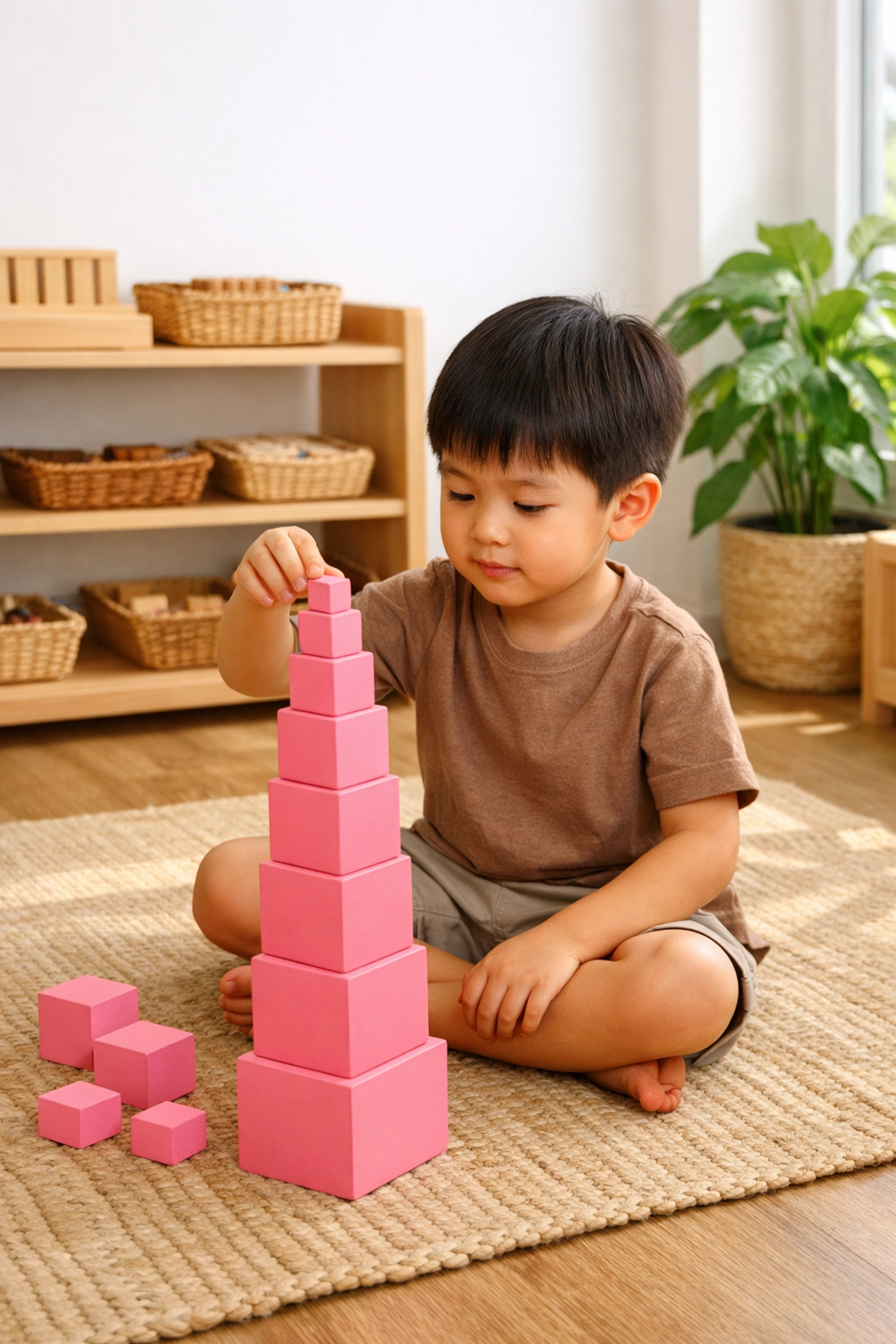
Two children building the Montessori Pink Tower with ten graduated pink cubes in a classroom

The Pink Tower consists of exactly ten wooden cubes. The smallest is one cubic centimeter. The largest is ten cubic centimeters. Each cube increases by exactly one centimeter on each side. And they're all the same color: pink.

Why ten cubes? Why all pink? Why these exact dimensions? Every single detail is intentional.

The number ten introduces the child to the decimal system that forms the foundation of our number system. The uniform pink color removes distraction: it isolates the single concept of size. When everything is the same color, texture, and material, the child's attention focuses exclusively on the differences in dimension. The precise progression allows the child to see, feel, and experience gradual change in a concrete way.

This is a key principle in Montessori education: isolation of a single quality. Each material focuses on one concept at a time. The Pink Tower is about size and size alone. The Color Tablets are about color. The Sound Cylinders are about auditory discrimination. This focused approach helps children build clear, strong neural pathways for each concept.

The Magic of Control of Error

Here's where Montessori materials become truly revolutionary: they teach without a teacher constantly correcting.

Watch a child build the Pink Tower. If she places the cubes out of order, what happens? The tower becomes unstable. It might topple. The proportions look "wrong" even to a three-year-old's eye. The material itself shows the child the mistake.

This is what we call control of error: the material is self-correcting. The child doesn't need an adult to say "That's wrong" or "Try again." The work itself provides immediate, neutral feedback. This builds independence, problem-solving skills, and most importantly, confidence. The child learns: I can figure this out myself. I can trust my own observations. I can fix my own mistakes.

Compare this to a regular set of blocks. You can stack them any way and they'll still stand. There's no inherent lesson in the material itself. They're open-ended, which has value, but they don't teach specific concepts with the same precision.

Beyond the Tower: Understanding the Prepared Environment

The Pink Tower doesn't exist in isolation. It's part of a carefully sequenced Montessori materials list that builds skill upon skill, concept upon concept.

Organized Montessori sensorial materials including Pink Tower, Brown Stair, and Red Rods on shelves

In the sensorial area alone, you'll find the Brown Stair (teaching thickness), the Red Rods (teaching length), the Color Tablets (teaching color discrimination), and dozens more. Each material prepares the child for the next. The three-finger grip developed while carrying Pink Tower cubes? That's preparing the hand for writing. The seriation skills from ordering cubes by size? That's preparing the mind for mathematics.

This is why, when you're finding an authentic Montessori school, you want to see these specific materials. Not plastic substitutes. Not "Montessori-inspired" alternatives. The real materials, in the right sequence, available to children when they're developmentally ready.

What This Means for Your Child at Home

You might be thinking: "This is fascinating, but my child goes to a Montessori school. What do I need to do at home?"

First, resist the urge to replicate the classroom. You don't need a Pink Tower in your living room. What you can do is understand and support the principles:

Respect the work. When your child comes home talking about the Pink Tower or the Golden Beads, they're not just playing. They're building crucial cognitive skills. Ask them to show you or tell you about their work. Listen with genuine interest.

Simplify when possible. While you don't need Montessori materials at home, you can apply the principle of isolation of difficulty. If your child is learning to pour, use one small pitcher and one cup at first: not a dozen options. If they're learning to button, practice on one button at a time.

Allow natural consequences. Let the spilled water teach about pouring. Let the fallen block tower teach about balance. Step back and let your child experience the control of error in everyday life.

Observe before intervening. This might be the hardest one. When you see your child struggling, wait. Watch. They might be on the verge of a breakthrough.

The Resources That Can Help

Understanding Montessori materials is just the beginning. We've created extensive resources to help parents support their child's Montessori journey.

The Montessori Family Alliance offers parent education courses that dive deep into the philosophy and practical application. Our guides like "How to Raise an Amazing Child" give you specific, actionable ways to bring Montessori principles into your daily routines: without turning your home into a classroom.

Child practicing Montessori pouring exercise at home with parent watching supportively

These resources help you understand not just what your child is doing at school, but why it matters and how you can support that learning at home in developmentally appropriate ways.

Questions to Ask When Visiting Schools

Since we're talking about authentic materials, let's address something important: not all schools calling themselves "Montessori" use authentic materials or follow the complete methodology.

When you're visiting schools, look for:

Complete sets of authentic materials. The Pink Tower should have exactly ten cubes, all wooden, all pink, in perfect condition. This attention to detail matters.

Children working independently. You should see children choosing their own work, carrying materials carefully, and completing full work cycles without constant teacher direction.

Trained guides. Ask about teacher training. Authentic Montessori teachers complete specialized training programs that teach them how to present each material in the specific Montessori way.

Mixed-age classrooms. Montessori works best when younger children can observe older ones and older children can mentor younger ones.

Freedom within limits. Children should have choice, but within a structured, prepared environment with clear ground rules.

These markers help you distinguish between authentic Montessori education and programs that have simply borrowed a few ideas or materials.

The Bigger Picture

The Pink Tower is just one material. But it represents something profound about how we approach education.

Instead of assuming children need to be told everything, Montessori materials trust that children can discover concepts themselves through sensory exploration. Instead of one-size-fits-all lessons, these materials allow each child to work at their own pace, repeating as many times as needed. Instead of external rewards and punishments, the materials provide intrinsic satisfaction: the tower stands, the puzzle fits, the color tablets create a beautiful gradation.

This is education that respects the child as a capable, curious, self-directed learner. The materials are simply the tools that make that learning possible.

When you understand this: when you see that pink tower as the sophisticated teaching instrument it is: you begin to see Montessori education differently. Those aren't just pretty materials on low shelves. They're gateways to understanding, carefully designed to help your child build the foundation for a lifetime of learning.

And that's worth far more than any toy.


Want to dive deeper into Montessori principles and how to support your child's development? Join the Montessori Family Alliance or explore our comprehensive parenting guides at The Montessori Foundation. We're here to support your family's Montessori journey.

The Screen-Free Priority: Why Montessori’s “Analog Sanctuary” Matters More Than Ever in 2026

The Screen-Free Priority: Why Montessori’s “Analog Sanctuary” Matters More Than Ever in 2026

It's 2026, and we're watching a generation of parents walk through our school doors carrying an invisible weight. They're exhausted. They're concerned. And they're asking us a version of the same question over and over:

"Is my child going to fall behind without screens?"

Here's what we need them to hear: A screen-free early childhood isn't a disadvantage. It's a developmental necessity.

If you're leading a Montessori school right now, or if you're a parent trying to navigate this digital tsunami, you're not just choosing an educational philosophy. You're choosing to protect something rare and increasingly precious: the conditions young children need to actually build healthy brains.

Let me be clear: this isn't nostalgia. This is neuroscience.

Montessori as a Refuge in a Notification-Driven World

We often describe Montessori schools as "prepared environments," but in 2026, there's another way to frame what we offer: we're creating analog sanctuaries.

Think about what children encounter outside our walls. Their parents' phones interrupt conversations mid-sentence. Apps are designed to trigger dopamine hits every few seconds. Notifications condition young minds to expect constant novelty and immediate reward. Even "educational" screen time fragments attention into bite-sized pieces.

Montessori classrooms offer something radically different: sustained, hands-on engagement with real materials in an environment designed for deep focus. That's not quaint. That's protective.

Child practicing hands-on Montessori water pouring activity at wooden work table

When parents express concern that their child might "miss out" without early tech exposure, here's the truth we need to share: The hardest skills to develop aren't digital. They're human.

Technology changes every few years. The ability to concentrate, persist through challenge, regulate emotions, and think creatively? Those capacities take years to build, and they're built through real-world, multisensory experiences during the most neurologically sensitive periods of development.

So yes, we mean screen-free. Not “screen-light,” not “just a little app here and there.” In the first plane of development, a child’s job is to construct the self. Our job is to protect the conditions that make that construction possible.

The Brain Builds Through the Hands

One of the most powerful things we can tell parents is this: Young children literally build their brains through their hands.

This isn't metaphor. It's developmental biology.

When a three-year-old pours water from a pitcher, her brain is integrating:

  • Visual tracking (watching the water level)
  • Motor control (tilting at just the right angle)
  • Proprioception (feeling the weight shift)
  • Cause and effect (too fast = spill, just right = success)
  • Error correction (adjusting when it starts to overflow)

That single, simple activity activates neural pathways across multiple brain regions. It builds executive function, coordination, and the capacity for self-correction, all while the child feels capable and engaged.

Now contrast that with swiping through a tablet app about pouring. The brain registers visual information, yes. But the movement is minimal, the feedback is artificial, and the learning stays surface-level. Nothing integrates. Nothing truly embeds.

This is why hands-on learning matters so profoundly in the early years. The Montessori materials aren't charming props. They're carefully designed tools that allow children to think with their whole bodies: and when children think with their bodies, the learning lasts.

The Uninterrupted Work Cycle: Training Attention in an Age of Distraction

Here's one of Montessori's most brilliant "technologies," and it costs nothing: the uninterrupted work cycle.

In authentic Montessori classrooms, we protect long stretches of time: typically two to three hours: during which children can choose meaningful work and stay with it as long as they need. No bells. No forced transitions. No interruptions unless absolutely necessary.

Why does this matter more in 2026 than ever before?

Because the world outside is systematically destroying children's capacity for sustained attention. The average adult now checks their phone 96 times per day. Children are watching. They're learning. And they're being conditioned to expect constant stimulation.

Montessori students engaged in uninterrupted work cycle with hands-on materials

The uninterrupted work cycle is our counteroffer. It says: "Here, you can think. Here, you can go deep. Here, your attention is valued and protected."

When children practice entering a state of flow: choosing work, persisting through challenge, completing a cycle: they're building the neural infrastructure for:

  • Planning and sequencing
  • Impulse control
  • Working memory
  • Emotional regulation
  • Intrinsic motivation

These are the foundations of executive function. And they don't develop through gamified apps or five-minute rotations. They develop through real work, real time, and real satisfaction in effort.

As school leaders, this is language you can use directly with parents:

"We protect concentration the way you protect sleep. Because concentration is where learning, confidence, and self-regulation grow. In a world of notifications, the ability to focus deeply is becoming our children's most valuable skill."

But Won't My Child Fall Behind Without Tech Skills?

This is the fear that keeps parents awake at night. Let's address it head-on.

The honest answer? No.

Tech skills are not the hard part. Most children can learn to navigate devices quickly when they're developmentally ready: usually around age 10 or later. What's genuinely difficult to rebuild once it's been lost is:

  • The habit of deep reading
  • Tolerance for challenge without instant reward
  • Comfort with silence and solitude
  • The ability to generate ideas rather than consume them
  • Genuine curiosity (not just clicking through curated content)

These capacities form in the early years. And they form through a clear, consistent boundary: early childhood stays screen-free while children build the attention, coordination, language, and self-regulation that make later tech use healthy and purposeful.

Here's what we know from decades of Montessori graduates: children who spend their early years in screen-free, hands-on environments don't struggle with technology later. They master it quickly when it's introduced, and they use it more thoughtfully because they've developed the executive function to manage it.

The question isn't whether children will learn to use technology. The question is: Will they learn to think, focus, and create before technology shapes how they do all three?

Child's hands tracing Montessori sandpaper letters for tactile learning experience

Montessori answers that question with a resounding yes.

Supporting School Leaders: The Language You Need

If you're a Head of School navigating parent concerns about screen-free childhood, you're not alone. Many parents want someone to take a clear, confident stand on behalf of their children; they just need reassurance that this approach is grounded in something real.

Here's a framework you can adapt for tours, newsletters, or parent meetings:

"Montessori is intentionally screen-free in the early years because we're protecting the developmental conditions young children need. Hands-on learning builds the brain in ways screens simply cannot replicate. Your child's future will include technology; our job is to ensure they have the attention, creativity, and executive function to use it well."

You might also frame it as a partnership (without backing away from the boundary):

"We know parenting in 2026 is intense. We are not here to shame families, but we are going to be clear: early childhood is better screen-free. What we can offer is a daily reset: a place where your child's brain can rest, focus, and grow through real materials and real relationships. You don't have to fight this battle alone."

Parents aren't looking for perfection. They're looking for clarity, support, and the reassurance that authentic Montessori has always prioritized what children developmentally need over what's culturally trendy.

What This Looks Like in Practice

A screen-free Montessori classroom in 2026 doesn't mean we ignore the modern world. It means we're clear about what the developing brain requires:

  • Movement: Children need to move, manipulate, build, and create with their bodies.
  • Real materials: Wooden blocks, metal insets, water, plants, fabrics: things with weight, texture, and natural feedback.
  • Social interaction: Face-to-face communication, conflict resolution, collaboration, grace and courtesy practiced in real time.
  • Silence and focus: The ability to work independently without external stimulation.
  • Mastery through repetition: Choosing the same work again and again until competence becomes confidence.

These aren't "extras." They're essentials. And they're exactly what gets crowded out when screens enter too early.

An Invitation to Go Deeper

A primary note for parents (because you are the ones carrying this every day)

If you're reading this as a parent, we want you to feel supported and not alone. Plenty of thoughtful, loving families worry that “screen-free” will mean their child is unprepared, left out, or behind.

We see the opposite. When we protect a screen-free early childhood, we give children the best possible start: robust sensory-motor development, stronger language, steadier emotional regulation, and the ability to concentrate for longer and longer stretches. That is not a small thing. It is the foundation.

If you want help making screen-free feel doable (and not like a constant battle), we have two easy next steps:

  • Join the Montessori Family Alliance for practical, parent-friendly guidance you can use at home (routines, independence, attention, and yes—screen boundaries).
  • Subscribe to Tomorrow’s Child magazine for grounded, encouraging reading on Montessori, neurodevelopment, and what families are facing right now.

You can explore both at montessori.org.

A closing note for Montessori school leaders

If you're leading a school and you want help communicating (and defending) a firm screen-free stance, strengthening the uninterrupted work cycle, or supporting your team through parent conversations, The Montessori Foundation is here to help.

Our consulting and coaching supports Montessori schools at every stage—from startups to well-established communities—through leadership support, program strengthening, and clear mission-aligned messaging. Learn more at montessori.org.

The Bottom Line

In 2026, Montessori's screen-free priority isn't radical. It's essential.

We're not rejecting the future. We're protecting the present: the narrow window of early childhood when the brain is most plastic, most vulnerable, and most hungry for real-world experience.

Parents are looking for a refuge. Children need one. And Montessori schools are uniquely positioned to offer it: a place where attention is respected, hands build brains, and childhood unfolds at a human pace.

That's not nostalgia.

That's neurodevelopment.

And it's exactly what this generation needs.

The Screen-Free Priority: Why Montessori’s “Analog Sanctuary” Matters More Than Ever in 2026

The Screen-Free Priority: Why Montessori’s “Analog Sanctuary” Matters More Than Ever in 2026

It's 2026, and we're watching a generation of parents walk through our school doors carrying an invisible weight. They're exhausted. They're concerned. And they're asking us a version of the same question over and over:

"Is my child going to fall behind without screens?"

Here's what we need them to hear: A screen-free early childhood isn't a disadvantage. It's a developmental necessity.

If you're leading a Montessori school right now, or if you're a parent trying to navigate this digital tsunami, you're not just choosing an educational philosophy. You're choosing to protect something rare and increasingly precious: the conditions young children need to actually build healthy brains.

Let me be clear: this isn't nostalgia. This is neuroscience.

Montessori as a Refuge in a Notification-Driven World

We often describe Montessori schools as "prepared environments," but in 2026, there's another way to frame what we offer: we're creating analog sanctuaries.

Think about what children encounter outside our walls. Their parents' phones interrupt conversations mid-sentence. Apps are designed to trigger dopamine hits every few seconds. Notifications condition young minds to expect constant novelty and immediate reward. Even "educational" screen time fragments attention into bite-sized pieces.

Montessori classrooms offer something radically different: sustained, hands-on engagement with real materials in an environment designed for deep focus. That's not quaint. That's protective.

Child practicing hands-on Montessori water pouring activity at wooden work table

When parents express concern that their child might "miss out" without early tech exposure, here's the truth we need to share: The hardest skills to develop aren't digital. They're human.

Technology changes every few years. The ability to concentrate, persist through challenge, regulate emotions, and think creatively? Those capacities take years to build, and they're built through real-world, multisensory experiences during the most neurologically sensitive periods of development.

So yes, we mean screen-free. Not “screen-light,” not “just a little app here and there.” In the first plane of development, a child’s job is to construct the self. Our job is to protect the conditions that make that construction possible.

The Brain Builds Through the Hands

One of the most powerful things we can tell parents is this: Young children literally build their brains through their hands.

This isn't metaphor. It's developmental biology.

When a three-year-old pours water from a pitcher, her brain is integrating:

  • Visual tracking (watching the water level)
  • Motor control (tilting at just the right angle)
  • Proprioception (feeling the weight shift)
  • Cause and effect (too fast = spill, just right = success)
  • Error correction (adjusting when it starts to overflow)

That single, simple activity activates neural pathways across multiple brain regions. It builds executive function, coordination, and the capacity for self-correction, all while the child feels capable and engaged.

Now contrast that with swiping through a tablet app about pouring. The brain registers visual information, yes. But the movement is minimal, the feedback is artificial, and the learning stays surface-level. Nothing integrates. Nothing truly embeds.

This is why hands-on learning matters so profoundly in the early years. The Montessori materials aren't charming props. They're carefully designed tools that allow children to think with their whole bodies: and when children think with their bodies, the learning lasts.

The Uninterrupted Work Cycle: Training Attention in an Age of Distraction

Here's one of Montessori's most brilliant "technologies," and it costs nothing: the uninterrupted work cycle.

In authentic Montessori classrooms, we protect long stretches of time: typically two to three hours: during which children can choose meaningful work and stay with it as long as they need. No bells. No forced transitions. No interruptions unless absolutely necessary.

Why does this matter more in 2026 than ever before?

Because the world outside is systematically destroying children's capacity for sustained attention. The average adult now checks their phone 96 times per day. Children are watching. They're learning. And they're being conditioned to expect constant stimulation.

Montessori students engaged in uninterrupted work cycle with hands-on materials

The uninterrupted work cycle is our counteroffer. It says: "Here, you can think. Here, you can go deep. Here, your attention is valued and protected."

When children practice entering a state of flow: choosing work, persisting through challenge, completing a cycle: they're building the neural infrastructure for:

  • Planning and sequencing
  • Impulse control
  • Working memory
  • Emotional regulation
  • Intrinsic motivation

These are the foundations of executive function. And they don't develop through gamified apps or five-minute rotations. They develop through real work, real time, and real satisfaction in effort.

As school leaders, this is language you can use directly with parents:

"We protect concentration the way you protect sleep. Because concentration is where learning, confidence, and self-regulation grow. In a world of notifications, the ability to focus deeply is becoming our children's most valuable skill."

But Won't My Child Fall Behind Without Tech Skills?

This is the fear that keeps parents awake at night. Let's address it head-on.

The honest answer? No.

Tech skills are not the hard part. Most children can learn to navigate devices quickly when they're developmentally ready: usually around age 10 or later. What's genuinely difficult to rebuild once it's been lost is:

  • The habit of deep reading
  • Tolerance for challenge without instant reward
  • Comfort with silence and solitude
  • The ability to generate ideas rather than consume them
  • Genuine curiosity (not just clicking through curated content)

These capacities form in the early years. And they form through a clear, consistent boundary: early childhood stays screen-free while children build the attention, coordination, language, and self-regulation that make later tech use healthy and purposeful.

Here's what we know from decades of Montessori graduates: children who spend their early years in screen-free, hands-on environments don't struggle with technology later. They master it quickly when it's introduced, and they use it more thoughtfully because they've developed the executive function to manage it.

The question isn't whether children will learn to use technology. The question is: Will they learn to think, focus, and create before technology shapes how they do all three?

Child's hands tracing Montessori sandpaper letters for tactile learning experience

Montessori answers that question with a resounding yes.

Supporting School Leaders: The Language You Need

If you're a Head of School navigating parent concerns about screen-free childhood, you're not alone. Many parents want someone to take a clear, confident stand on behalf of their children; they just need reassurance that this approach is grounded in something real.

Here's a framework you can adapt for tours, newsletters, or parent meetings:

"Montessori is intentionally screen-free in the early years because we're protecting the developmental conditions young children need. Hands-on learning builds the brain in ways screens simply cannot replicate. Your child's future will include technology; our job is to ensure they have the attention, creativity, and executive function to use it well."

You might also frame it as a partnership (without backing away from the boundary):

"We know parenting in 2026 is intense. We are not here to shame families, but we are going to be clear: early childhood is better screen-free. What we can offer is a daily reset: a place where your child's brain can rest, focus, and grow through real materials and real relationships. You don't have to fight this battle alone."

Parents aren't looking for perfection. They're looking for clarity, support, and the reassurance that authentic Montessori has always prioritized what children developmentally need over what's culturally trendy.

What This Looks Like in Practice

A screen-free Montessori classroom in 2026 doesn't mean we ignore the modern world. It means we're clear about what the developing brain requires:

  • Movement: Children need to move, manipulate, build, and create with their bodies.
  • Real materials: Wooden blocks, metal insets, water, plants, fabrics: things with weight, texture, and natural feedback.
  • Social interaction: Face-to-face communication, conflict resolution, collaboration, grace and courtesy practiced in real time.
  • Silence and focus: The ability to work independently without external stimulation.
  • Mastery through repetition: Choosing the same work again and again until competence becomes confidence.

These aren't "extras." They're essentials. And they're exactly what gets crowded out when screens enter too early.

An Invitation to Go Deeper

A primary note for parents (because you are the ones carrying this every day)

If you're reading this as a parent, we want you to feel supported and not alone. Plenty of thoughtful, loving families worry that “screen-free” will mean their child is unprepared, left out, or behind.

We see the opposite. When we protect a screen-free early childhood, we give children the best possible start: robust sensory-motor development, stronger language, steadier emotional regulation, and the ability to concentrate for longer and longer stretches. That is not a small thing. It is the foundation.

If you want help making screen-free feel doable (and not like a constant battle), we have two easy next steps:

  • Join the Montessori Family Alliance for practical, parent-friendly guidance you can use at home (routines, independence, attention, and yes—screen boundaries).
  • Subscribe to Tomorrow’s Child magazine for grounded, encouraging reading on Montessori, neurodevelopment, and what families are facing right now.

You can explore both at montessori.org.

A closing note for Montessori school leaders

If you're leading a school and you want help communicating (and defending) a firm screen-free stance, strengthening the uninterrupted work cycle, or supporting your team through parent conversations, The Montessori Foundation is here to help.

Our consulting and coaching supports Montessori schools at every stage—from startups to well-established communities—through leadership support, program strengthening, and clear mission-aligned messaging. Learn more at montessori.org.

The Bottom Line

In 2026, Montessori's screen-free priority isn't radical. It's essential.

We're not rejecting the future. We're protecting the present: the narrow window of early childhood when the brain is most plastic, most vulnerable, and most hungry for real-world experience.

Parents are looking for a refuge. Children need one. And Montessori schools are uniquely positioned to offer it: a place where attention is respected, hands build brains, and childhood unfolds at a human pace.

That's not nostalgia.

That's neurodevelopment.

And it's exactly what this generation needs.

Creatively Staffing Your Montessori School’s Summer Camp Program

Creatively Staffing Your Montessori School’s Summer Camp Program

As a life member of the American Camp Association, I often find myself nodding along as I read about challenges and innovations in the camp world. The staffing struggles camps face each summer are strikingly similar to what Montessori schools experience: especially when we turn our attention to summer programs. For many heads of school, this is also where thoughtful Montessori consulting and strong Montessori school leadership can make the difference between a program that merely runs and one that truly strengthens the school.

A recent ACA article by Ruby Compton, "Unconventional Recruitment Ideas for the Summer Ahead," prompted me to revisit a question I've written about before: why Montessori schools can: and should: run strong summer programs, and how we might rethink staffing them in more creative, sustainable ways.

Summer programs matter. They provide continuity for children, essential support for working families, meaningful enrichment opportunities, and often an important source of revenue. But staffing them well remains one of the biggest obstacles for schools. The good news? Montessori schools are uniquely positioned to learn from the camp world: and, in many cases, to do even better, especially when Montessori school leadership treats summer as a strategic system (not a scramble) and uses Montessori consulting support when needed.

Looking Beyond the Usual Staffing Pipeline (A Montessori Consulting Lens)

One of the most valuable lessons from the camp world is this: staffing problems often persist because we keep looking in the same places. Montessori schools tend to default to recruiting Montessori-trained guides or education majors. While that makes sense during the academic year, summer opens the door to a much wider: and often richer: staffing ecosystem.

Diverse Montessori summer camp staff of different ages in classroom

Some Montessori schools have already embraced this broader view. The Montessori School of Greater Hartford, for example, runs a Summer Days program that keeps the familiar Montessori classroom rhythm while incorporating art, science, and outdoor exploration. Because the structure of the day remains consistent with the school year, teachers aren't required to reinvent classroom management or supervision systems. This makes it far easier to bring in assistants, retirees, or part-time summer staff who can step into a stable, prepared environment rather than a chaotic or entertainment-driven camp model.

Similarly, Living Montessori Academy operates an immersive themed summer program that blends Montessori continuity with imaginative, project-based exploration. Their staffing model combines Montessori guides, assistants, and enrichment specialists who rotate roles. This allows teachers to work partial schedules, prevents burnout, and creates entry points for individuals who may later pursue Montessori training. Summer becomes not just a staffing challenge, but a recruitment pipeline.

Start your recruitment early: many successful programs begin outreach around Thanksgiving. Tap into your existing networks: former parents, alumni families, after-school program participants, and local high school students who've spent time in your classrooms. These individuals already understand your culture and values. From a practical Montessori consulting standpoint, this is one of the simplest high-leverage moves we can make: build the pipeline before we urgently need it.

Embracing Intergenerational and Community Talent (A Montessori School Leadership Advantage)

Camps have long understood the value of intergenerational staffing, and Montessori schools are especially well suited to this approach. Many adults aged 55 and older are seeking purposeful, community-centered work. Montessori summer programs benefit enormously from retirees and grandparents who bring patience, life experience, and specialized skills: art, music, gardening, storytelling, or practical life activities.

This approach also reduces the interpersonal drama that sometimes arises in youth-heavy summer staffs. Multi-generational teams bring perspective, stability, and emotional maturity: qualities that align beautifully with Montessori values.

Intergenerational Montessori staffing: grandmother teaching children with natural materials

Some schools extend this idea by recruiting from their immediate community. Montessori Centre's summer program, for example, integrates guest specialists and cultural enrichment opportunities while Montessori staff maintain classroom continuity. Local artists, musicians, and educators join the program for short periods, expanding children's experiences without requiring the school to staff every specialty internally. This both lightens staffing demands and deepens community relationships.

Use social media strategically. Recruit individuals who demonstrate through their online presence that they want to make a difference. Connect with local Montessori training centers and offer free informational sessions about careers in Montessori education. You're not just filling summer positions: you're building long-term awareness and interest in the field.

Rethinking Roles, Not Just Headcount

Another key insight from the camp world is that staffing challenges are often solved not by hiring more people, but by redefining roles.

Apple Montessori Schools illustrate this well through their session-based summer camps that blend Montessori continuity with STEAM, performing arts, outdoor activities, and swimming. Specialists such as swim instructors or theater educators join the program temporarily, while Montessori staff oversee classroom culture and child development. This allows schools to offer rich programming without requiring every staff member to be Montessori-trained or employed for the full summer.

This same flexibility applies to scheduling. Sammamish Montessori School offers separate summer tracks for toddlers, primary, and elementary students. Staffing can then be tailored developmentally. New assistants or interns often support younger children, while experienced teachers guide older students through more complex thematic work. This layered approach supports mentoring, professional growth, and more humane workloads.

If you cannot offer highly competitive pay (and let's be honest: most schools can't), flexibility with schedules becomes your strongest incentive. Structure your program to allow staff to commit fully while accommodating their school schedules, family needs, or other summer commitments. The most powerful retention tool, however, is making staff feel genuinely valued. Counselors who feel appreciated return: and they bring friends with them.

Montessori summer program with teachers and specialists leading multiple activities

Outdoor and Experiential Learning as a Staffing Asset

Montessori Discovery School's summer camps, built around gardening, animal care, outdoor exploration, and STEAM projects, highlight another important point: summer programs don't need to rely exclusively on classroom-based staffing. Outdoor educators, environmental specialists, and gardeners often thrive in Montessori summer environments. Many discover Montessori through these roles and later become long-term staff members.

This mirrors what camps have known for decades: experiential learning environments naturally reduce behavior issues, support mixed-age collaboration, and allow adults to guide rather than constantly manage children. When children are engaged in meaningful outdoor work: planting, observing wildlife, building, exploring: the adult's role shifts from enforcer to facilitator.

Why Montessori Summer Programs Are Especially Sustainable

What ties all of these examples together is not clever scheduling alone, but the power of the Montessori prepared environment. Montessori classrooms already support independence, peer learning, freedom within limits, and sustained engagement. These elements dramatically reduce the behavioral and emotional load placed on staff.

When summer programs preserve uninterrupted work cycles, hands-on materials, and meaningful choice, children settle into focused activity. Staff are freed to observe, guide, and connect rather than police behavior. This makes summer work more rewarding and far more sustainable.

Compare this to traditional summer camps, where staff often spend the day managing transitions, mediating conflicts, and keeping children entertained. The Montessori approach inherently reduces staff stress because the environment itself does much of the work.

Children engaged in outdoor Montessori learning activities in summer garden program

Building Your Infrastructure

Streamline your hiring process with management software like CampMinder or Daxko to handle applications efficiently. Develop clear job descriptions, structured interviews, and comprehensive onboarding that includes welcome materials, staff introductions, and mentorship.

Ensure all staff complete child abuse prevention training and pass background checks. Establish clear expectations around performance, conduct, and policies for recognizing and reporting concerns. This isn't just compliance: it's creating a culture of safety and professionalism that attracts quality candidates.

A Strategic Opportunity for Montessori School Leadership

The camp world has long understood that staffing summer programs requires creativity, flexibility, and community engagement. Montessori schools bring an additional advantage: environments designed from the ground up to support how children actually grow and learn.

Summer programs should not be viewed simply as seasonal childcare or a logistical headache. When thoughtfully designed, they become:

  • Recruitment pipelines for future teachers and assistants
  • Professional development opportunities for staff
  • Community-building tools that deepen relationships
  • Enrollment marketing opportunities that showcase your school
  • Essential financial supports that stabilize year-round operations

For Montessori school leaders, the question is not just how to staff the summer. The deeper question is: how do we design summer programs that strengthen the long-term health of our schools? This is exactly the kind of big-picture planning strong Montessori school leadership should own: and where targeted Montessori consulting can help teams clarify roles, budgets, and systems.

When we approach summer with the same intentionality we bring to the academic year: and borrow a few smart ideas from our colleagues in the camp world: we often discover that the staffing challenges we feared become opportunities we hadn't fully imagined.


Ready to strengthen your school's summer program? The Montessori Foundation offers resources, Montessori consulting, and community connections to support school leaders in building sustainable, joyful summer experiences and stronger Montessori school leadership practices year-round. Learn more about our leadership resources.

Montessori School Leadership in Action

Montessori School Leadership in Action

Cover image courage to lead

The Courage to Lead When People, Money, and Morale Are All at Stake


Montessori school leadership is often discussed in terms of vision, values, and philosophy. But day-to-day reality unfolds in far more complicated terrain—at the intersection of people, money, morale, and mission, where every decision feels consequential and often personal.

Today’s Montessori leaders navigate an especially fragile landscape. Teachers are challenging to find, and support staff are stretched thin. Burnout is real, and the fear that a valued teacher might leave—seeking higher pay, less stress, or relief from constant pressure—can lead to difficult decisions. Leaders must balance staff retention efforts with maintaining high standards to ensure school stability and quality.

Courageous leadership doesn’t ignore these realities. But it also doesn’t allow fear to dictate the school’s future quietly. Instead, it works through influence, systems, and sustained attention to the people who make the school work.

Montessori as a System of Systems

Montessori education itself can be understood as a system of systems—ways of organizing time, space, materials, curriculum, and human relationships that work together to support children’s development. While there can be legitimate disagreement about how to implement or organize these systems, schools work best when there is a common understanding about how we do things here.

This doesn’t mean imposing rigid uniformity or stifling professional judgment. It means developing carefully crafted agreements about the fundamentals:

  • How we treat each other—children, families, and colleagues
  • How we organize the day and the program at each age level
  • What Montessori and supplementary materials are needed for each classroom
  • What standards of cleanliness, order, and timeless beauty we maintain in our indoor and outdoor environments
  • What curriculum do we expect all children to experience, beyond their individual interests
  • What children should know or be able to do before progressing to the next level
  • How we respond to children who are struggling
  • How we work with challenging parents

When these agreements are clear, stress and resentment decrease. People know what’s expected. They can focus on their work rather than navigating constant uncertainty or dealing with conflicting work.

The key is that these agreements shouldn’t simply be imposed by leadership. They need to be developed thoughtfully, with input from those who will live by them, and then memorialized in writing as part of an organizational blueprint—a master plan or manual of how things work at our school. This living document serves as a reference point for everyone and a crucial tool for onboarding new community members.

The school can’t reinvent itself every time someone new joins. But neither can it ignore the need to help newcomers understand and embrace these shared agreements.

Courage in a Time of Scarcity

Staffing scarcity defines modern Montessori leadership. Experienced teachers are in short supply. Assistants and support staff are harder than ever to recruit and retain. Leaders know that replacing a teacher isn’t a simple transaction—it can take months, sometimes years. The disruption to children, families, and morale can be profound.

As a result, many leaders hesitate to:

  • Address misalignment or underperformance
  • Introduce needed changes in practice or structure
  • Make decisions that might be unpopular in the short term

The tendency to hesitate is understandable, but when fear of losing staff becomes the primary driver of decisions, the hidden costs accumulate. Standards erode. Resentment builds quietly among other staff. Strong teachers carry the emotional and practical load for those who are disengaged. Over time, morale suffers anyway.

Courageous leadership doesn’t mean ignoring scarcity. It means leading through it, rather than around it—by building systems and relationships that help people grow, feel supported, and work effectively together. And it means being thoughtful about who joins the community in the first place.

Taking Time to Find the Right Fit

One of the most important ways leaders protect their schools is by resisting the pressure to rush. When there’s an opening—whether for a teacher, assistant, specialist, or administrator—the temptation to fill it quickly can be overwhelming. When enrollment is soft, the pressure to accept any family willing to pay tuition is intense.

But courageous leadership means taking time in both hiring and admissions to find people who will be happy at the school and become great members of the community.

Before making an offer of employment or admission, both parties need time to get to know each other. Prospective families need to understand what they’re agreeing to—not just the philosophy in the abstract, but the practical realities of how the school operates. Prospective staff members need to understand not only their role, but the social norms and expectations of the community they’re joining.

Not every family will care deeply about understanding Montessori education—some are just trying to solve a childcare problem. But they still need a certain level of understanding right from the start. It’s far easier to establish shared expectations at the beginning than to try to change someone once they’re already part of the school.

The same is true for staff. Taking time to find the right fit can build confidence that the school is making thoughtful decisions, leading to greater stability and coherence.

Leading Through Influence, Not Just Authority

Decades ago, Peter Drucker highlighted how managers make things happen through influence, which can inspire Montessori leaders to foster trust and responsibility rather than relying solely on authority. 

Time and presence matter. Leaders who regularly spend time in classrooms signal that they care about what’s happening and who’s doing the work. Teachers notice when leaders show up—not to evaluate, but to understand, support, and stay connected to the daily reality of the classroom.

Coaching and support build capacity. Providing teachers with thoughtful, ongoing coaching—not just annual observations—helps them develop their practice and feel genuinely supported. This is especially important for support staff and specialists who may not have Montessori training. Rather than leaving them to feel inadequate or guilty about what they don’t know, leaders can create pathways for learning and growth.

Systems create space for collaboration. Organizing regular meeting time, planning structured opportunities for reflection and team-building, and creating traditions that bring people together all help build the connective tissue of a healthy school. Beginning-of-year team building and end-of-year reflection aren’t luxuries—they’re how shared understanding develops and how those foundational agreements get refined and renewed.

Communication shapes culture. Leaders influence their schools by how they communicate with all stakeholders—teachers, assistants, parents, students, boards, and partners. Effective communication doesn’t overwhelm people with information, nor does it leave them guessing. It’s clear about expectations, transparent about challenges, and consistent in tone and frequency.

Onboarding sets the foundation. Careful onboarding of new staff and families establishes expectations, builds relationships, and helps people understand not only their roles but also how their work connects to the school’s larger purpose and the carefully developed agreements about how we do things here. Poor onboarding leaves people adrift; thoughtful onboarding creates belonging.

These aren’t add-ons to leadership. They’re how leadership actually happens—through sustained attention to people, structures, and relationships.

Making Everyone Feel Seen, Heard, and Valued

One of the most important goals of Montessori leadership is ensuring that every member of the community. feels seen, heard, and valued. 

Parents may feel they’re not good enough or not part of the crowd because of race, religion, gender, wealth, level of education, or some other factor. Leaders must actively work to counteract this through how they communicate, how they welcome families, and how they create opportunities for connection that honor different circumstances and comfort levels.

Not every parent has the same time availability or interest. Some will eagerly engage with every aspect of school life; others are simply trying to solve a problem and get through the day. The goal isn’t to force everyone into the same mold, but to ensure everyone has access to the information and support they need, and that no one feels excluded or diminished.

The same principle applies to staff. Everyone—from the newest assistant to the art teacher, from office staff to administrators, from veteran guides to brand-new teachers—needs to feel that they matter. Support staff and specialists, who often feel invisible because they’re not Montessori-trained classroom teachers, especially need deliberate inclusion in the school’s mission and community.

Helping everyone feel that they are part of the fabric of the school requires ongoing effort. It’s not something you do once during onboarding and then forget. It means continually creating opportunities for connection, recognition, and meaningful participation. It means paying attention to who speaks and who doesn’t, who feels comfortable and who seems hesitant, who gets recognized and who gets overlooked.

Working With Resistance When the Stakes Feel High

Resistance to change intensifies when leaders feel they cannot afford to lose people. A teacher who says, “I’ve been doing this for thirty years,” or “This is not how I was trained,” may feel untouchable—not because their practice is beyond question, but because the leader fears the consequences of conflict.

Here, courage takes a relational form. It asks leaders to engage resistance thoughtfully rather than avoid it. To separate respect for experience from unquestioned authority. To create space for dialogue while maintaining clarity about expectations.

This is where influence-based leadership and those shared agreements become essential. Rather than issuing mandates, effective leaders:

  • Name shared goals for children, framing change around student needs rather than teacher shortcomings
  • Return to those foundational agreements about how we do things here—not as weapons, but as touchstones for dialogue
  • Create structured time for faculty to explore new ideas together, building consensus rather than imposing change
  • Provide professional development and coaching that helps teachers see possibilities rather than threats
  • Help people become more reflective and supportive of each other through facilitated conversation
  • Are transparent about what is essential to the mission and what is open to discussion
  • Accept that not everyone will choose to stay—and that this, while painful, is sometimes part of organizational health

Montessori schools don’t thrive because everyone agrees. They thrive when leaders create the conditions for honest dialogue, mutual support, and shared commitment to children.

Morale, Stress, and the Adult Prepared Environment

Teacher morale isn’t only a function of workload or compensation, though both matter deeply. It’s also shaped by clarity, consistency, and trust. In schools where expectations are ambiguous, decisions feel arbitrary, or leaders appear hesitant, stress increases—even when leaders believe they’re being protective.

Carefully crafted agreements about ‘how we do things’ are very helpful. When people understand the systems and trust that they will be implemented consistently, they can relax into their work. When standards shift depending on who’s asking or what day it is, everyone operates in a state of low-grade anxiety.

Adults, like children, need a prepared environment. They need:

  • Clear roles and boundaries
  • Predictable systems and rhythms
  • Honest, regular communication
  • Leadership that is calm, present, and consistent
  • Time and space for collaboration and community-building
  • Recognition that their work matters
  • Shared understanding of how things work here

Support staff and specialists—who often feel invisible because they’re not Montessori teachers—especially need to feel included in the school’s mission and supported in their work with children. When leaders create systems that honor all adults in the building, morale strengthens across the entire community.

Ironically, when leaders avoid difficult conversations out of fear of harming morale, morale often declines anyway. Staff sense uncertainty. Strong teachers feel unsupported. The emotional load shifts sideways rather than disappearing.

Courageous leadership recognizes that structure is a form of care—and that investing time in people’s growth and connection is not a luxury but a necessity.

Financial Courage in a Fragile Staffing Market

The fear of losing teachers also shapes financial decisions. Leaders know compensation matters, but they also know tuition has limits. Parents may resist increases. Markets vary. Not every school can simply “charge more.”

This is where courage becomes strategic and creative rather than simplistic—and where communication becomes critical.

When a school is underfunded, leaders must explore multiple avenues simultaneously:

  • Reduce expenses thoughtfully without cutting quality
  • Strengthen marketing and admissions to fill empty spaces—but without rushing or compromising on fit
  • Help families understand the value of Montessori education more clearly through consistent, honest communication
  • Use financial aid strategically to support access while protecting sustainability
  • Align staffing models with enrollment realities rather than historical patterns
  • Work with parents so they feel honored and understand both what the school asks of them and what the school is committed to providing.

Financial courage isn’t about pretending constraints don’t exist. It’s about refusing to accept chronic scarcity as inevitable—and being willing to have honest, ongoing conversations with all stakeholders about sustainability.

Leading With Others, Not Alone

For many Montessori leaders, these decisions are complicated by governance structures—boards, owners, or partners who may not fully understand Montessori education or the daily realities of staffing and morale.

Again, courage isn’t confrontation for its own sake. It’s persistence, education, and conversation. Building consensus over time and staying engaged even when progress is slow.

This requires the same influence-based approach that works with faculty:

  • Regular, structured communication that keeps boards and partners informed without overwhelming them
  • Helping them see the whole picture: how financial instability affects staff well-being, how unclear expectations undermine morale, how avoiding change today often creates greater disruption tomorrow
  • Creating opportunities for board members or partners to experience the school directly—to see classrooms, meet teachers, and understand the work.
  • Building shared language and understanding about what makes Montessori education work.
  • Developing those foundational agreements together, so that governance partners understand and support the school’s organizational blueprint

It means resisting the temptation to disengage when alignment feels difficult, and instead finding ways to bring people along.

Leadership as Steady Presence

At its heart, Montessori leadership isn’t about eliminating anxiety—your own or others’. It’s about becoming a steady presence within it.

Leaders can’t promise teachers that nothing will change or that stress will disappear. What they can offer is honesty, clarity, and a commitment to building a school worthy of people’s energy and talent.

School leaders support this through:

  • Showing up consistently in classrooms
  • Creating and maintaining systems that support collaboration and growth
  • Developing and stewarding those foundational agreements about how we do things here
  • Communicating clearly and regularly with all stakeholders
  • Investing in people’s development through coaching and professional learning
  • Taking time to find the right fit when hiring or enrolling new members
  • Building community intentionally, not accidentally
  • Making space for reflection, celebration, and honest assessment
  • Ensuring everyone—parents and staff alike—feels seen, heard, and valued

Yes, leadership can feel like herding cats. But it’s also the work of pathfinding—helping an organization move, step by step, toward sustainability, coherence, and trust.

When Montessori leaders lead with courage in this fuller sense—acknowledging scarcity, caring for morale, building systems that support people, trying to confirm that prospective employees and families will be a good fit, creating shared agreements about how things work, and still making principled decisions—they create schools where great teachers are more likely to stay, not less.

Not because leadership avoided difficulty, but because it faced it with integrity—and built the structures, relationships, and shared understandings that help everyone do their best work.


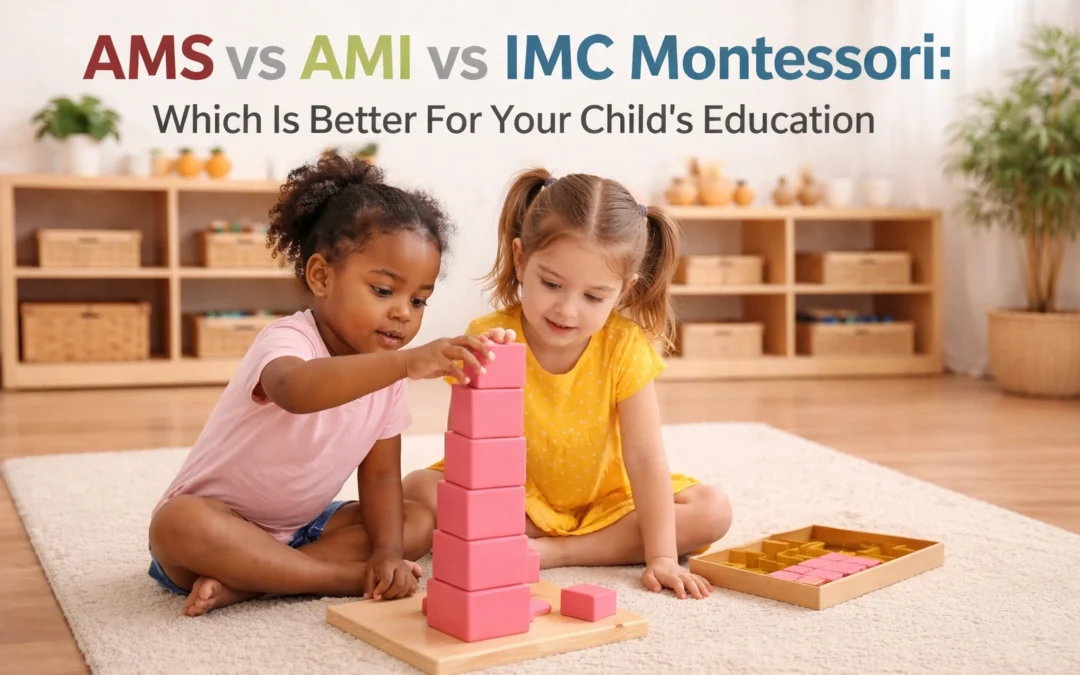
AMS Vs AMI vs IMC Montessori: Which Is Better For Your Child's Education

AMS Vs AMI vs IMC Montessori: Which Is Better For Your Child's Education


Authentic Montessori classroom with wooden shelves displaying colorful educational materials in a prepared environment


If you’ve started researching Montessori schools for your child, you’ve probably noticed three acronyms popping up again and again: AMI, AMS, and IMC. At first glance, they might seem interchangeable: after all, they all represent organizations dedicated to Montessori education. But dig a little deeper, and you’ll discover meaningful differences in philosophy, teacher training, and classroom implementation.

So which one is “better” for your child’s education? The honest answer is: it depends. Each organization brings something valuable to the table, and understanding their distinctions will help you make an informed decision when finding an authentic Montessori school.

Let’s break it down.

Understanding the Three Major Montessori Organizations

Before we compare, let’s establish who these organizations are and where they came from.

AMI (Association Montessori Internationale) was founded in 1929 by Dr. Maria Montessori herself. It’s headquartered in Amsterdam and is often considered the most traditional keeper of Montessori philosophy. AMI’s mission is to preserve the integrity of Dr. Montessori’s original methods exactly as she developed them.

AMS (American Montessori Society) was established in 1960 by Nancy McCormick Rambusch after she studied with Mario Montessori (Maria’s son). AMS was created to adapt Montessori education to the American context, offering more flexibility while maintaining core principles.

IMC (International Montessori Council) is a global accreditation body founded in 1996 that works to support Montessori schools worldwide. The IMC takes a balanced approach: honoring the authenticity of Montessori philosophy while recognizing that schools operate in diverse contexts and need practical support to implement the method effectively.


AMI: The Traditionalist Approach

AMI is often described as the “purist” organization in the Montessori world. If you’re looking for the closest possible interpretation of what Dr. Montessori envisioned, AMI-affiliated programs aim to deliver exactly that.

What defines AMI:

  • Rigorous teacher training: AMI certification programs are intensive, typically requiring 1-2 years of full-time study with substantial practicum hours
  • Strict adherence to materials: AMI classrooms use materials as Dr. Montessori designed them, with minimal modifications
  • International consistency: An AMI classroom in Tokyo should look remarkably similar to one in Toronto
  • Strong philosophical foundation: Deep emphasis on understanding the “why” behind every material and practice

Potential considerations:

Some educators feel that AMI’s strict adherence to tradition can sometimes limit a school’s ability to adapt to local needs, cultural contexts, or advances in child development research. That said, parents who value consistency and proven methodology often find comfort in AMI’s unwavering standards.

AMS: The American Adaptation

AMS emerged because American educators saw a need to make Montessori education more accessible and adaptable within the U.S. educational landscape.

What defines AMS:

  • Flexible implementation: AMS allows for more variation in how schools interpret and apply Montessori principles
  • Diverse training options: Multiple pathways to teacher certification, including programs that can accommodate working professionals
  • Research integration: Greater openness to incorporating contemporary educational research alongside traditional methods
  • Broader school membership: AMS accredits a wide range of schools, from those closely aligned with tradition to more eclectic interpretations

Potential considerations:

Critics sometimes argue that AMS’s flexibility can lead to inconsistency: that some “Montessori” schools under the AMS umbrella may drift far from Dr. Montessori’s core principles. This makes it especially important for parents to visit classrooms and ask specific questions about implementation.

Child's hands working independently with Montessori geometric materials during self-directed learning

IMC: A Balanced, Global Perspective

The International Montessori Council (IMC), founded in 1996, is often described as taking a thoughtful middle path. It respects Dr. Montessori’s original vision while also recognizing that schools around the world face different challenges, serve different communities, and operate in different regulatory environments.

What defines IMC:

  • Authenticity with practicality: IMC’s standards emphasize honoring Montessori philosophy without rigid uniformity. The principles matter more than surface-level details
  • Comprehensive school support: Beyond accreditation, IMC offers consulting, professional development, and resources intended to help schools continuously improve
  • Global perspective: IMC-affiliated schools span diverse countries and cultures, reflecting how Montessori principles can be implemented meaningfully in varied contexts
  • Focus on outcomes: IMC’s framework emphasizes whether children are thriving: developing independence, curiosity, and a love of learning

IMC’s approach to accreditation emphasizes essential characteristics of authentic Montessori education: mixed-age classrooms, extended work periods, specially trained teachers, the complete set of Montessori materials, and child-led learning within a carefully prepared environment.

IMC does not promote only one “right way” to run a Montessori classroom, but it does highlight non-negotiables—core elements that must be present for a program to genuinely serve children in the way Dr. Montessori intended.

Key Differences at a Glance

Aspect AMI AMS IMC
Founded 1929 1960 1996
Philosophy Traditional preservation American adaptation Balanced authenticity
Teacher Training Highly standardized, intensive Multiple pathways, flexible Recognizes quality training from various sources
Flexibility Limited Considerable Moderate with clear standards
Geographic Focus International Primarily U.S. International

What Should Parents Look For?

Here’s the truth we share with every family: the organization affiliation matters less than what’s actually happening in the classroom.

A school can hold credentials from any of these organizations and still vary widely in quality. Conversely, some excellent Montessori programs operate independently of any major organization.

When finding an authentic Montessori school, we recommend looking beyond acronyms to observe these elements:

Mixed-age classrooms: Children should be grouped in three-year age spans (3-6, 6-9, 9-12, etc.), not single grades

Extended, uninterrupted work periods: At least 2-3 hours where children can choose their work and engage deeply

Trained Montessori teachers: Ask where teachers received their training and what level of certification they hold

Complete materials: The classroom should have the full range of Montessori materials appropriate for the age group

Child-led learning: Teachers should serve as guides, not lecturers. Children should be moving freely, making choices, and engaged in purposeful work

The prepared environment: Everything in the classroom should be intentional, beautiful, and accessible to children

Mixed-age Montessori classroom with older student guiding younger child through hands-on math activity

Questions to Ask Any Montessori School

When you visit, consider asking:

  • What training do your teachers have, and from which organization?
  • How long are your uninterrupted work periods?
  • How do you handle discipline and conflict resolution?
  • What does a typical day look like for children?
  • How do you communicate with parents about student progress?
  • What makes your school authentically Montessori?

The answers will tell you far more than any organizational logo on the wall.

So, Which Is “Better”?

No organization is entirely neutral when it comes to standards and interpretation. Still, all three organizations contribute meaningfully to the Montessori movement. AMI preserves important traditions. AMS has made Montessori more accessible to American families. And IMC works to support schools in bringing authentic Montessori education to children worldwide.

The “best” choice depends on your values, your child’s needs, and the specific schools available in your community. Some parents prioritize strict tradition. Others value flexibility. Most simply want a school where their child will be respected, challenged, and inspired.

What matters most is that you find a school where Montessori philosophy lives in daily practice: where children are trusted, independence is nurtured, and learning happens through discovery rather than instruction.

Ready to Learn More?

Explore the school directory to find IMC-affiliated programs near you, or visit the About Montessori page to deepen your understanding of this remarkable educational approach.

Finding the right school for your child is one of the most important decisions you’ll make. Take your time, visit classrooms, ask questions, and trust what you observe. The right fit is out there.

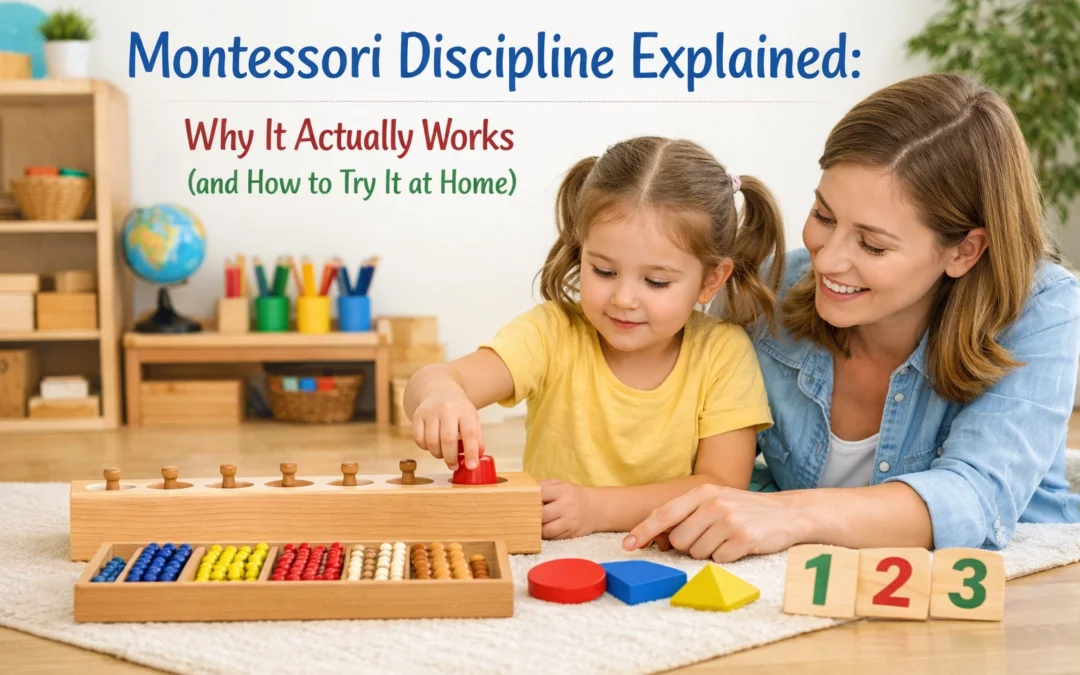
Montessori Discipline Explained: Why It Actually Works (and How to Try It at Home)

Montessori Discipline Explained: Why It Actually Works (and How to Try It at Home)

Mother and daughter practicing Montessori discipline through a practical life water pouring activity at home


Let’s be honest, traditional discipline isn’t working for most families these days. You’ve probably been there: the time-outs, the reward charts, the “because I said so” moments that leave everyone frustrated. And yet, your child keeps pushing boundaries, and you’re wondering if you’re doing something wrong.

Here’s the thing: you’re not doing anything wrong. You’re just using a system designed for compliance, not growth.

Montessori discipline takes a completely different approach. Instead of controlling behavior from the outside, it builds self-discipline from the inside. And after decades of working with families, I can tell you: it actually works.

What Montessori Discipline Really Means

First, let’s clear up a common misconception. When we talk about Montessori discipline, we’re not talking about punishment. We’re not even really talking about consequences in the traditional sense.

Montessori discipline is a teaching approach, a way of guiding children toward self-regulation, empathy, and intrinsic motivation. Dr. Montessori had a beautiful way of putting it: “To obtain discipline, give freedom.”

That might sound counterintuitive at first. How can freedom lead to discipline? But here’s what she meant: when children are given freedom within clear, consistent limits, they develop the internal compass to guide their own behavior. They learn to make choices, experience the results, and adjust accordingly.

This is fundamentally different from traditional discipline, which relies on external control, rewards, punishments, time-outs, to shape behavior. Those methods might get compliance in the moment, but they don’t teach children how to think for themselves or regulate their emotions.

Why It Actually Works: The Philosophy Behind the Method

Montessori discipline works because it addresses the root causes of challenging behavior, not just the symptoms.

When a child acts out, there’s usually an unmet need underneath. Maybe they’re overwhelmed, tired, or struggling to express big emotions. Maybe they need more autonomy or connection. Traditional discipline says, “Stop that behavior.” Montessori discipline asks, “What does this child need right now?”

This approach operates as what child development researchers call authoritative parenting, high warmth combined with high responsibility. You’re not a permissive parent who lets everything slide, and you’re not an authoritarian parent who demands blind obedience. You’re setting clear boundaries while maintaining deep respect for your child as a capable human being.

Child working independently with Montessori materials demonstrating self-discipline and concentration

Here’s what makes it so effective: when children feel respected and understood, they want to cooperate. They’re not rebelling against arbitrary rules; they’re learning to function within a community that values them. And because you’re teaching intrinsic motivation rather than training them to seek external approval, they develop genuine self-discipline that stays with them for life.

The Core Principles of Montessori Discipline

Let’s break down the foundation of this approach into three key principles:

Respect for the Child

This means treating your child as a person worthy of dignity, not a problem to be managed. It means speaking to them the way you’d want to be spoken to, explaining your reasoning (when appropriate), and acknowledging their feelings even when you can’t accommodate their wishes.

Respect doesn’t mean permissiveness, it means recognizing that your child has legitimate needs and perspectives, even when those conflict with yours.

Natural Consequences

Instead of imposing artificial punishments, Montessori discipline allows children to experience the natural results of their actions. Spilled water? Here’s a cloth to clean it up. Forgot your jacket? You’ll feel cold. Didn’t help clean up the playroom? We have less time for the park now.

Natural consequences teach cause-and-effect in a way that lectures never can. Children learn that their choices matter and that they have real agency in their world.

Freedom Within Limits

This is the heart of Montessori discipline. Children have freedom to make choices, explore, and direct their own activity, but within a prepared environment with clear, consistent boundaries.

Those boundaries aren’t arbitrary. They exist to protect safety, respect for others, and care for the environment. Within those limits, though, children have enormous freedom to learn, grow, and become independent.

Practical Strategies You Can Try at Home

Ready to put this into practice? Here are concrete ways to implement Montessori discipline in your daily life:

Model the Behavior You Want to See

Your children are watching you constantly. If you want them to speak respectfully, speak respectfully, to them, to your partner, to the cashier at the grocery store. If you want them to manage frustration calmly, show them what that looks like when you’re having a tough moment.

This isn’t about being perfect. It’s about being authentic and demonstrating real-world emotional regulation.

Father and son preparing a snack together modeling Montessori discipline and respectful collaboration

Use Redirection Instead of “No”

Constantly hearing “no” is exhausting for children and parents alike. When your child is doing something inappropriate, redirect their energy toward something acceptable.

“I can’t let you throw blocks because someone could get hurt. Would you like to throw these soft balls into the basket instead?” You’re acknowledging their need (to throw!) while maintaining your boundary (blocks aren’t for throwing).

Communicate Clearly and Respectfully

Get down on their level. Make eye contact. Use simple, clear language. Instead of “Why did you do that?” try “I see you’re frustrated. Can you tell me what happened?”

Encourage your child to express their thoughts and emotions. The more they can talk about their feelings, the less they need to act them out.

Involve Them in Problem-Solving

When conflicts arise, resist the urge to immediately impose your solution. Instead, ask: “We have a problem. How do you think we could solve this?”

You might be amazed at the creative solutions children come up with when given the chance. And even if their idea isn’t perfect, the process of thinking it through is valuable learning.

Give Age-Appropriate Responsibilities

Children want to contribute meaningfully to their families. Assign real tasks, setting the table, watering plants, folding washcloths. These responsibilities teach that everyone in the family has a role and that their contributions matter.

Plus, a child who feels valued as a contributor is far less likely to seek attention through challenging behavior.

Practice Active Listening and Validation

When your child shares something, even something that seems trivial to you, really listen. Reflect back what you hear: “So you’re upset because your friend chose to play with someone else at recess. That must have felt lonely.”

Validating emotions doesn’t mean condoning inappropriate actions. You can say, “I understand you were angry, and anger is okay. But hitting is never okay. Let’s talk about what you could do next time you feel that angry.”

Building Your Montessori Toolbox

Implementing Montessori discipline is a journey, not a destination. You’re going to have challenging days. You’re going to fall back on old patterns sometimes. That’s okay, it’s part of the learning process for both you and your child.

The good news is that you don’t have to figure this out alone. At the Montessori Foundation, we’ve developed extensive resources specifically for parents who want to bring Montessori principles into their homes.

The Montessori Family Alliance offers support, guidance, and a community of parents on the same journey. You’ll find practical workshops, expert advice, and connection with others who understand what you’re working toward.

Young child watering plants independently showing Montessori values of responsibility and self-care

We also recommend two particularly helpful books: “The Parenting Puzzle” and “How to Raise an Amazing Child.” These resources dive deeper into the philosophy and offer specific strategies for different ages and stages.

You can explore more resources and learn about Montessori education at montessori.org, where we share insights from decades of experience working with families and educators worldwide.

The Long-Term Payoff

Here’s what keeps me passionate about this work after all these years: I’ve seen the results. Children raised with Montessori discipline develop remarkable self-regulation, empathy, and problem-solving skills. They have strong self-esteem because they’ve learned they’re capable. They can resolve conflicts peacefully because they’ve practiced. They take responsibility for their actions because they’ve experienced real consequences, not arbitrary punishments.

These aren’t compliant children who do what they’re told without thinking. They’re independent thinkers who’ve developed an internal compass. They can ask themselves, “Is this the right thing to do?” and make good decisions even when no one is watching.

That’s the kind of discipline that lasts a lifetime.

Getting Started Today

You don’t need to overhaul your entire parenting approach overnight. Start with one strategy from this article. Maybe it’s using redirection instead of “no” this week. Maybe it’s really listening when your child talks to you. Maybe it’s allowing natural consequences instead of stepping in to fix everything.

Small changes create big shifts over time. Your child is watching, learning, and growing every single day. With patience, consistency, and respect, you’re not just managing behavior: you’re building character.

And that’s what Montessori discipline is really all about.

Explaining the Montessori Curriculum to Parents

Explaining the Montessori Curriculum to Parents

If you've ever been asked to explain the Montessori curriculum to a prospective parent, a board member, or even a licensing official, you know it's not as simple as handing over a textbook and saying, "Here's what we teach."

The Montessori curriculum is dynamic, interconnected, and deeply responsive to each child's developmental needs. It's not a list of lessons to check off: it's a carefully designed framework that supports children from infancy through adolescence in becoming independent, curious, and capable learners.

So whether you're launching a new school, refining your program, or simply looking to deepen your understanding of how it all fits together, this guide will walk you through the essentials of Montessori curriculum: what it includes, how it progresses, and why the materials matter so much.

What Is Montessori Curriculum, Really?

At its core, the Montessori curriculum is organized around five to ten key learning areas that develop progressively through hands-on, multi-sensory materials. Children advance at their own pace, guided by their individual development and interests rather than a rigid timeline.

But here's what makes it different from traditional education: the curriculum isn't just about academic content. It's about cultivating the whole child: cognitively, socially, emotionally, and physically. Dr. Montessori understood that children learn best when they can touch, manipulate, and explore concepts in concrete ways before moving to abstraction.

Each learning area contains materials organized by increasing complexity. A child doesn't move to multiplication until they've mastered quantity recognition and addition. They don't write sentences until they've worked with the Moveable Alphabet and understand phonetic sounds. This is the beauty of scope and sequence in action.

Understanding Scope and Sequence

When we talk about scope and sequence, we're referring to the bird's-eye view of curriculum progression across all subject areas. The scope tells us what will be covered: the breadth of skills, concepts, and learning objectives. The sequence tells us when and in what order these elements are introduced.

In a Montessori setting, this isn't about rigid timelines. A scope and sequence document shows the progression of skills within each learning area, but it acknowledges that children have varied interests and learning timelines. One child might spend months perfecting their work with the Pink Tower before moving to the Brown Stair. Another might breeze through and be ready for extensions within weeks.

This flexibility is essential, but it doesn't mean we're making it up as we go. A well-documented Montessori scope and sequence ensures that nothing gets missed and that each child receives comprehensive exposure to all areas of learning: even if they reach them in different orders or at different times.

Core Curriculum Areas: From Infant/Toddler to Elementary

Let's break down the key areas that form the foundation of Montessori education across the levels.

Infant/Toddler (Birth to Age 3)

At this level, the curriculum focuses on developing independence, language, movement, and trust. Activities are simple but profound:

  • Movement and coordination – crawling, walking, climbing, transferring objects
  • Practical life – self-care activities like washing hands, dressing, food preparation
  • Language – rich oral language exposure, naming objects, songs, and simple books
  • Sensory exploration – textures, sounds, tastes, weights

The environment is carefully prepared with materials that invite exploration and support emerging skills. Everything is child-sized, accessible, and purposeful.

Primary (Ages 2.5 to 6)

This is where the classic Montessori curriculum really takes shape. The five core areas are:

Practical Life – This area develops concentration, coordination, independence, and a sense of social responsibility. Activities include pouring, spooning, sweeping, polishing, buttoning, and food preparation. These exercises may look simple, but they're building the neural pathways for everything that comes next.

Sensorial – Children refine their perception through work with materials that isolate qualities like size, color, shape, texture, weight, sound, and temperature. The Pink Tower, Brown Stair, Color Tablets, and Sound Cylinders help children categorize and organize sensory information: a cognitive skill that extends far beyond the classroom.

Mathematics – Montessori math is breathtakingly concrete. Children work with golden beads to understand quantity and place value, then progress through the decimal system, operations, fractions, and eventually abstraction. The materials make abstract concepts tangible.

Language – Beginning with oral language and phonetic awareness, children move to Sandpaper Letters, the Moveable Alphabet, and eventually reading and writing. Grammar is introduced through hands-on materials like the Grammar Symbols, making parts of speech a tactile experience.

Culture – This broad area includes geography (puzzle maps, land and water forms), botany (leaf classification, plant care), zoology (animal classification), science experiments, history timelines, music, and art. It helps children understand their place in the world.

Elementary (Ages 6 to 12)

Elementary expands and deepens the curriculum with a focus on imagination, reasoning, and social collaboration. The core areas include:

  • Language – Advanced reading comprehension, writing across genres, grammar, word study, and research skills
  • Mathematics – Operations with larger numbers, fractions, decimals, percentages, geometry, algebra, and problem-solving
  • Geometry – Explorations of plane and solid figures, symmetry, congruency, similarity, and spatial relationships
  • Cultural Studies – History (timelines, civilizations, biographies), geography (physical and political studies), life sciences (botany, zoology, ecology), physical sciences (chemistry, physics, astronomy)
  • The Arts – Music theory and performance, visual arts, drama, and creative expression

Elementary students work collaboratively on projects, conduct experiments, and engage in "going out" experiences to extend their learning beyond the classroom walls.

Why Montessori Materials Matter

Here's a question I often hear: "Can't we just teach these concepts with worksheets or digital tools?"

The short answer? Not really. Not if we want children to truly understand.

Montessori materials are not just teaching aids: they're the curriculum itself. Each material is scientifically designed to isolate a single concept, provide hands-on exploration, and include a built-in control of error so children can self-correct without adult intervention.

Take the Binomial Cube, for example. At first glance, it's a beautiful wooden puzzle. But it's also a concrete representation of the algebraic formula (a+b)³. A Primary child explores it as a sensorial challenge. An Elementary child revisits it as an introduction to algebra. The same material, different levels of abstraction.

This is why having a comprehensive Montessori materials list and knowing the proper presentation sequence is critical. Without the materials, you don't have Montessori: you have Montessori-inspired activities, which is not the same thing.

Implementing the Curriculum: What Educators Need to Know

So, how do you actually implement all of this in your classroom or school?

1. Observation is everything. Montessori educators must be skilled observers. You need to know where each child is in the scope and sequence, what they're ready for next, and when to step back and let them work independently.

2. Prepare the environment meticulously. Materials should be complete, organized, and accessible. The classroom should invite exploration and support independence.

3. Document and assess progress. Use observation notes, checklists, and portfolios to track each child's journey through the curriculum. This documentation is invaluable for parent conferences, accreditation, and your own planning.

4. Collaborate with colleagues. Especially in schools with multiple age levels, it's essential that educators understand the continuum of learning. What happens in the Toddler room sets the stage for Primary. What happens in Primary lays the foundation for Elementary.

5. Seek ongoing professional development. The Montessori curriculum is rich and complex. Even experienced educators benefit from workshops, coaching, and continued study.

Resources and Support for Your School

At The Montessori Foundation, we understand that implementing and maintaining a strong Montessori curriculum requires support at every stage: whether you're just starting out or you're an established institution looking to strengthen your program.

We offer consulting and coaching services tailored to your school's unique needs. From curriculum development and teacher training to leadership coaching and strategic planning, we're here to help you build and sustain an authentic Montessori program.

Our professional development workshops cover everything from practical life presentations to advanced mathematics, ensuring your educators have the skills and confidence to guide children through the full scope and sequence. We also host leadership institutes for administrators and heads of school who want to deepen their understanding of Montessori philosophy and school management.

Whether you need a comprehensive curriculum review, help creating a scope and sequence document, or guidance on materials selection and classroom setup, we're here to support your school's success.

Bringing It All Together

The Montessori curriculum isn't a mystery: it's a carefully constructed pathway that honors each child's development while ensuring comprehensive learning across all domains. Understanding the scope and sequence, respecting the role of materials, and committing to ongoing observation and professional growth are the keys to implementing it effectively.

If you're ready to take your program to the next level, explore our consulting services and professional development opportunities or reach out to discuss how we can support your school's unique journey.

The beauty of Montessori education is that it works: when it's done with fidelity to Dr. Montessori's vision and with the support educators need to succeed.

AMS, AMI, or IMC Montessori: Which Is Better For Your Child’s Education

AMS, AMI, or IMC Montessori: Which Is Better For Your Child’s Education

Authentic Montessori classroom with wooden shelves displaying colorful educational materials in a prepared environment


If you’ve started researching Montessori schools for your child, you’ve probably noticed three acronyms popping up again and again: AMI, AMS, and IMC. At first glance, they might seem interchangeable: after all, they all represent organizations dedicated to Montessori education. But dig a little deeper, and you’ll discover meaningful differences in philosophy, teacher training, and classroom implementation.

So which one is “better” for your child’s education? The honest answer is: it depends. Each organization brings something valuable to the table, and understanding their distinctions will help you make an informed decision when finding an authentic Montessori school.

Let’s break it down.

Understanding the Three Major Montessori Organizations

Before we compare, let’s establish who these organizations are and where they came from.

AMI (Association Montessori Internationale) was founded in 1929 by Dr. Maria Montessori herself. It’s headquartered in Amsterdam and is often considered the most traditional keeper of Montessori philosophy. AMI’s mission is to preserve the integrity of Dr. Montessori’s original methods exactly as she developed them.

AMS (American Montessori Society) was established in 1960 by Nancy McCormick Rambusch after she studied with Mario Montessori (Maria’s son). AMS was created to adapt Montessori education to the American context, offering more flexibility while maintaining core principles.

IMC (International Montessori Council) is a global accreditation body founded in 1996 that supports Montessori schools worldwide. The IMC takes a balanced approach: honoring the authenticity of Montessori philosophy while recognizing that schools operate in diverse contexts and need practical support to implement the method effectively.

There are other organizations in the USA and other countries, but these are the three largest.


AMI: The Legacy of Tradition

AMI is often described as the “purist” organization in the Montessori world. If you’re looking for the closest possible interpretation of what Dr. Montessori envisioned, AMI-affiliated programs aim to deliver exactly that.

What defines AMI:

  • Rigorous teacher training: AMI certification programs are intensive, typically requiring 1-2 years of full-time study with substantial practicum hours
  • Strict adherence to materials: AMI classrooms use materials as Dr. Montessori designed them, with minimal modifications
  • International consistency: An AMI classroom in Tokyo should look remarkably similar to one in Toronto
  • Strong philosophical foundation: Deep emphasis on understanding the “why” behind every material and practice

Potential considerations:

Some educators feel that AMI’s strict adherence to tradition can sometimes limit a school’s ability to adapt to local needs, cultural contexts, or advances in child development research. That said, parents who value consistency and proven methodology often find comfort in AMI’s unwavering standards.

AMS: The American Adaptation

AMS emerged because American educators saw a need to make Montessori education more accessible and adaptable within the U.S. educational landscape.

What defines AMS:

  • Flexible implementation: AMS allows for more variation in how schools interpret and apply Montessori principles
  • Diverse training options: Multiple pathways to teacher certification, including programs that can accommodate working professionals
  • Research integration: Greater openness to incorporating contemporary educational research alongside traditional methods
  • Broader school membership: AMS accredits a wide range of schools, from those closely aligned with tradition to more eclectic interpretations

Potential considerations:

Critics sometimes argue that AMS’s flexibility can lead to inconsistency: that some “Montessori” schools under the AMS umbrella may drift far from Dr. Montessori’s core principles. This makes it especially important for parents to visit classrooms and ask specific questions about implementation.


IMC: A Balanced, Global Perspective

The International Montessori Council (IMC), founded in 1996, is often described as taking a thoughtful middle path. It respects Dr. Montessori’s original vision while also recognizing that schools around the world face different challenges, serve different communities, and operate in different regulatory environments.

What defines IMC:

  • Authenticity with practicality: IMC’s standards emphasize honoring Montessori philosophy without rigid uniformity. The principles matter more than surface-level details
  • Comprehensive school support: Beyond accreditation, IMC offers consulting, professional development, and resources intended to help schools continuously improve
  • Global perspective: IMC-affiliated schools span diverse countries and cultures, reflecting how Montessori principles can be implemented meaningfully in varied contexts
  • Focus on outcomes: IMC’s framework emphasizes whether children are thriving: developing independence, curiosity, and a love of learning

IMC’s approach to accreditation emphasizes essential characteristics of authentic Montessori education: mixed-age classrooms, extended work periods, specially trained teachers, the complete set of Montessori materials, and child-led learning within a carefully prepared environment.

IMC does not promote only one “right way” to run a Montessori classroom, but it does highlight non-negotiables—core elements that must be present for a program to genuinely serve children in the way Dr. Montessori intended.

Key Differences at a Glance

Aspect AMI AMS IMC
Founded 1929 1960 1996
Philosophy Traditional preservation American adaptation Balanced authenticity
Teacher Training Highly standardized, intensive Multiple pathways, flexible Recognizes quality training from various sources
Flexibility Limited Considerable Moderate with clear standards
Geographic Focus International Primarily U.S. International

What Should Parents Look For?

Here’s the truth we share with every family: the organization affiliation matters less than what’s actually happening in the classroom.

A school can hold credentials from any of these organizations and still vary widely in quality. Conversely, some excellent Montessori programs operate independently of any major organization.

When finding an authentic Montessori school, we recommend looking beyond acronyms to observe these elements:

Mixed-age classrooms: Children should be grouped in three-year age spans (3-6, 6-9, 9-12, etc.), not single grades

Extended, uninterrupted work periods: At least 2-3 hours where children can choose their work and engage deeply

Trained Montessori teachers: Ask where teachers received their training and what level of certification they hold

Complete materials: The classroom should have the full range of Montessori materials appropriate for the age group

Child-led learning: Teachers should serve as guides, not lecturers. Children should be moving freely, making choices, and engaged in purposeful work

The prepared environment: Everything in the classroom should be intentional, beautiful, and accessible to children

Mixed-age Montessori classroom with older student guiding younger child through hands-on math activity

Questions to Ask Any Montessori School

When you visit, consider asking:

  • What training do your teachers have, and from which organization?
  • How long are your uninterrupted work periods?
  • How do you handle discipline and conflict resolution?
  • What does a typical day look like for children?
  • How do you communicate with parents about student progress?
  • What makes your school authentically Montessori?

The answers will tell you far more than any organizational logo on the wall.

So, Which Is “Better”?

No organization is entirely neutral when it comes to standards and interpretation. Still, all three organizations contribute meaningfully to the Montessori movement. AMI preserves important traditions. AMS has made Montessori more accessible to American families. And IMC works to support schools in bringing authentic Montessori education to children worldwide.

The “best” choice depends on your values, your child’s needs, and the specific schools available in your community. Some parents prioritize strict tradition. Others value flexibility. Most simply want a school where their child will be respected, challenged, and inspired.

What matters most is that you find a school where Montessori philosophy lives in daily practice: where children are trusted, independence is nurtured, and learning happens through discovery rather than instruction.

Ready to Learn More?

Explore the school directory to find IMC-affiliated programs near you, or visit the About Montessori page to deepen your understanding of this remarkable educational approach.

Finding the right school for your child is one of the most important decisions you’ll make. Take your time, visit classrooms, ask questions, and trust what you observe. The right fit is out there.

Montessori School Leadership in Action

Montessori School Leadership in Action

Cover image courage to lead

The Courage to Lead When People, Money, and Morale Are All at Stake


Montessori school leadership is often discussed in terms of vision, values, and philosophy. But day-to-day reality unfolds in far more complicated terrain—at the intersection of people, money, morale, and mission, where every decision feels consequential and often personal.

Today’s Montessori leaders navigate an especially fragile landscape. Teachers are challenging to find, and support staff are stretched thin. Burnout is real, and the fear that a valued teacher might leave—seeking higher pay, less stress, or relief from constant pressure—can lead to difficult decisions. Leaders must balance staff retention efforts with maintaining high standards to ensure school stability and quality.

Courageous leadership doesn’t ignore these realities. But it also doesn’t allow fear to dictate the school’s future quietly. Instead, it works through influence, systems, and sustained attention to the people who make the school work.

Montessori as a System of Systems

Montessori education itself can be understood as a system of systems—ways of organizing time, space, materials, curriculum, and human relationships that work together to support children’s development. While there can be legitimate disagreement about how to implement or organize these systems, schools work best when there is a common understanding about how we do things here.

This doesn’t mean imposing rigid uniformity or stifling professional judgment. It means developing carefully crafted agreements about the fundamentals:

  • How we treat each other—children, families, and colleagues
  • How we organize the day and the program at each age level
  • What Montessori and supplementary materials are needed for each classroom
  • What standards of cleanliness, order, and timeless beauty we maintain in our indoor and outdoor environments
  • What curriculum do we expect all children to experience, beyond their individual interests
  • What children should know or be able to do before progressing to the next level
  • How we respond to children who are struggling
  • How we work with challenging parents

When these agreements are clear, stress and resentment decrease. People know what’s expected. They can focus on their work rather than navigating constant uncertainty or dealing with conflicting work.

The key is that these agreements shouldn’t simply be imposed by leadership. They need to be developed thoughtfully, with input from those who will live by them, and then memorialized in writing as part of an organizational blueprint—a master plan or manual of how things work at our school. This living document serves as a reference point for everyone and a crucial tool for onboarding new community members.

The school can’t reinvent itself every time someone new joins. But neither can it ignore the need to help newcomers understand and embrace these shared agreements.

Courage in a Time of Scarcity

Staffing scarcity defines modern Montessori leadership. Experienced teachers are in short supply. Assistants and support staff are harder than ever to recruit and retain. Leaders know that replacing a teacher isn’t a simple transaction—it can take months, sometimes years. The disruption to children, families, and morale can be profound.

As a result, many leaders hesitate to:

  • Address misalignment or underperformance
  • Introduce needed changes in practice or structure
  • Make decisions that might be unpopular in the short term

The tendency to hesitate is understandable, but when fear of losing staff becomes the primary driver of decisions, the hidden costs accumulate. Standards erode. Resentment builds quietly among other staff. Strong teachers carry the emotional and practical load for those who are disengaged. Over time, morale suffers anyway.

Courageous leadership doesn’t mean ignoring scarcity. It means leading through it, rather than around it—by building systems and relationships that help people grow, feel supported, and work effectively together. And it means being thoughtful about who joins the community in the first place.

Taking Time to Find the Right Fit

One of the most important ways leaders protect their schools is by resisting the pressure to rush. When there’s an opening—whether for a teacher, assistant, specialist, or administrator—the temptation to fill it quickly can be overwhelming. When enrollment is soft, the pressure to accept any family willing to pay tuition is intense.

But courageous leadership means taking time in both hiring and admissions to find people who will be happy at the school and become great members of the community.

Before making an offer of employment or admission, both parties need time to get to know each other. Prospective families need to understand what they’re agreeing to—not just the philosophy in the abstract, but the practical realities of how the school operates. Prospective staff members need to understand not only their role, but the social norms and expectations of the community they’re joining.

Not every family will care deeply about understanding Montessori education—some are just trying to solve a childcare problem. But they still need a certain level of understanding right from the start. It’s far easier to establish shared expectations at the beginning than to try to change someone once they’re already part of the school.

The same is true for staff. Taking time to find the right fit can build confidence that the school is making thoughtful decisions, leading to greater stability and coherence.

Leading Through Influence, Not Just Authority

Decades ago, Peter Drucker highlighted how managers make things happen through influence, which can inspire Montessori leaders to foster trust and responsibility rather than relying solely on authority. 

Time and presence matter. Leaders who regularly spend time in classrooms signal that they care about what’s happening and who’s doing the work. Teachers notice when leaders show up—not to evaluate, but to understand, support, and stay connected to the daily reality of the classroom.

Coaching and support build capacity. Providing teachers with thoughtful, ongoing coaching—not just annual observations—helps them develop their practice and feel genuinely supported. This is especially important for support staff and specialists who may not have Montessori training. Rather than leaving them to feel inadequate or guilty about what they don’t know, leaders can create pathways for learning and growth.

Systems create space for collaboration. Organizing regular meeting time, planning structured opportunities for reflection and team-building, and creating traditions that bring people together all help build the connective tissue of a healthy school. Beginning-of-year team building and end-of-year reflection aren’t luxuries—they’re how shared understanding develops and how those foundational agreements get refined and renewed.

Communication shapes culture. Leaders influence their schools by how they communicate with all stakeholders—teachers, assistants, parents, students, boards, and partners. Effective communication doesn’t overwhelm people with information, nor does it leave them guessing. It’s clear about expectations, transparent about challenges, and consistent in tone and frequency.

Onboarding sets the foundation. Careful onboarding of new staff and families establishes expectations, builds relationships, and helps people understand not only their roles but also how their work connects to the school’s larger purpose and the carefully developed agreements about how we do things here. Poor onboarding leaves people adrift; thoughtful onboarding creates belonging.

These aren’t add-ons to leadership. They’re how leadership actually happens—through sustained attention to people, structures, and relationships.

Making Everyone Feel Seen, Heard, and Valued

One of the most important goals of Montessori leadership is ensuring that every member of the community. feels seen, heard, and valued. 

Parents may feel they’re not good enough or not part of the crowd because of race, religion, gender, wealth, level of education, or some other factor. Leaders must actively work to counteract this through how they communicate, how they welcome families, and how they create opportunities for connection that honor different circumstances and comfort levels.

Not every parent has the same time availability or interest. Some will eagerly engage with every aspect of school life; others are simply trying to solve a problem and get through the day. The goal isn’t to force everyone into the same mold, but to ensure everyone has access to the information and support they need, and that no one feels excluded or diminished.

The same principle applies to staff. Everyone—from the newest assistant to the art teacher, from office staff to administrators, from veteran guides to brand-new teachers—needs to feel that they matter. Support staff and specialists, who often feel invisible because they’re not Montessori-trained classroom teachers, especially need deliberate inclusion in the school’s mission and community.

Helping everyone feel that they are part of the fabric of the school requires ongoing effort. It’s not something you do once during onboarding and then forget. It means continually creating opportunities for connection, recognition, and meaningful participation. It means paying attention to who speaks and who doesn’t, who feels comfortable and who seems hesitant, who gets recognized and who gets overlooked.

Working With Resistance When the Stakes Feel High

Resistance to change intensifies when leaders feel they cannot afford to lose people. A teacher who says, “I’ve been doing this for thirty years,” or “This is not how I was trained,” may feel untouchable—not because their practice is beyond question, but because the leader fears the consequences of conflict.

Here, courage takes a relational form. It asks leaders to engage resistance thoughtfully rather than avoid it. To separate respect for experience from unquestioned authority. To create space for dialogue while maintaining clarity about expectations.

This is where influence-based leadership and those shared agreements become essential. Rather than issuing mandates, effective leaders:

  • Name shared goals for children, framing change around student needs rather than teacher shortcomings
  • Return to those foundational agreements about how we do things here—not as weapons, but as touchstones for dialogue
  • Create structured time for faculty to explore new ideas together, building consensus rather than imposing change
  • Provide professional development and coaching that helps teachers see possibilities rather than threats
  • Help people become more reflective and supportive of each other through facilitated conversation
  • Are transparent about what is essential to the mission and what is open to discussion
  • Accept that not everyone will choose to stay—and that this, while painful, is sometimes part of organizational health

Montessori schools don’t thrive because everyone agrees. They thrive when leaders create the conditions for honest dialogue, mutual support, and shared commitment to children.

Morale, Stress, and the Adult Prepared Environment

Teacher morale isn’t only a function of workload or compensation, though both matter deeply. It’s also shaped by clarity, consistency, and trust. In schools where expectations are ambiguous, decisions feel arbitrary, or leaders appear hesitant, stress increases—even when leaders believe they’re being protective.

Carefully crafted agreements about ‘how we do things’ are very helpful. When people understand the systems and trust that they will be implemented consistently, they can relax into their work. When standards shift depending on who’s asking or what day it is, everyone operates in a state of low-grade anxiety.

Adults, like children, need a prepared environment. They need:

  • Clear roles and boundaries
  • Predictable systems and rhythms
  • Honest, regular communication
  • Leadership that is calm, present, and consistent
  • Time and space for collaboration and community-building
  • Recognition that their work matters
  • Shared understanding of how things work here

Support staff and specialists—who often feel invisible because they’re not Montessori teachers—especially need to feel included in the school’s mission and supported in their work with children. When leaders create systems that honor all adults in the building, morale strengthens across the entire community.

Ironically, when leaders avoid difficult conversations out of fear of harming morale, morale often declines anyway. Staff sense uncertainty. Strong teachers feel unsupported. The emotional load shifts sideways rather than disappearing.

Courageous leadership recognizes that structure is a form of care—and that investing time in people’s growth and connection is not a luxury but a necessity.

Financial Courage in a Fragile Staffing Market

The fear of losing teachers also shapes financial decisions. Leaders know compensation matters, but they also know tuition has limits. Parents may resist increases. Markets vary. Not every school can simply “charge more.”

This is where courage becomes strategic and creative rather than simplistic—and where communication becomes critical.

When a school is underfunded, leaders must explore multiple avenues simultaneously:

  • Reduce expenses thoughtfully without cutting quality
  • Strengthen marketing and admissions to fill empty spaces—but without rushing or compromising on fit
  • Help families understand the value of Montessori education more clearly through consistent, honest communication
  • Use financial aid strategically to support access while protecting sustainability
  • Align staffing models with enrollment realities rather than historical patterns
  • Work with parents so they feel honored and understand both what the school asks of them and what the school is committed to providing.

Financial courage isn’t about pretending constraints don’t exist. It’s about refusing to accept chronic scarcity as inevitable—and being willing to have honest, ongoing conversations with all stakeholders about sustainability.

Leading With Others, Not Alone

For many Montessori leaders, these decisions are complicated by governance structures—boards, owners, or partners who may not fully understand Montessori education or the daily realities of staffing and morale.

Again, courage isn’t confrontation for its own sake. It’s persistence, education, and conversation. Building consensus over time and staying engaged even when progress is slow.

This requires the same influence-based approach that works with faculty:

  • Regular, structured communication that keeps boards and partners informed without overwhelming them
  • Helping them see the whole picture: how financial instability affects staff well-being, how unclear expectations undermine morale, how avoiding change today often creates greater disruption tomorrow
  • Creating opportunities for board members or partners to experience the school directly—to see classrooms, meet teachers, and understand the work.
  • Building shared language and understanding about what makes Montessori education work.
  • Developing those foundational agreements together, so that governance partners understand and support the school’s organizational blueprint

It means resisting the temptation to disengage when alignment feels difficult, and instead finding ways to bring people along.

Leadership as Steady Presence

At its heart, Montessori leadership isn’t about eliminating anxiety—your own or others’. It’s about becoming a steady presence within it.

Leaders can’t promise teachers that nothing will change or that stress will disappear. What they can offer is honesty, clarity, and a commitment to building a school worthy of people’s energy and talent.

School leaders support this through:

  • Showing up consistently in classrooms
  • Creating and maintaining systems that support collaboration and growth
  • Developing and stewarding those foundational agreements about how we do things here
  • Communicating clearly and regularly with all stakeholders
  • Investing in people’s development through coaching and professional learning
  • Taking time to find the right fit when hiring or enrolling new members
  • Building community intentionally, not accidentally
  • Making space for reflection, celebration, and honest assessment
  • Ensuring everyone—parents and staff alike—feels seen, heard, and valued

Yes, leadership can feel like herding cats. But it’s also the work of pathfinding—helping an organization move, step by step, toward sustainability, coherence, and trust.

When Montessori leaders lead with courage in this fuller sense—acknowledging scarcity, caring for morale, building systems that support people, trying to confirm that prospective employees and families will be a good fit, creating shared agreements about how things work, and still making principled decisions—they create schools where great teachers are more likely to stay, not less.

Not because leadership avoided difficulty, but because it faced it with integrity—and built the structures, relationships, and shared understandings that help everyone do their best work.


Tuition, True Cost, and the Moral Courage to Charge What a School Requires

Tuition, True Cost, and the Moral Courage to Charge What a School Requires

mixed ages

One of the most emotionally complex tasks in founding or leading a private Montessori school is setting tuition. It is also one of the most consequential.

I have watched otherwise thoughtful, capable school founders lose sleep over tuition decisions. They worry about affordability. They worry about being perceived as elitist. They worry about turning families away. And sometimes, they worry that charging what the school truly needs will somehow betray the very values that drew them to Montessori in the first place.

These concerns are understandable—and they are also dangerous if left unexamined.

A private Montessori school does not become more humane by undercharging. It becomes fragile. And fragility is not a virtue when children, families, and staff are depending on you for continuity, stability, and trust.

The Montessori Landscape: Public, Private, and the Question of Access

Before addressing tuition strategy for private schools, it is important to acknowledge the broader Montessori landscape.

Public Montessori programs—whether charter schools, magnet programs, or district-operated schools—serve tens of thousands of children and families across the country. These schools demonstrate that Montessori education can thrive within public systems, offering high-quality programs at no direct cost to families. They are an essential part of the Montessori community and expand access in ways that private tuition-based schools cannot.

Additionally, many states now offer scholarship or voucher programs that help families afford private school tuition. These programs—sometimes called Education Savings Accounts (ESAs), tax credit scholarships, or school choice programs—can significantly reduce the financial burden on families and make private Montessori education accessible to a broader range of students.

Both public Montessori schools and state scholarship programs represent important pathways toward greater educational equity.

However, if you are founding or leading a private, tuition-dependent Montessori school, your financial reality is different. You do not receive per-pupil public funding. You cannot rely on state budgets to cover operating costs. While state scholarships can help some families, they do not eliminate the need for a sound tuition strategy—they simply shift how some families pay.

This chapter is written for nonpublic school leaders who must set tuition to sustain quality, protect staff, and ensure the school’s long-term survival.

Understanding the True Cost of a independent Montessori school Education

Every private school has a true cost per child, whether it acknowledges it or not. This is not an abstract number; it is the simple arithmetic of operating reality.

The true cost includes:

  • salaries and benefits for qualified adults,
  • classroom materials and their ongoing maintenance,
  • facilities, insurance, utilities, and compliance,
  • administrative systems that protect dignity and confidentiality,
  • professional development, mentoring, and supervision,
  • reserves for uncertainty and repair.

When we divide the total cost of operating the school by a conservative estimate of enrollment, we arrive at a per-child cost. That number is not a judgment about families. It is a reflection of what it takes to do the work well.

Tuition should be set with this number firmly in mind.

Charging less than the true cost does not make education more accessible. It merely shifts the burden elsewhere—onto underpaid staff, deferred maintenance, exhausted administrators, or a constant scramble for emergency funding.

State Scholarships and Tuition Planning

In states with robust scholarship or voucher programs, many private school founders ask: “Should we set tuition based on the scholarship amount?”

The answer is almost always no.

State scholarships can be a meaningful tool for families, and schools should absolutely help families access these programs where available. But scholarship amounts are set by legislators, not by the true cost of operating your school. They can change with political winds, budget cycles, or program caps.

A responsible approach is to:

  • set tuition based on your school’s actual operating costs,
  • communicate clearly about available state scholarship programs,
  • help families navigate application processes,
  • and recognize that scholarships supplement tuition—they do not replace sound financial planning.

Schools that tie their entire tuition structure to scholarship amounts often find themselves either overpriced in the market or financially unsustainable when funding levels shift.

Why Sliding Scale Tuition Rarely Works

Sometimes founders are drawn to sliding-scale tuition, especially early on. It feels equitable. It feels compassionate. And in theory, it allows families of varying means to participate.

In practice, sliding scales create significant challenges.

First, they require intrusive financial verification. To administer a sliding scale responsibly, you must review confidential tax documents and financial records. Most schools are not equipped to do this ethically or consistently, which is why third-party services are often required.

Second, sliding scales compress margins. Once a school publishes a range of tuition, it must carefully limit the percentage of families at the lower end of the scale. Otherwise, revenue will not cover expenses.

Third, they introduce ongoing tension. Families compare notes—staff field questions they should never have to answer. The school becomes a negotiator rather than a steward.

For these reasons, most healthy private Montessori schools set a single tuition and then offer needs-based financial aid within a clearly defined budget.

Financial Aid as a Planned Commitment

Financial aid is not an afterthought. It is not a favor. And it is not income.

Financial aid is a discount against tuition, and it must be planned before tuition is finalized—not after families begin asking.

A responsible approach is to:

  • set tuition at the true cost of operating the school at conservative enrollment,
  • establish a fixed dollar amount or percentage of revenue allocated to financial aid,
  • build an additional margin (often 10% or more) for unexpected expenses or shortfalls.

This approach allows the school to say “yes” where it genuinely can—and “not now” where it cannot—without destabilizing the whole enterprise.

Most schools use independent services, such as TADS or similar platforms, to confidentially and consistently review financial need. This protects families’ dignity and removes school staff from the role of financial gatekeeper.

In states with scholarship programs, schools can layer financial aid on top of state support, helping families who may still have a gap between the scholarship amount and full tuition.

Defining Who Your School Is For

There is a persistent myth in education that an “ideal family” should not be defined by income. While values and motivation are central, this belief ignores a practical reality: families must be able to afford the school—whether through tuition payment, state scholarships, financial aid, or some combination—or at least meet a clearly defined minimum commitment.

Defining your ideal family includes:

  • alignment with Montessori values,
  • willingness to partner with the school over time,
  • ability to afford tuition within your financial aid framework and available scholarship support,
  • proximity that supports daily participation in the life of the school.

This is not exclusion. It is honesty.

Marketing to families who cannot realistically enroll—even with all available support—creates frustration for them and for you. A clear definition allows your outreach, admissions process, and financial planning to work in harmony.

And for families who cannot afford private school tuition, even with scholarships and aid, public Montessori programs may offer an excellent alternative. Referring families to quality public options is not a failure—it is an act of service to the broader Montessori community.

The Emotional Weight of Tuition Decisions

Tuition decisions carry emotional weight because they sit at the intersection of values and money. Founders often feel pressure from friends, board members, or even staff to “make exceptions,” especially in the early years.

Clarity is kinder than flexibility without boundaries.

When tuition policies are clear, consistent, and aligned with the school’s financial reality, families trust the process—even when the answer is no. When policies shift unpredictably, trust erodes.

Your responsibility is not to say yes to everyone. It is to build a school that will still be there in five, ten, and twenty years—serving the families who can realistically participate while honoring the work of public Montessori educators who serve different communities through different models.

Tuition as a Signal of Stability

Families are perceptive. Tuition communicates more than price; it signals seriousness, stability, and confidence.

Schools that undercharge often experience:

  • higher attrition,
  • constant financial anxiety,
  • difficulty retaining experienced staff,
  • and a cycle of emergency fundraising that exhausts everyone involved.

Schools that charge appropriately—and explain why— are better positioned to build long-term relationships with families who understand the value of their choices.

Tuition is not a technical calculation. It is a leadership decision.

In following posts, we will turn to how tuition strategy connects to enrollment management, admissions practices, and the systems that allow families to commit with confidence—clear agreements, predictable payment processes, and a shared understanding of mutual responsibility.

A school that understands its true cost, charges accordingly, supports families with integrity, and recognizes its place within the broader Montessori landscape lays the foundation not just for survival, but for trust, stability, and genuine educational excellence.

The Integrated Montessori Curriculum

The Integrated Montessori Curriculum

mixed ages


Understanding Montessori’s Educational Foundation

Dr. Maria Montessori’s research led her to a revolutionary conclusion: intelligence is not rare among human beings but manifests naturally through the spontaneous curiosity present in children from birth. She observed that when children grow up in intellectually and artistically alive environments—spaces that are warm and encouraging—they spontaneously ask questions, investigate, create, and explore new ideas. Children, especially in their early years, possess a remarkable capacity to absorb information, concepts, and skills from their surroundings and peers through what might be described as educational osmosis.

Montessori argued that learning can and should be a relaxed, comfortable, natural process. The key lies in understanding the hidden nature of the child at each developmental stage and designing environments—both at home and school—where children begin to fulfill their innate human potential.

As a school founder, you must understand that Montessori education extends far beyond teaching basic skills and information. While cultural literacy matters, children must also learn to trust their own ability to think and solve problems independently. Montessori encourages students to conduct their own research, analyze their findings, and reach their own conclusions. The goal is to cultivate independent thinkers who actively engage in the learning process.

Rather than providing students with correct answers, Montessori teachers ask the right questions and guide students to discover answers themselves. Learning becomes its own reward, with each success fueling the desire to learn even more.

Accommodating Individual Learning Differences

Montessori recognized that students learn in different ways and at different rates at every age level. Many children learn far more effectively through direct hands-on experience than from textbooks or lectures. However, all students respond to careful coaching with ample time to practice and apply new skills and knowledge. Like all of us, children learn through trial, error, and discovery.

Critically, Montessori students learn not to fear mistakes. They quickly discover that few things in life come easily, and they develop the confidence to try again without embarrassment. This resilience forms a cornerstone of lifelong learning.

The Spiral Curriculum: Integration Over Compartmentalization

The Montessori curriculum is organized as an inclined spiral plane of integrated studies rather than the traditional model that compartmentalizes learning into separate subjects, with topics addressed only once at a given grade level. Lessons are introduced simply and concretely in the early years, then reintroduced multiple times over subsequent years with increasing abstraction and complexity.

The Montessori course of study employs an integrated thematic approach that connects disciplines into unified studies of the physical universe, the natural world, and human experience. Literature, the arts, history, social issues, civics, economics, science, and technology all complement one another seamlessly.

This integrated approach represents one of Montessori’s greatest strengths. Consider how elementary students might study Africa: they examine physical geography, climate, ecology, and natural resources, exploring how people have adapted to their environment through food, shelter, transportation, clothing, family life, and traditional cultures. They read African folktales, study great African civilizations, research endangered species, create African masks and traditional instruments, make African block-print t-shirts, learn Swahili phrases, study African dance in music classes, and prepare traditional meals from various African cultures. Guest speakers, performers, and community members help bring studies alive through their memories, talents, and personal experiences.

Practical Life: Independence and Community

Success in school directly correlates with the degree to which children believe they are capable and independent human beings. Even very young children essentially ask, “Help me learn to do it for myself!”

As we enable students to develop meaningful independence and self-discipline, we establish patterns for lifelong good work habits and responsibility. Montessori students are taught to take pride in their work.

Independence must be learned rather than simply emerging with age. In Montessori classrooms, even small children learn to tie their own shoes and pour their own milk. Initially, shoelaces become knotted, and milk spills on the floor. However, with practice, skills are mastered, and young children beam with pride. Experiencing success at an early age builds a self-image as capable, leading children to approach subsequent tasks with confidence.

As they mature, Montessori students master everyday living skills ranging from cleaning, cooking, and sewing to first aid and balancing checkbooks. They plan parties, learn to decorate rooms, arrange flowers, garden, and perform simple household repairs. The Montessori curriculum deliberately builds numerous opportunities for students to gain hands-on practical experience.

Learning to work and play together peacefully and caringly within a community may be the most critical life skill Montessori teaches. Everyday kindness and courtesy are vital practical-life competencies. Students come to understand and accept their responsibilities to others. They learn to handle new situations they will face as they become increasingly independent, developing clear values and a social conscience.

Montessori consciously teaches everyday ethics and interpersonal skills from the beginning. Even the youngest child receives treatment with dignity and respect. Montessori schools function as close-knit communities where people live and learn together in environments of warmth, safety, kindness, and mutual respect. Teachers become mentors and friends. Students learn to value the diverse backgrounds and interests of their classmates.

Parents play a vital role in fostering community within Montessori schools. Through their volunteer service and participation in social events and celebrations, students get to know their friends’ families and develop a sense of belonging to an extended community. A common goal is leading each student to explore, understand, and grow into full and active membership in the adult world.

Language Arts: Reading, Composition, and Literature

The process of learning to read should be as painless and straightforward as learning to speak. Montessori begins by placing the youngest students in multi-age classes where older students already read. All children want to “do what the big kids can do,” and when intriguing work that engages older students involves reading, it naturally motivates younger children.

Montessori teaches basic skills phonetically, encouraging children to compose their own stories using the movable alphabet. Reading skills develop so smoothly in Montessori that students often exhibit a sudden “explosion into reading,” leaving children and families beaming with pride.

Typically, children quickly jump from reading and writing single words to sentences and stories. At this point, a systematic study of the English language begins: vocabulary, spelling rules, and linguistics. We teach very young children—as young as first grade—the functions of grammar and sentence structure just as they first learn to put words together to express themselves. This timing allows them to master these vital skills during a developmental period when they find them delightful rather than burdensome. Before long, they learn to write naturally and well.

During elementary years, Montessori increasingly focuses on developing research and composition skills. Students write daily, learning to organize increasingly complex ideas and information into well-written stories, poems, reports, plays, and student publications.

Most importantly, the key to our language arts curriculum is the quality of material children read. Instead of insipid basal readers, even very young students encounter first-rate children’s books and fascinating works on science, history, geography, and the arts. In an increasing number of Montessori schools, students begin the Junior Great Books program in kindergarten, with literary studies continuing every year thereafter.

Mathematics: From Concrete to Abstract

Students who learn mathematics by rote often lack a fundamental understanding or the ability to apply their skills in everyday life. Learning is much easier when students work with concrete materials that graphically illustrate what happens in mathematical processes.

Montessori students use hands-on learning materials to make abstract concepts concrete. They can literally see and explore what is happening. This approach to teaching mathematics, grounded in Dr. Montessori’s research, provides a clear, logical strategy to help students understand and build sound foundations in mathematics and geometry.

Consider how Montessori presents basic concepts of the decimal system to young children. Units are represented by single one-centimeter beads, tens by a unit of ten beads strung together, hundreds by squares made of ten ten-bars, and thousands by cubes made of ten hundred-squares.

Using these concrete materials, even very young children can build and work with large numbers. “Please bring me three thousand, five hundred, six tens, and one unit.” Children thus internalize clear images of how mathematical processes work.

From this foundation, all mathematical operations—such as adding quantities in the thousands—become clear and concrete, allowing children to internalize a clear understanding of how processes work.

The Montessori math curriculum draws from the European tradition of “Unified Math,” which leading American educators have only recently embraced. Unified Math introduces elementary students to the fundamentals of algebra, geometry, logic, and statistics, alongside arithmetic. This integrated study spans years, weaving together subjects that traditional schools typically ignore until the secondary grades.

In measurement operations, geometry provides the framework for performing calculations. In operations involving numbers, algebra provides systems of more abstract symbols through which more complex relationships can be understood. Calculations of area and volume, squares and square roots, exemplify situations where algebra, arithmetic, and geometry all intersect. For Montessori students, arithmetic, algebra, and plane and solid geometry have never been arbitrarily separated. Four- and five-year-old Montessori children can name geometric forms most adults wouldn’t recognize.

Elementary Montessori students continue to gain hands-on experience by applying mathematics to wide-ranging projects, activities, and challenges—graphing daily temperatures and computing monthly averages, or adjusting recipe quantities for larger groups. Because children love outdoor work, teachers prepare tasks using the school grounds whenever possible. Using simple geometry, children determine tree heights or measure building dimensions. They prepare scale drawings, calculate area and volume, construct three-dimensional geometric models, and build scale models of historical devices and structures.

Computers are key tools for teaching mathematics. Students use them to memorize basic math facts and to engage in simulations and problem-solving, competing against computers or making reasonable predictions in engaging role-playing scenarios. Students work with spreadsheets, graphs, and logical analysis.

Montessori mathematics includes careful study of practical mathematical applications in everyday life—measurement, handling finances, making economic comparisons, gathering data, and conducting statistical analyses.

History and International Culture

We are all members of the human family. Our roots lie in the distant past, and history reflects our shared heritage. Without a strong sense of history, we cannot know who we are as individuals today. The goal is developing global perspectives, making the study of history and world cultures cornerstone elements of the Montessori curriculum.

With this goal in mind, Montessori teaches history and world cultures starting as early as age three. Youngest students work with specially designed maps and begin learning names of continents and countries. Physical geography begins in first grade with studies of Earth’s formation, emergence of oceans and atmosphere, and evolution of life. Students learn about rivers, lakes, deserts, mountain ranges, and natural resources.

Elementary students begin studying world cultures in greater depth: customs, housing, diet, government, industry, arts, history, and dress. They learn to treasure the richness of their own cultural heritage and those of their friends.

Elementary students study human emergence during old and new stone ages, development of first civilizations, and universal needs common to all humanity. For older elementary students, focus shifts respectively to early humans, ancient civilizations, and early American history.

Montessori strives to present living history at every level through direct hands-on experience. Students build models of ancient tools and structures, prepare manuscripts, make ceremonial masks, and recreate artifacts of everyday life from historical eras. Experiences like these make it far easier for Montessori children to appreciate history as taught through books.

International studies continue at every age level in Montessori education. The curriculum integrates art, music, dance, cooking, geography, literature, and science. Children learn to prepare and enjoy dishes from around the world. They learn traditional folksongs and dances in music and explore traditional folk crafts in art. In language arts, they read traditional folktales and research and prepare reports about countries they are studying. Units often culminate in marvelous international holidays and festivals that serve as school year highlights.

Practical economics forms another important curriculum element. Young students learn to use money and calculate change. Older students compute weekly meal costs for their class, plan weekly budgets, maintain checkbooks, organize and run holiday gift shops, sell produce they have grown, and create and sell cookbooks. Students learn to recognize the value of a dollar—how long it takes to earn and what it can buy.

Citizenship weaves throughout the elementary curriculum. Students study workings of local, state, and federal governments and begin following current events. During election years, they meet candidates, discuss current issues, and sometimes volunteer in campaigns for local candidates of their choice.

While Montessori schools are communities somewhat apart from the outside world—spaces where children first develop their unique talents—they are also consciously connected to local, national, and global communities. The goal is leading each student to explore, understand, and grow into full and active membership in the adult world.

Field trips often form integral parts of Montessori programs. Students take various trips over the years to planetariums, art galleries, zoos, museums, and many other destinations.

Foreign Languages

As part of international studies programs, most Montessori schools introduce second languages to even their youngest children. The primary goal in foreign language programs is developing conversational skills alongside deepening appreciation for the culture of the second language.

Science: Hands-On Discovery

Science is an integral curriculum element representing, among other things, a way of life—a clear-thinking approach to gathering information and solving problems.

The scope of Montessori elementary science curriculum includes sound introductions to botany, zoology, chemistry, physics, geology, and astronomy. The program is designed to cultivate students’ curiosity and determination to discover truth for themselves. They learn to observe patiently, analyze, and work through each problem. Students engage in field trips and hands-on experiments, typically responding enthusiastically to processes of careful measurement, data gathering, specimen classification, and hypothesis development to predict experiment outcomes.

Montessori does not separate science from the big picture of our world’s formation. Students consider universe formation, planet Earth’s development, delicate relations between living things and their physical environment, and balance within the web of life. These great lessons integrate astronomy, earth sciences, and biology with history and geography.

One goal of the Montessori approach to science is cultivating children’s fascination with the universe and helping them develop lifelong interests in observing nature and discovering more about the world they inhabit. Children are encouraged to observe, analyze, measure, classify, experiment, and predict—all with eager curiosity and wonder.

In Montessori, science lessons incorporate balanced hands-on approaches. With encouragement and solid foundations, even very young children are ready and eager to investigate their world, wonder at the interdependence of living things, and explore how the physical universe works and how it all may have come to be. For example, in many Montessori schools, children in early elementary grades explore basic atomic theory and processes by which heavier elements are fused from hydrogen in stars. Others study advanced biological concepts, including systems by which scientists classify plants and animals. Some elementary classes build scale models of the solar system stretching half a mile.

The Arts: Integration Across Subjects

In Montessori schools, the arts are normally integrated into the rest of the curriculum. They serve as modes of exploring and expanding lessons introduced in science, history, geography, language arts, and mathematics.

For example, students might make replicas of Grecian vases, study calligraphy and decorative writing, sculpt dinosaurs for science, create dioramas for history, construct geometric designs and solids for mathematics, and express their feelings about musical compositions through painting.

Art and music history and appreciation are woven throughout history and geography curricula. Traditional folk arts extend the curriculum as well. Students participate in singing, dance, and creative movement with teachers and music specialists. Plays and dramatizations make other times and cultures come alive.

Health, Wellness, and Physical Education

Montessori schools invest significantly in helping children develop control of their fine and gross motor movements. For young children, programs typically include dance, balance and coordination exercises, loosely structured cardiovascular exercise, and vigorous free play typical on any playground.

With elementary and older students, the ideal Montessori health, physical education, and athletics program differs markedly from traditional “gym” models. It challenges each student and adult in the school community to develop personal programs of lifelong exercise, recreation, and health management.

Many schools have limited space and facilities, but where funds and facilities are available for older students, the ideal Montessori gym offers variety in facilities and programs, potentially including rooms with stationary bikes and other child-appropriate exercise equipment, indoor tracks, basketball courts, rooms for aerobic dance, and perhaps even indoor pools and tennis courts. Ideally, these fitness centers would not be reserved for children alone—school families would be able to use facilities after hours, on weekends, and during school hours when it doesn’t interfere with student programs.

One important element in the Montessori approach to health and fitness is helping children understand and appreciate how our bodies work and the care and feeding of healthy human bodies. Students typically study diet and nutrition, hygiene, first aid, response to illness and injury, stress management, and peacefulness and mindfulness in daily lives.

Daily exercise is an important element of lifelong personal health programs, but instead of one program for all, students are typically helped to explore many different alternatives. Students commonly learn and practice daily stretching and exercises for balance and flexibility. Some programs introduce students to yoga, tai chi, chi gong, or aerobic dance. Children learn that cardiovascular exercise can come from vigorous walking, jogging, biking, rowing, aerobic dance, calisthenics, using stationary exercise equipment, actively playing field sports like soccer, or from wide ranges of other enjoyable activities such as swimming, golf, or tennis. With older students, the goal is exposing students to many different possibilities, encouraging them to develop basic everyday skills and helping them develop personal programs of daily exercise.

Implications for School Founders

As you establish your Montessori school, understand that the integrated curriculum represents not merely an educational philosophy but a comprehensive approach to human development. Your success depends on implementing this curriculum with fidelity while adapting to your specific community context.

Invest in comprehensive teacher training that ensures your staff understands not just individual curriculum areas but how they interconnect. Purchase authentic Montessori materials that support hands-on learning across all subject areas. Design your physical environment to accommodate the wide-ranging activities this curriculum requires—from science experiments to art projects to practical life activities.

Most importantly, resist pressures to compartmentalize learning in ways that appeal to parents familiar with traditional education models but undermine Montessori’s integrated approach. When you maintain curriculum integrity, the results speak for themselves: children who think independently, work collaboratively, and approach learning with genuine curiosity and confidence.

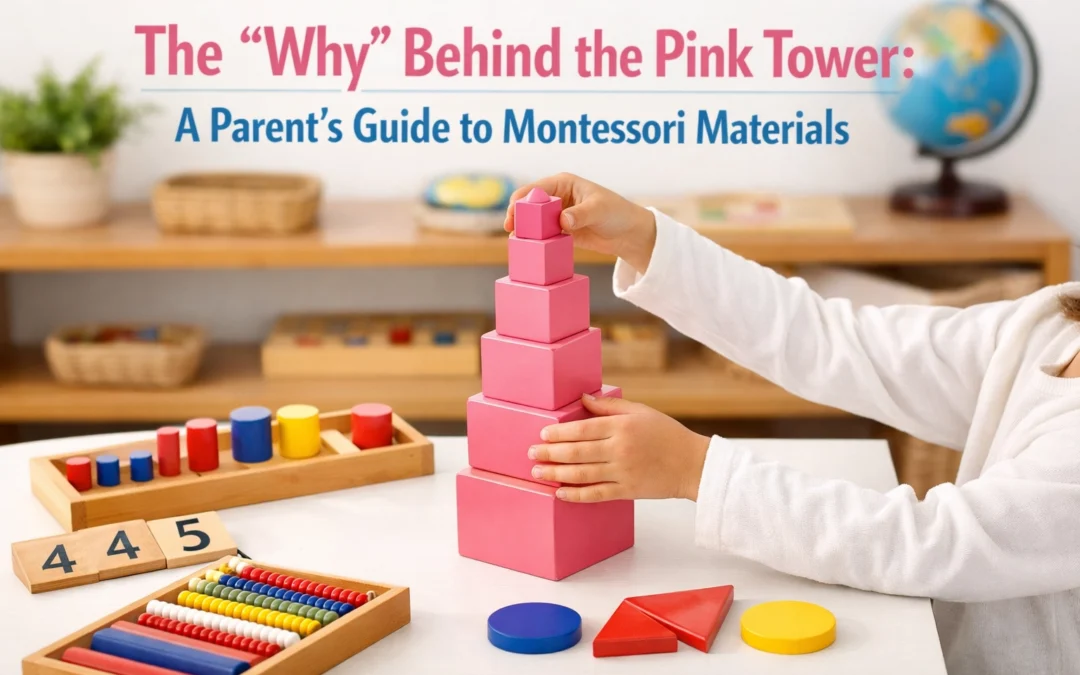
 

What makes a montessori school ‘Montessori?’

What makes a montessori school ‘Montessori?’

mixed ages


by Tim Seldin

If you’ve spent your career in independent schools or early childhood education, you’ve likely encountered Montessori—perhaps as a competitor, a curiosity, or simply another name in the landscape of educational options. I want to take a few minutes to explain what we do and why it matters to anyone who cares deeply about how children learn and grow.

I’ve spent four decades working with Montessori schools around the world. What I’ve learned is that, while our methods differ, many of our goals align closely with what thoughtful educators in any setting aim to accomplish: helping children become confident, capable, and curious human beings.

A Different Starting Point: How We View Children

The foundation of Montessori education stems from Dr. Maria Montessori’s discovery that children of different ages have distinct learning styles. Rather than viewing education primarily as delivering content, we see it as preparing an environment that draws out each child’s natural curiosity, deepens their concentration, and sustains their joy in learning.

Dr. Steven Hughes, a pediatric neuroscientist, once described the difference this way: in traditional models, we push content and curriculum. In developmental models such as Montessori, we follow the learner and optimize brain development.

This doesn’t mean we abandon academics—far from it. Montessori students typically perform exceptionally well on standardized measures. But we believe that when you prepare a child’s mind and body for learning first, the academic content follows naturally and is retained more effectively.

If you’ve ever watched a child lose themselves in deep, focused work—the kind where time seems to disappear—you’ve seen what we’re cultivating. We aim to make that the norm rather than the exception.

The Prepared Environment: Freedom Within Structure

Walk into a Montessori classroom, and you’ll notice it looks different. Rather than desks in rows facing a teacher, you’ll see low shelves arranged around the perimeter, with materials displayed at child height. You’ll see children working on the floor, at tables, sometimes alone, sometimes in small groups. You might see a six-year-old helping a four-year-old, or a child who’s been working with the same material for forty-five minutes, completely absorbed.

This is what we call the “prepared environment.” Every material in the room has been carefully selected to focus on a specific concept or skill. Unlike toys with multiple features, our materials focus on one thing at a time, allowing children to master it through repetition and self-correction. The materials often indicate when children’ve made an error, reducing their reliance on adult judgment.

The teacher has introduced these materials to each child individually or in small groups. Once introduced, children are free to choose what they work on, for how long, and whether to work alone or with others. This isn’t chaos—it’s disciplined freedom. And it requires something many educators find difficult: trusting that children, given the right environment and materials, will choose work that challenges them.

Time to Go Deep: The Uninterrupted Work Cycle

One of our most distinctive practices is the three-hour uninterrupted work period. This likely sounds impractical to many educators accustomed to 45-minute blocks and subject-switching bells.

But here’s what we’ve found: when children know they have extended time, they settle into deeper work. They’re not watching the clock. They’re not mentally preparing for the next transition. A child can start with a simple activity, warm up, and then move to a more challenging task. Or they can stay with one material for an hour, really mastering it.

The teacher circulates, observing carefully, giving lessons to individuals or small groups, but most of the time belongs to the children themselves. This develops something we desperately need in our students: the capacity for sustained attention, self-direction, and deep work.

If you’re concerned about whether children can handle this much autonomy, I understand. Most of us didn’t experience it ourselves. But I’ve watched it work for thousands of children across cultures, socioeconomic levels, and learning profiles. It turns out children rise to the expectations we set and the trust we extend.

The Teacher as Guide: A Different Kind of Mastery

Montessori teachers undergo extensive specialized training—typically a full academic year beyond their bachelor’s degree. But what they learn is quite different from traditional teacher preparation.

Rather than lesson planning for whole-group instruction, they learn to observe individual children with scientific precision. Rather than lecturing, they learn to give concise, engaging presentations that spark interest and then step back. Their goal is not to be the center of attention but to make themselves gradually unnecessary.

We often say the Montessori teacher is “the guide on the side” rather than “the sage on the stage.” After introducing a concept or material, the teacher observes and reflects on the child’s understanding. What did they miss? What captures their interest? Based on these observations, the teacher decides when to re-present, when to introduce something new, and when to stay out of the way.

This doesn’t mean Montessori teachers are passive. It means they’ve developed a different kind of mastery—one that requires deep knowledge of child development, precise observation skills, and the wisdom to know when to intervene and when to trust.

And here’s something that might surprise you: we’re as interested in character development as academic achievement. We want avid scholars, yes, but we also want happy, emotionally healthy children who work well with others, show resilience, and develop genuine self-esteem grounded in real capability.

Why Multi-Age Classrooms Matter

If you’re accustomed to age-segregated grades, our multi-age classrooms might seem strange. We typically group children in three-year spans: 18 months to three years for toddlers, three to six for early childhood, six to nine for lower elementary, nine to twelve for upper elementary.

There are powerful reasons for this. Younger children learn by watching older ones. Older children solidify their own understanding by teaching younger ones. No child is permanently “the struggling one” or “the star”—everyone is both learner and teacher depending on the context. And critically, children aren’t competing with same-age peers for the teacher’s attention or comparing themselves to a narrow cohort.

But we also intentionally cultivate other kinds of diversity: different learning styles, different cultural and socioeconomic backgrounds, boys and girls together, typically developing children alongside those with learning differences.

Why? Because this mirrors the real world our students will enter. They won’t work in organizations sorted by age and ability. They’ll collaborate with people who think differently, learn differently, and come from different backgrounds. The Montessori classroom becomes a laboratory for learning how to work effectively across differences.

It’s worth noting that many successful innovators and entrepreneurs—Jeff Bezos, the founders of Google, and many others—credit their Montessori experience with teaching them to think independently, work collaboratively, and approach problems creatively. The skills developed in our diverse, mixed-age classrooms translate directly to adult success.

Three Core Values: Independence, Individuality, and Interdependence

Everything we do rests on three foundational values.

Independence. A young child once said to Dr. Montessori: “Help me to do it myself.” This captures our entire philosophy. We give children just enough support to become self-reliant—not so much that they remain dependent, but enough that they can master genuine skills.

From three-year-olds learning to pour their own water and button their own coats, to twelve-year-olds designing independent research projects, we’re constantly asking: how can this child do more for themselves? The goal isn’t independence for its own sake. It’s building the confidence and competence that comes from genuine capability.

Individuality. We’re not processing children through a standardized curriculum at a standardized pace. We’re helping each child discover and develop their unique capacities. Some children are drawn to mathematics, others to language or art or the natural sciences. Some learn quickly in bursts, others through patient, methodical repetition.

The Montessori approach allows us to honor these differences rather than fight them. Every child works at their own pace through a carefully sequenced curriculum, which means advanced learners aren’t held back and struggling learners aren’t left behind. This is differentiation built into the model, not something teachers have to engineer on top of everything else.

Interdependence. But we’re not just cultivating isolated individuals. We want children to understand that they’re part of something larger: their classroom community, the school, the natural world, society.

This is why we have children of different ages working together, why we emphasize care for the environment, why older children mentor younger ones, why we study our place in the cosmos and on the planet. We want students who are empowered and capable, yes—but who understand their responsibilities to others and the world they inhabit.

The Home-School Partnership: Parents as Partners

One final element that might interest you: we take parent partnership seriously in ways that go beyond typical parent communication.

We don’t see parents as peripheral to the educational process. They have insights about their children that we need in order to understand the whole child. And we have observations and strategies that can help parents at home. This is a genuinely collaborative relationship, not a hierarchical one where the school is the expert and parents are clients.

In practice, this means regular, substantive communication; parent education events where we help parents understand child development and Montessori philosophy; and a culture where teachers and parents trust each other enough to have honest, productive conversations about children’s growth and challenges.

Many independent schools aspire to this kind of partnership. We’ve built it into our model from the beginning.

What This Means for Education

I’m not suggesting Montessori is the only way to educate children well. Many independent schools and early childhood programs achieve remarkable outcomes through different approaches. But I do think we offer something worth considering—particularly as education faces mounting pressure to serve diverse learners, prepare students for an unpredictable future, and honor childhood rather than simply rush through it.

If you’ve been in education long enough, you’ve probably noticed that many current reform movements are “discovering” things Montessori has done for over a century: personalized learning, hands-on engagement, mixed-age groupings, emphasis on executive function and self-regulation, project-based learning, and developmental appropriateness.

We don’t claim to have all the answers. But we do have a comprehensive, time-tested model that addresses many of the challenges educators are grappling with today. And perhaps most importantly, we have evidence that it works—not just academically, but in developing the kind of humans we want to send into the world: curious, capable, compassionate, and confident.

If you’re building or leading a school, I suggest that you look closely at what we do. You might not adopt the whole model, but you might find elements worth adapting. And if you’re a parent or educator exploring options, I’d invite you to visit a well-implemented Montessori school—not to convince you it’s the only way, but to see what’s possible when we truly follow the child.

The question I encourage every school founder and leader to ask is this: What kind of human beings are we trying to cultivate, and does every decision we make support that vision?

For us, that question has been central for more than a hundred years. And it continues to guide everything we build.

Family Celebrations and SPecial occassions for your child

Family Celebrations and SPecial occassions for your child

absorbent mind

Family life is characterized by gatherings that celebrate milestones—weddings, anniversaries, birthdays, holidays, and rites of passage. These occasions strengthen intergenerational bonds, root children in family traditions, and create memories that last a lifetime.

Depending on your family’s customs, beliefs, and cultural background, these moments often include special ceremonies that give the event shape and meaning.

From a Montessori perspective, celebrations are opportunities for children to feel included, contribute meaningfully, and connect their unfolding story to the larger story of family and culture. The key is to invite participation at a level that respects both their developmental stage and growing independence.

Handmade Gifts: A Child’s Contribution

Many celebrations include the exchange of gifts. While store-bought presents are common, families can also create traditions of giving handmade ones. Children love preparing something with their own hands, and Montessori emphasizes meaningful work. Even very young children can help bake cookies, roll candles, or mix homemade ice cream. Older children might sew a doll, paint a picture, or prepare a basket planted with herbs. With guidance, they can frame artwork, write and illustrate poems, or assemble a scrapbook of family photos.

Some families with teenagers undertake larger “secret” projects—building a dollhouse or model train set — as unforgettable gifts for younger siblings.

Creating and giving handmade items teaches that love and effort matter more than price tags and offers the deep satisfaction of seeing their work valued by those they love most.

Special Anniversaries: Building Family History. Anniversaries remind children that family stories stretch back before their own memories. Parents who share photos and stories of their wedding day show children the roots of their family tree. A simple meal, a candlelit dessert, or a shared story can make anniversaries meaningful, even for the youngest family members. Milestone anniversaries—25, 40, or 50 years together— often include extended family and friends. Inviting children to help decorate, make cards, or create a slideshow strengthens their sense of belonging to something larger than themselves.

Birthdays: A Montessori Tradition. Birthdays are especially powerful because they honor the day a life began. In Montessori classrooms, the birthday “walk around the sun” is a cherished ritual that families can adapt at home. Place a candle in the center of the room to represent the sun. Give the child a globe to carry around the circle, one lap for each year of life. As the child walks, parents share a photo and short story from each year—reminding everyone of the journey so far.

Some families add a candle lit at breakfast and kept burning throughout the day. At dinner, gather to reflect: What were the highlights of the past year? What are your hopes for the year ahead? This turns birthdays into more than a party—it makes them a moment of reflection, gratitude, and connection.

Another lovely tradition is preparing a time capsule: letters from parents, photos, drawings, or small treasures sealed each year and given to the child on their 18th or 21st birthday— a treasure chest of memories.

Rites of Passage: Joy and Sorrow Every family experiences rites of passage—baptisms, confirmations, bar and bat mitzvahs, graduations, weddings, funerals, and memorials. Some are joyful, others sorrowful, but all are significant. The challenge is deciding how much a child can participate. Long ceremonies or formal dinners may be overwhelming for the very young. Parents can plan for children to attend part of the event and leave with a caregiver before fatigue sets in. The goal is to let children share in family life while respecting their limits. With preparation and sensitivity, these moments help children understand life’s rhythm—celebration, remembrance, and continuity.

Real Families, Real Traditions: Holiday Traditions. Some families establish new traditions every year. One year, everyone created illustrated gratitude books to share at dinner. Another year, we smashed our Halloween pumpkins the next day and let the seeds take root. Our children love reminiscing and inventing new ideas. Following their lead fills our holidays with joy.

To Wrap Up

Children thrive when they are included in family life in ways that honor their developmental stage. Celebrations—large or small, joyful or solemn—offer belonging and continuity. By letting them help, create, and participate, we invite them into the ongoing story of family and culture. From handmade gifts to time-honored rituals, from birthdays to anniversaries, each occasion strengthens bonds and passes on tradition. As Montessori reminds us, children are always building themselves. Family celebrations help give them the roots and wings they need for the journey ahead.

The Absorbent Mind & Sensitive Periods

The Absorbent Mind & Sensitive Periods

absorbent mind

Understanding How Your Child Learns

One of the most fascinating and vital concepts in Montessori education is the understanding of how children learn in their early years — specifically, through what Dr. Maria Montessori termed the “Absorbent Mind” and “Sensitive Periods”.

If you’ve ever watched your child eagerly repeat a task — like pouring water over and over or asking you to read the same book nightly — you’ve witnessed these phenomena in action.

Understanding the Absorbent Mind and Sensitive Periods not only sheds light on your child’s development but also helps you respond in ways that deeply support their growth.

Let’s explore these two intertwined ideas, what they mean for your child, and how you can nurture them at home.

What is the Absorbent Mind? Dr. Maria Montessori coined the term “Absorbent Mind” to describe the unique, sponge-like capacity of children from birth to age 6 to absorb knowledge, behaviors, and experiences directly from their environment without conscious effort.

In these early years, children aren’t learning in the way adults do — by studying, memorizing, or rehearsing. Instead, they are unconsciously and effortlessly absorbing everything around them: language, movement, culture, social norms, and even the emotional climate of their home.

Dr. Montessori wrote: “The child absorbs these impressions not with his mind but with his life itself.” There are two phases of the Absorbent Mind: • Unconscious Absorbent Mind (Birth to 3 years): The child is passively soaking up everything in their environment.

This is when language, motor coordination, and emotional impressions are internalized rapidly and deeply.

Conscious Absorbent Mind (3 to 6 years): The child begins to seek experiences and deliberately repeat activities to master skills. Curiosity drives exploration and refinement. Understanding this helps explain why the early years are so crucial — and why Montessori environments, including your home, play such a vital role.

What are Sensitive Periods?

Within the broad landscape of the Absorbent Mind are specific Sensitive Periods — unique windows of time when the child is especially attuned to learning particular skills. During these periods, children exhibit intense interest, attention, and a capacity for mastery in specific areas. Once a Sensitive Period passes, the same learning can still occur, but it will require more effort and may lack the same natural enthusiasm.

Learning manners, social norms, and empathy Each period is characterized by focus, persistence, and joy in repeating related activities. For example, a child in the Sensitive Period for order might become upset if their toys are rearranged unexpectedly — not because they are fussy, but because their developing mind is constructing an internal sense of order.

How this plays out in Montessori classrooms

Montessori guides are trained to observe and respond to these Sensitive Periods with the right materials and activities at the right time.

For instance:

• A child showing keen interest in sounds might be introduced to Sound Cylinders to refine auditory discrimination.

• A child in the Sensitive Period for language is offered Sandpaper Letters and storytelling to enrich vocabulary and phonetic awareness.

• Children refining their movement are guided toward Practical Life activities, such as spooning, pouring, and using tongs.

The environment is designed to align with these developmental windows, ensuring that children experience deep, joyful learning.

As a parent, you play a crucial role in supporting the Absorbent Mind and Sensitive Periods at home. You don’t need specialized materials to support these developmental phases; although some Montessori-inspired tools can be helpful.

Here’s how you can nurture your child’s sensitive periods in daily life.

1. Sensitive Period for Order • Establish consistent routines — including morning rituals, meals, and bedtime — at predictable times.

• Keep belongings in designated areas — have a basket for shoes and a hook for jackets.

• Involve your child in organizing — such as sorting laundry, matching socks, and setting the table.

Resource Tip: Read Simplicity Parenting by Kim John Payne, which offers guidance on creating order and rhythm in family life.

The Key Sensitive Periods and Their Age Ranges

Sensitive Period Approximate Age Range What the Child is Drawn To

Order Birth to ~3 years Consistency, routines, and organization of the environment

Language Birth to ~6 years Listening, speaking, expanding vocabulary, sounds, and writing

Movement (Gross & Fine) Birth to ~4.5 years Control of the body, coordination, and manipulating objects

Refinement of the Senses ~2 to 6 years Discriminating sound, texture, color, shape, smell

Small Objects ~1.5 to 4 years Fascination with tiny details and objects

Social Behavior/Grace & Courtesy ~2.5 to 6 years Learning manners, social norms, and empathy

Observation: The Key to Supporting Sensitive Periods

Dr. Montessori emphasized the importance of observation.

At home, take time to watch your child play and explore:

• What tasks do they repeat?

• What objects capture their attention?

• Are they sensitive to changes in routine or environment?

Your observations will help you provide the appropriate experiences at the appropriate time.

In Closing

Your child’s mind is not just learning — it is building who they will become. The Absorbent Mind and Sensitive Periods are nature’s way of ensuring children acquire the skills, knowledge, and attitudes they need to thrive — with joy and ease. By observing and supporting these phases, both at your child’s Montessori school and at home, we can provide an enriching, respectful path that honors the wonder of childhood.

 Reflection Questions for Parents …

Have I noticed my child repeating certain actions or showing a strong interest in specific tasks? …

Is my home environment prepared to allow my child to explore these interests freely? …

How can I enrich my child’s day with more opportunities aligned with their sensitive period?

Recommended Reading and Resources

The Absorbent Mind by Maria Montessori — foundational reading for understanding this critical phase.

The Montessori Toddler by Simone Davies — a practical guide for parents of toddlers.

The Montessori Way by Paul Epstein, Robin Howe, and Tim Seldin, stage.montessori.org.

Montessori Services (montessoriservices.com) — offers child-sized tools for Practical Life at home.

Lovevery Play Kits (www.lovevery.com)—curated, age-appropriate toys based on developmental windows.

Finding Identity & Purpose in Montessori Middle & High Schools

Finding Identity & Purpose in Montessori Middle & High Schools

teens

A New Chapter in Development

The years from 12 to 18 are among the most intense and transformative in a young person’s life. Adolescence brings rapid growth—not only in the body but also in how young people think, feel, and connect with others. They test boundaries, challenge assumptions, and search for meaning.

Maria Montessori described this as the Third Plane of Development, a turning point that requires education to change in both style and purpose.

In the early years, children seek independence through action.

In the elementary years, it becomes independence of thought.

In adolescence, the need shifts to self-independence—forming identity, belonging, and purpose.

The questions change, too. They no longer ask how the world works. They ask who I am. Where do I belong? What difference can I make?

The Psychology of the Adolescent

Psychologists note that adolescence is a time of heightened self-consciousness. Teens measure themselves against peers and grapple with fairness, values, and justice. Friends exert significant influence, even as adolescents begin to form their own ideals.

The physical changes are pronounced, and emotions can fluctuate from high to low within hours. Beneath that turbulence lies a striving for balance, integrity, and authenticity.

Did You Know? Neuroscience shows that the adolescent brain undergoes a second major growth spurt. The prefrontal cortex—the region responsible for judgment and decision-making—is being rewired. This explains both teens’ risk-taking and their vast capacity for creativity, leadership, and innovation.

The Montessori Approach to Adolescent Education

Montessori recognized that adolescents require a distinct approach from Primary or Elementary education—an environment that eases the transition from childhood to adulthood.

The best Montessori Secondary programs rest on three essentials:

Work with purpose. Adolescents thrive when trusted with meaningful work—running a small business, creating art, farming, or organizing community projects.

Community life. Adolescents need belonging. Cooperative projects, service learning, and residential experiences foster empathy and responsibility.

• Exploration of identity. Through literature, science, history, and the arts, students explore humanity’s story, connect with role models, and form their own ideals.

A Parent’s Story: Becoming More Responsible. One parent reported that her 14-year-old daughter participated in a micro-economy project, selling handmade products at a local market. “She came home explaining supply and demand and profit margins,” her mother said. “But what struck me most was her pride. She wasn’t pretending to be grown up—she was contributing something real.”

Academics with Context

Montessori adolescent programs don’t dilute academics—they make them relevant—mathematics links to economics, science to ecology, history to social justice. Adolescents stay motivated when they understand why knowledge matters. Language work expands into persuasive essays, debates, and close readings. Science explores ecosystems, physiology, and chemistry labs. History becomes a study of human struggles for survival, justice, and meaning.

Did You Know? Research shows students retain more knowledge when it connects to their lives (National Research Council, How People Learn, 2000).

Montessori anticipated this a century ago by grounding academics in real-world experience.

Work Beyond the Classroom

As in the elementary years, adolescents extend learning into the wider world—but with greater responsibility. Programs often include farm work, internships, apprenticeships, and service projects that offer real experiences, not simulations. Some schools operate small farms or gardens, where students care for animals, plant crops, and sell produce. Others partner with local businesses or nonprofits. These experiences build practical skills and a deep sense of competence.

A Parent’s Story: Seeing the Bigger Picture One father described his son’s work at a school “land-lab.” “He used to roll his eyes at chores,” he said. “But after feeding animals and planting crops, he came home eager to cook, fix things, and pitch in. He felt useful—and that changed his whole outlook.”

“Adolescence is often described as turbulent, but it is also filled with extraordinary potential.”


The Social World of Adolescents

More than at any other age, adolescents live in a world defined by peers. Friendships can feel like lifelines, and social belonging is central to their well-being. Montessori embraces this energy, weaving it into learning. Collaborative projects, discussions, and shared responsibilities help adolescents practice empathy, navigate conflict, and experience authentic leadership.

Supporting Adolescents at Home

Parenting during adolescence can feel like a balancing act— offering guidance while allowing independence. Montessori parents can support this stage by:

Encouraging responsibility through chores, part-time work, or family contributions.

Respecting growing independence while maintaining consistent boundaries.

Listening more than lecturing—adolescents want to be heard.

Sharing stories of role models and heroes who embody strong values.


A Parent’s Story: Building Trust One mother said her 15-year-old son began challenging family rules. “We started holding family meetings. He helped set expectations, and suddenly, he was more willing to follow them. He needed to know his voice counted.”


Outcomes of Montessori Secondary Programs

Montessori graduates carry more than academic preparation. They leave with a strong sense of identity, purpose, and responsibility. They know how to manage projects, collaborate, and contribute to their communities.

Research on Montessori alumni shows lasting strengths in creativity, collaboration, and satisfaction with learning. Most importantly, they keep their curiosity alive.


Did You Know? Montessori called adolescent programs Erdkinder— schools for “children of the earth.” She envisioned farm-based communities where study was balanced with practical work. Not every modern school fully adheres to this model, but its principles of meaningful work, community, and identity remain central.

In Summary Adolescence is often described as turbulent, but it is also filled with extraordinary potential. Montessori sees this age not as something to endure but as something to celebrate. By offering meaningful work, genuine community, and opportunities to explore identity, Montessori schools help adolescents transition into adulthood with confidence and purpose. By the time they leave, Montessori adolescents carry not only knowledge but also a deep understanding of themselves and their world—a foundation for resilience, purpose, and a meaningful life. 

What the Brain Reveals About Montessori

What the Brain Reveals About Montessori

brain

A Conversation with Dr. Ann Epstein on Creativity, Thinking, and Memory

By Tim Seldin

I recently had the pleasure of speaking with Dr. Ann Epstein of the University of Wisconsin, a longtime researcher and advocate for high-quality early education. Our conversation turned to some fascinating new studies coming out of Europe and the U.S. that shed light on how different educational approaches actually shape the developing brain. What’s emerging, thanks to researchers like Dr. Solange Denervaud and her colleagues in Switzerland and at Penn State, is compelling scientific evidence for what Montessori educators have observed for over a century: the Montessori approach does more than help children learn well—it appears to support deep, lasting brain development tied to memory, creativity, and flexible thinking.

Dr. Epstein shared two recent studies with me, and I want to pass along what I learned from her. These findings offer new insights—not just affirming what we already know about Montessori education, but potentially helping us understand why it works so well.

Creativity and the Developing Brain: What the Science Shows

The first study Dr. Epstein pointed me to was Creative Thinking and Brain Network Development in Schoolchildren, published in Developmental Science (Duval, Denervaud, et al., 2023). The researchers used both behavioral assessments and fMRI brain scans to compare 75 children aged 4 to 18 from Montessori and traditional schools. The results confirmed what previous research has suggested: Montessori students tend to score higher on measures of creative thinking. But what’s truly remarkable is what was happening in their brains.

Children in Montessori classrooms showed more balanced and flexible activation across three key brain networks involved in creativity:

  • The Default Mode Network (DMN), which supports internal thought, imagination, and self-reflection. 
  • The Executive Control Network (ECN), which supports working memory and decision-making. 
  • The Salience Network (SN), which helps the brain decide what to pay attention to. 

Children from traditional school environments, by contrast, tended to spend more time in a static or introspective mode (high intra-DMN activity), suggesting less flexibility in switching between idea generation and evaluation. Montessori students, meanwhile, moved more fluidly between networks—exactly the kind of dynamic thinking that supports creativity, problem-solving, and adaptability.

This isn’t just academic. As Dr. Epstein reminded me, creative thinking is essential—not just for artists or inventors, but for anyone navigating a complex and ever-changing world. And these findings suggest that Montessori schools may be doing something unique to nurture it.

Memory: Learning by Heart or With Heart?

The second study Dr. Epstein shared was Learning by Heart or With Heart: Brain Asymmetry Reflects Pedagogical Practices, published in Brain Sciences (Schetter, Denervaud, et al., 2023). This paper looked at another important dimension: how children remember and organize what they learn.

Using structural MRI scans, the researchers measured differences in the parahippocampal cortex (PHC), a brain region involved in memory and learning. Children in Montessori classrooms showed a developmental trend toward left-hemisphere asymmetry in the PHC—associated with semantic memory (understanding concepts, generalizing ideas). In contrast, children from traditional schools showed right-hemisphere asymmetry—linked to episodic memory (recalling specific events or rote sequences).

What does that mean? According to Dr. Epstein, the data suggest that Montessori children are more likely to encode meaning, while children in traditional classrooms are more likely to recall isolated facts or events. It’s a difference between knowing and understanding—and it shows up in the structure of the brain.

Montessori students also tend to perform better on recognition tasks and show more interconnected and flexible semantic networks, according to earlier research by Denervaud and colleagues. That flexibility—how easily children link ideas together and transfer learning from one context to another—is at the heart of real-world problem-solving.

Why Might Montessori Make a Difference?

As Dr. Epstein and I discussed, the studies don’t claim that Montessori is the only path to healthy brain development. But they do suggest that some key features of Montessori classrooms may be contributing to these positive outcomes:

  • Multi-age classrooms and peer collaboration, which support social-emotional development and flexible thinking. 
  • Uninterrupted work periods, which promote sustained attention and deeper engagement. 
  • Freedom of movement and choice, which align with how the brain learns best: through agency and active exploration. 
  • Respectful adult-child relationships, where teachers serve as guides rather than lecturers—a factor Angeline Lillard highlights in The Montessori Handbook (Bloomsbury, 2021). 
  • Calm, well-ordered environments, which reduce behavioral disruptions and allow children to focus, regulate, and retain more of what they learn. 

From Dr. Epstein’s perspective, one of the most interesting questions ahead is why these differences arise. Is it the materials? The mixed-age grouping? The training of the teacher? Likely, it’s the synergy of all of the above. Montessori isn’t just a set of techniques—it’s a whole system designed around how children actually grow and learn.

A Word of Caution—and of Encouragement

It’s important to note, as Dr. Epstein emphasized, that this research is still developing. We need longitudinal studies to follow children into adulthood and determine how these early neural patterns play out over time. But even now, these findings offer a rare window into the deeper “how” behind Montessori’s effectiveness.

For parents, it’s an opportunity to see that the choice of school is about more than academics or test scores. Montessori may help your child build a brain that’s not just smarter—but more creative, more adaptable, and more capable of seeing the bigger picture.

And for teachers, these findings can be affirming. What you do each day—the grace with which you guide, the calm you maintain in your classroom, the respect you offer to each child—is quite literally helping shape the architecture of a developing mind.

We’ve always known that Montessori education works. We’ve seen it in the confidence, curiosity, and calm focus of our students. Now, thanks to researchers like Dr. Denervaud and advocates like Dr. Epstein, we’re starting to see why.

And the answer, it seems, is written not just in observation notes or test scores—but in the very folds and rhythms of the growing brain.


If you’re curious to learn more about these studies, I encourage you to watch the video summary from Dr. Denervaud’s team on creativity and the brain: https://www.youtube.com/watch?v=xWV_5o8wB5g. Or, better yet, talk with your child’s Montessori teacher. They’re your partner in this extraordinary journey.