Dear Cathie: Bullying

Dear Cathie: Bullying

curiousity

DEAR CATHIE— THE TOPIC OF BULLYING SEEMS TO BE ALL OVER THE PRESS. MY CHILD HAS JUST STARTED PRESCHOOL BUT I WANT TO BE PROACTIVE IN BEING SURE THAT MY CHILD DOES NOT BECOME EITHER A BULLY OR THE VICTIM OF BULLYING. IS IT TOO SOON TO THINK ABOUT THIS NOW?

A PROACTIVE MOM


Dear Mom,

I applaud you for already considering the challenging issues. Bullying is a highly discussed topic now, and many schools, religious organizations, and community groups are working hard to raise awareness and develop training and interventions to counteract this behavior!

There are mixed views about the reality of bullying in preschool. I am in the camp that some children begin to show signs of bullying behavior as young as three, and these behaviors need to be addressed as soon as they appear.

Luckily, Montessori guides are trained to do just that. We are trained to work with children in challenging interpersonal situations and to help both bullies and the bullied develop appropriate actions and responses in social settings.

Let’s look at bullying from a few angles.

• When can bullying begin?

• What does it look like?

• What kinds of interventions are possible with such young children?


Children begin to understand and appreciate others’ feelings around age 3. Before that age, children are totally self-absorbed. They have limited capacity to put themselves in another person’s shoes and understand how that person might feel in a given situation.

The development of empathy is central to social learning in the early years.

What actually constitutes bullying behavior? The answer lies primarily in the motivation for the behavior. If a child deliberately does harm to another and smiles about it, that is bullying. If a child regularly hits, kicks, or punches another, that is bullying. It is also bullying to call another child repeatedly “names,” exclude him from play, or put him down with either words or actions.

It is bullying behavior to recruit other children to misbehave and to sneak to do things. Bullies also intimidate their victims by hurting a child or threatening to hurt a child and demanding that she keep it a secret.

In reality, many preschoolers do engage in some of the behavior listed above. The challenge is to distinguish between typical preschool squabbles and actual bullying.

This is the time in life when children “try out” many types of behavior to learn how to interact with others. They work to understand the impact of their actions and their words.

Preschool children who are just learning to socialize may do things that are thoughtless, unkind, or even downright mean. In an effort to secure a friendship, Samantha may boss Rachel around and get her to do what Samantha tells her to do.

My most memorable story about this was a child who ordered another child to use a specific potty in the school bathroom. Even though it made her friend cry, she was adamant day after day. After discussion, she preferred the child use the potty next to her so they could sit together. “That is what friends do, Miss Cathie, they sit together,” she told me, nodding solemnly. This was not bullying but a misunderstood code of conduct in a friendship. The difference is that the negative consequences of these behaviors do not bring the child satisfaction or joy.


One of the main symptoms of bullying behavior is that it is repeated and has a deliberate intent to scare, harm, or upset another. In most preschool conflicts, the power is balanced.

Let’s look at a typical example. David and Paul (both three-year-old boys) are playing in the sandbox. They see a popular red dump truck. They both grab for it, and a conflict begins. “It’s mine! I had it first,” they both cry. One pulls the truck, and the other falls over crying. The child has his truck, and he walks away, leaving the crying child in the sandbox. This conflict will take some teacher interaction to resolve, but it is not bullying. Neither boy wanted to harm the other.

Learning to share, take turns, and care about others’ feelings is an important component of preschool social learning. When working with children to resolve squabbles, I often find they are surprised that their actions caused another child to be upset or cry. They are so egocentric at this age that they only want what they want and focus on getting it, often at the expense of others.

What can you do if you feel there is a bullying situation brewing in your child’s class?

The first step is to gather as much information as possible, then speak with your child’s teacher. While the adults in your child’s classroom are great observers and see much that happens at the school, they are not able to see everything. Therefore, they need your input on how things are affecting your child. Some children are shy, especially in their first year, and do not feel comfortable talking to the teacher. They only share those serious feelings with their parents at home. And a bully may be sneaky, and it may be hard for your child to make sense of the situation.

How do Montessori guides work with children on these skills?

We explain to children that “you can’t have your fun by making other people sad.” This is the basic anti-bullying mantra. When squabbles arise, Montessori works with both children to discuss, analyze, and resolve the conflict. They help each child to listen while the other tells their side of the story and identify the way the conflict made them feel. Then the children and the guide brainstorm for ways to resolve the problem. “What do you need to make you feel better?” is a question we often ask. We expect that the child who was hurt to initiate the conversation. “It is not Ok for anyone to hurt your body or your feelings.” We expect the child who did the hurting to “fix” the problem.

Problems are not left until they are resolved. The child who was hurt (or bullied) is helped to stand up for himself, and the child who was doing the hurting (or bullying) is taught to listen and make amends.

So in the Montessori Method, both types of children are taught anti-bullying strategies.


Guides in 3-6 classrooms spend significant time with these sorts of problems. And most children do this sort of self-advocacy independently by the end of their fourth year.


 For further reading on this subject, I recommend: The Everything Parents’ Guide to Dealing with Bullies: From playground teasing to cyber bullying, all you need to ensure your child’s safety and happiness by Deborah Carpenter, and the children’s picture book, One by Kathryn Otoshi.


Cathie Perolman has been involved in Montessori education for over 40 years. Cathie has worked in the classroom as a 3-6 assistant; a classroom teacher; a level leader; a teacher trainer; and a college professor. She currently spends her time mentoring teachers, conducting workshops for teachers and administrators; and writing for her blog and for magazines. She also serves as a consultant for schools and as a school validator for the Montessori Schools of Maryland. Cathie is the creator of the Color Coded Sound Games and the Rainbow Reading System as well as other reading and cosmic printable materials to enhance classrooms. Find them at cathieperolman.com.

Family Celebrations and SPecial occassions for your child

Family Celebrations and SPecial occassions for your child

absorbent mind

Family life is characterized by gatherings that celebrate milestones—weddings, anniversaries, birthdays, holidays, and rites of passage. These occasions strengthen intergenerational bonds, root children in family traditions, and create memories that last a lifetime.

Depending on your family’s customs, beliefs, and cultural background, these moments often include special ceremonies that give the event shape and meaning.

From a Montessori perspective, celebrations are opportunities for children to feel included, contribute meaningfully, and connect their unfolding story to the larger story of family and culture. The key is to invite participation at a level that respects both their developmental stage and growing independence.

Handmade Gifts: A Child’s Contribution

Many celebrations include the exchange of gifts. While store-bought presents are common, families can also create traditions of giving handmade ones. Children love preparing something with their own hands, and Montessori emphasizes meaningful work. Even very young children can help bake cookies, roll candles, or mix homemade ice cream. Older children might sew a doll, paint a picture, or prepare a basket planted with herbs. With guidance, they can frame artwork, write and illustrate poems, or assemble a scrapbook of family photos.

Some families with teenagers undertake larger “secret” projects—building a dollhouse or model train set — as unforgettable gifts for younger siblings.

Creating and giving handmade items teaches that love and effort matter more than price tags and offers the deep satisfaction of seeing their work valued by those they love most.

Special Anniversaries: Building Family History. Anniversaries remind children that family stories stretch back before their own memories. Parents who share photos and stories of their wedding day show children the roots of their family tree. A simple meal, a candlelit dessert, or a shared story can make anniversaries meaningful, even for the youngest family members. Milestone anniversaries—25, 40, or 50 years together— often include extended family and friends. Inviting children to help decorate, make cards, or create a slideshow strengthens their sense of belonging to something larger than themselves.

Birthdays: A Montessori Tradition. Birthdays are especially powerful because they honor the day a life began. In Montessori classrooms, the birthday “walk around the sun” is a cherished ritual that families can adapt at home. Place a candle in the center of the room to represent the sun. Give the child a globe to carry around the circle, one lap for each year of life. As the child walks, parents share a photo and short story from each year—reminding everyone of the journey so far.

Some families add a candle lit at breakfast and kept burning throughout the day. At dinner, gather to reflect: What were the highlights of the past year? What are your hopes for the year ahead? This turns birthdays into more than a party—it makes them a moment of reflection, gratitude, and connection.

Another lovely tradition is preparing a time capsule: letters from parents, photos, drawings, or small treasures sealed each year and given to the child on their 18th or 21st birthday— a treasure chest of memories.

Rites of Passage: Joy and Sorrow Every family experiences rites of passage—baptisms, confirmations, bar and bat mitzvahs, graduations, weddings, funerals, and memorials. Some are joyful, others sorrowful, but all are significant. The challenge is deciding how much a child can participate. Long ceremonies or formal dinners may be overwhelming for the very young. Parents can plan for children to attend part of the event and leave with a caregiver before fatigue sets in. The goal is to let children share in family life while respecting their limits. With preparation and sensitivity, these moments help children understand life’s rhythm—celebration, remembrance, and continuity.

Real Families, Real Traditions: Holiday Traditions. Some families establish new traditions every year. One year, everyone created illustrated gratitude books to share at dinner. Another year, we smashed our Halloween pumpkins the next day and let the seeds take root. Our children love reminiscing and inventing new ideas. Following their lead fills our holidays with joy.

To Wrap Up

Children thrive when they are included in family life in ways that honor their developmental stage. Celebrations—large or small, joyful or solemn—offer belonging and continuity. By letting them help, create, and participate, we invite them into the ongoing story of family and culture. From handmade gifts to time-honored rituals, from birthdays to anniversaries, each occasion strengthens bonds and passes on tradition. As Montessori reminds us, children are always building themselves. Family celebrations help give them the roots and wings they need for the journey ahead.

The Absorbent Mind & Sensitive Periods

The Absorbent Mind & Sensitive Periods

absorbent mind

Understanding How Your Child Learns

One of the most fascinating and vital concepts in Montessori education is the understanding of how children learn in their early years — specifically, through what Dr. Maria Montessori termed the “Absorbent Mind” and “Sensitive Periods”.

If you’ve ever watched your child eagerly repeat a task — like pouring water over and over or asking you to read the same book nightly — you’ve witnessed these phenomena in action.

Understanding the Absorbent Mind and Sensitive Periods not only sheds light on your child’s development but also helps you respond in ways that deeply support their growth.

Let’s explore these two intertwined ideas, what they mean for your child, and how you can nurture them at home.

What is the Absorbent Mind? Dr. Maria Montessori coined the term “Absorbent Mind” to describe the unique, sponge-like capacity of children from birth to age 6 to absorb knowledge, behaviors, and experiences directly from their environment without conscious effort.

In these early years, children aren’t learning in the way adults do — by studying, memorizing, or rehearsing. Instead, they are unconsciously and effortlessly absorbing everything around them: language, movement, culture, social norms, and even the emotional climate of their home.

Dr. Montessori wrote: “The child absorbs these impressions not with his mind but with his life itself.” There are two phases of the Absorbent Mind: • Unconscious Absorbent Mind (Birth to 3 years): The child is passively soaking up everything in their environment.

This is when language, motor coordination, and emotional impressions are internalized rapidly and deeply.

Conscious Absorbent Mind (3 to 6 years): The child begins to seek experiences and deliberately repeat activities to master skills. Curiosity drives exploration and refinement. Understanding this helps explain why the early years are so crucial — and why Montessori environments, including your home, play such a vital role.

What are Sensitive Periods?

Within the broad landscape of the Absorbent Mind are specific Sensitive Periods — unique windows of time when the child is especially attuned to learning particular skills. During these periods, children exhibit intense interest, attention, and a capacity for mastery in specific areas. Once a Sensitive Period passes, the same learning can still occur, but it will require more effort and may lack the same natural enthusiasm.

Learning manners, social norms, and empathy Each period is characterized by focus, persistence, and joy in repeating related activities. For example, a child in the Sensitive Period for order might become upset if their toys are rearranged unexpectedly — not because they are fussy, but because their developing mind is constructing an internal sense of order.

How this plays out in Montessori classrooms

Montessori guides are trained to observe and respond to these Sensitive Periods with the right materials and activities at the right time.

For instance:

• A child showing keen interest in sounds might be introduced to Sound Cylinders to refine auditory discrimination.

• A child in the Sensitive Period for language is offered Sandpaper Letters and storytelling to enrich vocabulary and phonetic awareness.

• Children refining their movement are guided toward Practical Life activities, such as spooning, pouring, and using tongs.

The environment is designed to align with these developmental windows, ensuring that children experience deep, joyful learning.

As a parent, you play a crucial role in supporting the Absorbent Mind and Sensitive Periods at home. You don’t need specialized materials to support these developmental phases; although some Montessori-inspired tools can be helpful.

Here’s how you can nurture your child’s sensitive periods in daily life.

1. Sensitive Period for Order • Establish consistent routines — including morning rituals, meals, and bedtime — at predictable times.

• Keep belongings in designated areas — have a basket for shoes and a hook for jackets.

• Involve your child in organizing — such as sorting laundry, matching socks, and setting the table.

Resource Tip: Read Simplicity Parenting by Kim John Payne, which offers guidance on creating order and rhythm in family life.

The Key Sensitive Periods and Their Age Ranges

Sensitive Period Approximate Age Range What the Child is Drawn To

Order Birth to ~3 years Consistency, routines, and organization of the environment

Language Birth to ~6 years Listening, speaking, expanding vocabulary, sounds, and writing

Movement (Gross & Fine) Birth to ~4.5 years Control of the body, coordination, and manipulating objects

Refinement of the Senses ~2 to 6 years Discriminating sound, texture, color, shape, smell

Small Objects ~1.5 to 4 years Fascination with tiny details and objects

Social Behavior/Grace & Courtesy ~2.5 to 6 years Learning manners, social norms, and empathy

Observation: The Key to Supporting Sensitive Periods

Dr. Montessori emphasized the importance of observation.

At home, take time to watch your child play and explore:

• What tasks do they repeat?

• What objects capture their attention?

• Are they sensitive to changes in routine or environment?

Your observations will help you provide the appropriate experiences at the appropriate time.

In Closing

Your child’s mind is not just learning — it is building who they will become. The Absorbent Mind and Sensitive Periods are nature’s way of ensuring children acquire the skills, knowledge, and attitudes they need to thrive — with joy and ease. By observing and supporting these phases, both at your child’s Montessori school and at home, we can provide an enriching, respectful path that honors the wonder of childhood.

 Reflection Questions for Parents …

Have I noticed my child repeating certain actions or showing a strong interest in specific tasks? …

Is my home environment prepared to allow my child to explore these interests freely? …

How can I enrich my child’s day with more opportunities aligned with their sensitive period?

Recommended Reading and Resources

The Absorbent Mind by Maria Montessori — foundational reading for understanding this critical phase.

The Montessori Toddler by Simone Davies — a practical guide for parents of toddlers.

The Montessori Way by Paul Epstein, Robin Howe, and Tim Seldin, stage.montessori.org.

Montessori Services (montessoriservices.com) — offers child-sized tools for Practical Life at home.

Lovevery Play Kits (www.lovevery.com)—curated, age-appropriate toys based on developmental windows.

Finding Identity & Purpose in Montessori Middle & High Schools

Finding Identity & Purpose in Montessori Middle & High Schools

teens

A New Chapter in Development

The years from 12 to 18 are among the most intense and transformative in a young person’s life. Adolescence brings rapid growth—not only in the body but also in how young people think, feel, and connect with others. They test boundaries, challenge assumptions, and search for meaning.

Maria Montessori described this as the Third Plane of Development, a turning point that requires education to change in both style and purpose.

In the early years, children seek independence through action.

In the elementary years, it becomes independence of thought.

In adolescence, the need shifts to self-independence—forming identity, belonging, and purpose.

The questions change, too. They no longer ask how the world works. They ask who I am. Where do I belong? What difference can I make?

The Psychology of the Adolescent

Psychologists note that adolescence is a time of heightened self-consciousness. Teens measure themselves against peers and grapple with fairness, values, and justice. Friends exert significant influence, even as adolescents begin to form their own ideals.

The physical changes are pronounced, and emotions can fluctuate from high to low within hours. Beneath that turbulence lies a striving for balance, integrity, and authenticity.

Did You Know? Neuroscience shows that the adolescent brain undergoes a second major growth spurt. The prefrontal cortex—the region responsible for judgment and decision-making—is being rewired. This explains both teens’ risk-taking and their vast capacity for creativity, leadership, and innovation.

The Montessori Approach to Adolescent Education

Montessori recognized that adolescents require a distinct approach from Primary or Elementary education—an environment that eases the transition from childhood to adulthood.

The best Montessori Secondary programs rest on three essentials:

Work with purpose. Adolescents thrive when trusted with meaningful work—running a small business, creating art, farming, or organizing community projects.

Community life. Adolescents need belonging. Cooperative projects, service learning, and residential experiences foster empathy and responsibility.

• Exploration of identity. Through literature, science, history, and the arts, students explore humanity’s story, connect with role models, and form their own ideals.

A Parent’s Story: Becoming More Responsible. One parent reported that her 14-year-old daughter participated in a micro-economy project, selling handmade products at a local market. “She came home explaining supply and demand and profit margins,” her mother said. “But what struck me most was her pride. She wasn’t pretending to be grown up—she was contributing something real.”

Academics with Context

Montessori adolescent programs don’t dilute academics—they make them relevant—mathematics links to economics, science to ecology, history to social justice. Adolescents stay motivated when they understand why knowledge matters. Language work expands into persuasive essays, debates, and close readings. Science explores ecosystems, physiology, and chemistry labs. History becomes a study of human struggles for survival, justice, and meaning.

Did You Know? Research shows students retain more knowledge when it connects to their lives (National Research Council, How People Learn, 2000).

Montessori anticipated this a century ago by grounding academics in real-world experience.

Work Beyond the Classroom

As in the elementary years, adolescents extend learning into the wider world—but with greater responsibility. Programs often include farm work, internships, apprenticeships, and service projects that offer real experiences, not simulations. Some schools operate small farms or gardens, where students care for animals, plant crops, and sell produce. Others partner with local businesses or nonprofits. These experiences build practical skills and a deep sense of competence.

A Parent’s Story: Seeing the Bigger Picture One father described his son’s work at a school “land-lab.” “He used to roll his eyes at chores,” he said. “But after feeding animals and planting crops, he came home eager to cook, fix things, and pitch in. He felt useful—and that changed his whole outlook.”

“Adolescence is often described as turbulent, but it is also filled with extraordinary potential.”


The Social World of Adolescents

More than at any other age, adolescents live in a world defined by peers. Friendships can feel like lifelines, and social belonging is central to their well-being. Montessori embraces this energy, weaving it into learning. Collaborative projects, discussions, and shared responsibilities help adolescents practice empathy, navigate conflict, and experience authentic leadership.

Supporting Adolescents at Home

Parenting during adolescence can feel like a balancing act— offering guidance while allowing independence. Montessori parents can support this stage by:

Encouraging responsibility through chores, part-time work, or family contributions.

Respecting growing independence while maintaining consistent boundaries.

Listening more than lecturing—adolescents want to be heard.

Sharing stories of role models and heroes who embody strong values.


A Parent’s Story: Building Trust One mother said her 15-year-old son began challenging family rules. “We started holding family meetings. He helped set expectations, and suddenly, he was more willing to follow them. He needed to know his voice counted.”


Outcomes of Montessori Secondary Programs

Montessori graduates carry more than academic preparation. They leave with a strong sense of identity, purpose, and responsibility. They know how to manage projects, collaborate, and contribute to their communities.

Research on Montessori alumni shows lasting strengths in creativity, collaboration, and satisfaction with learning. Most importantly, they keep their curiosity alive.


Did You Know? Montessori called adolescent programs Erdkinder— schools for “children of the earth.” She envisioned farm-based communities where study was balanced with practical work. Not every modern school fully adheres to this model, but its principles of meaningful work, community, and identity remain central.

In Summary Adolescence is often described as turbulent, but it is also filled with extraordinary potential. Montessori sees this age not as something to endure but as something to celebrate. By offering meaningful work, genuine community, and opportunities to explore identity, Montessori schools help adolescents transition into adulthood with confidence and purpose. By the time they leave, Montessori adolescents carry not only knowledge but also a deep understanding of themselves and their world—a foundation for resilience, purpose, and a meaningful life. 

What the Brain Reveals About Montessori

What the Brain Reveals About Montessori

brain

A Conversation with Dr. Ann Epstein on Creativity, Thinking, and Memory

By Tim Seldin

I recently had the pleasure of speaking with Dr. Ann Epstein of the University of Wisconsin, a longtime researcher and advocate for high-quality early education. Our conversation turned to some fascinating new studies coming out of Europe and the U.S. that shed light on how different educational approaches actually shape the developing brain. What’s emerging, thanks to researchers like Dr. Solange Denervaud and her colleagues in Switzerland and at Penn State, is compelling scientific evidence for what Montessori educators have observed for over a century: the Montessori approach does more than help children learn well—it appears to support deep, lasting brain development tied to memory, creativity, and flexible thinking.

Dr. Epstein shared two recent studies with me, and I want to pass along what I learned from her. These findings offer new insights—not just affirming what we already know about Montessori education, but potentially helping us understand why it works so well.

Creativity and the Developing Brain: What the Science Shows

The first study Dr. Epstein pointed me to was Creative Thinking and Brain Network Development in Schoolchildren, published in Developmental Science (Duval, Denervaud, et al., 2023). The researchers used both behavioral assessments and fMRI brain scans to compare 75 children aged 4 to 18 from Montessori and traditional schools. The results confirmed what previous research has suggested: Montessori students tend to score higher on measures of creative thinking. But what’s truly remarkable is what was happening in their brains.

Children in Montessori classrooms showed more balanced and flexible activation across three key brain networks involved in creativity:

  • The Default Mode Network (DMN), which supports internal thought, imagination, and self-reflection. 
  • The Executive Control Network (ECN), which supports working memory and decision-making. 
  • The Salience Network (SN), which helps the brain decide what to pay attention to. 

Children from traditional school environments, by contrast, tended to spend more time in a static or introspective mode (high intra-DMN activity), suggesting less flexibility in switching between idea generation and evaluation. Montessori students, meanwhile, moved more fluidly between networks—exactly the kind of dynamic thinking that supports creativity, problem-solving, and adaptability.

This isn’t just academic. As Dr. Epstein reminded me, creative thinking is essential—not just for artists or inventors, but for anyone navigating a complex and ever-changing world. And these findings suggest that Montessori schools may be doing something unique to nurture it.

Memory: Learning by Heart or With Heart?

The second study Dr. Epstein shared was Learning by Heart or With Heart: Brain Asymmetry Reflects Pedagogical Practices, published in Brain Sciences (Schetter, Denervaud, et al., 2023). This paper looked at another important dimension: how children remember and organize what they learn.

Using structural MRI scans, the researchers measured differences in the parahippocampal cortex (PHC), a brain region involved in memory and learning. Children in Montessori classrooms showed a developmental trend toward left-hemisphere asymmetry in the PHC—associated with semantic memory (understanding concepts, generalizing ideas). In contrast, children from traditional schools showed right-hemisphere asymmetry—linked to episodic memory (recalling specific events or rote sequences).

What does that mean? According to Dr. Epstein, the data suggest that Montessori children are more likely to encode meaning, while children in traditional classrooms are more likely to recall isolated facts or events. It’s a difference between knowing and understanding—and it shows up in the structure of the brain.

Montessori students also tend to perform better on recognition tasks and show more interconnected and flexible semantic networks, according to earlier research by Denervaud and colleagues. That flexibility—how easily children link ideas together and transfer learning from one context to another—is at the heart of real-world problem-solving.

Why Might Montessori Make a Difference?

As Dr. Epstein and I discussed, the studies don’t claim that Montessori is the only path to healthy brain development. But they do suggest that some key features of Montessori classrooms may be contributing to these positive outcomes:

  • Multi-age classrooms and peer collaboration, which support social-emotional development and flexible thinking. 
  • Uninterrupted work periods, which promote sustained attention and deeper engagement. 
  • Freedom of movement and choice, which align with how the brain learns best: through agency and active exploration. 
  • Respectful adult-child relationships, where teachers serve as guides rather than lecturers—a factor Angeline Lillard highlights in The Montessori Handbook (Bloomsbury, 2021). 
  • Calm, well-ordered environments, which reduce behavioral disruptions and allow children to focus, regulate, and retain more of what they learn. 

From Dr. Epstein’s perspective, one of the most interesting questions ahead is why these differences arise. Is it the materials? The mixed-age grouping? The training of the teacher? Likely, it’s the synergy of all of the above. Montessori isn’t just a set of techniques—it’s a whole system designed around how children actually grow and learn.

A Word of Caution—and of Encouragement

It’s important to note, as Dr. Epstein emphasized, that this research is still developing. We need longitudinal studies to follow children into adulthood and determine how these early neural patterns play out over time. But even now, these findings offer a rare window into the deeper “how” behind Montessori’s effectiveness.

For parents, it’s an opportunity to see that the choice of school is about more than academics or test scores. Montessori may help your child build a brain that’s not just smarter—but more creative, more adaptable, and more capable of seeing the bigger picture.

And for teachers, these findings can be affirming. What you do each day—the grace with which you guide, the calm you maintain in your classroom, the respect you offer to each child—is quite literally helping shape the architecture of a developing mind.

We’ve always known that Montessori education works. We’ve seen it in the confidence, curiosity, and calm focus of our students. Now, thanks to researchers like Dr. Denervaud and advocates like Dr. Epstein, we’re starting to see why.

And the answer, it seems, is written not just in observation notes or test scores—but in the very folds and rhythms of the growing brain.


If you’re curious to learn more about these studies, I encourage you to watch the video summary from Dr. Denervaud’s team on creativity and the brain: https://www.youtube.com/watch?v=xWV_5o8wB5g. Or, better yet, talk with your child’s Montessori teacher. They’re your partner in this extraordinary journey.


Why Child Care IS SO Expensive – and why it is worth the investment

Why Child Care IS SO Expensive – and why it is worth the investment

childcare

Recently, we read an opinion piece by Jordan McGillis in The Washington Post (August 18, 2025), titled “Why child care costs so much — and how to fix it.” It raised important points about America’s rising child-care costs and prompted us to reflect on this issue from a Montessori perspective. Why All Child Care Is Expensive

High-quality care is costly everywhere because caring for babies, toddlers, and young children is labor-intensive. There are no shortcuts. Children need attentive adults who respond with warmth, patience, and skill. Economists call this the Baumol effect.

In most industries, technology boosts productivity—factories produce more with fewer workers. But child care is different. It still takes one set of loving arms to rock one baby. A teacher cannot safely guide 20 toddlers at once. The adult-to-child ratio must stay low, which keeps labor costs high.

Meanwhile, fewer Americans are entering Early Childhood education. The pay is modest compared with other professions, despite the extensive training, stamina, and emotional intelligence required. A shortage of qualified caregivers drives up wages further, adding pressure on program budgets.

The Hidden Overhead of Montessori and Other Private Schools

Most Montessori schools in the U.S. are private and tuition- driven. They face the same challenges as other childcare centers—plus additional costs unique to their model.

Teacher Education and Salaries

Montessori teachers complete specialized training that can take a year or more and often comes with significant tuition debt. Schools must offer competitive salaries to attract and retain top talent, especially since many public schools provide higher pay and benefits.

Classroom Materials

Montessori classrooms are filled with hands-on learning materials—Golden Beads for math, Sandpaper Letters for literacy, Puzzle Maps, timelines, and science tools. These are durable and beautiful, but also expensive. Equipping one classroom can cost between $20,000 and $40,000.

Facilities and Support Staff

Private schools carry mortgage or lease payments, insurance, utilities, and maintenance without government funding to offset costs. They also need administrators, assistants, and specialists to maintain operations. Payroll, benefits, and retirement contributions add up quickly.

Safety and Compliance

Meeting state licensing standards requires investments in security systems, playground equipment, fire alarms, and frequent inspections. In regions prone to hurricanes, wildfires, or earthquakes, insurance premiums can be staggering.

Where Tuition Goes: A Montessori Cost Breakdown

Every school is different, but surveys of Montessori and other independent schools show a fairly consistent breakdown of tuition spending:

• 65% to Staffing (teachers, assistants, administrators): The majority of tuition goes directly to salaries and benefits. Low student-to-teacher ratios, especially in infant and toddler programs, make staffing the most significant expense.

• 20% to Facilities (mortgage, rent, utilities, insurance, maintenance): Maintaining a safe, child-friendly environment comes with high ongoing costs.

• 5% to Educational Materials and Curriculum: Montessori materials are carefully crafted, long-lasting, and often imported.

• 5% to Professional Development: Training Montessori teachers is a continual investment through refresher courses, conferences, and coaching.

• 5% to Other (licensing fees, technology, supplies): From playground upkeep to accreditation to liability coverage, “hidden” expenses add up quickly.

Tuition isn’t padded with excess—it reflects the real costs of providing safe, nurturing, high-quality care.

The Limits of Subsidies

As McGillis noted, subsidies help families manage tuition but don’t reduce the actual cost of care; they shift the expense to taxpayers. Subsidy programs also come with strict regulations: mandated curricula, credential requirements, and extensive reporting. While these rules aim to ensure safety and accountability, they can inadvertently reduce schools’ flexibility.

For Montessori programs, heavy regulation can conflict with values, such as individualized learning, freedom within limits, and respect for each child’s natural development.

Ideas That Could Help

The Washington Post article offered several ideas worth considering:

• Expand visa programs. The U.S. could welcome more qualified caregivers from abroad, many of whom are eager to work with children. Montessori schools, in particular, can recruit teachers from Europe, Asia, and Latin America, where training programs are strong.

• Rethink credential barriers. While training is essential, rigid rules can deter passionate caregivers and drive up costs.

• Give families more choice. Not every family wants the same model of care. Greater flexibility, while maintaining safety, would allow Montessori and other approaches to flourish.

Why the Investment Pays Off

The high cost of childcare, particularly for Montessori programs, can be a significant financial burden. Yet these are the years when a child’s foundation for life is built. Neuroscientists confirm that 85 percent of brain growth occurs before age six. Focus, self-regulation, empathy, and problem-solving all emerge from early experiences. When children spend those years in nurturing, well-prepared environments, the long-term benefits ripple outward for decades.

Montessori offers settings where independence, concentration, and curiosity are cultivated daily. A three-year-old carefully pouring water or a five-year-old teaching a younger child how to trace a letter are building confidence, competence, and belonging.

The Bigger Picture

Yes, childcare is expensive. Yes, Montessori tuition can feel daunting. But these costs reflect what it truly takes to offer children high-quality early experiences: skilled teachers, rich materials, safe facilities, and environments designed for growth. For parents, tuition can be seen not only as a bill to be paid, but as an investment—an investment in a child’s lifelong love of learning, resilience, and emotional growth.

As McGillis and others suggest, the challenge lies in expanding the pool of caregivers and reducing barriers that keep good people out of the field. If society can do that, more families will have access to early education options— including Montessori—that honor children’s needs and prepare them for a future full of promise. 

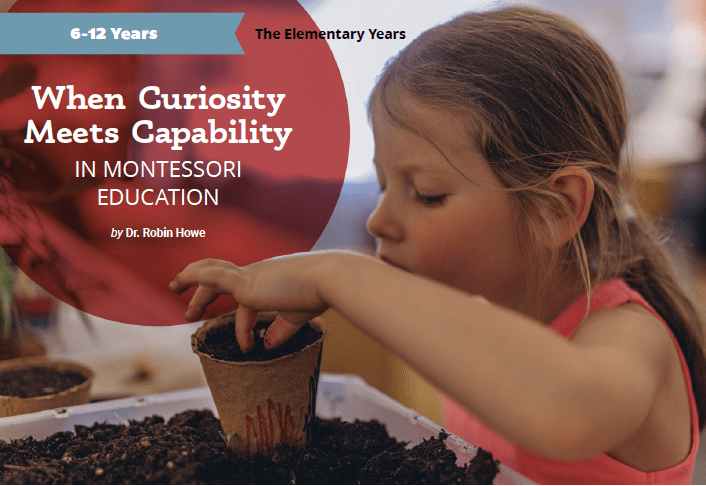
When Curiosity Meets Capability In montessori Education

When Curiosity Meets Capability In montessori Education

curiousity

A New Kind of Questioning

Children between the ages of six and twelve are in one of the most remarkable periods of development. It is during these years that their brains can imagine times, places, and people beyond their immediate experiences and the physical world. They arrive at school brimming with questions that stretch a brain that is hungry to imagine and understand. Why do leaves change color? How did the first language begin? Did humans create fire or discover it? What makes thunder? Who invented money? Their minds no longer settle for quick answers. They want to know how things connect, why events happen, and where humanity fits in the grand story of life.

This is what Maria Montessori referred to as the Second Plane of Development. It’s a time of enormous change. Children grow in confidence, abstract reasoning, and moral awareness. Their social lives expand, and their curiosity deepens. For Montessori educators, this is the moment when curiosity meets capability—and the Elementary program is uniquely designed to meet it.


The Psychology of the Elementary Child

Children in this stage are dramatically different from their younger peers. Their world expands from the self to the group, and there is a new hunger for shared experiences.  They thrive in collaboration. You’ll often find them gathered around large tables, sprawled on the floor with maps, or debating over how to divide tasks for a project. Their friendships evolve in complexity, and they start to challenge the rules of fairness, justice, and loyalty. This is a period when their own personalities and group members begin to take shape. Moral reasoning starts to bloom. A child who once followed rules simply because “that’s what you do” now questions whether those rules are fair. They want to talk about justice and responsibility, weighing what’s right and wrong in ways that mirror adult conversations. At the same time, their ability to think abstractly begins to expand. While they still love to work with their hands, they are also eager to grasp big concepts, such as civilizations rising and falling, the laws of physics, and the evolution of life. They are drawn to heroes—both real and imagined— who embody courage, resilience, and human greatness.

Did you know?

Developmental psychologists note that, between ages 6 and 12, children experience what Jean Piaget called the “concrete operational stage.” They are increasingly able to reason logically, understand cause and effect, and imagine perspectives beyond their own. Montessori’s approach aligns beautifully with these cognitive leaps. Furthermore, other developmental psychologists, such as Erik Erikson, described these years as ones where students have the psychosocial task of developing industry through work, versus the sense of inferiority, leading to the lifelong “virtue” of competency that will lead them into the early stages of adolescence, young adulthood, and eventual full adulthood.

The Montessori Elementary Approach

To meet the needs of these growing minds, the Montessori Elementary curriculum provides a learning experience that is both structured and expansive. At its heart are the Five Great Lessons, sweeping stories that serve as a unifying framework for everything that follows.

• The Story of the Universe introduces the origins of stars, planets, and the conditions for life.

• The Coming of Life traces the evolutionary journey of living organisms across billions of years.

• The Arrival of Humans explores what makes our species unique—our ability to imagine, communicate, and create culture.

• The Story of Communication in Signs follows the birth of language and writing.

• The Story of Numbers reveals humanity’s inventive ways of measuring, recording, and understanding the world.

These stories don’t just deliver facts. They are intended to be impressionistic. They ignite wonder. They provide a framework for children to see how science, history, math, and language are interconnected. Instead of isolated subjects, children experience knowledge as a web—alive, connected, and ever-expanding. Perhaps more important than what is mentioned above is the sense of appreciation that these lessons are intended to instill.

The late Montessorian Dr. Michael Dorer, author of The Deep Well of Time, among other great Montessori books, often mentioned that the Great Lessons (in addition to providing a framework for the Elementary years) give context and relevance to the curriculum. This helps children develop a deep sense of appreciation for everything that came before them, affecting almost all aspects of our lives, including digital technology and electronics.

One Parent’s Story: Wonder in Action

Jacob, age seven, listened to the Story of the Universe and went home buzzing with questions. That weekend, he built a three-dimensional solar system out of clay, complete with asteroid belts and moons. His parents were astonished by how deeply he absorbed the story. “It wasn’t homework,” his father, Scott, said. “It was joy. He wanted to know everything.”

Beyond the Classroom Walls

Montessori Elementary education doesn’t stop at the school doors. Students design and implement “going out” experiences: student-led trips to libraries, museums, businesses, and nature preserves. Unlike traditional field trips, these outings begin with a child’s question: What was daily life like in Ancient Egypt? How does a printing press work? What kinds of birds live in our county? The children often play a significant role in planning their trip, helping to set an agenda, and learning to navigate real-world logistics, such as writing letters, making calls, managing money, and practicing courtesy with adults in the broader community. These experiences cultivate independence and give them a sense that the whole world is their classroom.

Going Out: The concept of “going out” originates from Maria Montessori, who believed that the prepared environment for older children extended beyond the classroom to encompass the entire community.

Supporting Abstract Thinking

As children grow, their thinking shifts toward more abstract concepts. Montessori materials evolve alongside them, offering bridges from hands-on experiences to symbolic reasoning. As students progress through Elementary and into Montessori Secondary programs, the prepared learning environment becomes less based on materials and physical learning “tools” and more about the prepared opportunity for learning through research, discussion, or experience.

The following materials and curricular areas illustrate how the Elementary Montessori curriculum supports students’ cognitive abilities and interests during this second plane.

The Timeline of Life stretches across the classroom floor, making billions of years of evolutionary history tangible.

Mathematical materials shift from beads and cubes to algebraic formulas, preparing children for higher-level reasoning and problem solving. In the Elementary Montessori curriculum, Dr. Montessori considered geometry and arithmetic as related but separate curricular areas, where students learn the characteristics of shapes and then add the ability to quantify value, such as area and volume, through their discovery of the relationship of quantity and size.

Language studies expand to etymology, grammar, and literature, helping children appreciate the richness of communication.

Cultural charts illuminate the rise of civilizations, trade, and human innovation.

A Montessori classroom at this level is alive with research. Children write reports, create models, stage debates, and prepare presentations for peers. Instead of memorizing information for tests, they engage with knowledge in ways that make it meaningful and lasting.

A Collaborative Environment

Elementary Montessori classrooms are designed to encourage collaborative learning. Elementary classrooms often have large tables that invite group work, while open floor space allows for projects that sprawl. Children divide tasks, solve disagreements, and learn to appreciate diverse perspectives. Peer teaching thrives. Older students guide younger ones, reinforcing their knowledge while modeling leadership. A 12-year-old explaining fractions to an 8-year-old doesn’t just strengthen math skills; it builds patience, empathy, and confidence.

One Parent’s Story: A Different Kind of Classroom

A mother visiting her daughter’s classroom was startled to see a group of nine-year-olds leading a lesson on the American Revolution. “I thought, where’s the teacher? Then I realized that the teacher was guiding from the side, and the students were taking ownership of the learning. It was inspiring.”

Academic Rigor with Meaning

Parents sometimes wonder whether Montessori Elementary prepares children academically. The answer is an emphatic yes. Mathematics progresses from concrete exploration to geometry, pre-algebra, and, in some cases, early calculus concepts. Language studies move from writing simple stories to analyzing grammar, writing essays, and engaging with literature. Science includes classification, chemistry, biology, and physics. History and geography encompass ancient civilizations, cultural development, and the interconnectedness of societies.

Unlike conventional schools, Montessori does not teach these subjects in isolation. They are always connected to a larger story and a greater purpose. This integration ensures that children understand not only what to learn but also why it matters and how it is relevant to their lives and their experience as human beings.

Did You Know? Studies comparing Montessori and conventional students have found that Montessori graduates demonstrate stronger critical thinking, greater creativity, and equal or higher achievement in math and literacy by adolescence (Lillard, A.S., et al., Frontiers in Psychology, 2017).

Outcomes that Last

The benefits of Montessori Elementary extend beyond test scores. Children leave these years with exceptional research and critical thinking skills, the ability to collaborate and lead, strong communication abilities, and the confidence to tackle new challenges. Most importantly, they come away with a genuine love of learning. Elementary Montessori education provides socioemotional opportunities for children to develop the skills they need as they progress to a new level of emotional awareness. As these students enter adolescence, a challenging period in most cases, Montessori Elementary environments aim to prepare them as effectively as possible to understand, accept, and self-regulate their emotions.

One Parent’s Story: Independence Blossoms

One of my parents described her son’s ‘shift’ during the Elementary years: “He started asking questions we couldn’t answer. Instead of waiting for us, he grabbed books, searched online, interviewed neighbors, and even wrote letters to a local historian. Montessori taught him that curiosity isn’t the end of learning—it’s the beginning.” Possibly more important than his desire to learn was his ability to take action on his own to address his own needs, a skill that is possibly more important than any academic accomplishment.

Supporting Your Child’s Montessori Journey

For parents, raising an Elementary-aged Montessori child means embracing their boundless curiosity and growing independence.

Engage with their questions. Instead of rushing to give answers, ask, “What do you think?” or, “Where could we look that up?”

Offering enriching experiences includes museum visits, nature hikes, and cultural festivals—all of which feed the classroom curriculum. Give space for independence.

Allow them to plan family projects, cook meals, or resolve conflicts with siblings.

Respect their social world. Friendships are central at this age, and learning to navigate them is an integral part of the developmental process.

Supporting your child doesn’t mean doing everything for them—it means giving them the room and resources to grow into capable, thoughtful young people.

The Elementary Years as a Foundation

The Elementary years are a time of profound intellectual and social growth.

With Montessori’s unique approach, curiosity and capability come together in powerful ways. Children emerge as independent thinkers, problem solvers, and lifelong learners. At the end of the Elementary years, Montessori children don’t just know facts and figures. They know how to think, collaborate, and maintain their curiosity. That’s a foundation not just for school but for life.

In closing, choosing to have your children continue in Montessori through the Elementary years is a great and BRAVE decision. Elementary Montessori education inspires and encourages questioning, challenging, and advocating. While some might consider these three characteristics as adversarial, many of us believe that these are what evolve into leadership, confidence, and support, possibly exactly what the world needs. It takes brave people to raise Montessori children!


 Dr. Robin Howe began his Montessori education at the age of 2 at the Barrie School in Silver Spring, MD, where he attended through eighth grade. Graduating from Dickinson College with two majors (Spanish and Religion), he went on to earn a Master’s Degree in Bioethics from the University of South Florida. After a successful career in restaurant management, Robin decided to return to his Montessori roots. He earned his Primary certification from Palm Harbor Montessori School (AMS) and then attended St. Catherine’s University to earn his Lower and Upper Elementary Certification (AMS). He also participated NAMTA’s Orientation to Adolescent Studies (AMI). Robin holds a Doctorate in Educational Leadership from Argosy University and serves as a Senior Montessori School Consultant at The Montessori Foundation.