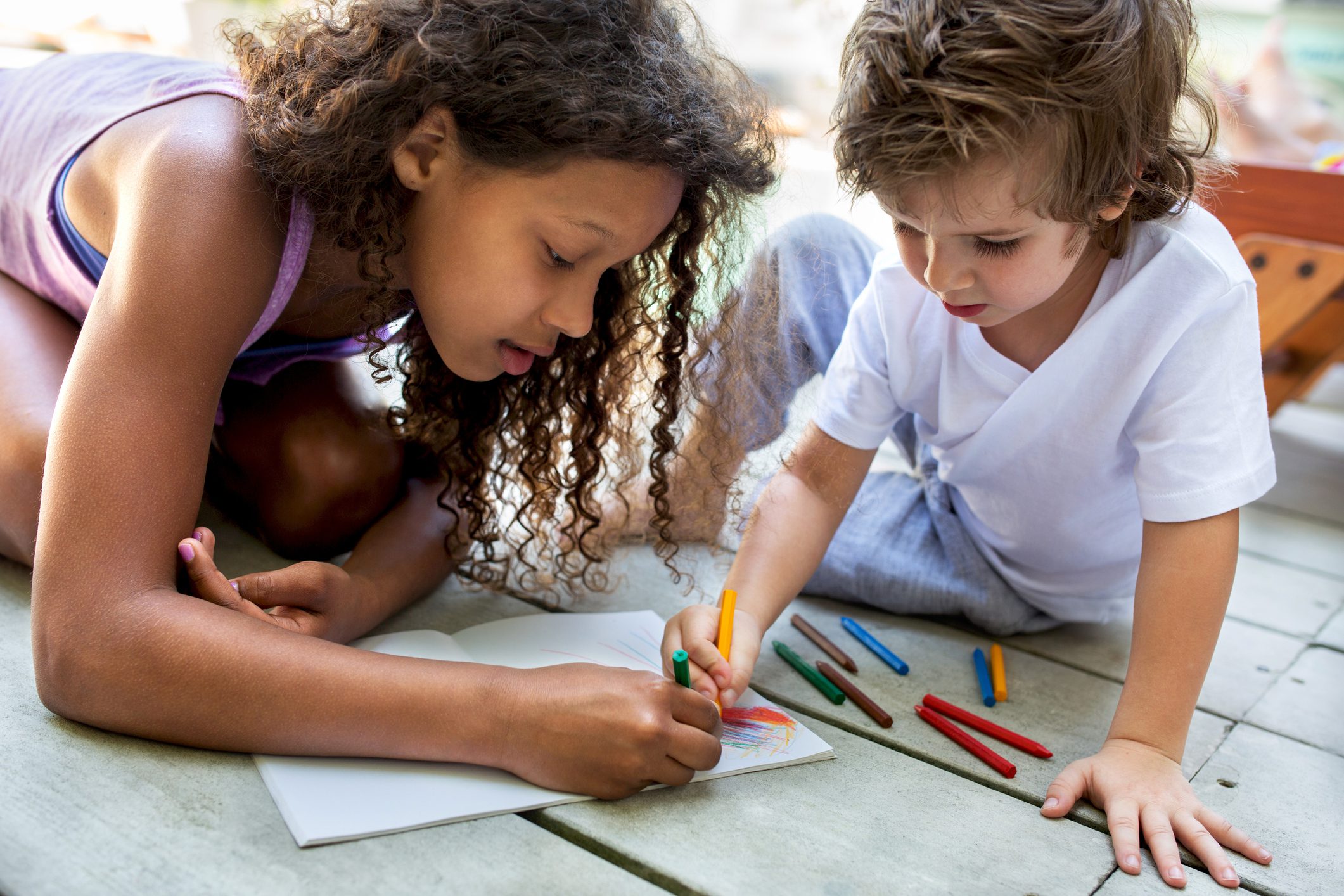
African American teenage girl and her Caucasian friend drawing with crayons on the floor.
Creative Development in Art
This is an excerpt from the full presentation from Margaret’s presentation at the
2017 21st Annual International Montessori Foundation conference in Sarasota, Florida
Creativity can come in many forms. It is an essential component of fine art, invention, and innovation and is an important part of many industries, such as design, engineering, economics, and medicine.
The origins of creativity are often debated but no one theory has proven stronger than others. Could it be the result of a person’s upbringing, social environment, personality, divine intervention, chance or serendipity?
The question of whether creativity is a trait we are born with or something that can be taught is also uncertain. Some approaches to defining creativity may include the possibility of it being a mental process that entails the generation of new or alternative ideas or concepts. It could also include new associations or assimilations of existing ideas into new form.
Unlike many concepts studied by science, there is no single, authoritative perspective or definition of creativity. The ability to generate unique alternatives or to see things in uncommon ways does not occur by chance. It is linked to other qualities of thinking such as flexibility, tolerance of ambiguity or unpredictability, and general comfort with uncertainty. And, just as there is no single definition of creativity, there is no single technique for measuring a person’s creative aptitude. There are, however, some tests that measure the number of alternative solutions and the uniqueness of these solutions.
Most children approach creativity and art with an open fearlessness that comes with the appropriate nature of their general development. Young children are often not aware of the possibility of judgment or the fear of making mistakes when creating art. They simply create the joy and love of making their mark.
In order to best understand the stages of creative development; it is best to observe the whole child. By looking closely at where any child is developmentally in their academic work and their social-emotional development, you will get a better picture of where children are in their overall development.
The stages of creative development have been studied by many over the ages. As with all developmental milestones, the ages listed are approximate and based on general experiences of the child. There are differences in terminology with different studies, but the universal characteristics permeate all stages. And just as we promote within the classroom, it is important to let children move naturally through each developmental stage. If the environment is properly prepared, they will move through the stages at their own pace.
STAGE 1: THE SCRIBBLE STAGE
Age: approx. 1 – 3 years
1st category: Irregular Scribbling
This stage begins when a child can hold a writing instrument and is most interested in the mark itself. It is important because it is the beginning of future development in writing and drawing. During this stage, the naming of the scribbles is an important milestone.
Major Characteristics:
Random markings are very accidental, as there is little muscle control in arm or hand
Large movements are based on the shoulder or elbow
Very accidental results with indistinguishable images
2nd category: Controlled Scribbling Emerges about 6 Months after the First Experiences
Major Characteristics:
More motor control allows for more intentionally varied motions
Shapes emerge
Recognizable elements begin to form
3rd category: Symbolic Scribbling
Last level of Stage 1
Children begin to identify unrecognizable parts of their drawings but change descriptions often
Complex forms develop
Color is generally unimportant to the child but should be available
Tadpole Stage emerges. This is a stage characterized by the emergence of the head, arms and legs in the drawings but the body is not separated from the head. There are many theories for this stage which, may include the child trying to draw a person but not putting a premium on realism. As they mature developmentally, the aim of their art changes and the images change accordingly.
STAGE 2: SCHEMATIC/SYMBOLIC 3-7; THROUGH 12 YEARS
1st category: Pre-schematic (3-5 years old)
These are the first representational attempts by the child:
Scribbles turn into shapes which may be decorated
Universal symbols emerge spontaneously (mandalas, suns, spirals, ladders)
Human figure only partially developed and reflect the child’s mood or feelings; some details are added while
others omitted
Size relationships are not yet formed, nor are they important to the child
Accuracy is unimportant to the child
Color is used to show enjoyment or express emotion—no goal of realism
2nd category: Schematic (5-7 years old)
Gender differences emerge and colors become more realistic
Consistency of style emerges
Distorted proportions continue based on importance
3rd category: Realistic (7-12 years old)
Interest in realism shows in the growing details of their work
Children are more emotionally vested in their work
Children can become very critical of their work
We should remember that art is a way of approaching life, of decorating a home and school, and of selecting toys and books. It cannot be separated from other elements of life. Children need to be exposed to a wide range of art forms, various styles, and media. By doing this, a child can recognize that there is not one single way to create. They learn that it is acceptable to try techniques that are different and new. They learn that personal expression can be rewarding and there are many right ways to approach it. By exposing children to a wide range of art styles, they learn to see the difference between a classical portrait and an abstract portrait; a photo of a real pond and a painted impression of a pond or how different emotions can be portrayed. They begin to find artistic styles they can relate to and begin to emulate. Without exposure to art and education about art/art history, many children are damaged by feelings of inadequacy about their attempts at art and may eliminate art from their lives altogether.
Montessori recommended children have daily exposure to art but offered few materials to support this specification. During her time, art education was nurtured by individual families and was not part of the school day. The Montessori approach to art is one of reverence and appreciation. However, Montessori created many materials designed to stimulate the child’s senses. The entire sensorial curriculum is filled with materials that support the development of the senses. The child is able to learn about size, shape, color, texture, pattern and so much more. Giving children the opportunity to express themselves creatively is essential. As with all things Montessori, it is the process, not the product that matters most.
Creativity, imagination, and fantasy are topics worth their own study. However, to offer a brief overview, I will define the three terms and share a few of Maria Montessori’s thoughts in regard to them. “Reality is the state of things as they actually exist and is the basis for creative imagination.” Montessori said “…the creative imagination…is based on the truth.” Imagination is the ability to form mental images that do not exist in front of you. The converse side of reality and imagination is fantasy, which is an illusion that will never change reality. Maria Montessori wrote, “When a man loses himself in mere speculations, his environment remains unchanged. But when imagination starts with contact with reality, thought begins to construct works by means of which the external world is transformed almost as if the thought of man had assumed a marvelous power: the power to create.” She continued in the Advanced Montessori Method, stating, “Every child should be able to experiment at first hand, to observe and to put himself in contact with reality. Thus, the flights of the imagination will start from a higher plane and will produce the necessary work to build a better humanity. It is through imagination that the intelligence will be directed into its natural channels of creation.”
“Hence, it is necessary that every artist be an observer…in order to develop the imagination, it is necessary for everyone first…to put himself in contact with reality.” This directly parallels her educational belief system of presenting concrete and real concepts first. By allowing the child multiple opportunities to observe and interact with reality, we are setting them up for success in creating a rich background of experiences from which they may tap into in their creative endeavors.
Tomorrow’s Child / January 2018 / p 15