Dear Cathie,
My wife and I are looking at preschools for our active three-year-old for next fall. We know that he loves to be “on the move” and is happiest when he is doing something. That is why we thought a Montessori school might be a good fit. We expected to see a big open space with lots of room for him to be active. But it seems that in each room there is one big rug space, and then most of the room is divided into small spaces. Can you explain why and calm our fears that out active little guy really will get enough movement during the morning? – Dad
Dear Dad,
Thank you for your concerns. As the mom of a son who seemed a lot like yours as a young child, I can totally identify with your worries.
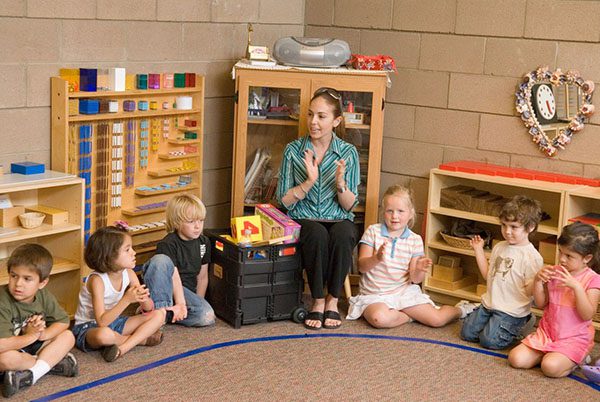
The Montessori classroom for 3- to 6-year-old children is designed to resemble a children’s house. It is scaled down in size to be a perfect fit for young children and is divided by area; think of it like rooms in a house. The shelves of materials or activities often divide the room, helping the children to see where each area ends and begins. Inside each area is workspace, where children can choose to put their work rugs if they so desire. Child-sized tables are also placed in some areas so that table work is encouraged to happen in that space. There are areas for one person to work as well as group work.
The big work rug that you noticed in each classroom serves as both a gathering space for the entire class when they have their ‘circle time” or “class meeting” and as a space to spread out and do larger rug works and partner works. This rug is often filled with the activities of many children during the morning, which creates the opportunities for your young child to see, absorb, and aspire to these.
The Montessori philosophy seeks to “control the environment and not the child.” Running is not permitted in the classroom due to safety, so we make the pathways in the classroom too small in which to run. Long stretches of space are obstructed with furniture so they encourage running. Children have to walk carefully in order to not bump into anything. This helps them learn to move carefully within the classroom, while still meeting their need for movement. The work rugs that are laid out on the floor create a sort of natural maze for the child to walk through. This creates a fun and sometimes challenging experience of careful walking in the classroom.
Classrooms have a line drawn or taped on the floor and children are taught to walk on that line. First they simply walk on that line. Later they carry things of greater and greater difficulty. This is a very popular movement activity for young children.
Many of the activities in the classroom also require movement to do them. A child may build the Pink Tower (a set of 10 graduated cubes from 10cm – 1cm) across the room with the random cubes on one rug and the emerging tower in order on another rug across the room. This is an enticing activity for young children. They may collect objects of a single color from around the room and bring them to their rug. They may match the pictures of the children in their class to the real children. These types of works keep children moving all morning and, yes, their need to movement is satisfied in a Montessori classroom. Children also choose the amount of movement that is right for them. They have choices as to which activity they select, how long they work with it and when they are finished. They might choose to have a water or a snack break in the middle of an activity. The Montessori classroom provides natural opportunities for movement.
Tomorrow’sChild / May 2017