10 Benefits of Montessori

10 Benefits of Montessori

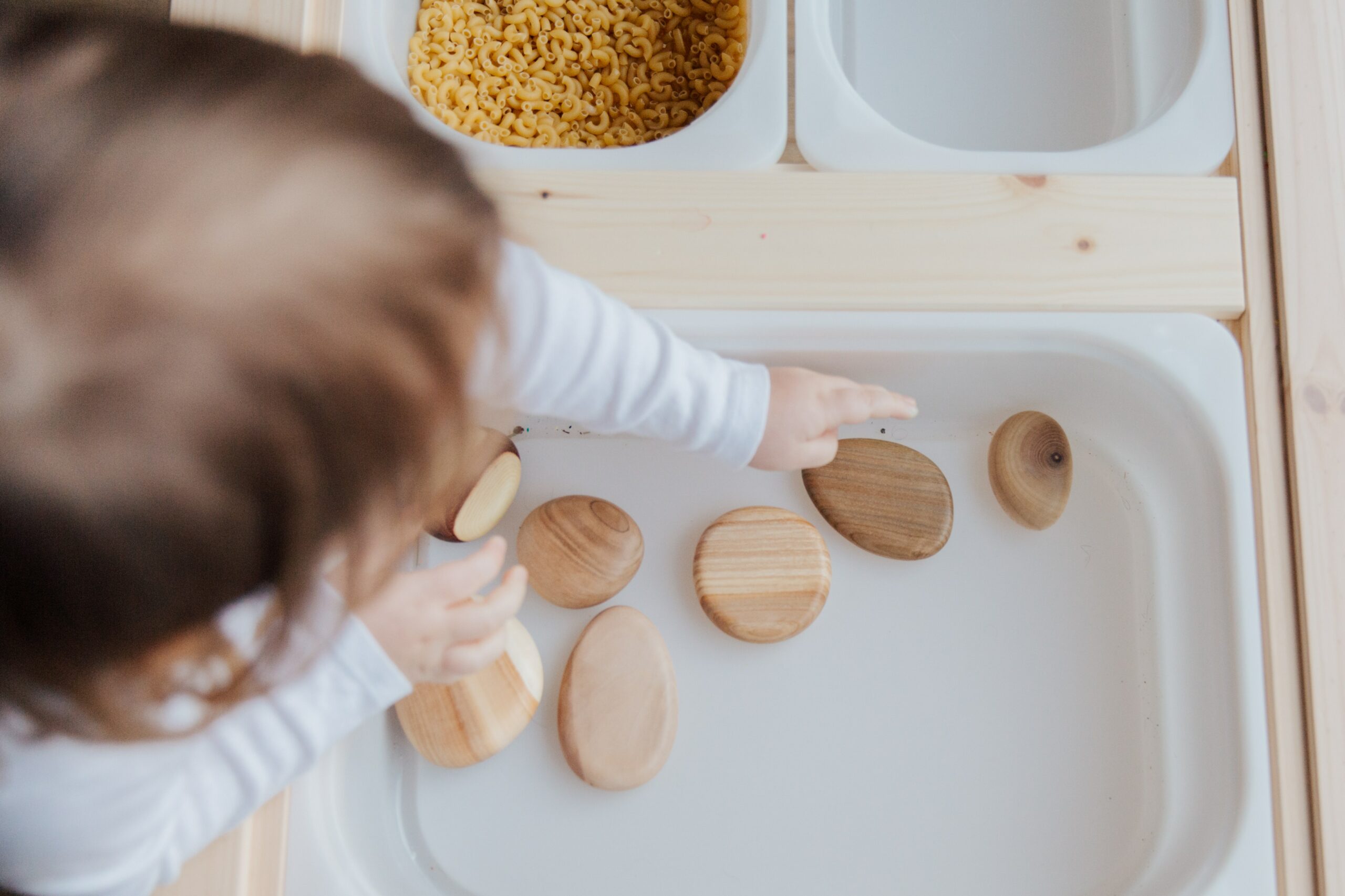
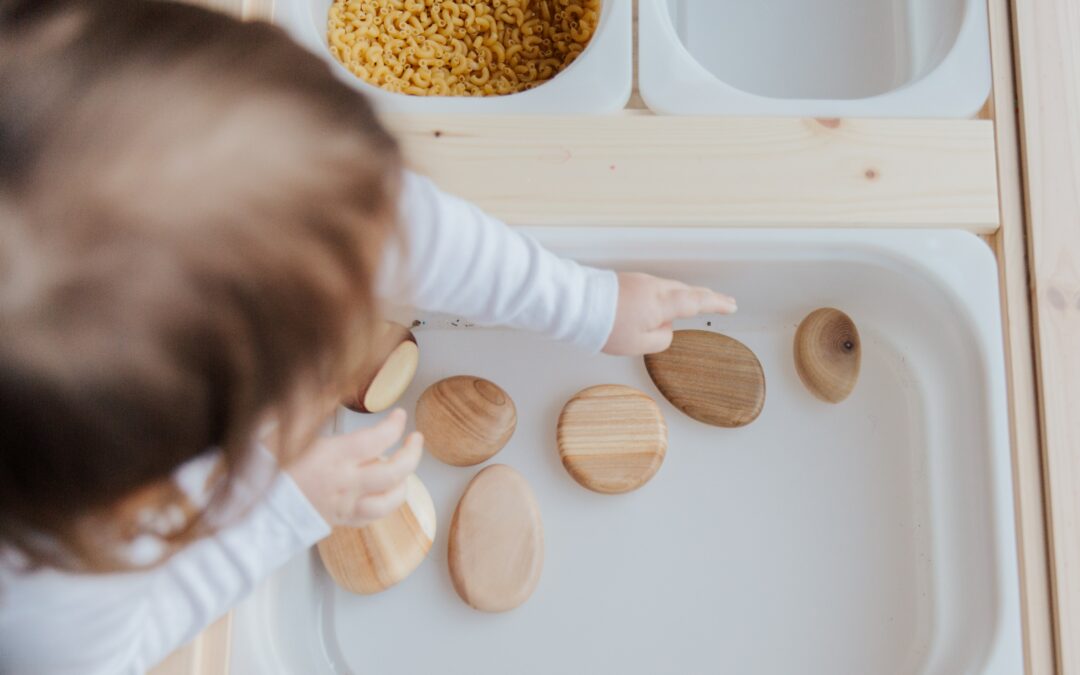
child sorting

If no one has asked you how Montessori will benefit your child, or will Montessori benefit your child, they have probably thought of it. In fact, you may have asked yourself the very same question. Why choose an education that is an alternative to traditional education?

Let’s examine ten reasons we may choose Montessori for our family.

1. Learning is child-centered and individualized. A similar curriculum to traditional schools is taught, often in a different order, and children move through the curriculum at their own pace. Teachers observe and guide students as needed to develop mastery, rather than following a timeline for learning set by others.

2. With the freedom and support to question deeply, they learn to think critically and act boldly, developing the ability to lead with respect and consideration.

3. By giving students a choice of activities, they develop their executive function skills, making choices on their own, learning to wait and take turns, and developing self-discipline and motivation.

4. The guided independent approach to learning allows Montessori students to become confident, enthusiastic self-learners. Teachers observe, monitor, and guide children to make good choices to progress their learning.

5. There is limited standardized testing, and it is most often used as a way to observe as well as a practical life skill. Children are motivated by and measured against their own achievements, not those of others.

6. Free from predefined times for activities, Montessori children delve into subjects that inspire them and are able to feel the intrinsic reward of seeing a task through to completion, without being cut off because that class has ended.

7. As students are active contributors to the classroom and the teacher their guide, there are more opportunities for cooperation and collaborative working among students of all ages.

8. Montessori focuses on the whole child, with social and emotional development equal to the academic curriculum. Learning to work with others, take turns, lead with respect, speak up, and consider needs outside their own prepares children to be global citizens.

9. The focus is on the key developmental stages of the child, with learning activities and materials designed to further develop key milestones. Neither introducing subjects or skills their brain and body are not prepared for, nor requiring them to stay with information and skills they have already mastered, allows children to reach their own full potential.

10. Montessori is hands-on learning with materials that enable self-correction and self-assessment. Auto-correcting materials (the largest cylinder does not fit in the smallest space) allow children to develop confidence in their own learning and become the developer of their own knowledge rather than go to an adult and drink from their fountain of knowledge.

Looking Back on My Years in Montessori

Looking Back on My Years in Montessori

A college essay by Douglas Delaney

I think my life will be a roller-coaster of emotion and experiences. I will never forget the beginning of my amazing ride at Beach Park, the Montessori school that I attended from preschool through eighth grade.

When I look back on those days, all I can think is that these are the moments that shaped me. They created the groundwork for who I am as a person. They also left me with stories that make others ask, “Did that really happen?” and all I can say back is, “yes, it did.” Many of my moments at my Montessori school shaped me, but what has shaped me the most is what the school practiced: Montessori.

I know that Montessori has a well-defined definition. Still, the only accurate way to describe how it affected me is to offer my own explanation. I think that Montessori allows for kids to grow into themselves. When I was in preschool, I chose my own work throughout the day and genuinely loved the work I was doing. Montessori allows students to learn what they love and have the resources to pursue it even at a young age. Through those experiences, I have discovered my love of mathematics. Montessori also allows students to grow at their own pace.

I remember in Lower Elementary, being allowed to choose my own daily work but still have specific things to accomplish by the end of the week. This gave us our own time and ability to decide what to do and when. It let each of us learn how to take charge and manage our own time. I remember when my sister first started college. She told my mom that almost no one around her knew how to self-plan without their parents, but she could come up with her own schedule and prepare her workload for that week. I genuinely believe that that skill came from her years in Montessori.

I had a special connection to the school and the people in it. I left Beach Park with only three other students, which was that year’s graduating class. Those three other people probably know more about me than any other people I know to this day. But it wasn’t just the students to whom I grew close; it was also my teachers and faculty. The school faculty were indeed the people who have had the most significant impact on me. Whether it be my eighth-grade teacher, Ms. Summer, who pushed me to my limits while preparing me for high school, my Upper Elementary teacher Mr. Greg who taught me the beginning of Algebra, or my PE teacher Ms. April whose son was one of my best friends; all of them have shaped me in ways that I cannot even begin to describe.

That tiny little school shaped me. Although those memories on the playground of Beach Park School are long behind me, I still look back on them fondly. The years that I spent in that small school prepared me in so many ways to take the next step into college. And even after finishing this wild ride through high school, I can’t help but look back to where it started, at a small school called Beach Park Montessori.

DEAR CATHIE: A CONCERNED PARENT

DEAR CATHIE: A CONCERNED PARENT

DEAR CATHIE—

I have visited a number of Montessori schools as we consider a placement for our 3 and 4 year old children next year. I see the children all busy on different projects, and it all looks great. But can it really work? How can one teacher, even with an assistant, really keep track of who did what and be sure that each child is progressing and getting what she or he needs? All those children—all those needs. I can see it more for younger children, but I really get concerned in the Elementary grades. Does this method really work?

— A CONCERNED PARENT

Dear Concerned Parent,

I am so glad you are looking at Montessori schools for your children and that you have started the search so early. Many schools have rolling admissions and are open to admission at times other than the start of the school year or semester.

The Montessori Method works, as it is truly an individualized approach to education. Each child spends his or her school days in a carefully prepared environment with a group of multi-aged learners and a guide. A child chooses activities that call to her from within that environment while her guide watches her interests and offers lessons. From there, she develops a set of skills upon which to build. She practices the lessons she has learned and asks for new lessons as soon as those are comfortably mastered.

Children in the Montessori prepared environment also have the opportunity to watch others work and are often enticed by the work of those older children, aspiring to do what they do. This leads to more and more advanced work within the classroom as a whole and by your child individually. No child needs to wait for another child to have mastered a skill to move on! She has a new lesson as soon as she is able. Children also assist others younger than themselves, often teaching lessons they have already mastered. The child teaching lessons is one of the best ways to ensure mastery and confidence about something they have learned. It also leads to a kind and caring community.

Children have a say in what parts of the curriculum with which they engage and when they do so—always with awareness and support from the guide and other adults in the room.

Guides spend time observing the class to see which children are working at the mastery level on certain skills and are ready for a new lesson, which children need re-presentation, and which children need social

encouragement. They carefully chart these observations on paper or on the many computer programs that are now available and used in schools. While the classroom may look free flowing and easy going, it is actually a skill and data-driven environment, even though students do follow their own interests and work on projects and activities of their choosing. Their connection with their guide—often for three

years—enhances this relationship and connection and allows for learning to happen more easily from year to year. They offer carefully timed lessons to children as they are ready. These lessons are often one on one, but can be executed with the whole class or small groups. It is often hard to find the guide in the classroom as she is working with only a few children at a time.

In answer to your question, yes, the Method can and does work!

Children have a say in what parts of the curriculum with which they engage and when they do so— always with awareness and support from the guide and other adults in the room. Children learn initiative, self-control, and discipline while mastering basic skills. This method truly parallels the expectations and skills needed as a child grows and faces more adult challenges.

Enjoy your journey looking at schools! Montessori schools truly are unparalleled! •

Cathie Perolmanis a reading specialist, elementary educator, author, consultant, and creator of educational materials for primary and elementary students. Check out her new downloadable materials on her website cathieperolman.com.

For more than three decades she has dedicated her energies to improving reading for all youngsters.

She is the author of Practical Special Needs for the Montessori Method: A Handbook for 3-6Teachers and Homeschoolers published by the Montessori Foundation (available throughmontessori.org.) She is a regular contributor to Tomorrow’s Child and Montessori Leadership magazines.

Cathie Perolman holds a BS in Early Childhood Education and a MEd in Elementary Education with a concentration in reading. She is credentialed as a Montessori teacher. She is married and has two adult children and two adorable granddaughters. Cathie lives in Ellicott City, Maryland with her husband.

TOMORROW’S CHILD © • NOVEMBER 2019 • WWW.MONTESSORI.ORG

BOOK REVIEWS assembled by Lorna McGrath

BOOK REVIEWS assembled by Lorna McGrath

Animals Reviewed

by Association of Zoos & Aquariums

Elementary and middle school children, along with their parents and teachers, will love this book. It is a hilarious review of wild animals from around the world! Each animal is rated in a humorous way that tells the reader a little something about the creatures. Animals Reviewed also includes the common name for the animal, its scientific name, and a zoo or aquarium where it can be found. This information is great because some of these animals may tickle a child’s curiosity and may motivate them to do more in-depth research about the animal. They may even be able to go see the animal in person if a zoo or aquarium nearby has one in residence. Enjoy!

”I declare after all there is no enjoyment like reading! How much sooner one tires of any thing than of a book! When I have a house of my own, I shall be miserable if I have not an excellent library.”

—JANE AUSTEN

Make Music!

by Norma Jean Haynes, Ann Sayre Wiseman, and John Langstaff

Another wonderful book for adventurous children and grown ups who want to have fun making music! The book is laid out in categories starting with Beginning Notes (pun intended I’m sure!); Household Things that Ring and Ping; Body Music; Percussion Beats and Rhythms; Breath Music: the Winds, The String Section; Instruments from the Workshop; and Creating Music. I’m excited just writing down the names of the sections and that’s not all. This book has beautiful photos of real children in action and having so much fun with music. Make Music is a great resource for an afterschool studio or for the vacation home or cabin, or at home on a school break, or ongoing project. The audience for the projects would probably be elementary-age children because of their skill and social levels; although, very clever teachers or parents could probably modify some of the projects for younger children as well.

Hatching the Cosmic Egg

Written by Michael Dorer Illustrated by Beth Wilson Music by Andrew Kutt

Michael Dorer, a well- known Montessori educator, author, and conference presenter, has now written his first children’s book and it’s ‘wonder-full.’ Hatching the Cosmic Egg opens with a request for the reader to “think of the very biggest thing you can.” I’m already intrigued and excited, and I think elementary children will be, too!

On each of the next few pages is a gorgeous, two-page, colorful drawing of very large earthly things that children might imagine and the author asking; Is it a great, gray elephant? Next two-page spread: A tall, snowy mountain? And so on. Then he begins to ask about more stellar images like the sun and the stars. This is so cool because the book brings the child’s mind to bigger and bigger images leading up to: It’s the UNIVERSE!

Now the story begins! This book encourages and entices children to think big about the universe, about themselves, and their part in the universe. Dorer, being the great storyteller that he is, seamlessly incorporates concepts from the great lessons and brings the readers to an awesome affirmation that they are connected to and part of everything in the universe.

Beth Wilson’s illustrations are perfect for the story, both in style and simplicity. They add to the wonder of this book. And, there’s more. With each book comes a CD with music and song by Andrew Kutt that enhances the story for readers in a totally different genre. This book needs to be in every home and classroom!

The Memory Box

Written by Joanna Rowland Illustrated by Thea Baker

Editor’s Note: I would like to personally thank Lorna for picking this book to review. My family suffered a great loss this year. It has had an enormous impact on all of us, especially my two grandsons (ages seven and eight). After reading this review, I immediately ordered this book on Amazon. This is such a difficult part or ‘adulting,’ but it is so needed to help children who struggle (often silently) to understand and find a way to celebrate and remember someone they loved so much.

The Memory Box is a very helpful book for children who have lost a loved one. It brings to light a variety of emotions from fear to sadness to happiness that children may experience as they go through the grief process and beyond. Sometimes, adults find it difficult to talk about feelings and death, especially if the person who has died is someone they loved as well. This book helps adults, as it tells a story about a child who is grieving, what feelings she experiences, and how she creates a “memory box.” The illustrations are lovely, almost whimsical, and yet realistic. At the end of the book there is a section to help adults support children through their loss. Children four years old through elementary and possibly the middle school years would benefit from The Memory Box.

Treasure Basket Explorations

Written by Laura Wilhelm Photos by Gryphon House and Shutterstock

Treasure basket exploration is a terrific idea for not-yet-mobile infants. The concept could be modified in some ways to better fit toddler’s through kindergartener’s strong sense of order. I struggled a little bit with this concept because I know from my own observations, as well as those of Maria Montessori and interactions with children in the early childhood years (birth-6 years old), that this period of time in a child’s development is crucial for preparing an environment that instills a very orderly way of thinking. At the infant and toddler stage of development, little ones are all about moving and exploring, so the baskets work well. There is a certain amount of order to it because the objects are contained within the basket. They come out of the basket and, when finished, return to the basket (sometimes by the infant or toddler—more often than not by the parent or teacher). The baskets are almost like introductory work for the primary level (3-6 years old), where the activities are contained in baskets or on trays but are designed to teach a skill rather than just allow for exploration.

I need to do more research about “heuristic learning” to truly understand what it is. As I read this book, it sounds like you put a bunch of stuff in a pile and the children get to “explore” it. For me it sounds a bit too unstructured for 3-6-year-olds, as they are really ready for order and imitation rather strictly exploration. Their activities always have some flexibility for exploration but also have a beginning, a middle, and end within each activity.

So, there are some very usable ideas for the infant-toddler years, and some ideas that can be modified for older children in Treasure Basket Exploration.

The Montessori Toddler: A Parent’s Guide to Raising a Curious and Responsible Being

Written by Simone Davies Illustrated by Hiyoko Imai

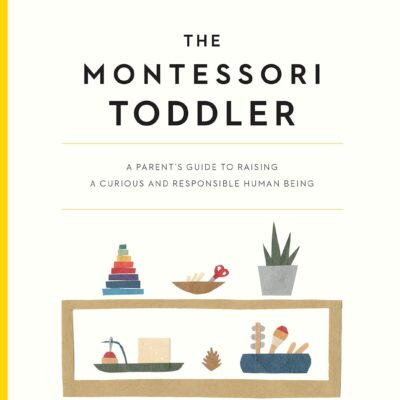
When I looked at the cover of this book I was intrigued. It was simple with a kind of unique illustration of a shelf with activities, and it was written for parents of toddlers—encouraging signs. Then I looked at the table of contents which was 3.33 pages long. Hmmm. Busy parents with small toddlers. Looks a little off-putting to me. So, I flipped through the book. I like photos and illustrations. There were very few photos and quite a few illustrations, but lots of words to read in this 248- page volume. Oh boy!

I made myself look more closely, and what I found was delightfully appealing. That huge table of contents I discovered was because the author listed each topic in each chapter, so it looked a lot more daunting than it truly is. Many of the topics listed are half a page to two pages at most. A parent can easily read a quick snippet and put the book down. They can also easily look up a specific topic that they are interested in because the topics are listed in such detail.

After looking more carefully, I really like the design. Simone Davies is very thorough. Her knowledge, understanding, and enjoyment of this age group is very apparent, and she shares it well with her audience. Often toddlers are misunderstood and so behave in ways that parents find difficult. Davies touches on some key points when thinking about toddlers. The first two chapters give parents valuable information about this stage in a child’s development and a brief introduction to Montessori. The rest of the book helps parents see their role as changing from a servant during infancy to a guide during toddlerhood and beyond. She brilliantly describes how to create a home environment that supports toddler success, both physically and emotionally, with furnishings and activities, as well as discipline.

The Montessori Toddler is a great resource for parents of infants, so that they can prepare for toddlerhood and for parents of toddlers who are already in the midst of toddlerhood.

TOMORROW’S CHILD © • NOVEMBER 2019 • WWW.MONTESSORI.ORG

BOOK REVIEWS by NewGate Secondary Students

BOOK REVIEWS by NewGate Secondary Students

Six of Crows

by Leigh Bardugo

If you like complex characters, a thrilling story, and Victorianesque setting, then you will love Six of Crows by Leigh Bardugo. This book tells the story of a convict, a sharpshooter, a runaway, a spy, a heart render, and a thief who band together to pull off an impossible heist.

Six of Crows takes place in the Grishaverse, a world where certain people called Grisha have the power to manipulate the tides, the wind, or even the chemicals in your body. Every chapter in this book follows the story from a different character’s point of view. The narrative switches between Kaz Brekker, a criminal underworld mastermind; Jesper, a sharpshooter, who can’t walk away from a bet; Wylan, the runaway son of a rich merchant; Inej, a circus performer turned into a deadly assassin; Nina, a Grisha heartrender far from home; and Matthias, a Drüskelle, witch hunter, and a convict. All of them must put aside their differences to complete an impossible heist, not only to save the world but for the money.

The first half of this book takes place in the city of Ketterdam, a city based on Amsterdam, specifically in The Barrel, the part of town with all the gambling halls are where anyone will do anything for the right price. The Barrel is home to thieves, conartists, and, most importantly, gangs. It’s a place where everyone is trying to outsmart everyone else. The second half takes place in the faraway country of Fjerda, a cold unforgiving country filled with Drüskelle. Overall, I loved the setting; I just wish we could have explored The Barrel more. Kaz, also known as Dirtyhands, is a lieutenant in a gang called the Dregs. Inej is a kind, yet dangerous, Suli acrobat who, through a series of unfortunate events, finds herself an assassin. Jesper is a jittery and funny sharpshooter, who can’t walk away from a wager. Nina is decisive and independent. Matthias is cold and a good soldier. Wylan is the moral compass of the team.

Six of Crows is a must-read for anyone who enjoys thrilling, suspenseful, and magical books. With its complex characters, engaging, and intriguing setting, Six of Crows is not only a good book but a masterpiece.

Reviewed by Daniel Pellizzari,10th grade

Matched

by Ally Condie

In the book Matched, a girl named Cassia lives in a tightly controlled society where decisions are made for her. Officials decide, no one else. They decide whom you love, where you work, when you die, and more.

Ally Condie’s husband gave her the idea to write the book, Matched. She had a conversation with him about marriage in the fall of 2008. He asked, “What if someone wrote the perfect algorithm for lining people up, and the government used it to decide whom you married, when you married, etc.?” But some of Condie’s inspiration also came from general experiences, such as becoming a parent and falling in love.

The main characters in this book are Cassia Reyes and Bram Reyes, Bram and Cassia’s parents, Cassia’s grandfather (Xander), and Ky. My favorite character is Cassia’s grandfather (aka Samuel Reyes) because he’s so sweet and he understands Cassia. He’s kind and gentle to everybody, and he loves poetry. In this story, Samuel is always there for his family, as well.

I would like to experience what living in that society would be like. Cassia is so closely monitored all the time and isn’t free to do whatever she pleases—other people control everything Cassia does from the time that she eats to the time that she dies. It would be really interesting to see what that would be like.

Matched is definitely one of my favorite books. It’s very well written and interesting to read. The book has many unexpected twists, turns, and lies that make you need to keep reading. If I could change one thing about this book, I would change something that happens to Cassia’s grandfather. If you want to know what happens to him, you should read the book!

I highly recommend this book because it opens up your mind and makes you more grateful to know that you aren’t always being watched or monitored at all times. It’s so crazy to think how free we are compared to these people who live in a place where they’re just like everyone else—from clothes, to school, to work, and even to falling in love. If you’re the type of person who likes family, adventure, fantasy, and love, then I believe that this would be the perfect book for you!

Reviewed by Maya Stutzman,9th grade

Flowers for Algernon

by Daniel Keyes

Flowers for Algernon is highly acclaimed, having earned the Nebula Award for Science fiction and Hugo award for best novel and considered a classic by many. Written initially as a short story in 1959, it was later expanded into a novel in 1966. The book challenges the status quo of science fiction, focusing not on laser guns, but on the human mind. When it was released in 1959, it changed the very definition of science fiction. However, besides the science aspect of the book, it also has a more important message about humanity.

The story follows Charlie Gordon, a developmentally delayed man who wants more than anything to be smart. When two scientists choose him to be part of a science experiment meant to raise his IQ, his view of the world is completely changed. Now he has to deal with the difficulties that come with intelligence and the painful memories that begin to manifest in his head. I won’t say that this book will change your life, but it should definitely make you think. For me, Flowers for Algernon really pulled at my heartstrings and made me feel emotions that few books have been able to elicit.

Before I elaborate more on the story, I would like to mention that this book is not for kids any younger than secondary school age or those who are afraid to feel a little uncomfortable. The reason I say this is as Charlie remembers more and more of his past, the book takes a darker turn. There are also some slightly mature moments in the second half of the book.

Charlie’s character goes through multiple changes as his intelligence increases. He starts off as a man who has the mind of a kid, working at a bakery owned by a family friend. This is the only place he is able to work, and the owner acts as a father figure to him. He can’t remember anything and is constantly bullied by the other workers. Then, when he receives surgery that slowly increases his intelligence, his character completely changes. He becomes a hyperintelligent person who remembers everything and is able to learn twenty different languages, but now he realizes everything that has happened to him in his life. He now understands that he was previously living in the moment but not able to understand the moment. He had no control over his life, yet now he does, and he’s impossibly frustrated by this. People treat him completely differently and are scared of him. He’s mad at the world, at people, and at his circumstances. He only finds true companionship with the lab mouse, Algernon, that was the scientists original laboratory test subject.

A cool aspect of Flowers for Algernon is how the book itself is written. The story is told in the first person and is written in progress reports by Charlie. This gives the reader a new way to look into the protagonist’s mind, and I really enjoyed reading something that is written so uniquely.

One of the major reasons why I truly recommend this book is its great message. It shows that people who have mental disabilities are still people. We shouldn’t treat people differently just because they struggle with simpler tasks. If anything, we should support them and help them like we would any other person.

Reviewed by Micah Levine,10th grade

Between Shades of Gray

by Ruta Sepetys

“Have you ever wondered what a human life is worth? That morning, my brother’s was worth a pocket watch.”

Between Shades of Gray is a historical fiction novel written by Lithuanian-American writer, Ruta Sepetys. Sepetys’ heritage inspired the creation of Between Shades of Gray, her first novel. This chilling novel is centered around the soul-crushing events of the sovietinvasion within the country of Lithuania in 1941. During this time, soviet police took men, women, and children and dispersed them wherever they pleased, all while leaving the captives uninformed of their destination. The soviets would tear families apart, leaving them to question the fate of their loved ones. The soviets essentially forced the Lithuanians to live as slaves under extremely harsh, inhumane conditions, while having to comply with every order given to them; if they failed to comply, it could mean instant death.

Between Shades of Gray begins with backstory on Kostas Vilkas. Kostas is the husband of Elena and father to Lina and Jonas. Like many other able-bodied men, he was taken and separated from his wife and children. His wife, Elena, is an intelligent and caring woman. Elena can be seen taking on the role of the voice of reason, as well as being a source of positivity. Their daughter, Lina, is a young teenage girl with a passion for art, only 15, when she and her family were taken from their home. Lina’s younger brother, Jonas, was only ten years old when their family was taken. Although they do have their mother by their side the majority of the time, both Lina and Jonas are forced to grow up extremely quickly due to the hardships they face within their situation. However, when the children briefly reconnect with their father, bumping into him in a nearby train car, Kostas gives the children words of wisdom, telling them to stay strong and not to give up. This empowers Lina and Jonas, making them want to keep going despite all their struggles.

The family, minus the father, was forced aboard a train headed towards Siberia. Here, they meet many fellow Lithuanian captives; most memorably, they meet Andrius Arvydas.

Andrius is around the same age as Lina, and during the novel, they become love interests. The family also meets Mr. Stalas, Mrs. Grybas, Ona, and others. They all soon come to be familiar with Komorov, the commander. It seems as if Komorov is the embodiment of evil; he is the main antagonist. Along with the commander, the Lithuanians also get to know Nikolai Kretzsky. Kretzsky is another soldier who takes part in torturing and ordering the captives around. However, as time progresses, Elena strikes an odd friendship with Kretzsky and it’s revealed that he isn’t completely evil.

Between Shades of Gray demonstrates many important themes, including: morality, sacrifice, integrity, strength, and much more. I love watching the characters develop and grow throughout their story. Each character looks at what it was like to be a captive in the mid 1900s from different perspectives; and you are somewhat put into their shoes. I especially appreciate that, to create this novel, Septeys interviewed real survivors of this time. The fact that everything happening directly stems from those peoples’ truths gives the story life; it gives the story more real feelings and emotions. It shows a more historically accurate representation of their hardships. Their stories must be shared, and the way Septeys delivers their stories is beautiful. Septeys makes the story more personal, incorporating thoughts directly from the protagonists’ minds.

Septeys brings to light the crushing tragedy of the persecution of Stalin’s victims in such a way that is extremely powerful and full of raw emotions. This novel covers such a real and touching topic, I would direct the novel to a more mature audience. Anybody who enjoys more intimate, emotional novels will love this book. Be warned, Between Shades of Gray is a rollercoaster; you better make sure to buckle up.

Reviewed by Katherine Laub,9th grade


Ninth and tenth grade students at NewGate School are reading and writing like crazy! Writing reviews for real publications provides students with an authentic reason for writing. Do you have students or children who would like to send in reviews? For submission guidelines, contact: lornamcgrath@montessori.org.

TOMORROW’S CHILD © • NOVEMBER 2019 • WWW.MONTESSORI.ORG

IB Is Something I Never Expected I Would End Up Doing

IB Is Something I Never Expected I Would End Up Doing

by Madison Dodd, NewGate Student

I have always pursued alternative education, whether that be through Montessori, Waldorf, or homeschool. Therefore, it was a shock to me to think that I would be involved in a program so widely recognized across all types of schools. I remember my first day touring NewGate School as a high school freshman. I met with Tim Seldin, who showed me around campus and encouraged me to give the IB Diploma Program a shot once my junior year came, to which I replied, “But I can’t do math!” (to which he replied, “Just do an IB Certificate!”).

I did not expect how much I was going to push myself over the course of these two years. I wasn’t aware of how much I was truly capable of. I remember the first day of our science (Biology HL) class, our teacher told us there was going to be a ‘learning curve’ and that we should prepare ourselves to not always get A’s on our test like we may be accustomed to. Although my classmates and I took in this information, it didn’t quite set in until we all studied for one of our first big tests We thought it was our best work yet, but then we realized that we all just scored in the ‘2-3 range’ … out of 7!

Suddenly, our teachers were no longer there to give us all the tools to get a good grade in the class, to make sure our homework was done on time, or to make sure we were present for the lessons. By IB’s design, the weight was now put on us, as the students, and it was time to get to work.

WHAT IS IB?

In a nutshell, IB is a two-year diploma or certificate program that is internationally recognized across universities to award college credit. That means that from junior to senior year, you will be in the same classes preparing for (depending on your course) between two to three final exams that will be scored from 1 to 7 in each subject. These courses will be three higher level (HL) courses and three standard level (SL) courses. The difference simply being that a HL course may have some extra requirements that SL students don’t have to complete.

Along with the end-of-year exams, there is the Internal Assessment that you must complete in each IB course. In Biology, that might look like a science experiment that you write a paper about. In Literature and Performance, you adapt a short story or poem into a play. The teachers grade it and then send it off to IB to be assessed by them.

I did not enter the program feeling that I was someone who was even remotely able to tackle all of these requirements. However, by putting in the work, learning how to manage my time, and not get in the way of myself, I’m able to positively reflect on it now.

In addition to your coursework, you must complete the Extended Essay (EE), which is a 4000-word research paper that is situated in one of your six IB courses. Then, there is the additional class you must take called “Theory of Knowledge” or “TOK.” This is essentially a philosophy class, and the only two requirements for it are that you complete:

• One TOK essay using one of IB’s supplied prompts

• A TOK presentation in which you develop your own research question and explore it using a real-world example

All of these go towards your final IB score, which can be up to 45 points. I promise this will all begin to make more sense once you are in the course.

Finally, at the heart of IB’s program, there is CAS (Creativity, Action, and Service). This is something you complete outside of school and, most of the time, you are already doing it. Do you play a sport or an instrument? If so, the action and creativity boxes are already checked off.

The only requirement for CAS is that you create a portfolio containing reflections about these activities throughout your two years (mine is in the form of a blog) and that you complete one CAS project, which can involve one or all of the CAS components, and is at least six weeks long. While this does not go towards your score, you will not receive your diploma if you do not complete it.

Overall, IB takes a global approach by looking at big ideas across disciplines. You will notice yourself finding connections between something you learned in science class with something you are talking about in Spanish. No matter what you’re studying, students dig deep into subjects and try to find answers.

WHAT IF YOU DON’T WANT TO COMMIT TOALL THAT EXTRA COURSEWORK?

For whatever reason, if a student does not want to do the full IB Diploma, they can take up to three IB courses; they only need to complete what is required in that course. That means no CAS, no EE, and no TOK. This represents the difference between the higher level and the standard level requirements in the courses. This is beneficial for a student who might have a tighter schedule and doesn’t have time for the full diploma or has a subject area they do not want to take at such an intensive level.

MY EXPERIENCE

IB is usually perceived as a big, scary, and difficult program that only those suited for ivy leagues can survive. However, through my experience, I have learned that it is not the skills that you enter the program with that matter; rather, it is the skills you will acquire throughout the program that will carry you to the exams.

I did not think, at the beginning of my junior year, that I would be leading a discussion in my social and cultural anthropology class about hegemony in marginalized groups in East Harlem. I also did not think I would ever receive a 90 percent on a math test, but it happened! For me, IB has been a journey full of self-discovery and lots and lots of struggling. However, my own academic struggles have taught me so much about who I am and what I am capable of.

I did not enter the program feeling that I was someone who was even remotely able to tackle all of these requirements. However, by putting in the work, learning how to manage my time, and not get in the way of myself, I’m able to positively reflect on it now. I can’t speak for every school, but at New- Gate the support system from the teachers and students is something I attribute to why I entered IB in the first place. Therefore, I encourage anyone considering the program to try it. Your name is not even registered as an IB student until late in your senior year, meaning you have time to see if the program works for you and adapt accordingly.

Looking back, all the stress tears I cried, the coffee I consumed, and nights I stayed up were all formative in enabling me to believe in myself. Even though I am not at the finish line, it is now in my line of sight, and I am sprinting towards it faster than I ever have before, with my teachers and family cheering me on until I arrive. •


Madison Dodd is a high school senior in the IB Diploma Program attending NewGate School. She lives in Sarasota, Florida with her parents and younger brother.

Practical  Life for Grown-Ups

Practical Life for Grown-Ups

Scott Osborne

You Can Be a Montessori Adult: Practical Life for Grown-Ups

from Tomorrow’s Child – The Montessori Family Magazine – September/October 2021

By Scott Osborne

Commencement talk given at the NewGate High School May 28, 2021 in Sarasota, Florida

You are now graduating from a Montessori High School: prepare yourself for questions. For the rest of your life, this will be a curiosity to other people. They will ask you about it, and they probably won’t understand it. Embrace this!

If you were lucky enough to be in a Montessori school in your early years, you’ll be able to tell them about the Pink Tower or the Checkerboard or perhaps the big bang lessons. Or maybe you were here at NewGate for weeklong Opera planning or research trips or theater immersion weeks.

But whatever you remember about your Montessori years, embrace them. These experiences have helped make you who you are today.

But you’re no longer a Montessori child. So, tonight, I’m going to give you a few brief suggestions for keeping Montessori in your life – for being a Montessori adult.

I want to encourage you to think of your Montessori education not as something that’s done, something that’s over, but as something that is now in your hands to continue.

About 15 years ago, I was teaching NewGate middle and high school students not so different from yourselves. We used to have many discussions about what they would need going forward – what would help them be the adults they wanted to be.

These conversations about credit cards and college roommates and cooking skills and driving led me to develop what is now called The Competencies Project. It’s like Practical Life for grown-ups.

You undoubtedly know that “Practical Life” is an actual curriculum area in Montessori early childhood classrooms. It’s that time when tiny humans learn table washing and silver polishing, line walking, and water pouring.

Some of you – especially parents – undoubtedly wondered why three-year-olds were learning silver polishing and table washing, activities they were most certainly not doing at home. But Maria Montessori knew what she was doing when she created these lessons.

So, in her honor, I am going to suggest that you continue this Practical Life journey, that you set your sights on new Practical Life skills – adult ones. It’s like the Pink Tower for grown-ups.

These suggestions I am going to offer you today might someday turn your life around. I wager they will have far more impact than the college you (do or do not) attend or the career path you are (or are not) successful in following. These offerings are much like the Montessori Method itself: obscure to outsiders, deceptively simple, yet profoundly significant.

Be forewarned. These first suggestions will make you think I’m crazy, but hear me out.

Take up juggling. Play poker. Compose flower arrangements.

In addition, learn how to:

1. Iron a shirt

2. Sharpen knives

3. Hold a baby with confidence

4. Play pool and billiards (and, yes, poker)

5. Write a condolence note and attend a funeral in a tradition not your own

6. Make a free-standing fire, outdoors, with available materials

7. Eat with chopsticks

8. Tie a Windsor knot tie

9. Orient with a compass

10. Unclog a toilet

11. Open an IRA

12. Use a clock face for telling direction

13. Open a bottle of wine with a traditional wine opener

14. Call someone you do not know on the actual telephone!

15. Drive a manual-shift automobile

Okay, you think. But why? What’s the big deal?

Well, how about some more nuanced Practical Life skills? Can you:

16. Make socially appropriate introductions in any setting

17. Cook a meal in an unfamiliar kitchen, like someone else’s home, figuring out how to navigate neatly and effectively

18. Set up a simple outdoor tent

19. Bargain in markets where prices are not stated – which is most of the world

20. Entertain a group of six-year-olds for an hour

21. Recite a least one poem by heart

22. Make change in another currency

23. Play a portable musical instrument

Those are very hands-on. But what about things you should know?

For example: do you know, without looking them up or consulting an app:

24. Five major star constellations

25. The significant forms of economic production in four other countries

26. The most prevalent health indicators in those other countries

27. The basic principles and vocabulary of a few world sports

28. The fundamental principles of the major world religions

29. The sounds of individual instruments in the orchestra

Before I go on, let’s pause and think about some of these.

If you’re like most people, you will have identified a few of these skills you have mastered.

And for most of the rest of this list, you’ve thought: why bother? You might say: I’ll never need to tie a Windsor knot. And you would be right.

You might also say, And if I do need to tie a Windsor knot, I’ll look it up! You would also be right.

So what good do these do? Are these just nice party tricks or things that will turn your life around?

I would argue these competencies, and others like it (I currently have a list of almost 200) form your foundation, the same way that the Pink Tower and table washing in early childhood provided your foundation then.

Remember, three-year-olds don’t really need to know how to stack a Pink Tower or wash a table! In a way, those too were just cute party tricks for a small child. Yet those lessons opened the door to everything that followed. And you need to continue to open doors — to make your own Practical Life lessons — for a fulfilling and productive adult life.

Continuing to expand your competencies does two things.

First, it provides opportunities for continued mastery. You need to keep making opportunities to say to yourself, Hey, I can do that! Just resting on your laurels, on the skills you’ve learned, is not enough. You need an active means of stepping outside the familiar, stepping outside your comfort zone of abilities, and mastering the new and challenging.

You can’t wait until important, major life challenges come your way. You continue with these small skills — the ones you don’t need — because mastery of those will help give you the confidence to face the real challenges of life.

And second, the experience of learning new skills creates the brain and body architecture you need to master the next big challenges — to be able to do and know the things that are important to you.

Someday you’re going to need to learn something hard, overcome a huge challenge, or just enjoy something new. It is this diverse architecture of experiences — this foundation — that will permit you to do just that.

So I’m telling you to actively continue to develop Practical Life skills, not just career or academic skills (you’ll be faced with those anyway). These are the Montessori Practical Life lessons you’re going to create for yourself.

Let me give you some examples.

One day you’ll see a co-worker busy working on a project, but she’s juggling a baby and a keyboard (because that seems to be what a lot of women do). Because you know how to hold a baby, you can walk over and say, How about I take that little one while you finish working? In that one moment, you will make a new friend for life, you’ll have the amazing sensation of ethereal, soft baby skin next to yours, and you’ll feel like a hero.

Or when you know the major tenets of four world religions and the major export products of a few other countries, think about the insights you’ve gained! You will have a window into entire populations, plus foreign policy, culture, economics, and you’ll probably know a lot more about why your phone or t-shirt costs what it does, just from those few facts.

And when you can distinguish between the different sounds of an oboe and a clarinet and a flute, you’ll be creating pathways in your brain, you’ll be using your senses in new, unexpected ways — and those pathways and senses will be there when you need them.

These competencies – these Pink Towers for grown-ups – give you the stepping stones for where you want to go, just like that first Pink Tower led you to further learning. Only now, you’ll be creating the lessons for yourselves.

So okay, you think, I’ll learn to juggle. I’ll open bottles of wine and start fires and hold babies.

Great. Go for it. But that’s just the warm-up. Here are the big Practical Life skills you’ll want. Even if you ignore all the first ones, you really need these. And they are competencies, skills you can develop, not innate immutable characteristics. There are five.

One, learn to make friends at every stage of life. You’d be amazed at the number of adults who do not feel skilled at this; they literally don’t know how and they don’t talk about it. They just stagnate. You’re very fortunate to come from this supportive school community, this family, if you will. And many of us will always be here for you. But you’re going to change, you’re going to move to new towns, and you’re going to want new friends who are not provided for you, ready-made, at school or work. And you may even outgrow some old friends. You’ll have new interests. How do you find these new people who are right for you? Where would you start? Do you know? That’s a critical life competency and you can develop it. It will put you in good stead all your life.

Two, identify and manage your social anxieties. Can you keep up a reasonable conversation with a totally new person? You’ll want this on your first day of college or your first new job – in person or online – and for much of life thereafter. You need to be able to walk into a room of new people, calmly, solid in yourself. Social anxiety is everywhere – if you experience it, do not think you’re the only one!

The sooner you figure this one out, the sooner you will have removed a huge impediment in life. You show me the college student who drinks far too much every weekend, and I’ll show you the college student with serious social anxieties. This is a competency; the absence of it is not a character flaw. It is a Practical Life skill for grown-ups.

Three, be able to speak up to defend your personal values. I do a lot of advocacy work for causes I care about. Among other things, I do a lot of advising about gender equity – making the world better by helping everyone see past gender.

There’s one issue I get asked the most: how to confront something offensive. People will describe a setting, usually a social setting, where they were told or overheard an offensive remark: perhaps it was openly sexist or homophobic or racist. It made them cringe. And the listener didn’t know what to say or do. We are trained to be polite in social settings, yet how do we bring about changes in attitudes if we remain silent in the face of offensive or unjust comments? Learning what and how to state your own beliefs, appropriately, so you don’t cringe inwardly and don’t alienate people you love — that is a skill you will need. Whatever your strongly held beliefs might be, you’ll need to learn to talk about them outside the controlled setting of the classroom.

And now, the gold star of Adult Practical Life Competencies: Can you articulate personal vulnerabilities safely and honestly? Because you know why? Stuff happens! Someday, if you’re like the average person, you’re going to have some personal issues. When you’re in college, or later, at some point, you will have serious problems you’ll need to articulate and navigate through. We all have problems that come up: mortgages that can’t be met, marriages that dissolve. People find themselves drinking too much. Or maybe a family member is struggling with an eating disorder. This is life! How are you going to cope – with your own issues and those of your friends and family? Have you cultivated people in your life with whom you can share those issues? And this is not just about the dramatic, the cataclysmic. If you’re in the fifth week of college calculus and you have no idea what’s going on and are getting increasingly anxious about failing, can you speak up? You would be amazed at how many people struggle with this. This is a Practical Life competency. You develop it by learning to find people you trust, by starting with small topics.

Let’s be honest, America is a competitive society. People don’t want to reveal perceived weaknesses – they feel it is stigmatizing and will reduce their value, competitively. But that’s not life. For life, you want to practice articulating some problems. It’s a skill you’re going to need and yes, it could have huge ramifications on your future.

And, finally, number five and closely related to four, can you receive vulnerabilities from others? When your roommate turns to you and says, I don’t have any friends, or I can’t make my car payment, will you be ready? Will you be able to be a listener? Will you understand when to help solve a problem and when to just listen — without making the problem about yourself? Or shying away? Or stigmatizing the person? It takes two to be open. Be the other person. for yourself; being open to vulnerabilities; and listening to them from others. They are competencies — not character traits — and they will, over time, be huge determiners of your life.

And those ‘smaller’ skills? Those little ‘unnecessary’ skills, like juggling, using a compass, hearing the oboe? Keep building them. They will give you the confidence to do what you want in life, and they will give you the mind and body architecture to make all the other things possible.

So take up knot tying. And fires. And learn new currencies. And practice talking with openness and vulnerability. These skills can be developed and practiced. You can start from exactly where you are. You just have to be willing to be the learner, the skill developer, the Montessori child all your life. I know you’ll do wonderfully.

The NewGate School is the Lab School of the Montessori Foundation. Its is an international Montessori school for infants through 12th grade.
WWW.NEWGATE.EDU

Scott Osborne is a certified Montessori teacher. She is a lawyer, a nonprofit director, writer, and a gender equality advocate. Her first teaching experience was with the Peace Corps in West Africa, and she has worked primarily with international development organizations, living in seven countries on four continents. Most recently, she lived for three years in India working with small NGOs and teaching English to orphaned teenage girls. Scott is the Chair of Through Women’s Eyes, an international film festival now in its 23rd year. She is president of the United Nations Women-USA, Gulf Coast Chapter.

She raised two terrific Montessori children, who graduated from NewGate School and are both now young adults. Scott is also an avid amateur athlete. She received her bachelor’s degree from the University of Pennsylvania. She received her Juris Doctorate degree from New York University, and an MBA from Princeton University, but (according to her) Montessori certification was the most difficult educational experience she ever had.

This speech was given at the NewGate Montessori High School Commencement in May of 2021. It is part of a forthcoming book: The Competencies Project – How You Can be a Montessori Adult.

This story is from:”Tomorrow’s Child – The Montessori Family Magazine – September/October 2021″
pg 4-7

 

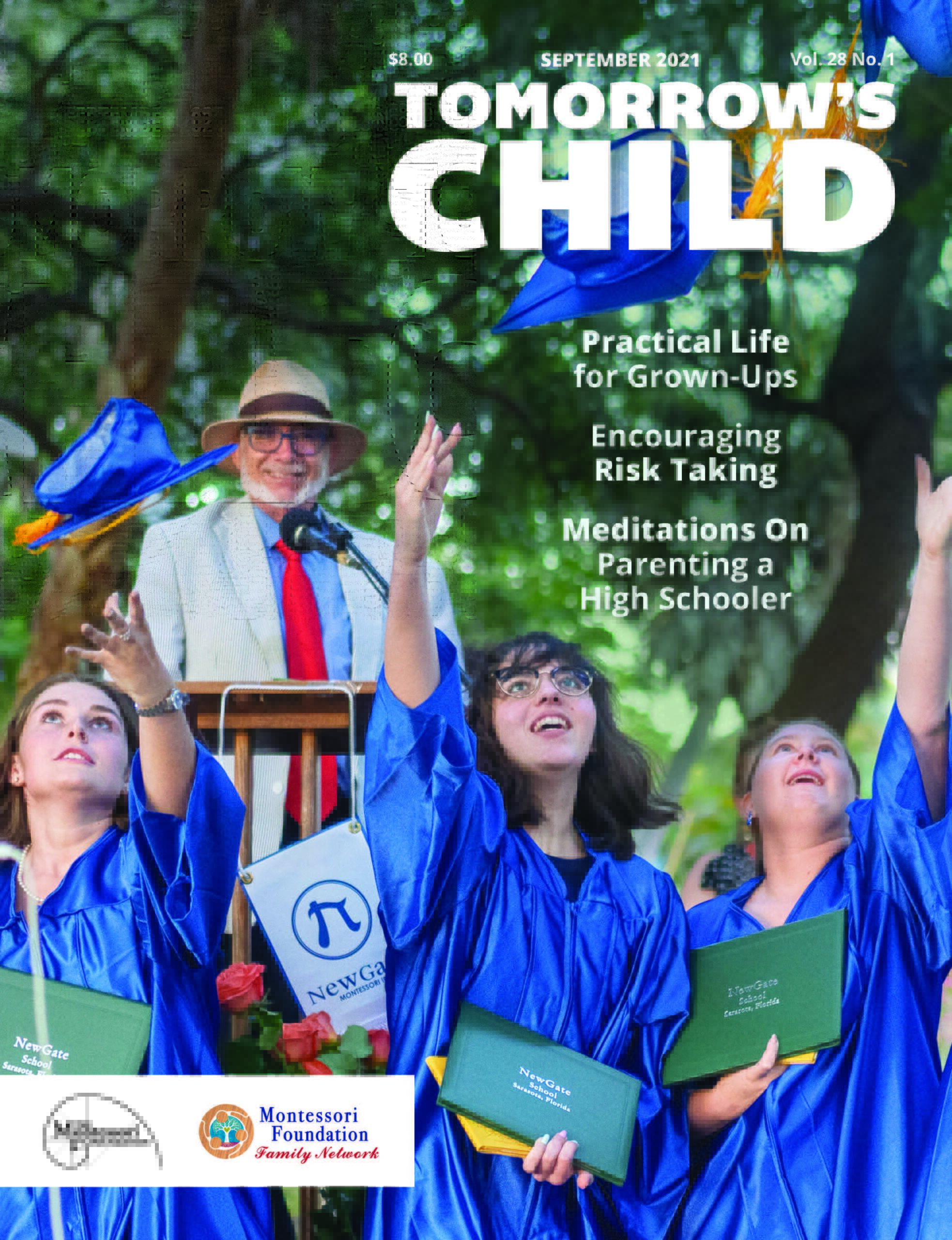
COver TC Sept 2021

Encouraging Risk Taking

Encouraging Risk Taking

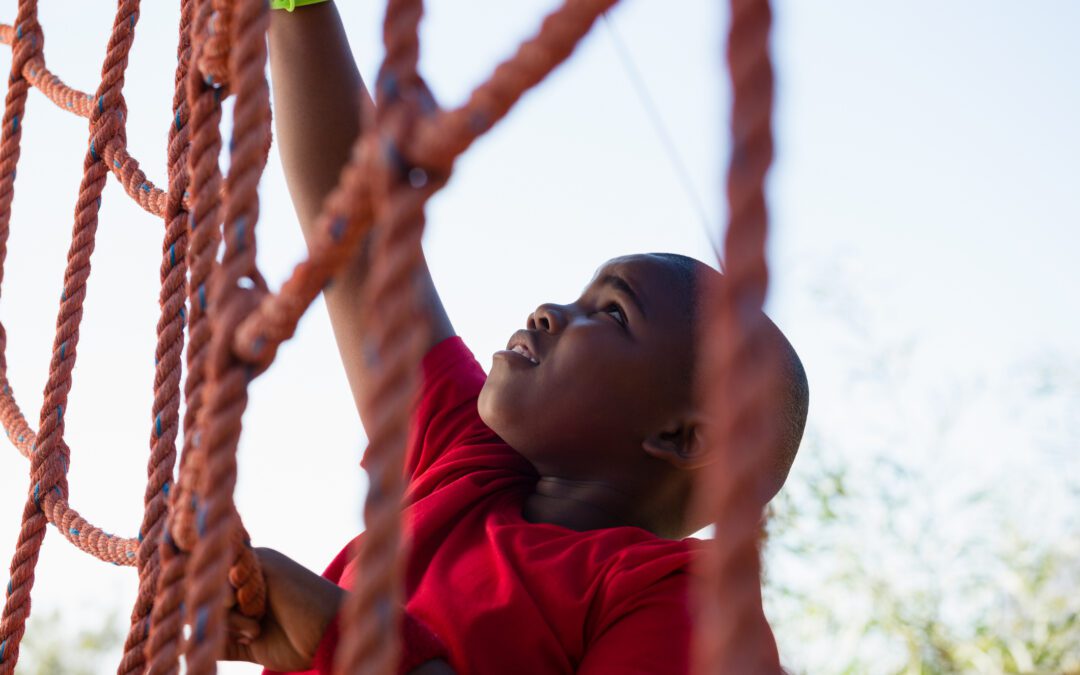
Boy climbing a net during obstacle course training

from Tomorrow’s Child – The Montessori Family Magazine – September/October 2021

By Peter Pizzolongo

Facing risks is an unavoidable part of life for most adults. So, why do we choose to take risks? Is it for the sensational thrill of trying something new or the tenacious hope that new opportunities will present themselves? Sometimes, maybe, we choose to take a risk just to exhibit a show of confidence. Whatever the reason, the lessons we learn from taking a risk have the potential to lead us on a new path (Rolison 2013) (Zeilinger 2017).

Learning to assess a risk is an essential skill for living.

The ability for adults to take calculated risks has its roots in early childhood. Yet we are in an era of limiting risk taking by children. Most parents (and caregivers of young children) worry about children, wanting them to stay safe—so they resort to limiting the risks that children take. “We are a nation of pushy helicopter parents, . . . waiting below our children on the monkey bars in case they should slip” (Bilinco 2015). By keeping our children ‘safe,’ are we inadvertently preventing them from learning how to calculate risks on their own?

The benefits of taking safe risks.

It is important for children to learn how to take safe risks, i.e., “situations that a child can perceive and choose whether or not they want to participate” (Keeler 2020). Risks that are not safe, aka hazards, are “truly dangerous for a child: situations or objects that the child does not see, cannot make a logical choice about, and that have a definite chance of hurting them.” As Rusty Keeler reminds us in Adventures in Risky Play: What is your yes? Risk is good… Risk is a natural part of life. In fact, learning to assess risk and deciding if you want to take a risk are essential skills for living” (Keeler 2020).

Children engage in play that involves taking risks to experience positive emotions, including: fun, enjoyment, thrill, pride, and self-confidence (Sandseter 2011). In risky play, children “dose themselves with manageable quantities of fear and practice keeping their heads and behaving adaptively while experiencing that fear” (Gray 2014). When a child takes a risk and attempts something outside her comfort zone, she uses the higher-order thinking skills of application and synthesis—applying what she knows to new situations (Church 2020).

The ability to calculate and take risks supports children’s learning in many ways. Taking risks develops and enhances a child’s self-confidence and ability to manage and overcome fear. Risk-taking promotes the kind of play that involves children’s use of problem-solving skills, self-regulation, and reflection. I would consider what helped me succeed. If the experience did not end as I expected, I would try to figure out what failed.

The ability to calculate and take risks supports children’s learning in many ways.

In “The Role of Risk in Play and Learning,” Joan Almon notes, “play means taking risks . . . Children are constantly trying out new things and learning a great deal in the process.” This is most evident in the risk-taking that children engage in as they use their muscles and senses in physical activities. When children are encouraged to take safe risks, they learn to assess what they can do and match that with activities that have an element of risk.

Children think about how high they can climb, from what height they can jump, and so on. They might find that what they were attempting is not possible and use problem-solving skills to try an alternative. These children are developing and using resilience; they will determine what they need to do to succeed or decide to abandon the task. Through taking safe risks, children “acquire better motor control and learn what is dangerous and what isn’t” (Sandseter 2011). A preschooler encountering a pile of logs might investigate how secure the logs are on the ground and decide whether she can climb on the pile or not. She is learning how to manage risk and develop an understanding of safety (Knight 2011). Taking risks while building physical skills is an important component of development and learning for young children.

The Role of Teachers

Recognizing the general processes of children’s development and learning in all areas is vital. It is the parent’s and teacher’s responsibility to identify the safe risks vs hazards and to set clear and reasonable limitations so that children understand what they may and may not do in the play environment.

Taking risks while building physical skills is an important component of development and learning for young children.

Understanding Developmentally Appropriate Practice is Key

Understanding developmentally appropriate practice is key: recognizing the general processes of children’s development and learning in all areas. In addition, they must consider the strengths, interests, and limitations of each child and be aware of the social and cultural contexts in which each child lives (NAEYC 2020). They must also “up the ante” when they discern children are ready for bigger challenges.

The two examples below show the difference between what is appropriate for a toddler and what is appropriate for a preschool child.

Eighteen-month-old Darius is beginning to use depth perception in his play. Today he demonstrated how he scans for obstacles and moves based on that information. He has gained control of a variety of movements: stooping, going from sitting to standing, running, and jumping. Darius shows an understanding of what size openings are needed for his body to move through, and today he successfully crawled through the tunnel.

Toddlers develop their physical abilities by continuously stretching themselves. Darius has learned (probably through trial and error) what size opening he can fit through. As toddlers freely navigate their relatively safe and supervised environment, they begin to figure out what are reasonable risks to take.

Four-year-old Ximena enjoys balancing on one leg and on the balance beam. Today she walked the entire length of the balance beam and ended by jumping off and standing on one leg for a few seconds. She coordinates her movements when jumping, hopping, and running. Ximena has mastered several large muscle skills, and after her jumping-hopping running experience, she climbed the ladder and slid down the slide—several times.

Preschoolers are adept at responding to physical challenges when such experiences are promoted. They can reach great heights on the climber, dangle upside down, and move from rung to rung with increasing ease. They can climb trees, cycle at fast speeds, and engage in ‘play fighting’ without actually hitting each other. They can balance on a beam, set increasingly higher as children begin mastering balance. They can climb up the slide, rather than only using the steps. Preschoolers can figure out how to get across a shallow creek using rocks and logs. With adult supervision, they can also begin to take risks at the fine motor level, for example, slicing fruits with a sharp paring knife.

What is your risk tolerance?

As a parent and/or teacher, you will need to determine your own tolerance to risk. What type of risky behaviors are you willing to let children engage in? If you have low risk tolerance when it comes to children’s play, it would be helpful to review expectations for young children at various stages of development and think about what children would like to do to ‘up the ante’. Then, recognizing that children are stretching themselves, your primary role “is to enable the stretching process to be manageable and safe enough . . . to help [children] to take reasonable risks” (Almon 2013).

Finally, the role of the teacher is to help children be aware of their actions and encourage safe risk-taking. Here are some examples, adapted from NAEYC’s Developmentally Appropriate Practice:

• Encourage children to choose their own learning activities: “We have several activities set up in the outdoor area today. You can choose what you want to do first.”

• Acknowledge children’s activities:

“You’re building with a lot of loose parts today!”

• Encourage them with specific feedback:

“Wow, you are certainly climbing higher today than I’ve seen you climb before!”

• Ask open-ended questions: “If you want to cross the creek, what will you need to step on so you stay dry?”

• Pose problems and ask questions, providing just enough assistance so the child can attempt a task at a skill level just beyond what she can do on her own (scaffolding): “You’ve been somersaulting down this hill. How else can you get from the top to the bottom of the hill?”

Supporting children as they explore ways to take safe risks sets them on the path to becoming adults who develop the confidence that comes from assessing risks and determining a course of action they learn from taking risks and who explore the opportunities to which risk-taking can lead.

References

Almon, J. 2013. “The role of risk in play and learning.” Community Playthings. Online: http://www.communityplaythings. com/resources/articles/2013/ the-role-of-risk-in-play-and-learning.

Blincoe, K. 2015. “Risk is essential to childhood—as are scrapes, grazes, falls and panic”. The Guardian. Online: https://www. theguardian.com/commentisfree/2015/ oct/14/risk-essential-childhoodchildren-danger?fbclid=IwAR0CZE vfmAN0udIDxWrI9xQHfob4QYM DT_R4eDpdLBvUInIkQutU0LNCapc

Church, E.B. n.d. “When to challenge children.” Early Childhood Today. Online: https://www.scholastic.com/ teachers/articles/teaching-content/ when-challenge-children/.

Gray, P. 2014. “Risky play: Why children love it and need it”. Psychology Today. Online: https://www.psychologytoday. com/us/blog/freedom-learn/201404/ risky-play-why-children-love-it-and-need-it.

Keeler, Rusty. 2020. Adventures in Risky Play: What Is Your Yes? Lincoln NE: Exchange Press.

Knight, S., 2011. “Why adventure and why risk in the early years?” ChildLinks. 3. Online: https://www.researchgate.net/ publication/275039981_children’s_ risky_play_in_early_childhood_education_ and_care.

National Association for the Education of Young Children (NAEYC). 2020. Developmentally Appropriate Practice. Washington DC: NAEYC. Online: dap-statement_0.pdf (naeyc.org) Rolison, J.J., Y. Hanoch, S. Wood, & P. J. Liu. 2013. Risk-taking differences across the adult life span: a question of age and domain. Journals of Gerontology, Series B: Psychological Sciences and Social Sciences, 69(6), 870–880, doi:10.1093/ geronb/gbt081. Online: https:// academic.oup.com/psychsocgerontology/ article/69/6/870/545646.

Sandseter, E. 2011. “Children’s risky play in early childhood education and care”. ChildLinks. 3.

Zeilinger, J. 2017. “7 reasons why risk-taking leads to success”. The Huffington Post. Online: 08/13/2013 03:15 pm ET Updated Sep 25, 2017

Peter Pizzolongo is President of Early Education Consulting and former Vice-President of the Delaware AEYC Governing Board. He has held the positions of Training and Technical Assistance Coordinator of the National Center on Early Childhood Education, Teaching, and Learning (NCECDTL) at Zero to Three; Associate Executive Director for Professional Development at NAEYC; and Director of the Analytical Support and Technical Assistance Services Division of CSR, Incorporated—a social sciences research and management support firm. He has over 30 years of experience as an author; training and technical assistance provider; program evaluator; Head Start and childcare agency administrator; teacher; and human services program manager. Mr. Pizzolongo has authored or co-authored more than 30 publications, digital programs, and other resources. He has conducted training programs on numerous topics, including child development; early childhood education; developmentally appropriate practice, ethics; developmental assessments; health and mental health; nutrition; parenting; and program evaluation. Mr. Pizzolongo has been a member of the University of Delaware (UD) College of Education and Human Development Dean’s Advisory Council since September 2015. He received his B.A. in psychology in 1972 and his M.S. in human resources with a child development major in 1974, both from the University of Delaware and coursework in the use of technology in education programs from the University of Maryland.


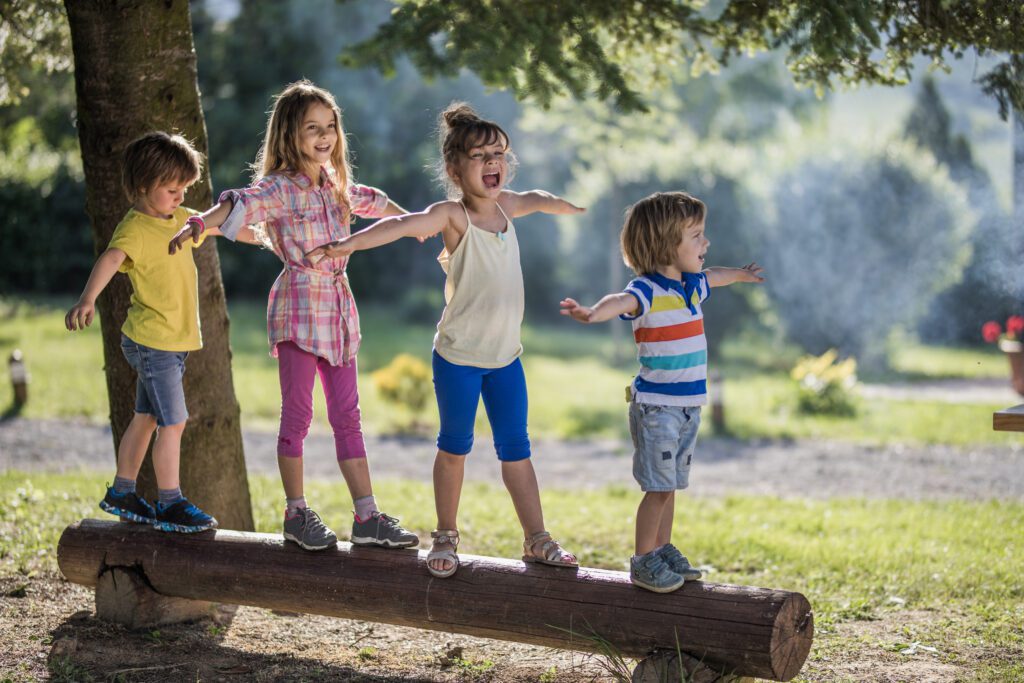
Group of small kids walking on a tree trunk in nature.
Grace & Courtesy:  From Early Childhood to Beyond

Grace & Courtesy: From Early Childhood to Beyond

Boy climbing a net during obstacle course training

from Tomorrow’s Child – The Montessori Family Magazine – September/October 2021

By Robin Howe, Ed.D.

“Each preceding phase prepares the one that follows, forms its base, nurtures the energies that urge toward the succeeding period of life”

Maria Montessori. (From Childhood to Adolescence, 134)


In early childhood (3 years to 6 years), there is a component of the Practical Life curriculum that is called “Grace and Courtesy.” It is a proper noun in that it has its own place in the early childhood curriculum. Some might say that it is the foundational piece, setting the expectations for behavior and interaction that lay the groundwork for successful work in the classroom; it is essential for the normalization of the class and the students in the class.  As students progress through the early childhood and then elementary classrooms, Grace and Courtesy is acknowledged as an essential piece of Montessori, a continuum through which Montessori can effectively be implemented. As students get older, however, there seems to be a greater emphasis and division between a student’s behaviors (ability to demonstrate grace and courtesy) and their academic abilities. This does not mean that these two skills are mutually exclusive, but the importance or emphasis may change from the teachers’ perspective.  In working with adolescents and adults, I consider myself lucky to have maintained contact with many past students, whom I have known through their childhood and into their adult lives. This has given me the opportunity to get to know these students as adults.  Sometimes I wonder, though, if we have adequately prepared children for adulthood, and whether we allowed Grace and Courtesy to dissolve into memory from our early childhood years when children were learning how to walk carefully through a classroom while balancing a tray or how they politely interact-ed with others.  Some questions I have been considering more and more are: • Does a four-year-old child having a tantrum in the middle of a grocery store have more leniency than a 17-year-old or a 25-year-old having the same level of a tantrum in the same grocery store?  • Does a flippant remark from a six-year-old affect people differently than that of a 16-year-old?

Of course, the answer is yes! Even the most balanced four-year-old may have a moment when they lose control and it doesn’t matter why. Parents may be judged by bystanders on how they handle the situation but, ultimately, when the child is back in the car and eventually falls asleep to the motion of the vehicle, supporting a notion that the cause of this uncharacteristic outbreak was exhaustion, the situation is over.  A young adult may not have this luxury. The threshold of understanding is much less for adults than it is for children and that is perfectly appropriate, based on our assumption that with age comes a level of self-control and maturity that would prohibit them from behaving in this way. So, my questions as a Montessori adolescent teacher are:  • Are we adequately preparing our young adults for the succeeding period of life?   • Are we preparing them for the expectations of existing in an adult world, even as they just enter adulthood?

I feel that Montessori does this better than other educational pedagogies in many ways. A few of them are outlined below.  Internships and Work Experiences We encourage our students to explore careers and be amongst professionals, who may not have the patience of educators. The assumption is that if students behave outside of a span of “acceptable” behavior, they will be asked not to come back.  Entrepreneurship Whether the students are participants in an Erdkinder program or other entrepreneurial experiences, they are learning about financial independence and being valued as part of the Montessori idea of “valorization.”  A goal of any adolescent entrepreneurship experience is the appropriate appreciation for money, their own role in earning it, and an understanding of how their participation is something of value. Field Experiences Many Montessori secondary programs have opportunities for students to work both in their communities and the greater world beyond. The importance of a student experiencing other cultures and realizing that drinking water and plumbing are not guaranteed rights are incredibly important lessons. Leadership A tenant of any Montessori experience is the opportunity to be a leader. Whether the 6-year-old in the early childhood class or the 12th grader in a high school, this experience is incredibly powerful for both the student in a leadership role as well as the younger students who are observing.  Each of these examples warrants entire courses and discussion, but is that enough?

On a recent trip with adolescent students, I passively listened to the conversations and observed behaviors, trying to demonstrate my own Montessori ability to know when and how to interact, while also trying not to be the misunderstanding adult, who (just a few years ago) might have been more understanding.  While none of the behavior was egregious, in this heightened world of accountability, I found myself torn. Jokes that might have been accepted or even funny five years ago, may now be means for expulsion or even legal action.  Flippant and loose language can be captured and reposted on a phone and can lead to the loss of scholarships and enrollment.  Teachers do a lot, and some of these questions are the responsibility of the parent! Agreed! But, if we accept Montessori’s belief that “each preceding phase prepares for the one that follows,” are we doing enough? Should Montes-sori’s Grace and Courtesy curriculum more specifically prepare our young men and women for today’s world? Thinking back to that four-year-old who had the tantrum in the supermarket, do we have the expectation that young adults will have a much higher degree of control? But what if they don’t? How can we as Montessori parents, teachers, schools, and systems, support the changing expectations of young adults and prepare them for the post-secondary world where the expectations are higher than those of the four-year-old in the supermarket? The world we (the adults in the room) grew up in is not the same as that of our current students. Physiologically, science suggests that we are not different; however, earlier civilizations did not have cell phones and Instagram™. If our goal is ultimately to prepare students for the next stage of their life, whether it be university, a trade, etc. they have expectations as adults (even if they are not) that they need to be prepared for and the learning curve is not as long as it once was.  In closing, while we consider Grace and Courtesy as a fundamental component of the Early Childhood curriculum, is it time to re-examine the importance for students in the third plane (12- to 18-year-olds)? As we prepare them for the succeeding experience, should this emphasis carry a capital G and C for our older students?

Group of small kids walking on a tree trunk in nature.

Why Community Service?

Why Community Service?

by Louise Seabrook Knisley

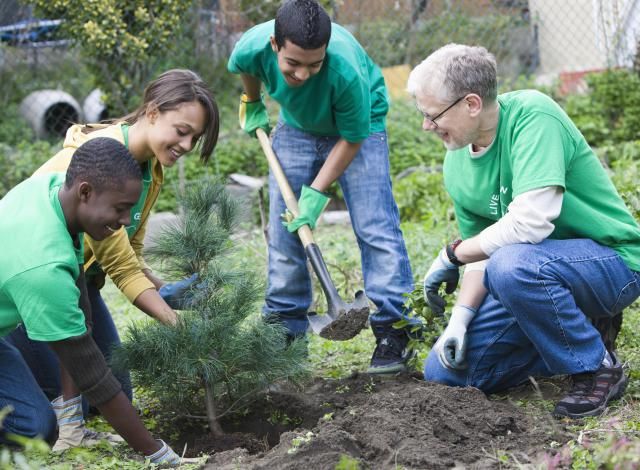
The Montessori School of Anderson, SC has always had a strong emphasis on community service. We know that sending students out into the community to do service work provides unique learning opportunities. Students learn the joys of giving of themselves, the value of volunteerism, a sense of compassion, and a little about the “real world” in the process. It is an important part of the education of the whole child.

About Our Program

The community service program at our school spans all the age groups. At the Primary and Lower Elementary level, children are involved with elderly participants at a nearby adult day-care center. The children visit on a regular basis, decorate windows for seasonal holidays, and make holiday cards and crafts for their elderly friends. The card-making and visits are simple ways and first attempts to help the children focus on doing something for someone else. Beyond that, it’s just fun!
At the Upper Elementary level, children function more independently. Fourth-year students do an in-house service project after Christmas. They go once a week to the Primary students or listen to the Primary students read. Having older children work with younger children fits nicely with the Montessori principle of peer learning. The children write about their work and meet as a group to discuss their experiences.
During their fifth year, students begin going into the community on a weekly basis to do service work. Students visit and work with special-needs children at a local child-development center. Sixth-year students help pack and deliver meals for the Meals on Wheels program once a week. They also make personalized birthday cards for Meals on Wheels recipients. Seventh-and eight-year students tutor children in Head Start classes each week.
In addition to weekly service work, students take part in several one-time service projects during the school year. In late fall Middle School students and their teacher help winterize the homes of senior citizens by covering their windows with plastic. Just prior to the Christmas holidays, each classroom chooses and completes a holiday-related project, such as “adopting” a needy family or having a toy drive. In winter older students collect and distribute personal-care products to shelters for the homeless. In spring Upper Elementary students assist their Special Needs friends during our county’s Special Olympics event.

Development of the Community Service Program

Developing and refining the community service program for our school has been one of the joys of my teaching career and of my life. Community service has always been my passion. It is a passion which I have been allowed to share with the students at our school as Community Service Coordinator. My background as a maters-level social worker as well as a trained Montessori teacher has enabled me to assume this role. Social work contacts with community-based service agencies have made it easy to create opportunities for the students to do volunteer work. Teaching experience in the classroom at most levels has allowed me to help the children make sense of their experiences and to track their growing awareness of the needs of others.
Just as the development of the child is a work in progress, so too is our community-service program. With feedback from the students, staff, and the community, new projects are conceived and put into action. With feedback from the children, we add new dimensions to the program and find new ways to “hook” children on the idea of serving others.

Benefits of Community Service

I am constantly amazed and gratified by the positive effects that serving others has on the children. The depths of their compassion is awe-inspiring. It is always surprising to learn how much community service means to them. Many children tell me that the day they work with special-needs children or deliver Meals on Wheels is their favorite day of the week. Children let me know that they finished all their work early just so they can read in the Primary classrooms. Students shed tears at the end of the school year wondering if they will ever see their favorite special-needs child again. Older students become inspired to do summer volunteer work following visits to local service agencies.
Think about how community service must affect a child’s growing self-esteem. For a child to KNOW, without a doubt, that his or her work is important sends a powerful message to that child. How awesome it is for a child to know that what he or she is doing, whether packing meals for delivery at Meals on Wheels or reading to a child at Head Start, is having a positive effect on another person’s life.
These child volunteers instinctively know that their work is important. Of course, the children often hear many positive comments about their work from grown-ups at the agencies where they serve. My own comments are usually directed toward possible ways that their work affects others. However, it is not the words they hear that make the difference. These children FEEL the importance of their work on a different level, from within themselves, instinctively, without being told. They just know. It is amazing to watch.

Promoting Volunteerism

One very practical reason for a community-service program is to promote the idea of volunteerism. In this age of federal cutbacks and “me first-ism,” we must encourage our children to care enough about those less fortunate to become involved. community service gives young students the opportunity to nurture their natural sense of compassion and to experience the joys of giving of oneself. children are capable of appreciating and integrating compassion and joy into their very character and being. They become willing helpers.

Community service gives students the opportunity to learn about the real world. They learn that some people don’t have enough to eat, BUT there is an agency like Meals on Wheels that helps to feed them. They learn that children of a different socioeconomic status or color are still children and need the same things all children need to grow into healthy adults. They learn that the elderly and those with physical or mental challenges are not to be feared or pitied.
Students learn that their own presence can make a difference in someone’s day or in someone’s life. They learn that a smile and handshake can brighten a lonely elderly person’s day. They learn that they can be a positive role model for a child who has few positive role models in his life. They learn that community service is fun. They learn that helping others feels good inside.
We believe that or program has a lasting impact on students. Some students who are presently participating in community service plan to do volunteer work in the summer. Others tell us that they plan to continue to volunteer after they graduate from our school. Our program makes a difference!

Louise Seabrook Knisley is Community Services Coordinator at the Montessori School of Anderson, SC. She has a Masters degree in Social Work and is a certified Montessori teacher who has taught at various levels.

Personality Type & Communication in Schools

Personality Type & Communication in Schools

Download PDF File

On September 30, 2015 we were joined by Carly Toomey.

Carly Toomey was Montessori Lead Teacher for 6 years, and an Executive Board Member at Lexington Montessori near Boston. She is also the co-founder of Type-Coach which offers a suite of tools focused on the practical application of personality type. Like the MBTI (Myers Briggs Type Indicator), the Type-Coach programs are based on the Jungian model of Personality Type.

We discussed how the Type-Coach online platform of tools is being used in schools to improve the dynamics on teaching teams as well as help students maximize their potential by understanding their own communication and work style. We are thrilled to report that Carly has made all of these tools available to Montessori school leaders and 3 other administrators of your choosing. You are encouraged to complete the Type-Coach Verifier prior to the webinar.

You can follow the instructions below to access the full Type-Coach platform:

The Type-Coach Verifier: An interactive online experience to discover and verify your best fit personality type and receive a 5 page report with tips for maximizing your natural strengths, minimizing your challenge areas, info about your stress responses, and more.

Coaching Videos for YOUR type: Engaging 5 minute video animations covering each of the Top 5 Ways to Maximize Your Career Potential given your type.

Type-to-Type Tool: An interactive type chart providing customized top ten tips for working with any type based on the combo of YOUR type and THEIR type. As an option, this chart can auto populate with the names of everyone in a group (i.e. your faculty) so that for example a teacher can click on the name of their co-teacher and access top tips for communicating with them based on their own type and their co-teacher’s type.

Online Type-Coach Course: This course teaches how to,

  1. Identify type preferences in others and,
  2. how to adjust your communication accordingly for maximum impact and collaboration.

Instructions for Accessing Type-Coach Tools:

Go to: www.type-coach.com, click on ?sign up? (top right)

Create a password

Enter the code:1G9Z64

When you come back to the site, just click on ?login? (top right) to pick up where you left off.

Download your report at the end of the Verifier.

Now you can access:

Coaching Videos for YOUR type (blue icon), and

The Type-to-Type tool (orange icon)

The Online Course (red icon)

Contact info@type-coach.com with any technical questions.


Establishing House Rules About Digital Devices & TV

Establishing House Rules About Digital Devices & TV


Social Media and Your Child’s Privacy & Safety

Be thoughtful before you post photos or videos of your children online. They may be embarrassing to your children one day, expose your family’s privacy in ways that might not be safe, and create a digital footprint for your children and your family that can never be erased.

In Montessori-inspired homes, parents want to carefully think through and establish House Rules regarding the use of digital devices and the media, games, and apps that they are comfortable allowing their children to use.

This is something that can be challenging if your children are older and you did not establish clear House Rules around digital media right from the start. However, those of you who have children in the upper elementary years and beyond probably already realize that setting these House Rules becomes increasingly important.

Before your children are born, it is best to talk with your parenting partner and come to a general consensus about the use of digital devices, media, and raising children at different age levels. You want to strike a balance between access to digital media and family life that supports your values from the beginning. When your children are very young, you are going to make the decisions. As they get older, your children will want to question, debate, and discuss why these rules are important and how your family makes choices.

We want to consider several different aspects of your children’s use of digital devices and the selection of media and games. It includes what devices are you comfortable allowing your children to have access to at a given age level, when can they use them, where can they use them, for how long per day can they use them, and what can they use them for? What messages and contacts are you comfortable with having your children exposed to?

We cannot emphasize enough the importance of establishing House Rules that really make sense and which ones you are willing to follow yourself to set a good example for your children. That doesn’t mean that the rules established for a child under six are the same rules that you would give to a child who is 15, or that you would follow as an adult. It just means that the House Rules need to be based on your family’s values, be fair, and be consistently followed. Also, House Rules need to recognize that time spent engaging with digital content can be positive, but we do not want it to interfere with the connections among family members and our ability to get work done. House Rules should help you keep relationships strong.

Here are some ideas for House Rules with older children.

  • • As with any other life situation that might be dangerous or harmful to your child, prepare them to keep themselves safe by discussing internet safety rules.
  • • For a variety of reasons it is best not to allow your children to have a TV or digital devices in their bedrooms. When allowed in their bedrooms, media can interfere with sleep, expose children to unwanted programs or games, become addictive, and pull children away from interacting with family members.
  • • Most media is rated in terms of violence or other content that is inappropriate for children. Check into ratings when selecting digital content. Many digital devices and digital media stream services offer various forms of parental controls. Learn about them and use them to limit your children’s screen time and access to content that you would find concerning.
    It’s important to set up media-free times for your family. These are times during the day when everyone stops interacting with their phones, tablets, or other digital devices, and just focuses on family, reading, games, or real-life experiences. Usually, they are times like mealtime, bedtime, and family outings.
  • • Children need to spend as much time every day reading, exercising or playing as they do on the screen.
  • • Discuss with your children what might be the consequences of breaking the House Rules. For example, if children take their tablet to their bedrooms when it is time to sleep, they might have to leave it in a specific place outside the bedroom for a period of time.
  • • Be sure that others who will be spending time with your children also know the House Rules, such as babysitters, grandparents, or friends.
  • • Use media with your children. Know what they are watching and listening to. Talk together about what you are viewing and hearing.
  • • Be a good model for your children. Abide by the media-free time rule. Put your smartphone away when dropping off and picking up children from activities. Take some time in the evening for a family game or other person-to-person interaction.

Social Media is a different challenge

Social media is ever-changing as new apps come and go, but the common thread is that they are intended to facilitate young people sharing photos, videos, and chats in real-time. As one person posts, others respond with comments, which may be mean-spirited, silly, or simply inane. In any case, social media can be highly addictive and a huge waste of time. If and when mean-spirited behavior gets going online, it can easily lead children to either feel that they are being bullied or shamed, and they cannot escape even at home, or they themselves may begin to try on a more mean-spirited persona themselves. Let’s face it, many people seem to ‘say’ things online that they, we would hope, would never say in person.

Then there are at least two other major concerns with social media. The first is the tendency that many people have of presenting their lives as much more exciting and glamorous than they really are. This tends to create a cycle where popularity is based on how many likes or shares a post can get, and a sense that everyone else is having a much better time than we are.

The second major concern with social media is that there is no way to know who may try to form a connection with children and teens that might make their parents extremely uncomfortable or actually be dangerous.

Texting

Texting is an easy way to keep in touch. However, there are certain cautions that you and your children need to be aware of. Texting takes away two very important aspects of communication. When we text we cannot see the other person or hear their tone of voice. Without these it is difficult to interpret messages that involve emotions and these messages can lead to quarrels or hard feelings. Guide your children to stick to messages that give information and save those that involve emotions for face-to-face conversations. Neither your children nor you want to get into a “text war.”

Hovering Parents/Overparenting

Technology can be so helpful to all of us in so many ways. In some cases, though, it can turn into an easy way for parents to communicate and watch over their children too much. It can actually inhibit children from learning and practicing life skills like problem solving and remembering, becoming confident in their ability to care for themselves when away from parents, and developing a strong sense of autonomy.
The most important things for you to think of when it comes to technology, just as in other areas of your children’s lives, are the core Montessori principles and your family values. Those will be your guides.

50 Life-Changing Questions to Ask Your Child After School

50 Life-Changing Questions to Ask Your Child After School


What did you do today?” is the age-old question parents ask their children as they enter the house from school, but as we know, the answer is almost always, “Nothing!”Here are 50 life-changing questions that will give parents across the world a chance to truly understand how their child feels about school.

  1. Did you see someone smile today? Why were they smiling?
  2. Can you tell me an example of someone who cared for somebody else today?
  3. Was there an example of unkindness at school today? What did you do?
  4. Was there anyone looking lonely during recess? How did you feel when you saw that?
  5. What did you talk about during group time?
  6. Did you learn any new words today?
  7. Did anyone do anything silly to make you laugh? Was it the right time to be silly?
  8. Did anyone cry? Why were they crying?
  9. What did you find hard? Did you still try even though it was difficult?
  10. What is the most popular game at recess? How would you change the rules?
  11. What was the best thing that happened today?
  12. How did you help your teacher today? Is it important to care about your teacher?
  13. Did you say “thank you?” to anyone today? What did they do to make you feel thankful?
  14. Who did you sit with at lunch? Why did you decide to sit together?
  15. What made you laugh?
  16. Did you learn something new?
  17. What are you looking forward to tomorrow?
  18. Was there a time when you were afraid? Did you tell anyone?
  19. Did you fail today in any way? How did you feel? What will you do to overcome the challenge?
  20. Did you ever feel unsafe? What happened to make you feel like that? Did you tell anyone?
  21. What is something you heard that surprised you?22.What do you regret doing? Why?
  22. Did your teacher say anything that has stuck in your mind?
  23. Tell me something you know today that you didn’t know yesterday.
  24. Was there a time when you felt tired?
  25. How did someone encourage you? Did you encourage anyone else?
  26. Did you like your lunch? Would you like to start making your own lunch?
  27. Rate your day on a scale from 1-10.
  28. Did anyone get in trouble today? What did they do wrong? How did the teacher react?
  29. Did you try something new?
  30. What questions did you ask at school today?
  31. Did you wake up feeling tired or energized?
  32. Would you like to plan an adventure this weekend?
  33. What are you reading at school? Did you have time to read to a teacher?
  34. What was the hardest rule to follow today?
  35. Which new rule would you like to put in place and why?
  36. Can you tell me a story? I promise I’ll listen to the whole thing.
  37. If school was canceled tomorrow, what would you like to do instead?
  38. Are you ready for tomorrow? Is there anything you need to do?
  39. Is there anyone who makes you feel worried at school? Why?
  40. What made your teacher smile? What made him/her frown?
  41. Did you have time to yourself today?
  42. Was anyone happy to see you arrive at school today?
  43. What made you feel proud?
  44. 44.Did anyone do anything to make you feel loved? Will you do the same to others?
  45. Do you need more time with me tonight?
  46. What would you change about your classroom if you could?
  47. How do you think your teacher felt today?
  48. What moment in your day made you think, “Wow, I did it!”
  49. If you switched places with your teacher tomorrow, what would you teach the class?
  50. Do you know how much I love you? And how proud I am of you?

Ask these questions, actively listen to their answers, and let’s change this world together.

Making Agreements with Older Children

Making Agreements with Older Children

from Tomorrow’s Child Magazine – May, 2021 | by The Montessori Foundation

After the second of three children left for college, we began to experience the initial feelings that may come with the reality of being empty nesters. We still have one incredible teenager in the house, and she is very “easy on the adult.” Her presence in the home stands in the gap between a sense of family and lost purpose; we love her very much.

My youngest daughter has learned, from the mistakes of her two adult siblings, precisely how to navigate parental waters without being eaten by sharks. She is calm, introspective, caring, and makes good grades. After some time, she began to experience the throws of loneliness not having her older brother and sister readily available for age-appropriate interactions and mental stimulation. And so, she did something she does not often do. She asked for something.

You have to understand that this is a profound development for our youngest child, as she only ever asks for what is necessary. She began asking her mother for a dog. Initially, she began implementing the divide-and-conquer method of asking mom only. Her mother refused, citing the fact that I (her husband) was incredibly allergic to pet dander. I explode into sneezing fits and watery eyes when I come in contact with pet fur of various unknown types. My daughter’s initial attempts to secure a dog friend were all nonstarters because the acquisition of one would make her life grand and mine miserable.

More time passed, and she began to implement the teen strategy of persistence. She asked us almost every day, as often as she could, explaining to us the various reasons why a small dog with small poops would greatly improve her life and emotional standing. After months of straight refusals, our patient, kind, loving, low-maintenance, and temperate little daughter began to implement the final solution. To seal the deal, our child began to have bouts of crying in order to secure her desires. She no longer asked for a dog, specifically, but simply cried to us about not having someone or something in her life to help occupy her time and curb the experience of single-child loneliness. I should mention that there is an eight-year gap between our middle child and our youngest daughter.

Without her knowing, she hit the jackpot; we as her parents had always observed the chasm that existed between the two older children, and our youngest child. As the years went by, we watched as the socio-emotional distance between the two older children (only a year apart) began to naturally grow, and the expanse between the two camps naturally widened. I knew, as weeks and months went by, that I would grant her a wish for a dog. After all of her attempts to implement “teen reverse psychology” and “emotional guilt,” we decided to capitulate, despite the constant discharging of her best physiological weapons of teen warfare. We began to prep her for ownership of the dog without letting her know that we intended to let her have a dog. When she would cry about the matter, we countered with anecdotes concerning the horrors that may follow like cleaning up poop, early morning pee-pee trips, walking the dog in the wee hours of the morning, the darkness of the backyard, contending with the night-time critters, and constant supervision. All of these possibilities fazed her naught, and she maintained the fact that she wanted a small dog, even if it meant waking up at the crack of dawn.

When she had successfully endured the gauntlet of situational, anecdotal objections laid down by me and my wife, we agreed to a non-allergenic breed AND that she would take full responsibility for the care of the dog. My wife and I love dogs, but we are clearly not “dog lovers.” These cautionary tales that we were giving to her were not being explained by any way of fault toward the K-9 species, but rather, the apprehensions of people such as my wife and me. However, our child convinced us that she would be able to handle the responsibility as the primary caregiver to this new life in our home. Then came the day that we brought her pet dog home. It was a one-year-old Chihuahua puppy from the rescue shelter. She took to him at once and named him Oliver, Ollie for short.

From day one, she exceeded our expectations of care and attention in every single area. She had said that she would not falter or wane in her affections for the dog as time transpired. We were not disappointed: walks at early dawn, walks at dusk, and three walks in between. Lovingly dealing with feeding times, poops, and pee-pee accidents without complaint. She lavished him with treats and biscuits, walks, and selfies; she even made a short film on her iPhone, which was actually quite impressive, editing and all!

I want to be honest about how things have progressed in our situation. Today, our daughter is secretly in anguish. I would not say regret, but definitely anguish. Although there is no doubt that she loves Ollie a great deal, she does not like getting up at dawn, cleaning up accidents, late-night walks, the night sound of shuffling critter paws among the leaves, beyond the reach of the backyard floodlights. She would rather not stand in the cold rain to make sure (by eyewitness account) that he has carried out a number one and two. She hates walking the dog on hot summer nights, cold mornings, and in between. No matter the situation, she does what she has to do to make Ollie’s existence with us a good one. She plays with him, and gives him a lot of attention as we all do. My wife and I lovingly sneeze and cough through my encounters with Ollie, without complaining.

I suspect that like any 14-year-old child, the responsibility for my daughter is hard work. The REALITY has set in. The reality of caring for another life has been a real wake-up call for this little lady. We help out as parents often do, but we do not take over as parents also often do. For my daughter, getting up early and traversing the cold or heat of the day may be a challenge. Taking a plastic glove and handling the solid waste of an animal may be yucky for her. Finding time to play with Ollie in the midst of her other obligations is not always easy for her, but we let her go through it. We let her go through it, without bailing her out, without being a crutch, without allowing her to abdicate the responsibility that she asked for, and she has grown a great deal in light of it.

Michael CrumpMichael Crump and his six siblings grew up together in the UK. He received a BA in Sociology/Education from Ashford University. Michael attended Manhattan College for two years and lived in NYC for 16 years. After working in corporate management for 25 years Michael decided to join his wife, Arlette, as a teacher at her school, the Montessori Village Academy in GA. He is now completing his Montessori Elementary Teacher Certification in an IMC training program. Michael and Arlette have three children – Isaiah and Morgan in college and Mattison a working actor in high school.

Montessori Jargon that You Ought to Know

Montessori Jargon that You Ought to Know

from Tomorrow’s Child Magazine – May, 2021 | by The Montessori Foundation

Montessorians are known for their jargon. We speak of red rods, didactic materials, auto-education and the like. However, there are three important aspects of Montessori that are seldom shared with parents. 

Those are Nebulae, Horme, and Mneme.

To Dr. Montessori, and to those who answer the calling to implement the pedagogy or to live their lives with and in deep reverence of the child, the nebulae, horme, and mneme are the foundations of the person who is yet to be evident.

Dr. Montessori wrote, “It is a mental chemistry that takes place in the child, producing a chemical transformation. These impressions not only penetrate the mind of the child, they form it; they become incarnated, for the child makes his own ‘mental flesh’ in using the things that are in his environment. We have called this type of mind the ‘absorbent mind’ and it is difficult for us to conceive the magnitude of its powers.”(Education for a New World, p. 14)

The nebulae is the unlimited potential present in the child at the time of birth. It was the potential present in the cells of the egg and the sperm that joined to create a new being of possibilities. The horme makes itself known in the child’s vital urge to interact with the environment. Through the senses and movement, the child’s interaction begins the unconscious construction of the individual through the absorbent mind. The mneme is the memory storage in the unconscious mind of all of the interactions with the environment. The potential of the nebulae, the
urge of the horme, the memory of the mneme are the psychic building blocks of the child. They are the ‘mental flesh’ that Dr. Montessori describes as being difficult for the mind of the adult to understand and, yet, are indispensable as the child constructs self; mind, body, personality, language, and spirit. 

The impact of understanding these concepts is crucial for Montessori parents, assistants, teachers, caregivers, and all who have the privilege to interact with young children. The child should be treated with great reverence, for the construction of the self is no less of a miracle than is described in the holiest of writings. It also demonstrates the tremendous responsibility of those who connect with the youngest children. The responsibility to prepare physical environments, to provide enriching experiences, to allow the development of independence, and to build emotional climates should be taken with the greatest of care and intentionality. 

The ‘hope for the future’ that Dr. Montessori envisioned resides in the child and is realized through the admirable work of the child in the first three years of life. The inconceivable power of the child, through the nebulae, horme and mneme, is made evident in the child who reaches to grasp us, who depends upon us, who observes us, and who incarnates before our very eyes. 

There is no greater privilege to witness. There is no greater responsibility to ensure.

Montessori, M. (2007). Education for a New World. In Education for a New World (Vol. 5). Amsterdam, The Netherlands: Montessori-Pierson Publishing Company.