 Dear Cathie:
My three-year-old is starting Montessori school in the fall, and they want her to go every day. The school has a three-day-a-week option, and that seems to be plenty of time in school to me. I know that very young children do advanced academic things in a Montessori school, and while I want my child to advance as quickly as she can, I don’t want her under that amount of pressure every day. Is it really necessary for a child to go every day? My child is quite bright, and I am confident she will learn easily.— A Conflicted Mom
Dear Mom:
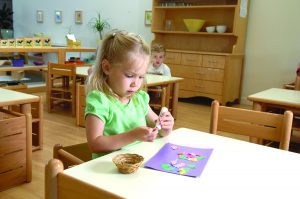
The Montessori Method is all about helping children reach their maximum potential. This is done by creating an environment that is rich in developmental opportunities for young children. Children then choose activities from this smorgasbord. They try new things and develop new skills, a process which takes time and repetition. During the course of the work time, the guide invites the child to new lessons, suggests activities that they might enjoy or benefit from, and watches as they choose and complete activities of their choice. The classroom develops a social culture, where children invite others to share a table, do an activity together, have snack with a friend, sit together on the circle at group time, or play together outside. This social experience parallels real life and requires repeated experiences to master.
Maria Montessori wrote extensively about the Sensitive Periods. These are times in a child’s life when they are particularly drawn to certain activities and when learning of a certain type occurs with great joy and ease. This effortlessness will never again exist in the child’s life. Yes, children will be able to learn the same skills at an older age, but never will it be this simple. The Montessori classroom maximizes these periods by allowing/encouraging children to work extensively in an area during this time. This can only occur with regular attendance and opportunities for work time in the classroom.
When most children attend full time and some children only attend part time, the social culture of the class is affected, as a part-time child cannot be fully integrated into the class. On the days he attends, he needs to make up for the time he did not attend. Thus, his time in the class is used somewhat artificially. He has to socialize with more intensity, as he has less time to do it.
This affects not only the choices he makes in the classroom, but those that the other children make as a result of his sporadic presence. He is often either more sought after than other children or somewhat ignored. Young children are just not that good at understanding time and predicting when to expect a part-time classmate and when not to. This creates a somewhat artificial social situation for the part-time child, more in keeping with part-time preschool than the Montessori environment.
Part-time attendance often has an effect on the child’s academic growth as well. It is true that parents and Montessori guides want children to progress academically. This happens naturally when children have enough time to explore all the activities in the classroom at their developmental level. When a child only comes part time, she does not have this time. Thus, she never gets to do all the activities she wishes to do.
These children choose a higher proportion of social works and more works that are new to the environment. They repeat activities less often, thus delaying the natural mastery of skills. Other part- time children opt to do the same activities every day they come, as they are too overwhelmed by the classroom to try new things. Thus, this child may need more than an average amount of adult attention to work at her developmental level.
This explains why parents of part- time children often view the Montessori classroom as mostly academic activities, placing high pressure on children. In order for these children to progress, they have to spend a higher proportion of their school day working on academic tasks. This may make the class tend toward a more teacher-directed style of Montessori that is not in keeping with the original philosophy.
While five days a week may feel like a lot to you, it is actually more predictable and comfortable for your child. Many families of beginning children do take a day off occasionally when they feel that their child needs a break. This is perfectly fine and is in keeping with the philosophy of “Follow the Child.”
Some Montessori schools do offer three-day-a-week programs, but their motivation is generally to meet the requests of parents and fill their spaces. Montessori guides almost unanimously agree that a child who attends five days has a richer and more authentic and complete experience.