Maria Montessori was “green,” far before the term was ever coined. Not only did she believe in the concept of environmentalism, but she taught children to respect the environment, learn from the environment, and, truly, to be one with the environment.
Only recently, however, has this term of “going green,” caught on not only as a catch phrase, but a necessity, given what we now know is happening to our planet.
Cynthia Burns, of the Montessori School of Maui, too, was a woman who had a belief, far before it became politically correct, that there was a need to follow Montessori’s directives and create a “green school.” What was once thought to be only a dream became a reality and a life mission that she continues throughout her teachings at the school today.
Cynthia received her Master’s degree in Integrative Education and decided to use her thesis as an opportunity to create a “living environment,” whereby she studied how using leaderships roles (as adults) might help create better learning environments for children. However, this only took her so far. In much the same manner, we sometimes plant seeds of knowledge that may not yet be ready to grow; however, given the right opportunities and the perfect nurturing, these seeds often go on to flourish at the right time – but only when they’re ready.
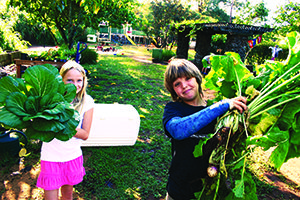
When Cynthia became Head of School at the Montessori School of Maui (MOMI), she worked with the community to create a “Model School Garden” that allowed students to learn about the water transfer system that ran down the side of a mountain covered in hibiscus. The children were very excited about the opportunity not only to be one with nature, but because they were learning in the process about the ways in which our planet generates vital elements. The teachers, however, sensed a much bigger meaning: they followed the children and discovered what it was that captured their attention. They found, too, that the children who had been so directly engaged in this experience with nature, would return to their classroom with a significantly higher sense of calmness than when they left.
This is the caption for the image
The seed planted in Cynthia’s head began to flourish. Perhaps the children’s response had been the sustenance to allow Cynthia the ability to know that her belief, her dream, could indeed grow. She approached the Board of Directors at the school and requested that they start to implement more “green living.” She asked, for example, to create an environmental policy, whereby there would be no chemical fertilizers, toxins, styrofoam, or chemical cleaners used on the school property. Agreed. But, there was more. Cynthia’s ambition, like Maria Montessori’s, went much further. She contracted a professor at the Hawaii School of Architecture, who also happened to have a Montessori child, as well, who decided to help her organize this new project. Soon enough, she was given a small grant by an organization called Rebuild Hawaii that would encourage them to build green.
Many meetings followed. Eventually, there was a team of 35 people who decided to publish the “Guidelines of Sustainability,” to help schools build and operate in an environmentally sustainable fashion. And, it all started falling into place…
Cynthia has chosen to make this project not solely about the school, but to broaden it to the community, at large. For example, she and her staff have created “green awareness” guidelines for children and their families. There are representatives from each classroom to help create committees and organizations. Her students participated in an Earth Education Community and won a competition in Maui for recycling such items as phonebooks, cans, plastics, and glass. There is also a “Young Philanthropist” committee that sponsors two fundraisers a year to support non-profits that are in the larger community. The concept is that children help to give back and contribute to those that may be in need.
Currently, the school has a water catcher system that consists of 55- gallon drums, which helps provide a watering system for each classroom. New projects are added each year. They have a compost system that provides a place for fertilizer to be made and recycling resources all over their campus. The campus is also involved in helping reforest and replant the island of Kahoolawe, which was bombed by the government years ago. This particular project offers children perspective on, not only the history, but also the damage that we, as humans, are capable of inflicting on our environment. But, more importantly, it also provides a message of hope that we, in unison, can be responsible for the repair and nurturance of our planet.
The seed planted in Cynthia’s head began to flourish. Perhaps the children’s response had been the sustenance to allow Cynthia the ability to know that her belief, her dream, could indeed grow.
There are, however challenges. As Cynthia describes, one of the hardest lessons for her to learn was that “not everything takes off.” She goes on to say that, “ Individual schools are like a living, breathing system,” meaning that some projects take off faster than others, and some people are more excited than others. She notes that she addresses such issues by having all-staff management meetings to discuss the goals for the classrooms every year, always with the children’s best interest in mind. She also feels that it is necessary to acknowledge each teacher’s “readiness” to join in the process, noting that this is a crucial element in maintaining a respectful, courteous, and peaceful community.
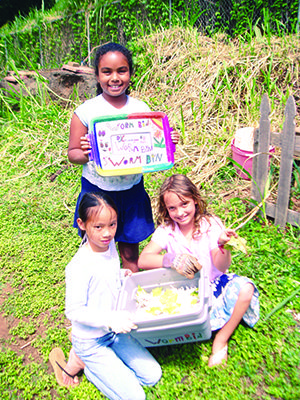 Cynthia recalls that, when she first had this idea of going green, people responded to her as if she was nuts! People were very nervous about financing this project, no matter how worthy it might seem. Many jumped on board, but there were still some reservations. She notes that, after addressing the Board, and being committed and passionate about her vision, she was able to convince others that, despite the hard work, and with faith, they could create something truly remarkable. Since the transformations at the school, she has found that the school’s families are very excited about what is going on in their children’s classrooms and are more sensitive to their own responsibilities for the environment. In addition, she finds that people fall more and more in love with their campus every day. People look forward to coming to their school and work, because it offers so much beauty, not only physically, but philosophically, in what it stands for.
Recently, a child was playing outside at their school and Cynthia was visiting their classroom garden. The child looked at her and whispered, “Be careful, chrysallis is growing,” speaking of the Monarch Butterflies. Cynthia described that moment as being so beautiful because she was able to observe a child, right in front of her eyes, respecting and sharing in the beauty of nature.
While Cynthia notes that they are not yet completely green, they are definitely on the path. In the process, she has created a sustainability guide to help other schools follow in her vision. She states, “We may not be the best at any one thing, but we have a holistic vision of everything.” Clearly, she also has an optimistic and ambitious mind that helps take her there.
Maria Montessori shared a message that all of our great lessons plant seeds in a child. They not only create seeds for academic growth but provide us with lessons that help us become better and more respectful consumers of our natural resources. I would argue that there was a seed planted in Cynthia’s head about what she hoped for the community and how she might be able to change the world, one child at a time. Only, that child was also the same child that allowed her seed to flourish and grow.