 “It was wonderful, Mommy! I pushed somebody, and then I hit somebody. And, then I went to time-out. And, I was angry and sad. Do you want to play trains?”
Although I am a licensed psychologist, that does not mean that I know everything about children. Other people’s children – possibly (at least I can be somewhat objective). My own children – not a chance!
While there are certainly more “learned” articles for me to write, I figured why not write one for my own therapeutic reasons, as well?
My husband and I have a recently-turned three-year-old and an almost-two-year-old. Both boys.
Every day, when I walk into my children’s lovely Montessori school, I brace myself. I don’t know how their day has been or exactly what they have done. I get cute little art projects brought home and little reminders that more clothes are needed (since my younger one changes clothes at least three times per day, given that he eats approximately a third of his food and spills the rest). But, more frequently than not within the past month, I get little behavior and code-of-conduct notes about my just-turned-three number-one son.
My lips are smiling as I greet my little ones, collect their backpacks, and herd them to the car.
In a calm voice, I ask, “How was your day?” Although my younger son understands language, he continues to enjoy practicing ‘caveman speak,’ substituting a series of grunting noises for language. It is safe, therefore, to assume that the perpetrator is generally the three-year-old, who has recently exploded into language.
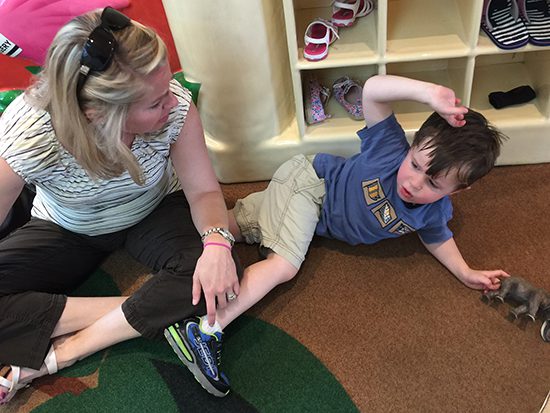
In response to my question, I received the following response: “It was wonderful, Mommy! I pushed somebody, and then I hit somebody. And, then I went to time-out. And, I was angry and sad. Do you want to play trains?” All in one breath. Really? Do I want to play trains?
So, psychologist mom decides to talk to him about his less-than-stellar behavior. And, he pretty much repeats after me. It goes something like this:
Me: “You made mommy very sad that you pushed someone. That is not nice. You hurt his feelings.”
Him: “No, mommy. You make me very sad. You’re not nice. You hurt my feelings.”
Epic fail. Or is it? He’s learning to use words, but he clearly hasn’t mastered their use yet. His teachers have told me that he gets so frustrated that he just loses it. He just can’t get the words out fast enough and resorts to more primitive responses.
So, the next day I braced myself for the daily report. Today, his teachers told me, he is now telling people (inappropriately, at times, but better than nothing) about his feelings and his thoughts. As a psychologist, I think this is wonderful! I really want to show him the emoticons so that he can start labeling his emotions, appropriately. But, secretly, I’m wondering how thrilled my husband will be by my “psychologizing” our son.
I continue to confirm with the teachers (yes, this is my neuroticism) that this is normal behavior. Now, if it were me talking to a fellow parent (which I have), of course I would tell them that it’s normal and it’s a stage in development. But, my kid? My kid who is provided unconditional positive regard, love, positive reinforcement, and praise? Where does he learn this behavior?
It is a phase, as I have been told countless times. But wasn’t that supposed to be part of the Terrible Twos? Nobody warned me about three-year-olds! If this is a phase, when will it end and will I be able to make it through? What other lovely stages do I have to enjoy that were not written in my personal book about how to raise a child? And, how do I keep loving my child when there are times that I literally need to walk away because he angers me so?
Case in point. I was driving in heavy rain with a tornado warning and hail bouncing around on my car. Other motorists had their flashers on, and my hands were gripping the steering wheel so tightly that I had white knuckles. Apparently, this was the opportune time to throw Thomas the Trains (you know the $13 creepy-looking metal thing) right at my head. Not one, but several! I almost lost it. I screamed out of fear and anger, which apparently meant, “Throw more!” I wish I could have ignored him, but I just couldn’t.
So, I called my psychologist friend (who I know will understand, since my husband minimizes it and says, “Yup, dealt with that last night”— not what I want to hear). She was so calm and reminded us that we are human and that raising children can be so rewarding and so fun, while so challenging and painful at the same time.
She reminded me how stressed I am, whether it’s balancing work and family life, regular stressors, and so on. She asked me if we’ve had any “us” time lately, where I just enjoy reading to my little “Jacksonman,” as he refers to himself. And, while I do, it’s only five minutes here and there rather than really good quality time. She reminded me to try to really be present in the immediate moments rather than rushing through life.
This is why being a psychologist with friends who are also psychologists is wonderful. I don’t pay for these little pearls of wisdom, because we offer them to each other in our moments of desperation. But, she was right. I am so stressed with everything else that I can’t even just appreciate the little things, fixating on what’s wrong rather than what’s right.
I have a beautiful son. He is mischievous. And a handful. And fun, bright, loving, caring, quirky, warm, friendly, outgoing, and so much more. I am working on trying to increase my frustration tolerance, while also decreasing my stress and focusing on being more present, aware, and appreciative. Trying, being the operative word.
So, I sat outside with Jacksonman last night, reading a book in the beautiful summer weather … and I heard my husband screaming inside as he came to the door.
“Jackson, what did you do?!?!”
We stopped reading, and both turned our attention to my hubby (aka Mr. It’s-not-that-big-of-a-deal). He said, “Jackson, you put your trains and your cars in my subwoofer, and I can’t get them out. Why did you do that? That’s not acceptable. Not acceptable!”
Jacksonman looked at him in the face and said, “Daddy, chill out. You’re making Jacksonman very sad and very angry. You hurt Jacksonman’s feelings.”
He must have learned those beautiful words from a wise psychologist.
“It’s just a stage,” I reminded him.
Tomorrow;s Child / September 2014 / p 5