by Chelsea Howe, PsyD | Communication, Discipline, Emotionally Healthy Children, Family Resources, MFA, Mindfulness, Montessori Family Life, Montessori Parenting, Parent-Teacher Communication
Montessori Teachers: How DO they do it?
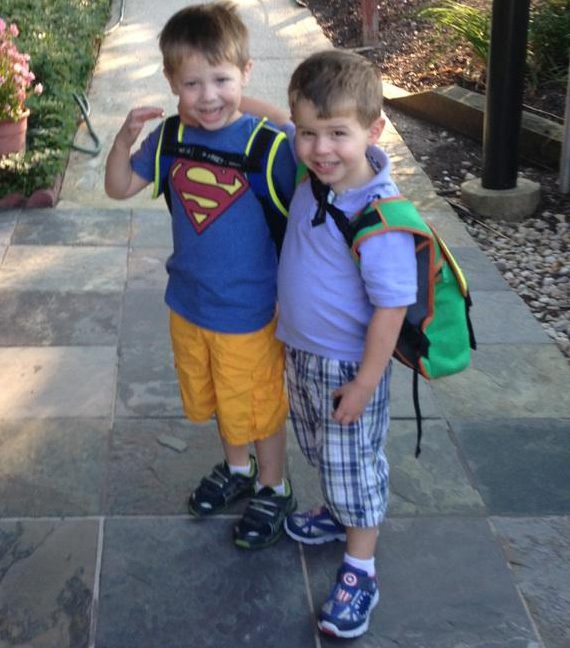
I’m sitting at home right now, drinking my second coffee of the day. My two boys have finally given in and are taking naps (at the same time!), and all is right with the world. It is a snow day, and this morning, when I saw the cancellation notice with the name of my kids’ school go by at the bottom of the TV screen, I silently sighed. I love my children, but the thought of a whole day snowed in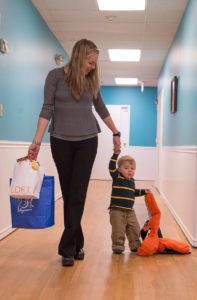 … two against one …all that ‘boy energy’ … another sigh.
This is snow day number two. My husband stayed home with them yesterday, and I received several texts from him reassuring me that they were alive (though he was only barely). Then, hours later, I received another text telling me that he was going to get Hudson’s head examined after a mishap with a ‘monorail’ that they had constructed in the house. Sometimes it’s just better not to ask. My husband has a degree in engineering, so a monorail running through the house is entirely possible. Anyway, an hour later, my 15-month old’s forehead was super-glued back together and as good as new. Nothing surprises me with these boys, NOTHING.
I don’t know how their Montessori teachers do it and remain positive and upbeat every day. I drop my children off in the morning, wish them a good day, transition through my own busy work day, and am worn out by the time I return to pick them up. They, on the other hand, are not worn out. I return to school and find my children happy, playing outside, and not ready to go home! In fact, I often get a tantrum about their intense desire to stay at school and play with their friends. And, I get it! I’m not nearly as cool as their peer group.
But, I wonder how these teachers do it. I once asked my older son’s teacher if she is exhausted at the end of the day, and she said, “No, they are great.” Either she is a great liar or that woman drinks more coffee than I do! But, I’ve been given the opportunity to observe her, and she is genuinely loving, caring, kind, compassionate, and warm. She speaks to the kids firmly but as though they are people, not kids. When one of them behaves badly, she explains what was wrong with their behavior and shares that they need to apologize. She has a heart of gold and wears it up and down her sleeves. And, the kids love her.
One day, I came to pick up my kids, and she shared with me that my lovely child hit another child (as if I ever thought he was an angel). I asked her how she handled the situation so that I can model my behavior based on hers. She shared the following: “I sat down, eye-level, and said, ‘That is not nice. These hands are made for hugs and helping other people, not hitting other people. These hands can do amazing things without hurting others.’” She had him sit in a chair until he had calmed down, walked him to the little boy, and the two hugged while my son said he was sorry.
Seriously?!?!?! How does she do it? At home, my older son will hit my younger one (or vice versa), and he laughs and snickers at me when I attempt to discipline him. But, that’s just it! His teacher attends to him and sees it as an act of communication rather than a reprimand. I have come to realize that we are constantly learning from our teachers, even when they are no longer OUR teachers. These teachers are setting the example of how to interact, inter-personally and intra-personally … with the children and with the parents.
The main lesson that I continue to learn about parenthood is that it is not easy. It is particularly not easy if you put on your parent goggles and reject the idea of asking for and receiving help. No matter how much you think you know, there will always be ideas and solutions that are new to you and may just be exactly what you and your family need to make life a little bit less stressful.
I may be exhausted and sleep deprived, but I am still able to appreciate life’s little lessons that creep up on me, daily. My kids are no angels. But, they are kids. And, I am reminded about the care that their teachers (who actually spend more time with them than we do) give my children when I observe their private moments: laughing, continuously hugging, consoling, and loving them. This is co-parenting at its best.
TOMMOROW’S CHILD © ♦ JANUARY 2014 ♦ WWW.MONTESSORI.ORG
by Chelsea Howe, PsyD | Communication, Psychology, Sensorial, Tomorrow's Child, Tomorrow's Child Online Issue, Young Adolescent, Young Adults
With a fast-paced society that often turns to medication for ‘quick fixes,’ we often perpetuate stigmas and neglect to consider all information prior to making diagnoses. As a psychologist and a mother, I know all too well how difficult it is to watch children struggle to find their way in classrooms that work to produce (and support) other “neurotypical” children.
But, what if our children are “neurotypical” but deviate only slightly (perhaps a half standard deviation) from the normal bell-curve? Do we provide supportive assistance to them to help maintain their self-esteem and guide them on their way? Or, are we too quick to judge that Johnny, at age four, “fits the criteria” for Attention Deficit Hyperactivity Disorder (ADHD)?
When I first started graduate school, over ten years ago, mind you, the ‘hot topic’ was ADHD. Everyone and their siblings were being diagnosed with ADHD, and why not? Wouldn’t we love all of our children to fit the “seen-but-not-heard” perfect-child stereotype and slap some medications into those neurotransmitters to help them “focus.” But, in my years of practicing, other trends are now popping up: Autism Spectrum Disorders; Bipolar Disorders; Sensory-Processing Disorders; and so on. But, these disorders have always existed, or have we just not paid attention? Or, were these kids just labeled weird, quirky, or angry?
Far too often, in my opinion, children get diagnoses that, truly, they do not deserve. That’s not to say that all are misdiagnosed, as many should and will benefit from pharmaceutical treatment. However, let’s remember that children at age four will be active (and quite active, at that). First and foremost, energy is a given at age four. Not being able to sit in a seat and focus for long intervals is also normal and typical; we call this “driven by a motor” or “restlessness” in the Diagnostic and Statistical Manual-Fifth Edition. The reality, however, is that developmentally, per age, we are asking kids to fit a norm that is counter-intuitive to what is biologically warranted. Children are being diagnosed (more than ever) with Bipolar Disorder or Disruptive Mood Dysregulation Disorder (both of which are real disorders), but we are not inclined to consider environmental and attachment patterns that mimic both disorders, in which case, drugs would not be the treatment of choice).
But, all of this takes time. It takes hours and hours of evaluation to determine what is really going on with each child. Thankfully, many schools are beginning to require psychologists to use testing to confirm a diagnosis rather than solely accepting diagnoses from pediatricians, who (respectfully) are not as well trained in the nuances of diagnosis. Further, we need to begin considering other factors.
How many hours is a child sitting in front of a television per day? While there is some research to suggest that television (particularly specific shows, such as Sesame Street) can help in acquiring language and beginning to learn (not develop) empathy, most are not beneficial. We know that television can be a ‘black hole’ for our minds (and particularly our children’s minds). Imagine if little Johnny is watching television all day long, while the parent or caregiver is trying to get laundry done, dinner made, and activities scheduled? And, Johnny doesn’t care! You know why? Because he’s happy! So, when he is at school, we are asking him to focus on something less stimulating when his ‘baseline’ is that of over-stimulation by watching television.
What about Johnny’s sleep and appetite? Is he getting adequate sleep per night? Is he attending to night-time rituals to help him both fall asleep and stay asleep? If not, perhaps that should be considered? And food? Does your child (like mine) exist on chicken nuggets, pizza, cheese, and yogurt? While there are worse foods that could be eaten, these are not nutrient-dense foods. So, we have a thriving child with less than “thriving” food upon which his brain is attempting to rely on fuel. At the very least, a good multivitamin and Omega-3 fatty acid supplement should be given. But, teaching kids at a young age about eating nutritious foods is important! Even attempting to “sneak in” nutritious foods is also important.
Teachers are also doing a great job of ‘thinking outside of the box.’ Kids are intrinsically active, more so the lower the age. My child, for example, fidgets non-stop. He plays with his tie, he eats his tie, he put his tie up his nose. Not the most hygienic of examples. There are options out there! If the teacher is willing to work with your child, all the better! There are sensory tools that exist for this reason—and they are not the classic fidget-spinners. There are necklaces, rubber rulers, mesh pockets, and so much more. They are tiny and unassuming, and children simply touch them while completing their work as a way to ‘stay busy.’ When used properly, they are discreet and can be quite helpful in helping children to be busy but focused.
Some teachers will also have children stand up to learn, as they know that sitting for long periods of time can be particularly difficult. Again, when done discreetly, this can be quite helpful. The key is to ‘normalize’ this rather than calling attention to it. I’ve seen teachers (with psychologist’s support) even use bouncy balls for kids to sit on while completing projects in class. Kids may also benefit from seat-bands, which help kids fidget with their feet to self-stimulate while working.
Again, the key to all of these techniques is to support the child, not stigmatize the child. We all have our habits when we get nervous or over-stimulated. We may chew on our nails, play with our hair, tap our pen, or bounce our legs. By providing kids with these outlets, we are treating their need for stimulation rather than diagnosing them with ADHD. If the behavior persists and/or worsens, there are certainly further accommodations and treatments that are available. But, in the interim, perhaps we should support our children and their development and try to find ways to hone in on their excitability rather than begin with diagnoses.
As a side note, my child is one of these children. He is a brilliant little boy with ‘magic hands’ that are incessantly busy. He has peeled just about every sticker and taped item from his workspace and his folders. A quick necklace fidget has fixed the busy hands, and he has frequent ‘breaks’ to go to the water fountain for a ‘change of scenery.’ And, our teacher has worked closely with us to help support him to be the best learner possible!
It’s worth a try rather than a pill.
Tomorrow’s Child/ April 2018/ pg 22
by Chelsea Howe, PsyD | Discipline, Infant-Toddler (0 to 3), MFA, Montessori Parenting, Psychology
“It was wonderful, Mommy! I pushed somebody, and then I hit somebody. And, then I went to time-out. And, I was angry and sad. Do you want to play trains?”
Although I am a licensed psychologist, that does not mean that I know everything about children. Other people’s children – possibly (at least I can be somewhat objective). My own children – not a chance!
While there are certainly more “learned” articles for me to write, I figured why not write one for my own therapeutic reasons, as well?
My husband and I have a recently-turned three-year-old and an almost-two-year-old. Both boys.
Every day, when I walk into my children’s lovely Montessori school, I brace myself. I don’t know how their day has been or exactly what they have done. I get cute little art projects brought home and little reminders that more clothes are needed (since my younger one changes clothes at least three times per day, given that he eats approximately a third of his food and spills the rest). But, more frequently than not within the past month, I get little behavior and code-of-conduct notes about my just-turned-three number-one son.
My lips are smiling as I greet my little ones, collect their backpacks, and herd them to the car.
In a calm voice, I ask, “How was your day?” Although my younger son understands language, he continues to enjoy practicing ‘caveman speak,’ substituting a series of grunting noises for language. It is safe, therefore, to assume that the perpetrator is generally the three-year-old, who has recently exploded into language.
In response to my question, I received the following response: “It was wonderful, Mommy! I pushed somebody, and then I hit somebody. And, then I went to time-out. And, I was angry and sad. Do you want to play trains?” All in one breath. Really? Do I want to play trains?
So, psychologist mom decides to talk to him about his less-than-stellar behavior. And, he pretty much repeats after me. It goes something like this:
Me: “You made mommy very sad that you pushed someone. That is not nice. You hurt his feelings.”
Him: “No, mommy. You make me very sad. You’re not nice. You hurt my feelings.”
Epic fail. Or is it? He’s learning to use words, but he clearly hasn’t mastered their use yet. His teachers have told me that he gets so frustrated that he just loses it. He just can’t get the words out fast enough and resorts to more primitive responses.
So, the next day I braced myself for the daily report. Today, his teachers told me, he is now telling people (inappropriately, at times, but better than nothing) about his feelings and his thoughts. As a psychologist, I think this is wonderful! I really want to show him the emoticons so that he can start labeling his emotions, appropriately. But, secretly, I’m wondering how thrilled my husband will be by my “psychologizing” our son.
I continue to confirm with the teachers (yes, this is my neuroticism) that this is normal behavior. Now, if it were me talking to a fellow parent (which I have), of course I would tell them that it’s normal and it’s a stage in development. But, my kid? My kid who is provided unconditional positive regard, love, positive reinforcement, and praise? Where does he learn this behavior?
It is a phase, as I have been told countless times. But wasn’t that supposed to be part of the Terrible Twos? Nobody warned me about three-year-olds! If this is a phase, when will it end and will I be able to make it through? What other lovely stages do I have to enjoy that were not written in my personal book about how to raise a child? And, how do I keep loving my child when there are times that I literally need to walk away because he angers me so?
Case in point. I was driving in heavy rain with a tornado warning and hail bouncing around on my car. Other motorists had their flashers on, and my hands were gripping the steering wheel so tightly that I had white knuckles. Apparently, this was the opportune time to throw Thomas the Trains (you know the $13 creepy-looking metal thing) right at my head. Not one, but several! I almost lost it. I screamed out of fear and anger, which apparently meant, “Throw more!” I wish I could have ignored him, but I just couldn’t.
So, I called my psychologist friend (who I know will understand, since my husband minimizes it and says, “Yup, dealt with that last night”— not what I want to hear). She was so calm and reminded us that we are human and that raising children can be so rewarding and so fun, while so challenging and painful at the same time.
She reminded me how stressed I am, whether it’s balancing work and family life, regular stressors, and so on. She asked me if we’ve had any “us” time lately, where I just enjoy reading to my little “Jacksonman,” as he refers to himself. And, while I do, it’s only five minutes here and there rather than really good quality time. She reminded me to try to really be present in the immediate moments rather than rushing through life.
This is why being a psychologist with friends who are also psychologists is wonderful. I don’t pay for these little pearls of wisdom, because we offer them to each other in our moments of desperation. But, she was right. I am so stressed with everything else that I can’t even just appreciate the little things, fixating on what’s wrong rather than what’s right.
I have a beautiful son. He is mischievous. And a handful. And fun, bright, loving, caring, quirky, warm, friendly, outgoing, and so much more. I am working on trying to increase my frustration tolerance, while also decreasing my stress and focusing on being more present, aware, and appreciative. Trying, being the operative word.
So, I sat outside with Jacksonman last night, reading a book in the beautiful summer weather … and I heard my husband screaming inside as he came to the door.
“Jackson, what did you do?!?!”
We stopped reading, and both turned our attention to my hubby (aka Mr. It’s-not-that-big-of-a-deal). He said, “Jackson, you put your trains and your cars in my subwoofer, and I can’t get them out. Why did you do that? That’s not acceptable. Not acceptable!”
Jacksonman looked at him in the face and said, “Daddy, chill out. You’re making Jacksonman very sad and very angry. You hurt Jacksonman’s feelings.”
He must have learned those beautiful words from a wise psychologist.
“It’s just a stage,” I reminded him.
Tomorrow;s Child / September 2014 / p 5
by Chelsea Howe, PsyD | Discipline, Emotional Intelligence (EQ), Lower Elementary (6-9), MFA, Mixed Ages, Montessori Education, Montessori Parenting, Montessori Teachers, Parent Education, Prepared Environment, Primary (3-6), Uncategorized, Upper Elementary (9-12)
I am sitting at home right now, drinking my second coffee of the day. My two boys have finally given in and are taking naps (at the same time!), and all is right with the world. It is a snow day, and this morning, when I saw the cancellation notice with the name of my kids’ school go by at the bottom of the TV screen, I silently sighed. I love my children, but the thought of a whole day snowed in … two against one …all that ‘boy energy’ … another sigh.
This is snow day number two. My husband stayed home with them yesterday, and I received several texts from him reassuring me that they were alive (though he was only barely). Then, hours later, I received another text telling me that he was going to get Hudson’s head examined after a mishap with a ‘monorail’ that they had constructed in the house. Sometimes it’s just better not to ask. My husband has a degree in engineering, so a monorail running through the house is entirely possible. Anyway, an hour later, my 15-month old’s forehead was super-glued back together and as good as new. Nothing surprises me with these boys, NOTHING.
I don’t know how their Montessori teachers do it and remain positive and upbeat every day. I drop my children off in the morning, wish them a good day, transition through my own busy work day, and am worn out by the time I return to pick them up. They, on the other hand, are not worn out. I return to school and find my children happy, playing outside, and not ready to go home! In fact, I often get a tantrum about their intense desire to stay at school and play with their friends. And, I get it! I’m not nearly as cool as their peer group.
But, I wonder how these teachers do it. I once asked my older son’s teacher if she is exhausted at the end of the day, and she said, “No, they are great.” Either she is a great liar or that woman drinks more coffee than I do! But, I’ve been given the opportunity to observe her, and she is genuinely loving, caring, kind, compassionate, and warm. She speaks to the kids firmly but as though they are people, not kids. When one of them behaves badly, she explains what was wrong with their behavior and shares that they need to apologize. She has a heart of gold and wears it up and down her sleeves. And, the kids love her.
One day, I came to pick up my kids, and she shared with me that my lovely child hit another child (as if I ever thought he was an angel). I asked her how she handled the situation so that I can model my behavior based on hers. She shared the following: “I sat down, eye-level, and said, ‘That is not nice. These hands are made for hugs and helping other people, not hitting other people. These hands can do amazing things without hurting others.’” She had him sit in a chair until he had calmed down, walked him to the little boy, and the two hugged while my son said he was sorry.
Seriously?!?!?! How does she do it? At home, my older son will hit my younger one (or vice versa), and he laughs and snickers at me when I attempt to discipline him. But, that’s just it! His teacher attends to him and sees it as an act of communication rather than a reprimand. I have come to realize that we are constantly learning from our teachers, even when they are no longer OUR teachers. These teachers are setting the example of how to interact, inter-personally and intra-personally … with the children and with the parents.
The main lesson that I continue to learn about parenthood is that it is not easy. It is particularly not easy if you put on your parent goggles and reject the idea of asking for and receiving help. No matter how much you think you know, there will always be ideas and solutions that are new to you and may just be exactly what you and your family need to make life a little bit less stressful.
I may be exhausted and sleep deprived, but I am still able to appreciate life’s little lessons that creep up on me, daily. My kids are no angels. But, they are kids. And,
I am reminded about the care that their teachers (who actually spend more time with them than we do) give my children when I observe their private moments: laughing, continuously hugging, consoling, and loving them. This is
co-parenting at its best.
Tomorrow’s Child /January 2014 / p 23/
by Chelsea Howe, PsyD | Brain Development, Children with Exceptionalities, Health / Nutrition, MFA, Montessori Administrators, Montessori Education, Montessori Family Life, Montessori Parenting, Montessori students, Montessori Teachers, Psychology
I was recently asked to do a psychological evaluation for a child at a Montessori school. Many believe that it is incongruent for one to get testing while going to a Montessori school. After all, the myth is that Montessori schools have no curriculum and don’t even require tests in their school. But, this is actually just that—a myth! More and more, schools are implementing psychological testing to help provide answers and recommendations to best help the child. Psychologists can help provide information that might not be observed in a classroom by a teacher or at home by a parent; we are trained to look holistically at all information (personal, academic, intellectual, behavioral, and mental) to provide a conceptualization to help the child best function.
If a teacher asks for a psychological assessment for your child, don’t assume that it is for a negative reason. In fact, giftedness evaluations are done with as much frequency as problem behavior to help ensure that the child is being as academically stimulated as possible.
Take Emma, for example (her name has been changed for confidentiality purposes). Emma presented in school with “behavioral problems.” She was often distracted during lessons, took longer than peers to complete assignments, and would often “goof off.” The parents were increasingly frustrated by the notes home asking for “extra attention” to homework and providing a detailed description of “problematic behaviors” in the classroom. The school was increasingly frustrated because the parents were not overly concerned and seemed minimally responsive.
In situations such as Emma’s, subsequent parent-teacher conferences are met with increased frustration because the child is not functioning as well as others. If behavioral issues are a concern, parent and teacher frustration can exacerbate the situation. If the child starts to be labeled as “that child,” it’s easy for her to start falling into that role. What happens all to often is that the parents grow more frustrated with their own child and the school, rather than being curious about what is really happening. I always encourage parents to “be curious” rather than jump to the conclusion that their child has attention or opposition problems.
Emma came to me for a psychological evaluation. When I told the parents the cost, they originally gasped at the price. Tests are expensive! As a fellow parent, I would feel the same. As a psychologist, I will share that I am typically spending two hours at the child’s school for observation of the student, interviewing parents and teachers for at least several hours, and then doing two days of testing. Then I’m writing a 10-15 page report. Many parents fail to recognize that it is generally a week’s worth of information gathering and result writing that truly needs to be completed. So, it’s expensive for a reason. Please, try not to be dissuaded by the cost, if you really want the help for your child. I can say with certainty that testing typically does give answers—many of which were never even considered.
Emma was a delight. She was wonderful in my office. She was pleasant and polite and, while initially nervous, very excited to come for testing. I asked her all kinds of questions, some of which were totally benign and some of which really provided me a glimpse of her life. Her parents were constantly fighting. One parent had lost his job. Emma was feeling emotionally bullied by a peer at school. And, finally, she felt bored with the schoolwork. Then I started with the testing …
I quickly learned that Emma is completely under-stimulated and bored. She kept telling me that she loved doing this testing because she liked to see what she could really do and it was “fun!” (How thrilled would I be if my kids described intelligence, achievement, and memory testing as fun.) And, as the results came in, I realized that Emma is actually functioning at least two grade levels above what she is being taught! Put all of this together, including the home challenges, and you see a better picture of how she is attempting to cope, which, in Emma’s case, is actually backfiring.
The beautiful aspect of this is that, by doing this testing, I was able to give a glimpse into her personal and academic life to both parents and teachers. Neither party needed to be defensive. It wasn’t any one person’s fault. The facts that were revealed through the data showed that neither school nor home life was truly providing the most optimal environment for Emma to thrive.
The irony is that, despite common knowledge, Montessori schools are the perfect places for children to get psychological evaluations (particularly if there is a good referral question). As you probably know, Montessori is different from other private and public schools, as evidenced in their mixed-age classrooms. Thus, the rate at which a child advances through the Montessori curriculum can actually be adjusted for each child. Emma, in this case, could be given more stimulating lessons without being overly frustrated; in fact, this is what she was asking for without knowing how to ask for it. Additionally, if a child needs more structure or more breaks, that can be implemented. I also discovered that Emma learns best from visual cues and through manual
manipulation, so that was provided as a recommendation.
Similarly, the parents didn’t realize how much Emma was picking up about their marital discord. We, as parents, often assume that, although children are present, they are unaware of the non-verbal cues that we provide to our spouse with whom we are fighting. Not only did she notice, she didn’t have the words to ask if they were okay. Emma also explained to me that she didn’t want to tell her parents about her peers bullying her because “they are already angry at each other.” What a beautiful little girl with incredible emotional intelligence and sensitivity. There were issues at school and at home. Emma was truly just trying to do the best she could, while carrying the weight of the world on her shoulders.
As an outside party, I came in and met with all parties, including Emma. I was able to talk about the troubles that she reported, the difficulties that she was experiencing, and we collectively came up with a plan. There was no blaming or frustration. It also helped teachers and parents incorporate changes into their own environments. Emma could and would succeed now that there was an understanding of the source of these behaviors. As a result, there was less frustration from the teachers, the parents, and most especially Emma. Now, Emma had a voice and learned how to say what was truly bothering her, knowing that she had an active audience. Emma also learned to take responsibility for how she might be contributing to the situation (as she admitted that sometimes she goofs off, knowing that she will get in trouble, just to get attention).
Generally, problems and difficulties arise at various points throughout a child’s life (whether it’s potty training, test anxiety, performance problems). While teachers are well trained at identifying problems and implementing solutions, sometimes there is a need for something more.
Don’t be afraid to ask for help; early intervention is best. It’s an investment in your child to help them succeed.
Tomorrow’s Child / November 2014 / p 26
by Chelsea Howe, PsyD | MFA, Montessori Education, Montessori Family Life, Psychology, Start of School Year
Summer!
Parents appreciate the more relaxed perspective that the summer offers (summer nights, vacations, lax bedtime routines, etc.), and children love the idea of summer camps, swimming, vacations, and less structure in their lives. Going back to school can be a difficult time for children – albeit a time of relief for many parents. Going back to school affects parents and their children. Parents are often overjoyed at the idea that children will be back in a structured environment with a consistent schedule and look forward to a return to ‘normalcy.’ Children (and parents) can’t help but have some nervous butterflies about the new school year. In fact, parents and children often go through a ‘mourning process’ at the same time. So, how are we to cope?
As parents, it’s important that we validate our children’s feelings. Let them express how they feel about going back to school. For most children, it’s a ‘mixed bag.’ They may appreciate playing with friends, seeing their teachers, and recess. But, they may be less excited about doing homework, getting up early, and being prepared and engaged with lesson plans. It’s important that parents validate that these feelings are normal; however, with time, it will become easier.
For parents, this, too, can be a ‘mixed bag.’ After getting home from a long day at work, parents are often starting their ‘second shift,’ of hustling to make dinner, helping their children with homework, preparing themselves for their next work day, getting their children ready for the next school day, and putting them to bed. It’s easy to become overwhelmed by the process. Validate your own feelings – that this is a difficult time and transition is challenging for everyone. The same advice applies to you – this can, and will, get easier. It’s an adjustment period.
Structure can be a good thing (even when it sometimes seems like a scary word). Begin stricter bed time routines earlier on in the summer to help children become accustomed to going back to school. Allow them the freedom to choose a book to read from every night. Perhaps, ask parents of children in the classes to join them for a ‘book club’ so they can read together and discuss books. Ask children to re-enact scenes from the book or create a diorama from the book. Use a fun alarm clock to help children become more oriented to waking up on time and getting up to start the day. Depending on the child’s age, ask them to help with breakfast routines or gathering their belongings.
For parents, this, too, is a time to re-connect with that lovely word, “structure.” Try to create meals for the week ahead of time so that you are not rushed when you get home. Get a white board and designate certain ‘chores’ for each member of the household (making sure that the chore is appropriate for the age and ability of the child) – note that the board includes items that you do (e.g., taking out the trash, recycling, laundry, etc.), so that they know that you are also responsible for duties. (Children are often concrete and do not recognize the many things we do, but visibly showing them that you, too, are responsible for household chores makes them feel that you are involved in the same process).
Write a list of meals for each night, so that you are more likely to stick to it. Perhaps, take turns cooking with your partner, so that you can indulge in self-care, whether going to the gym, going on a walk, taking some time to yourself, and so on. Once children go to bed, find some time to re-unite with yourself and your significant other, if he or she is present in your life. Discuss subjects other than the children, such as happenings in the day, friendships, etc. And, create date nights as frequently as possible to revitalize that relationship.
If expenses are difficult, offer to take turns with another couple with children once every other week to exchange services. It’s amazing how making yourself and your relationships a priority can create positive changes in your life.
Most importantly, be willing to say “no” to things. School becomes less “crunch time,” when children and parents become more focused throughout the year. Children often do not know their limits and need to model their behavior after their parents. As parents (we are human!), we often agree to do things that later on, we regret. Be willing and able to say “no” if it’s something that does not directly involve or benefit your family or if it causes too much strain on yourself and others. You will be happier in the long run if you learn to use this word, proudly and firmly.
Children, too, will learn to set their priorities and will help to decrease their anxiety of taking on too much. Sometimes, we see what is best for others but have difficulty applying it to ourselves. So, ask yourself why you are agreeing or disagreeing to do something. If you have good reason, commit, do it, and have no regrets. This is a learning process. But, apply it to your children, too. They do not need to be involved in every single sport or activity. Ask them to choose one, commit to it, and let it be.
We all have this lovely dance we do; it’s called life. But, it’s one moment at a time. And, stressors will come and go, without our even doing anything to “cause” them.
Stay present, stay focused, and stand still. The stressors will pass and you will learn how you coped with it. Choose to grow and validate the fact that you are a work in progress. There will always be times that we are overwhelmed; however, it is how we choose to deal with it (and model it to our children) that can truly teach us how to grow.
Tomorrow’s Child /Sept 2012Pg18
by Chelsea Howe, PsyD | Health / Nutrition, MFA, Montessori Education, Montessori Family Life, Tomorrow's Child
With so much controversy surrounding the safety of childhood inoculations, it is difficult for parents to come up with a sound decision as to what is best for their child. While we have long believed that vaccinations are not only suggested, but are often required,depending on state regulations, new data questions the effects that such vaccinations may have on our children, Sure, they are supposed to ‘protect’ our children but can they also cause harm?
May researchers contend that there may be a link between childhood vaccinations and the development of Autism and Asperger Syndrome
(and other Autism spectrum disorders). The media, too, has covered the issue extensively, giving parents the necessary information but often creating more questions than providing answers. While there is no conclusive evidence that states the direct causation effect of vaccinations on autism spectrum disorders, it has certainly provoked a sense of fear and skepticism when parents make choices about children’s health.
Where are parents to turn? What information can they trust? How do parents get the power back into their own hands when making such crucial decisions about the health of their children?
Dr. Bob Sears, pediatrician and author of
The Vaccine Book : Making the Right Decision for your Child, offers an alternative approach when making the decision to vaccinate your child. He argues that, given the inconclusive data surrounding the topic, it may be more beneficial for the child’s vaccinations to be spread out over a period of time, rather than the typical cocktail of inoculations given at one time. While he does believe that most children
(again, most) are able to tolerate the vaccines all at once, it may be more cautious to give smaller doses over and interval of periods as not to overload the child’s immune system with the inoculations, many which do contain chemicals.
This contends, decreases the risk of the verse side effects and may help parents to feel more secure that their children are better equipped to with stand the effects and prevent the potential harms that may contribute to the negative arguments surrounding vaccinations. Most children are given as many as six shots in one sitting, though Dr. Bob states that there is no specific reason why all six are necessary at one time.
Many doctor’s, however, are opposed to having children’s shots split up, mostly because of the time considerations of both the parents and the doctors, but also because of the potential risk of children’s immune systems being more susceptible to disease and illness, should the shots not be administered ‘on time’ In fact, Dr. Bob suggests that many doctors will actually refuse to see patients who choose not to vaccinate or prefer to have their shots spread out. Dr.Bob has begun a ‘movement’ to try to address such practices, in the hope to further satisfy parents, by giving them more options and more power, while also protecting our children in the process. For those who wish to explore the option of separating the vaccinations over a period of time, there is information provided on Dr. Bob’s website, as well as a database of doctors who are participating in the movement.
But, that still does not answer the question, and there is no simple answer. However, what seems more essential is that parents are provided with useful information, while also being given the power to make informed decisions to make the right choices for their children. Dr. Bob a father himself, states that it is important that children get the proper vaccinations throughout their childhood. The rate of disease has gone down significantly over the years, due to such vaccinations; although, some may argue that the ‘prevalence’ of some disorders has increased
(which, arguable could be due to increased reporting, a decrease in stigmatization, improved media coverage, and education). But, these diseases, including measles, mumps, rubella, chickenpox, and whooping cough could increase at alarming rates should people decide to vaccinate their children at all. Again, he states that, particularly if the shots are give in intervals, babies ‘immune systems can handle the ‘germs’ in the inoculations.
It may be most important, however to consider the environments to which the child is exposed. Is the child going to be raised in his/her home, devoid of external exposure to disease and illness? Is the child breast feeding and eating a healthy diet with minimal risk o exposure to other children? Most likely, the answer is no. But, Dr. Bob suggest that parents and doctors, together should address the needs and desires of the child
(and parents). Dr. Bob does not believe that there is a ‘right’ or ‘wrong’ side of decision, as long as parents are making informed and educated decisions.
He feels that, unfortunately, there are many misconceptions that are addressed, particularly in the media, which feed this frenzy of fear. In fact when discussing “green vaccinations” those which contain fewer chemicals and toxins, he seems to agree and support such changes by the manufacturers. But, this could be some 15-20 years away, after adequate testing by the government. In the meantime, if people choose not to vaccinate their children the chances of disease and illness increases dramatically, and there will be more cause for concern to present the spread of such illnesses and to treat such debilitating, even life-threatening diseases. Thus, his argument still exist that he respects the rights of the parents to make informed decisions, but to also look at alternative methods with doctors who may be open to interval vaccinations, potentially decreasing the risk of adverse reactions.
Dr. Bob also stresses the importance of nutrition
(nutritional immunization).as it also plays a significant roles in children developing a healthy and strong immune system. Additionally, he notes that, “through good nutrition may bot be enough protection to making vaccines unnecessary,” it does help to prevent diseases by providing protective minerals and nutrients. He explains to parents
(and children) the concept of foods as consisting of “green light, yellow light, and red light” foods
(communicating effectively with such titles). The ‘green light,’ understandably represents those foods that kids can freely enjoy regularly , as they include fruits and vegetables .”Yellow light” food are those that should be enjoyed in moderations, and include chocolate and homemade desserts, but only as an occasional treat. And, “red light” foods should be avoided as they are considered “junk food,” which ae deficient in nutrition and often include artificial ingredients. Again, while nutrition does not substitute for vaccination, it often plays a vital role in the development of healthy bodies as well as creating healthy lifestyles.
When asked about how parents can feel empowered in the decision to vaccinate or not to vaccinate, Dr. Bob offered a few suggestions. First it is helpful for parents to educate themselves, as doctors are equipped with a plethora of information, but cannot possibly share all the findings with parents
(particularly since there is such conflicting information). They may offer their own perspective or offer current research findings, but it is empowering for parents to feel that they are taking an active role in their child’s health and well-being.
Second, regardless of the actual decision, Dr. Bob suggests that parents should come up with a conclusion with informed reasoning. Third he notes that it would be most beneficial for parents to schedule and appointment before the first set of vaccinations to explore their view, ask any questions, and discuss the benefit/risk analysis of the vaccinations. Many doctors are so busy that they cannot allocate more time for ‘discussion’ outside of what is normative for routine visits. It is, therefore, essential for parents and doctors to work as a team to plan for the treatment of the child, there scheduling appropriate time for an open dialogue on this topic.
Again, our children’s future rest in the hands of those trusting adults that make such important and vital decisions. While Dr.Bob believes that vaccinations are essential, we understand that there are many other beliefs about the benefits and risks of vaccinations and do not support solely one argument. As someone that works in the field of psychology, it is fully understandable that people have fears of children developing such disorders that are commonly ’associated’ with the vaccinations. However, it is also important to continue, with caution, protection our children in whatever ways we feel comfortable and possibly can.
We write this article, not to encourage parents to vaccinate their children, or to dispel any misconceptions that are out there, but to offer an alternate approach to vaccinating children in, potentially, a safer and less threatening manner. Dr. Bob, shares a philosophy, herein he believes in the protection and health of the child foremost, but also fully supports and respect the decisions of parents. In conclusion, though, it is important, in following with Montessori’s beliefs to remain educated about our decisions, be respectful in the process, and continue exploring our world and what it offers.
Tomorrow’s Child/ BTS 2008/ p23
by Chelsea Howe, PsyD | Infant-Toddler (0 to 3), Kindergarten, MFA, Montessori Education, Montessori Family Life, Montessori Parenting, Montessori students, Montessori Teachers, Psychology, Tomorrow's Child
It’s the beginning of the school year in North America, after many months of unstructured or semi-structured summer activity. Undoubtedly, things will be shaken in your child’s world when they return to school this fall – perhaps, your world will be shaken, too!
Many children wait all year long for summer to hit, and who can blame them? They think about the pool, perhaps summer camp activities, seeing friends, taking family vacations, and so much more! But, the truth is, often summer seems to drag on at times and we all wish (even children) for the structured days to return.
For many children, even returning students, going back to school can be very difficult. Their idea of structure has taken on a whole new meaning over the last several months. Even for adults, it’s easy to get into a more lenient swing of things – late-night play-dates at the pool often carry over to sleeping in, ever so slightly the next morning. And, the truth is, sometimes even employers become a little more lax during the summer months. So, it only seems normal that children (and adults) might have reservations about getting back to routine.
There are things, however, that can be done that will make this transition easier, on everyone. (As a side note, this article can also be applied to coming back from Thanksgiving, winter, and spring breaks).
First and foremost, begin implementing a routine, sooner rather than later. Even if it is a more lenient routine than you will ultimately follow during the school year, at least it is a routine. Parents, invite children to take part in reading before bedtime (or some other ritual – singing a lullaby, drawing a picture, etc.). Allow them to form their own little ritual around this activity, whether it’s reading with a flashlight in a tented area over the bed, or a nighttime snack while reading. Parents, form your own routine, too! Let that story time be a time for you to begin relaxing. think of it as Phase I. While your child is reading a book, drink some hot (decaffeinated) tea and visualize the story that is being told.
Make sure to begin waking up earlier and transition into this slowly. No one needs to go from eight hours of sleep to five hours of sleep with no transition. That’s enough to cause anyone to have a meltdown.
Allow the routine to follow into morning rituals, too. This is a time for all of you to enjoy being together. For example, everyone can participate in making and serving breakfast. It not only helps provide a routine, but it is also an act of appreciation and allows for a feeling of connection, even in the morning when we may feel rushed, and many of us are not fully functioning yet.
If your school has this event, make sure to attend the orientation or back-to-school night prior to starting school. Many parents choose to skip this or may have vacations planned during that time period. Try to synchronize your schedule with school as best as possible. This is an important event for young children, even if they seem to protest at the thought of attending. These orientations help children rekindle and make new friendships and take the unknown and make it familiar.
When it comes to getting children off to school, it is so important for parents to support each other and to decide what will happen before it happens. With luck, children will show great enthusiasm on the first day, will jump out of bed, and will go forth without much reinforcement from parents. However, more often than not, there may be some reluctance, particularly in the first few days of school. Parents should determine how they want to handle the situation before it happens.
The first day of school is exciting for all children, but for some children it is more stressful than exciting. Parents know their children better than anyone else and may suspect that their children will have difficulty being dropped off at school and being away from home. Warning signs may include: prior incidents of difficulty when separation occurs; evidence of shyness; stressors (e.g. medical difficulties, parental discord, etc); or prolonged attachment (e.g. never having been left with a baby sitter or relative, no play dates at other children’s houses, etc.). To some extent, being ready to detach can be very difficult, not only for youngsters, but for parents, too.
If you suspect that your child may have difficulty with separating, it may be helpful to talk to the teacher ahead of time to give her the “heads up.” Teachers and parents can work together to help the child adjust. If it is truly difficult, it may be helpful for your child to bring a “transitional object,” something that he holds close to him to remind him that he is safe and make him feel comfortable (e.g. a friendship bracelet). If this is something that you feel might help, make sure you talk to the teacher first, so as not to cause any distractions to the rest of the class.
Parents should talk to their children before the first day to walk them through the steps. Even older children may be confused by the process (Where does the bus stop, where will they be dropped off, and, most important, where will they be picked up?). Children do best when certainty and routines are in place. Children who are overly fearful may require a little extra certainty. Allow them to ask questions and answer them to the best of your ability.
Finally, the day arrives (and many days after) that can cause parents heartache: the actual separation. Many parents will arrive at school with their children and believe that everything is going according to plan – no meltdowns – happy child, happy parent. When they arrive at the classroom, however, things go terribly awry. This is where advance planning is essential.
Understandably, parents want to nurture their children, comfort them, and do whatever possible to help them in the process. However, this often has poor consequences when it is done improperly during the drop-off process. It usually results in just a temporary solution and may actually reinforce in the child the feeling that the classroom is a scary place.
Instead of lifting up the child and allowing her to latch onto your neck and wrap her legs around your waist, comfort her by crouching down to her level, sharing how brave she is to try something new, and leading her in the direction of the teacher (who can guide her to other children who are already happy with an ongoing activity). Share with her that you love her and can’t wait to hear about her day at home when they will make macaroni and cheese together (or whatever is on tonight’s menu; the point is to be concrete, because children think literally at certain ages.
Don’t make promises, such as,
“I promise you will have a great day.” Don’t do or say anything to make them feel any more vulnerable, such as, “You can call me whenever you want throughout the day if it’s too hard.”
Do not sit in your car in the parking lot waiting for a call from the school. Do not hide in bushes to see if you can get a glimpse your child through the classroom window – just to make sure she’s settled in. Montessori teachers are trained and will know if they need to call. Children watch their parents for cues: parent happy, child happy! Tactfully and carefully, do the hand-off.
This may sound callous, even cold, and it may even sting you while reading this. Many parents have the image of their little one crying at the classroom door and feeling frozen in a panic, not knowing what to do next. That is almost never the case, and if it should happen, Montessori teachers know what to do. Being informed, planning, and creating what we call a “corrective experience” can lead to a change of experience in the future. Usually, even the children who have the most trouble saying good-bye will quickly transition to new friends and will want to join in an activities and come home and share fun experiences. Do not, however, be alarmed if there is a day two, day three, and possibly more of these experiences. It will get better.
Even if parents and teachers do everything ‘right,’ there are children that still have more serious separation anxiety issues. This disorder is not so uncommon. It affects about 3 to 4 percent of the child population and often develops after a life ‘stressor’ (e.g., divorce, moving to a new home, illness, death of a grandparent or pet, etc.). In acute situations, a child can experience extreme distress when away from the home or away from a parent: constant worry; inability to do anything on her own; inability to sleep separate from parents or away from home; nightmares; and may include physical symptoms (including headaches, stomach aches, etc.). This disorder can occur at any age and may vary in manifestation depending on the age and gender of one’s child.
If a parent sees these symptoms, it may be helpful to seek consultation from a school psychologist or counselor to try different interventions. It may also be helpful for parents to seek help from a psychologist who specializes in childhood disorders to help work in collaboration with the school, the family, and the child. This disorder can be extremely painful for parents and children, and early intervention can be the most significant factor in changing the course of the problem for the rest of the child’s life.
School experiences are memories that we carry throughout all of life. Many of these memories involve how parents help children cope with their transitions. Don’t underestimate your feelings, as parents, either – separation can be quite difficult on your end (we often underestimate the ‘fears’ of watching our children grow up, too!).
Whether it’s your child’s first experience at school or a new year for a returning student, it’s a time of great excitement and change. Even good change is stressful. Having a plan, listening to your child, and working together with teachers can make it a much smoother transition for everyone. Don’t forget yourself in the process. You’ll be returning to, or establishing, a new routine as well.
Tomorrow’s Child/ sept 2010/p28
by Chelsea Howe, PsyD | Family Resources, Infant-Toddler (0 to 3), MFA, Montessori Family Life
Choosing day care is a particularly hard venture, whether you are a first-time parent or a parent several times over. Not only is it expensive, but it also is a choice as to what is the best solution for their child. No matter what the ultimate choice, parents hope that their children will be welcomed with love, warmth, and the opportunity for personal development. As parents, we want the best for our children and often become anxious when choosing daycare.
Recently, I had the opportunity to visit several daycare centers, since I was getting ready to go back to work. I had visited exceptional daycares that had come highly-recommended. And, truly, they were excellent. Directors showed me schedules for the children that included structured activities and activities that would help with sensori-motor development, creative expression, and spark interests in linguistics and reading. There were colored pictures all over the walls and structured activities that children, toddlers even, were engaged in all around the room.
But, as a Montessorian, something still felt that it was ‘missing.’ I had visited a Montessori infant classroom that had many of the same ‘activities.’ Children’s artwork was colorfully displayed around the room, and there were clearly activities that would aid in developing all of the important milestones. But, when I walked into the room, the children (as young as infants) were on the carpeted floor crawling around, were engaged with one another or investigating something else that sparked their curiosity, were being rocked or soothed by teachers when needed, and there were cots around the room with each child’s sleeping gear set up in place.
The teachers sat on the floor with the children and fed bottles to those that were younger, while older children were encouraged to go around the room and explore various materials. When circle time came, the children eagerly joined one another and were encouraged to stay in the circle; however, they were not coerced to stay in the circle and could bring materials back to the circle if they had other interests they wanted to pursue.
It delighted me to see that children were expected to be children – exploring their environment, trying new things, bonding with one another, but also being exposed to group activities and developmental activities that would help them progress.
It also surprised me that several of the facilities used gloves while feeding the babies or changing the babies. Perplexed, I asked about this, as I had not been accustomed to seeing babies held by adults with gloves. Staff members indicated that they use gloves to prevent infection, to prevent the spread of disease, and so on. While I understand the intention, it saddened me to think that babies do not always get the skin-to-skin contact that, in my opinion, is so beneficial to helping to create and maintain attachment.
From early on, we are told to hold our babies and, even when breastfeeding, use skin-to-skin contact to help the baby feed more efficiently and bond with their caregivers. When I visited a Montessori Infant program (and admittedly, it was only one that I visited, since they are so rare to come by), there was no sighting of gloves, even though the staff constantly washed their hands and had hand sanitizer available. It made me that much more appreciative of the desire for babies to be held and children to engage in appropriate touch with one another, without the incessant fears of germs (though, we are proactive in fighting germs).
Also, interestingly, the other facilities had cribs for each child (up until 18 months). Some children looked like they had no interest in nap time (as my child, undoubtedly, would be THAT kid, singing loudly while others tried to sleep), and sat staring back through the bars at me. When I visited the Montessori school, there were cots on the floor, or pads on the floor that all children slept in. During nap time, the children were settled in to naps and, for those that were not napping, they were asked to have quiet time where they could look at a book or play with an object until they nodded off.
The children did not look upset; rather, they looked as though they were tired and were transitioning to sleep-time. It was such a different experience from one to the other. For me, it actually inspired me to place some books in our older son’s crib along with his favorite musical animal.
Before allowing my son to sleep with some stuffed animals, it was all-out screaming and singing-fest. As a result, I have adjusted my own idea of what constitutes “nap time.” My 16-month son now falls asleep on his own, but when he needs some transition time, having a book or stuffed animal friend allows him time to be quiet and calm. Children in the Montessori class just looked happier when they were asked to have quiet time/nap time. There was no need to fight the naps (although I ask how anyone could fight naps!).
I am not here to say that one daycare program is better than another. But, I am here to say that, as a parent, I want the best for my child and for what will best meet my family’s needs while upholding our values. There are so few Montessori Toddler programs, and even fewer Montessori Infant programs. When I visited the Montessori Infant program, it felt right. And, though they do not currently have space in the program, we are now on a wait list for a Toddler program, and I am most hopeful that our children will enjoy Montessori for years to come. I, myself, attended a Montessori school from age three to eighth grade.
While I know that the other daycares would probably be OK, there was a “missing piece.” I still can’t put a name to it; but, for me, I knew it when I experienced it. So we’ll wait for a spot in Montessori to become available. In the meantime, we have a wonderful nanny (ironically named Nan), and my husband and I work very closely with her to make sure all is well. But, for the sake of our older son, we can’t wait for him to experience the joy of being in a Montessori classroom.
Tomorrow’s Child / November 2012 / p. 5
by Chelsea Howe, PsyD | Family Resources, MFA, Montessori Education, Montessori Family Life, Montessori Parenting, Montessori students, Montessori Teachers, School Resources
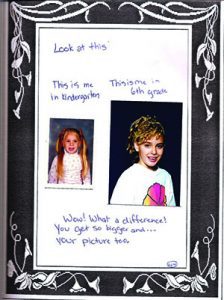
About a year ago, my parents were moving to a new house. My mom called me and told me, as any mother would, that she has a lot of old boxes that were mine that she wanted to give to me (Oh, the joys of moving!). Needless to say, when I received the boxes, and opened them, very carefully, I saw a colorful design that greeted me. A smile swept across my face. I began turning through the pages of my Autobiography, a project that I did at Barrie School in Silver Spring, Maryland, and I almost began to cry.
How different my life is now. It is amazing to re-read the dreams that inspired me at the grand old age of 11, reminding me of how significant my values, specifically those of my family, were back in those days. Those memories never change, but having my Autobiography, written so many years ago, is valuable and precious.
Back in late 2004, I remember watching The Today Show. One somber morning, Susan Saint James, an actress and a beautiful mother of five children, was being interviewed about a personal tragedy that had taken the life of her son, Teddy. During Thanksgiving that year, her husband, Dick Ebersol (a famous TV sports personality), and two of her sons (Charlie and Teddy) were aboard a plane that crashed. While Dick and Charlie survived the crash, Teddy died at the age of 14, a tragedy that took his life far too soon.
Ms. Saint James spoke so eloquently about the memories of her son and how she wanted to remember him, sharing such beautiful stories. In particular, she mentioned that Teddy had recently completed an autobiography project at his Montessori school—a project that had meant so much to her and became even more valuable after his death. At the end of the show, viewers were encouraged to write if they were interested.
Immediately, I went to the NBC website to find the address. I wrote to Ms. Saint James and Mr. Ebersol and shared my condolences. But, I also wanted to share with them that I, too, had attended a Montessori school and completed that very project. I shared that it was a project that, for me, impacted my life significantly, as it becomes so valuable when life throws curve balls. For me, it helped ‘ground’ me in the midst of my parents’ divorce, allowing me to recall memories that had become fuzzy over the years, and gave me a sense of who I was and what I valued while I was merely in middle school. Years later, getting my Autobiography back, in perfect form, wrapped carefully and placed neatly in a padded envelope, was a blessing.
I contacted Ms. Saint James to ask her if she would be willing to share her story with me — rather, Teddy’s story. I spoke with her one afternoon this past summer. I was a little nervous at first but, after about twenty seconds, my nerves faded. Ms. Saint James, who introduced herself as Susan seemed like an old friend — she was as friendly, comforting, and kind as any person I had ever met.
Susan shared that Teddy had attended a Montessori school, something that she said she wished all of her other children had done, stating, “It’s a much better way to start life out… It’s a tremendous, beautiful thing.” When the Ebersol family moved to Connecticut, they chose a nearby Montessori school for Teddy. She talked about how much Teddy loved his school, explaining, “Teddy knew as many first graders as he did eighth graders!” In particular, one project stood out. When he was in his seventh/ eighth grade program, he was responsible for completing the infamous Montessori Autobiography Project.
Now, the Autobiography is a long project, one which I remember well. It contains many chapters that discuss aspects of your life, goals for your life, important people, and so on. Susan expressed that she worked with Teddy on this project for a really long time. She remembers speaking with teachers, who “reminded” her that Teddy needed to place emphasis on other areas of his life, not solely his family members. Susan understood, but really let Teddy take the lead. Teddy was insistent on continuing to focus his project on his relationship with family members, describing favorite memories and family stories. The project was due two weeks before he graduated from his Montessori school. He finished it, doing so in his own unique style, despite his teachers’ urgings for him to include other elements of his life. Susan gave up even trying to expand his focus, she explained. She helped him organize the project and helped him with scrapbooking, but allowed him to place his own spin on it!
Months later, the unimaginable happened — Teddy died. Susan spoke of the tragedy and the incredibly painful and unexpected way in which everything happened.
As she was trying to come up with the words for the eulogy, she had great difficulty, as I imagine any parent would. During this painful time, she found Teddy’s Montessori Autobiography and was more appreciative than ever that Teddy hadn’t heeded the advice to expand his writing beyond his life experiences with his family — his life was his family. She expressed great gratitude towards her son’s school for assigning this project and allowing her to experience what he had lived for so many years, through his own words. She made numerous copies and gave them all to close family members. This, she explained, was his gift, and it “is the most precious gift in this world.”
Susan spoke of the funeral services, one of which was held in the gymnasium of the Montessori school that Teddy attended. They had chosen to hold a Quaker service and opened it to the community for anyone who wanted to come, even those affiliated with NBC, Mr. Ebersol’s network.
The community came together—members from the school, their community, the NBC family, even members of the NBA came all in unison to support the Ebersol family and recognize the life of Teddy Ebersol. Members sang four of his favorite songs before a traditional moment of silence was given, in remembrance of Teddy.
Susan remembered the silence as being “longer than comfortable.” She described the room as being packed with at least a thousand people, from all walks of life. There were students, parents, and faculty along with sports figures and other television stars. All that was asked was that, if anyone was moved to speak, they would not speak directly to Mr. or Mrs. Ebersol.
After that long pause — the one that lasted a little longer than expected — a little voice perked up. It was “a tiny little kid who spoke first,” saying that Teddy was like his “brother.” Another said, “Teddy used to bring me Fruit by the Foot™,” followed by other “little voices” of “little kids saying how much they will never forget Teddy.” His teacher later on noted, “During his Autobiography project, I’d get on him about talking too much about his family… Aren’t we glad that’s what he did?” Susan described this experience as being so precious.
Many years later, Susan is still healing. She took a lot of comfort in talking to her priest and spending time with family and friends. She described grief as being different for every person. For her, she has taken up many creative projects and finds that “Teddy is with me, always with me, all the time.” She said, she’s “looking for her second act,” including spending more time with her own pursuits, serving on the Board of her Montessori school, and spending more time with family and friends.
This interview was really about Teddy, and about how much one project can truly change the lives of others. It was also about the beauty of one person who had his own “will,” his own desire, and was confident in his abilities to express who he was, despite the rules that were given. It’s about how the Montessori Method encourages each student to be his or her own person, allowing them to take the lead and march to the beat of their own drum. And, it’s particularly about the value that a mother found in a son’s project that became a priceless gift.
Speaking with Ms. Saint James was also a gift given to me. She reminded me of how priceless life is and how we should value the things we are given, tangibly or intangibly, every day. She expressed her enthusiasm in following the human spirit, wherever it may lead, and allowing one to experience life to its fullest, no matter what obstacles it may bring. And, finally, she reminded me how precious my Montessori experience had been and how fortunate I was to have been given my own gift and my own healing.
In her parting words, she eloquently expressed her thoughts on this one component of Montessori: “There should be an obligation of doing an Autobiography. It’s tremendous!” And, I couldn’t agree more.

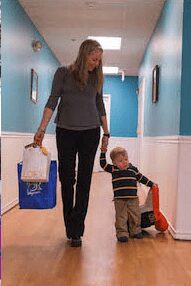
 … two against one …all that ‘boy energy’ … another sigh.