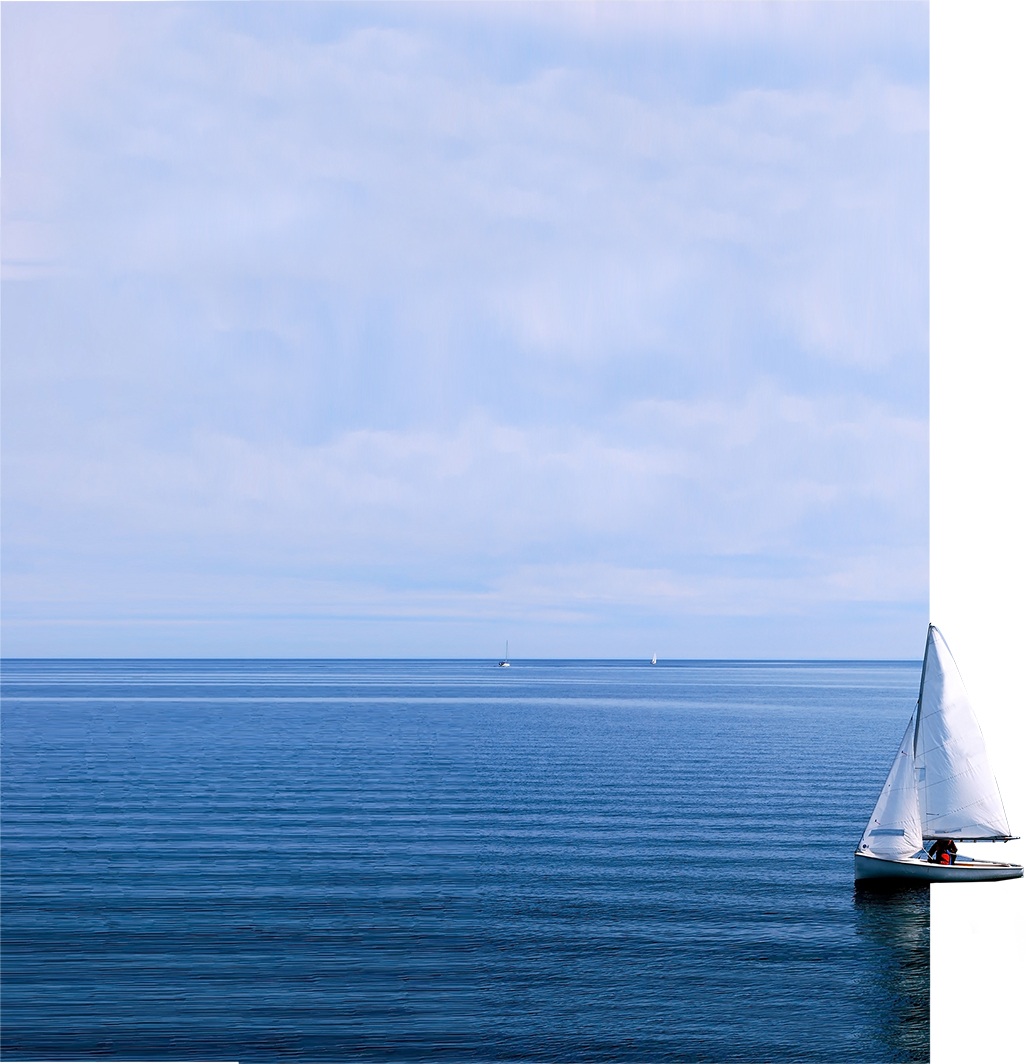
Looking over Lake Pokegama in Northern Minnesota, I was watching the beautiful white sails of the X boats gliding back and forth, propelled forward by their wind-taut sails. Sitting upon a bench above the water, I spent hour after hour tracking the wind and the boats. More than likely I was accompanied by a curmudgeon of a man, known fondly as Uncle Charlie by the campers. Uncle Charlie’s stories never ended, much like the wind and the sailors’ laughter. Sitting on that bluff, I knew that teaching sailing could open a window into a child’s desire to learn—a vessel to connect them to their world.
Oddly enough, I had never felt the joys of sailing, not on a sailing boat that is. My closest experience to boating came atop the crude rafts we would build as children to float on the small creek at the front of my childhood home “Moona,” a sheep station in the bush of Australia. These rafts were constructed of anything my brothers could get their hands on old sheep dip drums, wood, rope. Each construction resulted in an uncomfortable, unstable platform that we used to ride the crude rapids that intermittently scattered along our creek. The goal was never comfort—we weren’t trying to laze our bodies on; it was all about floating on our homemade contraption. Most of the time, these crafts slowly fell apart as the lashing (used to secure the drums to the deck) came loose…but these were the best of times.
Listening to Charlie and watching the kids, I realized: This is how children understand their surroundings; this is how they become aware of where they stand in nature. For a child to really understand their place within humanity, they must first connect to the place in which they live. This connection fosters the relationship of that place to the space they occupy. Once a child grasps this connection, the child’s mind opens to the potential of peace, freedom, and learning.
What I mean by the term place is where you live, where you spend your day, the physical location of your life. Space has a very different meaning; it is the air, the soil, the environment, to the people. It is like the description of good wine: the essence of everything that goes into making a wonderful wine, from the soil, the mist off of the hills, the sunshine to the vintner, and the barrel it is aged in. The totality of everything is reflected in the flavor of the wine. This is what is space.
As a child, our farm was my playground, filled with danger (not simple dangers, but life-threatening and catastrophic dangers). So much so that a reality TV show could be made of it, entitled “Child Survivor” or “Child vs. Wild.” But for me, this was paradise. There were snakes, spiders, scorpions, creeks, not to mention the miles and miles of bush where, as a three-year-old, I wandered uncompromised. That was my world: my teacher.
Many may wonder, how does one survive in an environment with deadly snakes and spiders that could paralyze you with a single bite? Where does a child safely play with scorpions hiding under every rock, in gullies and mountains that could swallow a child and never release him?
Growing up in Australia, I developed an acute sense of my environment out of necessity. Unawareness left me vulnerable to the ever-present dangers. I sensed the presence of a snake. With no visual cues, my body would react to the danger with heightened senses. These heightened senses governed my movement by bringing me to an immediate halt before my cognizance arrived. Slowly, my body would begin to back away, allowing my mind and consciousness to take in the surroundings. This sixth sense protected me from my childhood world.
Like the child playing in the bush of Australia, the children sailing across Lake Pokegama need to develop a keen understanding and awareness of their surroundings. The sailor must feel the wind. To glide effortlessly across any body of water, regardless of conditions, the sailor studies the movement, speed, and directional changes of the wind. After much practice, the connection to the wind becomes a part of the sailor’s environment; it becomes second nature. You know it’s there, and instinctively you detect its moods and changes. To sail well is to optimize the wind’s gifts.
E.O. Wilson, an American biologist, and researcher describes this idea as ‘biophilia’ — an innate sense that connects you biologically to your surroundings. This sense can guide you through life, protecting and helping you navigate your surroundings. It’s the feeling of calm you experience when lying under a great oak tree in soft grass or the fright that squeezes the breath from your lungs when dangling next to a cliff’s edge. All these feelings have no basis in logic. We are not told as children to be afraid of falling off a cliff, and yet we all know it. We are not told to feel calm when connected with a large oak or a sunset. We just know it.
What is the origin of this feeling? How does it develop in our minds? I call it the caution meter—that little voice that says: “Stop! Not a good idea!” The caution meter develops by experiencing as much life as we can: learning our own limitations and pushing those boundaries. The only effective caution meters are established internally, individually—not through limits and boundaries set by parents or adults.
This may fly in the face of intuition, especially for young parents who want to protect their children. They don’t want their child to get hurt. “Save the skinned knees for stories out of a book!” But the skinned knees, bruised elbows, and bumps or knocks teach us our limits. Paradoxically, they also push us to seek new heights, to test our capabilities. Without this gift of experience, we will never know what we are truly capable of. Wrapping our children in cotton wool, over-protecting them, only serves to teach children that they are not capable, they are vulnerable, and that we do not believe in them. In effect, we prevent children from developing their own caution meters.
There are secrets of the world to be discovered by each child—secrets that an adult can never reveal. Perhaps these secrets may help to understand human potential. Maybe they unlock an understanding of one’s place in the world. If children are to discover these secrets, their minds and bodies must be free. To be free is to be vulnerable or at risk. With risk comes failure. However, it is only through failure that true greatness occurs.
As a child, my mother would read to me each night before bed. I remember those evenings, vividly. My mother’s focus, free from the daily demands of running a farm and home in a harsh environment, finally turned to me. I would lie, tucked under the blankets, while she read the same book, night after night. Children love to hear the same stories repeatedly so that every detail, each nuance can be remembered. My story was Pookie the Rabbit with Wings by Ivy Wallace. Written in the early 1940s, the beautiful watercolor drawings and the magical story mesmerized me. It drew me into a world that would profoundly affect my life.
The story is told through the eyes of Pookie, a small rabbit born under a great fir tree with twelve brothers and sisters. Unlike his brothers and sisters, Pookie had two stub wings protruding out of his back. He does not fit in and is picked on at school, even made to wear the dunce cap by the teacher. Unhappy, Pookie packs a small bag and ventures to find his fortune—to find where he fits in.
The story of Pookie, his adventure and life, became the mantra of my life. From early childhood to not fitting in at school, the great wide world was a dream. Like Pookie, I also went forth into the world to seek my fortune. I sought to discover my true self, my strengths, weakness, dreams, and aspirations, to fit in. On this odyssey, I discovered many secrets, each of which has guided my life.
One secret that led me to teach is that buried deep inside each of us is a true gift. This gift distinguishes us in the world. However, few of us allow ourselves to experience enough in life to discover that true gift. As we age, we narrow our field of vision, narrow our acceptance of new ideals. Essentially, we become set in our ways; thus, blocking our true potential. Those who have found their passion bask in the light of true happiness. Their shine is contagious and undeniable.
In my travels I witnessed happiness in simple and complicated ways, through my observations and interactions with others. One interaction remains particularly vivid…
I am traveling in Morocco with a friend. Paul and I have been on the road for two weeks now, traveling south from Madrid through Granada. We have witnessed the different influences along the way: the Moorish influences of the Alhambra and the gardens of the Generalife to the dynamic British influences seen in Gibraltar. Then we crossed the Mediterranean to Tangier in Morocco. What a magical country. From Tangiers, we made our way south through Fez and the markets of Marrakesh and, finally, into the Atlas Mountains. It was here, near the small town of Asni in the mountains, that I witnessed true happiness in simple lives.
Wandering into a valley, Paul and I encountered a group of boys minding goats in the lower meadow. We wished to communicate with the boys, but we shared no common language. Soccer became our language. After playing for a while, the boys needed to return the goats to the village for the evening. Using only their hands and smiles, they invited us to the village. We worried that accepting would be impolite because the invitation hadn’t come from an adult. When we inquired about a hotel, they insisted we accompany them to their home. So we followed.
We spent every minute with that family for two days. The family of three young boys, two older sisters, and the parents shared a two-room house above the animal stores, where about 100 goats lived at night. The entire family, including Paul and I, shared everything: a large rug laid for a bed, eating together out of a tagine for meals, and the daily tasks of tending mountain goats. Living in the mountains meant the family relied upon the natural world to meet all of their needs. Despite this apparent hardship, the family bestowed hospitality, while expecting nothing in return.
The life of this family was truly hard. However, their happiness clashed starkly with the path of young people in our society today. Pressured to achieve in school, to earn admittance to a top-tier university so they may obtain a secure job, it is no surprise our young adults are so dissatisfied. This predetermined path does not necessarily incorporate the dreams and passions of each individual. Unlike the sailor connected to the wind on the water, many of us are not connected to our own place or space. We live a life hovering just outside, with a yearning to enter but unaware of how to do so. With modern world demands of adulthood, life does not allow us to “take the road less traveled” that is the mission of childhood through adolescence.
As teachers and mentors, it is our job to prepare the environment so that children can learn through multiple experiences, failures as well as successes. Laying open this path to self- discovery, we allow children to develop a true and natural understanding of themselves and their unique place within the world. We must provide the freedom to fail, so that they may succeed. ′
REFERENCES
I.V Wallace. Pookie the Rabbit with Wings, 1945.
E.O. Wilson. Biophilia,Cambridge:
Harvard University Press, 1984.
Robert Frost. The Road Not Taken, August 1915.
Reprinted and reformatted with
the permission of the author.
This article first appeared
Montessori Life magazine.
Tomorrow’s Child / April 2019 / Pg 4