Part 1: Home Strategies for Reducing Childhood Anxiety

Leave Time for Being Out of Doors

Affordable Summer Activities
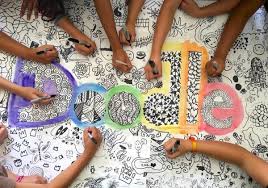
Collaborative, Inclusive Art Projects with Margot Garfield Anderson
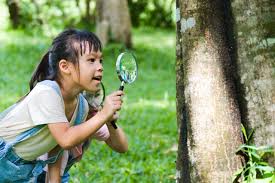
Summer Survival Guide Balancing Fun and Learning with Engaging Science Activities
Encourage the Outdoors with Exciting Equipment
by Cheryl Allen
When summer comes, we often are able to spend more time outdoors. If you have the space for a garden, or even a single plant, inviting your child to grow items with you is a great way to encourage practical life at home. Time outside at your child’s pace and exploring their interests can be just a few minutes or, when there is time and interest, a few hours together. We have gathered some items to encourage exploration outside.
These products are aligned with the Montessori philosophy. When you buy through our links, we may earn a commission.
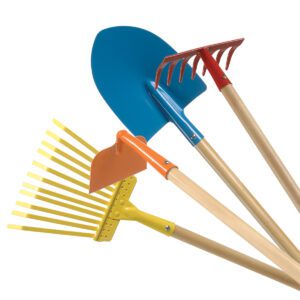
Primary Garden Tools
A set of tools for the youngest gardeners. The lighter weight and shorter handles make these tools easy for 3-5 years olds to use while gardening.
Lil’ True Temper Wheelbarrow
A child-sized wheelbarrow allows heavy work in the garden to involve the whole family.

EZ Read Rain Gauge
How much has it rained? Keeping track of the rain on this easy-to-read gauge encourages exploration of measurement and record-keeping.

The Fruits We Eat and
The Vegetables We Eat
These books by Gail Gibbons share information about how fruits and vegetables grow, where they grow, and what we eat from the plants.

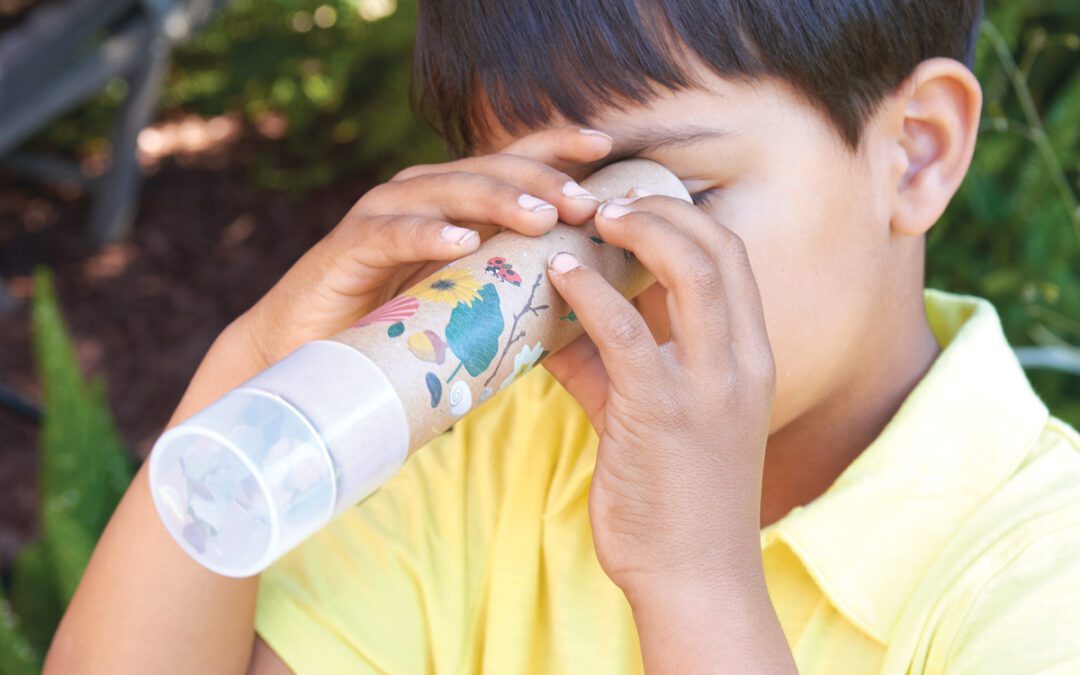
Nature Kaleidoscope
Place small items in the specially designed cup of this kaleidoscope and view the art you create.
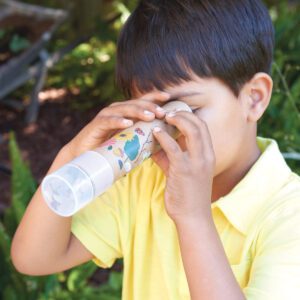
BugLoupe
Get a close-up look at bugs (or plants or rocks) without touching them. This magnifier is easy for even young children to use.

Sunprint Kit
Arrange objects on this specially treated paper, set it in the sun, rinse, and you have a piece of art.

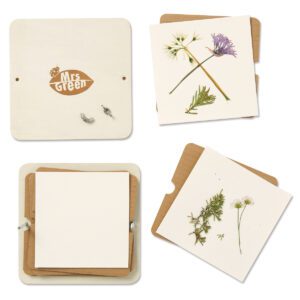
Leaf and Flower Press With Carrying Strap
This press can go on hikes with you to preserve pieces of nature you find along the way.
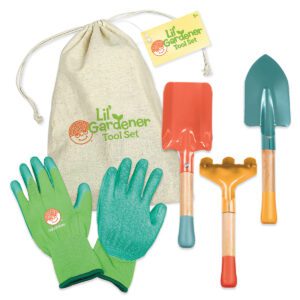
Lil’ Gardener Tool Kit
This kit includes child-sized gloves and three hand tools perfect for turning soil and digging holes.

Cheryl Allen is the Director of Parent Education for the Montessori Family Alliance and is also a parenting educator and a Montessori consultant with the Montessori Foundation. After some time as a traditional secondary teacher, she worked in Montessori classrooms, earning certifications from both AMS (3-6 and 6-9) and IMC (6-12). She is a teacher educator, workshop presenter, and member of IMC accreditation teams.
Get Kids Moving
Why Physical Play Must Be Part of the Formula When Kids Head Back to School
By Preston Blackburn

What began abruptly as a stay-at-home mandate two springs ago settled in for significantly longer than any of us expected. Fortunately, with vaccines, we are trending back toward normalcy. One of the brightest spots we are seeing is children returning to their classrooms in person.
As we get ready for a school year in the classroom rather than virtual, many educators are considering how to make up for suspected learning losses that may have occurred during a year of virtual school (Pearson, 2021). From an adult perspective, the first reaction might be to buckle down and power through as much curriculum content as possible to bridge any gaps in acquired knowledge. But is this the right answer? I would argue emphatically, no.
Play is the way kids wring out their brains. The brain is like a sponge. Once it is full, it cannot continue to absorb until it has been wrung out. As adults, we instinctively take breaks when we are working. We grab a coffee, head to the water cooler, or take a peek at social media. These breaks give the brain time to wring itself out.
Play is the way kids wring out their brains. Play is a time for resetting and relaxing their focus, so that their brains are more alert when it is time to go back to the desk. Students’ play was already being restricted before the pandemic. Reports found 44 percent of school administrators had already reduced recess and PE time to increase academics, despite studies proving that more time in recess leads to bigger gains in the classroom (Reilly, 2017). Coming back to school post-shutdown, we must remember to include play-based breaks. It is play that helps kids build strengths and motor patterns needed for classroom success, and it is play that helps kids develop social skills needed for lifetime success.
How Play Leads to Physical Skills and Strength, Leading to Classroom Success
Kids need strength in their arms, legs, necks, and core to sit at a desk, hold and move a pencil, or keep their bodies still so they can pay attention. Children build strength in play when they run, climb, and swing.
Kids need to know where their bodies end and begin, so they can transfer that information to the page as they learn to write. How much space does a letter, or a sentence take up? What direction are they moving their pencil when they write? Children learn these skills in play when they hide under the bed in a game of hide and seek or shimmy through a fence to explore what lies beyond.
Kids need to master rhythm so they can internalize patterns, which help them understand the rhythm of language, the sequence of writing, the patterns of math, the order of logic and reasoning. They develop rhythm in play while jumping, throwing, and skipping.
In addition, children’s aerobic activity releases chemicals in their brains that enhance cognition, behavior, and memory; thereby, having a direct impact on their learning trajectory. Kids get aerobic in big physical play.
These skills and strengths can only be built in movement. And children move best when they are engaged in big physical play. While some children were able to get outside and engage in big, body play during virtual schooling, many did not, spending more time on screens than ever before. As we look to bridge the academic development gap, we need to also bridge the physical development gap that grew for some of our most vulnerable students.
And we know that recess works. Consider Finland, a country known for scoring in the top levels of international academic exams. Finnish children get 15 minutes of outdoor recess in every hour of classroom time. Outdoor play allows them to explore with their bodies and gives their brains that crucial reset, helping them achieve academic success. Here in the U.S., Eagle Mountain Elementary School in Fort Worth, Texas decided to apply this theory by tripling their recess time to 60 minutes every day. Teachers worried that they would not be able to maintain their academic schedule, but by winter break, every single class was ahead of the academic schedule despite 40 fewer minutes of class time each day.
How Play Develops Social and Emotional Skills
There are the crucial social and emotional skills that can only be developed in play. When humans engage in self-directed, unstructured play, we learn how to socialize, collaborate, and read body language. We learn assertiveness, boundary setting, sharing, and restraint.
Imagine a playground filled with children engaged in play. The first thing you might notice is the sound. It is usually joyous and loud. Evolution and biology designed us to enjoy this kind of big, body, physical play. It builds key physical strengths and skills, like those listed above. It also helps children build lifetime social skills.
It might look like this: One child initiates a play idea, maybe a new idea or the continuation of a previous game. Another friend may join and suggest a modification, sending the play in a new direction. Over and over, new ideas and new alternatives surface as the play evolves. Inevitably, conflict will arise and possibly one player will become aggressive. When this happens, the other player may pull back, giving signs of displeasure with this sort of play. Or a player may have his idea dismissed and take exception, or there may not be enough equipment or material to continue the play as planned. Whatever the challenge, the players have a choice: Find a solution or the play will come to an end.
Play is the way kids wring out their brains.
How can this kind of play be woven into a child’s day?
These exchanges demonstrate the power of unstructured play. Children want the play to continue. They take ownership of the play. They are in charge of the game, they make the rules, and they have a vested interest in continuing the game. Out of this fundamental ownership grows a wealth of learning and development. And, for many children, this sort of interactive, conflict-resolving play was missing from their days during the pandemic shutdown. Many children missed out on a year of the give-and-take of listening to the ideas of peers, of sharing scarce materials, of finding a way to make the game work. The social and emotional learning that comes from this play is just as essential—maybe even more essential—as any academic skills missing from their repertoire.

How can this kind of play be woven into a child’s day? Through both structured and unstructured play. Structured play is adult-directed and designed, while children direct unstructured play. Children need both. Finding time for play in the school day is crucial for making a dent in any learning losses from the past year.
To start with, children should have unstructured play at recess every single day, for at least 30 minutes, but the more the better. There is really no excuse for eliminating this break in the day. Removing recess only makes the school day more challenging for everyone, putting stumbling blocks in front of learning.
Structured play is also crucial to children’s development. It takes place in PE but can move beyond the gym and into any learning environment with a little creativity and planning. Using play and movement in teaching helps kids secure neural connections in their brains, anchoring new knowledge. Whether it is adding physical movement to a memorization task or doing pushups to answer math problems, movement in learning helps children retain what they have learned. Believe it or not, something as simple as spelling practice can be active, sweaty, and fun. An example game can be seen above (Spelling Frenzy Relay).
Children can do these games at home, as well, with siblings or on their own.
There are many ways to add physical movement to academics. Do long division with sidewalk chalk and make it a dance. Use action words to practice rhyming. Hop down a giant number line. When students move, they learn.
All of us want children to be successful in all aspects of life. We want them to be strong students, with strong bodies, and strong friendships. These crucial skills suffered during virtual learning. We cannot further jeopardize students’ physical, social, and emotional development in the quest for checking off boxes on an academic curriculum. Play-based skills make us better people from the classroom to the boardroom. These are not skills that can be learned from an app, a computer, or flashcards. These skills are only developed in play—play that must be in every school day. •
Spelling Frenzy Relay
Work on spelling, practice teamwork, and get aerobic
Set-Up: Children are divided into teams of 2–4 children each. Each team has a set of three-letter words with one letter missing from each one (e.g., H _ T, _ I E, S E _). Scattered on the floor are cards with letters that could complete the words. The first team member finds a letter to complete one word, runs to the opposite side of the room around a cone or chair, comes back to complete the word, and tags the next teammate. Play continues until the team’s words are complete.
Change the Game:
» Instead of running, try jumping jacks, skipping, hopping, bear crawling
» Use longer words
» Make it a math game by using math facts
REFERENCES
Pearson, C. 2021. 1/11/21. “Experts Predict What School Will Look Like Next Fall.” Huffington Post retrieved from https://www.huffpost.com/entry/expertspredict-what-school-will-look-like-nextfall_l_5ffc916cc5b66f3f79601ffe
Reilly, K. 10/23/17. “Is Recess Important for Kids or a Waste of Time? Here’s What Research Says.” Time. Retrieved from https://time.com/4982061/ recess-benefits-research-debate/
Wong, A. 11/15/16. “Why Kids Need Recess.” The Atlantic

Preston Blackburn created Pop, Hop& Rock™ in 2000, when her children were preschoolers. What started as an exercise program has evolved into one that focuses on creating opportunities for children to hone fundamental motor skills, which allows them to develop physical literacy and foundational strengths, proven to help them find success socially, emotionally, behaviorally,and cognitively in the classroom and beyond.www.pophopandrock.com
Reprinted with permission from Community Playthings: www.communityplaythings.com

A Sense of Place
Engendering Love of One’s Home with Adolescents
The NewGate School, Global Campus Students, Research Their Place on Earth and Weave a Story to Share
By Amy Kremer-Treibly and Elizabeth Hale
The NewGate School’s Global Campus is composed of students in seventh through twelfth grades who live in Canada, the US, the Caymans, and Tanzania. These students are the first cohort of the Global Campus, and they work together with a dedicated faculty for humanities, math, science, and Spanish academic courses, as well as working in their home communities on creativity, physical wellness, and service.
Adolescents seek answers to key questions: Who am I? Where am I? What’s happening?
In order to gain insights and impressions of where each student resides, they set out as investigators of their own backyard, town, city, and country, with special attention to who inhabited the land first, including animals, plants, and humans. Students have been sharing their stories as presentations to the community in Opening Meetings held each morning of the week. This project offers a rich opportunity for students to explore the question of where do I find myself living right now?
During this process, students access local historical societies and talk to family and neighbors about generational memories of the place. Some students highlight developments, such as industry and railroad access. Others brought names of indigenous tribes to our attention, as well as the plants and animals that have thrived in the past and either do or do not live now. Overwhelmingly, the students learn more about where they call home. In addition to acquiring knowledge of place, by pausing and giving attention to the land that supports our lives, the people who have come before, and the bounty that nourishes us, we all grow in our appreciation and gratitude for home.
It has been said that to love a place and show true care for it, one must spend time, look with earnestness for the hidden treasures to be revealed, and then we can fully celebrate our home. Indigenous wisdom embodies connection and relationship, and for that reason, we like to include the Haudenosaunee Thanksgiving Greeting, which we read aloud in turns during Council before Thanksgiving. •
REFERENCE
Smithsonian Museum Blog. https://tinyurl.com/mvvjxu4f
Amy Kremer-Treibly, M.A. earned her Bachelor’s Degree in Anthropology at Loyola University where she also enjoyed studying Spanish during a study abroad term in Quito, Ecuador, and learning about world religions as her minor. She began her teaching career in a refugee resettlement program teaching ESL to adult students from around the world followed by teaching Spanish at the elementary level. While teaching at a Great Books Foundation high school in Arizona, she earned her Master’s Degree in Experiential Education at Prescott College with a focus on building schools and learning experiences to promote engagement, eco-literacy, and stewardship.
Elizabeth Hale teaches Humanities and other courses with NewGate School’s Global campus. She spent the last 13 years developing Heartmoor Farm Education Centre in central Virginia teaching Literature, Humanities, and Mindfulness to adolescents while nurturing her connection with the natural world specifically through contemplative practices, the stewardship of plants, and formal study of Western Herbalism. With 24 years of teaching experience, in classroom environments from Oregon and Ohio to Virginia, she has worked with families through all stages of their children’s development.

Summer Programs for Montessori Schools
This is a PDF of a PowerPoint presentation about organizing summer programs.
The Outdoor Environment
The PDF file was prepared by Sharon Caldwell.
Being in the Outdoors with Infants and Toddlers’ with Alanea Williams
Nature is calling! Time outdoors with our infants and toddlers is more important than ever today as busy family schedules, modern conveniences, and the distractions of technology keep us indoors. We will explore simple ideas for time in nature with our young children and discuss how the natural world supports healthy development.
Welcoming Spring and Getting Outdoors, Reconnecting with Nature After a Covid Winter
Tammy Willen, Head of Bay Montessori School in southern Maryland, will lead us back to our source of centering in the natural world as we look forward to spring and summer.

Nature as Our Muse
NewGate Montessori IB School (Sarasota, FL) approached the fall semester of 2020 with a bit of insight into how the school year would need to play out due to Covid concerns. I took the idea of “play out” literally and started to design an inquiry unit with nature as our muse that could have us reading and writing in and about the outdoors. My class was small and old enough to drive to most of the field experiences, and several of my students were quite interested in photography, so photography became a focal point for the unit as well,
pun intended!
Inspired by this student interest and by my roots in experiential and outdoor education, I found essays, Ted Talks, short films, photo essays, and field experiences that would allow us to learn and gather together safely and to find the numerous benefits we all know come from time experiencing and
reflecting on nature.
 Over the course of the semester we traveled all around our hometown of Sarasota, FL: Historic Spanish Point in Osprey; Turtle Beach and Midnight Pass, on the south end of Siesta Key; and the mangrove tunnels on South Lido Key. In these places, students wandered, collected details of the environment in their notebooks, read passages from nature writers, wrote poems with words and phrases taken from signage, surveyed seagrass for the county, and took photographs.
Back in our Zoom rooms, we wrote reflections and responses to the various forms of ‘texts’ we encountered.
Students practiced writing responses that included summarizing skills and critical thinking about the texts. Each response also included a reflective component that asked them how the text or experience related to their personal development as human beings.
 Enough of my words; now some of theirs:
“I learned that nature surprises us in many ways when wandering … I also learned that no matter where you wander, it will always give you satisfaction.
Thoreau felt that people stay inside all day because of either their job or their responsibilities, leaving them with a tight schedule that has little room for them to enjoy the outdoors. I should know, because I spend most of my days indoors while going outside for almost half an hour to get some vitamin D in my body.
Sadly, Thoreau would not approve of my method because I know that it is important to take a break from electronic devices and walk a little. For Thoreau, in his own words, “you must walk like a camel, which is said to be the only beast that ruminates when walking.” What he means is that when we walk, we tend to deeply focus on certain topics that haven’t crossed our minds.”
The Shining Sun
Much like a turtle
That lays in its shell,
I lay on the sand
And gaze the horizon view
The heron stands stiff
On the crescent beach,
Its lyric becomes a groan
While I settle on Midnight Pass
Ignoring what is known
And even though I lay so still
And make such a blind pass,
It’s as if I’m a crab
That digs deep in the ground,
Moving all over the beach.
—Jackson Prodger
It’s not a good habit for people to be inside working and doing responsibilities all day. You must get outside and walk to get rid of the ‘rust’ you have acquired sitting indoors. Thoreau extolled the experience of getting outside into the natural world to see, smell, and hear things you cannot inside. In addition, letting go, not having to worry about anything other than what you are doing at this moment in time.
I completely believe that spending time outdoors helps in many ways with the body. I have found that going outside is very relaxing and being able to breathe fresh air is refreshing. I find going outside for 20 to 30 minutes is very good for refocusing. Personally, I go outside and take pictures, then come back inside to take my mind off of things for the time being. Immersing ourselves in nature makes us feel alive and can be a de-stresser.”
—Koy Jacobsen
Thoreau saw it as a sin to stay inside without at least one walk a day; he was enthralled by nature and wanted to experience it as much as he could. He claimed that walking is not akin to exercise, and that he knows who walks and who does not. I spend a good amount of time indoors, but I try to get out at least once a day, whether I am skating, swimming, or biking. Even if I don’t get outside, I consistently have my window open to let a breeze in and listen to the outside world. Would Thoreau approve of this? Well, it’s hard to tell. In my opinion, I don’t think he would disapprove, but that being said I think he would still advocate to get out more. That is something I’ve been doing, but I’ve been needing to go further and just walk around in nature. Thoreau saw walking more as a means for meditation rather than for exercise. The phrase “it’s not about the destination, but it’s about the journey” rings true for Thoreau.
As I sit on Turtle Beach
I look at the horizon view
Listening to the ocean’s lyric— the waves crash
Saltwater splashes the surf
The heron standing still, waiting for its next victim
All of this near Midnight Pass
But I wander to Blind Pass.”
—Andrew Halperin
The first time I went to Historic Spanish Point I did not recognize the sights it had to offer. When wandering throughout Historic Spanish Point on a class trip, I came across many spots which stood out to me. Everyone who visits sees something different. Where one finds beauty in the bay, someone else may find it in the graveyard. If people continue not to see the beauty in protected areas, then sooner or later those places will evaporate and cease to exist. I hope these pictures (above) inspire you to go out, support your local protected areas and keep them alive so future generations can experience what makes that place beautiful to them.
During our time at Historic Spanish Point I walked to the Little Sarasota Bay which reflected the sun back into my eyes. The trees flanking either side of my view are known as Ponytail Palms, a native tree to eastern Mexico, which swayed in the breeze above the water. This very bay has been an important natural resource for many who have called it home due to its abundance of fish, shellfish, and other sources
of wildlife.
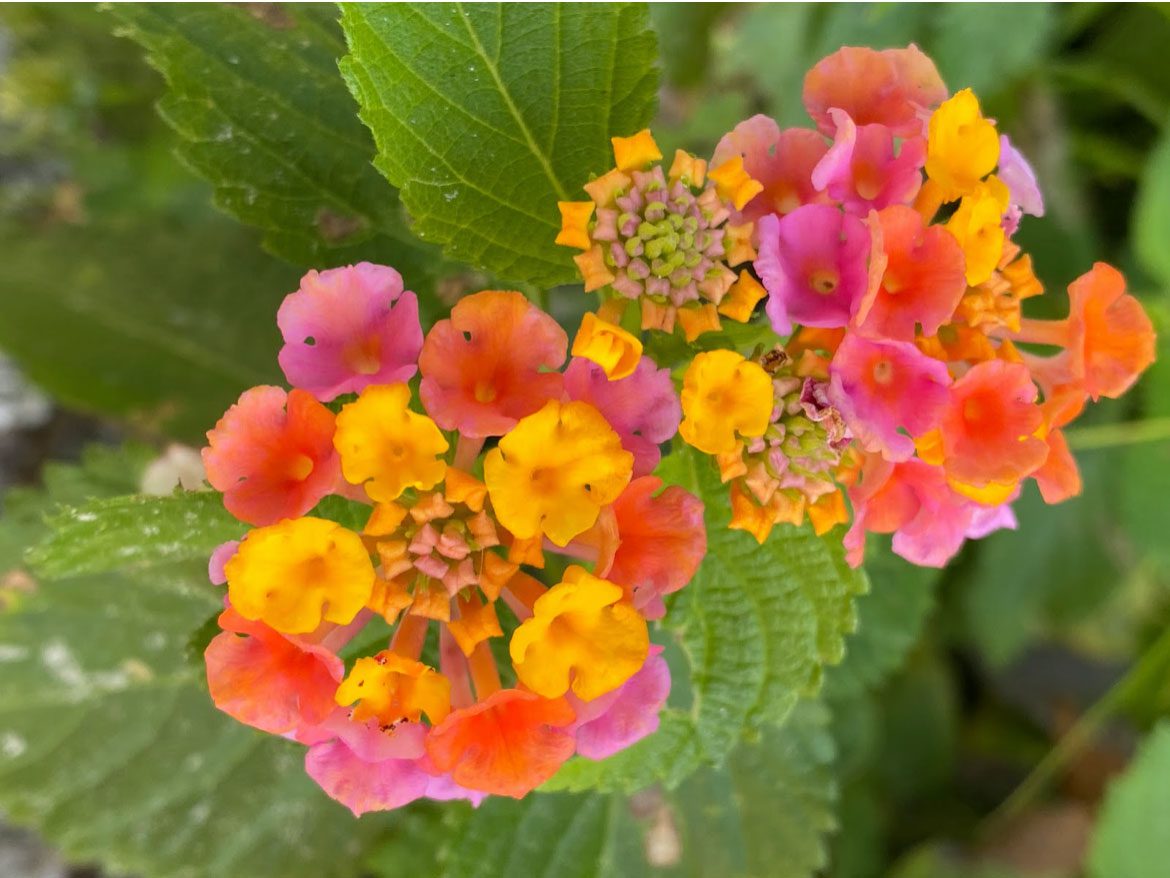
Walking along a path towards the bay, I came across a tiny cluster of small pink, yellow, and orange flowers. Secluded on their own in the middle of a trail, these two bundles of flowers caught my eye against the green brush.
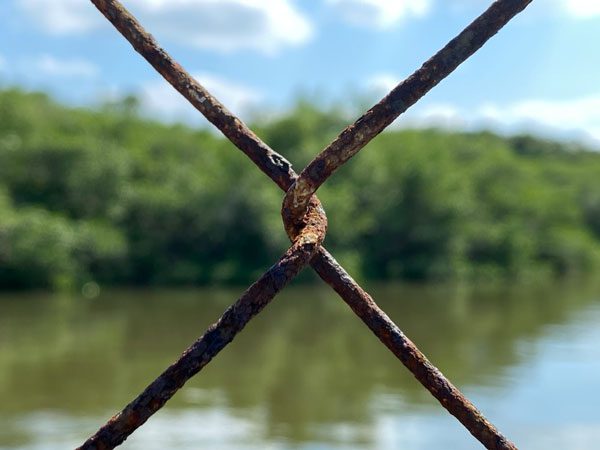
Cock’s Footbridge is connecting two strips of land at Historic Spanish Point. Due to the salt water getting kicked up into the air and onto the fence, it slowly ate away at the metal and rusted it. This picture was taken because of the clear texture and color presented onto the wire.
Day on the Beach
Near Midnight pass
I could smell the fresh sawgrass
On horizon’s view
The sky faded from white to light blue
The crisp navy blue ocean stretched from beaches end to the horizon
Filling the air with salt
The boats swiftly glided atop of the water
Which I can confirm was wet
I sat atop some sand to write when
I was amazed to see a 6’2” heron pass by
Crabs darted back and forth,
In and out of the sand
When sitting on the sand I thought back to someone who said “sand is coarse,
rough, and it gets everywhere”
—Nick Cavanaugh

Build a Playground


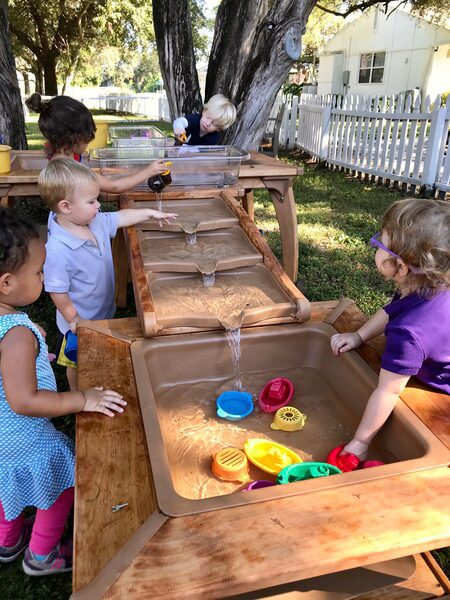
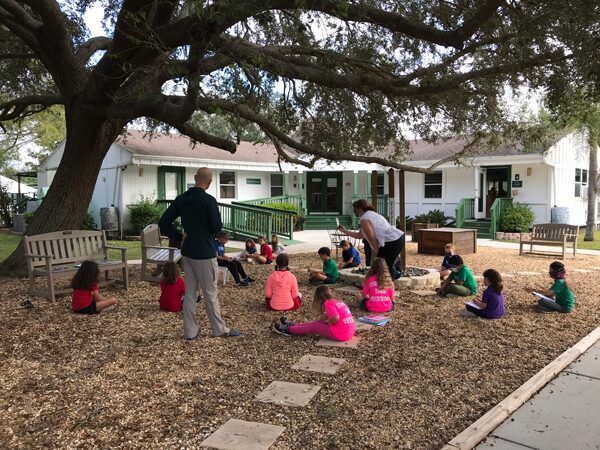

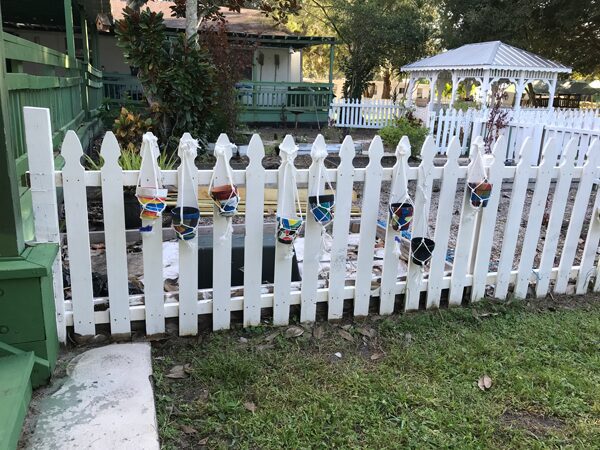

Tanya Ryskind examines the benefits of building a playground
After several years as a Montessori parent, I changed careers to become a Montessori teacher. Today, I am the Head of NewGate School, the Lab School of the Montessori Foundation, and charged with establishing a COVID task force to guide our school’s policies and procedures to mitigate risk and open safely. Our local health departments told us that maintaining physical distance and working outside was one way to reduce exposure and transmission. This year with the stressors of COVID-19, social tensions, and the uncertainty of whether to send our children to school or keep them home, my husband and I started to reflect upon what kept our children in Montessori through high school. We also wondered how parents of young children and elementary school-aged students were handling the situation. Did they feel safe sending their children back to school? Did they live in a state that closed schools indefinitely? How would I respond to parents’ needs at NewGate? How does a family stay connected to their teachers, their children’s friends, and follow state and local guidelines? I found my husband’s words profound. I listened to him from my new perspective as a school leader. He said, “What your school needs to do is build a playground like we did.” Last year, the NewGate buildings and grounds committee helped transform the peace garden into a contemporary rock garden giving the heart of our campus an inspirational renovation. This year, however, we needed to do more, we needed more appropriate work environments for our students. At the toddler level, we needed to rethink and add to our playscapes. At the elementary level, we needed to do more gardening and botanical studies. Our secondary students needed more outdoor seating that protected them from the sun while adjusting for social distancing. In a comprehensive manual from Harvard T. H. Chan School of Public Health, “Schools for Health, Risk Reduction Strategies for Reopening Schools,” June 2020, the authors outline multiple essential strategies for reopening schools and mitigating health risks. To help envision the true potential of these outdoor spaces, I went backward in time. “You need to build a playground like we did,” is what my husband said. When our children were in the infant/toddler and early childhood classrooms, our Montessori school had to move the playground to accommodate a building project. Over several weekends, my husband and I would make the 30-minute commute to our school on the weekend to volunteer to move the playground. Relocating the play area included cutting the sod and carrying it to the new location. It was backbreaking work. Having the three-year-old and infant in tow, I spent time pouring water and hanging out with other parents who had children. Throughout these weekends, we bonded. We discussed the hopes and dreams we had for our children. The laborers kept their energy up by sharing jokes and talking about their jobs. Mostly we heard, “How did we get roped into this?” Twenty-four years later, a group of masked NewGate parents came together to shovel gravel in the heat of the Florida sunshine to create a bike track for toddlers. They trimmed hedges and cleared areas where beautiful wooden playscapes and a treehouse would sit. The adults laughed and shared their hopes and dreams for their children. They cracked jokes. When family isolating is the protocol, in the open air, six feet away, parents of young children were bonding. What I saw reminded me of our family’s experience at our Montessori school. My husband and I believed then and now that we were in partnership with our Montessori school; the teachers, administrators, and other parents. The image of NewGate parents on the toddler playground showed me the replicable nature of our schools. NewGate parents were working as a team for the betterment of their school. Remembering our playground days and watching NewGate’s playground days highlights how a Montessori education gives us an education that focuses on partnership, independence, mutual trust, and respect, on both individual achievement and collaboration. The Harvard public health manual’s healthy activities section specifically outlines five pertinent areas: provide recess; modify physical education, continue sports with enhanced controls, add structure to free time, and reimagine music and theater classes. My husband and I helped build a play area that included a labyrinth, a large area for an organic garden, wood stumps for hopping or running around, a small treehouse, and a spectacular maple tree that would come to be called the giving tree. Over the years, our children strengthened their large motor skills and learned to play fairly. As a young adolescent, our daughter had serious talks with friends about her next steps and what the future looked like. The “playground” we built continues to serve children and families as a safe place, now a safe place to breathe without facial coverings. <h3>Each of the five pertinent parts outlined in the Harvard manual has a bulleted list of suggested activities. These guidelines include:</h3>- Move outdoors.
- Play outdoors as much as possible.
- Do not limit children’s access to recess, the schoolyard, or fixed play equipment.
- Hold physical education classes outdoors when possible.

Summertime Montessori Fun for the Whole Family
Not all Montessori schools run summer programs, but with some careful planning, you can keep your children fully engaged in learning and maintaining skills without having to micromanage them.
Over the years, we’ve gathered lots of ideas from lots of places. We’ll just list a few of them here with some guiding principles to keep it in the ‘Montessori Way’ of parenting.
Picking Produce
Many local farms have all-you-can-pick opportunities, and some even have hayrides, petting zoos, educational programs, or festivals to enjoy. Check to see what’s available in your area. Children love being outside, connecting with the earth. Families can easily make a day out of this activity. One big consideration for my family is the subject of pesticides. We try to find organic farms. If not, we highly recommend you very thoroughly wash and dry your purchases with a natural product designed to help remove some of the residue.
Casually engage children in a discussion of the seasons. See if the farm offers any small talks for children about the crop being harvested or cooking classes, and have a plan for what you are going to do with your pickings when you get home. Depending on the age of the children, vegetables can be roasted, blanched and frozen, cleaned and eaten raw, or put into soups or stews to be put away for cooler weather.
Fruits. Just thinking about all the summer fruits makes your mouth water. Of course, being able to eat fruit and vegetables fresh off the vine or tree is the best way to enjoy, but cold summer fruit soups can be delicious if some of your pickings become a bit too soft to use. When my twins were infants, I took that fruit, milled, and pureed it and then froze it in small batches. I did this with vegetables as well.
Strawberries, blueberries, raspberries, and blackberries are delicious if you place on a baking sheet, separated out and then frozen; same with grapes. Children love to eat frozen fruit on a hot summer day, and berries are super-fruits!
My daughters, now mothers to my four adorable granddaughters, plant summer gardens each year. The girls tend the garden by watering and weeding. They check the plants all through the growing season and delight in showing me the progress when we Facetime. My youngest, Harper, LOVES basil and eats it as soon as it’s ready. Little cherry tomatoes are a universal favorite for all my girls. Allowing young children to tend to their plants gives them an introduction to the cosmic nature of all living things, a responsibility for a living thing, and opens up discussion topics to keep them engaged.
Sand and Water Play
For those fortunate to live near a beach or lake with shorelines, you already know how much children enjoy this kind of outing.
Building sand castles can turn into short little lessons on geometry or discussions about ancient castles and how long they took to build. Building or playing during the tides can turn into short discussions about the effects of the moon on tides. Hunting for shells introduces some zoology if you know what animals live in the shells. Beach shops usually carry those beautifully illustrated or photographed books that can help you and your children make identifications. Of course, we discourage any collection of shells still containing their inhabitants.
Our grandchildren don’t live near this kind of body of water, so they had sand tables and did lots of table washing and water painting on all the surfaces (my feet usually prime targets) with both brushes and sponges. Children love to squeeze sponges, and this is a great way for them to develop strong grips. For younger children, table washing is one of the first practical life lessons at the primary level. Table washing is great preparation for writing. It also helps develop hand/eye coordination, and an extra benefit is that your outdoor furniture can stay nice and clean if you let them enjoy this activity.
Woodworking
Children love to use tools. Many schools introduce woodworking with young children using real tools made for smaller hands. There are easy kits for those that don’t have the skills to create their own, and there are many projects on websites, such as Pinterest, for more experienced builders. The important thing to remember is that parents let the child actually do the work with you, making sure to follow safety protocols. Try to estimate how long a project might take so that it can be segmented into intervals that will hold their attention and are geared towards their level of handling tools. Talk about the different shapes and angles the pieces have to reinforce geometry. Try letting them count the pieces, read the instructions (if they are old enough), or figure out directions from the pictures for younger children. Talk about the scale of what you are building to reinforce some concepts such as big and small; tall and short; hard and soft; the kind of materials, e.g,, metal or wood, etc,). Besides having a great experience with your children, you are aiding them in keeping up on skills learned during the school year, along with some new ones.
Family Drives
Need to be in the car with your children on a long drive? Don’t want to simply hand them a device to lock them into for countless hours of mind-numbing screen time? It might feel a bit old fashioned, but my dad and I searched for license plates from different states. We had a map of the US and stamps with sample license plates. When we both spied one, I put the stamp on the state. Then we’d count how many were able to spot. We’d be listening to classical music on the radio, and he’d tell me the story of the music. Not only was this precious and special time with my dad, who was on the road much of the week, it reinforced my love of classical music that I value to this day.
Not into license plates? Try having your child be the navigator using a paper map or compass? These are great almost lost skills for anyone to have.
Have them read road signs. One summer I challenged my granddaughter to an hour of reading every day. She was huffing and puffing over this, but when we added up all the time she was in charge of reading any kind of instructions for recipes or art projects, road signs, or directions on a map along with some book reading, she was shocked that an hour or more was achieved without her even realizing.
Rainy Days
Summertime isn’t all sunshine time. What to do on rainy days? My go to is always the public library. I take my girls to different locations so they don’t get bored. Libraries often have all kinds of free or very low-cost activities for children. Story times, craft projects, movies, games, etc. Check in with your library for their schedule. And, of course, let children pick out some books to bring home. Many libraries have bookstores where you can purchase used books for pennies on the dollar. Children love counting out the money and choosing a book for themselves. Lessons in money are important skills to help children learn to budget and understand the bigger picture of using money.
Children’s Museums
All my girls grew up going to museums. I was an art major in college, and sharing my love of art with them was important to me. As a child, my mother took me to museums, galleries, and art events at a very early age, and it was always the highlight of my time with her. Many museums have free or low-cost activities for children. Look online for these kinds of events and use them as your rainy-day experiences.
Supermarket Shopping
My youngest granddaughter used to LOVE going food shopping when I was visiting. I let her pick out the fruit and vegetables and put them on the scales to weigh them and print out the labels. We’d always stop at the fish counter, where the live lobsters were kept. The people behind the counter loved to take out a lobster and give her a short lesson on the life of a lobster. When we got home, we’d cut up a plate of rainbow-colored fruits and vegetables for our snack. When children are engaged in the process of food selection, they are more apt to be willing to try a variety when offered.
Summer Holidays
Between Memorial Day and Labor Day, some of the most important holidays in American history take place. It’s easy to just say it’s another day to party or day to wear red, white, and blue, but sharing the important of history with children is important. Towns and cities usually host events that celebrate with booths that have all kinds of related activities for children. Pinterest can also help you find some fun projects. Baking a cake and using sliced strawberries and blueberries as the stars and stripes on the American flag is a great way to review counting and recounting the story of American freedom. Our story of obtaining freedom is one all children should remember and since the 4th of July falls right in the middle of the summer break, it’s a great one to use for some civics lessons.
These are just a few of the ways parents and grandparents can help them retain skills learned during the year without too many power struggles.
The Wonder of Woodwork
In this broadcast, Pete Moorhouse explains just how valuable the experience of woodwork can be for young children. Across the world, we are seeing a renewed interest in woodwork. He will be discussing how to introduce woodwork and encourage children’s creativity and will share information about the most suitable tools for young hands and address any safety concerns.
What to Say Instead of “Be Careful”
So many adults are always telling children to, “Be careful.” What message are children getting about the world? Lorna has some ideas about the message and how to change that message into more empowering thoughts and build problem-solving skills.
Featured
-
 Montessori Family Alliance School Group Membership (Print & Digital 2026 1/2 year pricing)
Original price was: $30.00.$15.00Current price is: $15.00.
Montessori Family Alliance School Group Membership (Print & Digital 2026 1/2 year pricing)
Original price was: $30.00.$15.00Current price is: $15.00.
-
The Montessori Way, Revised and Expanded: An Education for Life; A Comprehensive Guide for Parents and Teachers
$25.00
-
The Montessori Child: A Parent's Guide to Raising Capable Children with Creative Minds and Compassionate Hearts (The Parents' Guide to Montessori)
$20.00
-
The Montessori Toddler: A Parent's Guide to Raising a Curious and Responsible Human Being (The Parents' Guide to Montessori)
$20.00
-
Montessori in Action: Building Resilient Montessori Schools 1st Edition
$29.95