 As parents, we now have a choice to make regarding how we approach this paradox in our own household. How do we balance freedom and limits? When do we give a choice and when do we just make the choice? How much stuff do we have readily available in our homes, and how much more should we bring in? Gosh, with the selection of choices available to us, we might be a little bit overwhelmed and unsure of how to choose. Now just imagine being a two-year-old trying to negotiate the choices that confront us daily in this world.
Failure is not an option; neither is success. An interesting idea. But isn’t it true that we learn most effectively when we’ve had to figure out a problem through trial and error?
On my typewriter (remember those things?) during my early 20s, I had a saying taped to it that read: “Babe Ruth struck out 1,330 times.”
Goodness, was I afraid of failure. Somehow I had snuffed out any risk taking in my life or looking like I didn’t know something. The quest for the good grade or the recognition for a job well done created a sickening feeling of fear in the pit of my stomach. A highly critical boss, who today we would say was verbally abusive, didn’t ease my situation. I was terrified of making a mistake.
Luckily, I had friends who could fall flat on their faces doing something new, laugh, and get right back up. I admired their verve and I tried to model some of their unflappability.
When I started looking for and believing in ways to be friendly with error for myself, I began to see an imperfect world that struggled towards perfection, but never actually arrived to that point. Everybody made mistakes.
The important work I learned through my trials and errors was to engage in new activities with new ideas and new people. I discovered that learning and growth occurred at the leading edge of my experimenting.
As we experiment with the new we should try to minimize risk, control variables as well as understand the consequences and opportunities of our endeavors. I think we used to call this common sense.
Of course when we are trying something new, we want to minimize the risk for failure or injury. We want to ensure success. Want to learn how to climb a hundred foot rock wall? First, learn to tie a bowline, how to put on a climbing harness, and find an experienced teacher. In short, learn to play safe and the next step seems challenging but headed in the right direction – up!
We also need to control the variables when we are learning so that we can focus and maximize what is put in our brain. This is one of the reasons for the advice to study with the radio/tv/computer/music off. Memory works differently in every person, and what may seem like background noise to one person may be the main attraction for another. Studying for an algebra test with Lady Gaga in the background? You might learn more lyrics than linear regressions.
Clarity supports positive learning experiences. If we know what we are supposed to be learning and why, the variables for learning can be addressed.
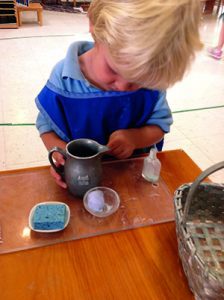
To be friendly with error means understanding the consequences of our actions. In Montessori classrooms, we show three-year-olds how to use glassware and other fragile items. Yes, objects get broken, but the child who breaks a glass learns to self-correct by moving more carefully. The child who witnesses a breakage also learns about consequences. As adults, we realize that the crystal bowl may break but recognize that when an accident occurs important learning follows.
True learning occurs at the edge of experimentation, and we should create opportunities for children’s investigation and exploration in a wide variety of situations that includes tools, people, ideas and nature. We prepare a place for this experimentation (aka learning) that can be directed through minimizing risk, controlling variables, and understanding consequences. We want to create places where ideas, tools, people and the outdoors can be explored, experienced and evaluated. We want to create places where everyone wants to be in the game of life, even if they’ve struck out 1,330 times.
Life is a ball. Play ball!