Last week was the first session of “Montessori Talks to Parents,” a series of six meetings. It is but one opportunity from among a rich offering from the parent education committee. I laud their efforts. In trying to respond to your needs, the committee is offering a variety of programs focused on Montessori education, parenting skills, and broader issues of child development. Sessions are being offered during the evening and at different times during the day. Some are directed by school staff, others by parents and others by outside experts.
So I found myself sitting with twenty parents to discuss the prepared environment of the home. There was no lecture – I hope they weren’t disappointed–because we all, as parents, struggle with these issues, and it was much more valuable to hear from each other and to compare notes on the range of responses to universal issues of parenting – all within the context of Montessori thought as presented in a little magazine distributed to participants.
The prepared environment of the home – what does that mean to them? They identified many issues central to child rearing from a Montessori point of view. We talked about “child proofing” a home. Yes, it’s important to prevent children from endangering themselves, so use safety latches on the cupboards containing household chemicals. However, children need to explore in order to learn, and they have a powerful need to belong to the family. So don’t imprison children in playpens.
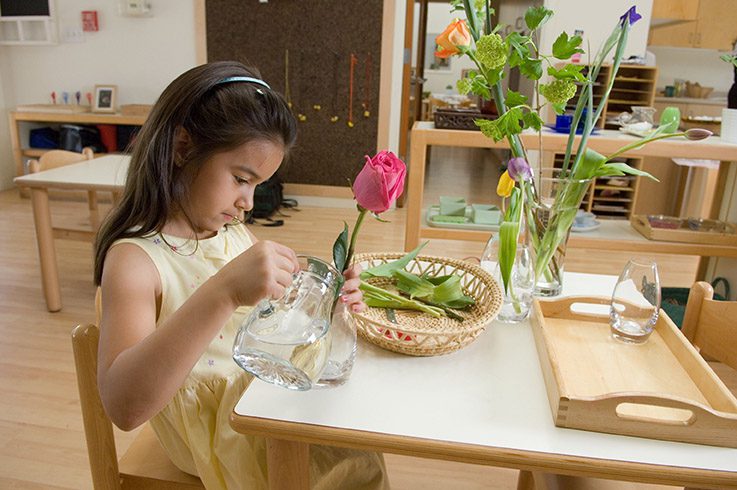
We talked about Montessori’s recommendation that every room of the house have a “child’s corner” because young children always want to be where you are. We talked about putting up breakables. It was pointed out that children will learn to respect your wishes regarding fragile items–either to handle them gently or to look but not touch–if you take the time to instruct them. Remember, though, that young visitors to your home may not have learned the same lessons. It was also suggested that irreplaceable heirlooms be put away if leaving them out will make you uncomfortable. For less valuable breakables, children learn the lessons of graceful controlled movement when they can see the results of their actions. For this reason, and for their intrinsic beauty, which children do appreciate, it is better to use glass drinking vessels rather than plastic. If it bounces when you drop it, what’s the motivation for being more attentive?
We talked about helping the child to achieve independence. Are your children able to get a snack for themselves? Parents talked about different ways to enable this. Put a low table and chairs in the kitchen, and put containers of healthy snack food on low shelves in the cupboard and refrigerator. We also talked about baby sitters and grandmothers who would rather feed the child than help him feed himself.
At what age can children begin to dress themselves? When can they choose their own clothes? How do you limit their choices? How are their clothes stored? At what age can children begin to wash their own clothes? The variety of answers to these questions gave everyone something to think about. The struggle Kathy and I had to persuade an eighteen year-old of the virtue in learning to do his own laundry would have been vastly relieved had we taught him to do so at six years-old as one mother has done in her house. Montessori said we enslave children when we fail to help them achieve independence.
And what about toys? There were some wonderful responses to why people use low shelves instead of toy boxes. As one person said, “Would you like to have all of your things piled in a big box?” We talked about limiting the number of toys and games on the shelf at any one time. When asked how many was the right number, one parent suggested no more than the child can care for. Another parent has a system of rotating toys between the shelf and the attic so that old favorites seem new when they reappear. Several parents help their children to learn about selflessness and giving by teaching them to donate toys that are in good repair but no longer used to hospitals, shelters or charities.
We laughed; we puzzled over our own conundrums; we asked, “How many of you do this?”; and I hope we deepened our partnership an inch or two more.
We want to once again thank John Long and the Post Oak School for allowing us to republish John’s wonderful essays in Tomorrow’s Child and in our online resource collections.