
Sometimes when I read or hear an advertisement for a school, I just marvel at some of the terms that are used, implying that some particular school does something so worthwhile that you absolutely must enroll your children. Often, these traditional schools are promoting exactly what thousands of children have experienced in Montessori schools for the past hundred years. So, here are some secrets that traditional schools (public and private) don’t want you to know.
Your Child Is Unique.
Everybody says that and, as parents, we know that to be true. All we have to do is take a close look at our own families. Our children and grandchildren are different even from their siblings. Unless you have identical twins, it’s pretty useless to expect the exact same growth, developmental markers, learning styles, or interests. Even twins are their own persons with differences in personality that make them unique.
 Traditional education, on the other hand, is geared to serve the needs of the average child en masse. In the early 20th century, when schooling became available to a greater number of children, schools were actually designed to produce a much-needed supply of factory workers. Curriculum was designed to meet the needs of the ‘average’ American child, which required a curriculum that was achievable by the majority. With this goal in mind, how could schools have enough resources to individualize a common curriculum to meet the needs of students who did not conform, either by being too advanced for their years or by being challenged by disability or circumstance? It couldn’t and it didn’t.
Dr. Maria Montessori saw this as an opportunity to try something different by creating what we now call a ‘casa’ for the children of underprivileged factory workers in Rome. In 1907, she was able to open a classroom for these street urchins who were quite literally running amok while their parents were at work.
The world was amazed at the success of her program, and Montessori schools began to take hold, showing that what worked with severely disadvantaged children would work even better with ‘normal’ children.
The Montessori Method’s ability to serve a diverse population may be the reason behind a common misperception that Montessori is either 1) just for the gifted and talented or 2) specifically designed for students with a wide scope of learning exceptionalities. Neither assumption is true.
The most important concept to acknowledge is that while Montessori is really different from other traditional approaches, the resulting content of a Montessori education is not so different from what is learned in traditional programs. The difference is in the delivery and the outcomes.
In Montessori classrooms, from Infancy through Secondary, each child is allowed to maintain the personal integrity and uniqueness with which they were born. While Montessori may not be the right fit for every student or every family, in general, it works very well for children and parents who, for whatever reason, want something different and who are comfortable with taking the path less chosen.
Today’s Cutting-Edge Curriculum Was Borrowed From Montessori (It Just Took Traditional Schools 100+ Years to Begin to Catch Up).
Some of the best advances in contemporary, cutting-edge curriculum and classroom environments, such as child-sized furniture, self-correcting manipulatives, and hands-on learning are not new to Montessorians.
Dr. Montessori developed these amazing advances more than one hundred years ago. Neither is “learning at your own pace.” Traditional public and private schools for children of all ages openly use these terms as if they were just invented! Montessori children have had them all along.
Montessori Has A Very Well-Defined Curriculum.
A shocking number of college graduates with degrees in education know nothing about the Montessori Method. I don’t know exactly why that is, except that maybe the ongoing need for trained assembly-line teachers, who are willing to teach to the test, is so great that there is no room to include the pedagogical and developmental discussions that comprise so much of Montessori teacher training.
Montessori teachers come to Montessori from all walks of life. Some already have a degree in education and turn to Montessori to re-ignite the spark that has long been dimmed in traditional schools; others come from different professions (such as, doctors, lawyers, banking, opera singers, and more); many are parents. Regardless of what these future Montessori teachers bring to the table, training for Montessori certification at every level takes two to three years of study and internship, and that is on top of whatever college and post-graduate degrees they may have
already earned.
Montessori’s curriculum is often referred to as the “Scope & Sequence.” It includes every Montessori material and every lesson from Infants to Upper Elementary (age 12), and, whenever possible, it is aligned to the Common Core Standards. Even a ‘simple’ lesson, such as washing a table, has more than 30 steps. At the higher, more abstract levels, older students transition from the Montessori manipulative materials to equally detailed lessons that correspond nicely to what is being taught in other, more traditional programs, with the exception that Montessori adds ‘real-life’ experiences to make the learning process relevant, memorable, and usually less painful.
Montessori Classrooms Are Beautiful and Calm
Did you know that dogs can smell stress? Well, it’s true. This is a secret of working in stressful situations (such as competitive events) with dogs: disguise the scent of stress by popping a mint in your mouth, because if you, as the handler, are stressed, your dog will know it. We like to say, “It goes down the leash.”
Going back to children, what do you think happens when they are required to endure a stressful school environment day after day
after day? Row after row after row. Most teachers know that their employment depends on their students’ test scores. Do you remember the humiliation of a teacher walking down a row of desks to return a less-than-stellar test paper in full view of other class members? Unfortunately, I do.
In younger classes, stress often takes the form of chaos, comprised of noise and un-focused activity. Often, the teacher needs to raise her voice to command attention, At the high school levels, the stress is palpable as teachers and students struggle to keep up with hormones and state-mandated curriculum— their futures seemingly at stake based on the outcome of their efforts.
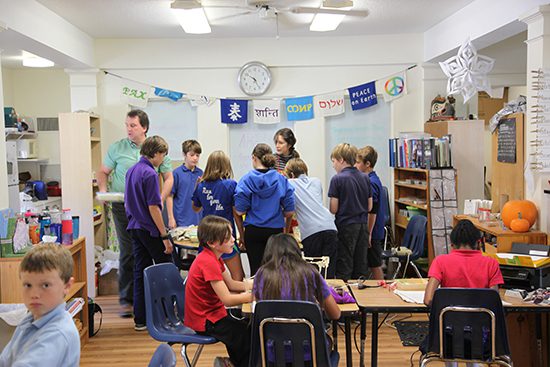
If you can, visit different types of schools before deciding on Montessori. Then, visit a Montessori classroom. Although there will be a buzz of activity in Montessori classrooms, the energy is good. It is a learning environment. No matter how ‘highly’ (code for ‘overly’) energized the child, when she enters her classroom, decorum prevails. It is not imposed on the classroom; it is the classroom.
Instead of the garish primary colors often found in early learning environments, the colors of the walls, the curtains, and the flooring are neutral and soothing. There is plenty of color in the Montessori materials that have special places on wooden shelves or the vases of flowers. The materials are made from heavy wood, polished or painted to perfection.
There is substance and gravitas that entices and grounds young students. Posters of far-away lands and famous artwork adorn the walls. Children work where they are comfortable, which may be at a table or on the floor, alone or in small groups. They are given the opportunity of choice and the responsibility of caring for and about themselves, their environment, and their classmates. Often, music accompanies the children as they work. It is a place of calm, where learning happens.
Montessori Schools Are Not Afraid to Test. While Montessori schools may not endorse standardized or any other form of testing, it is not because they fear that students are too fragile for this particular ‘real-world’ experience. Montessori teachers, who have been with their students for three years, are well-tuned to their students’ needs.
They observe and make notes. Many schools are now using computer software, such as MontessoriCompass, to simplify the note-taking process for teachers and to allow parents to follow their child’s progress online. Montessorians are very dedicated to ensuring that students in their care learn all the tools that they will need for college and beyond; this includes testing. The difference for Montessori educators is that they feel no need to test in order to compare students against other students.
Instead of using testing as a weapon to control funding, employment, and allocation of resources, testing in Montessori is just one more way to make sure that learning is happening. At NewGate (the Montessori Foundation’s Lab School in Sarasota, FL), we ran a pilot program using the Scantron Global Scholars Performance Series formative assessment program last year to help teachers understand what information and lessons students have already mastered. Students are invited to use the untimed, highly individualized online testing in class, one at a time, and it has proven to be a valuable and enjoyable classroom resource. In fact, most students enjoy it!
Although nationally standardized and correlated to the Common Core State Standards, this is very different from the once-a-year week-long high stakes achievement tests used in many schools. It allows us to track students’ ongoing individual academic progress over the years. It also gives them excellent practice in test taking skills. Beginning this fall, we invited interested Montessori schools to join the Montessori formative assessment program. Contact Montessori Foundation President, Tim Seldin, for more information (timseldin@montessori.org).
Montessori High Schools DO Exist. Everything that parents and students love about Early Childhood and Elementary Montessori experiences is becoming more available at the high school level. Some schools have adopted Dr. Montessori’s Erdkinder approach, which involves creation of a self-sustaining young adult community that lives and works together in an agriculture environment; more often, other schools have adapted Montessori curriculum to meet the needs of young adults in urban and suburban areas.
In more and more Montessori secondary programs, such as the NewGate School (Sarasota, FL), the Westwood School (Dallas, TX), the Montessori High School at University Circle (Cleveland, OH), and the Montessori School of the Virgin Islands, to name only four, the Montessori curriculum has been aligned and integrated with the International Baccalaureate’s Diploma Programme (IB). While maintaining the kindness, humanity, and broad reaching depth of Montessori’s curriculum for its older students, IB accreditation helps provide an academic infrastructure that is recognized worldwide.
It is the goal of these high school programs to reduce the crushing stress to perform that our society has imposed on our young adults. This theme is explored in the evocative documentary, The Race to Nowhere, “featuring the heartbreaking stories of students across the country who have been pushed to the brink by over-scheduling, over-testing and the relentless pressure to achieve.” See more at www.racetonowhere.com.
We believe that these re-designed high school programs are effective, viable, replicable, and very much needed!
Montessori Grads Get into College. Montessori graduates have no problem getting into the colleges of their choice–usually with scholarships. So do home-schooled kids, for that matter. College is not the holy grail of learning that deserves the stress that usually accompanies the American high school experience. While Montessori educators do not propose that its students should not do extra work at home or strive to achieve their dreams and better themselves, it is hard to believe that the key to success is directly linked to the number of hours of homework given and done.
Even Montessori students have to learn how to spell and memorize math facts, but ‘homework’ in Montessori is usually just an extension of what is being done in the classroom. It represents an opportunity for students of all ages to explore and go deeper into subjects and interests than time permits in a normal school day. In Montessori, long projects are assigned to teach collaboration with peers, research, and time management. These are the real-life skills that will not only get Montessori grads into college but, most importantly, allow them to graduate.
Tomorrow’s Child / September 014 / p 8