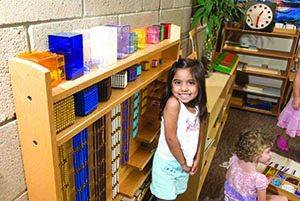
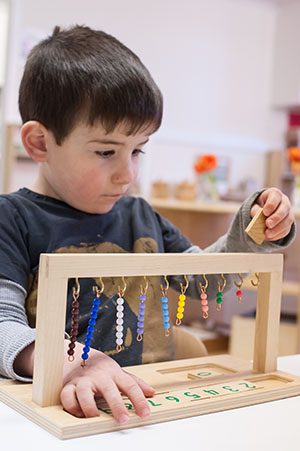
 A focal point in every Montessori classroom is the shimmering display of multicolor beaded chains hanging in a custom wooden cabinet. Adult visitors always notice it, wanting to reach out, to feel and hold the strands: they are that compelling. And it’s no different with children: they, too, are attracted to these gleaming chains, squares, and cubes. These materials call to us all, saying “pick me up; handle me; work with me!”
This remarkable, iconic display is the Montessori Bead Cabinet, an organizer for several foundational materials and innumerable activities appropriate for Children’s House (Primary), Elementary, Secondary, and even collegiate and post-graduate work! The cabinet offers innumerable applications in mathematics: counting, skip counting (counting by fours, counting by fives, etc.), multiplying, squaring, cubing, manipulating polynomials, and exploring base systems beyond regular old base 10.
With its myriad offerings, the Montessori Bead Cabinet merits a closer look.
Description
The bead cabinet is a simple wooden stand, specially made to hold two sets of bead chains (long and short), an intriguing array of beaded squares and cubes, and twenty containers of arrow-shaped labels. It may also have an additional set of bead bars, each of which represents a number from one to ten.
The Colors
Each number represented by the beads is color-coded with a distinct hue, using this system:
| One | Red |
| Two | Green |
| Three | Pink |
| Four | Yellow |
| Five | Light Blue |
| Six | Lavender |
| Seven | White |
| Eight | Brown |
| Nine | Dark Blue |
| Ten | Gold |
The Colored Bead Bars
This is a set of ten different bead bar lengths representing the numbers from one to ten and using the color scheme introduced above. The beads are of glass or plastic, and they may be strung on wire or fused. The fused beads are frequently preferred for elementary work and are sometimes kept in a different location.
Thus, the “One Bar” consists of one red bead threaded by a small metal wire with looped ends, effectively giving the bead a set of tiny handles. The “Two Bar” consists of two green beads connected by the metal thread. The “Seven Bar:” is seven white beads threaded by metal wire. And so on.
The Squares
The Squares of the Numbers (sometimes called the Bead Squares or Squares of the Beads) are accurate representations of the numerical squares of all the numbers one through ten composed of glass or plastic beads colored like the bars and chains, that have been fused or wired together. There are as many squares of each color as the number of that color; thus, there are three squares of three, eight squares of eight, and so on, making fifty-five squares in all. The squares are kept on special shelves in the Bead Cabinet.
The Cubes
The Cubes of the Numbers (also called the Bead Cubes) are actual geometric cubes of the numbers one through ten, composed of glass or plastic beads colored according like the squares, that have been fused or wired together. One cube for each number makes a total of ten cubes, each aligned on display along the top shelf of the Bead Cabinet.
The Chains
Ten Short Chains, kept in specially designed “troughs” on the Bead Cabinet (sometimes hung on a separate wall hanger) are made of colored beads using the consistent color system. The Short Chains correspond in equal number to the Squares of the Numbers (the Bead Squares) but are here arranged in linear form – stretched out like lines.
Ten Long Chains also hang on the Bead Cabinet, one for each number, one through ten, colored as indicated above. Each bead chain corresponds to the cube of its representative number: this means that it contains precisely the same number of beads as the Bead Cubes, except that the chains are stretched out like a line. The chains are made of bead bars of the appropriate color all linked together.
Here are the values of all of the chains. Remember that the Short Chains are equal to the Squares of Numbers and the Long Chains equal the Cubes of Numbers.
| The Short Chains
Squares of Numbers |
The Long Chains
Cubes of Numbers |
|||||
| With Exponents | Number Values | With Exponents | Number Values | |||
| The One Chain | 12 | 1 | 13 | 1 | ||
| The Two Chain | 22 | 4 | 23 | 8 | ||
| The Three Chain | 32 | 9 | 33 | 27 | ||
| The Four Chain | 42 | 16 | 43 | 64 | ||
| The Five Chain | 52 | 25 | 53 | 125 | ||
| The Six Chain | 62 | 36 | 63 | 216 | ||
| The Seven Chain | 72 | 49 | 73 | 343 | ||
| The Eight Chain | 82 | 64 | 83 | 512 | ||
| The Nine Chain | 92 | 81 | 93 | 729 | ||
| The Ten Chain | 102 | 100 | 103 | 1000 | ||
 The Arrows
The Arrows are simply arrow-shaped labels contained in two sets of boxes: one set for the Short Chains and one set for the Long Chains. Made of wood or plastic, the arrows are color-coded to match the beads and are printed with the value of the bead to which they should point. The boxes are usually kept on a special shelf on the Bead Cabinet.
***************
All of these colorful materials are especially attractive to children who usually begin using them in the preschool years and continue with them through upper elementary and even beyond, doing different mathematical exercises along the way.
What is it for?
Children first use the chains for linear counting, or counting one at a time, like 1, 2, 3, 4, 5, etc. Using first the short chains to 100 and then the Long Chain to 1,000, the children enjoy counting and writing these numbers. Sometimes they write the numbers on ling strips of adding machine tape (possibly its only use today).
Later, children begin to count the chains using skip counting. This is simply counting while skipping some numbers, like counting by twos, threes, fours, etc.— every number through ten. Children can also practice regressive counting, counting or skip counting backwards. That is a harder than it may seem: just try counting backward by sevens from 49! You will quickly appreciate the challenge that these children eagerly embrace.
When chains are matched with the squares and the cubes, children can discover on their own that they are equal and most often enjoy folding the short chains to makes square and the long chains to make many squares. They can then skip count by squares, for example, 25, 50, 75, 100, 125. They might end at the cube or, especially if they are at the elementary level, go farther!
While skip counting, children can place the arrows to match the beads. Later, the children may choose to place only every other arrow, or the even numbered arrows, or the arrows divisible by three, experimenting with many creative patterns. Though the arrows are colored coded to match the chains, at later levels children often mix them up, using one arrow color with a contrasting chain.
Connections
One of the reasons that the Bead Cabinet is so powerful is that it connects so many diverse areas in mathematics. As children use this material, they discover that while it begins with counting, it is much more than that. Here are some of the additional activities and connections:
- Blank arrows. Using a set of blank arrows that should be kept in the classroom, the adult or a child writes any number on an arrow, for example, 365. Let the children count a chain, find the exact bead, and place the arrow. Children can also use the arrows to practice counting and marking just as they wish (by elevens, for example.). Sometimes classrooms have a basket of randomly numbered arrows for this activity.
- Non-linear arrangement. Children love to arrange the chain in zigzag, spiral, or other shapes, and they can do this and then proceed to count as usual.
- Multiplication facts. All of the chains directly correspond to the multiplication tables, with which so many children struggle. With this material, that struggle evaporates and understanding dominates; the skip counting exercises directly aid memorization of multiplication facts.
- Squaring and Cubing. Because the chains equal squares and cubes, they encourage unwitting memorization of the squares and cubes of all of the numbers from one to ten, a huge benefit to upper elementary and even adolescent exercises. They also assist with square and cube roots while providing a concrete model for what those terms mean.
- Squares of squares. The students compare the chains that are themselves the squares of other long chains; i.e., 4 and 2; 9 and 3. The Eight Chain represents the cube of the Two Chain, another area of fascination for the children to “discover” on their own.
- Taking two or more chains together represents an algebraic idea called a polynomial. In the elementary classroom, the most explored of these is called the Decanomial, the result of the somewhat intimidating expression (1+2+3+4+5+6+7+8+9+10)2 = 3,025. This Decanomial is represented by all ten of the long chains taken together. Laid out all together and marked with their corresponding arrows like a sunburst produces the Chain Decanomial.
- Base systems. The Bead Cabinet is ideal for introducing Mathematical Base Systems other than Base Ten. Our number system is called Base Ten because it uses ten number symbols: 0, 1, 2, 3, 4, 5, 6, 7, 8, and 9, which we use to create all of our numbers. With the cabinet, we can explore other base systems, such as Base Five, in which we only use five digits: 0, 1, 2, 3, and 4. Figuring out how to write values in this system is like breaking a code; the Bead Cabinet provides the perfect introductory material for doing it.
- Every chain has a relationship to geometry. Each of the long and short chains – three through ten – form, successively, a triangle, a square, a pentagon, a hexagon, a heptagon, an octagon, a nonagon, and a decagon. While the One and Two Chains do not form geometric figures, they do suggest a point and an angle. The children use the chains to construct these geometric figures then write and draw them in their notebooks.
- Finally, there are so many vocabulary words associated with this work that it needs to be thought of as having a role in the language area. Just a small sampling of the important vocabulary words that can be introduced and practiced with the Bead Cabinet materials are: squares, cubes, squaring, cubing, linear counting, regressive counting, skip counting, arrows, numerals, Long Chains, Short Chains, bead bars, and the colors of the chains.
Summary
The next time you peek into a Montessori classroom, make a point to examine the Bead Cabinet – you should find it in every classroom from Children’s House up through Upper Elementary, and you may find it in higher-level classrooms as well. As you admire the squares, cubes and chains, I hope you think of all of the exciting and insight-producing math work represented in this one cabinet.
Just imagine what the world could be like if we all had had a Bead Cabinet in our own math background. What a gift it is to our children!
Tomorrow’s Child / May 2017