by Tim Seldin | Adolescence, Early Adolescence (12-15), Later Adolescence (15-18), Lower Elementary (6-9), Mathematics, MFA, Montessori Education, Montessori Materials, Montessori Teachers, Primary (3-6), Upper Elementary (9-12)
The Challenge of Mathematics
We use mathematics in almost every aspect of our everyday lives. As Dr. Montessori would often point out, much of our civilization is based upon mathematics. Science and technology depends upon mathematical calculations. Computers are totally mathematical devices. Businesses, research, and governmental agencies all rely upon the collection and interpretation of data and statistics. Art and music have direct connections to math. Despite its importance and many attempts at educational reform, mathematics continues to be a subject that many students find difficult.
Dr. Montessori observed that reason so many students struggle with math stems from the way it has traditionally been taught.
Numbers are symbols that help us to think about things, just as words do. When taught by workbook, text, and blackboard, math is almost totally abstract. Students who learn math by rote memory often have a fragile understanding and little or no ability to put their skills to use in everyday life. Learning comes much more easily when they work with concrete educational materials that graphically show what is taking place in a given mathematical process.
The study of math can become a fascinating occupation if it is begun at an early age and taught with hands-on experience and concrete materials to make abstract concepts clear.
Montessori’s Concrete Approach to Math
Beginning in the early childhood years, Montessori students use hands-on learning materials that make abstract concepts clear and concrete. Working with these fascinating educational tools, they can literally see and explore what is going on as each math process unfolds before their eyes. This approach to teaching mathematics offers a clear and logical strategy for helping students understand and develop a sound foundation in mathematics and geometry.
At the Children House level, children as young as three and four are form their first concepts of quantity and number symbols, and go on to enthusiastically explore the decimal system and arithmetical operations like addition and subtraction with materials such as the Golden Beads. The goal is to provide a concrete representation of a abstract idea, such as carrying forward when we add numbers greater than nine, which allows children to develop a clear inner image of mathematical concepts, such as how big is a thousand, what is meant by the ‘hundreds’ column, and what is taking place when we divide one number by another. This is consistent with everything that we know from research about the way young children think and learn.
Yes, mastering many math concepts will also require a certain degree of raw practice and, even in Montessori, students eventually have to memorize their math facts, but the process is greatly facilitated by helping them to develop a much more concrete grasp of the process at work. And yes, even in Montessori, some children will find math to be easy, while others may find it to be more challenging. The great strength of the Montessori approach is its ability to individualize to meet children’s different learning styles, pace of development, interests, and basic needs.
“Unified” Math
The Montessori math curriculum is based on the European tradition of “Unified Math,” which has only recently been discovered by leading American educators. Unified Math introduces elementary students to the study of the fundamentals of algebra, geometry, logic, and statistics along with the principles of arithmetic. This study continues over the years, weaving together subjects that traditional schools normally ignore until the secondary grades.
In operations concerned with measurement, geometry shows them how to perform their calculations. In operations concerned with figures, algebra gives a system of still more abstract symbols by means of which more complicated relationships can be comprehended. The calculations of area and volume, of squares and square roots are examples in which algebra, arithmetic, and geometry are all involved. For Montessori students, arithmetic, algebra, and plane and solid geometry have never been arbitrarily separated. Four- and five-year-old Montessori children can name geometric forms that most adults wouldn’t recognize.
Montessori mathematics includes a careful study of the practical application of mathematics in everyday life, such as measurement, handling finances, making economic comparisons, or in gathering data and statistical analyses.
The Elementary Years
Many parents and teachers think that the Montessori math materials are all very well for children under six, but when they go on to the elementary grades students shouldn’t need these artificial ‘toys’ or ‘crutches’. This represents an unfortunate misunderstanding of how children this age think and learn. Until a child can think at a high level of abstraction, which rarely occurs before early adolescence, he depends upon concrete experience and practice over a number of years before mathematical concepts begin to take firm root in his mind.
During the elementary years children almost never possess the capacity to think abstractly. Everything is either based on concrete experience or is “magic and mystery.” Math by its very nature is abstract. Montessori math uses the concrete mathematical material to help the child develop an inner picture of mathematics that will last a lifetime.
Naturally the child can’t depend on the materials forever. Can you see your child at age sixteen walking in to take the SATs carrying the Golden Beads? Dr. Montessori compared them to an airport runway which provides a smooth surface on which the plane can roll faster and faster until its built up enough speed to fly. The entire purpose of the Montessori Math curriculum is to make the abstract concrete, until the child can close her eyes and visualize mathematical processes at work. Step by step, the materials become less concrete and more symbolic. Step by step, the child is challenged to demonstrate her understanding by teaching what she’s learned to younger children, which also tends to reinforce and clarify the tutor’s grasp on the subject as much as teach something to the one being tutored.
Elementary Montessori students continue to gain hands-on experience by applying math in a wide range of projects, activities, and challenges, such as graphing the daily temperature and computing the average for each month, or adjusting the quantities called for in a recipe for a larger number of people. Because children love to work outdoors, teachers try to prepare tasks that use the school grounds whenever possible. For example, using simple geometry, children can determine the height of a tree or measure the dimensions of the buildings. They prepare scale drawings, calculate area and volume, construct three-dimensional geometric models, and build scale models of historical devices and structures.
Summary
It has often been said that either we find mathematics elegant in its logic, or terribly confusing. Our goal is at least to avoid the latter, and attempt to lead as many students as possible to discover that the first is indeed correct.
The Red and Blue Rods are the young child’s first introduction to Mathematics. These rods have the same dimensions as the Red Rods found in the Sensorial area of the Montessori classroom. Here, however, the rods are painted in alternating patterns of red and blue to distinguish their length in segments of one tenth of a meter (a decimeter). The first rod is one decimeter long and is just painted red. The second is two decimeters long, and is divided into two segments, one red and one blue. This continues through all ten rods.
As with the Red Rods, the children arrange the Red and Blue Number Rods into a stair from largest to smallest. Then they count each alternating colored segment. One of the insights that children begin to get from working with the rods is the nature of addition and the concept that two numbers can add to another. For example, when the children place the “one” number rod at the end of the “two” rod, they create a new rod that is the same length as the “three” rod just above. They explore similar relationships with all of the numbers 1 to 10. For example, they discover that the “four” and the “six” together are the same length as the “ten”.
Montessori found that young children find it difficult in the beginning to grasp the concepts of numbers by counting separate objects. While they can learn to “count” by rote, reciting the sequence of numbers from one to ten, most cannot easily grasp the difference between one quantity and another when looking at more than three or four objects. It’s almost as if they are thinking: “One, two, three….Many!” This is easily avoided by allowing children to visualize the concept of numbers and quantity by using this series of segmented rods of increasing length in the beginning, rather than trying to teach them to count sets of separate objects.
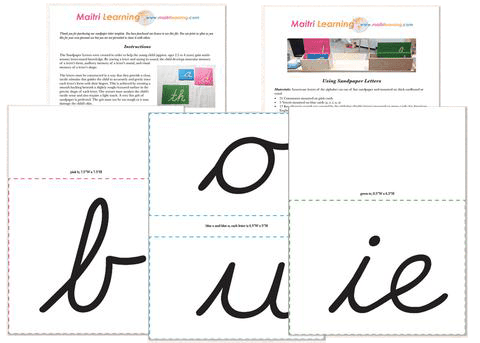
The children also use the sandpaper numerals to label each number rod. These tablets are designed and used in the same way as the Sandpaper Letters described in the section on Language Arts above.
The Spindle Boxes provide a nicely structured way for young children to make the next step in coming to understand the concepts of number and quantity. The material is made up of two wooden boxes which are divided into ten compartments, each labeled with the numerals from zero through nine. In a separate box or basket are forty-five wooden spindles used for counting. The exercises calls for the child to count out the correct number of spindles to go in each compartment: one, two, three…all the way to nine. Naturally the compartment labeled “0” is left empty, teaching the child at a very early age the concept of zero as an empty set. If the child has counted correctly there will not be any spindles left over when she fills up the compartment labeled “9”.
The Number Cards and Counters: After considerable experience with the more structured introductions to number and quantity created by the Red and Blue Number Rods and the Spindle Boxes, the child is finally ready to tackle the task of associating cards on which the numerals have been printed and objects to count.
The child begins by arranging the numeral cards in order from 1 to 10 Then she begin to count out the appropriate number of counters, placing them in parallel rows of two after the number one. Obviously, even numbers end with an even number of counters in the bottom row; odd numbers only have one. This begins to focus the child’s attention on the concept of odd and even numbers.
The Golden Beads: An Introduction to the Decimal System: Dr. Montessori developed a wonderful educational material to concretely illustrate the nature of the decimal system and its basic operations called the Golden Beads. The name comes from the beautiful color used for the enamel finish on this set of one centimeter diameter glass beads.
A single bead by itself represents a “unit of one”. Thus the quantity five would be represented by a collection of five unit beads.
Ten unit beads strung together on a length of wire represents a “unit of ten.” Three ten bars collected together actually consists of thirty unit beads, or three “tens”. The children quickly discover that ten unit beads is exactly the same as one ten-bar. They also begin to count not only the individual unit beads, but by units of ten: “ten, twenty, thirty…one hundred.”
Ten ten-bead bars naturally equals the quantity one hundred. Units of one hundred are made-up of ten ten-bead bars laid side by side to form a square, and wired together as a unit.
Ten hundred squares stacked one on top of the other form a square containing a thousand unit beads. They are permanently wired together to form the thousand cube.
Using these concrete materials, even very young children can build and work with great numbers. In a typical early lesson with the Golden Beads, the teacher might challenge the child to “Bring me three thousands, five hundreds, six tens, and one unit.” While they will also work with prepared problem cards, children often enjoy thinking up numbers for themselves..
The Number Cards: This special set of number cards is used to help the children learn to read numbers up to 9,999. Used to label the units, tens, hundreds, and thousands columns in which the Golden Beads are laid out, they help the children to begin to understand the concept of the hierarchy of the decimal quantities and how we borrow and exchange from the next column in mathematics operations. Notice how the size of the cards and the color coding to represent units, tens, hundreds, and thousands, makes it easy for children to understand how large quantities are written out from left to right, and worked with in vertical columns.
The Bank Game: The Bank is a name given to a collection of Golden bead materials, which should include enough units, ten bars, hundred squares, and thousand cubes to allow several children to each create large numbers.
In one of the first exercises, the children explore the equivalencies of the decimal system. They learn that ten units can be exchanged at the bank for a ten bar, and that a ten bar can be exchanged for ten units. They also find that ten tens can be exchanged for a hundred square, ten hundreds for a thousand, and that each can in turn be broken down into its equivalent in the smaller quantity.
Using the Golden Bead material, the children can build two or more large numbers and add them together. By going through the steps of addition in this very concrete manner, the children a clear impression about what addition means. They also come to understand the process of exchanging, as they count the new quantities in each of the columns, and trade in groups of ten units for one ten bar which they place in the tens columns, ten bars for one hundred, and ten hundreds for one thousand.
Once they understand how to add with the Golden Beads, Montessori children begin to use them to multiply, subtract, and divide. For example, to divide the quality 3,333 by three, a child would set out three wooden skittles, and, beginning with the largest quantity, in this case the thousand cubes, he gives one thousand to each skittle. He continues on with the hundreds, tens, and units. If the child were challenged to divide this same quantity by four, he would begin by exchanging the 3 thousands for 30 hundred squares, which he would distribute equally. After placing 6 thousands beneath each of the 3 skittles, he exchanges the remaining 2 hundreds for 20 ten bars. This process of exchanging continues until the final answer is derived.
The Short Bead Stair: Using the Golden Bead material, the child see the numbers one through nine represented as individual units. But, as we mentioned above, although the child can count the beads one at a time, it takes many years before most children can recognize and really understand the idea of numbers greater than three except by one to one correspondence. To help the child truly begin to grasp the idea of quantities from two through nine, Dr. Montessori prepared a set of colored glass beads, one centimeter in diameter, in which each quantity is represented by the appropriate number of individual beads wired together as a bar with a specific, easily recognizable color. In this material, a one is represented by a single red bead, a two by two green beads strung together, the quantity three by three pink beads, and so on, up through the ten golden beads that represent a unit of ten.
The children work with the Short Bead Stair for many years, using them to add and subtract, exchange, borrow, explore multiples, and many other arithmetic processes. For example, to multiply 9 by 8, the children would lay out 8 nine-bars or 9 eight-bars. By counting the result, they can check their work.
The Teens and Tens Boards: This material is made up of two different sets of boards used by the child to explore the nature of quantities and numbers greater than nine. Each set consists of two boards, which are laid in a vertical row. The two boards are divided into nine sections, each of which is fitted with a thin frame into which the children can slide wooden cards on which the numbers 1 through 9 have been printed. Numbers have also been printed on the surface of the board, spaced so that when the cards are slid into the frame they will cover up one of the two digits.
On the Teens Boards, the number 10 is printed in the nine spaces created by the frames. The children arrange the number cards from 1 to 9 in order, and slide them into the frames, creating the numbers 11, 12, 13..and so on through 19. Using the “Ten Bead Bars” and the Short Bead Stair material described above, the children lay out the numbers 11 through 19 concretely. For example, the number eighteen would be formed by placing one ten bar in the tens column and one brown eight bar in the unit column. This gives them a very clear picture of how the teens are formed and written: ten and one is eleven, ten and two is twelve, etc.
On the Tens Boards, the numbers 10, 20, 30, 40 through 90 are printed in the nine spaces created by the frames. They use the individual number cards to form numbers in the tens, such as 53, 24, 79, etc. and use the Golden Bead tens and unit beads to build their concrete representations along side.
The Hundred Board challenges the young child who can count aloud from one to one hundred to lay out the numerals in the same sequence. The Board is a square divided into ten rows with ten small squares along each row. The children work with a set of one hundred wooden tiles that are labeled from 1 through 100. They spread them out on the rug, arrange them in numerical order, and place them, one tile at a time, on the Hundred Board, working from the upper left corner along each row to the right, down to next row, and so on until complete. When they are comfortable with this, they attempt the same exercise by filling in the squares on a blank chart drawn to duplicate the surface of the hundred board.
The Hundred and Thousand Chain: Another way that the children practice their counting and develop an increasingly clear concept of how big is a hundred and a thousand, is the working with the chains. These are long chains created by connecting 10 ten bars together to form a chain 100 beads long, or in the case of the thousand chain, by connection 100 ten bars together to form a chain of 1,000. The children lay the chains out, duplicating them by creating a second line of individual ten bars. At the far end, they place the hundred square or thousand cube, as appropriate. When working with the Thousand Chain, they also set out hundred squares after every 10 ten bars along the chain, representing that the next hundred has been crossed. In another exercise, they work with number cards printed with the numbers 1 to 100 or 1 to 1,000 counting by tens. The children sort them in order and place them along the chain. They tend to be quite impressed when they first see the Thousand Chain laid out across the classroom floor.
The Squaring and Cubing Material: Following the same concept, the Squaring and Cubing Material introduces the child to the concept of skip counting by ones, twos, three, fours, etc., through tens. Each chain is constructed by connecting multiples of the short bead stair, using the same color scheme that the children learned before: red units, green two bead bars, pink three bead bar, etc. The material also introduces the children to the concept of the squares and cubes of the numbers one through ten. There are two chains for each number: one set representing the squares of the numbers one through ten, and the other representing the cubes. Thus, the square of five is shown as a chain of five bead bars (the square of 5=25), and the cube as a chain of twenty-five five bead bars (five cubed=125).
(NOTE; photo close up of squares and cubes 1-10 laid side by side) The material also includes a set of bead bars connected to show the squares and cubes of the numbers as actual squares and cubes. The children use the bead chains to skip count, working with number arrows similar to those used with the Hundreds and Thousand Chains.
The Fraction Material: As the children become more and more comfortable with the Golden Beads, they eventually begin to ask whether there is anything smaller than the unit. The Fraction Skittles, and many experiences in the classroom, gradually introduce them to the concept of a quarter, half, and whole. The Fraction Circles take this concept much further. It is a set of ten metal frames into which are set ten circles, one left intact, one divided into two parts, another into thirds, fourths, fifths through tenths.
The children learn the terminology, how to write fractions out as figures, and begin to explore first the concepts of equivalence (2/4 = 1/2) and basic operations with fractions (1/2 + 2/4=1).
The Stamp Game represents the first step on the Second Plane of Abstraction in the Montessori Math curriculum. Where in the First Plane, the Golden Beads and Colored Bead Bars concretely represented quantities as three dimensional objects, the materials used in the second plane are much more abstract. At this level they are essentially tokens, symbolic counters identical in size and differing only in color and in how they are labeled, but which represent different quantities. The Stamp Game is a box containing little wooden tiles (originally Montessori used paper squares that looked like postage stamps). Some are colored green and labeled “1” to show that they are units. Some are colored blue and labeled “10” to show that each represents a set of ten units. Some are colored red and labeled “100”, and the last set is colored green and labeled “1,000” to show that each represents a unit of 1,000 units.
The children use the Stamps just like they did the Golden Beads, laying out quantities using the symbolic tokens and adding them together, subtracting, multiply, and dividing. By this level, the children are normally writing their work out on paper and using the Stamps to help them visualize the process. For example, to subtract 822 from 1,000, the child would create four rows of stamps, beginning on the left with the thousands, then the hundreds, the tens, and the units. In to the top row she would place a single thousand stamp in the thousand column. Below, she would place nothing in the thousand column, eight hundreds stamps in the hundred column, two ten stamps in the tens column, and two units in the unit column. Beginning with the units, the child seeks to take two stamps away from the quantity above in that column. Since the column is empty, she turns to the row to the left (the tens), which is also empty. Eventually she finds that her only choice is to exchange the one thousand stamp for 10 hundreds, which she places in the tens column. Now she exchange one of the hundreds for 10 tens, which she places in the tens column. Finally, she is ready to borrow from the tens column to solve her problem. She exchanges one ten from the tens column and exchanges it for 10 units and places them in the unit column in the top row. From this ten, she takes away two, leaving 8 units. This process continues, until she finds that her top row contains the correct answer: no thousands, 2 hundreds, 8 tens, and 8 units ( 1,000 – 822 = 288).
The Short Multiplication offers another pathway to abstraction the child lays out individual unit beads on a board organized into nine rows of nine shallow holes. The child lays out the beads in rows, for example 4 * 8 would be four rows of eight beads per row.
The Division Board is similar, except that here each vertical column of shallow holes represents one equal share, where a quantity is divided into two or more groups. The child places one small skittle at the top of each column to mark the number of shares that will be in her divisor; to divide 24 by 6, she begins by placing 6 skittles along the top. Then she counts out the number of beads that she wants to divide and begins to distribute them, placing one bead in each hole from the top left to right and then down a row, until she finally has shared her quantity equally among the vertical columns. Any beads left over are her “remainder.”
The passage to abstraction: By this stage the children are recording their work on paper, although many won’t be able to solve the same problems if asked to work with paper and pencil alone without the visual aid of the Montessori materials..
Montessori uses a wide range of parallel materials and exercises to help the child extend his knowledge and gradually memorize the basic math facts that every one of us is expected to know. As parents, you will eventually begin to hear about materials with odd names like the Snake Game, the Addition and Subtraction Strip Boards, the Negative Snake Game.
Space doesn’t allow us to describe every one of the Montessori Math materials, but your child would probably be delighted to introduce them to you.
Children work on mastering their addition facts with the Addition Strip Board.
There are also an involved series of Memorization Charts and associated exercises that help the children in their final stages of mastering the addition, subtraction, multiplication, and division charts. The young fellow in this picture is working on memorizing his subtraction facts, exploring the combinations when the numbers 1 to 18 are subtracted from one another.
When the children have begun to show that they are ready for still more abstract exercises, they’re introduced to another series of math materials at the next plane of abstraction.
For example, the Bead Frames (or abacus) challenge the child to solve problems in a slightly more abstract process. The Short Bead Frame (shown) allows the child to work with quantities up to 9,999. The Long Bead Frame uses quantities as large as 9,999,999.
The Long Division Material (Racks and Tubes) allows the children to solve complex problems in long division. Its not unusual for elementary students to work through problems using numbers much larger than a trillion.
The Multiplication Checkerboard is still another more advanced material that introduces Long Multiplication.
(Slide: girl with geometry sticks) Geometry continues on from its early introduction in the Sensorial curriculum into the elementary level. This young lady is exploring angle and the construction of different geometric figures.
(Slide child with geometry definition cards) At the elementary level, the children move on beyond learning the names of geometric figures to mastering the definitions as well. they also begin to construct geometric forms with protractor and compass.
by Sara Stein | Adolescence, Brain Development, Early Adolescence (12-15), Kindergarten, Language & Reading, Later Adolescence (15-18), Lower Elementary (6-9), Maria Montessori, Mixed Ages, Montessori Education, Montessori Materials, Planes of Development, Primary (3-6), Tomorrow's Child, Tomorrow's Child Online Issue, Upper Elementary (9-12), Young Adolescent
As parents, we all want the best education for our children. But what does that mean? What does that look like? For me, it means having access to the teachings and philosophy of Dr. Maria Montessori.
We have three children, ages 10, 7, and 4. They are all unique; all with their own personalities, special gifts, and needs. As a child, I attended public school the whole way through, while my husband is the product of both public and private education. We both went on to higher education and will encourage our children to do the same. I am a traditionally trained teacher and taught for many years in a general classroom. I was successful, by everyday standards and felt good about the work I was doing. As young parents, we deliberately took to methods which promoted independence in our children. And then, everything changed in 2013. Big questions came bubbling up when our middle child turned 2.
On a whim, we placed our daughter in a well-known, established AMI Montessori classroom. I was skeptical, but figured it is “just preschool,” and we can always move her after a year if we don’t like it. Little did we know that this one leap of faith would end up profoundly affecting the entire family, and in a very short amount of time.
As an educator and a parent, I wanted to understand this new method. Come to find out—at all of those free parent education nights I couldn’t get enough of—I learned the Montessori Method is over 100 years old. Wow! How could one teaching philosophy withstand the test of time like that? As a teacher, I had grown accustomed to being trained, almost yearly, on a new math or reading program. I had to learn more.
Over the course of our daughter’s first year in Montessori, we were expecting our third child, moving our oldest (then age 6) over to the Montessori school to join his sister, and I was offered a job. Constantly comparing what our son was receiving in his traditional first grade classroom to what our now 3-year-old daughter was learning about at the Primary level (the continents, exchanging big numbers using the bank game, learning cursive with sandpaper letters, how to arrange flowers, just to name a few), I soon realized our children’s experiences were at opposite ends of the spectrum. Not shy with my awe and admiration with what I was observing through my children and all over the Montessori school, I was subsequently asked to be the assistant teacher in an ever-growing Upper Elementary classroom for the following school year.
In many ways, I was starting over, learning a new trade and craft. Many would ask, “You are going back to being an assistant when you have taught for so many years?” Or, “How different can Montessori truly be from Traditional?” Yes, I was going back. I was going back to learn. To start over, in many ways. And yes, Montessori is different than Traditional. Truly different.
I have the opportunity, at this stage in my career to follow what ‘speaks’ to me. I have found a teaching philosophy (a life philosophy) that honors and respects the developing brain of the child. It is a philosophy that understands how to cultivate lifelong learners, independent thinkers, and socially aware citizens of the world.
Shifting my mindset from being at the center, up front, and in control to humbly bringing it back to the child is my new mission. Now working on my Montessori Certification at the Elementary level and relentlessly searching for a place where our three children can be immersed in the Montessori community (and for as long as possible) is my mission. Helping others see the beauty and genuine remarkability of the Montessori Method is my mission. It is as if my entire universe stems out from here and will continue to guide us.
Children are OUR teachers, not the other way around. Children will tell us what they need and where their interests lay. They have questions about the world around them and how they might find a solution to a community, national, or global problem. It is our job as educators (as adults) to observe our children, to step out of their way, and to listen.
Today, I consider myself a budding Montessorian with still much to learn. And while I don’t know where this journey will lead, I know I am on the right path.
Tomorrow’s Child / Nov 2018 / Pg 29
by Tim Seldin | Empowerment, Imagination, Lower Elementary (6-9), Mixed Ages, Montessori Materials, Montessori students, Tomorrow's Child, Tomorrow's Child Online Issue, Young Adolescent
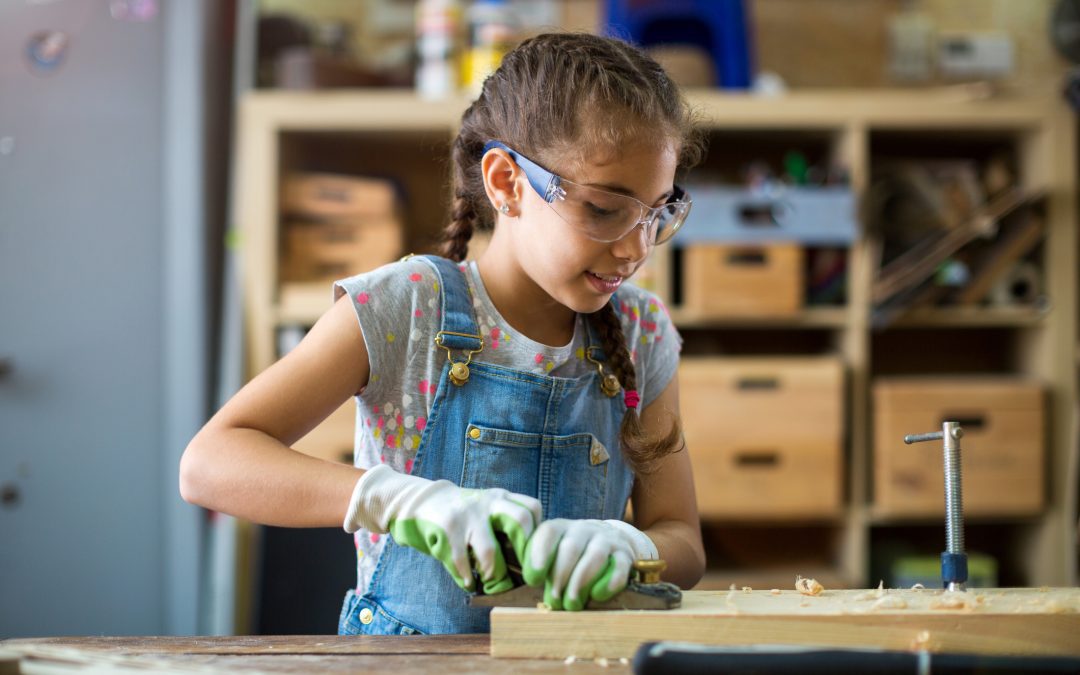
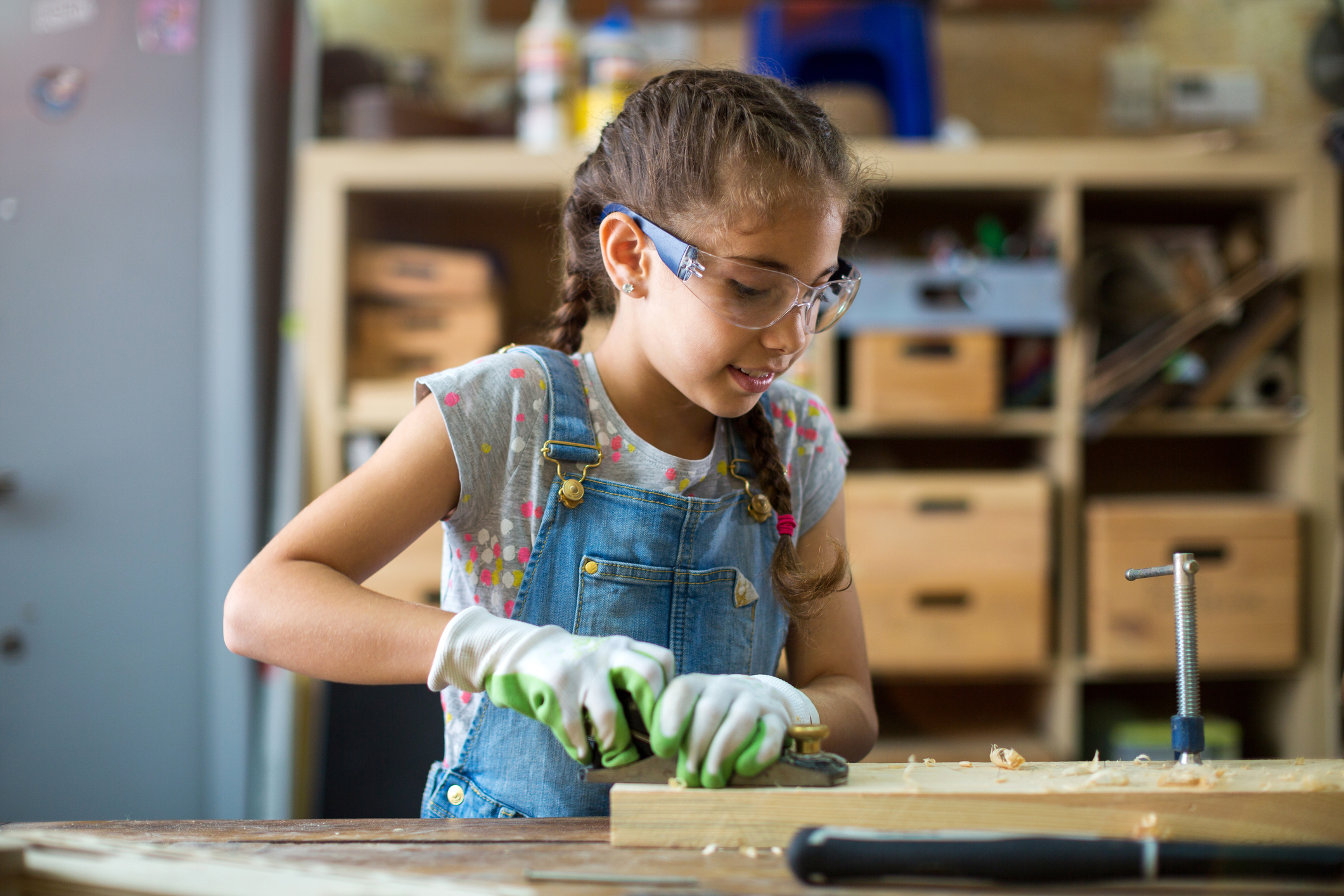
Young girl doing woodwork in a workshop
Anyone who has witnessed young children tinkering away with tools in the woodworking area will know just how magical it can be. While absorbed in constructing, children display extraordinary levels of concentration and engagement. Encompassing many aspects of the curriculum, the benefits of woodwork for children’s development are evident across all areas of learning. Woodwork is now making a comeback in early childhood.
The Return of Woodwork
Once almost eradicated due to fears of litigation, woodwork is now making a comeback in early childhood. This indicates a more balanced attitude towards risk and the growing view that health and safety measures are there to help children do activities safely, not deny opportunity. It is important for young children to experience risk in a controlled environment, promoting the development of self-management and decision-making skills.
The renewed interest in woodworking is also a reaction to our increasingly digital world. We are seeing a new generation of children who learn to “swipe” before they can walk. Children are surrounded by complex technology but this has limited their experience of basic technology. Many children today may never have the chance to use simple tools during their entire education.
Woodwork can be seen as a wonderful alternative, engaging children with real tools and authentic materials. Woodwork also provides children with an experience of making and repairing as opposed to our prevailing culture of consuming and disposing of. Globally there has been an upsurge in “making” as is evidenced in the rise of the “maker” movement. Makerspaces and tinkering studios are appearing in cities all over the world, providing spaces where children can be curious, inventive, and develop their creative and critical thinking skills.
It is extraordinary to see just how much learning is involved in a woodworking session.
Learning and Development
There is something really special about woodwork. It is so different from other activities. The smell and feel of wood, the sounds of hammering and sawing, the use of strength and coordination, all go together to captivate young children’s interest. Visiting teachers, observing the woodworking area, always notice the children’s deep levels of concentration and engagement and are surprised to find the same children still working on their creations an hour or two later. They observe children working with their hands, constructing models, and working on projects, but in fact, the real transformation is inside the child—personal development is at the heart of woodwork.
Woodwork is a powerful medium for building self-esteem. Children feel empowered and valued by being trusted to work with real tools. They show satisfaction in their mastery of new skills and take immense pride in their creations. This sense of empowerment and achievement provides a visible boost to their self-confidence.
With woodworking, children develop at their own pace and find their own challenges. Once they have mastered basic skills, they move into open-ended exploration—tinkering, discovering possibilities, and then making unique creations. Because children follow their interests, making what they want to make, they have the intrinsic motivation to persevere to resolve problems and learn from mistakes. Their imagination, creative thinking, and problem-solving skills really flourish as they meet and conquer new challenges.
It is extraordinary to see just how much learning is involved in a woodworking session. It encompasses all areas of development, fostering confident, creative children with a passion for life-long learning. Woodworking incorporates mathematical thinking, scientific investigation, developing knowledge of technology, a deepening understanding of the world, as well as physical development and coordination, communication and language, and personal and social development.
Essentially, woodwork is a ‘win-win’ experience: children greatly enjoy it and remain
Tomorrow’s Child/ September 2018/ pg 26
by Matt Johnson | Brain Development, Kindergarten, Language, Language & Reading, Lower Elementary (6-9), Mixed Ages, Montessori Education, Montessori Materials, Planes of Development, Primary (3-6), Sensorial, The International Montessori Council
As an educator and parent, I saw a need for children to have an outlet to explore and develop emotional and social sensitivity. We created ClayMatesTM in a direct response to this need as we now live in an age of overwhelming distractions from media, technology, and entertainment, we see a generation of children who are losing touch with authentic social connection, self-reliance, empathy, compassion, and creative problem solving; all of which can translate into feelings of social separation and anxiety.
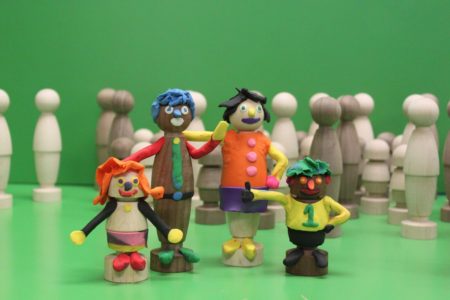
ClayMatesTM help quiet these distractions and open new doors to creativity and expression by nurturing positive connections and personal strengths in children. The non-gender-specific figures and colorful, tactile properties of clay engage children to make creative choices as they design their figures and naturally engage in imaginary role-play.
As a toy, ClayMatesTM inspires creation and expression while building the child’s fine and gross motor skills and executive planning skills. As an educational tool, ClayMatesTM are an easy-to-use platform for encouraging complex social and emotional conversations with children at home, in the classroom or in a therapeutic setting. ClayMatesTM are a hands-on, self-directed activity that promotes mindfulness and emotional intelligence. Children place clay on the wooden figures to create physical features to bring characters to life. Educators will find ClayMatesTM help them observe social cognition, emotional intelligence as well as guide without any preconceived outcomes and create an environment that supports age-appropriate social and emotional exploration and growth.
ClayMatesTM Inspire Self-awareness through Social Context and Emotional Response
When ClayMatesTM are introduced to the classroom, therapeutic, and family settings, the results are immediately observable. Using ClayMatesTM, children begin by building a figure of themselves, revealing each child’s perception of her or his own self in the world. Then, the children create figures that represent others in their lives. These two steps are the building blocks for observation, to help children in the process of social and emotional cognition.
As imaginary role-play becomes fluid, we can introduce a host of social context or scenarios for children to explore in their play—from helping around the house to experiences of bullying, to classroom behavior, even how to say “I’m sorry.”
By observing the children’s social and emotional response and problem-solving in their ClayMatesTM play, educators can engage them further in an age-appropriate contextual conversation around the possible solutions or responses to events and issues in their lives.
Here are two examples of ClayMatesTM play that demonstrate the ease and enormous potential they offer:
Example #1. Enacting a Social Scenario with ClayMates: Bullying
In a group of 5 children, each child builds a different figure: the victim, the bully, the bystander, the teacher, and the parent. This creates a social scenario in which each child role-plays and observes how the words and actions of the five ClayMatesTM unfold in the group. As educators, this type of prepared learning environment provides an open-ended dialog that explores the children’s observations and emotions about bullying, the emotional and social responsibility of different roles, some possible solutions, authentic feedback, and the opportunity for social and emotional growth.
Example #2. Developing Emotional Vocabulary with ClayMates
As our emotional vocabulary develops and expands, we, as individuals, learn to engage with our self and others with more understanding, patience, and acceptance of diverse thoughts and feelings. ClayMatesTM is an effective tool for building this vocabulary through role-play with directed emotional context.
We can attach to the bottom of every ClayMate figure one of 12 color-coded discs associated with 12 different emotions. Initially, we introduce the basic emotions such as anger–RED, sadness–BLUE, fear–PURPLE, yellow–HAPPY and integrate them into a social scenario. Each child then role-plays their ClayMate figure’s designated emotion. At first, all participants know who is performing which emotion. Each child acts out and experiences their own assigned emotion and observes the other participants doing the same. As students become more comfortable with this role-play, they are assigned an emotion “secretly” so that only they know what it is, and other participants try to figure it out. This exercise deepens the children’s sense of different emotions: both how to express them and how to relate and respond to others’ emotions.
As a fun, flexible, and expressive toy and tool, ClayMatesTM builds a foundation of social and emotional awareness so that children can develop authentic and meaningful connections, recognize social and emotional cues, and strengthen their capacity to problem solve and meet challenges with resilience. ′
Matt Johnson is married with two adult children and has worked with children for over 35 years as a gymnastics instructor, mentor, and advocate. As an instructor he has help students realize their physical and mental potential. As a mentor, he has supported students in building character, self-esteem and achieving personal goals. As an advocate, he has been outspoken in support of responsible coaching practices, resiliency in athletics and the idea of empowering children to be confident, competent, contributors who are self-sufficient, with skills for coping in life. Matt is a board member of SPARKindness and is the chairperson for their resilient athlete program. SPARK is a community-based organization that provides educational opportunities to families that focuses on understanding diversity, inclusion, resiliency, recognizing the difference and addressing social and emotional issues that affect families and the community. Matt also works with teens and adults as a personal trainer and life coach. Where he support clients in goal setting, recognizing their potential and helping to navigate the obstacles to success.
ML/ September 2018/ pg 27