The Joyful Child: Montessori Global Wisdom for Birth to Three (Michael Olaf, 2013) 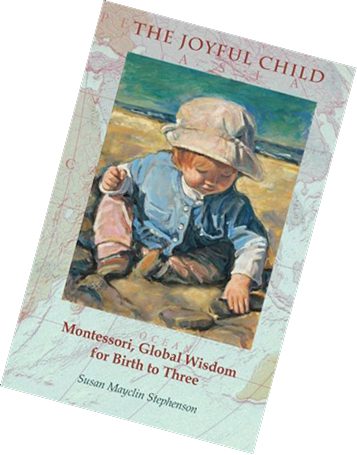 is Susan Mayclin Stephenson’s latest book. Susan draws on her extensive experience working with children in different cultures and socioeconomic contexts around the world, combined with deep insight into the philosophical and pedagogical underpinnings of the Montessori approach.
The book begins with a guide for parents of children in the first year of life, with many details on what to look for and enjoy in the first days and months. There are specific developmental steps to watch for and support, such as: the important visual and auditory experience of the child in the first days of life; the importance of language in the environment; and the development of movement stages of the whole body and the hand—reaching, grasping, sitting, crawling, pulling up, and walking.
Since we know that the first three years are vital in feeding the physical and mental development of the child in the correct way, there are many ideas for introducing the child to: the areas of practical life; sensorial toys and puzzles; music; language; art; people; plants and animals; the physical sciences; and math. These are useful not only for parents in the home but also for Montessori teachers at this level.
The appendix contains a child’s perspective on the process of weaning in 15 pages, with pictures, titled, “How I Weaned Myself,” which is based on the Montessori Assistants to Infancy Program that was initiated in Rome in 1947 by Maria Montessori. It also contains a reprint of an article previously published in Communications, the Journal of The Association Montessori International, comparing the Assistant to Infancy practices with the age-old traditions in Bhutan.
The author writes in such a way that the sometimes esoteric Montessori concepts are easily understood. As a result, this book has been used with adolescents in Montessori Human Development classes, as an overview in Montessori training courses at all levels from birth through the middle school years, and is being translated into several languages. As examples, the Japanese translation of an earlier version of The Joyful Child is a text for an online parenting course in that country and is being shared, chapter by chapter, with parents of schools in Russia.
The author’s first exposure to the international study of human development was as a college sophomore in 1962-1964; she took a course researching international practices of family life while traveling by ship, participating in intensive studies and in field trips in Europe, the Middle East, and Asia. She has been working in the Montessori field for almost 45 years, the last 25 in the area of the child in the first 3 years of life. She has been writing The Joyful Child throughout this time, constantly adapting the text to answer questions by parents, and during her work as a Montessori consultant, speaker, and examiner for Montessori 0-3 courses in many countries including Nepal, India, Bhutan, Russia, Holland, and China. Her website, if you would like to know more about this devoted Montessori mother, grandmother, and teacher, is www.susanart.net.
The book contains 260 pages with 160 black and white pictures of children. Published by Michael Olaf Montessori Company. Arcata, California. It is availavle through AMAZON.
Montessori Leadership / January 2014 / g 7