 In recent years, extensive neuroscience research of this age range has proven the importance of providing stimulating resources, opportunities, time, and space for play.
Through many years of research, it has been proven that providing sensory play for children is an essential part of their development. This type of stimulation makes connections in the brain, develops memory, and assists learning through multi-sensory emphasis. It also encourages discovery, problem solving, health and well-being.
The Sensory Stages are divided into three areas:
- Treasure Baskets / What is it?
- Heuristic play / What can I do with it?
- Further development /What else can this be?
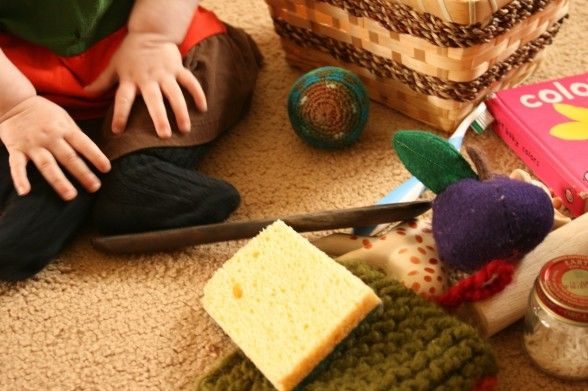
Treasure Baskets were developed by Elinor Goldschmied in the 1940s and were traditionally designed, in their purest form, for the infant who is sitting but then moves to walking (6 – 12 months). This round basket includes 40 – 80 natural objects and offers the child texture, color, shape, weight, sensory interest and play value, with safety paramount at all times.
The objects include natural items (such as: sponges, chestnuts, feathers, and pebbles, as well as objects made from metal, wood, wicker/bamboo, and pottery.) The items are not ‘bought’ toys or plastic; they should be washable, and most are common in everyday use by adults. The adult should feel confident about the items in the Treasure Basket,ensuring that anything they deem unsuitable is not included.
When introducing a Treasure Basket to the seated infant, it should be placed to the side or in front of him/her. This type of play is entirely child led; they will initiate their explorations by themselves and for themselves.
During this named time, the adult sits supporting them, observing at all times; however, the adult should resist the temptation to constantly offer comments, questions, or lead with their own ideas about how the baby should play with the objects in the basket. Through choosing, sucking, waving, handling, and banging these objects, infants will concentrate their attention for considerable periods of time, often up to one hour.
In recent years, extensive neuroscience research of this age range has proven the importance of providing stimulating resources, opportunities, time, and space for play. Babies are now commonly portrayed as sensory beings with incredible capabilities.
There are endless benefits of introducing Treasure Baskets to babies. They develop concentration, independence, confidence, fine- and gross-motor skills, hand/eye co-ordination, and logical reasoning. They also encourage language development, communication, social skills, creativity, and imagination.
The purpose of the collection of items in the basket is to offer maximum interest through:
- Touch texture, shape weight
- Smell variety of scents
- Taste limited scope but possible
- Sound ringing, tinkling, banging
- Sight color, form, length, shine
By 12 – 18 months, most babies are on the move and are developmentally ready for a further challenge. Heuristic play offers children of 12 months – 3 years the opportunity to play with lots of similar objects, including collections of bangles, bowls, balls, chains, or poms poms. The extensive range of materials offers the child open opportunities to investigate and are laid out in the form of a market stall. They explore the ‘cause and effect,’ (i.e: What can I do with it?) and through simple object categorisation, the child’s sensorial experiences are increased. Heuristic play enhances the child’s social interaction, and they experiment, share, take turns, and consider the needs of others.
In some nursery settings, the treasure basket idea has been expanded into interest baskets, which are usually a collection of similar objects, for example: collections of balls, bangles, or chains. Alongside the interest baskets, the adult may also provide activity cards for the children, if suitable.
In 1988, I founded Paint Pots Montessori Schools and Creative Classes, and my interest in Treasure Baskets grew when I had my first child 17 years ago. The first Paint Pots Treasure Baskets class was introduced a few years later and, to this day, is a cornerstone of what we do. We continue to offer infant classes, creative workshops, and Montessori education for children from birth – 6 years. The classes are a gentle introduction to parents as they embark on their Montessori journey.
I get great enjoyment from working with mothers and babies, and during these unique classes, they are introduced to Treasure Baskets, Heuristic Play and music, with guitar and voice. It is an amazing privilege to see so many families, who initially started attending my baby class and have progressed into one of our schools at Paint Pots.
When introducing music to the babies, they are each given a basket, similar to the Treasure Basket. Each basket initially contains one small egg shaker and builds up with a variety of instruments and props, introduced as the session progresses. The music session finishes with the child having a full basket of props and instruments and everyone singing the goodbye song.
Alongside the creative classes and the Montessori schools, I also offer parenting classes, where the focus is on using creative development to empower parents and enhance their understanding, knowledge, health and well-being.
In recent years I founded Heart Montessori and this International consultancy grew out of the experience and knowledge that I gained over two decades of research and practice in Montessori settings. I regularly speak at workshops and training sessions in locations, including Jordan and China. I am very excited to be leading a workshop at the Montessori Foundation’s Annual Conference “Peaceful Classrooms, Peaceful Children, Peaceful Schools” in Florida this November.
For over 17 years, I have introduced Treasure Baskets and Heuristic Play to many families and I believe that my approach achieves an ideal balance between the academic, social, and psychological development of the child and the adult. Whether it’s working in the class with children, parents, or teachers, my aim is to leave an imprint of care and creativity.
Tomorrow’s Child / September 2014 / p 35