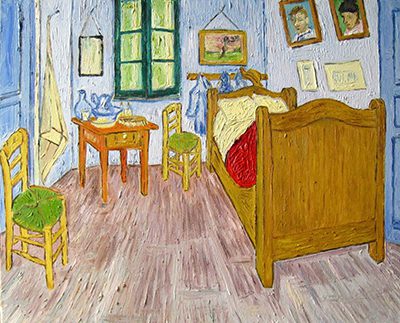
Vincent Van Gogh’s bedroom in the Yellow House in Arles, with its bed pressed into the corner of a sky blue room, a table with bottles and pitchers, clothes hanging on hooks and paintings adorning the walls, has hung in our classroom at Montessori Casa International from the time we opened our doors. We had looked at it during our study of Vincent Van Gogh and while the children were interested in it, they were always more drawn to his Sunflowers. When the Art Institute of Chicago held an exhibition (2016) of what they called “the most famous chambre in the history of art,” we felt it was time to look at the paintings in more detail and depth with the children.
Van Gogh created three paintings of his bedroom between the years 1888 to 1889. The first version of The Bedroom was painted soon after moving into the Yellow House, and he was very satisfied with the result. He wrote to his brother that he had painted the interior deliberately “flat,” having forgone all shadows, as with the Japanese prints he liked so much. “The color must be effective here and should generally suggest rest or sleep, and its simplicity should make the objects stand out. All in all, looking at this painting should make the mind feel at rest, or rather, the imagination.”
The second version of The Bedroom was painted less than a year later. Unfortunately, flooding in his studio had damaged the painting and his brother, Theo, suggested he paint a copy of it. Van Gogh wrote to Theo, “I’ve redone the canvas of The Bedroom. The study is certainly one of the best.” Research indicates that a comparison of both paintings shows subtle changes in the use of color and the way details were painted.
Three weeks later he painted a third and smaller version of The Bedroom as a gift for his mother and sister.
At Montessori Casa International, art appreciation is an integral part of our curriculum, as we find that children as young as three years of age are already able to benefit emotionally and intellectually from art education. We began our unit of study by showing the children the three versions of The Bedroom and asking them to look for differences and similarities. In doing this, we hoped to build their cognitive and analytical skills as well as their ability to describe a painting by looking at its design, lighting, color, composition, and perspective.
We then embarked on a more detailed study. Every morning, we took one aspect of the painting, for example, the chairs, the bed, the window, the floor, the portraits, and helped them ‘see’ the differences in the three paintings. In doing this, we were hoping to develop cognition as well as the ability to analyze art and encourage personal insights. What surprised us was the children’s lead in going to the painting of The Bedroom that was hanging on their classroom walls and to discover, with much discussion and going back and forth, as to which of the three paintings it was. That connection was made completely on their initiative and demonstrates the type of critical and intuitive thinking Froebel and Piaget envisioned.
Since children are better able to imagine in three dimensions, we created a model of The Bedroom with as much detail as we could. As I walked into the classroom with the model for the first time, a three-year-old said to me, “That is Vincent Van Gogh’s bedroom.”
We also provided them with furniture so they could create bedrooms themselves. One child went and got a picture of Van Gogh’s bedroom and declared, “I want to make my bedroom look just like the picture.” He then intently looked at the picture while he created his bedroom.
We were fortunate in having a puzzle that gave the children some flexibility to create The Bedroom, and now the children picked a postcard of one of the versions and created the room to look like the one on the postcard. Their sense of discrimination was developing as well as their aesthetic sense.
Wanting to make a connection with their lives, we encouraged parents to send in photos of their child’s bedroom. We then gathered together and children had an opportunity to talk about what was special to them in their room: a lamp; a pillow; and one mentioned a butterfly that her mom painted on the wall that was special to her. Later, we encouraged them to draw a picture of their bedrooms and one, in particular, was very impressive.
Being a bilingual immersion school, we used this opportunity to develop vocabulary and teach the children the Chinese words for bed, chair, window, portraits and floor.
This was followed by an exercise the children loved. The Chinese teacher would call out the word for bed, and the children would have to pick up the colored picture of the bed and place it on the black and white picture of The Bedroom.
We also took this opportunity to talk to them about the Netherlands, the country of Van Gogh’s birth and showed them artifacts from the country. Later, I overheard them talking amongst themselves that Van Gogh was from Europe, the red continent!
The integration of this unit of study into the MCI classroom benefitted the children emotionally, intellectually, and socially. From developing perception in seeing the differences in the paintings to expressing how the painting made them feel to creating their own bedrooms, these encounters strengthened the functions of both sides of the brain. It was most rewarding when a parent sent us a photo of her child looking over a book of Van Gogh’s works at home and was inspired to create her own book of his drawings.
Punum Bhatia, PhD has dedicated her life to Montessori education as a parent, teacher, and teacher educator for nearly thirty years. She completed her Bachelor’s degree in English Literature; earned Masters’ degrees in English Literature and Education from the University of Calcutta; and completed a certificate diploma in Montessori Pedagogy. She earned her Doctor of Philosophy from the University of Colorado Denver in 2012 for her work on the Self-Efficacy of Montessori teachers. (www.mcidenver.edu/www.punumbhatia.com).
Tomorrow’s Child / May2017 / pg 30