by Punum Bhatia Ph.D | Montessori Parenting, Outdoor Education / Resources, Practical Life
“Set the children free, let them have fair play, let them run out when it is raining, take off their shoes when they find pools of water, and when the grass of the meadows is damp with dew, let them run about with bare feet and trample on it; let them rest quietly when the tree invites them to sleep in its shade; let them shout and laugh when the tree invites them to sleep in its shade; let them shout and laugh when the sun wakes them up in the morning, as it wakes up every other living creature, which divides its day between waking and sleeping,” (Montessori, 1997, p. 71)
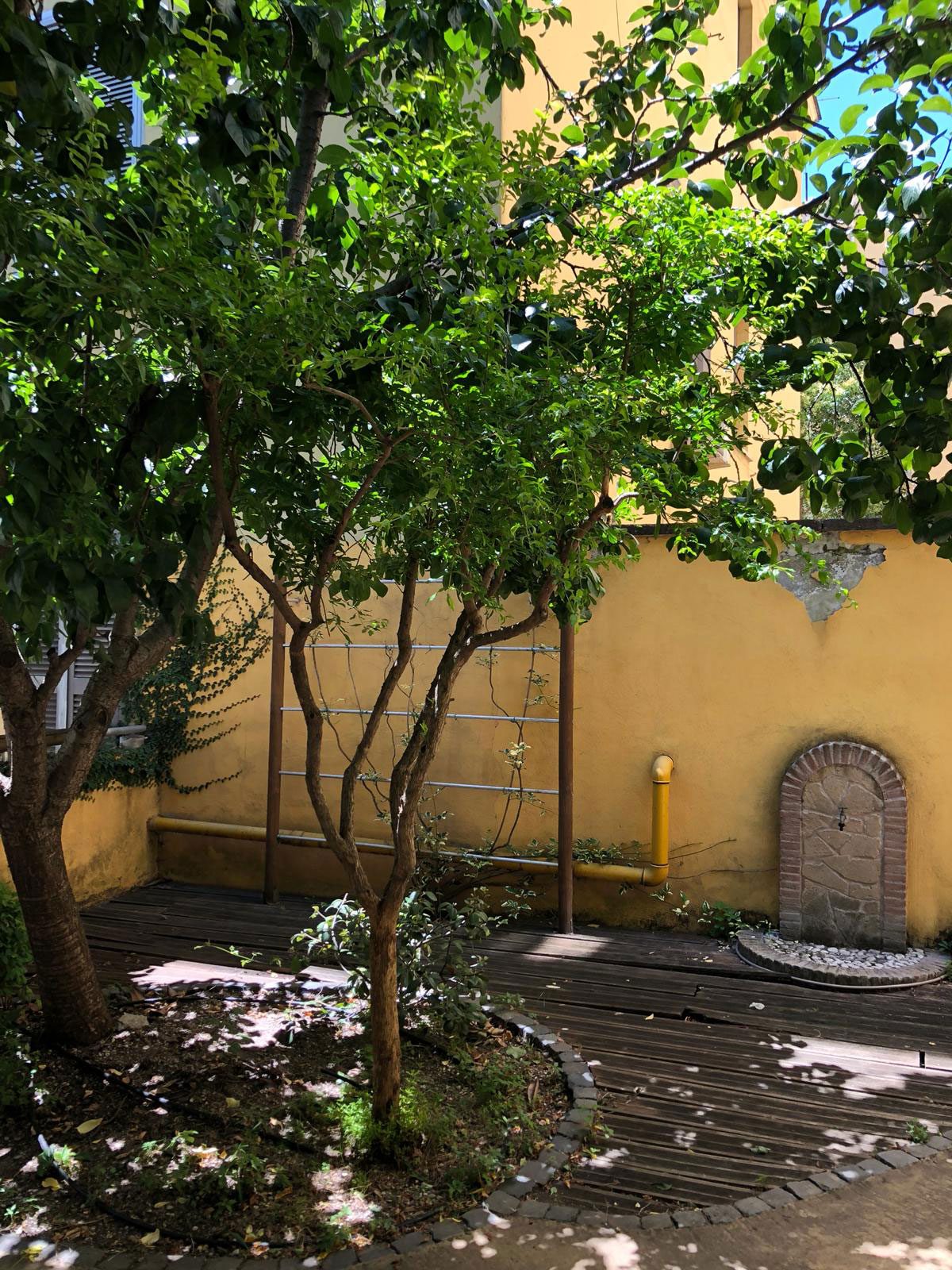 Children are inherently connected to nature and fascinated by living things. Due to a variety of factors, including increased academic pressures in schools, over-scheduling of extracurricular activities, increased reliance on technology for entertainment, and fear of children being left alone outdoors, children are spending more time indoors than ever before. Connection to nature, however, is an integral part of the Montessori philosophy and methodology. The Montessori Method stresses that immersion in nature is imperative for proper physical and psychological development. Today’s outdoor classrooms are not a new concept in Montessori schools. Maria Montessori wrote:
“In the first ‘Children’s House’ in Rome, we have a vast courtyard, cultivated as a garden, where the children are free to run in the open air…which is planted on one side with trees and a branching path in the middle, and on the opposite side, has broken ground for the cultivation of plants. This last, we have divided into so many portions, reserving one for each child…While the smaller children run freely up and down the path, or rest in the shade, the possessors of the earth (children from 4 years up) are sowing or hoeing, watering or examining the surface of the soil watching for the sprouting plants.”
Maria Montessori believed that the outdoors is a natural extension of the classroom and, hence, there should be harmony between the indoor and outdoor learning environments. She wrote:
“There must be provision for the child to have contact with nature; to understand and appreciate the order, the harmony, and the beauty in nature. It is also necessary for his psychical development to place the soul of the child in contact with creation, in order that he may lay up for himself treasure from the directly educating forces of living nature.” (1966)
She was a real advocate for the outdoor classroom and placed a great deal of emphasis on getting the children outdoors and connecting with nature.
There must be provision for the child to have contact with nature; to understand and appreciate the order, the harmony, and the beauty
in nature.” —Maria Montessori
I have fond memories of my own childhood growing up in nature. When I shut my eyes, I am easily transported back to that world. We had everything we needed and more! The river ran behind our home, and the banks provided us with rich clay for everything our imagination conjured up. Oh the mud pies we made and the tea parties we hosted underneath the gigantic, old trees. What fun! There was no lack of ideas to play, as we ran freely in the open, often in the rain, hiding behind trees, swinging from its branches, and digging to find the other end of the earth. It is no wonder then that, even now, it is to nature that I turn when I am in need of comfort and solace. I took my childhood for granted, thinking everyone had the same. It was only when I moved away that I realized how special it was and how privileged we were.
Maria Montessori once said, “The land is where our roots are. The children must be taught to feel and live in harmony with the earth.” (Gilder, 2009, p. 35) Today’s disconnection of the children from the natural world bothered me. My goal in opening an outdoor classroom at my school was to provide regular access to the outdoors, along with guided Montessori classroom work, in order to connect them back to nature. Richard Louv reminds us about the drastic need to bring children into contact with nature as he describes a haunting vision of children without access to nature suffering from nature-deficit disorder. He writes, “When children have regular contact with nature, in an unstructured way, they are more attentive, observant, creative, and self-content.” (Louv, 2008, p. 49)
In creating the prepared environment for the outdoor classroom, we followed the same meticulous principles as for the indoor classroom. The tenets of Montessori philosophy and methodology are the same:
- Child centered
- Well ordered and structured
- Beautiful
- Freedom within limits
- Intrinsic motivation
- Teacher as Guide and observer of the child
Young children thrive and their minds and bodies develop best when they have free access to stimulating outdoor environments for learning. Knowledgeable and enthusiastic adults are crucial to unlocking the potential of the outdoors. In creating the outdoor classroom, the intention is for the young child to learn the skills of social interaction, care for living things and the environment, curiosity, wonder, and joy.
The foundation of the Montessori environment is Practical Life, and this is easily done outdoors. Children learn to maintain their own place, just as they do indoors.
They take care of the plants and harvest vegetables and fruits. They learn to compost and to conserve water with the rain barrel. “Through outdoor education, children learn to take greater care of the environment, each other, and themselves. To gain self-confidence, children need to love nature and feel a sense of belonging in nature—a connection.” (Gilder, 2009, p.36)
Living things fascinate children. “It has been understood…that the best means of invigorating the child is to immerse him in nature” (The Montessori Method). Observing birds at the bird-feeding station teaches them so much about the natural environment. They take on the responsibility of filling the bird feeder and keeping the birdbath full of water. Binoculars come in handy as they look for birds in the trees. The curiosity regarding the birds they see can follow them into the classroom, where they learn the names of the birds as well as the parts of a bird. Similarly, butterfly observations can instill an interest in the life cycle of a butterfly, and they can watch the metamorphosis of a butterfly.
It is important to allow children to draw, record, or document their nature experiences or observations. Nature collages, leaf rubbings, and petal paintings make art come alive in the outdoor classroom. Given opportunities to discover nature, children not only experience the natural world to its fullest extent, they use those experiences to form important and lasting attitudes toward nature. Louv tells us that we can now assume that, just as children need good nutrition and adequate sleep, they may very well need contact with nature. “Healing the broken bond between our young and nature is in our self-interest…because our mental, physical, and spiritual health depends upon it” (Louv, p.3)
A Montessori primary environment is the perfect place to integrate nature exploration. The Montessori philosophy and Method emphasizes connecting to nature and inspiring wonder in children. Many of the classroom materials support nature discovery and research for connecting the outdoor and indoor environments, especially in the areas of natural history, geography, botany, and zoology. Maria Montessori stressed that immersion in nature is imperative for proper physical and psychological development and stated,
“When the child goes out, it is the world itself that offers itself to him. Let us take the child out to show him real things instead of making objects which represent ideas and closing them in cupboards…There is no description, no image in any book that is capable of replacing the sight of real trees and all the life to be found around them, in a real forest. Something emanates from those trees which speaks to the soul, something no book, no museum is capable of giving. The wood reveals that it is not only the trees that exist, but a whole, interrelated collection of lives. And this earth, this climate, this cosmic power are necessary for the development of these lives. The myriad of lives around the trees, the majesty, the variety are things one must hunt for, and which no one can bring into the school. How often is the soul of man—especially that of the child—deprived because one does not put him in contact with nature?”
The outdoor classroom provides children the opportunity to be outside, except on very cold days. The lessons build on what is learned in the indoor classroom—refinement of movement, sensory development, social skills, and care of the environment. They learn to become responsible citizens of our planet. These lessons lay the foundation for a lifetime love of nature, gardening, art, and science—and for me, most importantly, to be responsible global citizens. ¢
Bibliography
Gilder, S.A. (2009). Montessori by Nature. Montessori Life, 21 (4), 34-37.
Louv, R. (2008). Last child in the woods: saving our children from nature-deficit disorder. Chapel Hill, NC: Algonquin Books of Chapel Hill
Montessori, M. (1967). The discovery of the child. New York, NY: Ballantine. (Original work published 1948).
Montessori, M. (1994). From childhood to adolescence. Oxford, England: Clio Press.
Montessori, M. (1972). Peace and education. Madras: Kalakshetra Press.
Tomorrow’s Child / October 2019 / Pg 10
by Punum Bhatia Ph.D | Maria Montessori, Mathematics, Montessori Education, Montessori students, Planes of Development, Primary (3-6), Sensitive Periods, Sensorial, The International Montessori Council
The first essential for the child’s development is concentration. It lays the whole basis for his character and social behavior”
Dr. Maria Montessori (1870-1952) believed that children have an inner directive for their optimum self-construction and that concentration was the key to their natural development. This was perhaps one of her major contributions to the world: that if protected and nurtured, the child’s inner guide will lead to the development of the child’s full potential. She asked those working in her schools for close observations of the children’s behavior and it was Signorina Maccheroni in Rome that first provided specific information concerning the way in which the
children were working:
“The child keeps still for a while, and then chooses some task he finds easy, such as arranging the colors in gradation; he continues working at this for a time, but not for very long; he passes on to some more complicated task, such as that of composing words with the moveable letters, and perseveres with this for a long time (about half an hour). At this stage he ceases working, walks about the room, and appears calm; to a superficial observer, he would seem to show signs of fatigue. But after a few minutes, he undertakes some much more difficult work, and becomes so deeply absorbed in this that he shows us that he has reached the acme of his activity…When this work is finished, his activity comes to an end in all serenity; he contemplates his handiwork for a long time, then approaches the teacher, and begins to confide in her…The appearance of the child is that of a person who is rested, satisfied, and uplifted” (Montessori, 1917/1965, p. 97).
Many years of observation convinced Montessori that the work of the child and the formation of the personality occur during periods of intense concentration, which she called “polarization of attention” (Montessori, 1917/1965, p. 68). She observed that children deeply engaged and fully concentrating on a task at hand were transformed and “showed extraordinary spiritual qualities, recalling the phenomena of higher consciousness” (Montessori, 1917/1965, p. 68). A work cycle of three hours allows the child adequate time to become involved in his/her work, to observe and then become significantly engaged in an activity. “There is a vital urge to the completeness of action, and if the cycle of this urge is broken, it shows in deviations from normality and lack of purpose”
(Montessori, 1948/1967, p. 57).
The work cycle represents one of Montessori’s earliest observations about children’s development that, left uninterrupted, children would process through a regular and predictable pattern of engagement. She was able to document this in graphs, such as the one below, which shows a child advancing towards order.
Each day the children at Montessori Casa International engage in a prolonged, uninterrupted work cycle. Through this period they engage in a variety of activities, from practical life and sensorial to culture and math. Sometimes they work alone, at other times with a group of children and sometimes with the teacher. The pace of the classroom matches the developmental needs of the children when the schedule allows for three-hours of uninterrupted time in the prepared environment.
Anita (name has been changed) is in her first year in the primary classroom. She has recently moved to Colorado with her family and speaks both Russian and English. She enters the classroom, puts her lunch away in the refrigerator, and washes her hands as is customary for the children in the school. She joins a group of children receiving a lesson on the felt board of The Very Hungry Caterpillar. Her body is calm and she listens carefully to the teacher. Ten minutes pass and she starts to scream for no apparent reason. The teacher reminds her that she is in the classroom and should use her ‘inside voice.’
At 8:11 am, she leaves the group and starts to walk around the classroom. She bothers another child who is working on his own. The teacher intervenes and asks for her help in folding napkins. Anita folds napkins for two minutes and wanders away, but the teacher finds her and brings her back to her work. After a couple of minutes, Anita leaves her work again and drifts off, watching a child do a puzzle on The Very Hungry Caterpillar. The teacher follows her and reminds Anita that her work is not complete. Anita returns to the rug and finishes folding all the napkins. She rolls up the rug and puts it away.
It is 8:19 am and Anita watches another child working on a puzzle. She does not talk to the child and neither does she try to join the work. She stands next to the table watching the child put the pieces together. At 8:25 am, when the puzzle is back on the shelf, Anita takes it out and works with it. She is calm, quiet, and focused. In between, she tells a story to herself. She is not disturbing anyone else. At 8:33 am, she puts the puzzle back on the shelf and walks around the classroom.
Anita goes into the practical life area and chooses a pouring work. She is playing with the materials when another child on the table tells her this is not funny. Anita spills the colored rice on the tray and remarks about the other child, “She’s distracting me.” She cleans up the rice, puts the tray back on the shelf and takes out another pouring work. She is inattentive, talking with friends, looking around and playing with the work. It is 8:41 am when she cleans up and tells another child on the table, “Can I do that after you?” She works with another child and this time, she is focused. At one point, she goes up to a teacher and asks for help. Soon after she cleans up.
At 8:50 am she goes to a teacher and asks for her help with the listening station. She looks at the book as she listens to the story but is only there for three minutes. She says to another child, “It’s now your turn” and walks away. She does not go far. She takes out the bells and works quietly on her own for a couple of minutes. Soon after, she loses her focus and talks to friends close by. At 8:58 am she cleans up and walks around the classroom.
At 9 am, she is back in the practical life area working with opening and closing bottles. She talks to herself as she works but is not doing the work as the teachers have shown her. At 9:02 am, she cleans up and goes and sits next to another child who is working. She distracts the child by crawling under the table. The child tells Anita, “This is my work.” Anita asks her if she can watch and she is told “yes” but not to talk. Anita continues to distract the other child, playing with her work, laughing, and jumping up and down in her chair. She slips off her chair and says, “I’m ok” whilst laughing. She moves away from the area, goes to another part of the classroom, where she observes the growing caterpillars.
A teacher approaches her and asks if she would like to work with her. It is now 9:10 am. They return to the practical life area and Anita receives a lesson on opening and closing nuts and bolts. She watches the teacher who is giving the lesson with slow, isolated movements. Another child working on the same table, who dropped something that made a loud noise, does not distract her. When it is her turn to do the work, she begins confidently. However, the nut is stuck and she seeks the help of her teacher. Anita continues to work with the material. She is somewhat distracted but completes the work, cleans it up, and puts it away. She goes to the silence table. Two minutes later she returns to the practical life shelf and chooses a pouring work. Her body is calm now and her movements are slow as she pours water from one container into two. One minute later, she tells the other children on the table, “I am done.” She cleans up.
At 9:24 am, she goes to the felt board and follows the book carefully as she puts the felt pieces on the board. She is sitting and working quietly. At 9:27 am, she cleans up and walks back to the practical life area. She is distracted and not working. She goes from opening and closing bottles to pouring and transferring and then to the lacing cards. It is 9:44 am and she has found something that interests her. Her body movements are slow. She is quiet and very focused. There are children talking at the table around her, but she does not look up from her work. The caterpillar lacing cards have her full attention. She works with this for ten minutes before she cleans up and puts the materials back on the shelf.
Anita goes to the sensorial shelf and takes out the mystery bags but puts them back right away. She is talking with friends and together they go into the outdoor classroom. It is 10 am. She looks through the binoculars for a couple of minutes and then chooses to take care of plants. She goes with the teacher to get water from the rain barrel and then waters the plants. She is very interested in this work, focused and quiet. There are children talking loudly around her, but she is not distracted. Every time she needs more water, she goes with the teacher to the rain barrel and then continues watering the plants. At
10:14 am she puts her work away and chooses an art project. She is somewhat distracted until she goes to the chalkboard and tries to write her name. Another child shows her how to write a few letters, and when she is able to copy them, she says, “Look, I did it!” She moves on to writing numbers on the chalkboard.
It is 10:45 am and Anita chooses to sweep the outdoor classroom before going back inside and having a snack. At 11 am the chime rings bringing the morning work cycle to a close.
In her first year in the primary classroom, Anita is developing independence and the social responsibility that comes with living within a community. She chooses her own work and completes the cycle of activity. Concentration is beginning to develop as the teachers encourage a positive attitude towards learning. In the second year, they will continue to work on these skills, as well as promote self-confidence, initiative, autonomy, intrinsic motivation, and competence. ′
References
Montessori, M. (1917/1965). Spontaneous activity in education: The advanced Montessori method. New York: Schocken.
Acknowledgements-Shari Zeitler, Guide at
Montessori Casa International
for collecting the data for this observation.
ML/ August 2019/ Pg 34
by Punum Bhatia Ph.D | Maria Montessori, Mindfulness, Mixed Ages, Montessori Education, Montessori Teachers, Prepared Environment, Tomorrow's Child, Tomorrow's Child Online Issue
“The first essential for the child’s development is concentration. It lays the whole basis for his character and social behavior.” (Montessori, 1988, p.202)
Dr. Maria Montessori (1870-1952) believed that children have an inner directive for their optimum self-construction and that concentration is the key to their natural development. This was perhaps one of her major contributions to the world: that if protected and nurtured, the child’s inner guide will lead to the development of the child’s full potential. She asked those working in her schools for close observations of the children’s behavior, and it was Signorina Maccheroni in Rome who first provided specific information concerning the way in which the children were working:
“The child keeps still for a while, and then chooses some task he finds easy, such as arranging the colors in gradation; he continues working at this for a time, but not for very long; he passes on to some more complicated task, such as that of composing words with the Moveable Letters and perseveres with this for a long time (about half an hour). At this stage, he ceases working, walks about the room, and appears calm; to a superficial observer, he would seem to show signs of fatigue. But after a few minutes, he undertakes some much more difficult work and becomes so deeply absorbed in this that he shows us that he has reached the acme of his activity…When this work is finished, his activity comes to an end. In all serenity; he contemplates his handiwork for a long time, then approaches the teacher, and begins to confide in her…The appearance of the child is that of a person who is rested, satisfied, and uplifted.”
(Montessori, 1917/1965, p. 97).
Many years of observation convinced Montessori that the work of the child and the formation of the personality occur during periods of intense concentration, which she called “polarization of attention” (Montessori, 1917/1965, p. 68). She observed that children deeply engaged and fully concentrating on a task at hand were transformed and “showed extraordinary spiritual qualities, recalling the phenomena of higher consciousness” (Montessori, 1917/1965,p. 68). After completing a cycle of activity, children seemed refreshed, calm, and satisfied. This is similar to what Csikszentmihalyi (1997) termed “flow” and can be understood as an ability to focus on an interesting activity, which leads not only to quality performance but, most of all, to maximum effort and intensity of concentration.
For all of this to happen, there are certain key elements that need to be in place and, because this is not always the case, there are many differences in Montessori schools. The adults in Montessori settings facilitate children’s learning by preparing a favorable environment that meets the needs of the children and challenges them as well. They use observation as a vital tool for understanding and nurturing the individual potential within each child, offering plenty of opportunities for spontaneous engagement in activities. This requires the adult (or guide) to be well trained. Montessori placed the preparation of the teacher and the cultivation of her attitudes and values at the center of the process of becoming a teacher. In Montessori teacher training, preparing the adult emotionally and spiritually is fundamental to the education of future teachers. According to Montessori:
“The first essential is that the teacher should go through an inner, spiritual preparation; cultivate certain aptitudes in the moral order. This is the most difficult part of her training, without which all the rest is of no avail…She must study how to purify her heart and render it burning with charity towards the child. She must “put on humility,” and above all, learn how to serve. She must learn how to appreciate and gather in all those tiny and delicate manifestations of the opening life in the child’s soul. Ability to do this can only be attained through a genuine effort towards self-perfection. (Standing, 1957, p. 298).
Montessori teacher education is unique to others in placing more emphasis on developing self-awareness than on building theoretical knowledge. Inner preparation cannot be seen as effortless or resulting in an immediate transformation; it requires a lifetime of both deep reflection and passionate commitment. Given the inherent difficulty in changing existing beliefs, coupled with the relatively short duration of some Montessori teacher training programs, developing a valid lens through which a candidate can become a self-aware adult is not a simple undertaking. There are so many schools that I visit where the adult is not Montessori trained or may have had the bare minimum of training. It always surprises me how anyone can take on a classroom with only six months of online training!
Montessori teacher trainings can vary greatly from one to another, and this can get confusing for someone who is new to it all. A good benchmark to follow is to determine if the training center is a MACTE (Montessori Accreditation Council of Teacher Education) accredited institution. This way certain standards have been met, but there will always be some training centers that emphasize more on the methodology and others on the philosophy. The schools also have a role to play in whether they support the teacher’s observing daily and using their findings as a foundational tool to guide each child’s learning. Montessori was very firm on this aspect of ‘ following the child.’ At Montessori Casa International, the teachers have an hour every day of the morning work cycle to observe the classroom, a particular child, or themselves. Later, they get together as a team and discuss their findings with the intent of improving their practice. They also undertake regular professional development to enable them to be reflective practitioners and lifelong learners. Learning does not stop once the training and the albums are done! It is an ongoing process, as the child makes abundantly and repeatedly clear. In order to serve as the best facilitators for the child’s natural development, learning, and discovery, it is crucial that they be
well trained.
Another element that makes a difference in Montessori schools is the prepared environment. Montessori classrooms are “usually a large, open-feeling space, with low shelves, different sizes of tables that comfortably seat one to four children, and chairs that are appropriately sized for the children in the classroom” (Lillard, 2005, p. 18). Montessori describes this environment as a place where the child is nurtured, for its design meets his needs for self-construction and helps him reveal his personality and growth patterns to us. In the calm, ordered space of the Montessori ‘prepared environment,’ children work on activities of their own choosing and at their own pace. They experience a blend of freedom and self-discipline in a place specially designed to meet their
developmental needs.
A collection of materials (apparatus) is displayed on the shelves, with everything carefully ordered and in its place. The materials entice the child because they are: placed in the center of his vision; are within easy reach; and have a sensory appeal, varying in color, shape, size, texture, and possibilities of manipulation. The array of sensory contrasts, however, suggests purposeful variation rather than a random placement of brightly colored objects. A well-trained teacher will be able to organize the classroom according to the Montessori principles and, with some years of experience, will be able to make it aesthetically pleasing, ordered, and well maintained. Again, it baffles me how some are able to take on this job with little or no training. Surely it has to be daunting; the didactic apparatus/materials have a language and history all their own, and it takes years and years of practice to understand it.
Some schools choose to go with materials that are not the highest quality, without understanding the impact this makes on the lessons. For example, the experience of the biggest cube compared to the smallest one is not only in size but also in weight. I have seen some Pink Towers that are as light as can be! Budgets can be constraining, but isn’t it better to go with less but of the highest quality than more that one has to replace constantly? The licensing supervisor who came to our school was very confused about the range of materials she had seen in the various Montessori schools she visited and said she could not approve of some. When I expressed surprise, she walked to the shelf with me and pointed to the Constructive Triangles, which she said had dangerous points to them.
This is worth exploring further—why is it that there is such a range of Montessori schools? We know that the Method was never copyrighted; anyone can open a school and call it Montessori. There is no governing body that holds the schools accountable. Some are a little more honest and declare their school as “Montessori inspired” or “Montessori Lite.” Others don’t even do this! I caution the families that tour my school that what they see here can be totally different from the next Montessori school they visit. Admittedly, this can be very confusing for families that are seeking only the best for their children. A grandparent who visited our school recently and is an educator complimented me on not “warehousing” our children. She said she had never seen anything quite like this school and the way we develop the child’s individuality. I really am not sure why other schools cannot do the same. Is it a lack of understanding the Montessori philosophy, a scarcity of overall education, or is it a pursuit of profit that makes for compromises?
Another element that makes for an authentic Montessori school is multi-age groupings aligned with the planes of development. There was a reason why Montessori divided the classrooms the way she did and, yet, we often see two-year-olds in the primary classroom and sometimes a classroom only for the three-year-olds! Many a time, you don’t even have to visit the school to see this happen: it is on their website! So also is the lack of the three-hour uninterrupted work period for the 3-6 age group and a two-hour work period for the 1-3 age group. A work cycle of three hours allows the child adequate time to become involved in his/her work, to observe, and then become significantly engaged in an activity. “There is a vital urge to completeness of action, and if the cycle of this urge is broken, it shows in deviations from normality and lack of purpose” (Montessori, 1948/1967, p. 57). This is part of what makes Montessori unique and, as much as possible, this work cycle should be respected. An interruption, no matter how beneficial an adult may consider it to be, disturbs the growing development of the child’s concentration and focus. In fact, if children are aware that they may be interrupted during the course of the morning, they may choose not to work at all. Hence, it is crucial that all Montessori schools respect the three-hour uninterrupted work cycle, knowing that it is the foundation for the child to achieve lengthened periods of concentration, discipline, and normalization.
Montessori writes:
“Only normalized children, aided by their environment, show in their subsequent development those wonderful powers that we describe: spontaneous discipline, continuous and happy work, social sentiments of help and sympathy for others” (Montessori, 1988, p.188).
Another element that makes the difference between the quality and authenticity of a Montessori school is the school’s vision, commitment to improvement, and leadership. Is the educational leader/director knowledgeable about Montessori? I always joke that I would never accept a job as a Supervisor/Manager at Home DepotTM because my knowledge of tools and building supplies is nil. How then does a person who does not know what Montessori is accept a job as the leader of a Montessori school? How can s/he ensure that all aspects of the school are guided by Montessori principles? Doesn’t the difference start there?
In order to provide the highest level of Montessori experiences for children, we should be determined to provide them with the best start in life, not finding short cuts but staying true to the philosophy and methodology. The Montessori light should guide us, and we must not forget our teacher who allowed no obstacle to steer her away from her path of service to the child. In the words of Signorina Maccheroni:
“In the strange and wonderful life that has been hers, destiny has led her from country to country, from enterprise to enterprise, destroying, again and again, all she has created. But her courage and faith have continued unabashed wherever she was. No matter what her circumstances of life, she has continued her work for a better humanity, for peace, and for an understanding of the mission and nature of childhood” (1947, p. 108-109).′
Tomorrow’s Child/ April 2019 / pg 12
by Punum Bhatia Ph.D | Empowerment, Maria Montessori, MFA, Mindfulness, Montessori Charter Schools, Montessori Education, Peace Education, Practical Life, Prepared Environment, Research
“The first essential for the child’s development is concentration. It lays the whole basis for his character and social behavior.” (Montessori, 1988, p.202)
Dr. Maria Montessori (1870-1952) believed that children have an inner directive for their optimum self-construction and that concentration is the key to their natural development. This was perhaps one of her major contributions to the world: that if protected and nurtured, the child’s inner guide will lead to the development of the child’s full potential. She asked those working in her schools for close observations of the children’s behavior, and it was Signorina Maccheroni in Rome who first provided specific information concerning the way in which the children were working:
“The child keeps still for a while, and then chooses some task he finds easy, such as arranging the colors in gradation; he continues working at this for a time, but not for very long; he passes on to some more complicated task, such as that of composing words with the Moveable Letters and perseveres with this for a long time (about half an hour). At this stage, he ceases working, walks about the room, and appears calm; to a superficial observer, he would seem to show signs of fatigue. But after a few minutes, he undertakes some much more difficult work and becomes so deeply absorbed in this that he shows us that he has reached the acme of his activity…When this work is finished, his activity comes to an end. In all serenity; he contemplates his handiwork for a long time, then approaches the teacher, and begins to confide in her…The appearance of the child is that of a person who is rested, satisfied, and uplifted.”
(Montessori, 1917/1965, p. 97).
Many years of observation convinced Montessori that the work of the child and the formation of the personality occur during periods of intense concentration, which she called “polarization of attention” (Montessori, 1917/1965, p. 68). She observed that children deeply engaged and fully concentrating on a task at hand were transformed and “showed extraordinary spiritual qualities, recalling the phenomena of higher consciousness” (Montessori, 1917/1965,p. 68). After completing a cycle of activity, children seemed refreshed, calm, and satisfied. This is similar to what Csikszentmihalyi (1997) termed “flow” and can be understood as an ability to focus on an interesting activity, which leads not only to quality performance but, most of all, to maximum effort and intensity of concentration.
For all of this to happen, there are certain key elements that need to be in place and, because this is not always the case, there are many differences in Montessori schools. The adults in Montessori settings facilitate children’s learning by preparing a favorable environment that meets the needs of the children and challenges them as well. They use observation as a vital tool for understanding and nurturing the individual potential within each child, offering plenty of opportunities for spontaneous engagement in activities. This requires the adult (or guide) to be well trained. Montessori placed the preparation of the teacher and the cultivation of her attitudes and values at the center of the process of becoming a teacher. In Montessori teacher training, preparing the adult emotionally and spiritually is fundamental to the education of future teachers. According to Montessori,
“The first essential is that the teacher should go through an inner, spiritual preparation; cultivate certain aptitudes in the moral order. This is the most difficult part of her training, without which all the rest is of no avail…She must study how to purify her heart and render it burning with charity towards the child. She must “put on humility,” and above all, learn how to serve. She must learn how to appreciate and gather in all those tiny and delicate manifestations of the opening life in the child’s soul. Ability to do this can only be attained through a genuine effort towards self-perfection. (Standing, 1957, p. 298).
Montessori teacher education is unique to others in placing more emphasis on developing self-awareness than on building theoretical knowledge. Inner preparation cannot be seen as effortless or resulting in an immediate transformation; it requires a lifetime of both deep reflection and passionate commitment. Given the inherent difficulty in changing existing beliefs, coupled with the relatively short duration of some Montessori teacher training programs, developing a valid lens through which a candidate can become a self-aware adult is not a simple undertaking. There are so many schools that I visit where the adult is not Montessori trained or may have had the bare minimum of training. It always surprises me how anyone can take on a classroom with only six months of online training!
Montessori teacher trainings can vary greatly from one to another, and this can get confusing for someone who is new to it all. A good benchmark to follow is to determine if the training center is a MACTE (Montessori Accreditation Council of Teacher Education) accredited institution. This way certain standards have been met, but there will always be some training centers that emphasize more on the methodology and others on the philosophy. The schools also have a role to play in whether they support the teacher’s observing daily and using their findings as a foundational tool to guide each child’s learning. Montessori was very firm on this aspect of “following the child.” At Montessori Casa International, the teachers have an hour every day of the morning work cycle to observe the classroom, a particular child, or themselves. Later, they get together as a team and discuss their findings with the intent of improving their practice. They also undertake regular professional development to enable them to be reflective practitioners and lifelong learners. Learning does not stop once the training and the albums are done! It is an ongoing process, as the child makes abundantly and repeatedly clear. In order to serve as the best facilitators for the child’s natural development, learning, and discovery, it is crucial that they be well trained.
Another element that makes a difference in Montessori schools is the prepared environment. Montessori classrooms are “usually a large, open-feeling space, with low shelves, different sizes of tables that comfortably seat one to four children, and chairs that are appropriately sized for the children in the classroom” (Lillard, 2005, p. 18). Montessori describes this environment as a place where the child is nurtured, for its design meets his needs for self-construction and helps him reveal his personality and growth patterns to us. In the calm, ordered space of the Montessori ‘prepared environment,’ children work on activities of their own choosing and at their own pace. They experience a blend of freedom and self-discipline in a place specially designed to meet their
developmental needs.
A collection of materials (apparatus) is displayed on the shelves, with everything carefully ordered and in its place. The materials entice the child because they are: placed in the center of his vision; are within easy reach; and have a sensory appeal, varying in color, shape, size, texture, and possibilities of manipulation. The array of sensory contrasts, however, suggests purposeful variation rather than a random placement of brightly colored objects. A well-trained teacher will be able to organize the classroom according to the Montessori principles and, with some years of experience, will be able to make it aesthetically pleasing, ordered, and well maintained. Again, it baffles me how some are able to take on this job with little or no training. Surely it has to be daunting; the didactic apparatus/materials have a language and history all their own, and it takes years and years of practice to understand it.
Some schools choose to go with materials that are not the highest quality, without understanding the impact this makes on the lessons. For example, the experience of the biggest cube compared to the smallest one is not only in size but also in weight. I have seen some Pink Towers that are as light as can be! Budgets can be constraining, but isn’t it better to go with less but of the highest quality than more that one has to replace constantly? The licensing supervisor who came to our school was very confused about the range of materials she had seen in the various Montessori schools she visited and said she could not approve of some. When I expressed surprise, she walked to the shelf with me and pointed to the Constructive Triangles, which she said had dangerous points to them.
This is worth exploring further—why is it that there is such a range of Montessori schools? We know that the Method was never copyrighted; anyone can open a school and call it Montessori. There is no governing body that holds the schools accountable. Some are a little more honest and declare their school as “Montessori inspired” or “Montessori Lite.” Others don’t even do this! I caution the families that tour my school that what they see here can be totally different from the next Montessori school they visit. Admittedly, this can be very confusing for families that are seeking only the best for their children. A grandparent who visited our school recently and is an educator complimented me on not “warehousing” our children. She said she had never seen anything quite like this school and the way we develop the child’s individuality. I really am not sure why other schools cannot do the same. Is it a lack of understanding the Montessori philosophy, a scarcity of overall education, or is it a pursuit of profit that makes for compromises?
Another element that makes for an authentic Montessori school is multi-age groupings aligned with the planes of development. There was a reason why Montessori divided the classrooms the way she did and, yet, we often see two-year-olds in the primary classroom and sometimes a classroom only for the three-year-olds! Many a time, you don’t even have to visit the school to see this happen: it is on their website! So also is the lack of the three-hour uninterrupted work period for the 3-6 age group and a two-hour work period for the 1-3 age group. A work cycle of three hours allows the child adequate time to become involved in his/her work, to observe, and then become significantly engaged in an activity. “There is a vital urge to the completeness of action, and if the cycle of this urge is broken, it shows in deviations from normality and lack of purpose” (Montessori, 1948/1967, p. 57). This is part of what makes Montessori unique and, as much as possible, this work cycle should be respected. An interruption, no matter how beneficial an adult may consider it to be, disturbs the growing development of the child’s concentration and focus. In fact, if children are aware that they may be interrupted during the course of the morning, they may choose not to work at all. Hence, it is crucial that all Montessori schools respect the three-hour uninterrupted work cycle, knowing that it is the foundation for the child to achieve lengthened periods of concentration, discipline, and normalization.
Montessori writes:
“Only normalized children, aided by their environment, show in their subsequent development those wonderful powers that we describe: spontaneous discipline, continuous and happy work, social sentiments of help and sympathy for others”
(Montessori, 1988, p.188).
Another element that makes the difference between the quality and authenticity of a Montessori school is the school’s vision, commitment to improvement, and leadership. Is the educational leader/director knowledgeable about Montessori? I always joke that I would never accept a job as a Supervisor/Manager at Home DepotTM because my knowledge of tools and building supplies is nil. How then does a person who does not know what Montessori is accepting a job as the leader of a Montessori school? How can s/he ensure that all aspects of the school are guided by Montessori principles? Doesn’t the difference start there?
In order to provide the highest level of Montessori experiences for children, we should be determined to provide them with the best start in life, not finding short cuts but staying true to the philosophy and methodology. The Montessori light should guide us, and we must not forget our teacher who allowed no obstacle to steer her away from her path of service to the child. In the words of Signorina Maccheroni:
“In the strange and wonderful life that has been hers, destiny has led her from country to country, from enterprise to enterprise, destroying, again and again, all she has created. But her courage and faith have continued unabashed wherever she was. No matter what her circumstances of life, she has continued her work for a better humanity, for peace, and for an understanding of the mission and nature of childhood” (1947, p. 108-109).′
References
Lillard, A. S. (2005). Montessori: The science behind the genius. New York: Oxford University Press.
Maccheroni, A.M. (1947). A true romance: Maria Montessori as I knew her. The Darien Press, Edinburgh
Montessori, M. (1917/1965). Spontaneous activity in education: The advanced Montessori method. Oxford: Clio
Montessori, M. (1988). The absorbent mind. Oxford: Clio
Standing, E.M. (1957). Maria Montessori: Her life and work. New York: Penguin.
ML/ Feb 2019 / Pg 11
by Punum Bhatia Ph.D | Early Adolescence (12-15), Later Adolescence (15-18), Lower Elementary (6-9), Mixed Ages, Primary (3-6), Sensorial, Tomorrow's Child, Tomorrow's Child Online Issue, Upper Elementary (9-12), Young Adolescent, Young Adults
Chinese lanterns isolate on white.
Chinese New Year must be around the corner, for our school is decked in red and gold. Chinese New Year is celebrated according to the Lunar Calendar, sometime in January or February each year. It marks the coming of spring and new beginnings and is usually a two-week celebration. As in other cultures, there are many preparations leading up to the event. The week before the holiday, families clean their homes to sweep away all traces of misfortune. Shops and homes are decorated with lanterns, flowers, and bright banners. The color red and fireworks are used to frighten away monsters and evil spirits and to gain the attention of the Gods. On the night before the New Year, families celebrate with a family dinner, board games and midnight fireworks. On New Year’s Day, children are given presents of money in red envelopes and often visit neighbors and friends, with gifts of food and wishes of good fortune.
On the 15th and last day of the New Year celebration, the Chinese people celebrate what is called the Lantern Festival. Everyone goes out at night with colorful lit lanterns. Often children march in a lantern parade. The lanterns are left lit all night to thank the Gods for returning the daylight to them at this time of year. It is a time to celebrate nature, family, and friends and a time to pray for good fortune in the coming year. The day is filled with eating rice balls, family reunions, and solving puzzles often found on the outside of many of the lanterns.
Preparation in our classroom centers around a beautifully adorned display table with red and gold New Year banners, pictures of Chinese people celebrating all over the world, artifacts including the Great Wall, lanterns, dragons, and Chinese dolls. There are New Year signs on our windows and doors that welcome the children and get them excited and
curious at the same time.
In the Practical Life area, there are brightly colored Chinese bowls and spoons for transferring activities, and a variety of new ingredients for pouring including lotus nuts, rice and melon seeds. Chopsticks and a variety of culinary delights, such as star anise and peanuts, replace tongs and beads and erasers. In the flower-arranging area, fresh spring flowers are brought in and arranged for good luck with red adornments. Children learn to make a pot of tea and share it with their friends in a little ritualistic tea ceremony.
In Sensorial, the fabric box has the most gorgeous silks and other fabrics from China for the children to match. In our smelling bottles, we put a variety of spices including star anise, mixed spices, and jasmine tea. The stereognostic bags have Chinese coins, small pandas, moneybags, and little Chinese hats! Among the cultural ideas on our shelves are pairing cards of beautiful silk, weaving, and a box of objects from China, which the children can explore in conjunction with the puzzle map and flag.
The art area is a riot of activities, from appreciating Chinese artists to calligraphy and cutouts of the good-luck sign. There are fans for the children to fold and make and lanterns for them to cut, as well as firecrackers to roll and hang around the classroom.
Our talks during the week about the Chinese New Year describe the rituals performed by the Chinese people at this time of the year. We talk about the significance of the colors red and yellow, which are worn to bring good luck. We read Chinese poems and stories every day. One told about a New Year’s reunion; another of the dancing dragon; but the favorite is An Invitation to the Great Race. This tells the story of how the Chinese solar-lunar calendar came into being. We talk about the animals of the years in which they were born, and they learn more about this in literacy and have an opportunity to color and display the order of the animals in the race.
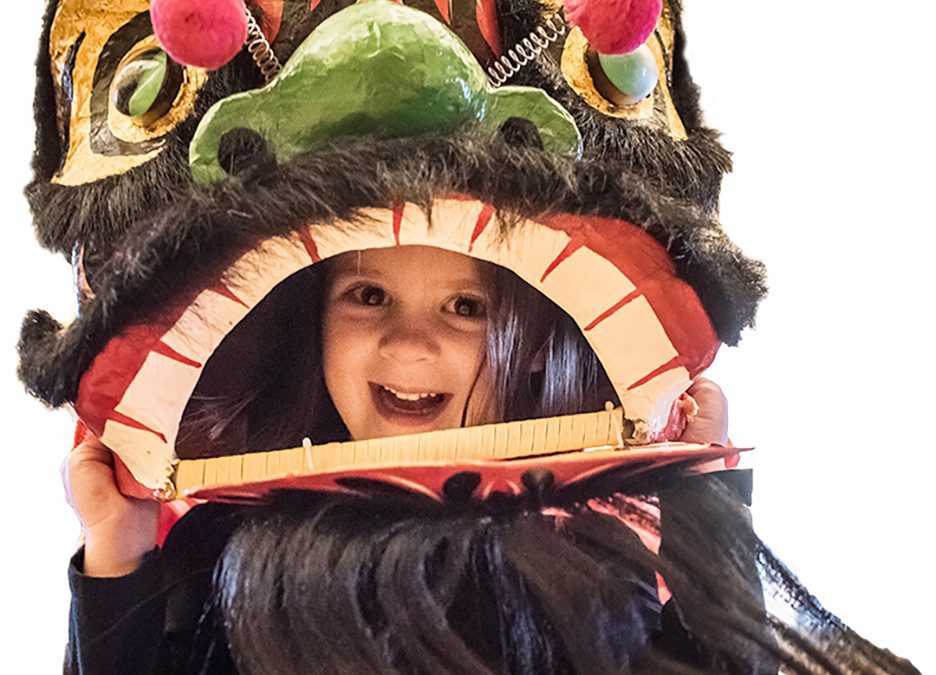
All of this leads to the very exciting event: the celebration of the festival itself. Family and friends are invited and encouraged to wear red and gold. The children carefully sweep and clean their classroom in true Chinese tradition. The performance starts with the Kindergartners introducing the audience to China and speaking not only of Chinese New Year but also of the Great Wall; the importance of the lion statues; the clothes and the money. It goes without saying that this is all done in Chinese! Chinese New Year songs follow and then, of course, the Lion Dance. It is all energy, color, and life—an experience enjoyed thoroughly by the lion dancers, themselves, and all the audience. Maria Montessori once said that, when bringing in other cultures all items, “would be received with enthusiasm,” and that “a child’s mind can acquire culture at an earlier age when involved with the movement,” as the lion dance shows.
The celebrations continue with The Great Race. The children enact the race called by the Jade Emperor with the animals gathering on the shore and crossing the river. The years of the Chinese calendar follow the order in which the animals arrived on the other side of the river. Their costumes are simple with black leotards and masks and tails. We keep their lines to one or two so they can easily memorize them and recite without stage fright! They do such a good job and hopefully, when they look back at their first acting stints, it will be a pleasant memory.
The Chinese teachers present the children with the lucky red envelope, which have some chocolate coins in them, as is the tradition in China. This is followed with a feast of all things the Chinese people consider auspicious to eat for Chinese New Year. There are dumplings, sticky Chinese New Year cake, watermelon seeds, New Year lucky candy, cookies, oranges, and jasmine tea. I overhear a parent telling a child, who insist the mother try some of the dumplings, “You are so lucky to have these opportunities I never had.”
It is true, the world is a really small place and festivals are a superb way of introducing children to different cultures and providing them with an enriching experience.
“All mankind shares a common history, a common world of cultures, and struggles toward a common future. The child should be given a sense of our heritage, our culture and our potential destiny from the earliest moments of sensitivity.
The needs of mankind are universal. Our means of meeting them create the richness and diversity of the planet. The child should come to relish the texture of that diversity.”
—Maria Montessori
Punum Bhatia, PhD has dedicated her life to Montessori education as a parent, teacher, and teacher educator for nearly thirty years. She completed her Bachelor’s degree in English Literature; earned Masters’ degrees in English Literature and Education from the University of Calcutta; and completed a certificate diploma in Montessori Pedagogy. She earned her Doctor of Philosophy from the University of Colorado Denver in 2012 for her work on the Self-Efficacy of Montessori teachers. In her efforts to understand children and the environments necessary for them to grow and flourish, Punum focuses on Maria Montessori’s original philosophy and techniques. After teaching the Montessori method to cohorts all around the world, she is now the proud owner of her very own bilingual preschool. (www.mcidenver.edu/ www.punumbhatia.com).
Tomorrow’s Child / Nov 2018 / Pg 21
by Punum Bhatia Ph.D | Maria Montessori, Montessori Education, The International Montessori Council
With the Second World War over, Maria Montessori and her son, Mario, returned from India and came to live in Amsterdam. This was a very busy time for Dr. Montessori, affectionately known as Mammolina by teachers and students “to whom she had become a symbol of hopefulness for humanity, of the kind of optimism necessary to once again rebuild a ravaged world” (Kramer, 1976, p. 350). She was constantly on the move, going from one country to another to lecture training course and, of course, to receive honors and rewards. Unlike what she had imagined in India during the war, she was far from forgotten in Europe, which was “once again liberated and once again in a mood of renewal, full of hopes and plans for rebuilding a better world” (Kramer, 1976, p. 360). The significance of Dr. Montessori’s work was being realized, and she was nominated for the Nobel Peace Prize in 1949 (and then again in 1950 and 1951).
The home in which Dr. Montessori chose to live in Amsterdam was to be her last. During my recent visit to Koninginneweg 161, I was told that the charm of this particular house and why it was chosen to be her residence was that it had an elevator that was much needed, as Maria Montessori was now old and frail. The house is beautiful, but it is her study on the second floor, that has been largely preserved in its original state, where one senses one is walking on sacred ground. It is as though her spirit lives on in this bright room with all her original furniture that had been moved from Barcelona.
I tiptoed into the room, scared to put my feet on the gorgeous rug, only to be told to come and sit on the chairs. I could scarcely believe that but was grateful to be able to sit down and soak it all in.
The walls are adorned with photographs —those of her parents, of herself during different episodes of her life, and one in particular that seeks our attention is the portrait painted by Sir Frank Salisbury, a famous British artist. The portrait was given to Mario Montessori in 1955. As Montessorians, we have all seen this beautiful painting of our Mammolina and probably have a framed copy in our schools but to see the original in her study is something quite different. In the painting, Maria Montessori is wearing a black gown with a pearl string, looking so elegant and dignified whilst holding a book that reads Mammolina Immortale (Immortal Mammolina).
The walls are also decorated with diplomas, certificates, awards and letters of recognition. My attention focuses on the letter by Rabindranath Tagor— poet, writer, philosopher and pedagogue from India who was also the first non-European to win the Nobel Prize for literature. He writes to Dr. Montessori in 1940:
As you know, I am a great admirer of your work in education and, along with my countrymen, think it is very fortunate indeed that India, at this hour, can get your guidance in creative self-expression. I am confidant that education of the young, which must underlie all work of national reconstruction, will find a new and lasting inspiration from your presence.
It is interesting to note that the diploma awarded by King Umberto I to Maria Montessori on her graduation as a doctor (July 10, 1896), was modified to say ‘Signora’ as she was the first woman in Italy to graduate as a doctor. Similarly, when Mario Montessori obtained his Montessori diploma in London (1925), his certificate was changed from ‘she’ to ‘he.’ Both mother and son as ambassadors of change!
The display case in the study holds many of Maria Montessori’s medals and awards. I was fortunate enough to be able to hold a few of them. Amongst them was the gold brooch with the inscription that translates: “To Maria Montessori from her native town.” This was presented to her when she visited the place of her birth, Chiaravalle, on August 26, 1950. In a picture close by, she is wearing the brooch during the ceremony.
The bookcase in the Study contains titles written by Dr. Montessori herself. There are several editions and languages of the books, including The Absorbent Mind and The Montessori Method. There are also books by her followers and admirers who have dedicated their books to her. Next, to the mantelpiece, a familiar picture catches my eye and provides me comfort. It is Raphael’s Madonna della Seggiola. Of this painting that Maria Montessori said every school should have, she wrote:
In this beautiful conception, Raphael has not only shown us the Madonna as a Divine Mother holding in her arms the baby who is greater than she but by the side of this symbol of all motherhood, he has placed the figure of St John, who represents humanity. So in Raphael’s picture, we see humanity rendering homage to maternity—the sublime fact in the definite triumph of humanity.
(Montessori, 1912/1964, p. 82)
I stand behind her desk and gently run my fingers along it. I can scarcely breathe as I take it all in. This is the desk at which she wrote as my eyes rest on the inkstand and the bottle of Gimborn ink. There is also an ink blotter, which one does not see much of anymore in our age of computers, but I remember it from my childhood. As I pick it up, I can see her beautiful signature blotted on it. There is also a typewriter in the room, and I am told it is extremely heavy and that Montessori preferred to write by hand. There are a few boxes on her desk, one looks like a papier-mâché from Kashmir, India and another is a wooden box with dragons on it, which probably held stamps and papers. There is also an ashtray made of onyx with a matchbox in a leather cover that looks like a book.
With great trepidation, I ask if I could sit in her chair and I am told I may just because I asked so politely. As I do so, I am filled with gratitude for this woman who has given my life direction and purpose. I pledge again to follow her principles with integrity and do my best to serve the child. There are fresh flowers on her desk for the day that I am visiting is her birthday. How perfect!
Maria Montessori’s “long and self-sacrificing labours on behalf of the child—and through him of humanity—ended suddenly on 6th May 1952 at Noordwijk-on-Sea, in Holland.” (Standing, 1957,p. 72) She was eighty-one years old and had kept a demanding work schedule, traveling and lecturing in international congresses in Italy, France, Austria, England, and Scotland. As customary, Montessori had come to Noordwijk to spend a couple of weeks in the summer home of Ada Pierson’s family. She was sitting with Mario in Het Huis aan Zee (The House at the Sea), the summerhouse of the Pierson family and was thinking of taking a trip to Africa to give a lecture. It was suggested that she was too weak to travel and perhaps someone else should go in her place. Dr. Montessori turned to Mario and said, “Am I no longer of any use then?” (Kramer, 1976, p. 367). She died shortly afterward of a cerebral hemorrhage.
Dr. Montessori considered herself to be a citizen of the world and had always said she wished to be buried where she died. In accordance with her wishes, she was interred in the courtyard of the Catholic cemetery at the Gooweg. Her grandson, Mario Montessori Junior designed her grave and the epitaph in Italian reads: I ask the lovely children that can do everything to help me to build peace among people and in the world.
References
Kramer, R. (1976). Maria Montessori: A biography. New York: Putnam
Montessori, M. (1912/1964). The Montessori method. New York: Schocken
Standing, E.M. (1957). Maria Montessori: Her life and work. New York: Penguin.
ML / September 2018/ pg 13
by Punum Bhatia Ph.D | Infant-Toddler (0 to 3), Lower Elementary (6-9), Maria Montessori, Mindfulness, Mixed Ages, Montessori Parenting, Montessori Teachers, Practical Life, Tomorrow's Child, Tomorrow's Child Online Issue
“Practical Life activities keep children at the leading edge of their skill development, building their intelligence, deepening their concentration, and giving them a new appreciation of their expanding capabilities.” —Lillard and Jessen (2008)
It was during my recent consultation visit to a Montessori school in India that I found myself required to convince others, more than I had ever needed to do before, of the importance of Practical Life skills in a child’s life. India is a large country with the second largest population in the world and has a very strong belief that the earlier a child can be started on reading, writing and numeracy skills the sooner and better prepared the child will be to enter the rat race of school and college admissions and later secure a job in life.
Practical Life, in my opinion, has never received the importance it so truly deserves. It is the foundation of the Montessori classroom. In the first Casa dei Bambini in San Lorenzo, Maria Montessori had noticed the children’s interest in the tasks of everyday living and carefully formulated activities which would enable the children to learn how to dress themselves, sweep the floor, prepare and serve food, and do other daily tasks. In doing so, the children became more independent, more aware of their environment and more dexterous. She also taught them how to behave courteously, thus endowing them with social as well as practical skills.
In India, and I am sure in many other countries, the need for the child to do these activities is not considered important because they have domestic help/servants who sweep and clean their homes, cook for them, do their laundry, etc. The families argue with the schools that they do not send their children to school to learn these skills but to learn to read and write. I knew at the outset convincing them of the importance of this area of the Montessori curriculum was not going to be an easy one, but I was determined to do so for the sake of the child. If I had my way, I would strip the classroom of other areas and keep just the Practical Life activities for the first month or so. Maria Montessori’s first biographer, E.M. Standing writes:
“Yet, in point of fact, no other occupations which could be undertaken by the children at this stage (3-5) could be more important for their whole development—physical, mental, and moral—than these ‘exercises of practical life,’ as they are called.” (1957, p.213)
I began at the very beginning by explaining how Maria Montessori had observed that very young children are frequently frustrated in their attempts to do things for themselves and that what they need is to have specific exercises, as closely linked to real life as possible, that allow them to master the tasks that they see going on around them in everyday life. The Exercises of Practical Life do just that—they bridge the gap between the home and the school. The child is fascinated by these activities that he has seen his parents perform daily since birth, and tries to copy and learn from them. It is the child’s way of adapting to the world and constructing his own sense of reality.
Maria Montessori also saw that, unlike the adults in their lives, children are not interested in the activity itself, but in the process of learning. This is the difference between the adult and the child—the child is focused on the process and the adult on the product. As a result, the child happily repeats the exercises again and again until he feels satisfied. Practical Life activities are therefore an important part of the Montessori environment.
The young child is attracted to activities that he sees going on around him and that gives him independence and control of his own life. I could see where the Indian families were coming from, for the Practical Life exercises can seem routine and mundane—after all, we all dress ourselves each day. What these families needed to understand was how fundamental the skills learned in Practical Life are to the whole Montessori philosophy, and to her concept of holistic education.
According to Angeline Lillard, “Some of the main purposes of including such exercises in the classroom are (1) to educate children’s movements to be geared to a purpose; (2) to develop children’s ability to concentrate on a task; (3) to help children learn to carry out a series of steps in sequences; and (4) to help children learn to care for the environment. As such, these exercises are foundational to many aspects of Montessori education.” (2005, p. 48).
Through the Practical Life activities, the child is not only preparing himself for later intellectual work but also developing his emotional and social skills, expanding his knowledge of his environment, increasing his physical skills, and engendering a sense of community. Nothing else prepares a child better for life than these activities. “The first thing to realize about these exercises of practical life is that their aim is not a practical one. Emphasis should be laid not on the word practical but on the word life.”(Standing. 1957, p. 213) Through the Exercises of Practical Life, the child learns the skills that enable him to become an independent human being. That is why once he has been shown a skill, he needs the freedom and the opportunity to practice and perfect it. Through this greater independence grows greater self-confidence, which is reflected in every area of the classroom.
When a child becomes totally absorbed in an activity and repeats it over and over again, he begins to develop his powers of concentration. That is why a well-trained Montessori teacher spends so much time observing the children in her classroom, assessing their needs and interests, so she can prepare the environment to entice the child to work with the materials. The more he repeats the activity, the more his concentration develops. At Montessori Casa International, the teachers do everything they can to prepare the Practical Life shelves so the children are drawn to the activities. We know that concentration can only begin in Practical Life and we do everything we can to get the children in this area and keep them there!
The Exercises of Practical Life look so simple that they are almost deceptive. They encourage the child to develop through activity many of his large and small motor movements. A child who sorts and threads different sizes of beads washes a chair or table, prepares a snack, or waters the plants in the classroom will have greater control over his movements. Polishing activities and the dressing frames develop eye-hand coordination. Besides and most importantly, all of these activities prepare the child’s hand indirectly for the time when he will hold a pencil to write. For instance, the transferring activities with the tongs and spoons develop the pincer grip. As a result, we find that when the time comes, we really do not have to show a Montessori child how to hold a pencil correctly.
As the child develops his Practical Life skills, he becomes more independent and confident. Now that he can put on his own smock and button all the buttons himself, for example, his self-confidence grows and his self-esteem becomes stronger and more positive. Pretty soon he will be helping the younger/newer children in the classroom with their smocks, and this will not only boost his own self-esteem, but it will reinforce his own understanding. He will feel a valuable member of the community and this, in turn, will lead to a greater sense of consideration for others and a feeling of belonging. Through the exercises of grace and courtesy, the child develops social graces. He learns, for example, to use “walking feet”; “inside voices”; how to interrupt others and in doing so learns the acceptable behavior of his own and other cultures.
Practical Life is the soul of the Montessori classroom. Every activity contributes to the child’s intelligence. “Practical Life activities educate the child to carry out organized sequences of activity, employing the body in the service of the mind.” (Lillard, 2005, p. 49) They develop the child’s sense of order—he learns where to find specific activities, conduct the activity in the proper sequence and then return the material from where he got it. The cycle of activity encourages logical thinking and develops the child’s inner sense of order.
At Montessori Casa International, we change the theme in Practical Life every two to three weeks in an attempt to draw children to this area. New colors of pitchers, new objects to sort or transfer, a tarnished silver object in the middle of the table calling to be polished, all bring the children in and, we hope, will develop in them a sense of order, concentration, coordination, and independence which will be the foundation for all the skills they will eventually learn in the other areas of the classroom.
I left India slightly optimistic and very hopeful. The realization that Practical Life is a building block for Math and Literacy and helps the child in his progress towards normalization had started to come to those who had considered it to be a waste of time. A few of the activities of Practical Life, including grace and courtesy, have now been included in the curriculum of the school I have been working with. This is a beginning but there is still so much work to be done.
References:
Lillard, P. & Jessen, L., (2008). Montessori from the start: The child at home, from birth to age three. Schocken.
Lillard, A. S. (2005). Montessori: The science behind the genius. New York: Oxford University Press.
Standing, E.M. (1957). Maria Montessori: Her life and work. New York: Penguin.
Punum Bhatia, Ph.D. was inspired by Dr. Maria Montessori’s philosophy, Punum Bhatia, PhD has dedicated her life to Montessori education as a parent, teacher, and teacher educator for nearly thirty years. She completed her Bachelor’s degree in English Literature; earned Masters’ degrees in English Literature and Education from the University of Calcutta; and completed a certificate diploma in Montessori Pedagogy. She earned her Doctor of Philosophy from the University of Colorado Denver in 2012 for her work on the Self-Efficacy of Montessori teachers. In her efforts to understand children and the environments necessary for them to grow and flourish, Punum focuses on Maria Montessori’s original philosophy and techniques. After teaching the Montessori method to cohorts all around the world, she is now the proud owner of her very own bilingual preschool. (www.mcidenver.edu/ www.punumbhatia.com)
Tomorrow’s Child/ September 2018/ pg 17
by Punum Bhatia Ph.D | Imagination, Infant-Toddler (0 to 3), Kindergarten, Language, Language & Reading, Lower Elementary (6-9), Maria Montessori, Mixed Ages, Montessori Education, Reading, The International Montessori Council
“You may have tangible wealth untold:
Caskets of jewels and coffers of gold.
Richer than you can never be.
I had a mother who read to me.”
—Strickland Gillian
Cuddling up with my mother and being read to by her is probably one of my most favorite memories of my childhood; and well past the time when I could read myself, I always enjoyed being read to by her. She was quite the storyteller and spinner of words, and I was mesmerized into listening so intently as we traveled through different lands, met the most interesting people, and engaged in any number of emotions from sad, happy, fearful, and admiration. Later, when my children were born, the first words they heard from their grandmother were Shakespeare!
With that background, it surprises me no end why books, stories, and poems are given so little importance in the curriculum of many schools today. Literature is often just a ‘filler,’ tacked on when a few minutes are left for children to go home or go out to play. Yet, if we just paused a moment here and thought about it, we would realize that literature is probably the most important part of the curriculum of any school.
“Literature entices, motivates and instructs. It opens doors to discovery and provides endless hours of adventure and enjoyment.” (Norton, 2003, p. 2)
Literature is a child’s window onto a wider world: a world of imagination and emotions; a world of situations (some familiar, some new); a world of ideas and concepts. It can be argued that, for a small child, books provide him with insight into other cultures that are beyond what he has seen in his own little life.
Maria Montessori wrote: “Reading is the entrance by means of the written language to the field of culture.” (1989, p. 95).
Children’s books are important tools to create an enriched environment. When we use the best poems and stories, with their rich language and their exploration of human experiences, we are opening so many doors for our children and filling their lives with a richness and wealth that can come from nowhere else.
When I opened my own Montessori school in Denver, Colorado, it was natural that I would fill the bookshelves with good literature. As a young child and even when doing my Masters’ in English Literature, books had transported me to different realms and exposed me to customs that were so different from any that I knew. My imagination had been nourished in more ways than one, and I wanted to ensure that every child that came to our school would have the same experience. As Maria Montessori wrote:
“If then, the true basis of imagination is a reality, and its perception is related to the exactness of observation, it is necessary to prepare children to perceive the things in their environment, exactly, in order to secure for them the material required by the imagination.” (1991, p. 254)
If the basis of creativity is knowledge and experience, then there is great value in carefully choosing literature and exposing children to the richness of their inherited culture. Literature and the child’s direct sense experiences interact in order to strengthen his grasp of the external world.
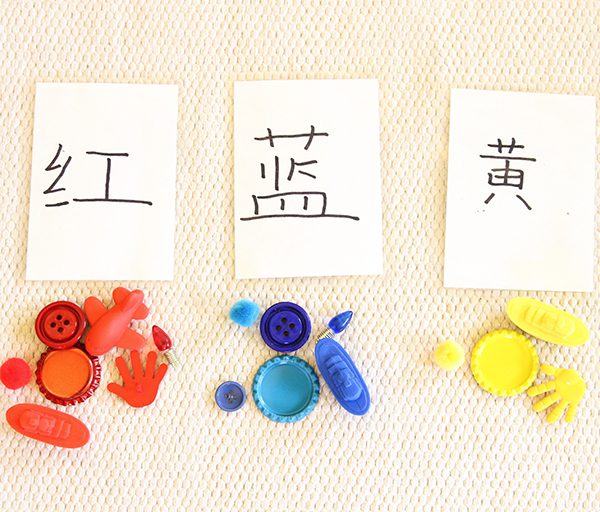
Michael Bond’s Paddington Bear is an immediate favorite among the children of our school. They are able to identify with the bear because Paddington displays many childlike characteristics. He is frequently in trouble, and his ways to hide this from people who would disapprove provides the children with squeals of laughter. When we begin this unit of study, we ensure that it is in multiple areas of the classroom. For instance, the listening corner has a book and CD for the children to hear the story on their own; puppets of Paddington and his beloved Aunt Lucy are in the dramatic play area; there are pictures to color and puzzles to complete. Since we are a bilingual school, the children hear the story read to them in Mandarin as well as English. We take this opportunity to create a material with matching cards to teach them the words for a hat, coat, and boots in Mandarin.
Within a culture, more magic happens! Since Paddington Bear began his journey in Peru and arrived in England, the children learn all about Peru and England. Towards the close of the unit, they are invited to bring their very own Paddington Bears (or any other if they don’t have one) for a tea party. In very proper British style, they enjoy a cup of tea and marmalade sandwiches!
Literature plays a very strong role in helping us understand and value not only our own culture but helps us develop positive attitudes towards the culture of others as well. It certainly makes the world a much smaller place and what better time to begin to realize similarities and differences than in early childhood before any forms of prejudice set in. Our kindergartners, for example, take the stories to a whole new level when they write their own tales. Paddington Bear gets to travel to India to see the Taj Mahal and taste Indian sweets; to Paris to see the Eiffel Tower and even comes to Colorado to ski with one of them! Literature plays such an important role in nurturing and expanding their imagination. It stimulates them to write their own stories based on their experiences and inspired by what they have read.
It is important to distinguish that becoming literate does not automatically denote an entrance into “the field of culture” (Montessori, 1989, p. 85). It merely means an ability to read with skills that come from reading books (primers) that have limited vocabulary and ideas that in no way represent literature. Children need the stimulus of good stories and poems that reflect the richness of language and human experience. In The Uses of Enchantment: The Meaning and Importance of Fairy Tales, Bruno Bettelheim (1976), provides a strong rationale for using traditional tales with children. He claims that nothing is so enriching as conventional tales to allow children to learn about human progress and how to problem solve.
“The Three Little Pigs teaches the nursery-age child in a most enjoyable and dramatic form that we must not be lazy and take things easy, for if we do, we may perish. Intelligent planning and foresight combined with hard labor will make us victorious over even our most ferocious enemy—the wolf!” (1976, pgs. 41-42)
In The Three Little Pigs, the wolf threatens, “I’ll huff and I’ll puff and I’ll blow your house in,” and the pig replies, “Not by the hair on my chinny chin chin.” The repetitive language appeals to children who get carried into the story, repeating the refrain. So, too, in Goldilocks and the Three Bears, where the repetition is in the chairs, bowls of porridge, beds, and the question that is asked repeatedly: Who is sitting in my chair…eating my porridge…sleeping in my bed. So the love for literature and a good story begins, and we are hopeful that this will stay with them for the rest of their lives.
At Montessori Casa International, the children enjoy stories from all over the world. They read stories on China as we celebrate Chinese New Year and learn the rituals the Chinese perform at this time of the year. Hence, it is of little surprise when they put their experiences together and make comments such as these overheard during lunch:
“I want to go to China.”
And another will add:
“To see the Great Wall. I really want to see that.”
It gets more interesting as another adds:
“I would like to go during Chinese New Year and eat some dumplings!”
It really is hard to imagine at most times that the children we are talking about are only four or five years old. Their intellectual curiosity has been awakened, and the world is already such a small place as their imagination takes them places.
We use every opportunity to expose them to different cultures often tying up the units with art history lessons. So, when studying the work of Edgar Degas, we introduce the children to a book from France, Babar the Elephant. Of literature’s most beloved elephant, author Maurice Sendak writes:
“Like an extravagant piece of poetry, the interplay between few words and many pictures, commonly called the picture book, is a difficult, exquisite, and most easily collapsible form that few have mastered…Jean de Brunhoff was a master of this form. Between 1931 and 1937 he completed a body of work that forever changed the face of the illustrated book.” (1981, p.7)
As we look at the art of Alphonse Mucha, we bring in The Little Mole, a cartoon mole created by the Czech animator Zdenek Miller. His universally appealing cuteness makes him quite a favorite in our classroom too and gives the children an opportunity to practice color recognition in Mandarin.
The choice of books available to children today has never been so varied or of such high quality in terms of text, illustration, and production. Children’s books are marvelous as a medium for carrying simple messages about the world we live in and the foibles of human character. The Tale of Peter Rabbit begins with the well-known line, “Once upon a time there were four little rabbits, and their names were—Flopsy, Mopsy, Cottontail, and Peter.” The children identify with Peter Rabbit wanting to go into the garden so badly and sympathize with his fright as he tries unsuccessfully to flee from Mr. McGregor. Beatrix Potter’s illustrations complement the story, adding another dimension that draws the children in and develops a close relationship with Peter Rabbit.
Animal characters, such as Miffy, created by Dick Bruna, are written about things that children can understand, and situations they will face, such as going to the hospital and going to school. What appeals to the children (other than the happy endings) is the instantly recognizable Miffy with her bright colors.
Books have the ability to transport us to unknown worlds and envision people and places. Imagination takes flight as we turn the pages of a book, enabling the children to enter the inner worlds of others and, in doing so, drawing them out of their purely egocentric world. Their emotions are engaged, and as they explore and identify with a range of feelings, they gain insights into new roles and situations. Every aspect of a child’s development can be supported by the literature. It is the answer in some ways to Montessori’s constant emphasis on the need for a holistic education:
“The essential thing is for the task to arouse such interest that it engages the child’s whole personality.” (1988, p. 206) ′
References
Bettelheim, B. (1976), The Uses of Enchantment, The Meaning and Importance of Fairy Tales. Thames and Hudson, London
Montessori, M. (1988). The Absorbent Mind. Clio Press Ltd., Oxford England
Montessori, M. (1989). Education for a new world. Clio Press Ltd., Oxford, England
Montessori, M. (1991). Spontaneous Activity in Education, Clio Press Ltd., Oxford, England
Norton, D.E. (2003). Through the eyes of a child. Merrill Prentice Hall, Columbus, Ohio
Sendak, Maurice (1981). “Homage to Babar on his 50th Birthday.” introduction to Jean de Brunhoff & Laurent de Brunhoff’s Babar’s Anniversary Album. Random House
Punum Bhatia, Ph.D. was inspired by Dr. Maria Montessori’s philosophy to dedicate her life to Montessori education as a parent, teacher, and teacher educator for nearly thirty years. She completed her Bachelor’s degree in English Literature; earned Masters’ degrees in English Literature and Education from the University of Calcutta; and completed a certificate diploma in Montessori Pedagogy. She earned her Doctor of Philosophy from the University of Colorado Denver in 2012 for her work on the Self-Efficacy of Montessori teachers. In her efforts to understand children and the environments necessary for them to grow and flourish, Punum focuses on Montessori’s original philosophy and techniques. After teaching the Montessori method to cohorts all around the world, she is now the proud owner of her very own bilingual preschool.
(www.mcidenver.edu/www.punumbhatia.com)
ML/ September 2018/ pg 18
by Punum Bhatia Ph.D | Early Adolescence (12-15), Kindergarten, Later Adolescence (15-18), Lower Elementary (6-9), Mixed Ages, Montessori Education, The International Montessori Council
“You may have tangible wealth untold:
Caskets of jewels and coffers of gold.
Richer than I or you can never be.
I had a mother who read to me.”
—Strickland Gillian
Cuddling up with my mother and being read to by her is probably one of my most favorite memories of my childhood; and well past the time when I could read myself, I always enjoyed being read to by her. She was quite the storyteller and spinner of words, and I was mesmerized into listening so intently as we traveled through different lands, met the most interesting people, and engaged in any number of emotions from sad, happy, fearful, and admiration. Later, when my children were born, the first words they heard from their grandmother were Shakespeare!
With that background, it surprises me no end why books, stories, and poems are given so little importance in the curriculum of many schools today. Literature is often just a ‘filler,’ tacked on when a few minutes are left for children to go home or go out to play. Yet, if we just paused a moment here and thought about it, we would realize that literature is probably the most important part of the curriculum of any school.
“Literature entices, motivates and instructs. It opens doors to discovery and provides endless hours of adventure and enjoyment.” (Norton, 2003, p. 2)
Literature is a child’s window onto a wider world: a world of imagination and emotions; a world of situations (some familiar, some new); a world of ideas and concepts. It can be argued that, for a small child, books provide him with insight into other cultures that are beyond what he has seen in his own little life.
Maria Montessori wrote: “Reading is the entrance by means of the written language to the field of culture.” (1989, p. 95).
Children’s books are important tools to create an enriched environment. When we use the best poems and stories, with their rich language and their exploration of human experiences, we are opening so many doors for our children and filling their lives with a richness and wealth that can come from nowhere else.
When I opened my own Montessori school in Denver, Colorado, it was natural that I would fill the bookshelves with good literature. As a young child and even when doing my Masters’ in English Literature, books had transported me to different realms and exposed me to customs that were so different from any that I knew. My imagination had been nourished in more ways than one, and I wanted to ensure that every child that came to our school would have the same experience. As Maria Montessori wrote:
“If then, the true basis of imagination is a reality, and its perception is related to the exactness of observation, it is necessary to prepare children to perceive the things in their environment, exactly, in order to secure for them the material required by the imagination.” (1991, p. 254)
If the basis of creativity is knowledge and experience, then there is great value in carefully choosing literature and exposing children to the richness of their inherited culture. Literature and the child’s direct sense experiences interact in order to strengthen his grasp of the external world.
Michael Bond’s Paddington Bear is an immediate favorite with the children of our school. They are able to identify with the bear because Paddington displays many childlike characteristics. He is frequently in trouble, and his ways to hide this from people who would disapprove provides the children with squeals of laughter. When we begin this unit of study, we ensure that it is in multiple areas of the classroom. For instance, the listening corner has a book and CD for the children to hear the story on their own; puppets of Paddington and his beloved Aunt Lucy are in the dramatic play area; there are pictures to color and puzzles to complete. Since we are a bilingual school, the children hear the story read to them in Mandarin as well as English. We take this opportunity to create a material with matching cards to teach them the words for a hat, coat, and boots in Mandarin.
Within culture, more magic happens! Since Paddington Bear began his journey in Peru and arrived in England, the children learn all about Peru and England. Towards the close of the unit, they are invited to bring their very own Paddington Bears (or any other if they don’t have one) for a tea party. In very proper British style, they enjoy a cup of tea and marmalade sandwiches!
Literature plays a very strong role in helping us understand and value not only our own culture but helps us develop positive attitudes towards the culture of others as well. It certainly makes the world a much smaller place and what better time to begin to realize similarities and differences than in early childhood before any forms of prejudice set in. Our kindergartners, for example, take the stories to a whole new level when they write their own tales. Paddington Bear gets to travel to India to see the Taj Mahal and taste Indian sweets; to Paris to see the Eiffel Tower and even comes to Colorado to ski with one of them! Literature plays such an important role in nurturing and expanding their imagination. It stimulates them to write their own stories based on their experiences and inspired by what they have read.
It is important to distinguish that becoming literate does not automatically denote an entrance into “the field of culture” (Montessori, 1989, p. 85). It merely means an ability to read with skills that come from reading books (primers) that have limited vocabulary and ideas that in no way represent literature. Children need the stimulus of good stories and poems that reflect the richness of language and human experience. In The Uses of Enchantment: The Meaning and Importance of Fairy Tales, Bruno Bettelheim (1976), provides strong rationale for using traditional tales with children. He claims that nothing is so enriching as conventional tales to allow children to learn about human progress and how to problem solve.
“The Three Little Pigs teaches the nursery-age child in a most enjoyable and dramatic form that we must not be lazy and take things easy, for if we do, we may perish. Intelligent planning and foresight combined with hard labor will make us victorious over even our most ferocious enemy—the wolf!” (1976, pgs. 41-42)
In The Three Little Pigs, the wolf threatens, “I’ll huff and I’ll puff and I’ll blow your house in,” and the pig replies, “Not by the hair on my chinny chin chin.” The repetitive language appeals to children who get carried into the story, repeating the refrain. So, too, in Goldilocks and the Three Bears, where the repetition is in the chairs, bowls of porridge, beds, and the question that is asked repeatedly: Who is sitting in my chair…eating my porridge…sleeping in my bed. So the love for literature and a good story begins, and we are hopeful that this will stay with them for the rest of their lives.
At Montessori Casa International, the children enjoy stories from all over the world. They read stories on China as we celebrate Chinese New Year and learn the rituals the Chinese perform at this time of the year. Hence, it is of little surprise when they put their experiences together and make comments such as these overheard during lunch:
“I want to go to China.”
And another will add:
“To see the Great Wall. I really want to see that.”
It gets more interesting as another adds:
“I would like to go during Chinese New Year and eat some dumplings!”
It really is hard to imagine at most times that the children we are talking about are only four or five years old. Their intellectual curiosity has been awakened, and the world is already such a small place as their imagination takes them places.
We use every opportunity to expose them to different cultures often tying up the units with art history lessons. So, when studying the work of Edgar Degas, we introduce the children to a book from France, Babar the Elephant. Of literature’s most beloved elephant, author Maurice Sendak writes:
“Like an extravagant piece of poetry, the interplay between few words and many pictures, commonly called the picture book, is a difficult, exquisite, and most easily collapsible form that few have mastered…Jean de Brunhoff was a master of this form. Between 1931 and 1937 he completed a body of work that forever changed the face of the illustrated book.” (1981, p.7)
As we look at the art of Alphonse Mucha, we bring in The Little Mole, a cartoon mole created by the Czech animator Zdenek Miller. His universally appealing cuteness makes him quite a favorite in our classroom too and gives the children an opportunity to practice color recognition in Mandarin.
The choice of books available to children today has never been so varied or of such high quality in terms of text, illustration, and production. Children’s books are marvelous as a medium for carrying simple messages about the world we live in and the foibles of human character. The Tale of Peter Rabbit begins with the well-known line, “Once upon a time there were four little rabbits, and their names were—Flopsy, Mopsy, Cottontail, and Peter.” The children identify with Peter Rabbit wanting to go into the garden so badly and sympathize with his fright as he tries unsuccessfully to flee from Mr. McGregor. Beatrix Potter’s illustrations complement the story, adding another dimension that draws the children in and develops a close relationship with Peter Rabbit.
Animal characters, such as Miffy, created by Dick Bruna, are written about things that children can understand, and situations they will face, such as going to the hospital and going to school. What appeals to the children (other than the happy endings) is the instantly recognizable Miffy with her bright colors.
Books have the ability to transport us to unknown worlds and envision people and places. Imagination takes flight as we turn the pages of a book, enabling the children to enter the inner worlds of others and, in doing so, drawing them out of their purely egocentric world. Their emotions are engaged, and as they explore and identify with a range of feelings, they gain insights into new roles and situations. Every aspect of a child’s development can be supported by the literature. It is the answer in some ways to Montessori’s constant emphasis on the need for a holistic education:
“The essential thing is for the task to arouse such interest that it engages the child’s whole personality.” (1988, p. 206) ′
References
Bettelheim, B. (1976), The Uses of Enchantment, The Meaning and Importance of Fairy Tales. Thames and Hudson, London
Montessori, M. (1988). The Absorbent Mind. Clio Press Ltd., Oxford England
Montessori, M. (1989). Education for a new world. Clio Press Ltd., Oxford, England
Montessori, M. (1991). Spontaneous Activity in Education, Clio Press Ltd., Oxford, England
Norton, D.E. (2003). Through the eyes of a child. Merrill Prentice Hall, Columbus, Ohio
Sendak, Maurice (1981). “Homage to Babar on his 50th Birthday.” introduction to Jean de Brunhoff & Laurent de Brunhoff’s Babar’s Anniversary Album. Random House
Punum Bhatia, Ph.D. was inspired by Dr. Maria Montessori’s philosophy to dedicate her life to Montessori education as a parent, teacher, and teacher educator for nearly thirty years. She completed her Bachelor’s degree in English Literature; earned Masters’ degrees in English Literature and Education from the University of Calcutta; and completed a certificate diploma in Montessori Pedagogy. She earned her Doctor of Philosophy from the University of Colorado Denver in 2012 for her work on the Self-Efficacy of Montessori teachers. In her efforts to understand children and the environments necessary for them to grow and flourish, Punum focuses on Montessori’s original philosophy and techniques. After teaching the Montessori method to cohorts all around the world, she is now the proud owner of her very own bilingual preschool.
(www.mcidenver.edu/www.punumbhatia.com)
Montessori Leadership/ April 2018 / Pg 18
by Punum Bhatia Ph.D | Archived Issues / Montessori Leadership, Maria Montessori, Mixed Ages, Peace Education, The International Montessori Council
Climate change is one of the most pressing issues of our time and one of the biggest challenges facing the international community today.
Desmond Tutu, Nobel Peace Laureate and Archbishop Emeritus of Cape Town alerts us to this fact:
“Climate change is the greatest human-induced crisis facing the world today. It is totally indiscriminate of race, culture, and religion. It affects every human being on the planet.”
(Kagawa and Selby, 2010)
Back in 1946, Maria Montessori describing Cosmic Education wrote:
“Similarly, all other animals, by the process of feeding themselves or seeking food, carry out a ‘cosmic’ task, which contributes to keep nature in a harmonious state of purity. Each kind works for the whole and, upon the work of each, depends the possibility of the life of the whole. … When one observes the generality of this contribution, one cannot but wonder about Man. Is Humanity the only parasite who lives among useless struggles and immense work merely to keep itself living?” (1989, p. 107)
It certainly seems so. We have selfishly used our planet to serve our own needs, and scientists claim that two human actions are solely responsible for global warming: burning fossil fuels and deforestation. We have been warned that if greenhouse gas emissions keep going up, with business as usual, this will produce rapid and devastating warming. This is not just bad news for animals, such as polar bears; dependable food and water supplies could be disrupted, too, and rising seas could remake maps. What’s more, extreme weather, worse droughts, and more fierce wildfires could become increasingly common.
It was in December 2015 that world leaders began assembling in Paris to try and do what they were unsuccessful in doing for the past two decades: steer the world away from climate disaster. They signed an important historic agreement to fight global climate change. In the words of President Barack Obama:
“I believe this moment can be a turning point for the world. We’ve shown that the world has both the will and the ability to take on this challenge…the planet will be in better shape for the next generation.”
A beginning was made to save the planet and, at Montessori Casa International, we thought it was time to do our bit. Now, more than ever, it seemed like a great time to talk to the children about the amazing planet that we live on and how we can best use and protect its resources. Montessorians are well versed when it comes to protecting the Earth and its environment. Dr. Montessori believed wrote:
“The land is where our roots are. The children must be taught to feel and live in harmony with the Earth” (1948/1973, p. 35). She also said, “There is no description, no image in any book that is capable of replacing the sight of real trees and all of the life to be found around them in a real forest” (1948/1973, p. 3). Montessori placed great importance on Cosmic Education, beginning with the miracle of the cosmos, filling children with a great sense of awe, as they encounter the wonders of creation and realize their role and responsibility. She wrote:
“Let us give the child a vision of the whole universe…for all things are part of the universe and are connected with each other to form one whole unity” (Montessori, 1948/1989, p. 5-6).
Dr. Montessori felt that human existence had become overshadowed by a focus on materialism and external goals. She spoke of a lack of balance between mankind and the environment, regarding people as victims of their own technological progress, greedy for personal gain at the expense of others. She maintained that the rapid pace of technological advancement exceeded man’s pace of psychological adjustment and urged that “man should raise his values and become the master instead of the victim of the environment he himself has created” (Montessori, 1989, p.11).
It is easy to forget that Montessori was writing over a century ago, for her ideas are so relevant today. In order to reinstate ‘inner’ goals, Montessori maintained that we must acquire a fundamental respect for life, derived from an understanding of how life has evolved and the conditions it requires for continuation. She wrote:
“This is not the time to fight each other…The real enemy is man’s impotence against his own products…To vanquish this enemy, man has only to react and behave in a different manner towards the environment.” (Montessori, 1955/1989, p.13).
She believed that we must consciously educate the child towards an understanding and appreciation of the environment that will, in turn, awaken his/her sense of responsibility towards it. Montessori referred to this as her ‘Cosmic Plan’ (Montessori, 1948/1989), the aim of which was to bring about world peace. She firmly believed that educating children according to these values is the only way of improving a lot of mankind.
At Montessori Casa International, we wanted to spread the sense of responsibility and ownership that the children had towards their classroom to the larger environment. We wanted them to know that there was always a choice and that they should choose responsibly as citizens of the world. Empowering them to care for the planet would have a long-lasting impact that would take them into their adult lives, where environmental protection would be second nature to them.
Opening the young child’s mind to the richness and diversity of life requires a thoughtful approach on the part of the adult. The young thinker, who is just beginning to develop conscious memory, is dependent on concrete, physical experiences to make sense of things.
We realized that we must, therefore, find ways of making information about the wider world accessible to the child. Since ours is a lab school, we gave this task to our teachers in training. Each teacher trainee took, as her project, one aspect of caring for our environment. She explored it in many ways, realizing that what we must offer to the children is a whole host of first-hand experiences. This would arouse their interest and provide sensory stimuli that can be internalized and used as a basis for the imagination. Without this initial input, the child would be unable to ponder aspects of the world beyond his/her immediate environment.
This was quite a challenge for the teacher trainees, but they had plenty of opportunities to learn as they went, changing their lesson plans to meet the needs of the children. They began as a group, showing the children pictures of the sad state of our planet: drylands, melting glaciers, extinct animals, and so on. They discussed with the children how this made them feel and what could be done to change and make the planet healthy again. Gradually the children were steered in the direction of teaching responsibility. Compositing, recycling, reusing, repurposing, and water harvesting were all introduced to them over the next few months.
All these projects have stayed in the school, becoming a part of the children’s daily life. There is much less wastage. Everything is composted or recycled or reused. The families were also involved in this program and urged to help us teach environmental responsibility to the children. The children certainly had come a long way from the initial responses we received. For instance, when asked, “What if the water in the drinking fountain ran out? What would you do?” The response from a four-year-old was, “We could drink lemonade!”
The lesson on melting ice caps seemed to have made a lasting impact on them. A discussion on water pollution and its negative effects on our ice caps had one of the children remarks when looking at the picture of the sick polar bear, “Oh no! We have to save his home!”
The teacher trainees learned that, if we take time to share the child’s interest in the environment (making sure we model positive attitudes) and find ways to extend the child’s discoveries, we will go a long way to developing a true ‘citizen of the world’ —an individual who has a fundamental respect for life in all its manifestations. This was Montessori’s vision, to promote the child as an agent of humanity’s survival and improvement.
References
Kagawa & Selby. (2010)
Education and Climate Change: Living and learning in interesting times. New York: Routledge
Montessori, M. (1948/1976). From childhood to adolescence. New York: Schocken.
Montessori, M. (1948/1989). To educate the human potential. Oxford: Clio
Montessori, M. (1955/1989). The formation of man. Oxford: Clio.
Montessori, M. (1989). The child, society, and the world: Unpublished speeches and writings (Vol. 7). Oxford: Clio.
Montessori Leadership/ Sept 2017/ Pg 17
by Punum Bhatia Ph.D | Brain Development, Infant-Toddler (0 to 3), Language, MFA, Montessori Education, Montessori Parenting, Psychology
A common misperception is that exposure to multiple languages causes brain confusion and leads to delayed speech and literacy in young children. In reality, however, a bilingual environment fosters cognitive development and increases creativity, concentration, productivity, and problem-solving skills. As early as the womb, humans are able to distinguish between multiple languages and are able to detect various phonetic sounds through pattern-recognition (Klass 2011); at the age of eleven months, babies begin to acquire and absorb language in all its complexities. Researchers at the University of Washington (Klass 2011) noted, however, that at six months old, monolingual infants could discriminate between phonetic sounds whether they were uttered in their native tongue or in a foreign language not spoken at home. At the crucial age of ten to twelve months old, though, monolingual children no longer detect sounds in the secondary language (Klass 2011). Thus, it is clear the ability to master multiple languages, and the resulting effects on the brain, begin as early as six months.
“Bilingualism is good for you. It makes brains stronger. It is a brain exercise” says Ellen Bialystok, a cognitive neuroscientist who has spent almost 40 years learning how bilingualism sharpens the mind. As educators realize that a child’s early years are critical for language acquisition, preschools and kindergartens are quickly creating bilingual curriculums in a variety of languages, from Chinese to Russian to Spanish. According to Fred Genesee of the University of Minnesota, bilingual children are more likely to outperform monolingual children academically and socially.
This stems from the fact that when a child is fluent in two or more languages, he has multiple associations for a single object or concept. For example, the word “sister” in English can refer to either an elder or a younger sibling; in Mandarin Chinese, however, there are separate words for elder sister (姐姐jiějie) and younger sister (妹妹mèimei). In addition to increasing a child’s vocabulary, the distinct relationships inherent in the words often encourages him to express more complicated thoughts (i.e., “I have an older sister,” instead of “I have a sister”). This means that the child is more flexible in how he thinks, and can, therefore, be more creative. Most importantly, this transition happens seamlessly, without the delayed steps of forced translation that occurs in adult language-learners.
According to Peal and Lambert (1962), a bilingual child is:
“a youngster whose wider experiences in two cultures have given him advantages which a monolingual does not enjoy. Intellectually his experience with two language systems seems to have left him with a mental flexibility, a superiority in concept formation, a more diversified set of mental abilities… There is no question about the fact that he is superior intellectually. In contrast, a monolingual appears to have a more unitary structure of intelligence which he must use for all types of intellectual tasks.” (p. 20)
At Montessori Casa International (MCI), we offer a dual-language environment precisely for the long-term benefits to our preschool students. Instead of attempting linguistic fluency in Mandarin Chinese, the aim is to advance brain development in young children by awakening their neural pathways into processing a language that is so completely different from English. A pictorial and tonal-based language with few grammar rules, studying Chinese will also equip children with the tools to learn additional languages in the future—be it Arabic or Russian. The bilingual classroom is also in accordance with the Montessori Method, which emphasizes independence and intrinsic self-motivation. Early on, Dr. Montessori noted the impact the environment had on an impressionable mind:
“The absorbent mind is indeed a marvelous gift to humanity! By merely ‘living’ and without any conscious effort the individual absorbs from the environment even a complex cultural achievement like language. If this essential mental form existed in the adult, how much easier would our studies be?”
While these ideas all seem to make perfect sense in theory, we were a little hesitant about how they would work in practice. Would using English and Chinese in our classroom successfully open up a whole new way of seeing the world in our children? Although we taught the children basic greetings in Chinese and displayed corresponding exercises on our shelves, our first real experiment with bilingualism came during the Chinese Mid-Autumn Festival. The festival centers around the harvest and the full moon, so we taught the children to write the four stroke character for moon 月(yuè). It was later revealed that one of the students was writing this character in the steam from his shower! What followed was absolutely fascinating.
Using the Montessori approach, we introduced the children to compound words and showed them how to bring two characters together in Chinese. For example:
月(yuè, moon) + 光(guāng, light)= 月光 (yuèguāng, moonlight)
and 月饼(yuèbǐng, moon cake)
as well as 圆月(yuányuè, circle, or full, moon)
In addition to seeing how easy it was to build these common words involving the character for moon, we also showed the children a different way of thinking about the months. Instead of the Roman concept of January, which is named for Janus, the “god of the doorway,” Chinese uses a secular measurement. Therefore, January, the first month of the year is:
一(yī,one)+ 月 (yuè , moon) = 一月 (yīyuè, January), 二 (èr, two)+ 月 (yuè, moon) = 二月 (èryuè, February), and so on.
In this way, the children:
- Learned that there are multiple ways to express the same concept;
- Understood the ideas behind compound words;
- Improved their numerical abilities;
- Developed the right side of their brains by associating the characters with the sounds and the meanings, while also developing the left side of their brains through deductive reasoning; and
- Discovered another culture and appreciated its traditions.
While we are excited that our students can communicate in Chinese and in English (and in a few other languages as well), we realize that they may not be able to recall the word for “moon cake” several years down the road. For this reason, our emphasis is on cognitive analysis: What can I do with this piece of information? After the initial character for “moon,” we introduced a series of simple three to four-stroke characters that very representative in nature, and made three–part cards with photographs that resembled the characters. These were the characters for rén (person); fēi (to fly); and mén (door).
After three months, the students not only have a working knowledge of both English and Chinese (colors, numbers, basic adjectives, etc), but they independently choose to complete their exercises in either language. Furthermore, we are noticing their ability to construct patterns and develop logical reasoning. In one of our new works, the child is supposed to count the number of dots on a dragon and place a peg near to the corresponding number; the cards are all jumbled together, but one of the students was doing this work in a sequential order and was thus redefining the categories of information through executive functioning.
As the school-year progresses, we are eager to see what discoveries our children make and to refine our own methods to keep up with their innovative—and absorbent—minds! 加油!
References
Bialystok, E. (2009). Bilingualism in development: Language, literacy & cognition. Cambridge University Press
Klass, P. (2011). Hearing bilingual: How babies sort out language. The New York Times
Montessori, M. (1988). The absorbent mind. Oxford, England: Clio Press
Peal, E., & Lambert, W. (1962). The relation of bilingualism to intelligence. Psychological Monographs, 76, 1-23.
Tomorrow’s Child / September 2017 / p 20
by Punum Bhatia Ph.D | Maria Montessori, Montessori Education, The International Montessori Council
I have been told I need to meet Raji teacher. Before I know it, an older woman ushers me into a small red car and we careen down the back alleys of Chennai, India. We arrive at a garden-level flat, where two grinning women in earthy silk saris and jasmine flowers dangling from their hair greet us. Immediately, these three women are gossiping and giggling like schoolgirls in the playground as they recall their encounters with a woman they call ‘Madam.’ The rest of us know ‘Madam’ by the slightly more formal title of Dr. Maria Montessori.
I am here in the south of India as the final stage of my Montessori pilgrimage. I have been involved in Montessori education since 1984 and have since traveled to many significant Montessori sites in Italy and the Netherlands. As a lifelong learner of the Montessori philosophy, I am looking for a deeper understanding of how and why Montessori developed the spiritual dimension to her Method and her vision of cosmic education. I have read that the inspiration for both had come from this lush region that tumbles down into the Indian Ocean.
At the age of 69, “Maria Montessori began one of the most interesting and important phases of her already remarkable life” (Standing, 1957, p. 70) when the Theosophical Society of India extended an invitation to Dr. Montessori and her son, Mario, to journey to India to give lectures and training courses. World War II had just broken out and Montessori was forced into exile from Italy because of her liberal and anti-fascist views. Montessori accepted the
invitation and reached India in 1939.
I was watching the three women’s animated faces without really listening when suddenly my ears perked up. They were reminiscing about the time they were asked to assemble a guard of honor for Montessori and her son. Their voices swelled with pride as they recounted how children stood waving on both sides of the road from the gates of the Theosophical Society to the Olcott Bungalow.
Earlier in the day, I had met Mr. C. Nachiappan, founder of Kalakshetra Publications (the first publishers of Montessori texts) and a strong supporter of the Montessori movement, who had told me that Dr. Montessori had been received with “such an august welcome only given to very few people in those days.” He had been at the airport and witnessed the arrival of the Montessoris in Chennai: “She arrived in Madras via Bombay in November 1939. She came on a mail plane that was personally piloted by JRD Tata.” Every Indian knows JRD Tata. He was one of the most enterprising Indian entrepreneurs and built the largest industrial house of India. The fact that he personally flew the Montessoris to Madras (now Chennai) makes it quite obvious that her arrival in India was a matter of huge significance and that she was greeted as a very special guest. Nachiappan continued to describe the event: “Children were lined up along both sides of the road and waving out to her.”
The Theosophical Society is nestled within 250 acres of vibrant green trees and plants, including a 500-year-old banyan tree, under which Montessori is known to have held discourses with many notable personalities. As we walked along the grounds towards the banyan tree, I was amazed at the diversity of nature and the serenity and solitude it provided. Away from the noise of the city and people, this was a sanctuary, and I found myself at once at peace in this tranquility. I thought of Montessori and what this place must have done for her, away from the wars that the western world was fighting.
We were given a brief introduction to the aims of the Theosophical Society, and immediately I could see similarities with the Montessori philosophy: respect for all things; freedom of thought; and development of latent potentialities in individuals. The banyan tree was amazing: the parent tree is now dead but the rest of the tree sprawls around a huge area. In honor of my teacher, I hung a mallai on the tree: in the south of India, the flower garland or mallai is presented to gods and people of honor. In quite a few pictures of Maria Montessori at this time, she is wearing the mallai along with the angavastham (also given as a symbol
of honor).
The three women continued to reminisce about ‘Madam’ and her son. They chattered about what beautiful human beings they both were and how they genuinely cared about their students. One of the ladies excitedly recalls how she had visited Mario Montessori in Amsterdam many years later and how touched she was that he remembered her and made it a point to ask about many of his students in India.
It was also clear that school with the Montessoris was a lot of fun as they discussed the time line “that was more than a furlong long… we started unrolling it from the gate…” and that taught them how civilization evolved. Happily, they remembered “how we went on long walks to collect leaves, and then we dried them and studied them.” They spoke proudly about their standard math exams in which they chose questions that no one else attempted because Mario had made math so much fun and they found it very easy.
We then drove to the Olcott Bungalow and were shown the grounds in which the first course was held in 1939. I was told that thatched huts were constructed here to house the 350 students who came to attend the course, and the largest of them was used as the lecture hall. Dr. Montessori lectured in Italian, and I asked Bhuvna, who had taken the training under Montessori, if this was a problem? She explained that although Montessori did not lecture in English, she certainly knew the language. Once she had heard Montessori speak in English and questioned her about her knowledge of the language. To this Montessori replied with a twinkle in her eye, “Only know Italian…very convenient!”
Mr. Nachiappan further explained that Mario translated Montessori’s lectures into English: the translation was done after every few lines. Dr. Montessori paid very close attention to the translation and whenever Mario fumbled for words, it was Montessori that provided the suitable English expression.
Besides, Bhuvna elaborated, she must have known English, for she corrected all their albums. What I would not give to hear her speak or watch her give a presentation or two! “Madam had beautiful hands with which she demonstrated her materials,” Nachiappan said.
It was hard for me to believe that I was standing in the place that had housed my teacher during World War II; first in the school that had been used as an observatory and practical training school for the Montessoris and the participants in the course and then in their residential quarters. The Olcott Bungalow is grand, with gigantic Roman pillars that once had a great view of the Bay of Bengal. I imagined Maria Montessori in a white, “very loose-fitting full-length gown…walking up and down most of the time in the open balcony of the bungalow.” What had she been thinking as she lived in this foreign country that showered her with respect and strived to meet all of her needs? Did she miss the way of life she was used to? Or was she so absorbed in studying the universal bambino that it did not matter to her where she was?
The conversation between the three women stirred me towards an answer to these questions: both Montessori and Mario were focused on education and studying the child. “Madam pointed at the child, but the problem today is that most of the people are looking at their fingers and not at what they were pointing at: the child,” Bhuvana said. She went on to emphasize how important it is not to lose focus on the child. “Always think of the child,” she advised.
Close to the grounds of the Theosophical Society is the Kalakshetra Center, which I also visited. What a place of quiet, beauty and simplicity. It is truly India at its cultural best, bringing together traditional dance, theatre, music and art. It reminded me of my visit to Shanktinektan (‘abode of peace’) many years ago. It was here that Rabindranath Tagore started a school whose central premise was that learning in a natural environment was more enjoyable and meaningful.
I have never forgotten the idyllic existence and experience of watching students taking classes in the outdoors. At Kalakshetra, I was fascinated by the simplicity, dedication, and the relationship between the teacher and the students. I thought of how this place must have influenced Maria Montessori. She speaks of beauty in the classroom as something that is simple and harmonious, not luxurious, and always of respect for the environment and the people in it. Was this the beginning of the spiritual aspect of her teacher training? Could it also be that the idea of the Erdkinder and cosmic education took root here? It well may have been.
Mario Montessori summed up the significance of their stay in India saying, “And in my heart the light of India steadily warms the sense of gratitude for the country that showed so great a regard for Dr. Montessori, surrounded her with friendship, and gave her the support and collaboration of selflessly devoted students.” I feel fortunate that I was able to meet some of the people who supported the Montessoris during their stay in India, share photographs with them, and gain personal insights. As we were leaving, the ladies continued reminiscing, and then Raji talked of how they had only one chair in their home and out of respect it was reserved for ‘Madam.’ In fact, it was called the ‘Madam Montessori chair.’
Safety and Salvation in Kodaikanal: The Birth of Cosmic Education
“We had made a new discovery which was special and long-lasting, and it all came about in the hills at Kodaikanal, where practice and ideas met, and a better vision emerged.” (Mario Montessori, 1998,p. 42)
Having visited the Olcott Bungalow in Chennai and seen for myself where Maria Montessori had lived during the Second World War, I was now keen to visit Kodaikanal, the birthplace of cosmic education.
When the Theosophical Society became the headquarters of the army, the Montessoris were shifted to a hill station called Kodaikanal. There was growing concern regarding Maria Montessori’s health, and the Theosophical Society took the responsibility of moving the Montessoris to “a higher place where there was a better climate” (Montessori, 1998, p. 35.) Mario Montessori wrote about the house (Rose Bank):
“We found a house which met our needs, with a minimum of stairs, a fireplace, a garden in the front, and a garden in back. The garden in the front was on the same level as the house.” (1998, p. 35)
Kodaikanal is a tiny mountaintop town known for its rugged beauty with wooded slopes, gorgeous waterfalls and the beautiful Kodai Lake. It is also renowned for its educational institutions of international repute. About 325 miles from Chennai, it takes approximately nine hours over winding roads to get to Kodaikanal.
The cooler weather and the scenic beauty must have provided a welcome change to Maria Montessori, but she missed the cultural and political bustle of Chennai. She was no longer training teachers and had no opportunities to work with little children. As she said to her student, Lena Wikramaratne, who had followed her to Kodaikanal:
“What can I do here? I can’t give a course; all I can do if you come to me in the evenings is talk and show you some material.”
(2013, p. 86)
It is during this period and under these circumstances that cosmic education was born. Deprived of the Montessori didactic apparatus to begin with, Mario Montessori and Lena Wikamaratne used nature as their teaching tools. As Ms. Wikramaratne describes:
“We used to go together and pick the moss and marsh plants and come back and make the terrariums and aquariums. We used to bring samples from nature and keep them to let the children see the different ways of life.” (2013, p. 87)
Mario Montessori expands:
“So we created these terrariums to show the collaboration between plants and animals. We would catch one animal at a time, observe them in our constructed surroundings and then return them to nature after a while. When the curiosity of the children seemed satisfied, we would move on to a different animal and a different concept.” (1998, p. 37)
It was the Kodaikanal experience that generated the theosophical vision of universal unity and the interdependency that exists in nature. It was here that so many of the materials that we use to teach today (botany, the story of the universe, geography charts) were created and I was keen to see the place where it all began.
However, other than the fact that the Montessoris had resided in a bungalow called “Rose Bank” in Kodaikanal, I had no other information. I did not have the address or any milestone (in India this is a very common way of telling people where you live!). So, when we decided to make the drive to Kodaikanal, we were not certain we would find the bungalow. There could have been so many things that might have changed since 1942, amongst them being that the house might have been renamed or demolished.
Our driver was not very optimistic but humored me by saying that there was no point worrying about it at the start of our journey. When we got there, we would see! As we drove into Kodaikanal, the beauty of the surroundings was truly mesmerizing. I was happy to be away from the heat and pollution of Chennai and could see why this place is often called the “Princess of Hill Stations.” Our hotel is situated on Kodai Lake, and the beauty of the rolling clouds and serenity of the water takes my breath away.
However, my first point of business here is to find “Rose Bank.” I head into the hotel and, before checking in, I ask the concierge in a most hesitating way if he knows where “Rose Bank” might be. He shakes his head no, not knowing how upset this was making me, but points to the manager’s office and suggests I ask him. The manager has been here longer than he has I am told. I promptly make my way to the manager’s office and ask my question again, hoping against hope.
To my surprise and delight, he nods, yes. I could have hugged him, but he is a formal Indian gentleman and, in hindsight, I am glad I did not. He asks me, in a most polite manner, if I have a driver and tells me to fetch him so he can give him directions. Much head nodding follows as directions are exchanged in Tamil, and my driver asks me if I am ready to go. As we get into the car, even my driver is smiling.
The roads are hilly as we make our way to “Rose Bank.” Suddenly, the car stops and I am told, “We are here.” As I look outside the car window, I see the gate to the house with the sign reading “Rose Bank.” We ring the doorbell, and the housemaid opens the gate just a fraction. Through this, she talks to the driver in Tamil. I am told that the ‘masters’ of the house have gone to the Club and she does not have their permission to open the gate. I resort to begging her to let me in just a little so I can see my teacher’s house and take a photograph or two. I promise her I will be quick. She obliges most reluctantly.
There are flowers everywhere! The house is exactly as Mario Montessori had described it. The garden in the front led to a few stairs, which I climbed to get into the house and see the fireplace and then through the house to the back garden. I could scarcely believe I was standing in the place that had guided my teacher’s thinking towards the nature of the relationships among all living things—what we now call cosmic education. As Mario
Montessori acknowledges:
“It was at Kodaikanal where Dr. Montessori developed certain visions and through these visions applied and planned classes for children.” (1998, p. 42)
Deprived of their teaching materials, the Montessoris used the resource that was plentiful in Kodaikanal: nature! They wrote a curriculum that had no boundaries and is still relevant today. It arouses interest and intensifies the child’s sense of belonging to the planet through time and space. Montessori wrote:
“Let us give the child a vision of the whole universe. The universe is an imposing reality and an answer to all questions. We shall walk together on this path of life, for all things are part of the universe and are connected with each other to form one whole unity.” (1989, p. 5-6)
Back at the hotel, I expressed my gratitude to the manager, and I ventured to ask him how he knew where “Rose Bank” was. He smiled at me and said every house in Kodaikanal is known by its name. We have no addresses here, just the names of the houses. I was certainly glad that some things don’t change and “Rose Bank” has stayed “Rose Bank” over the years.
References
- Montessori, M. “The Impact of India.” (Reprinted The NAMTA Journal Spring1998).
- Standing, E. M. (1957). Maria Montessori: Her life and work. New York: Plume.
- Kahn, D. “The Kodaikanal Experience: Kahn-Wikramaratnei Interview” (Reprinted The NAMTA Journal Winter 2013)
- Kahn, D. “The Kodaikanal Experience: Kahn-Montessori Interview” ( Reprinted The NAMTA Journal Spring 1998).
- Montessori, M. “The Impact of India.” (Reprinted The NAMTA Journal Spring1998).
- Montessori, M. (1989) To Educate the Human Potential. Clio Series
Montessori Leadership / June 2015 / p 4
by Punum Bhatia Ph.D | Montessori Administrators, The International Montessori Council
“Wouldn’t it be cool to have a school in a historic hangar?” I asked my friend. We had been driving around Lowry (the site of the former Air Force Base in Colorado) for well over an hour, looking for a suitable site to open a preschool. Five real estate agents had given us the very disappointing news that the market here was saturated and nothing was available. Not prepared to give up and determined to find something in this area, we decided to set out on our own! “Just call,” she said, pulling into the parking lot. I did, and the rest is as they say, history.
I believe everything happens for a reason. Reflecting back on my life, I can clearly see the steps that have brought me to this point. Today, as I sit in my office and hear the hum of the children busy at work, my heart fills with joy and gratitude. It has not been an easy journey. In fact, most of it has been very hard as I struggled against odds to keep Montessori in its purest form.
I was introduced to Montessori whilst pregnant with my first child. Since then it has been my philosophy for life, gently guiding me and keeping me anchored through all the storms that I have weathered. We have lived in several parts of the world and in each, I have carried my beliefs, fine tuning my understanding of Montessori and, spreading it only in it’s purest form.
Back in the USA, after a five-year stint in Indonesia where I had been running a Montessori teacher-training center, I opened one in the basement of our home. Within the first year of operation our center received its non-profit status, accreditation from MACTE and, soon after, Title IV recognition.
The students that I trained loved the atmosphere of being in a home, felt very nurtured and often called it “the womb”. The problems began when they completed the academic portion of their training and went out to do their internship. None of the schools met the standards to which they had been trained and they often returned to me telling me about their frustrations. I always encouraged them to “work it out” and that every experience, no matter how negative, provided one with an opportunity to learn. However, I could see that I was failing them. For their training to be complete they needed to see and work in classrooms that followed the philosophy and methodology as they had been taught.
Eventually I had to put my foot where my mouth had been all along and decided it was time to open a primary classroom alongside the teacher-training center. It was June and we were still driving around looking for space with the intention of opening the school in August! We received a lucky break when the administration from the Hangar called us back and fixed a time to see the place. They were not very sure if this was going to work for us and asked if we had peeked in through the windows to sort of get an idea of what the space was like. We had not and what lay ahead was a big surprise to say the least!
We walked into a room that was dark with brick walls and concrete floors. The windows had been taped over and it did not seem that anyone had entered this place for many years. We were informed that Hangar 2 is a historic hangar from the time of the Second World War and where we were now standing were the administrative offices. In 1934, the US Army had sought a new training site for its growing Army Air Corps and chose Denver as the location for the new facility.
Named after 2nd Lt. Francis Lowry, whose plane was shot down during World War 1, Lowry Field was used to train thousands of incoming servicemen during World War II. After the war, Lowry Field became Lowry Air Force Base, and President Dwight D. Eisenhower even chose Lowry as the location of his Summer White House from 1952 to 1955. As a part of the national downsizing of the US armed forces in the early 1990s, Lowry Air Force Base was decommissioned and closed in 1994. Since then the historic Hangar No. 2 has been placed on the National Register of Historic Structures in recognition of its heritage.
Despite the looks of the place, I knew we were standing in history and could not help but feel butterflies in my stomach. I walked across the large room and could see a Primary classroom. The high ceilings were a definite advantage and the room had no obstacles such as a pillar down the center. I hoped the windows would provide enough light once the coverings had been removed. In any case, I had always said it did not matter where it was, I could create a pure Montessori classroom. Well, here was my chance and my challenge.
Little did I know of the challenges that lay ahead…this was a historic building and permits and permissions to redevelop it can have you holding your breath for a very long time. One of the earliest buildings in the country to be constructed with steel trusses, the structure has an interior span of more than three football fields in area. However, the building was unused since the base closure and bringing it up to modern safety standards was not only expensive but also difficult. Added to this was the even bigger challenge of meeting state licensing requirements for opening a center with preschool children.
My heart was set and no obstacle was too big to be overcome. Montessori was my inspiration and nothing had stopped her. I loved the idea of having my school surrounded by history. The landlords worked with me, encouraging me to draw up a plan with a needs and wants list. What more could I possibly ask for? I got to work and in no time at all I could clearly see the classroom with all the different curriculum areas. It was not hard at all. I had lived and breathed Montessori for the past thirty years and had trained my teacher trainees to think about Montessori as a philosophy for life.
I had always said it was not the Pink Tower or the Golden Beads that made a Montessori school. In fact one should be able to open a Montessori school with none of the materials and only natural resources available. If one is trained correctly, one should be able to do Montessori anywhere!
Impulsively I chose yellow for the walls and a few years down the road realized why I had done so—it was the exact shade of yellow of the original Casa dei Bambini in San Lorenzo. We had to cover the concrete floors and I thought wooden floors would be beautiful. However, the budget had to be reckoned with and on a whim I went to Lumber Liquidators and asked them if they would consider donating the floor to a school. No one was more surprised than I was when they agreed and all they wanted in return was to make a video on our school.
The playground was a whole different story! I had dreams of an all-natural playground that were obviously not coming to fruition. For all we had to play with was this solid tarmac from the 1930s. We decided it was best not to try and break it but to work around it and we did the best we could with what we had.
In the end, the children loved it and that’s all that mattered. We used natural timber for a balance beam and stepping-stones and had big planters so we could have some greenery. We had natural musical instruments and even created a labyrinth and Zen garden.
A few months behind schedule, our school opened with four children and a teacher-training center. We were blessed to have David Elkind (author of The Hurried Child; The Power of Play, etc.) cut the ribbon and open the school with the very touching opening remarks:
“One small step for Punum, one great step for childhood.”
Montessori Leadership / September 2016 / p 15
by Punum Bhatia Ph.D | Montessori students, The International Montessori Council
I love the Netherlands. I who, having no native country had hoped that it might become my fatherland, and I still hope it will. Yours, Anne M. Frank …
… says the writing on the wall above the entrance of the Montessori school, where Anne Frank used to be a student. Sadly, we know that her hope was not fulfilled.
Perhaps the most famous personal account of the Holocaust, The Diary of a Young Girl was written in Amsterdam, the Netherlands, between 1942 and 1944. The author, Anne Frank—born in Frankfurt am Main, Germany on the 12th of June 1929—is one of the millions of victims of the Nazi persecution of the Jews during the Second World War. In 1933, when Hitler came to power and established an anti-Jewish regime, the Jewish Frank family moved to the Netherlands. They settled in Amsterdam where they started a business dealing with pectin, which is a gel used in the preparation of jam. Both the children started school and the family began to feel safe and free again.
Anne Frank writes in her famous diary:
“In 1934 I went to school at the Montessori Kindergarten and continued there. It was at the end of the school year, I was in form 6B, when I had to say good-by to Mrs. K. We both wept, it was very sad.” (Frank, 1993, p.4)
Her father explained his choice of school for Anne: “Anne was a demanding character. She continually asked questions… When we had visitors, it was difficult to free yourself from her, because everyone and everything interested her… It was good that Anne went to a Montessori School, where each pupil gets a lot of individual attention.” Anne’s mother, Edith Frank, said of her daughter, “God know everything, but Anne always know it better!”
The Montessori school that Anne Frank went to from 1934 – 1941 is in Niersstraat, a few minutes walk from her house in Merwedeplein. The school still exists as a Montessori school where one classroom is kept in its original state. The staff of the school calls it a “monument” to Anne Frank. I traced her steps from her home in Merwedeplein to the Anne Frank Montessori School, stopping to look at the bookshop where the diary was bought for her as a birthday present. My heart stopped as I saw the little statue of Anne Frank made by Jet Schepp in the garden just outside her home. It shows Anne at the moment that she has to leave her home in order to go into hiding elsewhere in the city. She carries her belongings with her and her head is slightly turned back as she looks at the home that she is leaving behind.
“I hope I will be able to confide everything to you, as I have never been able to confide in anyone, and I hope you will be a great source of comfort and support.” Anne Frank begins her diary with the hope that she will be able to reveal everything in it. She had really wanted one and received it as a birthday present on her thirteenth birthday. In her years in hiding, it became her friend and confidante, Kitty. One just has to stop and wonder how much of an influence her Montessori schooling was on all of this. She was drawn to writing and had a beautiful cursive hand that as Montessorians we know is developed through the metal insets sandpaper letters and the rest of the language curriculum. The language materials must also have contributed to her good understanding of the function of words.
According to Anne Frank’s friend, Hanneli Goslar, Anne showed aptitude for reading and writing at an early age. This was a talent that was nurtured in her Montessori school. She frequently wrote at school, and was outspoken, energetic and extroverted, telling everyone that one-day she wanted to be a published author. She writes in her diary: “Now, about something else: you’ve known for a long time that my greatest wish is to become a journalist someday and later on a famous writer.” (1993, p. 233) Not in the way she could have ever imagined but her wish did come true.
The artist, Harry Visser, who was born in the same year as Anne Frank and also had to go into hiding but fortunately survived, projected a background of bright colored texts from her diary on the wall of her old Montessori school. Inside the school, her classroom has been preserved and as the current teacher informed me, “We are not allowed to move anything in this classroom. Even the furniture is the same.” That is so true—I took one of the original photographs from Anne’s time and could see the tables, cabinets, bead cabinet was very much the same. Even the corner of the room with the water heater that has the most well known photograph of Anne Frank still exists untouched from the early forties.
Without a doubt, this school laid the groundwork for her later writing. What captures my attention though are the insights of this young girl and the optimism and resilience she carried with her despite the circumstances. In so many ways, Maria Montessori and Anne Frank had similar spirits and were saying the same things at the same time.
“I see the world gradually being turned into a wilderness, I hear the ever approaching thunder, which will destroy us too, I can feel the suffering of millions and yet, if I look up into the heavens, I think that it will come right, that this cruelty too will end and that peace and tranquility will return again.” (Frank, 1993,p. 263)
References
Frank, A. (1993). The diary of a young girl. New York: Bantam
Montessori Leadership / February 2017 /p 6
by Punum Bhatia Ph.D | Free Reads, MFA, Montessori Administrators, School Resources
“Wouldn’t it be cool to have a school in a historic hangar?” I asked my friend. We had been driving around Lowry (the site of the former Air Force Base in Colorado) for well over an hour, looking for a suitable site to open a preschool. Five real estate agents had given us the very disappointing news that the market here was saturated and nothing was available. Not prepared to give up and determined to find something in this area, we decided to set out on our own! “Just call,” she said, pulling into the parking lot. I did, and the rest is as they say, history.
I believe everything happens for a reason. Reflecting back on my life, I can clearly see the steps that have brought me to this point. Today, as I sit in my office and hear the hum of the children busy at work, my heart fills with joy and gratitude. It has not been an easy journey. In fact, most of it has been very hard as I struggled against odds to keep Montessori in its purest form.
I was introduced to Montessori whilst pregnant with my first child. Since then it has been my philosophy for life, gently guiding me and keeping me anchored through all the storms that I have weathered. We have lived in several parts of the world and in each, I have carried my beliefs, fine tuning my understanding of Montessori and, spreading it only in it’s purest form.
Back in the USA, after a five-year stint in Indonesia where I had been running a Montessori teacher-training center, I opened one in the basement of our home. Within the first year of operation, our center received its non-profit status, accreditation from MACTE and, soon after, Title IV recognition. The students that I trained loved the atmosphere of being in a home, felt very nurtured and often called it “the womb”.
The problems began when they completed the academic portion of their training and went out to do their internship. None of the schools met the standards to which they had been trained and they often returned to me telling me about their frustrations. I always encouraged them to “work it out” and that every experience, no matter how negative, provided one with an opportunity to learn. However, I could see that I was failing them. For their training to be complete they needed to see and work in classrooms that followed the philosophy and methodology as they had been taught.
Eventually, I had to put my foot where my mouth had been all along and decided it was time to open a primary classroom alongside the teacher-training center. It was June and we were still driving around looking for space with the intention of opening the school in August! We received a lucky break when the administration from the Hangar called us back and fixed a time to see the place. They were not very sure if this was going to work for us and asked if we had peeked in through the windows to sort of get an idea of what the space was like. We had not and what lay ahead was a big surprise, to say the least!
We walked into a room that was dark with brick walls and concrete floors. The windows had been taped over and it did not seem that anyone had entered this place for many years. We were informed that Hangar 2 is a historic hangar from the time of the Second World War and where we were now standing were the administrative offices. In 1934, the US Army had sought a new training site for its growing Army Air Corps and chose Denver as the location for the new facility.
Named after 2nd Lt. Francis Lowry, whose plane was shot down during World War 1, Lowry Field was used to train thousands of incoming servicemen during World War II. After the war, Lowry Field became Lowry Air Force Base, and President Dwight D. Eisenhower even chose Lowry as the location of his Summer White House from 1952 to 1955. As a part of the national downsizing of the US armed forces in the early 1990s, Lowry Air Force Base was decommissioned and closed in 1994. Since then the historic Hangar No. 2 has been placed on the National Register of Historic Structures in recognition of its heritage.
Despite the looks of the place, I knew we were standing in history and could not help but feel butterflies in my stomach. I walked across the large room and could see a Primary classroom. The high ceilings were a definite advantage and the room had no obstacles such as a pillar down the center. I hoped the windows would provide enough light once the coverings had been removed. In any case, I had always said it did not matter where it was, I could create a pure Montessori classroom. Well, here was my chance and my challenge.
Little did I know of the challenges that lay ahead… this was a historic building and permits and permissions to redevelop it can have you holding your breath for a very long time. One of the earliest buildings in the country to be constructed with steel trusses, the structure has an interior span of more than three football fields in area. However, the building was unused since the base closure and bringing it up to modern safety standards was not only expensive but also difficult. Added to this was the even bigger challenge of meeting state licensing requirements for opening a center with preschool children.
My heart was set and no obstacle was too big to be overcome. Montessori was my inspiration and nothing had stopped her. I loved the idea of having my school surrounded by history. The landlords worked with me, encouraging me to draw up a plan with a needs and wants list. What more could I possibly ask for? I got to work and in no time at all, I could clearly see the classroom with all the different curriculum areas. It was not hard at all. I had lived and breathed Montessori for the past thirty years and had trained my teacher trainees to think about Montessori as a philosophy for life. I had always said it was not the Pink Tower or the Golden Beads that made a Montessori school. In fact, one should be able to open a Montessori school with none of the materials and only natural resources available. If one is trained correctly, one should be able to do Montessori anywhere!
Impulsively I chose yellow for the walls and a few years down the road realized why I had done so—it was the exact shade of yellow of the original Casa dei Bambini in San Lorenzo. We had to cover the concrete floors and I thought wooden floors would be beautiful. However, the budget had to be reckoned with and on a whim, I went to Lumber Liquidators and asked them if they would consider donating the floor to a school. No one was more surprised than I was when they agreed and all they wanted in return was to make a video on our school.
The playground was a whole different story! I had dreams of an all-natural playground that were obviously not coming to fruition. For all, we had to play with was this solid tarmac from the 1930s. We decided it was best not to try and break it but to work around it and we did the best we could with what we had.
In the end, the children loved it and that’s all that mattered. We used natural timber for a balance beam and stepping-stones and had big planters so we could have some greenery. We had natural musical instruments and even created a labyrinth and Zen garden.
A few months behind schedule, our school opened with four children and a teacher-training center. We were blessed to have David Elkind (author of The Hurried Child; The Power of Play, etc.) cut the ribbon and open the school with the very touching opening remarks:
“One small step for Punum, one great step for childhood.”
Tomorrow’s Child / November 2016 / p 34
by Punum Bhatia Ph.D | MFA, Montessori Curriculum, Montessori Family Life, Montessori Parenting, Montessori Teachers, Prepared Environment
Set the child free, let them have fair play, let them run out when it is raining, take off their shoes when they find pools of water, and when the grass of the meadows is damp with dew, let them run about with bare feet and trample on it; let them rest quietly when the tree invites them to sleep in its shade; let them shout and laugh when the sun wakes up in the morning, as it wakes up every other living creature which divides its day between waking and sleeping. (Montessori, 1966, p. 100)
Maria Montessori advocates freedom as an ideal component for the young child; yet, the idea of freedom is a hard concept for most people to understand. Those who have attempted it without firmly grasping all of the concepts inherent within it have promoted a climate of permissiveness. It was never Montessori’s intent to offer children freedom without limits or checks that would provide a balance for that freedom. She believed that all freedoms given must be accompanied by responsibilities. If that requirement is not met, then the freedom will become license, and chaos and confusion will ensue.
“Freedom is understood in a very elementary fashion, as an immediate release from oppressive binds; as a cessation of corrections and of submission of authority. This conception is mainly negative, that is to say, it means only the elimination of coercion.”
(Montessori, 1988, p. 187)
Dr. Montessori, being a scientist and a practitioner, realized that for the two concepts of freedom and responsibility to develop, they must happen together in a controlled environment. Neither of these could be introduced in a vacuum. She wrote, “The liberty of the child ought to have as its limits the collective interest of the community in which he moves; its form is expressed in what we call manners and good behavior. It is our duty, then, to protect the child from doing anything that may offend or hurt others and to check the behavior that is unbecoming or impolite.” (Montessori, 1966, p. 68)
As someone who has been in the Montessori field for the past 30 years or more as a preschool teacher, teacher trainer, examiner, and administrator, I am often asked if I went to a Montessori school as a child. The answer is no, but as I reflect back, I realize that I have had the privilege of a true Montessori upbringing. Growing up in the outskirts of Calcutta (now Kolkata), India, in a compound built by the British for their jute and woolen mills, it was a childhood dream.
On the banks of the River Hooghly, our compound, known as Anglo India Jute Mills, was 500 acres big and at least a mile long. Within the red boundary walls lived 250 families. Our surroundings were beautiful with well-manicured lawns, old sprawling trees, and flowers of every kind, size and color. In fact, the flowers (roses and dahlias) from our compound won awards and trophies at the Botanical Gardens and flower shows every year. We had our own swimming pool; badminton and tennis courts; soccer and cricket fields; indoor games, such as billiards and table tennis; as well as our own playgrounds with swings, slides and everything that delights a child’s heart.
It was a true prepared environment in every sense of the word. Maria Montessori wrote:
In this environment only those things are allowed to be present which will assist development. Out of it must be kept anything that would act as an obstacle, not least a too interfering adult. Even such things as are neutral or irrelevant should be rigorously excluded. The constructive psychic energy granted by nature to the child for building up his personality is limited; therefore, we must do everything we can to see that it is not scattered in activities of the wrong kind.
(Standing, 1957, p. 267)
Meticulously clean and well ordered, it provided us with everything we needed as we were growing up. Within the boundary walls, we were safe and secure and had all the freedom we could have wanted. There was freedom of movement. In the spacious grounds, we could go anywhere and, best of all, we were outdoors most of the time. There was a scramble to return from school and spend the evening playing a sport or two. The standards were high and, like the vertical grouping in Montessori classroom, we learned from those older than us. In turn, they were the best and the most patient of teachers; so indulgent and caring as they rallied on the tennis courts or taught us to slice the ball whilst playing table tennis. There were no rewards or punishments. We never sought any. We never looked for outcomes. We played for fun but gave it everything we had, always pushing to better ourselves.
Montessori speaks powerfully that the roots of tyranny lie in the adults forcing children to obey their commands and recommends, instead, that children have freedom of choice. In a well-prepared Montessori environment, the free will of each child is gradually developed as s/he chooses his work instead of doing what s/he is told to do. E. M. Standing points out the freedom to choose is not the freedom to do anything you want, but to do the right thing. Each choice the child has is appealing, constructive and developmentally appropriate and as a result this follows:
In our specially prepared environments we see them all at once fix themselves upon some task, and then their excited fantasies and their restless movements disappear altogether; a calm, serene child, attached to reality, begins to work out his elevation through work. Normalization has been achieved. (Montessori, 1966, p. 162)
As an adult looking back, I can see all the wise choices that surrounded us and also the very carefully defined limits. We were free to choose and use what was available, but we always had to leave it the way we found it. Respect for the materials was of paramount importance and those expectations were laid down early on. For instance, we could not litter our beautiful gardens or pluck flowers. We left the billiards/snooker room as neat and clean as we found it. We returned library books in as pristine a condition as when we borrowed them. There were definite ground rules for the community, and we were redirected promptly and firmly if we ever crossed the line. The freedom that we were given came with limits and we respected them. As a result, similar to a Montessori classroom, we arrived at self-discipline through a total engagement in activities that interested us.
The spontaneous creation of a community was the most remarkable outcome of our magical upbringing. The community promoted mutual respect, shared responsibility, collaboration, and friendship. Freedom of choice became a habit of mind with us. As we grew older, it gave us freedom of thought and opened us up to pursue as many interests as we wanted. After a gap of thirty years, when we all left our childhood home to pursue further education, careers, and matrimony in the wider world and lost touch with each other, thanks to Facebook, we have recently been joyfully reunited. At one of our physical reunions, as we laughed and shared stories from our childhood and got caught up with more recent happenings in each other’s lives, my grown-up and much travelled daughter remarked:
“I understand you better now after seeing you with all your friends. You share such a spontaneous joy for living and camaraderie. The way you laugh, all your friends do too.”
Despite the different directions in which our lives have taken us and in which we have excelled, we have a common bond—united by the strong ties of a childhood built on freedom given and responsibility expected.
Bibliography
Montessori, M. (1966). The secret of childhood. New York: Ballantine Books.
Montessori, M. (1988). The absorbent mind. Oxford, England: Clio Press.
Standing, E.M. (1957). Maria Montessori: Her life and work. New York: Penguin.
Tomorrow’s Child /January 2017 / p 28
by Punum Bhatia Ph.D | MFA, Montessori Education
Vincent Van Gogh’s bedroom in the Yellow House in Arles, with its bed pressed into the corner of a sky blue room, a table with bottles and pitchers, clothes hanging on hooks and paintings adorning the walls, has hung in our classroom at Montessori Casa International from the time we opened our doors. We had looked at it during our study of Vincent Van Gogh and while the children were interested in it, they were always more drawn to his Sunflowers. When the Art Institute of Chicago held an exhibition (2016) of what they called “the most famous chambre in the history of art,” we felt it was time to look at the paintings in more detail and depth with the children.
Van Gogh created three paintings of his bedroom between the years 1888 to 1889. The first version of The Bedroom was painted soon after moving into the Yellow House, and he was very satisfied with the result. He wrote to his brother that he had painted the interior deliberately “flat,” having forgone all shadows, as with the Japanese prints he liked so much. “The color must be effective here and should generally suggest rest or sleep, and its simplicity should make the objects stand out. All in all, looking at this painting should make the mind feel at rest, or rather, the imagination.”
The second version of The Bedroom was painted less than a year later. Unfortunately, flooding in his studio had damaged the painting and his brother, Theo, suggested he paint a copy of it. Van Gogh wrote to Theo, “I’ve redone the canvas of The Bedroom. The study is certainly one of the best.” Research indicates that a comparison of both paintings shows subtle changes in the use of color and the way details were painted.
Three weeks later he painted a third and smaller version of The Bedroom as a gift for his mother and sister.
At Montessori Casa International, art appreciation is an integral part of our curriculum, as we find that children as young as three years of age are already able to benefit emotionally and intellectually from art education. We began our unit of study by showing the children the three versions of The Bedroom and asking them to look for differences and similarities. In doing this, we hoped to build their cognitive and analytical skills as well as their ability to describe a painting by looking at its design, lighting, color, composition, and perspective.
We then embarked on a more detailed study. Every morning, we took one aspect of the painting, for example, the chairs, the bed, the window, the floor, the portraits, and helped them ‘see’ the differences in the three paintings. In doing this, we were hoping to develop cognition as well as the ability to analyze art and encourage personal insights. What surprised us was the children’s lead in going to the painting of The Bedroom that was hanging on their classroom walls and to discover, with much discussion and going back and forth, as to which of the three paintings it was. That connection was made completely on their initiative and demonstrates the type of critical and intuitive thinking Froebel and Piaget envisioned.
Since children are better able to imagine in three dimensions, we created a model of The Bedroom with as much detail as we could. As I walked into the classroom with the model for the first time, a three-year-old said to me, “That is Vincent Van Gogh’s bedroom.”
We also provided them with furniture so they could create bedrooms themselves. One child went and got a picture of Van Gogh’s bedroom and declared, “I want to make my bedroom look just like the picture.” He then intently looked at the picture while he created his bedroom.
We were fortunate in having a puzzle that gave the children some flexibility to create The Bedroom, and now the children picked a postcard of one of the versions and created the room to look like the one on the postcard. Their sense of discrimination was developing as well as their aesthetic sense.
Wanting to make a connection with their lives, we encouraged parents to send in photos of their child’s bedroom. We then gathered together and children had an opportunity to talk about what was special to them in their room: a lamp; a pillow; and one mentioned a butterfly that her mom painted on the wall that was special to her. Later, we encouraged them to draw a picture of their bedrooms and one, in particular, was very impressive.
Being a bilingual immersion school, we used this opportunity to develop vocabulary and teach the children the Chinese words for bed, chair, window, portraits and floor.
This was followed by an exercise the children loved. The Chinese teacher would call out the word for bed, and the children would have to pick up the colored picture of the bed and place it on the black and white picture of The Bedroom.
We also took this opportunity to talk to them about the Netherlands, the country of Van Gogh’s birth and showed them artifacts from the country. Later, I overheard them talking amongst themselves that Van Gogh was from Europe, the red continent!
The integration of this unit of study into the MCI classroom benefitted the children emotionally, intellectually, and socially. From developing perception in seeing the differences in the paintings to expressing how the painting made them feel to creating their own bedrooms, these encounters strengthened the functions of both sides of the brain. It was most rewarding when a parent sent us a photo of her child looking over a book of Van Gogh’s works at home and was inspired to create her own book of his drawings.
Punum Bhatia, PhD has dedicated her life to Montessori education as a parent, teacher, and teacher educator for nearly thirty years. She completed her Bachelor’s degree in English Literature; earned Masters’ degrees in English Literature and Education from the University of Calcutta; and completed a certificate diploma in Montessori Pedagogy. She earned her Doctor of Philosophy from the University of Colorado Denver in 2012 for her work on the Self-Efficacy of Montessori teachers. (www.mcidenver.edu/www.punumbhatia.com).
Tomorrow’s Child / May2017 / pg 30