
 It’s the beginning of the school year in North America, after many months of unstructured or semi-structured summer activity. Undoubtedly, things will be shaken in your child’s world when they return to school this fall – perhaps, your world will be shaken, too!
Many children wait all year long for summer to hit, and who can blame them? They think about the pool, perhaps summer camp activities, seeing friends, taking family vacations, and so much more! But, the truth is, often summer seems to drag on at times and we all wish (even children) for the structured days to return.
For many children, even returning students, going back to school can be very difficult. Their idea of structure has taken on a whole new meaning over the last several months. Even for adults, it’s easy to get into a more lenient swing of things – late-night play-dates at the pool often carry over to sleeping in, ever so slightly the next morning. And, the truth is, sometimes even employers become a little more lax during the summer months. So, it only seems normal that children (and adults) might have reservations about getting back to routine.
There are things, however, that can be done that will make this transition easier, on everyone. (As a side note, this article can also be applied to coming back from Thanksgiving, winter, and spring breaks).
First and foremost, begin implementing a routine, sooner rather than later. Even if it is a more lenient routine than you will ultimately follow during the school year, at least it is a routine. Parents, invite children to take part in reading before bedtime (or some other ritual – singing a lullaby, drawing a picture, etc.). Allow them to form their own little ritual around this activity, whether it’s reading with a flashlight in a tented area over the bed, or a nighttime snack while reading. Parents, form your own routine, too! Let that story time be a time for you to begin relaxing. think of it as Phase I. While your child is reading a book, drink some hot (decaffeinated) tea and visualize the story that is being told.
Make sure to begin waking up earlier and transition into this slowly. No one needs to go from eight hours of sleep to five hours of sleep with no transition. That’s enough to cause anyone to have a meltdown.
Allow the routine to follow into morning rituals, too. This is a time for all of you to enjoy being together. For example, everyone can participate in making and serving breakfast. It not only helps provide a routine, but it is also an act of appreciation and allows for a feeling of connection, even in the morning when we may feel rushed, and many of us are not fully functioning yet.
If your school has this event, make sure to attend the orientation or back-to-school night prior to starting school. Many parents choose to skip this or may have vacations planned during that time period. Try to synchronize your schedule with school as best as possible. This is an important event for young children, even if they seem to protest at the thought of attending. These orientations help children rekindle and make new friendships and take the unknown and make it familiar.
When it comes to getting children off to school, it is so important for parents to support each other and to decide what will happen before it happens. With luck, children will show great enthusiasm on the first day, will jump out of bed, and will go forth without much reinforcement from parents. However, more often than not, there may be some reluctance, particularly in the first few days of school. Parents should determine how they want to handle the situation before it happens.
The first day of school is exciting for all children, but for some children it is more stressful than exciting. Parents know their children better than anyone else and may suspect that their children will have difficulty being dropped off at school and being away from home. Warning signs may include: prior incidents of difficulty when separation occurs; evidence of shyness; stressors (e.g. medical difficulties, parental discord, etc); or prolonged attachment (e.g. never having been left with a baby sitter or relative, no play dates at other children’s houses, etc.). To some extent, being ready to detach can be very difficult, not only for youngsters, but for parents, too.
If you suspect that your child may have difficulty with separating, it may be helpful to talk to the teacher ahead of time to give her the “heads up.” Teachers and parents can work together to help the child adjust. If it is truly difficult, it may be helpful for your child to bring a “transitional object,” something that he holds close to him to remind him that he is safe and make him feel comfortable (e.g. a friendship bracelet). If this is something that you feel might help, make sure you talk to the teacher first, so as not to cause any distractions to the rest of the class.
Parents should talk to their children before the first day to walk them through the steps. Even older children may be confused by the process (Where does the bus stop, where will they be dropped off, and, most important, where will they be picked up?). Children do best when certainty and routines are in place. Children who are overly fearful may require a little extra certainty. Allow them to ask questions and answer them to the best of your ability.
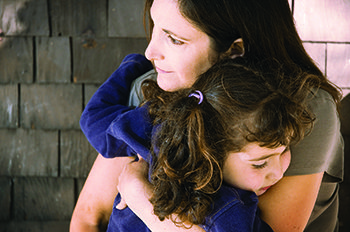
Finally, the day arrives (and many days after) that can cause parents heartache: the actual separation. Many parents will arrive at school with their children and believe that everything is going according to plan – no meltdowns – happy child, happy parent. When they arrive at the classroom, however, things go terribly awry. This is where advance planning is essential.
Understandably, parents want to nurture their children, comfort them, and do whatever possible to help them in the process. However, this often has poor consequences when it is done improperly during the drop-off process. It usually results in just a temporary solution and may actually reinforce in the child the feeling that the classroom is a scary place.
Instead of lifting up the child and allowing her to latch onto your neck and wrap her legs around your waist, comfort her by crouching down to her level, sharing how brave she is to try something new, and leading her in the direction of the teacher (who can guide her to other children who are already happy with an ongoing activity). Share with her that you love her and can’t wait to hear about her day at home when they will make macaroni and cheese together (or whatever is on tonight’s menu; the point is to be concrete, because children think literally at certain ages.
Don’t make promises, such as,
“I promise you will have a great day.” Don’t do or say anything to make them feel any more vulnerable, such as, “You can call me whenever you want throughout the day if it’s too hard.”
Do not sit in your car in the parking lot waiting for a call from the school. Do not hide in bushes to see if you can get a glimpse your child through the classroom window – just to make sure she’s settled in. Montessori teachers are trained and will know if they need to call. Children watch their parents for cues: parent happy, child happy! Tactfully and carefully, do the hand-off.
This may sound callous, even cold, and it may even sting you while reading this. Many parents have the image of their little one crying at the classroom door and feeling frozen in a panic, not knowing what to do next. That is almost never the case, and if it should happen, Montessori teachers know what to do. Being informed, planning, and creating what we call a “corrective experience” can lead to a change of experience in the future. Usually, even the children who have the most trouble saying good-bye will quickly transition to new friends and will want to join in an activities and come home and share fun experiences. Do not, however, be alarmed if there is a day two, day three, and possibly more of these experiences. It will get better.
Even if parents and teachers do everything ‘right,’ there are children that still have more serious separation anxiety issues. This disorder is not so uncommon. It affects about 3 to 4 percent of the child population and often develops after a life ‘stressor’ (e.g., divorce, moving to a new home, illness, death of a grandparent or pet, etc.). In acute situations, a child can experience extreme distress when away from the home or away from a parent: constant worry; inability to do anything on her own; inability to sleep separate from parents or away from home; nightmares; and may include physical symptoms (including headaches, stomach aches, etc.). This disorder can occur at any age and may vary in manifestation depending on the age and gender of one’s child.
If a parent sees these symptoms, it may be helpful to seek consultation from a school psychologist or counselor to try different interventions. It may also be helpful for parents to seek help from a psychologist who specializes in childhood disorders to help work in collaboration with the school, the family, and the child. This disorder can be extremely painful for parents and children, and early intervention can be the most significant factor in changing the course of the problem for the rest of the child’s life.
School experiences are memories that we carry throughout all of life. Many of these memories involve how parents help children cope with their transitions. Don’t underestimate your feelings, as parents, either – separation can be quite difficult on your end (we often underestimate the ‘fears’ of watching our children grow up, too!).
Whether it’s your child’s first experience at school or a new year for a returning student, it’s a time of great excitement and change. Even good change is stressful. Having a plan, listening to your child, and working together with teachers can make it a much smoother transition for everyone. Don’t forget yourself in the process. You’ll be returning to, or establishing, a new routine as well.
Tomorrow’s Child/ sept 2010/p28