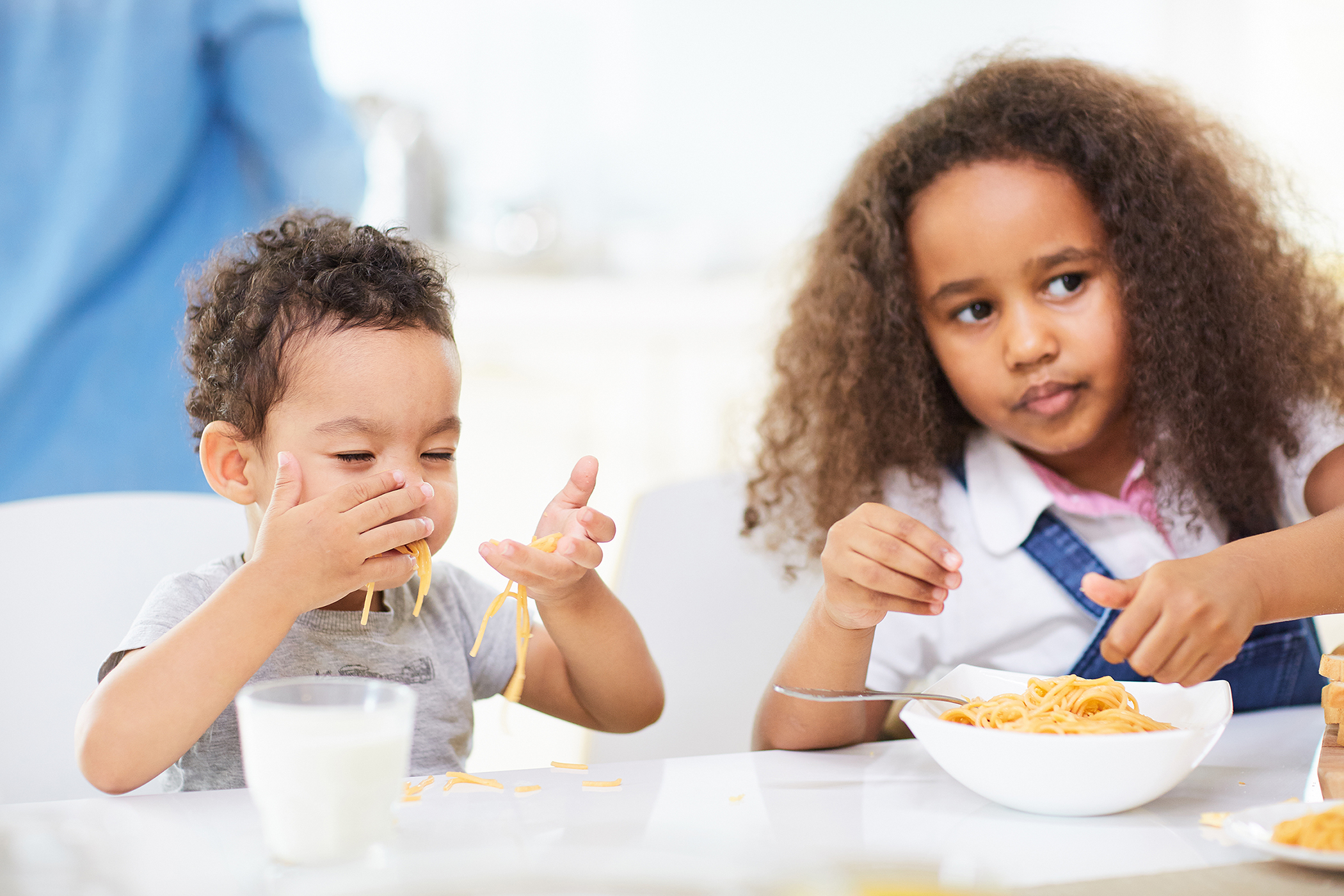
Cute toddler boy and his pretty sister with long curly hair sitting at the dinner table and eating delicious pasta with hands
“It is our responsibility to learn to become emotionally intelligent. These are skills. They’re not easy. Nature didn’t give them to us. We have to learn them.” —Paul Ekman
Children today are more emotional, strong-willed, and reactive than ever before. They have big feelings and oftentimes don’t yet know how to constructively release them. Of course, this is one of the reasons I wrote the book, The Emotionally Healthy Child, which gives adults the ideas and tools to help their children with these emotions. But you have a front-row seat witnessing your child’s emotions whether she’s saying, “That’s not fair” followed by tears or your son doing his happy dance when he finds out today’s a snow day!
Boys and girls tend to react to their emotions quickly—sometimes in smart ways, and sometimes the opposite. The good news is that any healthy child can learn how to slow down and make smarter choices, even when challenged emotionally– and I know it means that the classroom becomes a central place for this education. Just today, I had a teacher ask me: What makes an emotionally healthy classroom? In this short article, I’ll share what emotional health is and what it looks like in today’s 21st-century classroom.
Emotional Health: A Starting Point
The starting point for emotional health is learning to identify your emotions, and then beginning to express them constructively. Of course, there’s much more to emotional health, but to simplify the concept, that’s where we begin. And it’s approximately age four and up when we can expect children to be able to make more logical (smarter) choices consistently. Before the age of four, logic and reason aren’t commonly online in your child yet. Remember Jerry Seinfeld said, “Having a toddler is like having a blender that you do not have the top for,” which explains their high energy and emotional disorganization.
Older children can begin their journey in earnest of mastering their emotions and expressing them constructively through education. But remember this isn’t simply a lesson for children—cultivating positive emotional health is a lifelong endeavor. Some days we’re learning about enthusiasm and excitement, while other days it’s disappointment and loss. But the school, and even more specifically, the classroom is where many children’s feelings bubble up, from disappointment to sadness to excitement and enthusiasm, and oftentimes they don’t yet have the skills to handle.
The Emotionally Healthy Classroom
What makes a classroom go from good to great? I would say the teacher, but when it comes to emotional health and the classroom, the teacher is doing certain things to elevate that room. He or she is:
1. Handling emotions first.
2. Creating connections second.
3. Focusing on learning third.
The emotionally healthy classroom puts emotional health front and center. They don’t hope that children learn about their emotions or gain self-awareness at home, but they teach children how to calm and connect with the present moment. Take for example a group of first-graders returning from recess, which may include some quiet and some rowdy children. Using a breathing tool, (for example, “Five for Five” from my new book, The Emotionally Healthy Child) when children get back into the classroom can help them become calm and centered before they start their next project.
Along with teaching children what emotions are, how they work, and smart ways to express them, the emotionally healthy classroom teaches how to interact with others. Every classroom has children from varying backgrounds—some dealing with serious issues, whether it’s a parent with chronic health problems or a wildfire in their community—life isn’t always easy for today’s children. But helping children make, keep, and repair relationships are essential to cultivating positive emotional health. Take Tommy for example, he forgot his lunch, but his cousin Juniper was quick to share hers with him. This is a healthy connection, which mitigates stress and challenges.
Of course, the emotionally healthy classroom also inspires children to learn. This is one of the main tenets of Montessori education, as you know. Maria Montessori said, “The greatest sign of success for a teacher … is to be able to say, ‘The children are now working as if I did not exist.’” Because learning happens when we, as adults (teachers, professionals, parents), create the conditions for learning to occur, then step back and allow children to use their curiosity and ability to discover new things on their own. Yes, we can point them in certain directions, coach them, and keep them safe, but, ultimately, learning is a solo act that happens when the conditions are correct.
Emotional Health is a Learnable Skill
Children who feel their best can do their best. This isn’t rocket science, but deliberately including exercises and activities to help children manage their emotions is the first step towards creating a well-being centered classroom. Also, there isn’t shame or embarrassment if someone cries, or stomps their feet to the other side of the room. Instead, the teacher says: “What do you need right now?” and helps that child calm down as well as come back to center so engagement and connection can begin again. So along with children learning, adults are learning how to feel our best and, ultimately, do our best, too.
We’re all in it together!
Tomorrow’s Child/ Jan 2019 / pg 12