For Montessori elementary and adolescent students, the opportunity for learning outside the classroom is an important part of the curriculum. Students may plan a “going out” for a small group of students related to a project, such as going to the grocery store for ingredients for a cooking project. Or a larger trip for the whole group may be planned, usually related to work going on in the classroom.
These opportunities to learn outside the classroom allow students to have hands-on opportunities with the world and their community. In the first plane of development (ages 0-6), we try to bring the world to the classroom, but in the second plane of development, we want to bring the student to the world. Although we cannot take the students around the world, we can take advantage of local opportunities that introduce students to places and activities from around the world.
The tea ceremony and tea appreciation are part of our curriculum at NewGate School. Students are given the opportunity to partake in tea ceremonies at school, and students were able to go to The John and Mable Ringling Museum of Art to experience an afternoon of a traditional Japanese tea ceremony, hosted by Dr. Rebecca Corbett, author of Cultivating Femininity: Women and Tea Culture in Edo & Meiji Japan.
The Japanese tea ceremony (Sado) is rooted in a tradition of mindfulness, naturalist intrigue, and political stability; all of which served to unify, strengthen, and pacify an ancient culture. Tea brokered the deal. Tea welcomed the guest. Tea served as a reminder to pause and appreciate the ephemeral nature of impermanence in an increasingly complex and turbulent world. When we arrived, our host explained how the natural surroundings play an important role in setting the mood; the sounds of the wind blowing through the bamboo grove and cedar branches, the bird song, all contributed to the experience of calm and tranquility presented during the ceremony. As the audience sat with straight spines, attentive to the moment of peace, receptive to the myriad gifts of nature, we were quickly interrupted by the sounds of gasoline-powered golf carts, transporting people to and fro, and prop planes flying above the Gulf of Mexico. Our host joked and suggested that, today, we would have to replace the more traditional sounds of nature with those of mechanized equipment and vehicles, to which the crowd laughed and relaxed further into their seats awaiting the ancient spectacle to unfold.
The designated guest was invited to partake, the sweet was offered, and the tea was prepared. Each gesture of the tea master was carried out with profound precision, meaning, and purpose. As this quiet dance unfolded, the noise of human interference quickly dissipated into an inner abyss of luminous silence that was noticeably felt by all; the experience became palpable. For this brief moment, that felt like an eternity, we were all interconnected: students, teachers, guests, masters, all one. Before we knew it, the ceremony had come to a close, and our host opened up the floor for questions. NewGate students quickly raised their hands in unison! Though I am biased, naturally in a way a teacher would be toward their students, their questions were thoughtful, mature, and insightful. The audience was captivated by the interaction between young people and our host. The students asked questions such as, “What was the food item presented at the beginning of the ritual? What is the significance of the design on the belt (obi) of your kimono?” Our host was visibly pleased with the genuine sincerity and enthusiasm of our students. Eventually, their questions had to be capped off as another group prepared to receive the presentation; otherwise, their dialogue could have continued indefinitely.
This kind of interaction, unexpected by many adults, is typical of students who are expanding their knowledge and building on what they have already experienced. The opportunity to interact with specialists, whether a traditional host for a tea ceremony, or the stocker at the local grocery store, provides a living, hands-on opportunity to ask questions and fulfill curiosity.
The Ringling Museum (Sarasota, FL) also provided a tour of the traditional, yet modern, Japanese Tea House that was recently constructed on the grounds. The tea house is regularly available to view from the outside; there are large glass windows showing the craftsmanship of the interior and the equipment inside. However, today was different. We could actually walk inside, feel the tatami mats below our feet and smell the scent of grass, cedar, and pine. The students delighted in asking more questions and exploring the tea house. We learned that the tea house was designed by a student from the Ringling College of Art + Design. The design combines elements of a traditional tea house, fused with classical, modern Sarasota architecture.
Being able to go out and explore, whether exploring nature, the visual arts, or experiences such as a tea ceremony or live theater, provides a deeper understanding of lessons learned in the classroom. By becoming a part of the larger community, with family, a small group, the whole class, or even the whole school, bonds are strengthened, lessons are learned, and new interests are kindled. Taking the time to let students help plan and attend opportunities, especially those that are out of their regular experiences, both with school and with the family, is time well spent. Those memories of experiences will remain with them and be building blocks for continued learning.
In crossing an immense stretch of desert in Arizona, if one was hunting and searching those very arid acres, attempting to quench a thirst for inspiration, answers, and enlightenment, the desert is not a place to find such an oasis, a fertile spot, or place to nourish your soul and bloom strong. At first glance, the desert might look hot, dry, and lifeless; nevertheless, on deeper inspection, one can see that within the seemingly endless desert, there are numerous ecosystems and plant communities living and thriving together. Nature has a way of creating whole systems filled with abundance and diverse life. These systems are based on interdependent relationships, where resources are regularly exchanged because it is both more effective, and it allows them to contribute to the health of the whole system.
Nature is one of our greatest teachers. It teaches us that there is another way of living and working together, one that is not based on scarcity and fear but on abundance and generosity. It teaches us that we need each other to survive. As healthy ecosystems evolve in nature, they become more diverse. This diversity creates more resources, not less, in a community. So, what is it about differences that threatens us? Is it because being a part of a group identity meets our fundamental needs: safety (survival), as well as a sense of belonging? Nature finds ways to work together to help systems regenerate and create conditions for sustainable life. Nature counts on diversity and rewards cooperative, interdependent relationships, showing us that diverse systems are more resilient.
Conservationist Eleanor O’Hanlon has seen this theory in action repeatedly through her work. “The patterns of living relationships are always in motion as the animals test and are tested by the terrain, the weather, and each other,” she explains. “Through the generations, they refine their capacity to innovate, adapt, and thrive together as one community, interdependent, and whole. To be what they truly are, to live ardently and fully, each one requires the other. This is what’s required of us as well — a willingness to observe the patterns of relationship that give shape to the systems we inhabit and perpetuate, alongside the courage to adjust our behavior accordingly in ways that will benefit the whole.”
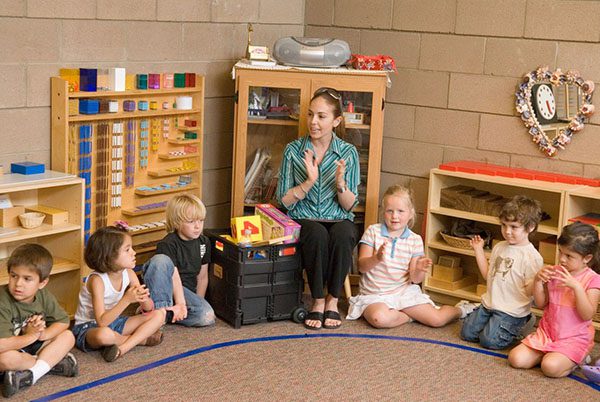
One does not, of course, need to go on a hike in the Arizona desert to see these systems in action. Just peek into Montessori classrooms. Children are encouraged to be their authentic selves and learn in ways that connect to their minds and hearts. The Montessori prepared environments are supportive learning communities that honor all, built on mutual trust and care for one another across a wide spectrum of human diversity, so they can all thrive. Montessori works from an abundance mindset, opening spaces for everyone, which makes those spaces stronger, richer, innovative, dynamic, more engaging, and more fulfilling. In turn, Montessori children tend to honor and embrace people who are different from themselves and find ways to create space for them to find their place within the group. Yet, our children can still grow to become influenced by the world around them, so that biases form and negatively affect how they treat others who may be different from them. Our part in that influence is determined by our willingness to do the work of change.
WHERE DO WE BEGIN?
We begin with ourselves. In The Absorbent Mind, Dr. Montessori extolled that “the real preparation for education is a study of oneself. The training of the teacher, who is to help life, is something far more than the learning of ideas. It includes the training of character; it is a preparation of the spirit.
We might truly believe ourselves to be open-minded and accepting, but the fact remains that we all have biases. Montessori describes how adults must systematically study themselves to be able to see a child in their purest form. It is our responsibility as adults to examine our biases and understand where they come from. The personal biases we carry significantly influence what we teach and what we don’t teach our children about valuing differences.
Recognizing our own bias is essential as we teach our children to love themselves and value diversity. Bias is often an unconscious belief that is developed in our own upbringing and experiences and reinforced by status quo systems. If we don’t recognize the biases that we hold ourselves, we may unintentionally pass them on to our children. We need to be vigilant about always asking ourselves why we have a bias. How might we create different learning experiences for our children if we open-heartedly and open-mindedly accept that we have biases and acknowledge our biases inherently embedded in how we parent? We are all called on to do this work, so we can be prepared to teach our children.
Biases are learned. Children begin to absorb both the attitudes and biases attached to aspects of identity by family members and other significant adults in their lives. Adults can convey negative biases through gestures, body language, and facial expression. Children pick up on these non-verbal cues to form their own biases. If we, as parents, guardians, and caregivers, want to pass on lessons that emphasize acceptance and inclusion, we must be willing to live those values, through our words and our actions. To do this, we must take on the critical work of examining and addressing our own personal biases: why we developed those biases; what contributed to us having those biases; and what we might do about that inevitability within the systems around us. This work never ends.
From Learning for Justice, explore your experiences with and attitudes about differences by considering these situations and questions:
• The first time I became aware of differences was when…
• As I was growing up, my parent(s) taught me that people who were different from us were…
• As I was growing up, my parent(s) taught me that people who were like us were…
• A time I was mistreated because of my own difference was when…
• A time I mistreated someone for being different was when…
• I feel most comfortable when I am around people who…
• I feel least comfortable when I am around people who…
• The memories I have of differences in people affect my parenting by…
• How do I create a space and teach in a way that invites and encourages difference?
• How do I reinforce acceptance and the value of difference in our home?
WHERE DO WE GO FROM HERE?
Giving children the opportunity to look for the value in difference helps them engage in their world with curiosity, confidence, and love. It helps them better understand themselves and those around them. They learn to empathize with people who are different from them. They gain a deeper understanding of subjects and issues when looked at from multiple perspectives.
Children are remarkably good at observing differences in the world. This ability is an important developmental learning strategy. Noticing differences between people helps children construct their own social identity. According to research, children begin to take note of differences in other people as early as age two. Early childhood provides children their first introduction to human characteristics, such as gender, ethnicity, race, physical ability, etc. They marvel both at the differences and at the similarities they share with others in their world. They begin to use their observations to determine how they should treat others and how others should treat them. This factoring includes how the adults around them respond to differences. It is the time when parents, guardians, and caregivers have the greatest influence on a child’s perception and attitude about differences. If we don’t help our child process their observations, they will create their own understanding of what those differences mean.
Elementary-aged children start moving past simply noticing similarities and differences among people. They begin to experience how these differences and similarities are used to either include or exclude people. Although it is uncomfortable to think about, during these years your child will likely be excluded themselves, as well as exclude someone else because of differences. While a parent’s influence still plays a critical role in how children view and respond to differences, outside sources (social media, friends, TV/internet, video games, etc.) start to compete for influence.
Once your child reaches adolescence, your opinion and advice may not be the first they seek, if they seek it at all, because they rely heavily on those outside influences. It is important that you continue to find ways to communicate with them and provide a safe space for them to share their views and opinions. The lessons, advice, opinions, and experiences you have provided about embracing differences begin to have real-world impact and consequences during these years. Open, honest conversations with adolescents is essential, to provide messages that promote a healthy self-esteem, which will encourage them to embrace differences in themselves and others. Your words are very important, but your actions are what an adolescent will remember more. They are quick to point out the incongruence between what you say and what you do.
Whether you are the parent of a 3-year-old who is curious about why a friend’s skin is brown; the parent of a 9-year-old who has been called a slur because of his religion; or the parent of a 15-year old who snubs those outside of her social clique at school, it is helpful to have strategies to navigate these situations and conversations.
The following tips are in a resource guide from Learning for Justice called “Beyond the Golden Rule: A Parent’s Guide to Preventing and Responding to Prejudice.” The tips are designed to help you teach your children to honor the differences in themselves and in others — and to reject prejudice and intolerance.
Primary (3-6 years old)
Be honest. Don’t encourage children “not to see color” or tell children “We are all the same.” Rather, discuss differences openly and highlight diversity by choosing picture books, toys, games, and videos that feature diverse characters in positive, non-stereotypical roles.
Embrace curiosity. Be careful not to ignore or discourage your youngster’s questions about differences among people, even if the questions make you uncomfortable. Not being open to such questions sends the message that difference is negative.
Broaden choices. Be careful not to promote stereotypical gender roles, suggesting that there are certain games, sports, or activities that only girls or boys can do.
Explore family history. Talk to your child about your family heritage to encourage self-knowledge and a positive self-concept.
Lead by example. Widen your circle of friends and acquaintances to include people from different backgrounds, cultures, and experiences.
Elementary (6-12 years old)
Model it. Talking to your child about the importance of embracing differences and treating others with respect is essential, but it’s not enough. Your actions, both subtle and overt, are what they will emulate.
Acknowledge difference. Rather than teaching children that we are all the same, acknowledge the many ways people are different, and emphasize some of the positive aspects of our differences. Likewise, be honest about instances, historical and current, when people have been mistreated because of their differences. Celebrate the victories of those people in overcoming this discrimination. Encourage your child to talk about what makes them different and discuss ways these differences may have helped or hurt them at times. After that, finding similarities becomes even more powerful, creating a sense of common ground.
Challenge intolerance. If your child says or does something indicating bias or prejudice, don’t meet the action with silence. Silence indicates acceptance, and a “don’t say that” is not enough. First, try to find the root of the action or comment. Then, explain why the action or comment was unacceptable.
Seize teachable moments. Look for everyday activities that can serve as springboards for discussions. Elementary children respond better to lessons that involve real-life examples than to artificially staged discussions about issues. For example, if you are watching TV together, talk about why certain groups are often portrayed in stereotypical roles and why this is a problem.
Emphasize the positive. Just as you should challenge your child’s actions if they indicate bias or prejudice, it is important to acknowledge them for behaviors that show respect and empathy for others. Catch your child treating people with kindness and dignity and let them know you noticed; also discuss why it is important.
Adolescent (12-18 years old)
Keep talking. Many believe that the last thing adolescents are interested in is having a conversation with parents, guardians, or caregivers; however, even if your adolescent doesn’t initiate conversation about issues of difference, find ways to bring those topics up with them. Use current issues from the news as an impetus for discussion. Ask your adolescent what they think about the issues.
Stay involved. Messages about differences exist all around your adolescent: the Internet; songs; music videos; reality shows; ads; commercials; social media; and social cliques at school. Know the social media in which your adolescent participates; take the time to listen to or watch the music and shows they enjoy; get to know their friends. Then, discuss the messages they send. Ask your adolescent about the group or groups they most identify with at school. Discuss the labels or stereotypes that are associated with such groups. When discussion is limited, some of this information can be garnered by careful observation and listening.
Live congruently. Discussing the importance of valuing difference is essential, but modeling this message is even more vital. Evaluate our own circle of friends or the beliefs you hold about certain groups of people. Do your actions match the values you discuss with your adolescent? Adolescents are more likely to be influenced by what you do rather than what you say, so it’s important that your words and actions be congruent, especially when these actions take place at a time of great pressure or concern about the family’s well-being and the child’s future. who is still creating [themselves] and therefore capable of affecting true change, perhaps even breaking out of our shared human heritage of strife and conflict, and building true peace,” she continued.
Broaden opportunities. It may be natural for adolescents to stick to groups they feel most comfortable with during the school day. These are often the people they identify as being most like themselves. Provide other opportunities for your teen to interact with peers from different backgrounds. Suggest volunteer, extracurricular, worship, and work opportunities that will broaden your adolescent’s social circle.
Encourage activism. Promote ways for your adolescent to get involved in causes they care about. No place for them to hang out with friends? Encourage them to get together with peers to lobby city officials for a teen social center or skate park. Upset about discriminatory treatment of teenagers by a storekeeper or business? Give your adolescent suggestions for writing a letter or planning a boycott. When young people know they have a voice in their community, they are empowered to help resolve issues of injustice.
In Conclusion
Dr. Montessori was a humanitarian; her educational research and work with children are deeply rooted in serving and bettering humanity on individual, social, and global levels. She believed that the key to saving humanity lies within the child. She dreamed of a peaceful, harmonious world filled with kindness, respect, and dignity that is offered to each human being. She also knew that these beliefs and dreams mean little if the systems that hold all such ways of being are designed to actively work against providing those things for all, working for some but not others. She also knew that the only way to achieve her dream was through a new way of educating our children. “An education capable of saving humanity is no small undertaking; it involves the spiritual development of man, the enhancement of his value as an individual, and the preparation of young people to understand the times in which they live,” Dr. Montessori professed. “Our salvation is the child. For it is only the child who is still creating [themselves] and therefore capable of affecting true change, perhaps even breaking out of our shared human heritage of strife and conflict, and building true peace,” she continued.
Dr. Maria Montessori believed that the path to peace, social change, and, ultimately, saving humanity is through children. The path, whether through a seemingly barren desert or any other of nature’s unexpectedly thriving biomes, can be found in the Montessori philosophy of how to educate children. The children move from respecting the materials (or resources) to respecting their classmates (or fellow denizens), from working as individuals to working with others, from voicing their opinions on peace and justice to taking action. They can become independent, self-actualized, empathetic, and compassionate members of the community (thriving elements of the natural abundance).
We are living in a time where there is a fundamental shift in how we must think about diversity. We need to let go of the notion that diversity is a threat, and we must shift to see the fundamental value and benefit of having difference, and thus abundance, in our system. Nature has proven that, to support a regenerative system, diversity is critical. It is time to learn from our 3.8-billion-year-old universe, to apply its lessons to our lives, and to model them for our children. For, only then will they be able to reap the rewards of diversity and to live in peace.
Resources
Learning for Justice
www.learningforjustice.org
Beyond the Golden Rule: A Parent’s Guide to Preventing and Responding to Prejudice
Dr. Maria Montessori was a person who was not only a brilliant visionary for world peace and harmony but also was actively involved in making changes to accomplish her visions. In this session as we prepare for Earth Day on Friday, April 22, our team will discuss how we can become actively involved in working to make changes in the condition of our planet for a brighter future both individually and with our families.
This Montessori Leadership Forum will focus on helping Montessori school leaders cope with the onslaught of internal reactions they have to the recent catastrophic world events in order to better prepare them for leading the Montessori communities they serve. The emphasis of this Forum will be on discussing some of the assumptions about the current world events that will help us avoid dead ends and anxiety. Then we will discuss some practical ideas to help you do the inner work necessary in order to lead the Montessori community you serve with calm and without scapegoating others or nations.
Blackwater – Sometimes a Lie is Harder Than the Truth
Written by Eve Bunting
Eve Bunting is not new to writing children’s picture books, storybooks, and children’s novels. Blackwater will engage readers from ages 11-14 years old with a story of tragedy, mystery, and moral dilemmas.
It reminds readers of the importance of always being mindful of the choices they make and the actions that they take. Sometimes, even just a simple act of jealousy or revenge can lead to tragedy and can ruin a person’s life or worse. In this story an entire town was affected by the sudden death of two teens and the unspoken truth about the incident.
Brodie, the main character of the novel, struggled with guilt, grief, and truth telling because of his part in the accidental deaths of two of his peers. Fortunately, a good friend encouraged Brodie to confess his actions. When he did, his parents stood by his side as he suffered the consequences of his actions.
This is a book that parents, and teachers will want to read along with their teens to openly discuss the choices that were made and the events that occurred. Guiding children through the teen years and allowing space for them to express opinions and wrestle with tough decisions is an important part of our role in parenting and teaching. Expressing our own values in a non-defensive or non-judgmental way, while creating that space, is the key to helping our teens process real life situations.
Kindness
Written by Jonathan Wolff
Kindness is one in a series of resource and activity books for parents and teachers of children ages three to nine years old. This series was inspired by (and developed as) an extension of “The Virtues Project.” The author, Jon Wolff, wellknown in the Montessori community around the world, wondered how parents and teachers could explore virtues or universal qualities of character in fun, interactive, and imaginative ways with children.
The series that he put together is called The Self-Awakened Child and includes the following titles: Kindness, Assertiveness, Caring, Creativity, Courage, Forgiveness, Loyalty, Peace, Respect, Responsibility, Self-Discipline, Tolerance, Trust, and Unity. Each of these short books has a variety of exercises and role plays to help children build character, develop problem-solving skills, and nurture strong, healthy relationships. The exercises are meant to be adjusted according to the setting, as well as the age and understanding of the children who are participating.
Today, more than ever, children need support in recognizing that what they say and do can make a positive difference in their lives and the lives of others. As they internalize the characteristics from this series, they realize that they can make our world a more peaceful, sustainable, and united planet. The Self-Awakened Child series is a powerful guide for adults to provide activities that support children in becoming “the change.” I recommend this series for use in schools and homes.
The Self-Awakened Child is available in the Montessori Foundation store at stage.montessori.org.
Little Humans
Written by Brandon Stanton
Brandon Stanton is a photographer in New York City. In this book, he used only photos of children from toddlers through the elementary years. He adds some prose to tell the readers all that “little humans” can do and be. The photography was not done in a studio but out on the streets of New York. Readers will see children who are dressed up in their fancy clothes, sports gear, and everyday clothes, doing all kinds of things like dancing, playing a musical instrument, riding a bike, getting ready for hockey, and more. Young children will enjoy both the text and the photos.
Night Becomes Day: Changes in Nature
Written by Cynthia Argentine
This is a truly gorgeous book for children! Cynthia’s words flow as you turn the pages, and she describes how the natural world is constantly transforming. The photographs superbly illustrate the transformations in nature. The message is about paying attention and to be in awe of all that is around us in the world and to realize how dynamic nature is. And watch for this – “What goes around, comes around.”
Cynthia includes three pages at the end of book for parents and teachers to share with children about different areas of science.
Beautifully written, beautifully illustrated, and a beautiful message for readers! Night Becomes Day would be a terrific addition to children’s (ages 3-8 years old) book collections at home, at school, or both.
Cynthia Argentine has been a guest on our Montessori Family Life Webinar Series. Join the Montessori Foundation Family Network at stage.montessori.org to watch the broadcast, Science— An Open Door to Creativity: How
Science Connects Kids to Nature, Arts, Literature, and More with Cynthia Argentine. Visit her website www.cynthiaargentine.com to purchase this and other books she has written.
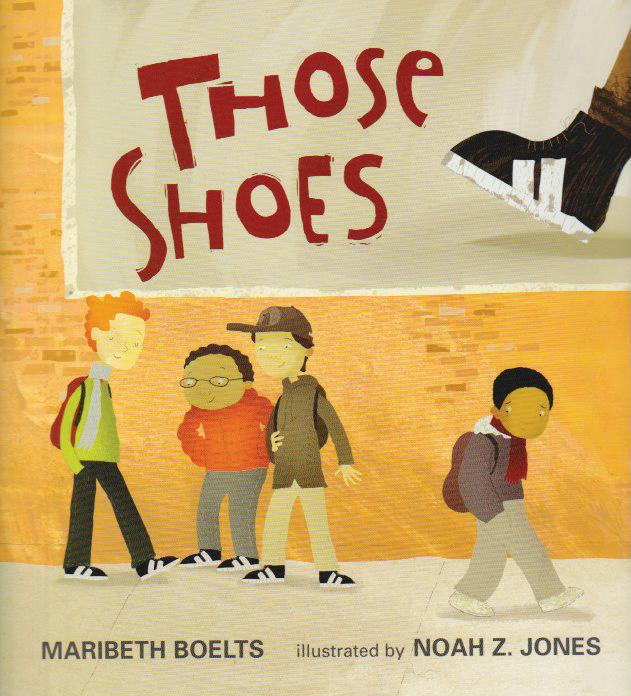
Those Shoes
Written by Maribeth Boelts
Illustrated by Noah Z. Jones
As children grow into the elementary years and beyond, they are often influenced by the media and their peers. They want to fit in with the other kids in their schools and neighborhoods.
This story is set in a city but could be any setting whether urban, rural, or suburban. The main character, Jeremy, sees that many of his peers are all getting a particular type of shoe and are feeling very cool about it. One day his shoes fall apart at school, and the counselor gives him a pair of shoes, but Jeremy is embarrassed. When the other boys see the shoes, they laugh at him.
His grandmother says that what he really needs is a new pair of snow boots, but Jeremy really wants to have a pair of “those shoes.”
After much searching from one thrift store to another, Jeremy finds a pair of “those shoes.” He pays for them himself, even though he knows they are too small for him. Find out what Jeremy finally decides to do with “those shoes” at the end.
The illustrations are vibrant with color and movement. The style reminds me of the style of Ezra Jack Keats. Elementary children will enjoy this book, and it may serve as a conversation starter about Jeremy and the choices that he makes.
Your Baby Is Speaking to You
Written by Dr. Kevin Nugent
Photography by Abelardo Morell
Whether this is your first newborn or your fourth, this book has a lot to offer. It will stimulate your awareness of how much and how often babies are speaking to us, if we would only listen. More than anything else, Dr. Nugent is calling us to slow down and pay attention to all the ways that newborns and infants communicate with us without using a word.
These little, tiny humans, new to the world, are ready, willing, and able to express themselves, if we not only take the time to be present but also begin to understand their language. They are awesome!
The photographs beautifully connect Dr. Nugent’s written words with the innocence, the emotions, and the sheer wonder of these small beings! Buy this book for yourself or give it to someone you know. You’ll be glad you did.
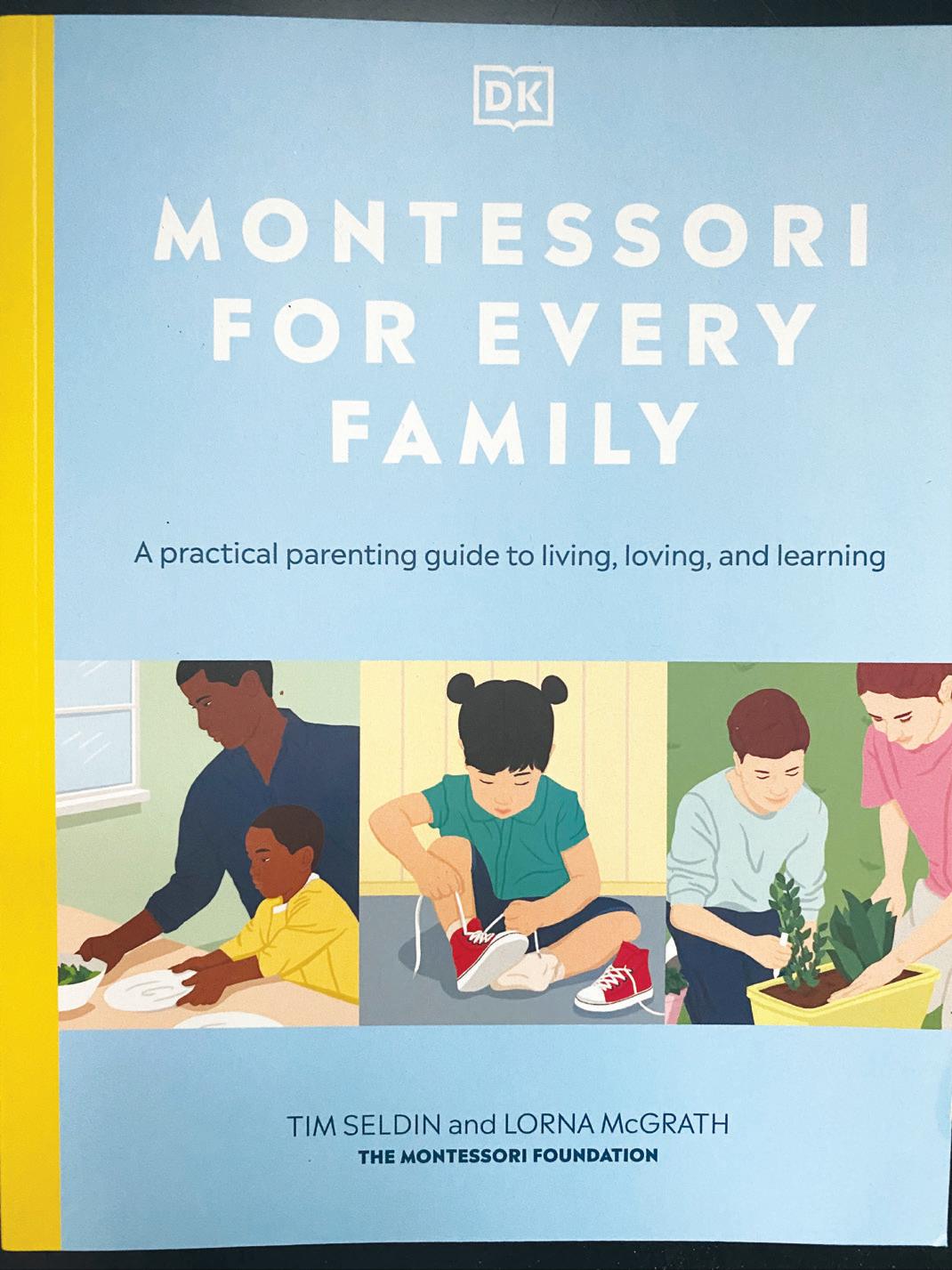
Montessori for Every Family: A practical parenting guide to living, loving, and learning
Written by Lorna McGrath and Tim Seldin
Tim Seldin and Lorna McGrath, both with the Montessori Foundation, have released a new book, Montessori for Every Family: A practical parenting guide to living, loving, and learning. This book is truly for every family, those that are in a Montessori school, those who Montessori homeschool, those who wish to be in a Montessori school, and those who have not even heard of Montessori. The three chapters, “What Is Montessori?”, “Montessori Family Life”, and “Family Life Through a Montessori Lens” take the reader through an introduction to Montessori, practice with Montessori, and application of Montessori philosophy to their own family.
Parents can read it straight through, or simply choose a topic and read about that. The book is easy to read either way, with most topics covered in a single two-page spread with beautiful illustrations and clear explanations. Included with most topics, the “Ages and Stages” sections help families adjust their approach for young children (18 months to 6 years); elementary-aged children (6 years to 12 years); and adolescents (12 years to 18 years). Also included are real life stories, sharing how different families have managed these topics.
Tim Seldin and Lorna McGrath have worked with families as Montessori guides, school administrators, and parent educators for years, as well as raising their own families and enjoying grandchildren. Their depth of understanding and experience with a variety of families is shown in this book. As a parent, you can find some suggestions you are already practicing with your family and some that you feel you could strengthen to make your family life more enjoyable. Each topic is presented as a practical way to engage as a family and invites you to try it out. This book is intended to help families connect and celebrate themselves and their daily life. It will help every family that reads it and applies even one topic to their own family.
Lorna described the reason, in part, behind the creation of this book as a step toward world peace. She said, “World peace begins at home…If families are all on the same page, we will create world peace. I totally believe that, and it’s why I do what I do, and have done throughout my career.” I highly recommend this practical, beautiful, and easy to read book for families, schools, and guides to strengthen their connections and language with all their children.
Montessori for Every Family: A Practical Parenting Guide to Living, Loving and Learning can be purchased for Kindle, Audio, and paperback on Amazon.
This is a truly gorgeous book for children! Cynthia’s words flow as you turn the pages, and she describes how the natural world is constantly transforming. The photographs superbly illustrate the transformations in nature. The message is about paying attention and to be in awe of all that is around us in the world and to realize how dynamic nature is. And watch for this – “What goes around, comes around.”
Scan code for more information.
Calling all teachers, parents, & children!
We would love to publish reviews of your favorite books.
Reinvigorating Culture and Peace Curriculums with Yoga, Music & Movement
Are you a lead teacher looking for new ideas to spice up your culture circles and shelves? Are you intimidated by integrating music & movement into your classroom? Or are you are a music specialist/phys ed. specialist looking for new ways to marry your curriculum with the themes occurring in the Montessori classroom?
A message from Sarah:
This handout outlines some initial ideas for introducing shelf lessons and circle ideas to inject some cultural excitement into the exploration of the continents, zoology and peace education!
*** On my blog I have free printable card materials, lesson plans, songs, and yoga zoology stories that can be acted out during circle time! I hope these free resources somewhat make-up for the cancellation of this workshop.***
Please check the blog often for free resources regarding yoga, music & movement for the Montessori Culture & Peace Curriculums. If you have any questions or need ideas regarding a specific topic please email me anytime:
As part of the Montessori philosophy we strive to introduce the concrete before the abstract. Ideally we do the same when introducing instruments from other cultures. If your budget allows, you can gradually collect instruments from different continents over time. Here are some places to look:
• Ask a willing parent/friend/family member who is going on a trip to bring back an instrument (I’ve asked parents to bring back the receipt so that I can reimburse them/ this may or may not work in your school environment so it is best to consult your administrators first)
• Festivals & markets
Instruments can be placed in a beautiful basket and placed on the culture shelf or floor. This works well as a one person activity on a work mat (to prevent instruments from rolling off a table). The initial presentation should be how to carry the instruments safely, place them gently on the mat, and how to create sound with them (shake, tap gently together etc.). This can be done individually or during group lessons or circle (see below “In Your Circles”).
The 3 Period Lesson can be used to introduce the names of the instruments.
Caution: I usually avoid putting wind instruments into the basket because they are just too tempting to blow into and if multiple children use them then germs inevitably spread. Avoid plastic instruments whenever possible to encourage handling with care and aesthetic appeal.
World Music Instrument Nomenclature Cards
You can introduce these 3-part cards in a number of ways. Have one set on your culture shelf at a time to correspond with your continent study. Use them for matching or sort them into their instrument families (percussion, string, wind). For an extra challenge continue adding sets of instrument cards as you study new continents and have the child sort the instruments by continent. Check above blog for free resource.
Yoga Pose Cards
This is a simple matching exercise. This lesson requires matching the picture of a child doing an animal pose to picture of the animal. Check above blog for free resource.
In Your Circles!
Music & Continent Ideas
World Music Mailbox
A fun way to add some excitement when introducing new materials during your culture or music circles! You can use a real mailbox (the sturdier option), make one out of cardboard, or you can sometimes find pre-designed ones that just need to be assembled from school supply retailers such as Scholar’s Choice, S&S Worldwide etc. Whatever choice you make just be sure it is big enough to fit a few items, such as a postcard & small instrument, and its even better if it has the red arm to signal new mail!
Children LOVE to get “mail” through the World Music Mailbox! There are endless possibilities here, but I will share some of my favourites with you!
1. Postcards: collect postcards (new or used) from countries and continents from around the world (you can ask your school community if anyone has any they are willing to donate). I use these postcards as a means to introduce new concepts to the children. The post cards are from a “Mystery Traveler” who sends us postcards from around the world… but we never find out who they are! The Mystery Traveler tells us about the music & culture of the place they are “visiting.” Sometimes I use the postcards to tell the children about a particular instrument or introduce a famous composer. The children enjoy hearing a quick postcard… but sometimes the Mystery Traveler sends something more concrete!
2. Instruments: there are many stores (such as Ten Thousand Villages) that carry small musical instruments from around the world. I have collected a few from each continent over time that fit wonderfully inside the mailbox. After reading the postcard the children ooh and ahh as I carefully take out each instrument and place it on the mat in front of me. At this point we learn the names of the instruments (never more than 3) and discuss what instrument family (percussion, wind, string) they belong to and why. I play the instruments for the children so we learn their sounds.
Extensions:
During future circles we play a guessing game where I play an instrument out of their sight (behind a piece of fabric for example) and the children try to guess which instrument made the sound. This can also be a small group activity during the work cycle.
Yoga, Zoology & Peace Education Ideas
You don’t need yoga mats to add yoga into your circles! If you do have yoga mats they are helpful for children to stay within a designated space. If you do not have yoga mats it may be helpful to begin yoga time with a quick discussion about the rules for keeping everyone safe:
1. The spot you choose is the spot you stay in. (Explain if everyone moves around this middle of the circle people can bump into each other and get hurt)
2. Hands to yourself. (Unless we are doing a special “partner pose” we keep our hands on our own bodies for yoga)
3. Listening ears on. (Just like every other circle ☺)
We open and close our circles the same way every time, creating a routine which the children become accustomed to.
We begin our yoga/movement circles by centering and calming ourselves. This ties in well with the Peace curriculum. We exaggerate the actions spoken in this poem and gradually increase the time we hold the silence over the year.
I cross my legs (uncross & re-cross legs)
I put my hands in my lap (raise hands, clasp them, set down in lap) I sit up veeeery straight (sit tall, roll shoulders up, back and down) I close my eyes (squint eyes closed)
I ask my mouth not to talk (shake head from side to side)
I take a deep breath (inhale & exhale)
And together we make silence. ~Author Unknown
Following our silence we begin our yoga story of the animal family we are studying. Depending on your class, you may find that after the opening poem may be the best time to do your zoology culture circle and then finish the circle with the zoology yoga story and poses, or the reverse. Sometimes the stories are fun & fictional and sometimes they have to do with the life-cycle of that animal.
Please check the blog for posts with free yoga stories and corresponding poses… or get creative on your own!
During my Montessori training with CGMS we were introduced to the beautiful Universal Greeting from the wisdom of Mahatma Gandhi. This is how we close our yoga circles together.
I Offer You Peace (palms up together with elbows bent, stretch arms forward)
I Offer You Love (palms to heart)
I Offer You Friendship (hands clasped in front of chest)
I See Your Beauty (cover eyes with both hands, open hands to reveal eyes)
I Hear Your Needs (cup hands behind ears)
I Feel Your Feelings (cross arms over chest, hands rest rear shoulders)
My Wisdom Flows From the Highest Source (left hand palm up at chest, right palm up at head move hand from head down to join left hand)
I Salute that Source in You (both palms together in prayer position at chest, bow head slightly)
Let Us Work Together for Unity and Love (gently hold hand of person next to you)
While we are holding hands in our circle we send a gentle “friendship squeeze” around the circle to remind us that we are all connected and part of a special classroom community. I generally take this time to acknowledge each child.
“Each one of you is very special. There is no one in the world exactly like you! Our class would not be the same if one of you was missing. We are so lucky to have Anna here, and Rowan, and Liam and … each of you is an important part of our community!”
Be sure to make eye contact and give a smile to each child as you acknowledge them.
The final thing to remember is that YOU ARE AMAZING! It takes a special type of individual to guide children with such care. Your enthusiasm for the Montessori curriculum is contagious. If you are excited about what you are introducing to the children they will be too! I hope some of these ideas become classroom favourites or inspire you to create your own. Please contact me anytime with any questions or to share new ideas!
On June 17th, Andrew Kutt, peace educator, Montessori Consultant, and Head of The Oneness Family School in Chevy Chase, Maryland, joined Tim Seldin for the Montessori Foundation’s weekly webinar. The topic was Building a School Culture of Peace and Transformation.
Montessorians are familiar with the daily “Circle” and use this important practice for starting or closing the day, but the Peacemaking Circle or Conferencing approach has become part of restorative practices in schools, workplaces, prisons, and Court systems around the country and throughout the world. Based on ancient practices of aboriginal peoples, this approach creates an intentional space with a particular process designed to:
support participants in bringing forward their ‘core self”
to help them conduct themselves based on the values that represent who they are when they are at their best
make visible our interconnectedness even in the face of very serious differences
recognize and access the gifts of every participant
elicit individual and collective wisdom
engage participants in all aspects of the human experience – mental, physical, emotional and spiritual or meaning-making
practice ‘core self,’ value-based behavior when it might feel risky to do so.
The more people practice that behavior in circle, the more those habits are strengthened to carry that behavior into other parts of their lives. Create a space and time for participants to voice their thoughts and feelings, to take ownership for their behaviors, connect them to others, and learn from the collective wisdom of the group.
Peacemaking Circles: Creating Peace in Our Schools One Circle at a Time
Presented by Claire J. Salkowski IMC Peace Conference
ADR Specialist and Educational Consultant Nov 4, 2012
Planning the Specifics of the Circle – The Keeper puts together the circle plan answering the following questions:
• Who will be part of the circle?
• What time?
• Where?
• What will be the talking piece?
• If and what will be in the center?
• What opening ceremony will be used?
• What question will be used to generate values for the circle?
• What question will be used for an introduction or check-in round?
• Is there a need for further relationship building before getting into the issues? If so, how will that be done?
• What question(s) will be used to begin the dialog about the key issues?
• What further questions might be useful if the group is not getting deeply enough into the issues?
• What closing ceremony will be used?
Circle Outline
The detail in this outline is provided to offer concrete examples and stimulate creative thinking. It is not intended to be prescriptive. The circle is not a rigid process. It is always important to be responsive in the moment to the needs of the circle participants which may not follow the outline you planned. Nonetheless, it can be useful to have an outline to guide you as a keeper.
Welcome: Welcome everyone to the circle. Thank them for coming. Express appreciation for the willingness to work together in a shared space.
Opening: Openings mark the time and space of the Circle as a space apart from the pace and tone of everyday life. The opening ceremony is designed to help participants center themselves, be reminded of core values, clear negative energies, encourage optimism and honor the presence of everyone there. Lead the group in whatever opening ceremony you have chosen
Explain center: If you have created a centerpiece, identify any items in the center and why they are there.
Explain Talking Piece: Explain that the talking piece is a critical element of creating a space in which all participants can both speak and listen from a deep place of truth. The person holding the talking piece has the opportunity to speak without interruption while everyone else has the opportunity to listen without the need to respond. The talking piece will be passed around the circle from person to person. Only the person holding the talking piece may speak. It is always okay to pass the talking piece without speaking. The keeper may speak without the talking piece if necessary to facilitate the process. If the talking piece has a particular meaning explain that.
Purpose: Remind participants of the purpose of the circle
Introduction/Check-in Round: Tell participants that you are going to pass the talking piece around so that we can all hear how everyone is doing today. Invite participants to introduce themselves if they are not already acquainted. We suggest the keeper share first. People will most likely model their response after the keeper. Be authentic. Pass the talking piece and ask, “How are you feeling today?” “Is there anything you feel is important for us to know about how you are doing?” Sometimes it is useful to pose a question in this round that invites sharing about oneself so the participants get to know one another better.
Values/Guidelines: Before the circle starts place a paper plate or half sheet of paper and a marker at each seat. Ask participants to think of a value they feel would be important in order to feel safe to speak from the heart and listen from the heart. Ask them to write the value on the paper plate or sheet of paper. Pass the talking piece and ask them to share the value they chose, explain why it is important, and place their value in the center of the circle. Keeper models.
After establishing values, develop guidelines for the circle. The guidelines of the Circle are the agreements that participants make with one another about how to behave in the Circle. They establish clear expectations and common ground to provide a space where people feel safe to speak in their authentic voice, connect to others in a good way and ensure a space that is respectful for all. Pass the talking piece and ask participants to name one agreement important to their participation in Circle. (e.g. “Speak only for yourself.” or “Keep body language respectful.”) Write down the suggested guidelines on a sheet of paper or flip chart. When the talking piece has gone all the way around, read the list. Pass the talking piece and ask participants to indicate whether they accept these guidelines. If there are objections explore the objections and the original purpose of the person who proposed that guideline and work to find wording that is acceptable to everyone.
Extensive conversation about the guidelines can be good practice for working through a difference in opinion or perspective in a respectful way. In an on-going circle group the values and guidelines generated at the first circle are brought back to any subsequent circles.
Storytelling round: In some circles it is crucial to take the time for people to share stories from their own lives to increase understanding of one another or to build empathy. Stories often shatter stereotypes or assumptions people have about one another making it possible for them to hear one another more clearly when they discuss sensitive issues later in the circle. The Keeper generally goes first in a storytelling round.
Exploring the topic of the circle: Pass the talking piece, posing a question about the issue or topic that is the purpose of the circle. Alternatively, direct participants in an activity which helps participants connect with their thoughts and feelings on the topic. Follow with multiple rounds reflecting on the experience of the activity or exercise and reflections about the topic. Thank participants for the wisdom shared in the process. Acknowledge the courage that it takes to speak and listen from the heart.
Check-out Round: Pass the talking piece around and ask participants to share their thoughts about the Circle or one word that sums up how they are feeling right now as the Circle comes to a close.
Thanks: Thank everyone for coming and for their efforts to understand themselves and others in a way that allows everyone to be at peace with themselves.
Closing: Lead the circle in a closing ceremony. Closing activities bring closure to the circle, help participants feel centered and mark the ending so that everyone can transition from the reflective circle space back to the outer world. It maybe a poem, quote, song or music or it could be a ritual such as extinguishing a candle flame or ringing a soft bell.
Materials Needed: Determine from the outline all the materials you need to bring to the circle (e.g. paper plates for values, markers, talking piece, center items, readings or other opening materials, the circle outline, etc.)
Circle Prep Sheet for Longer Circles
Preparation
• Co-Keepers:
• Circle Purpose:
• Where and When:
• Talking Piece, center piece and what other things you need to bring:
• Who do you have to talk to and what prep do you do ahead of time:
Circle
• Opening Ceremony/Activity:
• Check-in question:
• Questions for going into guidelines (what you might be able to ask):
• Story telling/Trust Building Question:
• Guiding Questions on the Topic or Issue:
• Guiding question for consensus building, planning or summary round:
• Check-Out round question – what you might be able to ask:
• What “must” be addressed in the circle:
• What is the follow-up:
• Closing Ceremony/Activity:
Circle Prep Sheet for (Shorter) Classroom Circles
Preparation
• Co-Keepers:
• Topic:
• Talking Piece, center piece and what other things you need to bring:
Conducting the Circle
• Opening Ceremony/Activity:
• Quick Check-in round question:
• Guiding Questions on the Topic or Issue:
• Question to elicit Storytelling/Personal experience related to the Topic:
• Questions for Deepening Round(s):
• Question for consensus building/decision making/planning/summary:
• Check-Out round question:
• Closing Ceremony/Activity:
Follow-up
• Decisions/Insights that need to be shared with others:
• Work that needs to be implemented before the next Circle:
Revised and adapted by C.J. Salkowski from Heart of Hope Resource Guide by Kay Pranis and Carolyn Boyes-Watson
CONDUCTING THE CIRCLE
As keepers or facilitators you are responsible for creating and keeping the “form” of the circle. The basic manner of interacting in the circle generally involves use of a talking piece which is passed from member to member during sharing “rounds.” Only the person holding the talking piece may speak and they may do so as long as they have the talking piece. Typically the talking piece is passed around the circle, in order, although the keepers may choose to use a different form of passing the piece. The circle may also use other activities to move the group. These are described more fully below.
Keepers or facilitators act as guides to move the circle through the phases of circle it needs to experience. Note that these phases are flexible depending on the purpose for which a circle has been called. In a school setting, the circle can be used for many purposes. Circles can be used with the children in the classroom, faculties or parent groups. They can be the vehicle for discussions, resolving conflict, celebration, healing or learning about a particular topic.
It is important that all circles include an opening and closing, and that these two elements are always given time and depth.
Four phases of circles – Although the content or topical focus of circles may vary, all circles generally follow four phases. How you facilitate these phases is flexible. For example, a new group may need to spend more time on guidelines and on storytelling rounds. As keeper, trust your instincts on how to structure the circle, and be flexible enough to let the circle move in the way that it needs.
The four phases of circles are:
Phase One – Introductions
Phase Two – Building Trust
Phase Three – Issues
Phase Four – Solutions
Phase One – Introductions
The introductions phase of circle may include the following elements, all of which are designed to create safety and form and to begin to prepare participants for deeper sharing and understanding. This phase generally should include the following:
Welcoming – Make sure everyone is greeted warmly.
Opening ritual – All circles start with an opening ritual that helps us make the transition from the outer world and into the reflective circle space. Openings are designed to help us feel more centered and open to sharing. Openings may involve burning sage or incense which someone either places in the middle of the circle or passes over participants, using a feather to move the smoke around them – allowing people to cleanse themselves of negative energies and to prepare for sharing deeper emotions. They may include a poem, song or meditative music. Consider asking one of the participants (in advance), to offer the opening. With children and adults, I have found that using the Tibetan bells as an initial opening and a final closing, offers a quick way to a begin and end the circle when time is a perplexing concern. If they are used consistently in an on-going group it becomes a valuable ritual in itself. With children they will often ask to ring the bells in order to open or close the circle. We ring the bells three times with a sustained moment to let the sound move out into the group and find its own ending. It creates a reverence for what we are doing and brings us to that place of quiet and peace.
Introductions and check-in – In the first round, the keepers ask participants to introduce themselves by name (perhaps first name only), how they feel, why they are here in circle, and what they hope for.
Seeking consensus around guidelines – If it is a new group, then participants develop guidelines of how they want to be together while in circle (e.g. respect all opinions, confidentiality, etc.) Then, take a complete round of the circle to ensure that each person indicates support of the guidelines. If it is an ongoing circle, then the keeper might review the basic circle guidelines and if invite the group to add any additional guidelines if necessary. Take a full round to be sure everyone has a chance to comment on the guidelines and to demonstrate their support of the final list. Remember that the guidelines are a “living document” and may be revised in circle at any time.
Acknowledgment of those present – Remember to acknowledge those present in circle, especially if the circle is gathered to discuss a difficult topic or resolve a conflict or find healing and resolution for an incident of harm. It takes courage and commitment to participate in circle. Also be sure to acknowledge the volunteers who have helped make the circle happen.
Clarifying the purpose of circle – The keeper summarizes what has been experienced in phase one of the circle, using this summary to further set the tone of the circle and to clarify the purpose of the circle.
Phase Two – Building Trust
Next, the keepers move the circle into deeper sharing as a way of increasing the level of trust among members. This may take a variety of forms. Depending on the nature of the circle, keepers may guide it toward a single or multiple rounds of sharing, and may or may not choose to use other methods of sharing such as ice breakers, art work, individual reflection or small group activities depending on the amount of time available.
Ice breaking – With groups involving young people it might be useful to begin with individual reflection, or sharing in pairs or small groups. Consider using art supplies to having members (individually or as teams), draw representations related to themselves or the purpose of the circle. Or consider using icebreaking activities that are neutral to the purpose of the circle, but which help members to get to know one another as people.
Storytelling round – If the issue or purpose for the circle involves a difficult issue, it may be useful to have a storytelling round. Invite participants to share a personal life experience related to the issue offers (perhaps in a very indirect way.) Storytelling is a powerful way to move beyond masks and appearances and to develop a better understanding of one another. Story telling is a powerful way to share our wisdom with each other and allows us to take in what we might otherwise reject if we were simply “told” in some other form.
Deepening rounds – The circle may move into deepening rounds of sharing. These rounds get to the heart of why the circle was called or if time allows, a topic is explored in depth for further insight and deeper learning. Depending on why it was called, these rounds may include an expression of needs and interests (in the case of a conflict circle), sharing memories and grief (in the case of a healing circle). If small group activities or dyad sharing feels appropriate they may be used here, but always come back to the circle and to sharing in the full circle.
Phase Three – Issues
In this phase, the focus expands from what’s gone wrong or what’s hurting to what can be done to make things right, to promote healing, or to initiate positive change. In many circles, such as those focused on healing, listening may be what’s most needed – giving people a chance to tell their story and to have it received deeply. In other circles, though, exploring options helps break the sense of being stuck in either a painful experience or a self-destructive way of life.
Phase Four – Solutions
Some circles, such as those involved in healing or understanding, do not require decision making. In these circles, the focus of the keeper may be to work toward creating a sense of unity. Other circles do require decision making or resolution of conflict. In these circles the keeper attempts to build consensus by building on each circle participant’s input, until a decision is reached that all members are at least “able to live with.”
Consensus involves an agreement among all participants to “live with the outcome” – to accept a decision or course of action because it promises the best for everyone given the circumstances. Generating consensus involves patience, creativity, candor about interest and concerns, and a willingness to think outside the box. We are challenged to set aside our personal agendas and fixed notions about outcomes, so that something may emerge that is larger than any one person’s preconceived ideas. Consensus is about dialogue, listening and honesty.
To help the group move toward a consensus decision the keep
1. Help participants to identify areas of disagreement,
2. Encourage participants to explore and understand one another’s perspectives, and
3. Work with participants toward final consensus decisions that are as inclusive as possible, and that are respectful of differing viewpoints.
Reaching decisions by consensus often takes more time than other decision making models, such as voting. The strength of the process is that it assures that all participants will “own” and support the decision. In consensus there are no winners and losers, but rather everyone is in agreement and willing to move forward on whatever plan or decision has been devised. When using this process it is important that the group commit to addressing issues or concerns that may be raised on the way to achieving a consensus decision.
Closing
All circles end with a closing ceremony that helps us make the transition from the reflective circle space back to the outer world. Closings are designed to help us feel centered and to bring a sense of closure to the circle. They may include a poem, song or meditative music. Consider asking one of the participants (in advance), to offer the closing.
AFTER THE CIRCLE (FOLLOW UP)
Follow-up is one of the greatest challenges of the successful use of circles. Follow up may include:
• If strong emotions are shared in circle, affected individuals need to be contacted to see how they are doing and ensure that they are getting the support they need.
• Planning one or more follow up circles, if necessary.
• Discussions with people who were not in the circle, but who have relevant information or position to affect issues discussed in circle.
• If agreements are made in the circle, it is important that someone follow up to see if people are accountable to those agreements.
One of the responsibilities of the circle keepers is to attend to follow up. It is not necessary that the keepers handle all follow up activities, only that they ensure that members commit to specific follow up. It is the keepers’ responsibility to follow up with those individuals to ensure that follow up is in fact occurring.
Adapted by C.J. Salkowski From Circle Keepers Manual (draft) by Kay Pranis
For more information or to schedule a circle session or training contact:
As the new millennium unfolds we have made promises of hope and peace to ourselves and our children. The United Nations has declared a decade of peace and non-violence for children and we as educators aspire to developing a peace culture within our teaching and learning environments. As we decide together as teachers, educators and even as parents the essential understandings upon which to base the programs we undertake in our schools and universities we consciously try to attend to these promises in every moment. The notion of peace education has been bantered amongst us for at least 5 decades since the dropping of the atomic bombs on Hiroshima and Nagasaki and we pay serious attention when the children of Hiroshima bravely cry out to us every August 6th.
The challenge is to now pay serious attention to their plea for peace on the 7th and following days.
Honoring our promises
In our classrooms and lecture theatres we have courageously attempted to define peace and establish many peaceful processes that reflect our heartfelt desire for a world that is safe for our children and one in which they will be treated fairly and justly. As we present the truth in relation to the inequities that painfully exist throughout the world we also actively search for ways to alleviate these injustices and make the world, especially in relation to our own local communities, better. In our genuine efforts to create ‘peace and harmony echoing across the lands’. We have incited a true commitment amongst many people in educational communities throughout the world to develop a peace culture…and our children we influence are also committed to ensuring that peace is a self-fulfilling prophecy.
We have explored the notion of difference and celebrated it in our schools and taught our children the meaning of equity and social justice and insist upon it operating at all levels within our profession. We creatively have established data bases that isolate the many different things children can achieve along a continuum and we diligently focus upon using the appropriate language we use to define our positive intentions. We conscientiously avoid making biased judgements and encourage and support self assessment, openness, independence and empowerment remaining confident in the knowledge that the road to a peaceful and interdependent world will be paved by the new generations of independent thinking and acting peacemakers, hopefully being the children whom we teach.
We do pay serious attention, especially to issues unfolding daily in the Middle East, but sometimes a great sense of hopelessness can prevail. Carefully must we tread this road as teaching wonderful peaceful ideals to our children can present many frustrating contradictions to them when the real world is thrust upon them. But we can reassure them that every little step counts along the road to peace and our positive intentions do matter.
As a teenager 30 years ago, reflecting on the hopelessness pervading and defining my future, my father, a man who possessed a very powerful sense and commitment to social justice, would answer when I angrily blamed God for creating or allowing such horrible things to occur:
“God had nothing to do with this mess. Humanity has managed this all by itself.”
Fortunately in the year 2000 most of us will choose resolution strategies that are guided by social justice and peaceful initiatives rather than choose “war” as our strategy and we have accepted the responsibility for making the associated positive changes in our thinking. Consultation rather than confrontation ….working as teams rather than individually….collaboration rather than competition…all dominate the thinking and actioning these days. Together we are creating a better world on many fronts well beyond the boundaries of our classrooms.
As educators trying to create new, stimulating and meaningful peace education programs we have asked ourselves if is there is anything about peace we must essentially understand before we can define processes within our educational environments that pertain to our objectives.
It is necessary that peace be defined clearly and that this definition be agreed upon by all of us before the creation of the kind of
educational experiences that will sustain and nurture
a peace culture can occur ?
I personally have explored this question with a friend who is enthusiastically developing an alternative approach to the already established peace education processes for us to consider. Hassaun Ali Jones-Bey, who lives in Fremont California, and is a US Navy veteran and peace-maker, has raised some extremely challenging notions with me. Ali has told me he believes humanity, after having eagerly explored both peace and war as options to establishing peace, now honestly would prefer to choose peaceful options only. But he also believes this choice requires some very active imagining to occur.
He invites us to explore some new thinking and creative adventuring into developing some simple but workable processes that might help in the establishment of a meaningful and lasting peace for the world…and these peace-making processes rely primarily upon our imaginations and not on the effectiveness of our expanding nuclear arsenals or equitable laws or peace keeping forces…..and the best part is that they are free and are something each and everyone of us can actively participate in. He challenges us to move beyond the exploration of issues in our classrooms and work with imagery instead.
As educators will we need to define these steps….isolate relevant understandings and produce measurable outcomes ???
Ali would suggest NO ! Peace education, as he understands it, cannot be a curriculum that requires solely upon a content and agreed upon list of understandings and measurable outcomes…or be something you can pass or fail. It should evolve from a set of on-going cross generational experiences that constantly reinforce a real sense of humanity and peace as a way of life with story-telling being the key. He reminded me of the powerful story-telling our ancestors did around their campfires and how the teachings were passed along generations via this process without the aid of books and other teaching resources except for simple tools for painting and basic musical instruments and songs and of course, stories. The understandings were intrinsically enmeshed in every word chanted, every step danced and in very symbol used on cave walls or bark to represent every ancestral story’s message that needed to be passed along to the new generations. He conveyed also his wonderment in relation to how only a few years ago some very powerful imaginations in the valleys of California magically created the multi-million dollar silicon industry that has revolutionized our communication systems let alone our entire world and he pondered what stories were these children told to ignite their imaginations? Now we have the Internet to help share our stories with each other.
Ali is developing a very unique but special project called Imagine Peace. He invites us to explore our true natures and allow and nurture a very natural unfolding to occur. He invites us to use our imaginations and create new thoughts and peace associated experiences, then create stories we can share with each other within our classrooms and lecture theatres, our homes and communities about these wonderful peaceful possibilities that we have imagined. Beginning with our imaginations we can develop so many new understandings and possibilities…
ones based upon peace and love…..
and these necessary understandings will help create experiences that will reinforce our humanity and universality not only amongst ourselves. By sharing these stories across cultural, geographical and socio-economic boundaries these understandings could also become universal. Just as the magical silicon valley was initially created by powerful imaginations perhaps a new peaceful and peace loving world can be as well..
Ali says: the first step in creation is imagination.
Ali is not naïve and doesn’t believe our imaginations alone can create peace. He does believe though they provide the necessary first step in the process because once these new understandings and peaceful options are created in our imaginations we can then set about to actively make them work in the real world. We can create with our imaginations visions of the new peaceful communities and world in which we would like to live. Our imaginations can even help us explore different ways of achieving our aims.
From my own personal experiences children innately know what peace means for them and as Maria Montessori believed, these innate understandings need to be nurtured and allowed to unfold in a non-judgmental and non-competitive yet enabling environment. Reminders of genocide and our failure as humanity to care for each other won’t sustain a peace culture and for us it just reinforces a recurrent need for revenge and perpetuation of hatred and distrust in each other…certainly not peaceful thoughts and actions…nor thoughts and actions that will secure world peace….and neither will continual debate and argument about who is right and who is wrong, even if it is undertaken peacefully.
Ali recommended I read “The Forest People” by Colin Turnbull. The book is an account of an anthropologist’s research in the forests of Central Africa. He lived with a very spiritually oriented group of people who taught him the power of molimo….the healing music. As the pygmies played their music and sang their songs they believed the forest was healed and rejuvenated and in doing so it was then able to heal and rejuvenate them, thus constantly nurturing their spirituality and providing for their physical needs as well. Ali, being African American himself, and taunted by the voices of his own ancestral spirits, appreciates this strong attachment between the pygmies and the forest and suggests we along with our children, can also create our own molimo music and stories that nurture our environment and assist in the perpetuation and growth of peace for ourselves personally and in our communities….because in healing our thoughts our imaginations will create a healed earth…and vice versa.
Ali has challenged me to create and document meaningful educational experiences that are based upon the essential understandings of his project Imagine Peace. I intend to involve my school community and not just the children I teach. Not only do the children need to be story-telling, listening and sharing but so do their parents and grandparents. As our imaginations are set to work and the reality of the day to day feasibility and practicality of them unfold, our progress will be presented as student developed webpages at the following URL. I teach at Pulteney Grammar School in South Australia:
To begin and establish a focus upon Ali’s Imagine Peace based understandings we will explore educational possibilities in relation to his initiated Light the Lamp of Peace ceremony. This ceremony acknowledges the coincidence of Hanukkah, Christmas and Ramadan simultaneously occurring this December 2000 and he invites us to celebrate this once in every thirty years happening as being the appropriate time to truly commit our imaginations and energies to creating sustainable peace. Although this particular ceremony focusses upon the three main Abrahamic faiths’ celebrations he invites everyone from all faiths, or those who choose to have no particular religious association to celebrate together the possibility of world peace eventuating and begin by sharing our stories. Our involvement can be a powerful symbolic gesture to begin truly uniting us in the quest for peace.
For any further information about Imagine Peace or the Light the Lamp ceremony please contact:
by David Loye
In the beginning there was the Domination System and the Organism. Then the Love System entered life and meaningful Evolution began…
This is the disarming and I hope engaging way my telling of the new story of the new story of evolution begins.
Behind it lies a long unknown connection between the theories of Charles Darwin and Maria Montessori that a startling new reconstruction of Darwin’s theory reveals.
As has long been evident to anyone familiar with standard Darwinism and Montessori their theories as taught throughout the 20th century have been poles apart. Surely nothing could be farther from Montessori’s approach in her original rescuing of Italian slum children than the stereotypical keystone ideas for standard Darwinism of “survival of the fittest” and the supremacy of selfishness, or the idea of “selfish genes” popularized by ostensibly Darwinian sociobiologist Richard Dawkins.
Yet what happens if, at last, we are confronted with the startling but incontestable fact that in The Descent of Man Darwin actually wrote only twice of “survival of the fittest” – once to apologize for actually ever using the term. So what does he write of? 95 times of love! 92 times of moral sensitivity! And 200 times of brain and mind!
Morever, in designating what in contrast to the origin of species advances human evolution, he specifically says natural selection (i.e., survival of the fittest) drops off in importance at our level of emergence and “other agencies” become more important.
And what are these other agencies? Above all, Darwin wrote in hundreds of editions of his book in a majority of the languages of this earth for scientists, educators, and all the rest of us to read – but ignore – for over a century, are “the moral qualities.”
These, Darwin said, are “advanced, either directly or indirectly, much more through the effects of habit, by our reasoning powers, by instruction, by religion, etc., than through natural selection.”
As an educator via classroom but much more so by the books I have written over many years, I personally find this Darwin to be clearly in the tradition articulated by Montessori as well as by Pestalozzi earlier, and by Dewey, Piaget, on up to morally oriented, progressive and holistic educators such as Nel Noddings and Ron Miller in our time.
But while this discovery of the “new” Darwin is startling and encouraging, what we now do with it is a far more important matter. Indeed, it is, I am convinced, a matter bearing on whether our species is to live up to and fulfill its incredible potential, or —as thousands of species have before us and currently — eventually fall by the wayside in evolution.
A vital scientific challenge is to wed the two halves of Darwin’s theory. For that is what now confronts us. On one hand is the vital first half described in Origin of Species for laying a good part of the foundation for evolution. But on the other is the completing half for his theory, this thrilling superstructure in tune with progressive spirituality, progressive philosophy, progressive science, and progressive education over by now thousands of years.
As I develop at length elsewhere, underlying both Darwin and the work and theories of a long stream of great thinkers including cultural evolution theorist Riane Eisler in our time there lies, in basic systems terms, the maturational sequence and interaction of a Domination System and a Love System.
And what is the challenge for education? Most of us have been forced to teach only the destructive Darwinian first half for over a century. But having been unwitting collaborators, what can we do now to make up for this now?
One way is to get behind the effort of the newly formed Darwin Project. With a Council of over 50 American, European, and Asian scientists and educators, our goal is to shift teaching at all levels of education, as well as globally throughout the power of the media, from a disastrous focus solely on Darwin’s first half to the prohuman, prosocial, and clearly progressive emphasis for Darwin’s completion of theory.
Here one of the most effective things the Montessori movement, with its international scope, can help pioneer is the telling of the new story of evolution which weds both halves.
The Great Adventure
The new website for The Darwin Project (www.thedarwinproject.com) outlines the challenge and, in many ways, the prospects for pioneering educators. Specific to the opportunity for the Montessori movement is the “Great Adventure” segment of the website and component “Telling the New Story.”
Going by how Darwin’s perception of the Love System was suppressed for a century, we can begin to see how long it takes to change anything in science if it bumps up against an established paradigm. It is evident then that normally wedding the two halves could take science another century. Going then by how long it takes for what is written in scientific language about anything really new to be translated into and widely published in the everyday language we all use, we may add another fifty years or so. Then of course beyond all that are the schools. Once such a project got this far one must add another forty years or so of committees and school boards to decide whether this odd and controversial new hybrid thing of a theory of human evolution involving so subversive a matter as love, as well as the more serviceable matter of domination, is suitable for the instruction of the young. Then one must add another thirty years for consultants to assess and parcel it out by grade levels for the curricula.
As it is evident we no longer have a century to waste in this way— indeed quite possibly less than a decade—I have gone ahead and wedded the two halves into what, out of now many years involvement in evolution theory and education, into what I believe is as close as presently possible to the full and true story of human evolution.
The aim is to provide teachers with a story line that can be adapted for use anywhere along the line for K-12 into college and graduate studies. The idea is not to set this forth as some inviolable and forever enduring integration of theory and story, but just to get the full story down in one place and for a teacher to read, and think about, and then rework to present at one’s particular grade level.
One would start with the easiest part for the earliest level, then work up by stages, so that by the time students reach college they would possess the whole story and theory from which to launch out on their own.
What follows here is a sampler for the opening of what in its entirety will be available for free downloading from the Darwin Project website by the time this article is published. As you read, please keep in mind this is not the actual telling of the story, which is up to you, but merely the meta-story, or story line for individual shaping.
Telling the New Story
In the beginning there was the Domination System and the Organism. Then the Love System entered life and meaningful Evolution began…
A good place to start is to think of what was mostly taught and thought for a whole century to be the whole picture for the Darwinian theory and story of evolution, then ask ourselves what is the story that now emerges from a melding of the old with the new.
If we look at both Origin and Descent carefully in relation to one another, and also at precisely when they emerged within the pattern of Darwin’s creative life, it is evident we are looking at a perspective on human evolution based on his perception of three primary entities, forces, or—in the most useful term we use in science today— systems at work in the lives of our species over thousands of years.
Out of the creativity of the middle years of his great fame and immense impact on the lives of all of us, there is the Domination System he wrote of in The Origin of Species.
Out of the creativity of his early and final years— as will be detailed in Darwin’s Unfolding Revolution, the key book for this website section also to be available for download— there is the Love System he writes of in The Descent of Man.
And then there is the third, most vital part of all, the major player in this drama on which he actually focused from beginning to end, but which again was very close to also being ignored: the Organism.
There is this life form for every living thing, plant or animal, from the earliest point in the emergence of life on this earth, to all creatures living today from the smallest to the largest.
There is this life form that includes ourselves, as the species with the most advanced brains and greatest capacity to change things around on this earth— therefore the species not only with a clear evolutionary responsibility for the well being of all other life forms as well as for the earth itself, but also the only species capable of recognizing and acting on this responsibility.
This puts the weight on us to approach the question of how we are to tell the new story as more than a matter of entertainment, or of only trying to get the science right. It says squarely—to repeat what certainly bears repeating, as it is all too easy to flinch and turn away—that it is up to us to get clear on this story as a bedrock matter of species survival. And then as parents, teachers, writers, activists, as well as scientists and other scholars concerned about gaining the better life for us all, to as widely and as quickly as possible start telling this story to try to save us from ourselves by speeding up the process of our evolution.
Here we see a basic sketch for the three primary systems I touched on in the two stage-setting lines which head and open our story, to which I will refer to as we move along.
IMAGE 1
Here is the fiercely self-protective “closed mind” of the Domination System in contrast with the still formative and venturing “open mind” of the Love System—and the wiggly lines of their differing impact on us, as well as the wiggly lines of our impact (or lack of impact) back on them.
I have purposely left this and all successor sketches in their squiggly homespun “natural state,” just as I drew them, in order to give the flavor of something drawn quickly on a blackboard.
My goal is to encourage the teller of the new story to, as much as possible, use the quick, hand drawn pictures many of us naturally resort to.
There is something about how the fact of a hand moving in tandem with a mind can engage others better than the best of professional drawings or slides, which risk the sterile “uptown” polish that signals to some readers “this is dead, finished and 7 intimidating, so skip on.”
The Domination System, the Love System, and the Organism
But one must be careful here. The true story of human evolution—that is, of the evolution of all species up to, reflected within, and including ourselves—does not begin with abstractions such as these or any others at this level of thinking.
Nor does it begin, as in the old theory and the old story, with the grim, foreboding weight of Natural Selection as this large mysterious force external to ourselves.
Why was this the ominous emphasis for the old story? Within this new approach to telling the new story an important reason could be what comes to mind if we look at ourselves in relation to all other life on this planet, over the 100,000 years of our rise as the species homo sapiens sapiens. It would seem that because of our situation on this earth as the chief thinking representative for all other organisms, in the way the mind works, inevitably we were driven to seek large, mysterious ideas to account for the haunting mystery of where we came from, who we really are, and where we may be going.
This certainly seems to be why for centuries before Darwin this space in mind was filled with either the fearful or the comforting idea of God. But with the success of Darwin’s Origin of Species— as scores of ministers discerned and decried at the time—the idea of Natural Selection began to shove God out of that place for the Big Answer.
In further looking at our situation over the past century from the perspective of systems psychology, I am convinced that within the unconscious of the Western educated man and woman the hole in mind this displacement left behind came to be filled with two kinds of patterns for thought that have worked against us.
One is what I identify in the article “Montessori, Darwin, and Human Evolution” in Montessori Leadership as the “bog holes” of PseudoDarwinian Mind—i.e., the powerfully compelling but distorted partial reading of reality rising from Origin of Species or “first-half” Darwinism, such as the governing idea that as all life involves “the war of all against all” or “survival of the fittest.”
This is a complicated matter that many teachers will not want to fool with, nor will most students short of college and graduate school be equipped to deal with it. So I leave it to others to figure out where and how to best fit in this vital aspect of underlying systems dynamics and what can become the stranglehold of paradigm on our minds. This leaves us with the question of what to do with first half Darwinian science’s nightmare creation of Natural Selection as the main or even sole over-riding explanation for evolution.
The history of many centuries and the psychology of the last few has repeatedly shown us that whatever we may find or teach is in the end a small chink of knowledge tossed into the vast boiling pot of much else working within and shaping the minds of our time. So it was I believe that during the 20 th century within the unconscious of the nonscientist as first child, then adult, there also came to exist within the hole for the Big Answer an unsettling picture linked to the powerfully enduring image of Mary Shelley’s Frankenstein’s monster from earlier.
IMAGE 2
Here we see Natural Selection as this giant invisible force that strides among us, occasionally reaching down to pick and choose and gobble us up as though we are no more than the food that it may arbitrarily eat now, or let us go for later, as though saving us for desert.
This, I suggest, is a sketch for the psychic bugaboo of Natural Selection in pursuit of Variation that operates today in unconscious mind of millions of us.
It is obviously the connection with no place in the education of the child, which for many vital reasons must be sheltered and protected as long as possible. But by the time the late teen-ager is beginning to contemplate the responsibilities of adulthood, it can become meaningful to that cohort of the particularly bright, caring and courageous upon whom the better future for our species depends.
For then it can become crucial they understand how this gift of misguided modern science came to reinforce the dark earlier gift of regressive religion in the abysmal figure of a vicious deity who must be placated with blood sacrifice—which drives the terrorists and more generally still exists in the unconscious of other millions of us on this planet.
Important this fledgling leadership cohort understand, yes. But most important they are encouraged by the great teacher to go on beyond understand to decide what they personally are going to do about it. . .
L’Envoi
And so the new story goes on our website: on and on through first half and second half with my sketches and guesses as to what parts could be best to bring in early in a child’s education, and where it’s best to wait until later, on into graduate school.
As one can see from this sample, this is an idea in much need of thinking through for presentation from the Montessori perspective.
I hope this is enough to encourage creative Montessorians to pursue this new telling of the story of human evolution by going to our Darwin Project website (www.thedarwinproject.com) and downloading the rest of the story, or rather, the story line, and going to work on it.
I hope, too, I have begun to convey how extremely important this pioneering contribution by Montessorians could be to the advance toward the better world that the first woman in Italy to gain her medical degree set in motion, really not so long ago as evolution goes.
The invasion of our Capitol on January 6th was a watershed moment in the history of the United States. It will sit among the darkest moments in our nation’s history and will continue to haunt us as we try to understand what led to this disturbing event. We hope it will also spur us onward to become a better version of ourselves.
During that day, I happened to be with a group of my elementary students from Oneness-Family Montessori School. We were in the woods alongside a creek, and the students were cheerfully building a shelter out of fallen limbs and branches. They were blithely unaware of the shocking events happening just a few miles to the south. I, too, was in their cocoon of contentment, though increasingly distracted by the news and images coming through my phone.
January 6th brought a new and unique horror, because it was not some small band of anti-government resisters camped out at a remote wilderness compound. It was a desecration of the citadel of our ideals that struck at the heart of the United States. A sacred threshold was breached. The temple of our democracy was ransacked. The events we citizens watched were gut wrenching; the images we saw an affront to our love of our country. We recoiled because we could feel something terrible attacking the soul of America. It was clear that on this day the “better angels of our nature” had been overrun by the darkest forces in American society.
As Americans, we have faced many trials and tribulations in our 245 years, as we’ve soldiered on, however slowly and irresolutely at times, toward a more perfect union. The tapestry that is America has been stretched to the brink at times, as during the Civil War and the two World Wars. It has been torn and burned, when we’ve fought over our national identity during Reconstruction and the Civil Rights Movement. Our country has stayed intact due to the resilience of the threads that hold this tapestry together; these include the belief in the rule of law, the veneration of reason as superior to blind passion, and the commitment to the peaceful transfer of power.
We cherish these threads of our national fabric in a sacred—a trust not just in the vision and ideals of our founders, but in each other as citizens. That trust is based upon a shared and commonly accepted understanding of our constitutional republic, that no matter how vehemently we may disagree on policy and legislation, we respect the votes of our elected officials, and we honor the will of the people. Inherent in this understanding that we embrace as citizens is the knowledge that, while we each have individual rights and freedoms, we also share a commitment to, and must play an active role in, maintaining the well-being of our country as a whole.
This sacred trust is the essential knot that keeps the American form of government functioning smoothly. Yet throughout our history this sacred trust has been strained by the tension between two core principles of our national identity—that of individual liberty on the one hand and general welfare on the other.
The notion of individual liberty is perhaps most notably enshrined in the second paragraph of the Declaration of Independence:
We hold these truths to be self-evident, that all men are created equal, that they are endowed by their Creator with certain unalienable Rights, that among these are Life, Liberty and the pursuit of Happiness. That to secure these rights, Governments are instituted among Men, deriving their just powers from the consent of the governed….
This was the radical idea, the bold proposition that made America unique in the history of modern human civilization. The United States was the first to break away from the tyrannical empires of Europe; the regimes that ruled for centuries through blood lineage, military might, and the suppression of individual freedoms. Inspired by thinkers of the Enlightenment such as Hobbes, Locke, Rousseau, Montesquieu, and Voltaire, America’s founders fashioned a new vision that placed the rights of the individual citizen at the center of the body politic. There would be three branches of government, but the engine that drove it all was the freedom of the individual to speak their truth and to cast their vote.Meanwhile the concept of the general welfare, or of the common good, is embedded as a core principle in the preamble of the Constitution:
We the People of the United States, in Order to form a more perfect Union, establish Justice, insure domestic Tranquility, provide for the common defense, promote the general Welfare, and secure the Blessings of Liberty to ourselves and our Posterity, do ordain and establish this Constitution for the United States of America.
One of the things that has defined the “American experiment” is the idea that government should not just be the voice of the people and the upholder of laws, but that it should strive to ensure the well-being of its citizenry. This trait of the American idea has origins as far back as Aristotle, who used the idea of “common interest” as the basis for the distinction between good and bad governance. Saint Thomas Aquinas held the “common good” to be the goal of law and government. Thinkers such as David Hume, who used terms such as the “public” or “common interest,” paved the way for James Madison and Thomas Jefferson’s own thinking in those early days when our foundational ideals were drafted.
Fast forward to January 6, 2021: The tension between our right to individual liberty and the commitment to the common good boiled over in a paroxysm of violence from which we are still reeling. The rights we have to protest come with a solemn responsibility to do so peacefully. That is the compact we make to each other as citizens, for we know when that compact is broken, the very fabric of who we are is torn, and we can no longer ensure the well-being of our country.
Our freedom of speech is not unlimited. It is proscribed by the commitment to exercise our free speech in accordance with existing laws protecting the welfare of other citizens, as well as private and public property. To put it another way, if in the act of protesting, one attempts to destroy the buildings that exist to preserve one’s right to protest, then that protest is a grotesque miscarriage of the right to free speech itself. We have the right to speak out stridently against our government, but we don’t have the right to take up arms against it. Inherent in who we are as Americans is the faith that we can resolve our differences by honest debate and by casting our votes at the ballot box.
As Americans, we now face a somber time of reckoning as we ask ourselves how we got here. We reflect upon these new painful rips to that great tapestry that is our national soul, which has withstood furious and fierce onslaughts in times past. We face harsh challenges ahead.
The political divisions in our society are as great as they’ve been in our worst moments. The loss of faith in our electoral system, fueled by the epidemic of misinformation and fanned by the duplicitous words of demagogues, is a severe illness that will need an inoculation of truth via congressional action and educational initiatives. The rise of hatred spread by white supremacist groups will need to be confronted not just by the force of the law, but by the power of a country-wide counter force energized by empathy and unity. And the stories we embrace about who we are as a nation need to be examined in a new light as we seek to better understand the mistakes we’ve made along the way, so we don’t risk perpetuating or repeating them.
It will be a long road, but our forebears knew that it would be when they embarked on this American journey nearly two and a half centuries ago. From the writings of our founders, and through the actions of so many bold, heroic leaders since, we have learned (and re-learned) a few hard-fought, important truths: 1) Though we elect leaders to represent us, the power they hold is delegated by us, the citizens; 2) Though we rely on national, state, and local governments to uphold the laws, it is we as a collective citizenry that sustain the rule of law by acting lawfully; 3) Although the general welfare is the stated responsibility of our governing bodies, it is we who uphold the common good through our acts of service to the welfare of our fellow citizens; and 4) While the Constitution specifically charges the federal government with maintaining a free public education system, it is we who must value learning for our children and for ourselves.
On January 6, my elementary students were focused on working together to build their shelter. There was quiet unity as they worked in harmony under the trees and the singing birds. They were energized by their common purpose. They made enthusiastic suggestions about the design of their shelter, yet deferred when better ideas were expressed by others. In the end, they displayed a palpable sense of fulfillment in the collective work they had done together. The lessons they unwittingly taught me were simple: building things collaboratively is fulfilling and fun. Keeping a balance between your own wants and the needs of others is both wise and effective in reaching your goals. Solving differences peacefully is easier when you embrace a common purpose.
As I watched my students that day they filled me with hope, even as I knew that a tragedy was unfolding just down the street.
My students reminded me that we have within us an indomitable spirit, which has demonstrated time and again that we can overcome the obstacles facing us and transform challenges into opportunities, as we march ever onward toward a more perfect union.
by Tanya Zabinski Reviewed by Susan French-Lawyer, Director of Admissions at Montessori School of Syracuse, NY
It’s been quite the year. Frankly, it’s been quite the four years. I, for one, have had to work hard to keep my positivism and sense of hope alive, and I can’t imagine what it must be like for younger people to watch grown ups making such a mess of things.
Thanks to Tanya Zabinski, there is a concrete step you can take right now to give your child a sense of empowerment and hope, along with the reassurance that there are plenty of people out there making the world a better place.
Tanya, a talented silk screen print artist from Buffalo, NY, and owner of Planet Love Designs, has taken some of her favorite prints and added a few new ones to create a book that is part art, part biography, and part social change recipe.
Peace, Love, Action! takes the reader through an alphabet of themes and features familiar social change icons such as: Martin Luther King, Jr., Thich Nhat Hahn, Jane Goodall, and John Muir. But it also includes people like teenage Native American water advocate Autumn Peltier, Literacy Volunteers of America founder Ruth Johnson Colvin, Afro-Indigenous farmer Leah Penniman, Alice Waters, and Colin Kaepernick. It is a diverse group, both local and international in feel.
The prints are beautiful, simple and soothing; the biographies are short and inspiring; and the list of practical things you can do and fun factoids takes the reader from the abstract to the concrete, from observer to participant.
Though this book has a slant towards the elementary or middle school reader, it has an ageless theme and appeal. It could also make a great gift for a high school or college student, or anyone you think might enjoy a boost of optimism. I purchased a copy for myself, and now I want to spread the word about this wonderful book!
This year, give yourself and someone you love a gift that reminds us of the good that is possible and the bountiful opportunities for positive change that lie ahead.