 Developing new skills that will enable us to live full and productive lives is something that all of us encounter throughout the years. It’s not just a process for the very young.
Think about the last time you started a new job, took up a new hobby, moved to a new city, upgraded your computer’s software, or faced the need to re-learn old skills, as you recovered from an injury or illness. Life is familiar in the sense that you see others around you functioning, but you are not quite up to speed. You are not yet competent with the new set of circumstances, but you very much want to be!
Competence, independence, willingness to embrace the challenges of change are, quite possibly, the most important building blocks of the Montessori Method. These skills will enable children to thrive – and not just survive – in their lives. We can help our children learn to read, ‘do’ math, and understand science, but how can we prepare them for the changes, life experiences, and new technology they will face throughout their lifetime when we can’t even begin to imagine what the future will hold?
And so, in Montessori, we provide opportunities to help our children learn these skills at the most basic level: Practical Life.
–Maria Montessori
Knots Happen
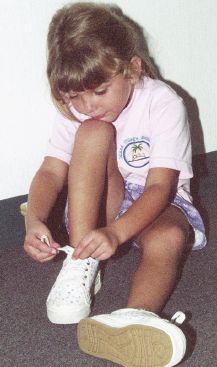
Shoelaces learn to be tied; however, knots *do* happen. Liquids get spilled during pouring. Spooning exercises might run amok at the beginning with beans or marbles strewn on the floor. But that’s *OK* in a Montessori classroom. It’s not failure; it’s an opportunity to practice and refine skills, while taking responsibility for restoring order and caring for the classroom environment.
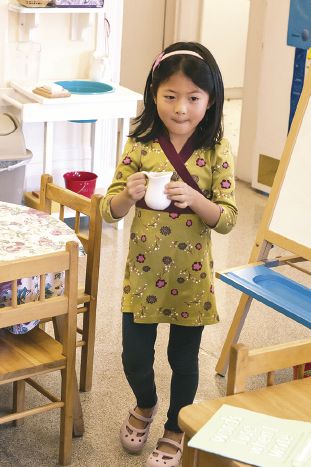

Montessori provides a safe environment to experiment and learn without fear of embarrassment or reprimand. The ‘oops factor’ is an expected, and necessary, part of the process. As adults, we know how tempting it is to play it safe and only do what we know how to do well. It takes courage and self-confidence to risk the awkwardness of trying something new: whether it’s pouring water from a child-sized pitcher or learning to play tennis as an adult.
One outcome of Montessori education for children, who are now adults, is their ongoing willingness to adapt to change while pursuing new ideas and new ventures. They understand that it is not always possible to be the best at everything when they first begin, but, when they are able to measure their efforts against their own sense of self, instead of looking for validation from others, there is a greater internal satisfaction and joy in their progress and accomplishment.
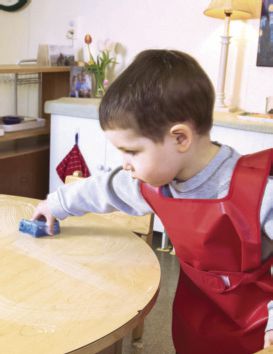
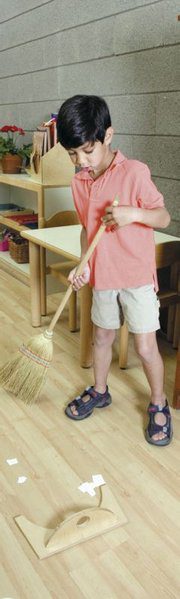
Independence does not come automatically as we grow older; it is learned. Sweeping and cleaning help children develop eye-hand coordination and motor skills. Special child-sized tools are important factors to make success possible. Imagine trying to learn to bowl with a bowling ball that is too heavy.
It’s the same for children. The Montessori curriculum and prepared environment encourage success and the self-confidence that follows. With the development of skills, children increasingly become responsible for their environment, which is why Dr. Montessori called it a children’s ‘house’ or ‘community.’ It is this combination of skills and responsibility that characterizes Montessori children throughout their time in Montessori and throughout life.

The spooning exercises require not only motor skills, but concentration, on the part of young children. A variety of spooning materials are used. Children love the challenge of using a spoon to transfer materials from one container to another. Take a closer look at the containers in the photos and the manner in which the exercises are presented. There is an elegance to even the simplest Montessori exercises. Containers are selected for form as well as function.


The water exercises might very well become your child’s favorite ‘work.’ Using child-sized pitchers and containers, children master precision as they transfer liquids from one container to another. Notice the little trays that define (and confine) the critical components of the exercise, including a little sponge for clean-up.
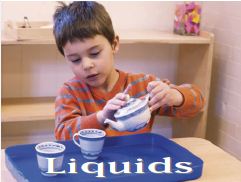
Pouring
These are clearly exercises that your children will love to demonstrate at home. Add sieves and turkey basters to expand the exercise. A little food coloring added to the water enhances the experience.

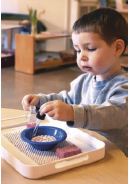
Using an eye dropper and pouring liquids to mix colors


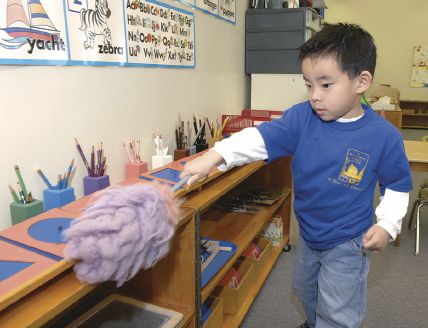 Montessori children learn to treat their classrooms as their ‘home away from home.’ They take pride in caring for the
  cleaning and beautifying of their environment. It is not happenstance that Dr. Montessori referred to the Montessori classroom as a *casa* – Italian for ‘home.’
 In Montessori, children learn to listen to their bodies. When they are hungry, they prepare a snack, cleaning up after themselves when they are finished. You will often see young students cutting fresh fruit for themselves and their friends.

The Three Rules of Work
1. Out of clutter, find simplicity.
2. From discord, find harmony.
3. In the middle of difficulty lies opportunity.
— Attributed to Albert Einstein
Independence comes from learning to control their bodies and to care for themselves & others.

Walking the line
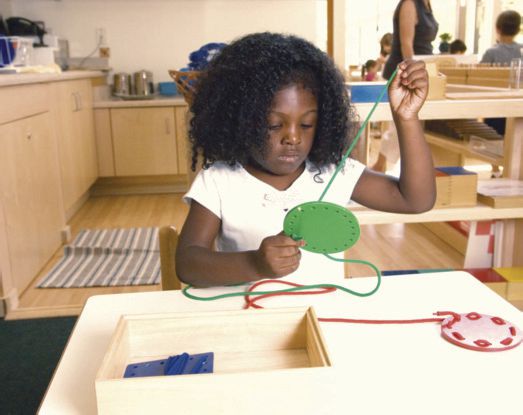
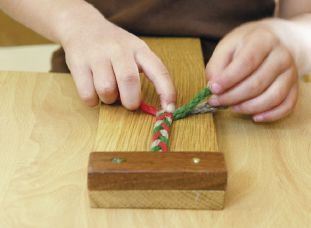
Children work with several different Dressing Frames, each of which teaches a specific skill: buttoning, tying, snapping, zipping. Why then, do Montessori teachers ask parents to send their young children to school in comfortable, easy-to-manage clothing, such as pull-on pants and T-shirts?
Before they have mastered the skills to fasten the buttons, zip, and tie, they need to be independent– successful in caring for themselves, especially when it comes to visiting the bathroom. It won’t take long before they can do everything the big kids can do. Soon, they will stop you when it comes time to put on their coats, eager to show you how they do it in class. It’s a sight to behold!

Walking the line, heel to toe, helps children develop balance and control of their bodies, allowing them to move carefully and gracefully around the room. Once they have developed basic line-walking skills, children are then challenged to carry items that should not be dropped, such as Montessori materials, small flags, or a tray of cups.


Using an old-fashioned washboard and the classroom sink, children wash the cotton napkins they have used at lunch, place them on a drying rack, and then iron them with a small, child-sized, low-temperature iron.The napkins are then folded and ready for the next day.
Safety first: Children learn how to use common household tools.


It is not unusual to find small animals in Montessori classrooms. In the classroom below, young children learn to care for the guinea pig that shares their classroom environment.