
INSIDE Montessori: DOcumentary
INSIDE MONTESSORI: A DOCUMENTARY

INSIDE MONTESSORI: A DOCUMENTARY

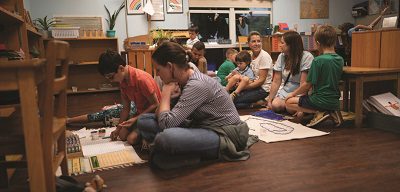
When we try to define what our children really “get” from Montessori, we need to expand our vision to include more than just the basics. Of course, they learn to read, do four digit mathematics, recognize geometric shapes, and identify the parts of a plant and a mollusk.
They also learn how to be contributing members of a community. A Montessori school is more than a classroom. It is society in a microcosm, and the skills and lessons that children learn in this environment extend well beyond the definition of academic success. They are life lessons that were very much needed when Dr. Montessori developed her teaching methodology, and they are life lessons that are still very much needed by our children today.
In her book, The School home, Dr. Judith Rowland Martin writes that she was not very impressed when she first encountered Montessori education. She understood that Montessori schools placed children in multi-age classrooms and used manipulative learning materials, which may have been very unusual during Montessori’s lifetime, but has since been incorporated into most early childhood and many elementary classrooms thanks to the Open Classroom movement of the 1960s.
Dr. Martin’s understanding of the value of the Montessori approach changed when she came across a statement in Dorothy Canfield Fisher’s book, A Montessori Mother, in which Fisher disagrees with the universal interpretation given to Montessori’s “Casa dei Bambini” or “Children’s House.” In A Montessori Mother, first published in 1912, Dorothy Canfield Fisher wrote, “The phrase, ‘Casa dei Bambini,’ is being translated everywhere nowadays by English-speaking people as “The Children’s House,” whereas its real meaning, both linguistic and spiritual is “The Children’s Home (or Children’s Community, ed.).” Fisher insisted upon this rendering, which she felt offered a much more accurate and complete insight into the character of the Montessori classroom.
Dr. Martin recognized that:
“This misreading of the Italian word ‘Casa’ as ‘house’ has effectively cut off two generations of American educators from a new and intriguing vision of what school can and should be. Read ‘casa’ as ‘house,’ and your attention is drawn to the child-sized furniture, the Montessori materials, the exercises in practical life, and the principle of self-education. But if you read ‘casa’ as ‘home’ and you begin to perceive a moral and social dimension that transforms your understanding of Montessori’s idea of a school. Once I realized that she thought of school on the model of a home, the elements of her system took on a different configuration. Where before I had seen small children manipulating concrete learning materials, I now recognized a domestic scene with its own special form of social life and education.”
She realized that what Montessori had established was not simply a classroom in which children would be taught to read and write. The Casa dei Bambini represented a social and emotional environment where children would be respected and empowered as individual human beings. It was an extended family, a community in which children truly belonged and really took care of one another. Montessori described this sense of belonging as “valorization of the personality,” a strong sense of self-respect and personal identity. Within this safe and empowering community, the young child learned to believe in themselves at the deepest possible level. In an atmosphere of independence within the community and personal empowerment, she never lost her sense of curiosity and innate ability to learn and discover. Confident in herself, she opened up to the world around her and found that mistakes were not something to be feared but rather the endless opportunity to learn from experience.
This special relationship that is so common between Montessori children and their teachers and schools is very different and much more dramatic than most children’s experience.
Many Montessori students describe their experience in words quite like these written by Frances Merenda, a 1990 graduate of the Barrie School in Silver Spring, Maryland.
“I started in Montessori at age 2. I am a product of the entire system. I did well in the lower grades and upper school. But still, many people wondered if I had been prepared for college, whether I could ‘make it in a ‘real school.’ The skepticism of so many acquaintances was so disconcerting that I never bothered to step back and see what 15 years of trust, respect, teaching, and learning had done for me. When I went off to college at Northwestern University, I left my support system and community behind and entered a world that was much colder and uncaring. At first, I deeply missed that sense of belonging. I did not realize that Barrie had not only given me a second family but had also taught me how to build new friendships, support systems, and community wherever I go. Now, at Northwestern, I have used my years of experience in community building to cultivate secure relationships with people I have come to know. Barrie did more for me than just prepare me academically for college; it prepared me for anything to which I chose to apply myself. I feel prepared for life, and I wouldn’t want it any other way.”
To understand how this evolved, it is helpful to understand the world in which Montessori lived at the time she developed her educational approach. Montessori was a professor of medicine specializing in psychiatry. At that time, there was no such thing as Freud’s ‘talking cure.’ There were basically two approaches to the treatment of disturbed individuals. The most common and familiar to modern readers was to confine people who acted strangely to insane asylums. The second and almost forgotten approach was the “Moral Education” movement that spread across Europe and North America during the 1700 and 1800s.
These therapeutic communities were villages set off in the country where chronically despondent or non-violently dysfunctional individuals lived in group settings with caring individuals. The fundamental principle of the Moral Education movement was respect and kindness. Instead of treating their patients as prisoners, the staff acted on the belief that within each human being, there is a core of goodness and a “sound mind.” The community lived and worked together as an extended family and developed a sense of belonging reminiscent of what we see in our children’s classrooms today.
These communities were much like an Israeli Kibbutz, selfsufficient farming communities in which everyone was encouraged to become more independent while contributing to the overall operation of the village. Patients lived in small homes with a couple who served as their mentors. Surviving reports suggest that a tremendous bond developed among those who lived and worked together. The movement recorded success rates far more effective than traditional approaches, returning their clients to their home communities as productive, happy citizens after an average stay of eleven months. A sense of close personal community and positive human relationships was proven successful as a means to help bring these disturbed people back to reality.
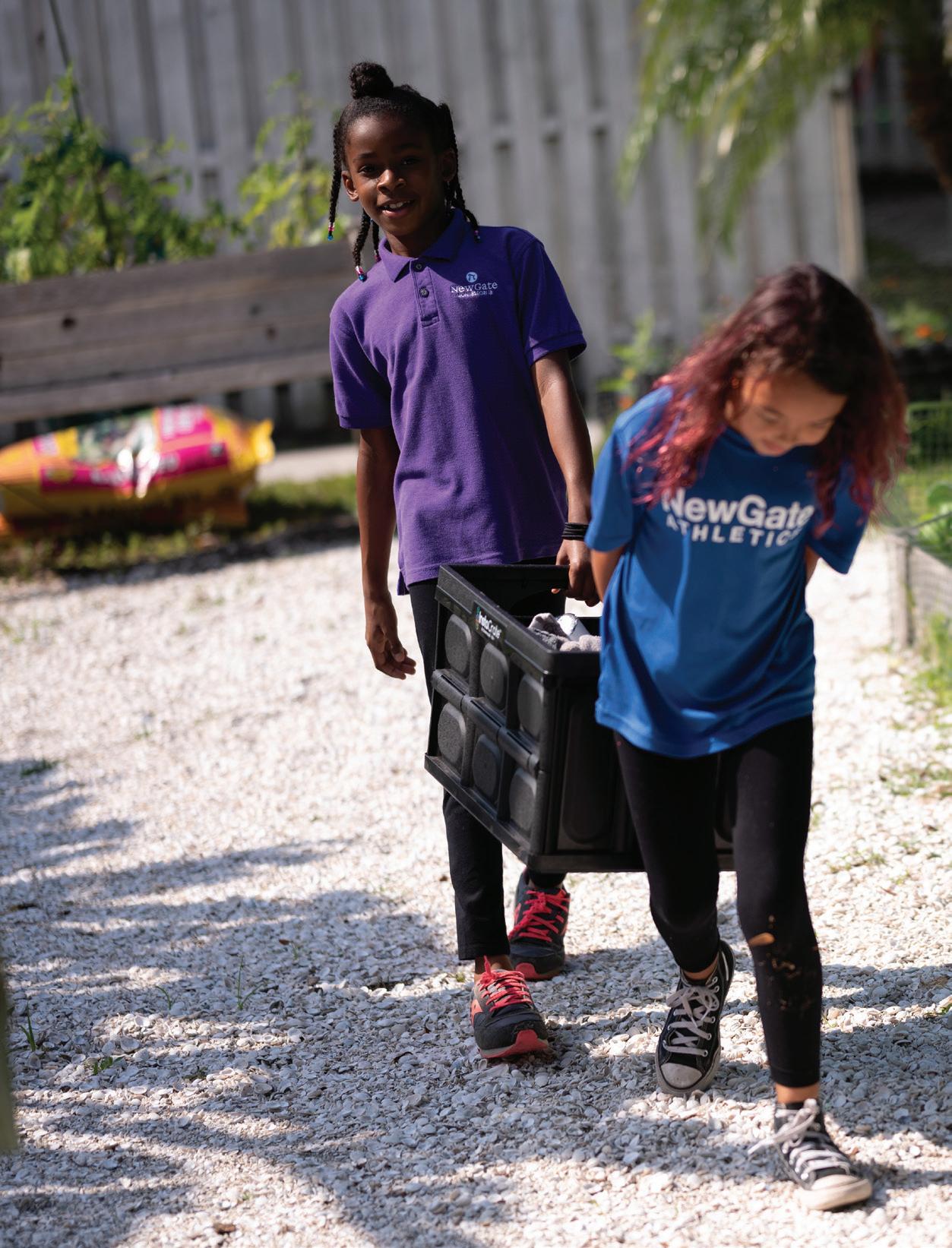
Montessori was well-aware of this movement through her medical research into innovative strategies for treating the “retarded,” autistic, and emotionally disturbed. She used this same model with tremendous success in her own work with mentally disabled and autistic children in Rome. She later hypothesized that even more dramatic results might be achieved with “normal” children. Her first “Children’s Community” was composed of inner-city children from dysfunctional families. In her book The Montessori Method, Maria Montessori describes the transformation during the first few months of operation, as the children evolved into a “family.” The children had a sense of becoming the owners of their school. They were encouraged to rearrange the furniture, prepare, and serve the daily meals, wash the pots and dishes, help the younger children bathe and change their clothes, sweep, clean, and work in the class garden. Through their day-to-day involvement in their classroom community, Montessori saw these children develop a sense of maturity and interconnectivity that helped them realize a much higher level of their potential as human beings.
While times have changed, the need to feel connected is still as strong as ever. In fact, for today’s children, it is probably even more critical. Whether it is an inner-city child or a child from an affluent suburb, the sense of community has all but disappeared from our children’s lives. Families regularly move from house to house and from town to town. Grandparents usually live in other cities or other states. Both parents work out of necessity, and when they are at home, they are very, very busy.
The “Latch-key” child has become the norm for this generation. Many children have the sense that they do not belong to anything or anybody, which is why gangs, which give a sense of belonging, have always had a certain appeal for some children. According to one study after another, astounding numbers of preteens and teenagers engage in sexual activity in their homes after school before their parents come home from work. What is most disturbing is that for most of these children, sex does not represent love or lust, but a simple need for human contact, to be hugged and touched, a need to not be so incredibly alone in the world.
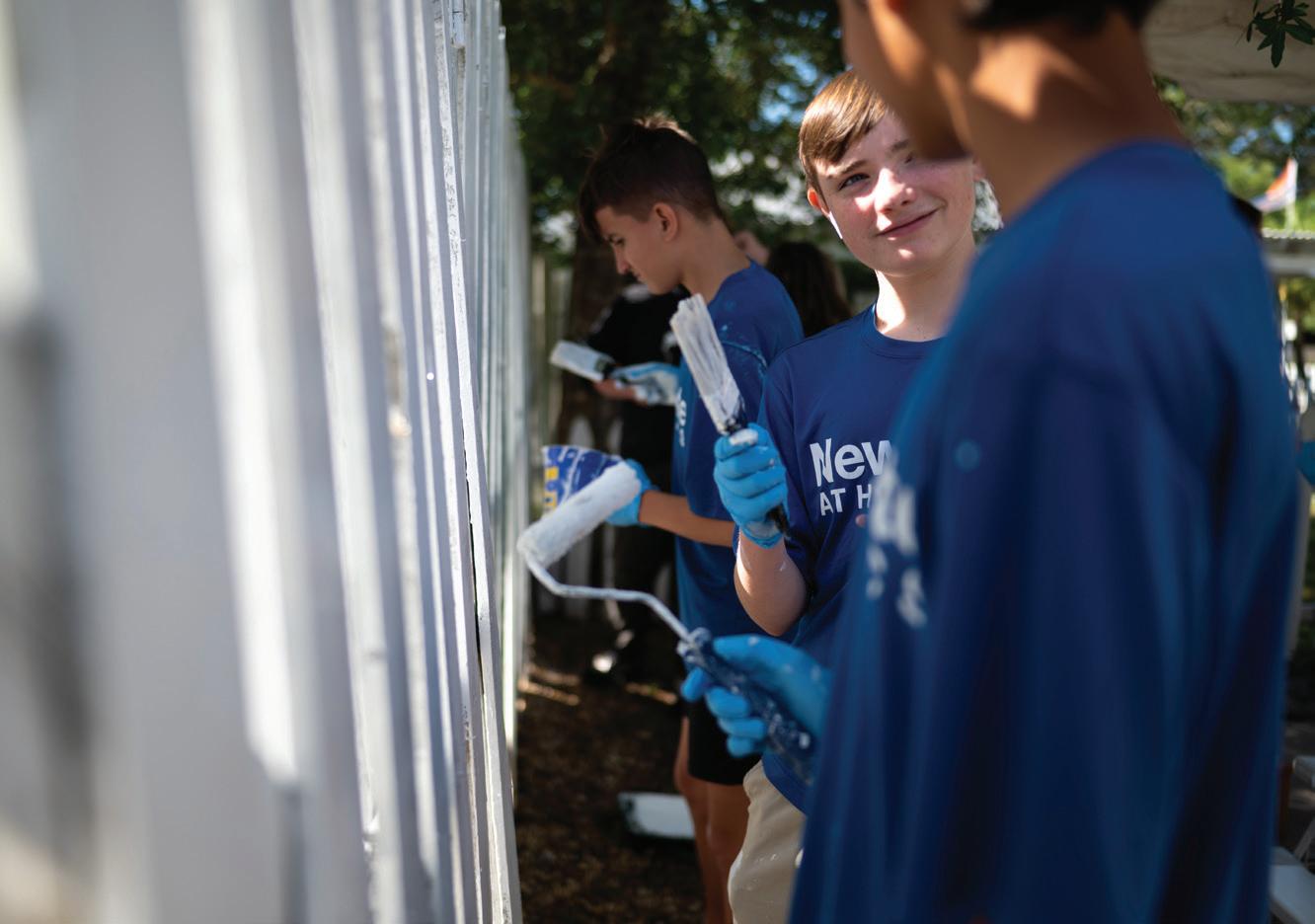
Along with whatever else Montessori gives our children, it gives them the message that they belong – that their school is like a second family. Studies on children’s moral and emotional development strongly suggest that while there are probably a few children in every thousand who are truly little “gangsters” at heart, a child’s sense of moral reasoning and sense of self are directly related. Children typically grow up to be productive, happy, positive individuals if given the right emotional environment. It seems clear that our attitudes about people, the ability to overcome our tendency to be ego-centric, our willingness to share, to compromise, to resolve conflicts non-violently, and our ability to discover a basic sense of self-worth are not qualities that human beings develop spontaneously, but rather through years of experience with caring people who convince us that we belong and allow us to practice and master these skills of everyday living. As in all things, we “learn by doing.”
One of the greatest strengths of the approach that Montessori developed is the three-year age grouping you will find in every Montessori school. By consciously bringing children together in a group that is large enough that it will allow for two-thirds of the children to return every year, the school environment promotes continuity and the development of a very different level of relationship between children and their peers, as well as between children and their teachers.
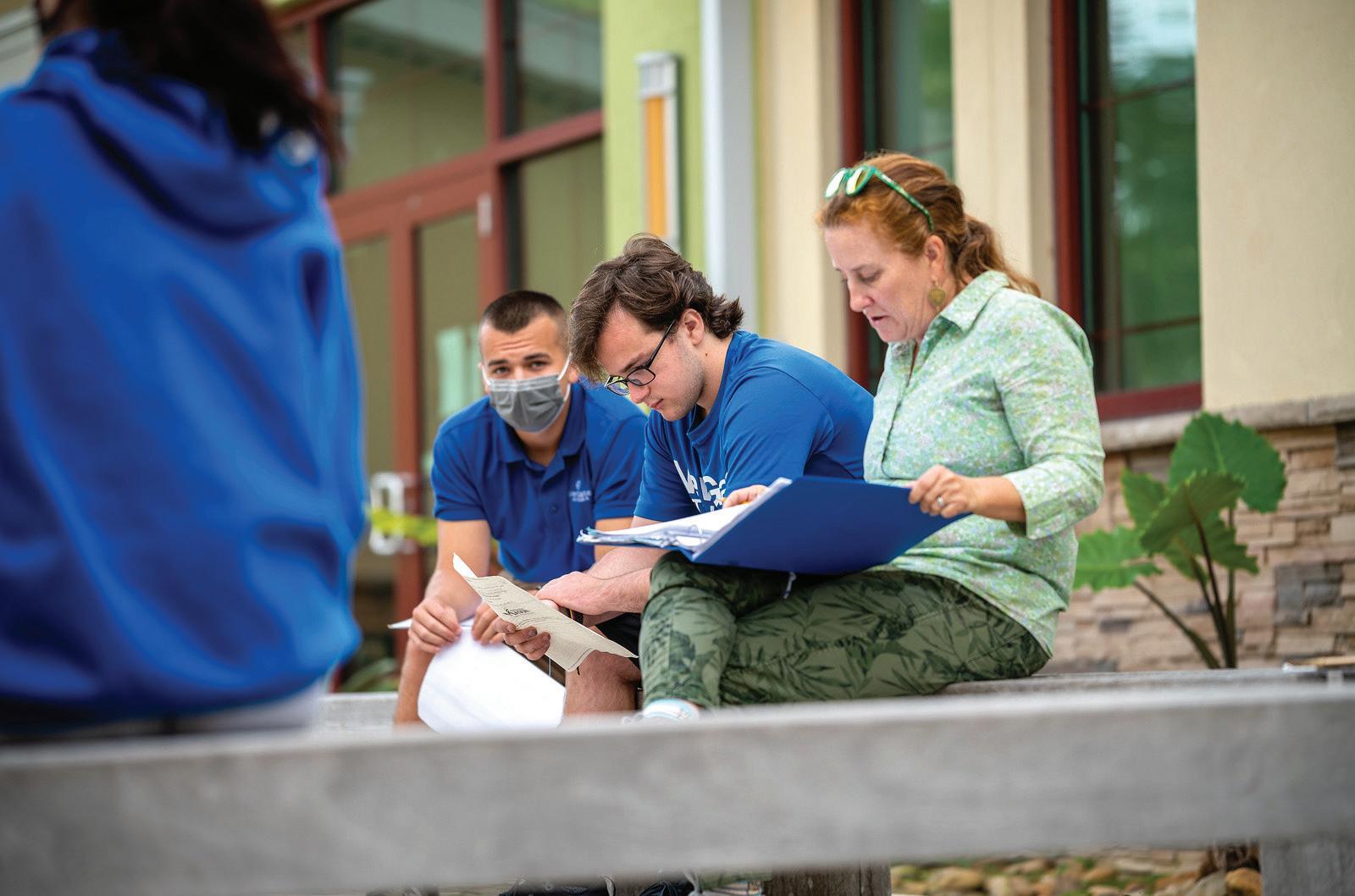
For teachers, this relationship presents itself as a commitment that they make to stay with the children in their class for a prolonged period, rather than just jumping from job to job or from classroom to administration.
Montessori teachers do more than present curriculum. The secret of any great teacher is helping the learner get to the point that their minds and hearts are open and they are ready to learn, where the motivation is not focused on getting good grades but involves a basic love of learning. As parents know their children’s learning styles and temperaments, teachers also develop this sense of each child’s uniqueness by developing a relationship over a period of years with the child and her parents.
Montessori schools give our children not only the sense of belonging to a family but also how to live with other human beings. By creating a bond between parents, teachers, and children, Montessori sought to create a community where individuals could learn to be empowered, where children could learn to be a part of families, where they could learn to care for younger children, learn from older people, trust one another, and find ways to be appropriately assertive rather than aggressive. To reduce these principles to the most simplistic form, Montessori proposed that we could make peace by healing the wounds of the human heart and by producing a more secure child. She envisioned her movement as essentially leading to a reconstruction of society. Montessori schools are different, not just because of the materials used in the classrooms. Look beyond the pink towers and golden beads, and you will discover that the Montessori classroom is a place where children really want to be — because it feels a lot like home.

What Makes People Work Better and Harder and Stay Onboard Longer . . . In a recent article in Harvard Business Review, entitled, “Designing Work That People Love,” author Marcus Buckingham proposes that, “Creating a place where all people can find love in their work means incorporating three principles: People are the point. Employees are the most important stakeholders in your organization. One size fits one. Each of your employees is a unique person with distinct loves, interests, and skills. In trust we grow. For employees to discover and contribute their loves at work, leaders must explicitly make trust the foundation of all practices and policies.” In this period of a critical Montessori teacher shortage, unprecedented turnover, and challenges with retention (especially among Assistants) there are ways to make the everyday work life of your faculty and staff more meaningful, more energizing, and more engaging. Join Jonathan Wolff for a discussion on what makes people love their work, work better and harder, and stay with you longer.
What Makes People Work Better and Harder and Stay Onboard Longer . . . In a recent article in Harvard Business Review, entitled, “Designing Work That People Love,” author Marcus Buckingham proposes that, “Creating a place where all people can find love in their work means incorporating three principles: People are the point. Employees are the most important stakeholders in your organization. One size fits one. Each of your employees is a unique person with distinct loves, interests, and skills. In trust we grow. For employees to discover and contribute their loves at work, leaders must explicitly make trust the foundation of all practices and policies.” In this period of a critical Montessori teacher shortage, unprecedented turnover, and challenges with retention (especially among Assistants) there are ways to make the everyday work life of your faculty and staff more meaningful, more energizing, and more engaging. Join Jonathan Wolff for a discussion on what makes people love their work, work better and harder, and stay with you longer.


Most of us are aware that the United Nations adopted a declaration on the universal rights of the child, but many of us have not read it. Here is the introduction and the link to the full text. We encourage you to revisit it from time to time and reflect on the vital message and vision within.
ADOPTED
20 November 1989
BY
General Assembly of the United Nations
resolution 44/25
Entry into force: 2 September 1990, in accordance with article 49
The States Parties to the present Convention,
Considering that, in accordance with the principles proclaimed in the Charter of the United Nations, recognition of the inherent dignity and of the equal and inalienable rights of all members of the human family is the foundation of freedom, justice and peace in the world,
Bearing in mind that the peoples of the United Nations have, in the Charter, reaffirmed their faith in fundamental human rights and in the dignity and worth of the human person, and have determined to promote social progress and better standards of life in larger freedom,
Recognizing that the United Nations has, in the Universal Declaration of Human Rights and in the International Covenants on Human Rights, proclaimed and agreed that everyone is entitled to all the rights and freedoms set forth therein, without distinction of any kind, such as race, colour, sex, language, religion, political or other opinion, national or social origin, property, birth or other status,
Recalling that, in the Universal Declaration of Human Rights, the United Nations has proclaimed that childhood is entitled to special care and assistance,
Convinced that the family, as the fundamental group of society and the natural environment for the growth and well-being of all its members and particularly children, should be afforded the necessary protection and assistance so that it can fully assume its responsibilities within the community,
Recognizing that the child, for the full and harmonious development of his or her personality, should grow up in a family environment, in an atmosphere of happiness, love and understanding,
Considering that the child should be fully prepared to live an individual life in society, and brought up in the spirit of the ideals proclaimed in the Charter of the United Nations, and in particular in the spirit of peace, dignity, tolerance, freedom, equality and solidarity,
Click the link below to read the full text:
https://www.ohchr.org/en/instruments-mechanisms/instruments/convention-rights-child

Montessori For Every Family: A practical parenting guide to living, loving, and learning by Tim Seldin and Lorna McGrath is the picture-perfect guide to championing families in the creation of hallowed spaces where love, joy, connection, and respect are nurtured by amalgamating Montessori principles into a family’s daily life. This book honors and respects all families and is meant to offer suggestions and support. It is extremely practical, giving parents a plethora of organized tools and named strategies that they can apply immediately to create and strengthen positive family life. The authors offer specific suggestions for different stages and ages of a child’s development throughout the book. The writing is conversational and includes many real-life stories from families; their willingness to be candid and vulnerable allows for beautiful relatable storytelling. The charming illustrations look like ordinary moments on first inspection but hold magic in the possibilities of growth. There is also no need to be familiar with Montessori to benefit from this book because it provides you an introduction to Montessori and focuses on key Montessori principles.
As a Montessori leader, what immediately came to mind while reading this book was the support that it can give to guides and administrators while working in partnership with families.
Educators are committed to the development of the whole child and focus on growing strong, confident, compassionate, and capable human beings. And the whole child includes their family. I highly recommend this book be given to every Montessori guide and every parent to use as a resource. It will aid in establishing a partnership based on mutual respect, love, shared language, strategies, and consistency. The short chapters have clearly defined topics for easy access and do not even need to be read in order. It is beneficial when the whole school community is working from the same resource. It provides consistency for the child, the guides, and the parents as children change classroom environments and guides.
I would use this book in a parent book club, as well as give a series of workshops for parents based on the concepts of the book.
It is quite possible this might become your most highlighted and ear-tagged book because every page is packed with significant and ready-to-use gems of advice.

Tim and Lorna share their wisdom, knowledge, understanding, and experience in an exquisite book that can enrich and celebrate family life in so many ways. Make this a go-to book in your parenting journey or as a Montessori educator supporting families. Montessori For Every Family: A practical parenting guide to living, loving, and learning is an intention, a guide, and a reminder of the sacredness of having a peaceful family, as well as a reminder of the many blessings families already, have as well as those on their way.

Cassi Mackey, M.Ed. is passionate about helping communities create spaces where people are encouraged to make changes to improve relationships. Cassi has witnessed the transformational power of communities that engage in Courageous Conversation and Collaborative Coaching as imputable practices. It is a promise of more meaningful relationships, greater depth of experience, and a broader, more compassionate view of oneself and the world. She truly believes open, honest, and kind communication is essential for our children and the future of humanity. Cassi is currently a principal, as well as a lead teacher in a 9-12 classroom at Montessori Education Centre-Charter School in Mesa, Arizona and has successfully guided her school, as well as others, through this transformation. Cassi recently completed her AMI Administrator Certification. She consults with and provides advice to Montessori communities that are intent on generating positive and lasting change.

Quite often with a 3-, 4- or 5-year-old, there’s a lot of grey areas when they’re testing boundaries and you’re not sure a break is necessary—maybe he’s touching the baby’s face and he’s looking at you and he’s got this look in his eye like he’s thinking, “Can I do this? How about this? Am I making you nervous? What can I do before you say something?”
Typically, parents give ambiguous information in these moments, like, “Be careful. Your baby brother is very delicate, so I need you to be gentle.”
What is more effective in these moments is to give a clear action direction, “I need you to come and stand next to me for a moment.” Then, if he’s not moving to follow your direction, count: “5…4…3…2…1…”. And if he hasn’t come to you by the end of the count, give him a break. If he does come to you, have him stay there for a moment and then either let him return or give him a direction to play somewhere else. This inserts a very clear map for him (and you) to follow in that moment. You’ve asked him for something specific, and you’ve given him a clear timeline. He’ll begin to take your direction in these moments, because he doesn’t want a break.
It’s important that the parents aren’t threatening to do a break (so it’s not—“I need you to come over to me, or I’m going to give you a break”) because we want him to generate this thought and self-prompt in this moment.
You say, “I need you to come and sit on the couch to play.” He ignores you and you say, “5…4…3…2…1….” Then if he’s
still not on the couch, and you say in a relaxed tone, “Oh, now I need you to take a break.” Now he looks up and says, “No, no, no! I’ll sit on the couch.” And you respond, “It’s no big deal. You take the break; then you can go to the couch. Right now, you have a short break.”
You follow this pattern because your goal is to have your child follow your directions when you give them. Once you have a break process in place, you can give all kinds of other prompts, because now he takes your words seriously. As you move forward, you ask him to do what you need, and if he doesn’t, you give him a break, or you count down and then give him a break. But you don’t always have to count down.
You might simply ask your child to do something and then pause quietly for five seconds and then give the break. You don’t have to do it the same way each time because you want to keep him on his toes, so he learns to hold an awareness of your needs. There’s no judgment in your tone with this; it’s easy, it’s fun, it’s playful—like your child. This speaks directly to the difference between punishments and consequences.
You can begin by giving a clear direction and then counting. A few days later, you shift to pausing quietly for 5 seconds, then giving the break. Inevitably, your child will say, “Wait! You didn’t count!” and you can tell him, “Well I’m not always going to count. I don’t want to work so hard. You know what happens after I give you a direction. I wait a few moments, and then you get a break. It’s no big deal; you take the break, and you come right back.” The tone of voice you use and the lack of moralizing is the difference between punishment and consequence. You’re shifting from judgment and anger, which implies his actions are either good or bad, to good-natured coaching with cause and effect.
There is often a misunderstanding that administering cause and effect without judgment is too soft, but it’s not; it’s actually more effective. When your child is very defiant you can give consequence after consequence after consequence and frustrate the heck out of him. But the more you frustrate him, the more your tone should be sweet and empathetic so that your children focuses on the consequence of their choices rather than your judgment of them. •
Joe Newman was born and adopted in1963. In 1970 he was diagnosed ADHD and medicated with Ritalin. Every where he went, the playground, the classroom, even at home, Joe heard one message loud and c ear: you’re broken; your brain doesn’t work; you don’t belong.” No surprises when, at eighteen, he dropped out of college, shaved his hair into a mohawk and took off to surf the coastlines of the Caribbean and Central America. It was out in the world, working scores of jobs and starting his own businesses, where Joe realized he was not actually broken. Away from the tethers of school and home, Joe realized the same qualities called disorders were also qualities of positivity and value. Aggression became passion, distractibility became broad understanding, and stubbornness became tenacity. Realizing there must be millions of children out there, just like him, with ferocious spirits but misunderstood, he threw himself into finding and reaching these children.
His book, Raising Lions, has developed a growing following not simply because it helps parents understand why their children behave the way they do, but because the tools and solutions actually work.
TOMORROW’S CHILD © • NOVEMBER 2019 • WWW.MONTESSORI.ORG

by Rachel Buechler
 A little girl sits at the table with the Snap Dressing Frame. She has picked it up several times before today and quickly returned it to its stand after a short attempt. Today she picks it up and places it on the table. She tries the first snap; it doesn’t connect. She looks at the snap from the left side, then the right side. She tries again; it doesn’t connect. She looks at her teacher for help. The teacher demonstrates how to connect the snap then returns it to its unconnected state. The child moves onto the snap above and, as she pushes down, she hears it connect. She pauses, smiles. Then goes back to try the first one; it still doesn’t connect. She squeals in frustration. She takes a moment to look again and again; then she keeps trying. This continues for twenty minutes until she looks at the dressing frame and the three connected snaps. She sighs and smiles then exclaims, “I did it!” Her teacher says, “You did it!” The little girl continues to look at the completed work before quickly taking it apart again to repeat the lesson.
There is so much for us to learn from this toddler’s determination to work on mastering this lesson. She is showing us how we can develop a skill that will place us ahead of others in the working world: grit. Grit is what keeps us working with our children, even when it is hard, even when we think we aren’t getting the results we want, or the progress is slower than we hoped. No matter what, we keep thinking of new ideas to try and keep believing we will see results. We are displaying grit. How can you help your students, or your own children, develop grit?
Let the child experience frustration. This is hard to do when we can see the solution to their problem is so easy for us to fix. As they try to fit puzzle pieces into a board, we can see they just need to turn it a little further, and we can feel so helpful if we just showed them how it fit by reaching over to place the piece. If we continue to solve the child’s frustrations, we are robbing them of the opportunity to feel greater success in working through the issue. We are also telling them that anytime they are frustrated, they should rely on an adult to solve the issue. We need our future leaders to learn how to problem solve and persist to solution by accepting frustration, then working through it.
During the Dressing Frame story, the teacher did show that the snap can be connected and, thus, modeled the action for the child. The teacher also returned the snap to its original state so the child would continue to work from where she left off. Deciding exactly what help children need is critical to allowing them to persist with the challenge, but not discourage them by completing it on their behalf. It also helps children to learn when to ask for help.
If we continue to solve the child’s frustrations, we are robbing them of the opportunity to feel greater success in working through the issue.
Even if children don’t succeed with lessons, tomorrow might just be the day they will figure it out. Maria Montessori believed repetition was the key to mastering a skill. If an infant went to walk for the first time but fell after one step, and we said: “Looks like that’s not the activity for you,” they would likely feel discouraged from attempting it again. Our response is more likely to be supportive, helping them up and encouraging them to try again and again until they are walking with stability. This is how we should help our children attempt many lessons in different areas of the classroom or skills at home. There are times when a child masters a difficult skill and then finds joy from repeating the lesson over again, as it gets easier and easier each time. As new skills are developing, mistakes will be made. When mistakes are made, we must be matter of fact about them. As the book, The Montessori Toddler, says, “Mistakes are simply opportunities to learn… if they break or spill things, we can have things at the ready for them to help tidy it up…. We can model being friendly about mistakes by not taking ourselves too seriously when we make mistakes” (Davis, 2018, p.93).

The child had picked up the Snap Dressing Frame several times on various days before and realized, through self-awareness, that this was not a task that would give her immediate success. There were other skills that needed to be built first. This shows great knowledge in knowing her own abilities and where she is ready to seek the next challenge. By allowing children to guide their own learning journeys through choice and freedom, they develop more than the academic skills. They build skills in planning, organization, order, and determination (or grit). The growth of these skills allows children to feel internal celebration when they complete activities on which they have been working. This grows confidence as children learn how to fail and keep persisting until they succeed. As the book, The Confidence Code, says, “failing fast allows for constant adjustment, testing, and then quick movement toward what will actually work” (Kay & Shipman, 2014, p. 140).
ADULT INTERVENTIONS THAT DISCOURAGE THE DEVELOPMENT OF GRIT:
• Jumping in to help before you have assessed exactly how much help the child truly needs. Give only this amount of help. The joy within the child comes from persisting through a difficult task to reaching completion.
• Saying “good job” or “I like it when you_____”. These statements make the success about you and not about the internal development of the child.
• Moving the child away from a task because you think it looks too difficult prevents developing grit. Let them try; model it. Help them to determine what is too difficult. Don’t become frustrated or upset about mistakes made.
REFERENCES:
Davies, S. (2018) The Montessori Toddler. Amsterdam: Jacaranda Tree Publishing Kay, K. & Shipman, C. (2014). The Confidence Code. New York: HarperCollins
Rachel Buechler earned her BA in Education in 2009 before relocating to Charlotte, NC from England, UK. She joined Charlotte Montessori School in 2010and was the Lead Toddler Teacher for three years. During that time she earned her Infant/Toddler Montessori Certification. Ms. Buechler enjoys the individualization of the Montessori classroom foreach child and watching them follow their own unique interests as they learn and grow in the classroom.
TOMORROW’S CHILD © • NOVEMBER 2019 • WWW.MONTESSORI.ORG
Introduction
Montessori schools are different – profoundly different – from the familiar traditional classrooms that most of us attended in our childhood years.
Those of us who have spent years around Montessori children know that Montessori works; however, while the average person has heard of Montessori, most know little about it and have conflicting impressions of what Montessori reflects. This is nothing new or unique. It has been the case since Dr. Montessori opened her first school outside Rome in 1907.
Some people rave about Montessori; others think that parents must be nuts to put their children in a Montessori school. Some are firmly convinced that Montessori is too rigid and robs children of their creativity, while others object that it is completely unstructured and without any academic standards.
“Isn’t Montessori the sort of school where they allow the children to do and learn whatever they want, whenever they want? Perhaps it will work for your little Sally, but I’m afraid that if my Danny were left to his own devices, he’d never choose to do a lick of schoolwork! He needs order, structure, a small class size, and discipline!”
Over more than thirty years leading two wonderful Montessori schools, I tried to help parents sort all this out so they could reassure themselves that Montessori is not going to leave their children academically handicapped and unable to make it in the real world. Most of the parents that I’ve known are sympathetic and enthusiastic, but it is still difficult for them to defend their decision to send their children to Montessori when the rest of the world seems so completely committed to a very different approach to raising children.
Having made the decision to take this course through the Center for Montessori Leadership, we hope that you will seriously consider the possibility of leading your school through this process of extensive self-evaluation and improvement. We think of this process as Building a World-Class Montessori School.
This is a daunting task. For most Montessori schools, taking the step from being a good Montessori school to becoming a great one will require a great deal of work, the investment of a year or longer, and a considerable amount of money. Moreover, once begun, it is very important that you not back off from your commitment to excellence. Your school must be prepared to meet your families’ and staff’s raised expectations, and you must follow through on the commitments that you have made to the school community. This is not something to be undertaken lightly.
You will begin with the process of clarifying your unique character and carefully defining the fundamental values on which your work from this point forward will be based. You will address a host of issues regarding your day-to-day operation and future plans. You need to make several complex decisions about enrollment, administration, and finances; raise capital and endowment funds; and begin to implement major change. And it is quite likely that you will face a host of additional issues that you have yet to identify.
Change is often stressful to a school community but also presents new opportunities for growth.
Like anything new, it is easier to go through the process for the first time if you have a guide who has been there before. While this book cannot do your homework for you, nor avoid the necessity of putting in countless hours of hard work, planning, and decision-making, it should make the nature of your journey more easily understood and may make the process easier for you and your school community.
By our definition, a world-class Montessori school has made an absolute commitment to excellence. The school clearly defines its identity, mission, and core values. The school community has sought out examples of true excellence in Montessori practice around the world and has consciously defined what excellence would look like in every aspect of its programs, facilities, and operations. Plans have been laid for how one might create and maintain this excellence in each area, not by chance, but year after year by deliberate design.
The school has further identified what it would cost to create and sustain excellence in all things and has developed a plan for funding the cost of excellence.
Montessori schools do not become world-class simply by building the right buildings or hiring the right teachers. First and foremost, a school lives in the minds and vision of those who are central to its life. No school can be great without a clear sense of its core values and the culture of the institution: this is who we are and how we do things here. The character of the school will evolve, but it should evolve slowly and in a logical progression of maturation.
Unfortunately, we all know that it is all too easy for a Montessori school to make compromises because of tight budgets, lack of parent understanding and support, or because Montessori-trained teachers are hard to find.
We all know the story of the Emperor’s New Clothes. We must not live out this fairy tale in our schools. Ideally, we should translate what we say our school does and believes into day-to-day operation. A great school stands for something quite distinct. It cannot possibly please everyone. The school that some deeply respect and admire will have no appeal for others.
Building a World-Class Montessori School
In time every school can drift away from its original vision and core values, just as a sailboat will eventually be blown off course by the wind, current, and tides. Educational leadership can be compared to navigating at sea. It requires a clear sense of where you are trying to go, close attention to where you really are, and periodic course corrections. A blueprint will give your school a tool that will allow you to remain true to your vision.
Over the years I have had the opportunity to work with and learn from several hundred different Montessori schools around the world. Experience has shown that the most effective schools are those which commit to an ongoing process of self-study that involves not only the faculty and administration but parents and older students as well. The Montessori Foundation recommends that schools prepare a Blueprint of fundamental values and beliefs, which is used to govern the schools’ activities and decision-making processes in every area of its operation. This procedure is the first step required of schools undertaking IMC accreditation. The Head of School and the Board make a formal public commitment in writing to make no decision that is not consistent with the school’s Blueprint of Core Values.
In building a world-class school, you will have a long list of policies and procedures to reconsider, decisions to make, and milestones to accomplish, including:
Bringing world-class vitality and commitment into an existing school is a complex process. If you are starting a new school, you can begin the process from day one, minimizing “mistakes” that need correcting later.
The Blueprint Model
We began this work more than thirty years ago at the Barrie School in Silver Spring, Maryland. Our goal was to break away from the familiar jargon-laden statements of philosophy so common in Montessori. After a great deal of self-study, we broke our philosophy down into a comprehensive statement of our fundamental values and core principles of educational practice. They were intended to present a detailed picture of who we thought we were and what we stood for that could be used as a reference by the future school community over the years.
To date, we have shared this document with almost a thousand schools around the world. The New Gate School was the first to completely rewrite Barrie’s original blueprint, creating something fresh to reflect its own vision. More than forty parents engaged in weekly meetings over a three-month period, adding up to more than fifty hours. Having worked with many schools, we were deeply impressed by the enthusiasm, positive energy, and commitment that these people shared in their dreams for the school they were beginning to build.
Once adopted by the school’s board of trustees, the blueprint can be used in planning for the future, setting policy, and for evaluating of the school’s facilities and evolving educational programs.
Using the Blueprint on a Day-to-Day Basis
Blueprints and similar philosophical statements are useless if no one knows them or cares. To be effective, they must be at the core of actual decisions and actions on a day-to-day basis. This is equally true for the administration, board, faculty, and staff. This excerpt from the New Gate Blueprint outlines how the Blueprint should be used:
Community Meetings
Community meetings are critical in building and retaining a healthy school and are indispensable for ensuring that the Blueprint is properly implemented.
The school schedules and guarantees that monthly Community Meetings of parents, teachers, administrators, trustees, and interested students will be held throughout the school year, regardless of levels of interest and attendance.
These meetings will be run according to the Montessori Rules for Meetings. They will be led by a rotating facilitator, who will never be an Administrator or Board Member. There will be no elected officers. The meeting is a direct voice for the school community.
The community meeting is the official voice of the community as-a-whole. It is the place where the board introduces issues that are due to come before the board. This allows the community to hear the issue, listen to information about why this issue needs to be handled, consider how this issue would fit into the core values of the school as set forth in the Blueprint document, and gives them the opportunity to sign off with their support or to request a month to do some research and come back with it to the next monthly community meeting.
The community meeting can address questions or make official recommendations to the faculty, Head of School, or to the Board, knowing that each has agreed to respond to them following its next meeting.
Their response may be to explain that they need more time or that they respectfully disagree; however, their response would be official and timely. In each case, all parties would be expected to copy and paste into their communication not only a description of the question or recommendation, or response but the specific numbered elements of the Blueprint that affect this issue.
Likewise, when the Board meets to make policy decisions, it will first ask if it has brought this issue to the Community Meeting to allow the stakeholders to understand and respond to the issue under consideration.
Before the Board considers an issue, it will first identify and copy and paste into the minutes of the Board the numbered statements of core values and beliefs that should be kept in mind before the discussion begins. When the Board does vote on an issue, the minutes of the Board will include the text and item numbers of each element that they found that applies to this decision.
The formal agreement is that the Board and Administration agree that they will make no decision that is not consistent with the school’s values.
The Blueprint process will challenge the community to participate in an ongoing monthly meeting of parents, teachers, and administrators throughout the school year.
These issues can be mundane or very serious. Work can be done outside of the meetings, but recommendations or formal questions can only come from the Community Meeting itself. It is a place where all stakeholders can become part of a conversation, make recommendations, or ask questions of the board.
The blueprint will be used constantly in Community Meetings. It will also be used by the faculty, board, and administration in their meetings.
Board Meetings
Even though the Board is the highest authority in the school, and the Head of School is the Chief Executive Officer, they agree to policies or decisions that would be inconsistent with the school’s core values as represented in the Blueprint document. Furthermore, they are held up to public scrutiny and remain accountable to the school community.
The Board holds open meetings. Before considering any motion, the Board will review the Blueprint to see which of the hundreds of Core Values would influence a decision. Those values are copied and pasted into the minutes of the board beneath the motion.
By making this commitment and by making decisions openly under public scrutiny, parents can challenge the Board’s or Head of School’s decisions on the basis of the School’s Blueprint of Core Values in an appropriate public forum. The Board and Head of School do not need to agree, but if challenged based on the School’s Core Values, it becomes very difficult for them to defy the reason for the challenge, with the ultimate balance of power resting in their decision to continue to give the school their support.
The Blueprint is a constant reminder of the board’s mission to preserve and protect the school as a Montessori program through the years.
The Blueprint Process at Work
Here is one example of how a school used the Blueprint to resolve what could have been quite a challenging situation.
After the winter break, a child became ill when he reentered his classroom. Knowing that her child was exceptionally sensitive to many toxic chemical compounds, the child’s mother suspected that a carpet cleaning company had used a cleaning compound that had left a residue in the carpet that was making her child sick.
She came into the office and expressed her concern. The Head of School contacted the cleaning company, recognizing that the Blueprint requires her to take all such concerns seriously and with respect and courtesy. It turned out that the carpet shampoo could leave a residue in the carpet fibers if the operator did not manage to get all the compounds out of the rug. The solution is simple. The cleaners came back in and cleaned the rug a second time, this time using no chemicals. The school covered the expense for the second cleaning, even though it was not in the budget because each child’s health and well-being superseded normal budget priorities. The immediate problem was solved.
At the next monthly Community Meeting, the child’s mother and several of her friends proposed an addition to the school’s Blueprint under Section 5: Facilities: “No toxic chemical can be brought on to the campus without an advisory committee made up of volunteer scientists.”
The community meeting discussed this proposal and quickly agreed that it was impractical because no doctors or scientists would be comfortable committing the time or assuming the legal liability. So the proposal failed at the Community Meeting level, but a somewhat amended proposal was made and supported. This amendment to the Blueprint stated that the school will attempt to avoid using toxic substances for cleaning or pest control, and in selecting materials for the finishing of new facilities, will seek finishes and floor and wall coverings that are not known to be toxic. This proposal reached the board and was approved into school policy as part of the Blueprint.
The Benefits of Having a Blueprint for Your School: Schools that have a Blueprint in place tend to develop a strong sense of community among parents and staff. Parents and faculty have a clearer sense of the school’s fundamental values and are more likely to communicate concerns based on issues rather than personal likes and dislikes or factional loyalties. The Blueprint also provides a clear and impersonal means for resolving grievances.
One of the unexpected benefits of the process is that it normally leads to substantially higher levels of re-enrollment, especially at the ages where children typically tend to withdraw. It also tends to lead to a substantial increase in fundraising. It is not uncommon to see one or more major gifts come out of this process.
Developing the Blueprint: The Montessori Foundation recommends that the Blueprint is developed through a process involving the whole school community – Board, administration, faculty, parents, and students who are mature enough to understand and contribute to the process. The reason is that this results in a strong community that understands and has “buy-in” to the principles incorporated in the document.
Understand, however, that the Blueprint will always be a work in progress, which is able to be adapted to changing needs and circumstances. While it is possible to prepare a Blueprint over a series of meetings spread out over weeks or even months, the Montessori Foundation recommends that the work be done over a weekend —a “Blueprint Retreat.”
Intensive Communication: As you prepare for your Blueprint Retreat, use Intensive communication to let people know what you are up to, why this is important, and how the process will work. Give people at least a month’s lead time to allow them to understand what this is all about and to fit this into their calendar if they are interested.
Prepare a Sample Blueprint: Rather than begin with a blank page, we have found the process becomes much more manageable to start with another school’s Blueprint. Choose a Sample Blueprint which most corresponds with your school’s character and prepare for the weekend by making some minor adaptations.
The Board and Head of School go through the sample and shape it somewhat to fit their school – removing aspects that do not correspond with your school and noting any possible additions. No two schools will likely have the same Blueprint, although most schools will probably have much in common. The nine sections of the Blueprint document are aligned to the nine functions that are examined when a school is examined and evaluated for IMC School Accreditation.
There is nothing magic in this way of looking at a school; someone else could have more or fewer sections in their frame of reference. We have found this to be a useful structure.
Communicate with the School Community: Send the sample Blueprint (the one from which you will start) to every school community member, either by email or printed copy.
Clarify the purpose and structure of the blueprint so that every member of the community understands the reasons for this process.
Emphasize the importance of this meeting. This is a watershed event in the history of the school. Tell parents and teachers that if they can only come for an hour or two, that they should still come for as long as they can. The process is enlightening, and even those people who stay for a few hours will often gain new insight into the school and Montessori. Everyone should feel comfortable coming for whatever amount of time they can invest. ‘If you care, you want to be there.’
Publish this information in a variety of ways to reach the widest possible number of community members. Send it home to all parents.
The success of the experience depends on how good the facilitator is and how much he or she really knows about Montessori education. The facilitator should be more of a teacher than just a facilitator. In some ways, the Blueprint Retreat is like a college seminar that leads people, teachers, as well as parents to understand Montessori on a much deeper level.
You also need a scribe who will be able to alter the draft document as the meeting progresses, to project the changes onto a screen for the entire working group to view.
Hold a Blueprint Retreat.
We recommend that the Blueprint be drawn up in a marathon weekend retreat rather than being spread out over many weeks. We find that there is momentum that builds up over a weekend. When it is spread out, people tend to lose the thread of the discussions and do not develop a full sense of how the Blueprint ties together.
Crafting the Blueprint Point by Point
The Facilitator leads from the front of the room.
The first item is projected on a screen large enough that everyone can see it. Go through the numbered items on the draft Blueprint one item at a time. A scribe with a laptop connected to a projector makes changes to the original text file as the group moves along. The entire group can see changes as they are made. Post the day’s work on your website so parents and teachers can see what has been accomplished.
Do not attempt to write or amend your mission statement first. Even though it comes first in the document, reviewing your current mission statement, or writing one from scratch, should come after the Blueprint has fleshed out the nature of the school. It comes last in the process because it captures the spirit of all the details in the governing document.
Tackle the biggest and most important section first — the Educational Program: All great schools have a coherence of core principles and values that define their character. The educational program should not be the arbitrary creation of the teachers who happen to be at the school this year. The program should be based on a central and clearly defined model, which is consistently followed from class to class, from one level to the next, and from year to year.
These fundamental defining elements of practice are nonnegotiable. Teachers are to be hired on the basis of the school’s conviction that they have the skills, experience, and personality to faithfully and effectively implement the school’s program by conscious design, not chance. Anything behind these core issues can be added in as well, so long as the addition is consistent with the school’s core values.
At first, people tend to struggle with the process. Generally, this is because the Blueprint is not a statement of what is true in the school today. It is a statement of what we believe and what we are prepared to commit the school to follow. After the first hour, groups tend to move through the long document quickly.
Self-Study Working Committees: The self-study process will usually involve seven working committees focusing on the following areas:
Educational Program: This is clearly the largest area, and you may want to establish several subcommittees to focus on curriculum and program development in each major area, which might include:
Community Relations
The work of the various committees will be coordinated and compiled into a central Self-Study report by a Steering Committee of five community members who are highly organized and skilled editors.
As the self-study gets underway, giving the entire school community information about your progress will be essential. We recommend that you hold regular “Town Meetings” to allow the committees engaged in the self-study process to report to the school community and invite their suggestions and involvement in the next phase.
You will also need to publish occasional progress reports.
The Blueprint of Core Beliefs and Values
After the Blueprint has been written, there is a four-step process to develop and implement the Blueprint of Core Beliefs and Values. The Blueprint document is developed following the procedure outlined below.
Working from the Blueprint, the school develops a simple, one-sentence mission statement that succinctly summarizes the fundamental reasons for the school’s existence and clearly communicates its special character.
If this were a perfect world and if your school had the resources to be the very best that it could be in this area, how would this program or these facilities have to look to be consistent with your school’s vision as set forth in our blueprint?
What does your school look like in this area today? How well are you doing?
What do you propose to do over the next three years to improve your program or facilities to make them more consistent with your institutional blueprint?
This last portion of each committee’s report should be very detailed and specific: tasks, cost, timing, who will supervise, how will you evaluate your progress.
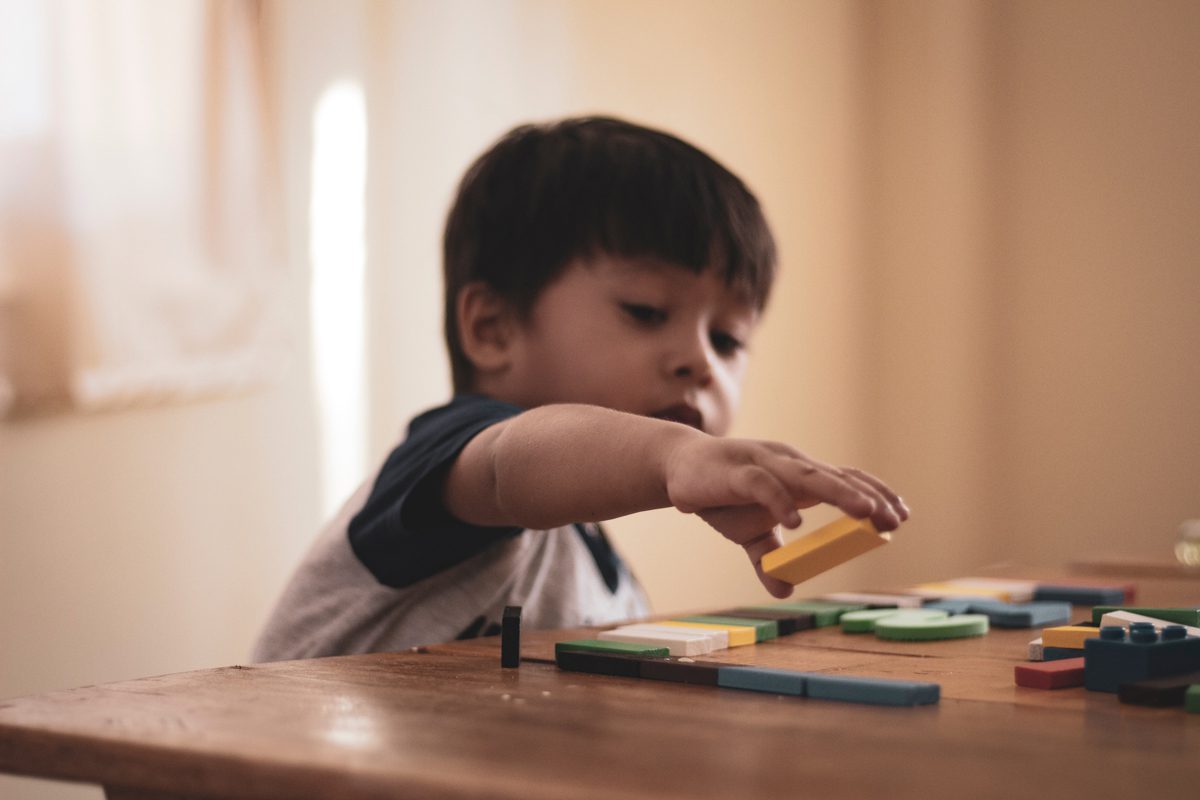
Lorna McGrath explores how we can encourage our children’s independence from 18 months to age 3.
Coming to the realization that one’s child is not learning or growing as anticipated is truly one of life’s most daunting challenges. Each family’s experience of having a child with an exceptionality is completely unique. And yet, there are a few common threads that can make the journey a bit easier for teachers and for families to navigate.
STAGES AND PERSONAL NARRATIVES
Being the parent of a child with a special need is a deeply personal experience. Disability experts suggest that families go through the classic stages of grief. However, families may find this approach stereotypical and even insulting. To suggest that a family is ‘in denial’ or in any of the other stages of grief can feel dismissive and insensitive. On the other hand, being aware of a range of possible feelings can be helpful for both families and teachers.
Shock, denial, guilt, isolation, panic, anger, bargaining, acceptance and hope comprise the usual set of stages (Boushey, 2001). I am the mother of a very grownup daughter who is deaf. Alicia is 35, married, and part of her job involves lobbying on Capitol Hill for employment opportunities for people with disabilities. I can certainly remember each of these stages. I also remember feeling confused when several of these feelings (especially panic and anger) would reoccur. “I was already angry and scared last year. How could I be mad and fearful again this year?” Then I remembered a counselor explaining that this is not a checklist of sequential steps. It is a cyclical and often reoccurring process. And it plays out differently for every mother, father, grandmother, and grandfather, as well as each additional member of the child’s family.
An alternative view suggests that every family has their own narrative or story or journey (Lavani & Douglas, 2013). Early childhood specialists who employ this family-centered approach focus on each family’s concerns, their priorities, and their particular set of resources. As families and teachers work together, these three components drive conversations, planning sessions, and evaluations. Specific concerns, priorities, and resources (‘CPR’) of the family are honored and valued, along with professional recommendations. While keeping the stages of grief in mind can be helpful, placing the family’s unique set of ‘CPRs’ front and center is often more productive. These two approaches (stages and personal narratives) can be seen when families and teachers first begin talking about a child’s special need. They are not mutually exclusive; in fact, they can work well together.
HEARING “THE NEWS”
More often than not, families have a sense that something is not going right before their child’s teacher shares a concern. Families hear this statement (“Let’s find a time to meet. I’d like to talk with you about a concern I have regarding T’s reading… or behavior… or… ”) in a myriad of ways. It is not unusual for families to feel devastated or at least upset. It’s vitally important for teachers to understand this reaction. Some families sit quietly, appearing polite and ‘on board’ but not actually hearing anything stated after the word ‘concern.’ Others respond quickly that the teacher is mistaken and provide specific examples of why their child is just fine.
Most are somewhere between these two reactions. They try to understand the teacher’s concern and even try to engage in planning how to address the concern. But as they ask questions and share their own insights, their hearts are usually racing and their thoughts are tumbling into a confused jumble. Here, it is important for teachers to gently guide families toward identifying their concerns. What worries the family? Are they concerned that more information is needed? That they can’t afford an evaluation? That their child might have difficulty making and keeping friends? Or that he or she might start to feel ‘different’? Or … ? Every family is different; every conversation will take its own course.
Teachers need to provide time and support for families at this point. Hearing and understanding ‘the news’ can take weeks, months or even years. During this time, teachers can provide clear examples of both the child’s areas of difficulty and the child’s areas of strength. Sharing balanced, accurate information will help families begin to set a course of action.
COMMON GROUND
As teachers and families begin the process of working together, remembering their shared goal of supporting the child is crucial. This is the first of two golden keys to partnering with families. Questions about this first key include: What is in the child’s best
interest? What can we do to support the child’s learning? Is this the best we can do for the child? These questions can provide common ground during difficult conversations between teachers and families. They can also steady teachers and families during upsetting interactions with the child.
Returning to the initial conversation, it is important to remember that each family’s reaction to the teacher’s concern is a demonstration of their care for their child. Whether the family objects, agrees, or appears to not respond, all families want the best possible outcome for their child. During this very difficult conversation, families appreciate hearing that their child’s teacher also truly cares and is searching for ways to assist the child grow and learn.
“PLOP”
The second golden key for families, as well as for teachers, is to know and honor the child’s present level of performance (affectionately known as the PLOP.). This is tricky. Teachers and families both want the child to be moving forward (that vitally important common ground). But progress can be slow. At times, there may not be any progress at all; or worse, the child may regress. Knowing what the child is able to do (rather than focusing on what he or she cannot do) is key. Can the child stay focused for 5 minutes? Rather than lamenting that the child cannot focus for 6 minutes, begin planning ways to support reaching this goal. Can the child recognize three letter sounds? Hold this as the child’s present level of performance (rather than as a problem), and with the family, implement lessons to assist the child in recognizing four sounds.
PARTNERING FOR THE CHILD
This seems like a lot of alphabet soup and jargon (CPR, PLOP, stages, narratives, journeys, common ground). Dr. Montessori provided a simple, clear focus. She urged us to recognize each individual child’s potential. She also pointed out that teachers transform themselves by observing the child carefully. Finally, she considered families as the cornerstone of each child’s journey toward adulthood. This is true for all children. Our work as teachers
and parents, then, is to be partners on behalf of children, particularly children who learn and grown differently.
RESOURCES:
Boushey, A. (2001). The Grief Cycle – One Parent’s Trip Around. Focus on Autism and Other Developmental Disabilities, 16(1), 27-30.
Lalvani, P. & Douglas, L. P. (2013). Historical perspectives on studying families of children with disabilities: A case for critical research. Disability Studies Quarterly, 33(3), 9–9.
TOMORROW’S CHILD © ♦ APRIL 2014 ♦ WWW.MONTESSORI.ORG

Montessori is an educational philosophy and approach that can be found in all sorts of settings, from the most humble to large, well equipped campuses. In general, Montessori schools consciously strive to create and maintain a diverse student body, welcoming families of every ethnic background and religion, and using scholarships and financial aid to keep their school accessible to deserving families. Montessori is also found in the public sector as magnet public-school programs, Headstart centers, and as charter schools.
No. Dr. Montessori simply observed that competition is an ineffective tool to motivate children to learn and work hard in school. Traditionally schools challenge students to compete with each other for grades, class rankings, and special awards. For example, tests are graded on a curve developed from the performance of the students in that class. Students are constantly measured against their classmates, rather than considered for their individual progress.
In Montessori schools, students learn to collaborate with each other rather than mindlessly compete. Students discover their own innate abilities and develop a strong sense of independence, self-confidence, and self-discipline. In an atmosphere in which children learn at their own pace and compete only against themselves, they learn not to be afraid of making mistakes. They quickly find that few things in life come easily, and they can try again without fear of embarrassment.
Dr. Montessori argued that for an education to profoundly touch children’s hearts and minds, they must learn because they are curious and interested, not simply to earn the highest grade in the class. Montessori children compete with each other every day, both in class and on the playground. Dr. Montessori, herself an extraordinary student and a very high achiever, was never opposed to competition in principle. Her objection was to using competition to create an artificial motivation to get students to achieve. Montessori schools allow competition to evolve naturally among children, without adult interference unless the children begin to show poor sportsmanship. The key is the children’s voluntary decision to compete, rather than having it imposed on them by the school.
All children play. They explore new things playfully. They watch something of interest with a fresh, open mind. They enjoy the company of treasured adults and other children. They make up stories. They dream. They imagine. This impression stems from parents who don’t know what to make of the incredible concentration, order, and self-discipline that we commonly see among Montessori children. Montessori students also tend to take the things they do in school seriously. It is common for them to respond that “this is my work,” when adults ask what they are playing with. They work hard and expect their parents to treat them and their work with respect. But it is joyful, playful, and anything but drudgery.
You will not generally find play kitchens, dress-up corners, or dolls in a Montessori class for children under age six, because children are using real tools
and doing real things, instead of pretending. However, fantasy and creativity are important aspects of a Montessori child’s experience.
Montessori classrooms incorporate art, music, dance, and creative drama throughout the curriculum. Imagination plays a central role as children explore how the natural world works, visualize other cultures and ancient civilizations, and search for creative solutions to real-life problems.
In Montessori schools, the arts are normally integrated into the rest of the curriculum. They are modes of exploring and expanding lessons that have been introduced in science, history, geography, language arts, and mathematics.
Art and music history and appreciation are woven throughout the history and geography curricula. Traditional folk arts are used to extend the curriculum as well. Students participate in music, dance, and creative movement with teachers and specialists. Students’ dramatic productions make other times and cultures come alive.
While Montessori students are allowed considerable latitude to pursue topics that interest them, this freedom is not absolute. Within every society, there are cultural norms; expectations for what a student should know and be able to do by a certain age. Experienced Montessori teachers are conscious of these standards and provide as much structure and support as is necessary to ensure that students live up to them. If for some reason, it appears that a child simply needs time and support until he or she is developmentally ready to catch up, Montessori teachers provide it nonjudgmentally.
Many parents have heard that Montessori schools do not believe in homework, grades, and tests. This is really a misunderstanding of Montessori’s insights.
Homework
Most Montessori schools do not assign homework at all below the elementary level. When it is assigned to older children, it rarely involves page after page of busywork; instead, it involves meaningful, interesting assignments that expand on the topics that the children are pursuing in class. Many assignments invite parents and children to work together.
Homework should never become a battleground between adult and child. One of our goals as parents and teachers should be to help the children learn how to get organized, budget time, and follow through until the work is completed. Ideally, home challenges will give parents and children a pleasant opportunity to work together on projects that give both parent and child a sense of accomplishment. They are intended to enrich and extend the curriculum.
Homework doesn’t need to be boring! Montessori challenges children to think, explore, and pursue tangible projects that give them a sense of satisfaction. Homework is intended to afford students the opportunity to practice and reinforce skills introduced in the classroom.
Moreover, there is a certain degree of self-discipline that can be developed within the growing child through the process of completing assignments independently.
Many elementary Montessori classes send home packets of At-Home Challenges for each age group in the class. The children have an entire week to complete them. When the week is over, teachers will normally sit down with the children to review what worked, what they enjoyed, and what they found difficult or unappealing.
Depending on the child’s level, assignments usually involve some reading, research, writing, and something tangible to accomplish.
They may be organized into three groups:
1) Things to be experienced, such as reading a book, visiting the museum, or going to see a play;
2) Things to learn, stated in terms of skills and knowledge, such as See if you can learn how to solve these problems well enough that you can teach the skill to a younger student; and
3) Things to be submitted, such as a play, essay, story, experiment, or model.
When possible, teachers will build in opportunities for children to choose among several alternative assignments. Sometimes, teachers will prepare individually negotiated weekly assignments with each student.
Tests
Montessori children usually don’t think of our assessment techniques as tests so much as challenges. Early childhood Montessori teachers observe their children at work or ask them to teach a lesson to another child to confirm their knowledge and skill.
Most elementary Montessori teachers will give their students informal, individual oral exams or have the children demonstrate what they have learned by either teaching a lesson to another child or by giving a formal presentation. The children also take and prepare their own written tests to administer to their friends. Students are working toward mastery, rather than being graded using a standard letter grade scheme.
Standardized Tests
Very few Montessori schools test children younger than the first or second grade; however, most regularly give elementary students quizzes on the concepts and skills that they have been studying. Many schools ask their older students to take annual standardized tests.
While Montessori students tend to score very well, Montessori educators frequently argue that standardized testing is inaccurate, misleading, and stressful for children. The ultimate problem with standardized tests in our country is that they have often been misused, misunderstood, and misinterpreted in other schools. Tests can be fairly useful when seen as a simple feedback loop, giving both parents and school a general sense of how students are progressing.
Although standardized tests may not offer a terribly accurate measure of a child’s basic skills and knowledge, in our culture, test-taking skills are just another practical life lesson that children need to master.
Reporting Student Progress
Because Montessori believes in individually paced academic progress, and encourages children to explore their interests rather than simply complete work assigned by their teachers, we don’t assign grades or rank students within each class according to their achievement.
At the elementary level, students will often prepare a monthly self-evaluation of the previous month’s school work. When completed, they will meet with the teachers, who will review it and add their comments and observations.
In many Montessori schools, children compile a collection of their work that is pulled together in a portfolio of the year’s work.
Most schools schedule family conferences two or three times a year to review their children’s portfolios and self-evaluation and go through the teachers’ assessment of their children’s progress.
Typically, once or twice a year, Montessori teachers will prepare a written narrative evaluation of the students’ work, social development, and mastery of fundamental skills.
Every child has areas of special gifts, a unique learning style, and some areas that can be considered challenges. Each child is unique. Montessori is designed to allow for differences. It allows students to learn at their own pace, and is quite flexible in adapting for different learning styles. In many cases, children with mild physical handicaps or learning disabilities may do very well in a Montessori classroom setting. On the other hand, some children do much better in smaller, more structured classrooms. Each situation has to be carefully evaluated individually to ensure that the program can successfully meet a given child’s needs and learning style.
Most Montessori educators would agree that Montessori is a good fit for most children — but it may not be the right match for their parents.
Everything depends on what your family believes to be true about your children and important in their education.
Do you believe that children should be treated with dignity and respect and be encouraged to be independent, self-confident, and self-disciplined?
Do you believe that the best way to discipline is by being consistent, modeling the correct behavior, and by consciously teaching children how to do things correctly?
Do you believe that education should be enchanting, intriguing, and delightful, rather than traditionally structured and highly competitive?
If so, Montessori may be right for you.
The answer is both yes and no. Montessori schools are often successful with children, who would challenge any school, including the highly distractible
and impulsive ones, for whom parents typically have the most concern. The reason why should be obvious: Montessori is designed to be flexible, adapting
the program to meet the needs of each given child. It also allows children to move about, socialize independently (rather than work as part of a group), and progress at their own pace. This doesn’t mean, though, that every class and every Montessori teacher can meet the needs of every child.
This is especially true if a child is violent, destructive, or excessively disturbing of the peace and order of the classroom. Each decision has to be made on a case-by case basis
Many people assume that all Montessori schools are essentially the same. In reality, Montessori schools can differ dramatically, in size, facilities, programs, and emotional climate. They share a common philosophy and basic approach, but there may be tremendous variation among schools that use the name Montessori. There are more than four thousand Montessori schools in North America, but every one is unique. Even within the same school, each class may look and feel quite different from the others, reflecting the interests and personalities of the teachers; however, certain characteristics will be found in all classes that are honestly following the Montessori approach.
Dr. Montessori was a brilliant student of child development, and the approach that has evolved out of her research has stood the test for more than ninety years in Montessori schools around the world. The Montessori approach has three great qualities: the model is replicable, it can be adapted successfully into all sorts of new situations, and it is sustainable.(Montessori programs don’t tend to self-destruct after a few years, as do many other educational reforms.) However, the only ‘pure’ Montessori educator was Dr. Maria Montessori herself. The rest of us interpret and filter her ideas through our personalities and experience.
Free parenting tips online. Check out this website and sign up for free daily parenting tips and other fun stuff for families: www.parenting.com
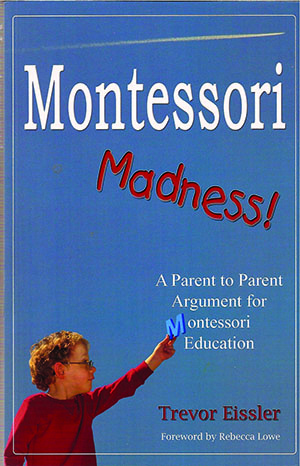
Trevor Eissler is a Montessori dad, and author of a highly regarded book for parents: Montessori Madness,
The Montessori Method is an inclusive educational method that was formed by Dr. Maria Montessori in which it delves into the perception of children’s preferred learning modalities as they develop. The classroom environment consists of attractive manipulatives, educational toys that involves children in academic learning. “The Montessori classroom is a “prepared environment” planned in advance to support independent, student initiated work.” In the classroom, children are free to select manipulative’s of their preference and through curiosity and innate interest engage in learning activities of their own individual choice. In the traditional Montessori environment, children manipulate objects and discover the joy of learning while a teacher guides them and “… by making discoveries with the materials, cultivating concentration, motivation, self-discipline, and a love of learning.”
The traditional classroom setting consists of a teacher assigned to a group of students. Rather than guiding children through learning, the teacher’s role is to instruct students. The job of the teacher is to provide each student with a firm foundation and enrich their minds by teaching the grade level standards. In this setting, the teacher delivers curriculum from textbooks, with an outline of the lesson to be taught that day. The students are seated in chairs or tables, either working by themselves or in collaborative groups, contingent on the set up of the classroom. In this setting, there exists a variety of learners however the teacher teaches from a whole group perspective. The outcome of student learning relies heavily on assessments, or tests. Rather than constructively learning through manipulating their environment, the students in this setting are taught in a very structured environment.
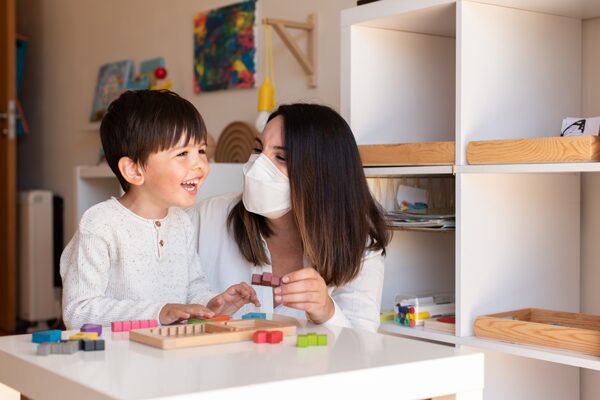
A 12 minute introduction to Montessori education from the Montessori Foundation. The video was prepared by Artrix Video in Sarasota, Florida. Copyright is held by the Montessori Foundation. The video is available on DVD from the Montessori Foundation’s publication center: www.montessori-foundation-books.org

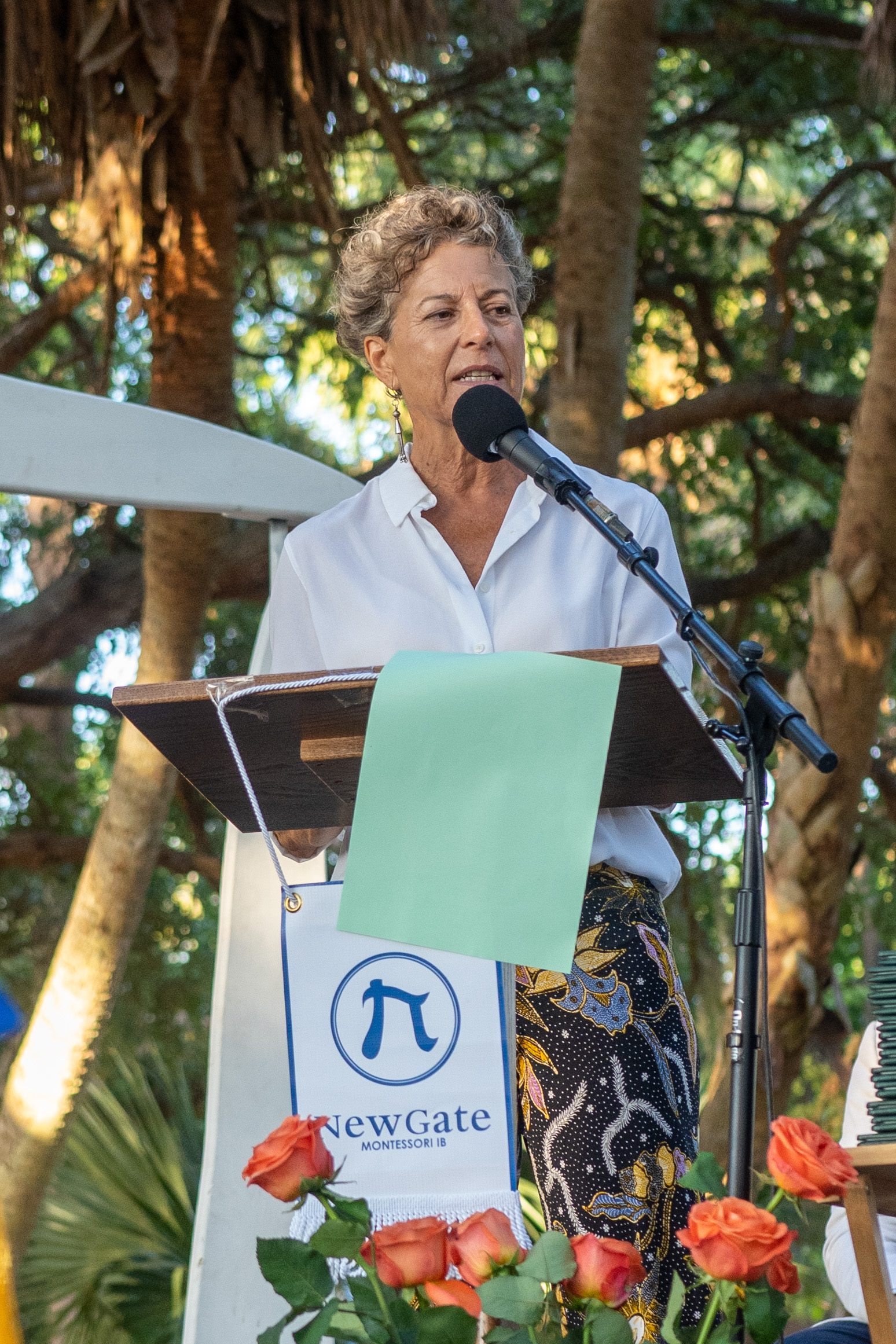
You Can Be a Montessori Adult: Practical Life for Grown-Ups
from Tomorrow’s Child – The Montessori Family Magazine – September/October 2021
By Scott Osborne
Commencement talk given at the NewGate High School May 28, 2021 in Sarasota, Florida
You are now graduating from a Montessori High School: prepare yourself for questions. For the rest of your life, this will be a curiosity to other people. They will ask you about it, and they probably won’t understand it. Embrace this!
If you were lucky enough to be in a Montessori school in your early years, you’ll be able to tell them about the Pink Tower or the Checkerboard or perhaps the big bang lessons. Or maybe you were here at NewGate for weeklong Opera planning or research trips or theater immersion weeks.
But whatever you remember about your Montessori years, embrace them. These experiences have helped make you who you are today.
But you’re no longer a Montessori child. So, tonight, I’m going to give you a few brief suggestions for keeping Montessori in your life – for being a Montessori adult.
I want to encourage you to think of your Montessori education not as something that’s done, something that’s over, but as something that is now in your hands to continue.
About 15 years ago, I was teaching NewGate middle and high school students not so different from yourselves. We used to have many discussions about what they would need going forward – what would help them be the adults they wanted to be.
These conversations about credit cards and college roommates and cooking skills and driving led me to develop what is now called The Competencies Project. It’s like Practical Life for grown-ups.
You undoubtedly know that “Practical Life” is an actual curriculum area in Montessori early childhood classrooms. It’s that time when tiny humans learn table washing and silver polishing, line walking, and water pouring.
Some of you – especially parents – undoubtedly wondered why three-year-olds were learning silver polishing and table washing, activities they were most certainly not doing at home. But Maria Montessori knew what she was doing when she created these lessons.
So, in her honor, I am going to suggest that you continue this Practical Life journey, that you set your sights on new Practical Life skills – adult ones. It’s like the Pink Tower for grown-ups.
These suggestions I am going to offer you today might someday turn your life around. I wager they will have far more impact than the college you (do or do not) attend or the career path you are (or are not) successful in following. These offerings are much like the Montessori Method itself: obscure to outsiders, deceptively simple, yet profoundly significant.
Be forewarned. These first suggestions will make you think I’m crazy, but hear me out.
Take up juggling. Play poker. Compose flower arrangements.
In addition, learn how to:
1. Iron a shirt
2. Sharpen knives
3. Hold a baby with confidence
4. Play pool and billiards (and, yes, poker)
5. Write a condolence note and attend a funeral in a tradition not your own
6. Make a free-standing fire, outdoors, with available materials
7. Eat with chopsticks
8. Tie a Windsor knot tie
9. Orient with a compass
10. Unclog a toilet
11. Open an IRA
12. Use a clock face for telling direction
13. Open a bottle of wine with a traditional wine opener
14. Call someone you do not know on the actual telephone!
15. Drive a manual-shift automobile
Okay, you think. But why? What’s the big deal?
Well, how about some more nuanced Practical Life skills? Can you:
16. Make socially appropriate introductions in any setting
17. Cook a meal in an unfamiliar kitchen, like someone else’s home, figuring out how to navigate neatly and effectively
18. Set up a simple outdoor tent
19. Bargain in markets where prices are not stated – which is most of the world
20. Entertain a group of six-year-olds for an hour
21. Recite a least one poem by heart
22. Make change in another currency
23. Play a portable musical instrument
Those are very hands-on. But what about things you should know?
For example: do you know, without looking them up or consulting an app:
24. Five major star constellations
25. The significant forms of economic production in four other countries
26. The most prevalent health indicators in those other countries
27. The basic principles and vocabulary of a few world sports
28. The fundamental principles of the major world religions
29. The sounds of individual instruments in the orchestra
Before I go on, let’s pause and think about some of these.
If you’re like most people, you will have identified a few of these skills you have mastered.
And for most of the rest of this list, you’ve thought: why bother? You might say: I’ll never need to tie a Windsor knot. And you would be right.
You might also say, And if I do need to tie a Windsor knot, I’ll look it up! You would also be right.
So what good do these do? Are these just nice party tricks or things that will turn your life around?
I would argue these competencies, and others like it (I currently have a list of almost 200) form your foundation, the same way that the Pink Tower and table washing in early childhood provided your foundation then.
Remember, three-year-olds don’t really need to know how to stack a Pink Tower or wash a table! In a way, those too were just cute party tricks for a small child. Yet those lessons opened the door to everything that followed. And you need to continue to open doors — to make your own Practical Life lessons — for a fulfilling and productive adult life.
Continuing to expand your competencies does two things.
First, it provides opportunities for continued mastery. You need to keep making opportunities to say to yourself, Hey, I can do that! Just resting on your laurels, on the skills you’ve learned, is not enough. You need an active means of stepping outside the familiar, stepping outside your comfort zone of abilities, and mastering the new and challenging.
You can’t wait until important, major life challenges come your way. You continue with these small skills — the ones you don’t need — because mastery of those will help give you the confidence to face the real challenges of life.
And second, the experience of learning new skills creates the brain and body architecture you need to master the next big challenges — to be able to do and know the things that are important to you.
Someday you’re going to need to learn something hard, overcome a huge challenge, or just enjoy something new. It is this diverse architecture of experiences — this foundation — that will permit you to do just that.
So I’m telling you to actively continue to develop Practical Life skills, not just career or academic skills (you’ll be faced with those anyway). These are the Montessori Practical Life lessons you’re going to create for yourself.
Let me give you some examples.
One day you’ll see a co-worker busy working on a project, but she’s juggling a baby and a keyboard (because that seems to be what a lot of women do). Because you know how to hold a baby, you can walk over and say, How about I take that little one while you finish working? In that one moment, you will make a new friend for life, you’ll have the amazing sensation of ethereal, soft baby skin next to yours, and you’ll feel like a hero.
Or when you know the major tenets of four world religions and the major export products of a few other countries, think about the insights you’ve gained! You will have a window into entire populations, plus foreign policy, culture, economics, and you’ll probably know a lot more about why your phone or t-shirt costs what it does, just from those few facts.
And when you can distinguish between the different sounds of an oboe and a clarinet and a flute, you’ll be creating pathways in your brain, you’ll be using your senses in new, unexpected ways — and those pathways and senses will be there when you need them.
These competencies – these Pink Towers for grown-ups – give you the stepping stones for where you want to go, just like that first Pink Tower led you to further learning. Only now, you’ll be creating the lessons for yourselves.
So okay, you think, I’ll learn to juggle. I’ll open bottles of wine and start fires and hold babies.
Great. Go for it. But that’s just the warm-up. Here are the big Practical Life skills you’ll want. Even if you ignore all the first ones, you really need these. And they are competencies, skills you can develop, not innate immutable characteristics. There are five.
One, learn to make friends at every stage of life. You’d be amazed at the number of adults who do not feel skilled at this; they literally don’t know how and they don’t talk about it. They just stagnate. You’re very fortunate to come from this supportive school community, this family, if you will. And many of us will always be here for you. But you’re going to change, you’re going to move to new towns, and you’re going to want new friends who are not provided for you, ready-made, at school or work. And you may even outgrow some old friends. You’ll have new interests. How do you find these new people who are right for you? Where would you start? Do you know? That’s a critical life competency and you can develop it. It will put you in good stead all your life.
Two, identify and manage your social anxieties. Can you keep up a reasonable conversation with a totally new person? You’ll want this on your first day of college or your first new job – in person or online – and for much of life thereafter. You need to be able to walk into a room of new people, calmly, solid in yourself. Social anxiety is everywhere – if you experience it, do not think you’re the only one!
The sooner you figure this one out, the sooner you will have removed a huge impediment in life. You show me the college student who drinks far too much every weekend, and I’ll show you the college student with serious social anxieties. This is a competency; the absence of it is not a character flaw. It is a Practical Life skill for grown-ups.
Three, be able to speak up to defend your personal values. I do a lot of advocacy work for causes I care about. Among other things, I do a lot of advising about gender equity – making the world better by helping everyone see past gender.
There’s one issue I get asked the most: how to confront something offensive. People will describe a setting, usually a social setting, where they were told or overheard an offensive remark: perhaps it was openly sexist or homophobic or racist. It made them cringe. And the listener didn’t know what to say or do. We are trained to be polite in social settings, yet how do we bring about changes in attitudes if we remain silent in the face of offensive or unjust comments? Learning what and how to state your own beliefs, appropriately, so you don’t cringe inwardly and don’t alienate people you love — that is a skill you will need. Whatever your strongly held beliefs might be, you’ll need to learn to talk about them outside the controlled setting of the classroom.
And now, the gold star of Adult Practical Life Competencies: Can you articulate personal vulnerabilities safely and honestly? Because you know why? Stuff happens! Someday, if you’re like the average person, you’re going to have some personal issues. When you’re in college, or later, at some point, you will have serious problems you’ll need to articulate and navigate through. We all have problems that come up: mortgages that can’t be met, marriages that dissolve. People find themselves drinking too much. Or maybe a family member is struggling with an eating disorder. This is life! How are you going to cope – with your own issues and those of your friends and family? Have you cultivated people in your life with whom you can share those issues? And this is not just about the dramatic, the cataclysmic. If you’re in the fifth week of college calculus and you have no idea what’s going on and are getting increasingly anxious about failing, can you speak up? You would be amazed at how many people struggle with this. This is a Practical Life competency. You develop it by learning to find people you trust, by starting with small topics.
Let’s be honest, America is a competitive society. People don’t want to reveal perceived weaknesses – they feel it is stigmatizing and will reduce their value, competitively. But that’s not life. For life, you want to practice articulating some problems. It’s a skill you’re going to need and yes, it could have huge ramifications on your future.
And, finally, number five and closely related to four, can you receive vulnerabilities from others? When your roommate turns to you and says, I don’t have any friends, or I can’t make my car payment, will you be ready? Will you be able to be a listener? Will you understand when to help solve a problem and when to just listen — without making the problem about yourself? Or shying away? Or stigmatizing the person? It takes two to be open. Be the other person. for yourself; being open to vulnerabilities; and listening to them from others. They are competencies — not character traits — and they will, over time, be huge determiners of your life.
And those ‘smaller’ skills? Those little ‘unnecessary’ skills, like juggling, using a compass, hearing the oboe? Keep building them. They will give you the confidence to do what you want in life, and they will give you the mind and body architecture to make all the other things possible.
So take up knot tying. And fires. And learn new currencies. And practice talking with openness and vulnerability. These skills can be developed and practiced. You can start from exactly where you are. You just have to be willing to be the learner, the skill developer, the Montessori child all your life. I know you’ll do wonderfully.
The NewGate School is the Lab School of the Montessori Foundation. Its is an international Montessori school for infants through 12th grade.
WWW.NEWGATE.EDU
Scott Osborne is a certified Montessori teacher. She is a lawyer, a nonprofit director, writer, and a gender equality advocate. Her first teaching experience was with the Peace Corps in West Africa, and she has worked primarily with international development organizations, living in seven countries on four continents. Most recently, she lived for three years in India working with small NGOs and teaching English to orphaned teenage girls. Scott is the Chair of Through Women’s Eyes, an international film festival now in its 23rd year. She is president of the United Nations Women-USA, Gulf Coast Chapter.
She raised two terrific Montessori children, who graduated from NewGate School and are both now young adults. Scott is also an avid amateur athlete. She received her bachelor’s degree from the University of Pennsylvania. She received her Juris Doctorate degree from New York University, and an MBA from Princeton University, but (according to her) Montessori certification was the most difficult educational experience she ever had.
This speech was given at the NewGate Montessori High School Commencement in May of 2021. It is part of a forthcoming book: The Competencies Project – How You Can be a Montessori Adult.
This story is from:”Tomorrow’s Child – The Montessori Family Magazine – September/October 2021″
pg 4-7
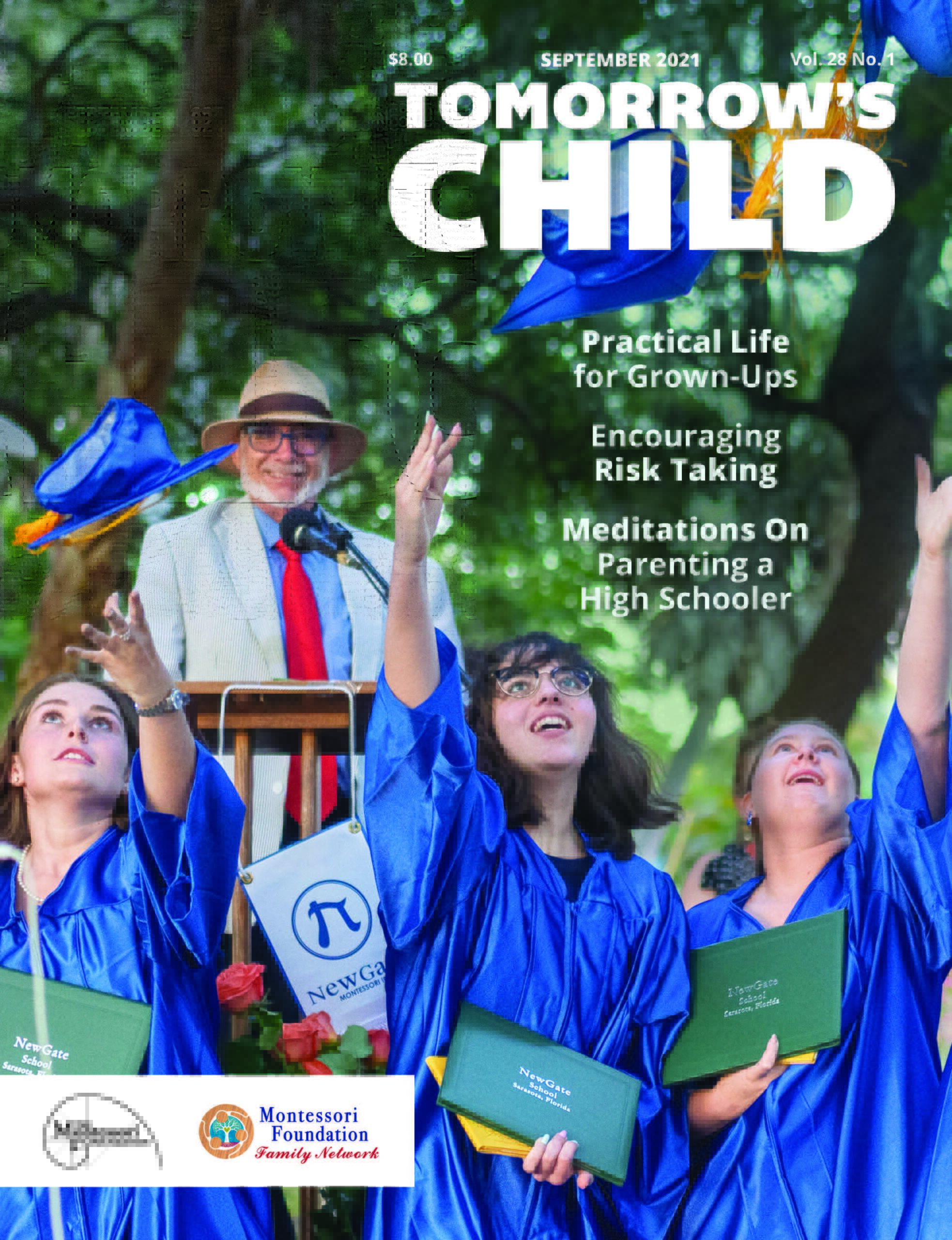
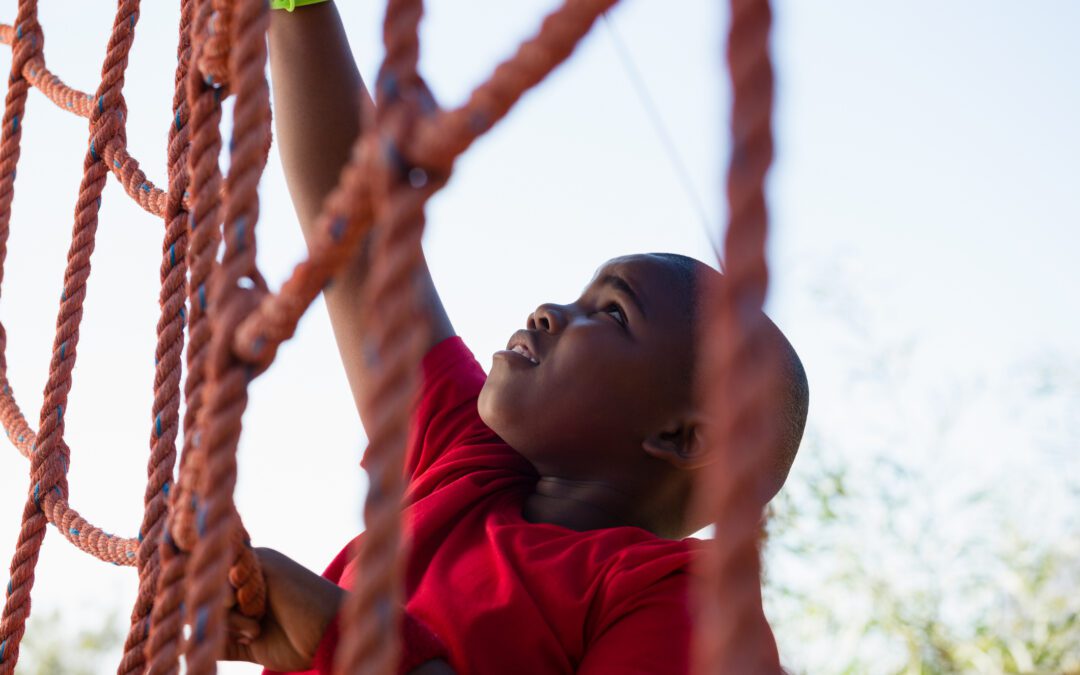

from Tomorrow’s Child – The Montessori Family Magazine – September/October 2021
By Peter Pizzolongo
Facing risks is an unavoidable part of life for most adults. So, why do we choose to take risks? Is it for the sensational thrill of trying something new or the tenacious hope that new opportunities will present themselves? Sometimes, maybe, we choose to take a risk just to exhibit a show of confidence. Whatever the reason, the lessons we learn from taking a risk have the potential to lead us on a new path (Rolison 2013) (Zeilinger 2017).
The ability for adults to take calculated risks has its roots in early childhood. Yet we are in an era of limiting risk taking by children. Most parents (and caregivers of young children) worry about children, wanting them to stay safe—so they resort to limiting the risks that children take. “We are a nation of pushy helicopter parents, . . . waiting below our children on the monkey bars in case they should slip” (Bilinco 2015). By keeping our children ‘safe,’ are we inadvertently preventing them from learning how to calculate risks on their own?
It is important for children to learn how to take safe risks, i.e., “situations that a child can perceive and choose whether or not they want to participate” (Keeler 2020). Risks that are not safe, aka hazards, are “truly dangerous for a child: situations or objects that the child does not see, cannot make a logical choice about, and that have a definite chance of hurting them.” As Rusty Keeler reminds us in Adventures in Risky Play: What is your yes? Risk is good… Risk is a natural part of life. In fact, learning to assess risk and deciding if you want to take a risk are essential skills for living” (Keeler 2020).
Children engage in play that involves taking risks to experience positive emotions, including: fun, enjoyment, thrill, pride, and self-confidence (Sandseter 2011). In risky play, children “dose themselves with manageable quantities of fear and practice keeping their heads and behaving adaptively while experiencing that fear” (Gray 2014). When a child takes a risk and attempts something outside her comfort zone, she uses the higher-order thinking skills of application and synthesis—applying what she knows to new situations (Church 2020).
The ability to calculate and take risks supports children’s learning in many ways. Taking risks develops and enhances a child’s self-confidence and ability to manage and overcome fear. Risk-taking promotes the kind of play that involves children’s use of problem-solving skills, self-regulation, and reflection. I would consider what helped me succeed. If the experience did not end as I expected, I would try to figure out what failed.
In “The Role of Risk in Play and Learning,” Joan Almon notes, “play means taking risks . . . Children are constantly trying out new things and learning a great deal in the process.” This is most evident in the risk-taking that children engage in as they use their muscles and senses in physical activities. When children are encouraged to take safe risks, they learn to assess what they can do and match that with activities that have an element of risk.
Children think about how high they can climb, from what height they can jump, and so on. They might find that what they were attempting is not possible and use problem-solving skills to try an alternative. These children are developing and using resilience; they will determine what they need to do to succeed or decide to abandon the task. Through taking safe risks, children “acquire better motor control and learn what is dangerous and what isn’t” (Sandseter 2011). A preschooler encountering a pile of logs might investigate how secure the logs are on the ground and decide whether she can climb on the pile or not. She is learning how to manage risk and develop an understanding of safety (Knight 2011). Taking risks while building physical skills is an important component of development and learning for young children.
Recognizing the general processes of children’s development and learning in all areas is vital. It is the parent’s and teacher’s responsibility to identify the safe risks vs hazards and to set clear and reasonable limitations so that children understand what they may and may not do in the play environment.
Taking risks while building physical skills is an important component of development and learning for young children.
Understanding developmentally appropriate practice is key: recognizing the general processes of children’s development and learning in all areas. In addition, they must consider the strengths, interests, and limitations of each child and be aware of the social and cultural contexts in which each child lives (NAEYC 2020). They must also “up the ante” when they discern children are ready for bigger challenges.
The two examples below show the difference between what is appropriate for a toddler and what is appropriate for a preschool child.
Eighteen-month-old Darius is beginning to use depth perception in his play. Today he demonstrated how he scans for obstacles and moves based on that information. He has gained control of a variety of movements: stooping, going from sitting to standing, running, and jumping. Darius shows an understanding of what size openings are needed for his body to move through, and today he successfully crawled through the tunnel.
Toddlers develop their physical abilities by continuously stretching themselves. Darius has learned (probably through trial and error) what size opening he can fit through. As toddlers freely navigate their relatively safe and supervised environment, they begin to figure out what are reasonable risks to take.
Four-year-old Ximena enjoys balancing on one leg and on the balance beam. Today she walked the entire length of the balance beam and ended by jumping off and standing on one leg for a few seconds. She coordinates her movements when jumping, hopping, and running. Ximena has mastered several large muscle skills, and after her jumping-hopping running experience, she climbed the ladder and slid down the slide—several times.
Preschoolers are adept at responding to physical challenges when such experiences are promoted. They can reach great heights on the climber, dangle upside down, and move from rung to rung with increasing ease. They can climb trees, cycle at fast speeds, and engage in ‘play fighting’ without actually hitting each other. They can balance on a beam, set increasingly higher as children begin mastering balance. They can climb up the slide, rather than only using the steps. Preschoolers can figure out how to get across a shallow creek using rocks and logs. With adult supervision, they can also begin to take risks at the fine motor level, for example, slicing fruits with a sharp paring knife.
As a parent and/or teacher, you will need to determine your own tolerance to risk. What type of risky behaviors are you willing to let children engage in? If you have low risk tolerance when it comes to children’s play, it would be helpful to review expectations for young children at various stages of development and think about what children would like to do to ‘up the ante’. Then, recognizing that children are stretching themselves, your primary role “is to enable the stretching process to be manageable and safe enough . . . to help [children] to take reasonable risks” (Almon 2013).
Finally, the role of the teacher is to help children be aware of their actions and encourage safe risk-taking. Here are some examples, adapted from NAEYC’s Developmentally Appropriate Practice:
• Encourage children to choose their own learning activities: “We have several activities set up in the outdoor area today. You can choose what you want to do first.”
• Acknowledge children’s activities:
“You’re building with a lot of loose parts today!”
• Encourage them with specific feedback:
“Wow, you are certainly climbing higher today than I’ve seen you climb before!”
• Ask open-ended questions: “If you want to cross the creek, what will you need to step on so you stay dry?”
• Pose problems and ask questions, providing just enough assistance so the child can attempt a task at a skill level just beyond what she can do on her own (scaffolding): “You’ve been somersaulting down this hill. How else can you get from the top to the bottom of the hill?”
Supporting children as they explore ways to take safe risks sets them on the path to becoming adults who develop the confidence that comes from assessing risks and determining a course of action they learn from taking risks and who explore the opportunities to which risk-taking can lead.
Almon, J. 2013. “The role of risk in play and learning.” Community Playthings. Online: http://www.communityplaythings. com/resources/articles/2013/ the-role-of-risk-in-play-and-learning.
Blincoe, K. 2015. “Risk is essential to childhood—as are scrapes, grazes, falls and panic”. The Guardian. Online: https://www. theguardian.com/commentisfree/2015/ oct/14/risk-essential-childhoodchildren-danger?fbclid=IwAR0CZE vfmAN0udIDxWrI9xQHfob4QYM DT_R4eDpdLBvUInIkQutU0LNCapc
Church, E.B. n.d. “When to challenge children.” Early Childhood Today. Online: https://www.scholastic.com/ teachers/articles/teaching-content/ when-challenge-children/.
Gray, P. 2014. “Risky play: Why children love it and need it”. Psychology Today. Online: https://www.psychologytoday. com/us/blog/freedom-learn/201404/ risky-play-why-children-love-it-and-need-it.
Keeler, Rusty. 2020. Adventures in Risky Play: What Is Your Yes? Lincoln NE: Exchange Press.
Knight, S., 2011. “Why adventure and why risk in the early years?” ChildLinks. 3. Online: https://www.researchgate.net/ publication/275039981_children’s_ risky_play_in_early_childhood_education_ and_care.
National Association for the Education of Young Children (NAEYC). 2020. Developmentally Appropriate Practice. Washington DC: NAEYC. Online: dap-statement_0.pdf (naeyc.org) Rolison, J.J., Y. Hanoch, S. Wood, & P. J. Liu. 2013. Risk-taking differences across the adult life span: a question of age and domain. Journals of Gerontology, Series B: Psychological Sciences and Social Sciences, 69(6), 870–880, doi:10.1093/ geronb/gbt081. Online: https:// academic.oup.com/psychsocgerontology/ article/69/6/870/545646.
Sandseter, E. 2011. “Children’s risky play in early childhood education and care”. ChildLinks. 3.
Zeilinger, J. 2017. “7 reasons why risk-taking leads to success”. The Huffington Post. Online: 08/13/2013 03:15 pm ET Updated Sep 25, 2017
Peter Pizzolongo is President of Early Education Consulting and former Vice-President of the Delaware AEYC Governing Board. He has held the positions of Training and Technical Assistance Coordinator of the National Center on Early Childhood Education, Teaching, and Learning (NCECDTL) at Zero to Three; Associate Executive Director for Professional Development at NAEYC; and Director of the Analytical Support and Technical Assistance Services Division of CSR, Incorporated—a social sciences research and management support firm. He has over 30 years of experience as an author; training and technical assistance provider; program evaluator; Head Start and childcare agency administrator; teacher; and human services program manager. Mr. Pizzolongo has authored or co-authored more than 30 publications, digital programs, and other resources. He has conducted training programs on numerous topics, including child development; early childhood education; developmentally appropriate practice, ethics; developmental assessments; health and mental health; nutrition; parenting; and program evaluation. Mr. Pizzolongo has been a member of the University of Delaware (UD) College of Education and Human Development Dean’s Advisory Council since September 2015. He received his B.A. in psychology in 1972 and his M.S. in human resources with a child development major in 1974, both from the University of Delaware and coursework in the use of technology in education programs from the University of Maryland.
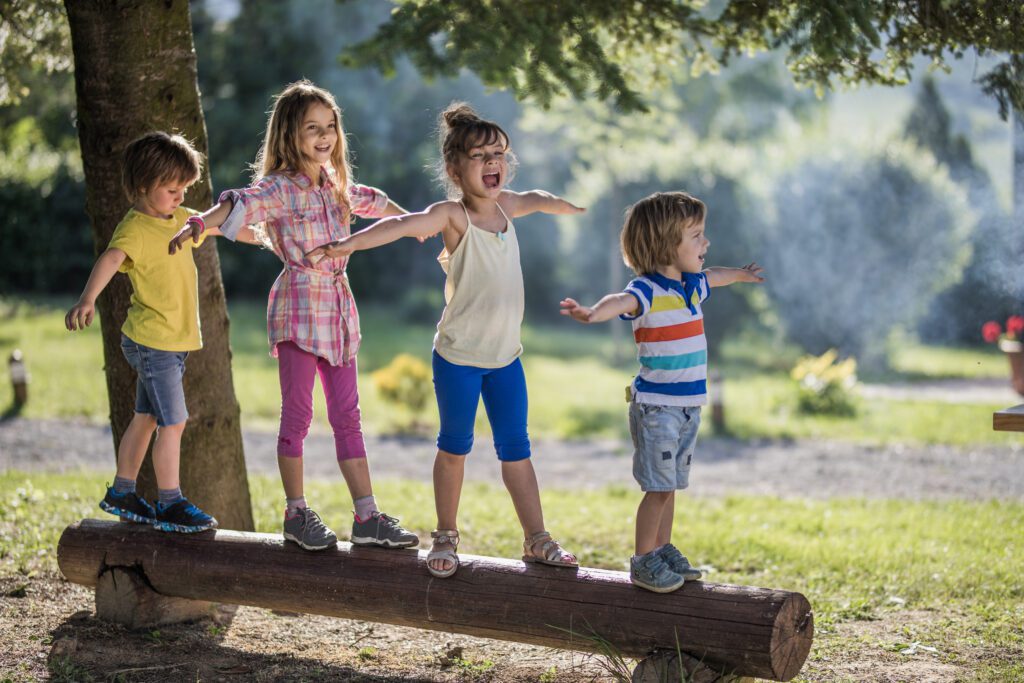
 Montessori Family Alliance School Group Membership (Print & Digital 2026 1/2 year pricing)
Original price was: $30.00.$15.00Current price is: $15.00.
Montessori Family Alliance School Group Membership (Print & Digital 2026 1/2 year pricing)
Original price was: $30.00.$15.00Current price is: $15.00.
 The Montessori Way, Revised and Expanded: An Education for Life; A Comprehensive Guide for Parents and Teachers
$25.00
The Montessori Way, Revised and Expanded: An Education for Life; A Comprehensive Guide for Parents and Teachers
$25.00
 The Montessori Child: A Parent's Guide to Raising Capable Children with Creative Minds and Compassionate Hearts (The Parents' Guide to Montessori)
$20.00
The Montessori Child: A Parent's Guide to Raising Capable Children with Creative Minds and Compassionate Hearts (The Parents' Guide to Montessori)
$20.00
 The Montessori Toddler: A Parent's Guide to Raising a Curious and Responsible Human Being (The Parents' Guide to Montessori)
$20.00
The Montessori Toddler: A Parent's Guide to Raising a Curious and Responsible Human Being (The Parents' Guide to Montessori)
$20.00
 Montessori in Action: Building Resilient Montessori Schools 1st Edition
$29.95
Montessori in Action: Building Resilient Montessori Schools 1st Edition
$29.95