Nature Mandalas
 THE INSPIRATION
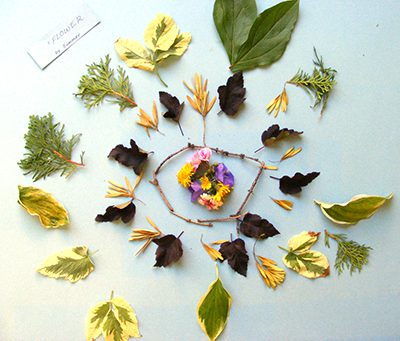
Just outside the art studio, fall was filling the hearts and minds of my elementary students. Many of them would collect the fallen leaves, pine cones, and seeds and bring me their treasures. Lining them up on my nature shelf, they were fascinated by the colors, shapes, and even the smells of them! When I saw the way the students arranged the leaves, it reminded me of a Mandala, and so began our creation and exploration of the ancient sacred symbol.
THE OPENING CIRCLE:
‘THE SEDUCTION’
Before the students entered the studio, I created a large Nature Mandala on black bristol board placed on the carpet to capture their attention. As the students entered the studio and sat down on the carpet, they were drawn to the beauty of the design and the natural materials.
An inquiry followed into what they observed about the artwork, and I gave them a brief history of the Mandala, its significance in nature and in ancient societies. We focused on four main features of the Mandala: the Circle, the Center, the Symmetry, and the Pattern. We talked about the symbolism of a circle and how it is endless, with no beginning and no end. I also told them about the way that some Mandalas are created as part of a ceremony and that at the end of that ceremony the Mandalas are destroyed and returned to nature. More than a few eyebrows were raised at this point, and I assured the students that I understood that this would take great courage. I reassured them not to worry, as I would photograph their Mandalas and display them electronically on the monitor in the main hallway of our school for all to see!
THE ARTISTS’ CHALLENGE
Students would create a Mandala using items found in nature, being sure to observe the guidelines. A Mandala is a circle; it has a center; it is symmetrical; and it has a pattern. (Students also needed to come up with a title for their artwork to complete the project.)
THE MATERIALS
22” X 28” Poster Board (various colors) to build the Mandalas.
A materials table for baskets of nature items, such as small sticks, evergreen strands, stones, pine cones, leaves, seeds, flowers, etc. (Note: students also had access to an outdoor courtyard if they couldn’t find what they wanted on the materials table).
2” X 4” name and title tags (to be photographed)
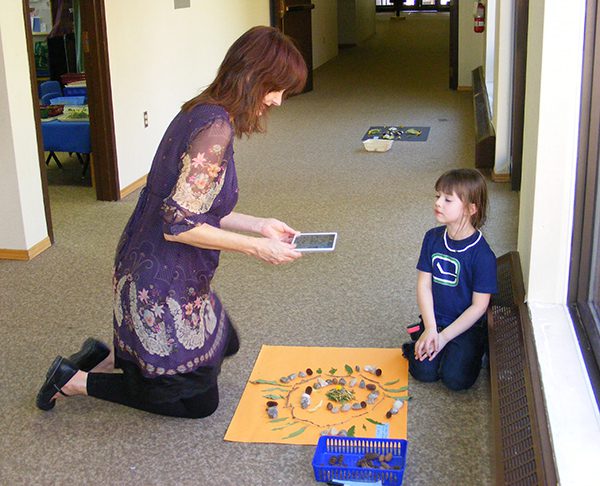
A tablet for photographing the student’s Mandalas for display on the hallway monitor. (The photographs were also shared during Closing Circle.)
THE CREATION
The students worked in the hallway outside the art studio with access to an outdoor courtyard with plenty of natural light. The materials table was also set up in the hallway along with the colored sheets of poster board. Each student had their own basket to collect items from the materials table.
Starting with the center, the students began “building” their Mandala on the poster board. Working outward, they focused on using the items from nature to create a circle, a pattern, and symmetry. When they had completed their Mandala, I asked them to come up with a title, which was printed on a tag. The Mandala’s were photographed, and then I asked the students to take their Mandalas apart and put the materials back into the baskets on the materials table.
THE CLOSING CIRCLE
I quickly created a slideshow with the photographs of their Mandalas. They were transfixed by seeing their artwork as part of a slideshow. They shared their artist’s observations about each other’s designs. Later that week, the hall monitor became their “Art
Gallery” filled with all the colors and creativity that fall can muster.
THE EXTENSIONS
This art lesson can be extended with the addition of some simple materials and concepts. Adding wooden beads, craft sticks, and chalk pastels to create a background, the Mandalas can take on a more
colorful geometric look.
The students also enjoyed working on this project outside, creating the Mandalas on the sidewalk or on the grass. Being outside also enabled them to collect whatever caught their eye in the natural area around the school and returning the items back to nature once they were finished—a nice touch staying true to the Zen concept of the Mandala.
Nature portraits is another idea that the students enjoyed. Using items from nature to create a face opened up discussions about art history, details of the face, and facial proportions and expression. There were quite a few chuckles during the closing circles, as some of the portraits turned out quite comical.
Tomorrow’s Child / November 2014 / p16