by The National Center for Montessori in the Public Sector | Kindergarten, Language, Lower Elementary (6-9), Montessori Charter Schools, The International Montessori Council, Upper Elementary (9-12)
Montessori Bilingual Education: Prevalence and Type of Bilingual Montessori Programs / A white paper from The National Center for Montessori in the Public Sector
Downloaded and shared with the National Center’;s permission from http://public-montessori.org/wp-content/uploads/2016/12/Montessori-Bilingual-Brief.pdf
Montessori bilingual programs are increasing in number in both the private and the public sectors. In the private sector, a bilingual school, typically, follows an enrichment model. The intent is to provide the children of professional and/or middle class parents a head start in becoming linguistically diverse, a characteristic with much cachet in our interconnected world.
The Renaissance School, for example, is a private Montessori school in Oakland with tuitions that range from $17,000 to $26,000. They call themselves the best private school in the Bay area. The schools offer a trilingual program that begins at age three. In the primary program children are in a classroom that teaches either English and French or English and Spanish. At least one of the classroom teachers speaks the second language at all times. At the elementary level the third language is introduced. English, French and Spanish-speaking teachers are present in the classrooms.
With the increasing prevalence of Montessori as an urban public school reform model, Montessori public schools, by necessity, are implementing programs that allow non-native English speakers the opportunity to be successful learners and speakers of English. Many schools do not officially have a bilingual program, even though they may have a large population of English language learners. These schools do, however, provide two teachers in each classroom (or a teacher and an assistant), one of whom is a native English speaker and one who is a native speaker of the language brought from the home environment. Frequently, the aim is to provide a transitional support that will allow student to eventually participate fully and solely in English while in school.
Increasingly, though, public Montessori schools are developing dual-language immersion classrooms where the goal is to affirm the native language while providing the support necessary to allow students to become successful in English. Maintenance of the primary language is sought, even as more class instructional time is conducted in English as children grow older.
As we cast our net to learn about public Montessori bilingual programs, one school, the Latin American Bilingual Montessori Public Charter School (LAMB), was mentioned over and over as the top school using this approach. LAMB delivers its Montessori curriculum bilingually in Spanish and English. Primary students receive the majority of their education in Spanish, with English literacy and vocabulary formally introduced in the Kindergarten year. In the Lower Elementary classrooms, 60% of instruction is delivered in Spanish and 40% is delivered in English. In the Upper Elementary community, Spanish and English instruction is delivered 50-50. The student demographics for LAMB are 22% African American; 58% Hispanic; and 21% White.
In sum, Maintenance and Enrichment are the most common bilingual models in place. Two-way immersion programs vary greatly yet share three key characteristics:
- Instruction in two languages.
- One language at a time.
- Peer-to-peer facilitated language sharing.
Types of Bilingual Education1
|
Model
|
Aim
|
|
Transitional
|
The aim is monolingualism. Instruction in the student’s language (L1) is temporary because the aim is to leave that behind and teach only using English (L2). The dominant culture and identity is affirmed.
|
|
Maintenance
|
The aim is bilingualism and biliteracy, albeit somewhat limited. The student’s L1 is maintained so that it can become the basis for L2 learning, but the L1 is not developed or extended. The student’s culture and identity is affirmed.
|
1 Pacific Policy Research Center (2010). Successful Bilingual and Immersion Education Models/Programs. Honolulu: Kamehameha Schools, Research & Evaluation Division. http://www.ksbe.edu/spi/pdfs/bilingual%20immersion%20full.pdf
|
|
|
Heritage
|
The aim is rejuvenation of an indigenous language. The aim is usually bilingualism and biliteracy, although the heritage language can take priority.
|
|
Enrichment
|
The aim is bilingualism and biliteracy as well as extension of the minority language and culture into the community and nationally.
|
Outcomes for Children Educated in Bilingual Montessori Programs In this 2003 study, children educated in a bilingual Montessori pre-kindergarten program were compared to children educated in a non-Montessori bilingual pre-kindergarten program. Both groups continued in a transitional bilingual program through second grade.
Researchers found that the students who completed the Montessori program significantly outperformed the non- Montessori group on tests of reading in both Spanish and English.2
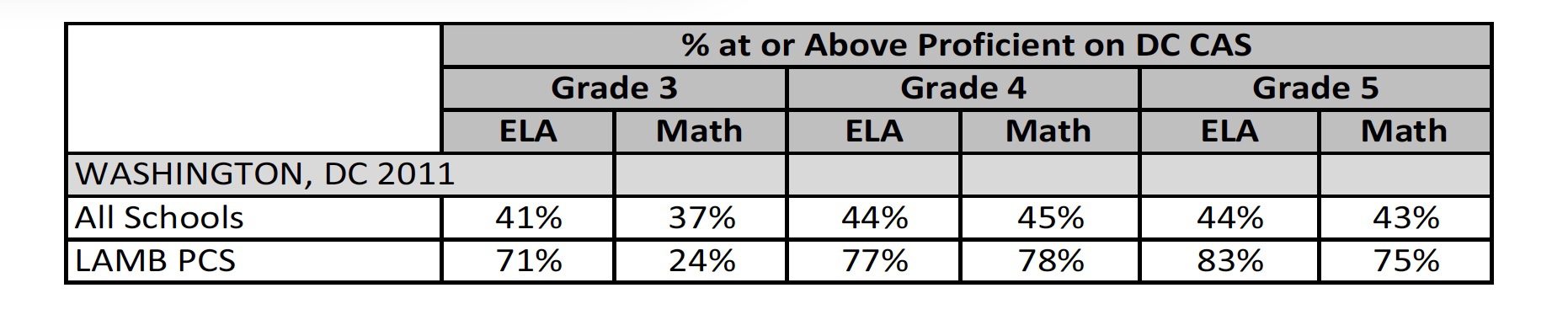
The Latin American Montessori Bilingual Public Charter School in D. C. reports similar outcomes. Here are the test results from the 2011 District of Columbia Comprehensive
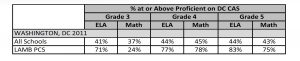
Assessment System (DC CAS).
Best Practice for Montessori Bilingual Education
The following must be present in prekindergarten Montessori bilingual programs to be successful in public schools: (a) strong teacher training by quality training programs, (b) parent support, (c) administrative support and understanding of Montessori, (d) ongoing staff development and research and study by the Montessori staff of both what Montessori wrote and current research findings, (e) Montessori programs that are integrated with district benchmarks and assessment, and (f) private and public programs that cross the boundaries and offer their strengths to each other by co-training and other initiatives that can strengthen the bonds.
Several important findings can be drawn from the research on language and literacy development in two-way immersion programs:
There seems to be a native language effect, such that native English speakers (NES) generally perform higher than second language speakers in terms of both oral and written language proficiency.
Not surprisingly, there seem to be slightly different patterns for NES and language minority students, with NES always showing a clear dominance in and preference for English, and language-minority students demonstrating more balanced bilingualism. Sometimes the language-minority students tend to perform slightly higher in their native language, and other times slightly higher in English. In general, however, their performance on language and literacy measures across languages is much more similar than that of their NES peers.
There is some evidence for transfer of skills across languages, with some studies reporting similar writing processes and products across the two languages. This is not the case in the writing study conducted in a Korean/English program, however, and may point to differences in the amount of potential cross-linguistic transfer and/or interference that may occur depending on the similarities or differences in orthographies in the two languages of instruction.
Both the Korean reading study in this section and the reading studies presented on academic achievement point to inter-relationships between language and literacy skills within and across languages.
2 Rodriguez, L. Irby, B.; Brown, G.; Lara-Alecio, R.; Galloway, M. (2003). Prekindergarten Bilingual Montessori Program: An Analysis of a Public School Prekindergarten Bilingual Montessori Program. A paper presented at the Annual Meeting of the American Educational Research Association, Chicago, IL. http://ldn.tamu.edu/sites/default/files/documents/publications/AERA%202003%20Montessori%20Education.pdf
Model Montessori Bilingual Programs
Public
Latin American Montessori Bilingual Public Charter School 1375 Missouri Avenue • Washington, DC 20011 • Tel 202.726.6200 http://www.lambpcs.org/
Independent
Castle Island Bilingual Montessori 1 Delaware Avenue • Albany, NY 12210 • Tel 518.533.9838 http://castleislandmontessori.org/en/content/bilingual-montessori-school-albany-ny
La Casa Montessori School 514 West Adams • Oak Park IL 60304 • Tel 708.613.0514 http://www.lacasamontessori.org/index.html
American International Montessori School 3339 Martin Luther King Jr. Way • Berkeley, CA 94703 • Tel 510.868.1815 http://www.aimmontessori.com/
Recommended as an expert in bilingual Montessori education
Alice Murray Renton, http://inotherwordsamr.com/Alice_Murray_Renton.html
by The National Center for Montessori in the Public Sector | Kindergarten, Lower Elementary (6-9), Montessori Charter Schools, Montessori Education, Montessori Teachers, Primary (3-6), The International Montessori Council, Upper Elementary (9-12)
A white paper from The National Center for Montessori in the Public Sector. Downloaded and shared with permission from http://public-montessori.org/wp-content/uploads/2016/12/The-Assistant-in-a-Montessori-Classroom.pdf
Key Points:
- Assistants are key to ensuring that the complex learning environment is prepared for children.
- Assistants enable Montessori teachers to focus on instruction without interruption.
- The assistant’s broad awareness and scanning of the environment not only protects the teacher’s lessons but also assures that observational data are being gathered continuously, students are navigating the environment appropriately, and concentration is honored.
- The teacher and assistant’s interactions offer a constant model of grace and courtesy for students to emulate, something not possible with only one adult present.
In conventional schools, students are grouped by grade and are taught by a single classroom teacher. In Montessori schools, however, students are grouped by three-year age spans (i.e., 3-6 years old, 6-9 years old, 9-12 years old), and require two teachers: a Montessori trained lead teacher and an assistant. Having a lead Montessori trained teacher and an assistant is vital to ensuring fidelity of implementation of the Montessori pedagogy, which in turn fosters the students’ executive functions.
Fidelity of Implementation
In a fully implemented Montessori classroom, the teacher’s most important task is to prepare an environment rich in developmental activities and to offer students individualized instruction. To ensure this fidelity of implementation of the Montessori pedagogy, an assistant is necessary to help prepare the environment, observe and record student behaviors, support procedural autonomy, protect student concentration, and model grace and courtesy. It is simply not possible for a lead Montessori teacher to do all of these things while offering individual and small group lessons. These role designations are often referred to as “one up, one down,” reflecting the respective foci of the assistant and the teacher.
Preparation of the environment. Montessori classrooms are carefully prepared learning environments, requiring great attention to detail. The shelves, which are organized by subject, must be kept orderly. Materials used daily need constant replenishing. The hundreds of hands-on materials in Montessori classrooms necessitate the help of an assistant to prepare and maintain the environment so that students can practice their lessons and engage in self-initiated projects.1
Observation. Maria Montessori developed her educational method through systematic observation of children, and observation remains central to assessing the needs of Montessori students.2 Specifically, observation in a Montessori context provides quantitative data for individual students and the class as a whole. However, a lead teacher has limited time to observe given the time required for instruction. An assistant acts as a “second set of eyes,” identifying and recording each student’s activity and his or her level and duration of engagement. These data enable the lead teacher to identify the ebb and flow of a student’s work cycle as well as patterns in learning and demonstrated need.1 All of this information is necessary for highly targeted and individualized student lesson planning and for developing effective classroom management practices and procedures.
Procedural autonomy support. For a Montessori classroom to run smoothly and for students to independently navigate the environment, procedures must be determined, implemented, and followed. The multitude of procedures could involve academic work, such as steps for proposing a research project, as well as classroom management procedures, such as when and how students can make class announcements. An assistant is necessary to ensure procedures are followed so that students can move through the environment independently and the classroom can run effectively, leaving the teacher free to give students lessons.3
This brief was prepared for NCMPS by Laura Flores Shaw, the founder and Editor-in-Chief of White Paper Press, a think tank specializing in translating scientific research into terms that allows people to make informed decisions about education and human development. For more information on the scientific basis of Montessori education visit http://www.whitepaperpress.us
Recommended citation: National Center for Montessori in the Public Sector (2015), The Assistant in the Montessori Classroom. West Hartford, CT: National Center for Montessori in the Public Sector.
Protection of student concentration. The process by which a child becomes self-regulated in their learning and other behaviors – what Montessori called “normalization”— occurs through concentration with self-chosen, hands-on materials.4 Through concentration neurons fire and wire together, reinforcing the neuronal pathways of the brain’s central executive region,5 the region responsible for executive functions (EFs) – cognitive skills that enable attentional focus, planning, self-regulation, and multitasking.6 As neuroscientist Adele Diamond states, “What Montessorians mean by ‘normalization’ includes having good EFs” (p. 961).7 Thus, adults must, as Montessori trainer Dr. Annette Haines states, “protect the child who is concentrating.”8 If the classroom environment is disruptive and does not allow opportunities for deep concentration, the pedagogy is not being implemented as designed and EFs development is hindered. In the Montessori classroom, with her upward gaze and broad overview of the room, the assistant is a diligent protector of student concentration.
Grace and courtesy. Grace and courtesy is an essential component of the Montessori curriculum that supports students’ executive functions, academic growth, and social development. These lessons, which are provided to the entire class or a small group, enable students to act out various social situations (e.g., introducing oneself to a new classmate) or movements within the classroom (e.g., how to carefully return work to the shelf). Students’ social development is supported through this social situation practice, enabling students to eventually navigate those situations independently and effectively.9 Students’ executive functions are built through this precise practice of impulse control and deliberate action, which contributes to students’ academic growth.10
Adults support the practice of grace and courtesy through modeling and, when necessary, scaffolding. As the teacher and assistant interact with one another, they must consistently model grace and courtesy so that students can see how these behaviors are enacted among members of the entire community.11 Scaffolding, in the form of direct reminders or cues, may also be necessary. For instance, students involved in a conflict over a project may need to be reminded to actively listen to one another; or a student may need to be reminded how to navigate the classroom without stepping on others’ work. A single teacher in the classroom cannot model adult-to-adult interaction, nor can that teacher consistently provide the necessary scaffolding of students’ own grace and courtesy behaviors throughout the day.
Conclusion
Montessori pedagogy and the scholarly research as described herein demonstrate the necessity of an assistant in a Montessori classroom to ensure faithful implementation of the Montessori pedagogy, which, in turn, fosters students’ executive functions and social and emotional development.
Notes
- Haines, A. (2000). The role of the teacher and the role of the assistant. Paper presented at the Freedom & Responsibility: A Glorious Counterpoint, Boston, MA.
- Montessori, M. (2013). The Montessori method. New Brunswick, NJ: Transaction Publishers.
- Koh, J. H. L., & Frick, T. W. (2010). Implementing autonomy support: Insights from a Montessori classroom.
- International Journal of Education, 2(2:E3), 1-15.
- Montessori, M. (1967). The absorbent mind (1st ed.). New York, NY: Holt, Rinehart & Winston.
- Yuste, R. (1992). Cells that fire together, wire together. Journal of NIH Research, 4, 60-60.
- Anderson, P. (2002). Assessment and development of executive function (EF) during childhood. Child Neuropsychology, 8(2), 71.
- Diamond, A. (2013). Executive Functions. Annual Review Psychology, 64, 135-168.
- Diamond, A., & Lee, K. (2011). Interventions shown to aid executive function development in children 4 to 12 years old. Science, 333(6045), 959-964. doi: 10.1126/science.1204529
- Haines, 2000.
- Haines, 2000.
- Diamond, A., & Lee, K. (2011). Interventions shown to aid executive function development in children 4 to 12 years old. Science, 333(6045), 959-964. doi: 10.1126/science.1204529
- Bandura, A. (1986). Social foundations of thought and action: A social cognitive theory. Englewood Cliffs, NJ: Prentice-Hall.
NCMPS, 07/07/2016