by Sara Suchman | Administrative Team, Montessori Administrators, Montessori Charter Schools, Montessori Education, School Leadership, School Resources, The International Montessori Council, Video, Webcasts / IMC
The National Center for Montessori in the Public Sector (NCMPS) launched with a mandate to understand and respond to the needs of public Montessori schools. In this Leadership Forum, Sara Suchman, Executive Director of NCMPS, will share what the organization has learned, the state of public schools now, and priorities as we look around the corner. Bring your questions and thoughts about what Montessori looks like in public schools and what a robust ecosystem of public and independent schools might look like.
by The Montessori Foundation Staff | Lower Elementary (6-9), Montessori Charter Schools, Montessori Curriculum, Montessori Materials, School Resources, The International Montessori Council, Upper Elementary (9-12)
List of Recommended Montessori Materials for an Elementary Class
This is an Adobe Acrobat PDF file with a detailed list of the Montessori materials recommended by the Montessori Foundation for an elementary class for either ages 6 to 9 or 9 to 12.
Download File
[pdf-embedder url=”https://stage.montessori.org/wp-content/uploads/2021/09/List-of-Recommended-Montessori-Materials-for-an-Elementary-Class-1.pdf” title=”List-of-Recommended-Montessori-Materials-for-an-Elementary-Class”]
by Tim Seldin | MFA, Montessori Charter Schools, Montessori Education, Montessori Teachers, School Leadership, Webinars / MFA
How Can Montessori Teacher Education Programs Better Support Students Preparing to Teach in the Public Sector.
On November 13th, 2014, Sara Suchman from The National Center for Montessori in the Public Sector; Josie Zinninger, Founder and Director of Lakeland Montessori Charter Schools; and Tim Seldin, President of The Montessori Foundation continued the series of webinars on the Promise and Challenge of Montessori In The Public Sector: How Can Montessori Teacher Education Programs Better Support Students Preparing to Teach in the Public Sector. Most Montessori teacher education programs have a few student teachers who are preparing to teach in the public sector. This week we will explore how we can help them, and their fellow students, to understand the unique challenges and rewards of creating fully-implemented Montessori in the public or charter school sector.
by Tim Seldin | Lower Elementary (6-9), MFA, Montessori Charter Schools, Montessori Education, Montessori Teachers, School Leadership, Upper Elementary (9-12), Webinars / MFA
On October 23rd, 2014, we explored the challenges of organizing and maintainig fully implemented elementary Montessori programs for ages 6 to 12 in public and charter schools. Among the topics that we considered were how to maintain authenticity in a culture that tends to be focused on state standards, the common core, and weekly lesson plans.
by Tim Seldin | Montessori Charter Schools, Montessori Education, Primary (3-6), The International Montessori Council, Webcasts / IMC
The Promise and Challenges of Montessori In The Public Sector – Fully Implemented Early Childhood Montessori Programs: On October 9th, 2014, we were joined by Sara Sussman of the National Center for Montessori in the Public Sector, Dr. Virginia Riga, Montessori Public Educational Consultant, and Josie Zinninger, Founder and Director of Lakeland Montessori Charter Schools. We explored strategies that public schools and charter schools use to successfully implement successful early childhood (age 3 to 6) programs.
by Tim Seldin | Administrative Team, Montessori Administrators, Montessori Charter Schools, School Leadership, The International Montessori Council, Webcasts / IMC
On June 24th, 2015 Josie Zinninger joined host Tim Seldin to discuss the development and leadership of fully implemented public and charter Montessori schools.
by Kath Kvols | Family Resources, MFA, Montessori Administrators, Montessori Charter Schools, Montessori Education, Montessori Family Life, Montessori Grandparenting, Montessori Parenting, Montessori Teachers, Parent Education, The International Montessori Council, Webinars / MFA
This week, Kathryn Kvols and Tim Seldin discussed the Montessori Family Alliance.
Download File
by Christine Lowry | Montessori Administrators, Montessori Charter Schools, Montessori Education, Montessori Teachers, School Leadership, The International Montessori Council, Webinars / MFA
This was a participatory conversation about the impacts of current and trending policy that impacts our Montessori community. We spoke about how each of us can support our classroom work, our school work, and our Montessori community.
Christine Lowry, M.Ed. has been involved in Montessori education as an early childhood teacher, school founder and director, parent educator, teacher educator, and consultant on public policy as it impacts high quality Montessori education.
by Marc Seldin | Montessori Charter Schools, The International Montessori Council, Webcasts / IMC
by International Montessori Council Staff | IMC Teacher Education, Montessori Administrators, Montessori Charter Schools, Montessori Education, Montessori Teachers, The International Montessori Council
 The original mission of the International Montessori Council (IMC) did not include teacher education. In fact, IMC existed for many years without any affiliated teacher education programs. The IMC’s main focus in those early years, and still today, is creating an open-minded and open-hearted Montessori organization.
Eleven years ago, that mission expanded with the approval of the first IMC affiliated Montessori Teacher Education Program, The Center for Guided Montessori Studies (CGMS). Forging this new path was not done casually. The IMC Board had the wisdom to recognize the need for Montessori teacher education to adapt to the technological and educational trends budding in the 21st century. As a result, IMC and CGMS have paved a path for hybrid Montessori teacher training that blends online with short residential/ face-to-face training; a trend that is now finding acceptance in other Montessori organizations.
Continuing in the direction of innovation, the IMC Teacher Education Standards have been designed to encourage programs to find creative ways to meet the needs of learners without sacrificing the quality of course content. The academic hours, for example, are significantly higher than required by the Montessori Council for Teacher Education (MACTE) or other organizations, but there is much more flexibility for course delivery format. This means that the required hours can be met through a variety of meaningful learning activities, with a balance of on-campus, online, and independent study projects.
Montessori is about so much more than materials. For this reason, IMC requires all programs to have a plan for ongoing reflection and discussion of course topics. These discussions are part of the academic hours and can take place in person or virtually. Helping adult learners grasp the significance of Montessori philosophy and how to support the development of children requires deep study. We can’t just leave this to chance. We need to guide adult learners through a process of discovery, and this requires time to read, reflect, and share. Modern technology provides many opportunities for ongoing contact, support, and meaningful dialog, through online discussion groups and video conferencing. These kinds of activities enrich the teacher education program and provide a higher level of support for the learner as they travel their Montessori path. IMC is ready to support teacher education programs in developing these strategies to better serve their learners and better prepare the next generation of Montessori teachers.
Whether a teacher education program is in its infancy and early development stages, or is an established independent program, or even affiliated with another organization, we hope you will look at what the IMC has to offer. The IMC is more than just another Montessori organization, we are a community with a network of passionate Montessorians always ready to offer friendship,
coaching, and support.
As an international organization, IMC can offer teacher education affiliates global recognition. Programs will be able to submit news and feature articles for Montessori Leadership magazine. The newly developing teacher education section of the IMC website will list all affiliate teacher education programs with links to the TEP website. Every affiliate program will get
a seat on the IMC Teacher Education Committee, where everyone’s input
is welcome.
IMC is a strong supporter of MACTE. As such, all IMC teacher education affiliates must obtain MACTE accreditation. The process of adding IMC as your affiliating organization is fairly simple. IMC standards match up closely with MACTE guidelines with only a few requirements needing special attention such as the additional academic hours, and additional years of experience required for instructors. We have also kept the IMC affiliation and adult learner fees low so that programs can afford to have an organization on their side.
Recognizing the increasing demand for well-prepared Montessori teachers worldwide, IMC is committed to supporting new and existing teacher education programs expand their reach. As we grow with more teacher education affiliates, IMC plans to offer professional development instructor training opportunities for teacher educators. We look forward to growing and learning as a united Montessori community. We all get stronger when we work together. ′
For more information and a copy of the IMC TEP Standards and Guidelines for Affiliation, email Kitty Bravo, IMC Teacher Education Chair at kbravo@guidedstudies.com.
ML/ August 2019 / Pg 41
by Cindy Acker Sarah McArthur LeValley | Emotionally Healthy Children, Empowerment, Mindfulness, Mixed Ages, Montessori Charter Schools, Prepared Environment, School Leadership, Sensitive Periods, Social Justice, The International Montessori Council, Webcasts / IMC
Webcast The Importance of Social Justice Practice in Montessori Schools
by IMC | Montessori Charter Schools, Montessori Education, School Leadership, The International Montessori Council
In March of 1977, a group of families formed The Kingwood Montessori Foundation. The school was originally organized as a for-profit primary school in a rented space in a shopping center in Kingwood, TX. In 1983, Pines Montessori School was offered the opportunity to purchase the property where it currently resides, also in Kingwood. The elementary building was added and the elementary community began the following year. In recent years, Pines has become a not-for-profit organization and there have been opportunities for further growth with the purchase of the adjoining property.
At Pines, you will find a group of caring staff and parents, well-maintained school grounds, and new/renovated buildings. The physical location in Kingwood puts the school in a low traffic neighborhood. They have achieved financial stability with guidance from external consultants. Their passionate and dedicated Board of Trustees and Patty Sobelman, Head of School, with strong Montessori knowledge and commitment, have set the school up for positive community relationships and longevity. They now serve infants through middle school students.
Pines Montessori School provides an education that encompasses the entire child and includes the entire family. This education is based on the philosophy and principals set forth by Dr. Maria Montessori. Pines prides itself on the attention to detail that is given to the parents and to the children. They have earned the loyalty of families for close to four decades.
Pines achieved IMC accreditation during the fall of 2018. Patty Sobelman, HOS, describes the process, “Our school has 17 Montessori credentialed teachers from infants through high school, representing ten training centers in three countries and many different American states. The International Montessori Council thrives due to its diverse and inclusive membership and leadership, and we at Pines Montessori School in Kingwood, TX, USA knew that we needed to be a part of this by becoming an accredited school. The process of self-study acted as a catalyst for change when we needed it and as an affirmation of our collective passion and dedication to our school, our local and global community, and to the work and legacy of Dr. Montessori. We are thrilled to be an Accredited School by the International Montessori Council, and we will work hard to uphold the values of the IMC as we strive to contribute significantly to a better world.”
ML / Feb 2019 / Pg 24
by Renee DuChainey Farkes | Empowerment, Maria Montessori, MFA, Mixed Ages, Montessori Charter Schools, Montessori Education, Montessori Parenting, Parent Education, Parent-Teacher Communication, Planes of Development, Practical Life, School Leadership, The International Montessori Council
I used to think that our school’s mission was solely about each student and his/her learning; now I know that our mission also includes the parent as a learner. My personal journey from “I used to think…but now I know” occurred through observation and research during my 30 years in leadership at Kingsley Montessori in Boston and was confirmed in my travels last year visiting over 65 Montessori schools worldwide. In conversation, heads of school acknowledged the value of parent partnerships for the child’s learning outcomes as well as, strikingly, the parent’s learning.
The parent experience is not just about making parents happy; it’s also about helping parents learn and grow, which positively affects the student experience and learning outcomes. Through my research, I have learned that the parent experience is both related to and separate from their child’s experience. It is about self-identity and individual learning on how to be a confident parent. As parents learn and grow, they look to educators for support and guidance. The foundational stages that our student’s experience coincide with the parent’s own
developmental stages.
There are many benefits. When parents feel connected to the school, they are happier, they are more confident, and they actually become more self-assured as parents. We know that children learn best when they see the connection between the adults in their life—their parents and their teachers. This special partnership supports children to do their best work. Happy parents become strong ambassadors for the school, and word of mouth is the best advocate for new students and families. Parents can be a rich source of information and experience. What’s better than our parents having a great personal experience for themselves in addition to their child’s great learning experience? And happy customers share their enthusiasm with others.
The Parents as Partners initiative positively affected enrollment, retention, student learning assessments, reduced parent anxiety, and made the community more collaborative and positive. It was fueled by many “I used to think …but now I know” experiences by administrators, faculty, and parents, as we worked at opening our own and others’ minds to the potential benefits.
My objective in writing is to open minds to the benefits of embracing and enhancing the parent experience at your school and to introduce effective implementation strategies and processes. Please join me in a journey from “I used to think…but now I know.” We will cover the concept of Parents as Learners and introduce the Voice of the Parent so we can listen to it. What we know today about parents’ needs and wants is profound and provides significant opportunities and benefits to all of us. Some of these benefits include improved student learning, better parent (customer) experiences, strong student retention, and increased new admissions.
During the last decade, I have participated in a multi-year research initiative including surveys, school visits, parent interviews, and a variety of readings. The non-traditional survey tool was created by the research and consulting firm Resonance Insights. In this survey, parents were asked to describe their ‘ideal’ school experience as well as their ‘current’ school experience. The results highlighted gaps between what parents desired and what they were actually experiencing. This gave us a unique opportunity to reflect on our work and think about the parent in a different way.
During a six-month sabbatical, I traveled and met other Montessori heads of school. We engaged in this very topic—how to partner with parents in a way that enhances the student and parent experience, together and separately. These conversations acknowledged the potential benefits as well as the challenges. In addition to the many surveys and visits, I also reviewed the findings from AMI’s research on Montessori parent aspirations and motivations. Here again, parents want to be brought into the experience so they can understand the process and aid in their child’s growth through partnership with the school. Two books were instrumental in my learnings, Small Animals (Kim Brook), and Ellen Galinsky’s Developmental Stages of Parenthood. Both do an excellent job at helping us understand the Parent as a Learner.
Who is the customer in our schools? Is it the child, or is it the parent? Many teachers/administrators believe it is the child. I believe (and now know) the parent is the customer; the student is the consumer. The parent is the one who decides where the child goes to school and for how long. Much of this is based on the student’s experience, but we also now know that the experience of the parents is a key factor in whether the child will stay at the school (retention). While our mission is about helping each child to grow and develop in their own unique way, we should ask ourselves: What about parents growing and developing? Parents are growing and learning about parenting during the same time that their children are at our schools. Galinsky shows us that parents also go through their own developmental stages of growth, and they often look to us for support and guidance.
The parenthood experience is complex and diverse, yet it is also predictable and universal. Parents are well-intentioned and need involvement and connection. These feelings are linked to their aspiration to be good parents in harmony with themselves and their families. How do we open this dialogue? How do we help our schools support the needs of parents? In my experience, we have a special opportunity to support each parent to reach their greatest potential, which directly benefits the child and the school. This opportunity for partnership is stunning!
The parent’s experience is both about the child’s learning as well as the parents’ own learning. This was breakthrough thinking for me and offered profound benefits. The parent experience and the student experience are together and separate. We must focus on the totality of this experience: the parent experience with school and the student (my child) and the parents’ own experience with the school for themselves (me as a parent).
Our Voice of the Parent research told us what parents wanted for their child from the school. They want to be sure that their child is a learner—that s/he is curious, adept, and will be a lifelong learner. They want their child to become independent, finding and following his or her own passion. They want their child to be treated with respect as a unique individual. They want their child, and themselves, to be connected to a welcoming community, to be happy, and to be safe. They want to be assured that their child is well prepared socially, emotionally, and academically. And most importantly, they want teachers to love their child and for their child to have friends at school. They want teachers to see their child(ren) as unique individuals and to help them reach their greatest potential.
Our extensive research data affirms that parents want the school to help them not only learn about their child but how to be better parents.
And we now know what parents want from the school for themselves as parents. They want effective two-way communications between home and school. They want to understand that parents and teachers have equal roles in developing and supporting the child. They want to be involved in their child’s education and need the teacher to tell them how. They want to understand the process of learning and how it takes place. They also want to feel connected and have a sense of belonging in the school. They want to be assured that their child is in the best place for him/her to grow. Parents want to be proud of their child’s school and, in return, they will advocate it to others.
Parents today experience fear, worry, and, anxiety about whether their child is developing ‘on schedule.’ There is a general trend of parents seeking more information about their child’s learning and a less-than-full understanding of Montessori pedagogy. Over and over, parents have shared that they are uncertain, and they worry all the time. They report often feeling overpowered, out of control, and unable to set boundaries and limits with their child because they are unsure. They feel pressured to do the right thing and often not sure what the right thing is! The better we can understand our parents’ concerns, the more we can support them to grow and learn as they navigate from one stage of parenthood to the next, often at the same time, their children are moving from one developmental stage to another. They want help; they want guidance. They want to understand how and why. For schools, this is a wonderful opportunity; it is mission-centric for us. We know that parents have good intentions, through all of this worry and anxiety. They often report that they want to be the ‘best parent’ … tell me how!
The Voice of the Parent categorizes themes that drive parents and are ranked as follows: Me as a Parent (self); My Child, Teachers and Staff; Curriculum/methods, Outcome; Community/people; Communications/Participation; and Location/Facility. Within these categories, specific questions include the following:
Did I choose the right school for my child?
Is my child having the best experience?
How can I fully understand my child’s learning in Montessori?
Is my child challenged?
How can I be involved in my child’s education?
Is my child safe?
Does my child have enough friends?
Are the teachers the best?
Parents feel responsible for their children’s successful development and make a tremendous effort and investment to support that development. Acknowledging this and involving parents as partners gives parents confidence that they will be successful in their role.
My experience is that it is difficult for administrators/faculty to consider that parents are their customers, and their experience is mission critical. But when we allowed ourselves to consider it and explored our work in light of it, we create many opportunities. What is our communication style? What does programming look like? Are we focused on the parent experience? Have we defined the parent experience at our schools? The essential question is: Can we make the parent experience better?
What can we do to enhance the parent experience? It begins with the Voice of the Parent, a whole new way of thinking about what we do and how we do it. Creating a framework for embedding the Voice of the Parent into your school work is key. It is critical for success that all operations of the school are included: leadership; admissions; development; education; facilities; finance; and marketing and communications. Through this framework, every parent communication, calendar event, or other interaction must be reviewed and guided by what we call three clear points (TCP). Three clear points utilizes the domains of learning: Feel, Know, and Do. For each activity or action, we ask ourselves these three questions, which often lead to redesigning our format and/or our communications.
1. How do we want parents to feel?
2. What do we want parents to know? (pedagogy before logistics)
3. How will we execute this task, responsibility and/or deliver the message? (make the shift)
Implementation begins with full commitment from leadership. Teachers and staff need to adjust their mindset to ‘parent as customer,’ and professional development needs to highlight the benefits to both the teacher and child. Using a survey to find out what parents want, as opposed to what we think they need is important because the issues may not be the same.
Once schools have this information, it’s important to define what partnership is at your school. Engaging the parent association to help with the work is critical to success. They should be involved from the beginning, allowing them to see the survey results and help define priorities since they are on the ground with other parents! And of course, communicating priorities and actions is important, as well as progress and outcomes/decisions. Keeping the parent association involved is extremely helpful because they can keep this new work on their monthly agenda and provide continuous feedback and updates.
This framework has led us to reconsider our spaces, to add programs, and to communicate with this new focus shift on how we want parents to feel at school.
Here are a few examples:
1. We created a more welcoming environment in our community open space for parents, adding a coffee bar, couches, tables and stools so they could meet together, or do their own work while waiting for pick up.
2. We altered morning drop-off in our elementary building—we now encourage parents to walk their children to their classrooms.
3. We reached out to new families with personal phone calls three times a year. This is a shared exercise by all members of leadership rather than just teachers. They continue their regular outreach, but this is part of our orientation.
4. We created a parent experience steering committee that meets three times a year to give input (not decision-making) on topics under review. This committee involves parents, teachers, and administration.
5. From time to time, we develop parent/teacher task forces to study an issue. A task force, as opposed to a committee, has a clear goal and timeline. It ends when the work is done.
6. We developed task forces (beginning and an end) on the major areas of review for the year. Parents report on the results to school leadership.
7. We worked with Chip Wood (author of Yardsticks) to redesign our parent-teacher conference and progress reports, now more focused on meeting parents expressed needs.
8. We have developed leadership retreats and professional development for faculty to aid them in developing parent partnerships.
9. We developed a Parent Speaker Series on topics determined by parents.
10. We developed “the Kingsley Way” to define our pedagogy, teaching, and parent expectations.
In summary, we embraced the Voice of the Parent and used it to create an action plan. Everybody was involved in the sharing of the findings, as well as in determining priorities. We had a strong commitment to execute the plan from leadership, faculty, and the parent association. Everybody benefits in moving toward the ‘ideal’ parent experience. Overall, our plan closed programmatic communication gaps, developed the leadership to be more customer focused in their work, and changed the mindset of teachers to better understand and leverage the role of the parent. As a result, parents were happier, retention strengthened, and parents became our best ambassadors for admissions events. A happy school!
My journey lead me to move from “I used to think…but now I know” on most aspects of the parent experience with substantial benefits for the students, administrators/faculty, and the parents. I urge you to consider the parents’ experience at your school and, more specifically, how your programs can, perhaps, better focus on the needs of parents as learners. We have so much to gain from what parents know about their children, and we have so much knowledge and experience to help our parents feel more confident and be the best parents they can be. This is the true partnership of the school and home, working to help each child achieve their greatest potential. Remember, children learn best when parents learn with them. Let’s respect parent insights and concerns and help them. Then, we will gain a more engaged and energized parent community. This is important work.
We understand the great importance of parents becoming partners in the education of their child during these formative years. Our work is for them. We believe that schools are transformational forces in the lives of our children and families. Please join us in this important work!
“Let us place the school in the home; not only that, but let us place it there as collective property, and let us place under the eyes of parents the entire life of the teacher, in the accomplishment of her mission.”
—Maria Montessori, Il metodo della pedagogia scientifica, 1909. P.45 ′
ML / Feb 2019 / Pg 15
by Punum Bhatia Ph.D | Empowerment, Maria Montessori, MFA, Mindfulness, Montessori Charter Schools, Montessori Education, Peace Education, Practical Life, Prepared Environment, Research
“The first essential for the child’s development is concentration. It lays the whole basis for his character and social behavior.” (Montessori, 1988, p.202)
Dr. Maria Montessori (1870-1952) believed that children have an inner directive for their optimum self-construction and that concentration is the key to their natural development. This was perhaps one of her major contributions to the world: that if protected and nurtured, the child’s inner guide will lead to the development of the child’s full potential. She asked those working in her schools for close observations of the children’s behavior, and it was Signorina Maccheroni in Rome who first provided specific information concerning the way in which the children were working:
“The child keeps still for a while, and then chooses some task he finds easy, such as arranging the colors in gradation; he continues working at this for a time, but not for very long; he passes on to some more complicated task, such as that of composing words with the Moveable Letters and perseveres with this for a long time (about half an hour). At this stage, he ceases working, walks about the room, and appears calm; to a superficial observer, he would seem to show signs of fatigue. But after a few minutes, he undertakes some much more difficult work and becomes so deeply absorbed in this that he shows us that he has reached the acme of his activity…When this work is finished, his activity comes to an end. In all serenity; he contemplates his handiwork for a long time, then approaches the teacher, and begins to confide in her…The appearance of the child is that of a person who is rested, satisfied, and uplifted.”
(Montessori, 1917/1965, p. 97).
Many years of observation convinced Montessori that the work of the child and the formation of the personality occur during periods of intense concentration, which she called “polarization of attention” (Montessori, 1917/1965, p. 68). She observed that children deeply engaged and fully concentrating on a task at hand were transformed and “showed extraordinary spiritual qualities, recalling the phenomena of higher consciousness” (Montessori, 1917/1965,p. 68). After completing a cycle of activity, children seemed refreshed, calm, and satisfied. This is similar to what Csikszentmihalyi (1997) termed “flow” and can be understood as an ability to focus on an interesting activity, which leads not only to quality performance but, most of all, to maximum effort and intensity of concentration.
For all of this to happen, there are certain key elements that need to be in place and, because this is not always the case, there are many differences in Montessori schools. The adults in Montessori settings facilitate children’s learning by preparing a favorable environment that meets the needs of the children and challenges them as well. They use observation as a vital tool for understanding and nurturing the individual potential within each child, offering plenty of opportunities for spontaneous engagement in activities. This requires the adult (or guide) to be well trained. Montessori placed the preparation of the teacher and the cultivation of her attitudes and values at the center of the process of becoming a teacher. In Montessori teacher training, preparing the adult emotionally and spiritually is fundamental to the education of future teachers. According to Montessori,
“The first essential is that the teacher should go through an inner, spiritual preparation; cultivate certain aptitudes in the moral order. This is the most difficult part of her training, without which all the rest is of no avail…She must study how to purify her heart and render it burning with charity towards the child. She must “put on humility,” and above all, learn how to serve. She must learn how to appreciate and gather in all those tiny and delicate manifestations of the opening life in the child’s soul. Ability to do this can only be attained through a genuine effort towards self-perfection. (Standing, 1957, p. 298).
Montessori teacher education is unique to others in placing more emphasis on developing self-awareness than on building theoretical knowledge. Inner preparation cannot be seen as effortless or resulting in an immediate transformation; it requires a lifetime of both deep reflection and passionate commitment. Given the inherent difficulty in changing existing beliefs, coupled with the relatively short duration of some Montessori teacher training programs, developing a valid lens through which a candidate can become a self-aware adult is not a simple undertaking. There are so many schools that I visit where the adult is not Montessori trained or may have had the bare minimum of training. It always surprises me how anyone can take on a classroom with only six months of online training!
Montessori teacher trainings can vary greatly from one to another, and this can get confusing for someone who is new to it all. A good benchmark to follow is to determine if the training center is a MACTE (Montessori Accreditation Council of Teacher Education) accredited institution. This way certain standards have been met, but there will always be some training centers that emphasize more on the methodology and others on the philosophy. The schools also have a role to play in whether they support the teacher’s observing daily and using their findings as a foundational tool to guide each child’s learning. Montessori was very firm on this aspect of “following the child.” At Montessori Casa International, the teachers have an hour every day of the morning work cycle to observe the classroom, a particular child, or themselves. Later, they get together as a team and discuss their findings with the intent of improving their practice. They also undertake regular professional development to enable them to be reflective practitioners and lifelong learners. Learning does not stop once the training and the albums are done! It is an ongoing process, as the child makes abundantly and repeatedly clear. In order to serve as the best facilitators for the child’s natural development, learning, and discovery, it is crucial that they be well trained.
Another element that makes a difference in Montessori schools is the prepared environment. Montessori classrooms are “usually a large, open-feeling space, with low shelves, different sizes of tables that comfortably seat one to four children, and chairs that are appropriately sized for the children in the classroom” (Lillard, 2005, p. 18). Montessori describes this environment as a place where the child is nurtured, for its design meets his needs for self-construction and helps him reveal his personality and growth patterns to us. In the calm, ordered space of the Montessori ‘prepared environment,’ children work on activities of their own choosing and at their own pace. They experience a blend of freedom and self-discipline in a place specially designed to meet their
developmental needs.
A collection of materials (apparatus) is displayed on the shelves, with everything carefully ordered and in its place. The materials entice the child because they are: placed in the center of his vision; are within easy reach; and have a sensory appeal, varying in color, shape, size, texture, and possibilities of manipulation. The array of sensory contrasts, however, suggests purposeful variation rather than a random placement of brightly colored objects. A well-trained teacher will be able to organize the classroom according to the Montessori principles and, with some years of experience, will be able to make it aesthetically pleasing, ordered, and well maintained. Again, it baffles me how some are able to take on this job with little or no training. Surely it has to be daunting; the didactic apparatus/materials have a language and history all their own, and it takes years and years of practice to understand it.
Some schools choose to go with materials that are not the highest quality, without understanding the impact this makes on the lessons. For example, the experience of the biggest cube compared to the smallest one is not only in size but also in weight. I have seen some Pink Towers that are as light as can be! Budgets can be constraining, but isn’t it better to go with less but of the highest quality than more that one has to replace constantly? The licensing supervisor who came to our school was very confused about the range of materials she had seen in the various Montessori schools she visited and said she could not approve of some. When I expressed surprise, she walked to the shelf with me and pointed to the Constructive Triangles, which she said had dangerous points to them.
This is worth exploring further—why is it that there is such a range of Montessori schools? We know that the Method was never copyrighted; anyone can open a school and call it Montessori. There is no governing body that holds the schools accountable. Some are a little more honest and declare their school as “Montessori inspired” or “Montessori Lite.” Others don’t even do this! I caution the families that tour my school that what they see here can be totally different from the next Montessori school they visit. Admittedly, this can be very confusing for families that are seeking only the best for their children. A grandparent who visited our school recently and is an educator complimented me on not “warehousing” our children. She said she had never seen anything quite like this school and the way we develop the child’s individuality. I really am not sure why other schools cannot do the same. Is it a lack of understanding the Montessori philosophy, a scarcity of overall education, or is it a pursuit of profit that makes for compromises?
Another element that makes for an authentic Montessori school is multi-age groupings aligned with the planes of development. There was a reason why Montessori divided the classrooms the way she did and, yet, we often see two-year-olds in the primary classroom and sometimes a classroom only for the three-year-olds! Many a time, you don’t even have to visit the school to see this happen: it is on their website! So also is the lack of the three-hour uninterrupted work period for the 3-6 age group and a two-hour work period for the 1-3 age group. A work cycle of three hours allows the child adequate time to become involved in his/her work, to observe, and then become significantly engaged in an activity. “There is a vital urge to the completeness of action, and if the cycle of this urge is broken, it shows in deviations from normality and lack of purpose” (Montessori, 1948/1967, p. 57). This is part of what makes Montessori unique and, as much as possible, this work cycle should be respected. An interruption, no matter how beneficial an adult may consider it to be, disturbs the growing development of the child’s concentration and focus. In fact, if children are aware that they may be interrupted during the course of the morning, they may choose not to work at all. Hence, it is crucial that all Montessori schools respect the three-hour uninterrupted work cycle, knowing that it is the foundation for the child to achieve lengthened periods of concentration, discipline, and normalization.
Montessori writes:
“Only normalized children, aided by their environment, show in their subsequent development those wonderful powers that we describe: spontaneous discipline, continuous and happy work, social sentiments of help and sympathy for others”
(Montessori, 1988, p.188).
Another element that makes the difference between the quality and authenticity of a Montessori school is the school’s vision, commitment to improvement, and leadership. Is the educational leader/director knowledgeable about Montessori? I always joke that I would never accept a job as a Supervisor/Manager at Home DepotTM because my knowledge of tools and building supplies is nil. How then does a person who does not know what Montessori is accepting a job as the leader of a Montessori school? How can s/he ensure that all aspects of the school are guided by Montessori principles? Doesn’t the difference start there?
In order to provide the highest level of Montessori experiences for children, we should be determined to provide them with the best start in life, not finding short cuts but staying true to the philosophy and methodology. The Montessori light should guide us, and we must not forget our teacher who allowed no obstacle to steer her away from her path of service to the child. In the words of Signorina Maccheroni:
“In the strange and wonderful life that has been hers, destiny has led her from country to country, from enterprise to enterprise, destroying, again and again, all she has created. But her courage and faith have continued unabashed wherever she was. No matter what her circumstances of life, she has continued her work for a better humanity, for peace, and for an understanding of the mission and nature of childhood” (1947, p. 108-109).′
References
Lillard, A. S. (2005). Montessori: The science behind the genius. New York: Oxford University Press.
Maccheroni, A.M. (1947). A true romance: Maria Montessori as I knew her. The Darien Press, Edinburgh
Montessori, M. (1917/1965). Spontaneous activity in education: The advanced Montessori method. Oxford: Clio
Montessori, M. (1988). The absorbent mind. Oxford: Clio
Standing, E.M. (1957). Maria Montessori: Her life and work. New York: Penguin.
ML/ Feb 2019 / Pg 11
by Kathy Leitch | Montessori Administrators, Montessori Charter Schools, Montessori Education, Planes of Development, School Leadership, The International Montessori Council
Dear IMC Members:
We begin 2019 having completed 20 years of the International Montessori Council’s presence and impact in the Montessori community! As I look forward to the next 20 years, I wonder what the state of Montessori education will be 20 years hence. Will we continue to build bridges across schools, organizations, and pedagogies? Will research continue to support our theory and practices? Will we be able to stay relevant, meet the increased need for highly qualified Montessori educators and leaders and stay true to Montessori’s legacy for the humanity?
The International Montessori Council was founded in 1998 on the principle of equity, a circle of equals, welcoming all Montessori tribes and traditions. We have made great strides in coming together with one voice as a Montessori community, creating innovative and relevant teacher education programs, creating research consortiums, and supporting the phenomenal growth of schools in the USA, as well as around the world.
Over the past year, as your Executive Director, I have had the opportunity to meet with many members, listen to your needs, and share your passion for children, schools, and the future of humanity. I’ve visited some of our accredited schools and represented IMC at international, national, regional, and local conferences and symposiums. You have let me know (through personal conversations, emails, surveys, and webcasts) that you appreciate IMC’s accessibility, responsiveness, and personal touch. We appreciate you! Your support for your professional organization is what makes IMC successful. You have offered to help with projects, volunteer in a variety of capacities, and contribute your expertise and wisdom to mentor others. This community of caring engagement is what I love about the IMC.
Recently, our board of trustees engaged in a process of strategic planning. We appreciated and reflected on the past 20 years as we envisioned the future. Although we cannot predict where we’ll be in 2038 as an organization, we can dream, hope, and plan for a future that continues to serve students, families, educators, and leaders. Our time together resulted in four strategic domains:
1. Strengthen our governance, finance, and internal systems to ensure sustainable growth.
2. Develop an array of meaningful and responsive services aligned with our core values to attract, retain, and increase our membership.
3. Lead educational innovation with a unifying voice, impacting education, families, and Montessori worldwide.
4. Embrace inclusivity, seeking to understand and embody the principles and practices of social justice, restorative practice and conflict resolution, encouraging Montessori’s vision of peace throughout the world.
With your help, these domains will allow us to prioritize our work and bring our dreams to reality. If you are interested in collaborating with our team on any one of these domains, please contact me at kathyleitch@montessori.org. I often say a membership organization is only as good as what the members are willing to contribute of themselves. If I’m correct, we are quite fortunate, as my experience with our members is that you are all in!
Thank you for your continued support and engagement with the International Montessori Council. We continue to be inspired by our mission “unifying a worldwide network of Montessorians dedicated to nurturing the human spirit of those seeking a peaceful world through the education of children using the Montessori method, because we believe in
Montessori’s transformative powers.
All my best,
Kathy Leitch,
Executive Director, IMC
ML / 2019 / Pg 4
by Tim Seldin | Montessori Charter Schools, Re-enrollment, The International Montessori Council, Webcasts / IMC
Webcast Re-enrollment, Retention, and the Role of our Faculty
Tim Seldin, Patricia De Leon, Tonya Ryskind
by Michael Dorer, EdD | Communication, Mixed Ages, Montessori Charter Schools, Montessori Education, Montessori Parenting, Montessori Teachers, Planes of Development, Prepared Environment, The International Montessori Council, Webcasts / IMC
A Montessori Retrospective With Kathy Leitch, Margaret Whitley, Michael Dorer Lorna Mcgrath
by Maly Pena | Empowerment, Mindfulness, Mixed Ages, Montessori Charter Schools, Montessori Education, Practical Life, Sensorial, Tomorrow's Child, Tomorrow's Child Online Issue, Young Adolescent, Young Adults
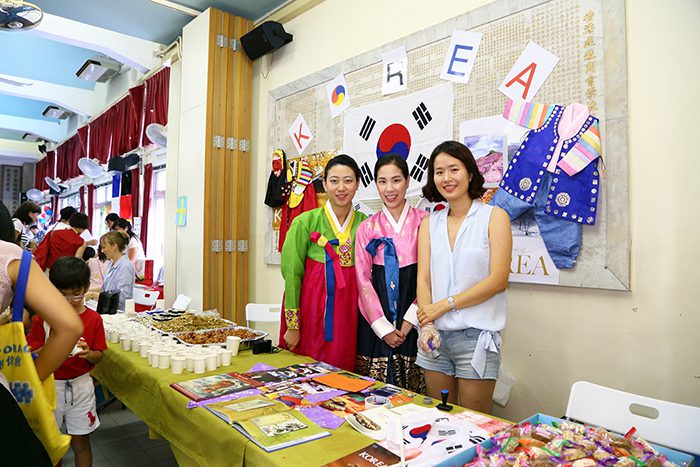
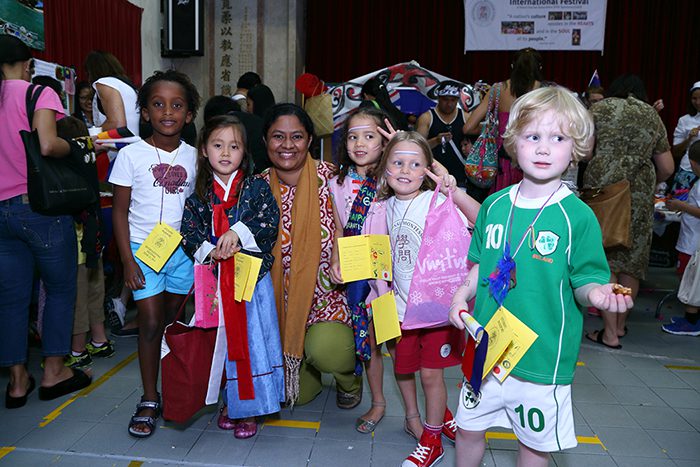
Each June, the IMS Community, supported by our Parent Teacher Association, hosts a joyous cultural gathering of our diverse community: the beloved International Festival. This chance to take a mini tour of the world in the school hall is always embraced by our children and parents alike.
Dressed in their own traditional attire, they get to experience some of the traditions that shape people’s lives both near and far. Our generous band of parent volunteers does a fabulous job to keep the cultural experience sensorially stimulating for our young tourists with an array of delicious cuisine samplings, treasured objects, hands-on crafts, colorful flags, and costumes, and even live performances! We are incredibly proud to be able to share some of the customs ascribed to 25 nations represented at this year’s event; from Peruvian music to Swiss raclette, Japanese fans, Dutch tulips, Maori kapa haka, Korean hanboks, and Indian dancing in silk saris!
To date, IMS’ multicultural community now stems from 46 countries. Our deepest appreciation goes out to our show-stopping volunteers from around the world! In addition, throughout the year, many of our Casa parents also present different holiday traditions that their family celebrates and share their experiences with the children; these cultural presentations help open up the 3-6 child’s awareness that even if we do not share a particular heritage, we often notice that, “We do that in our family too!” Time and again, what we find and aspire to pass on to our students, is that we are all alike. We all need and deserve a warm home. We all eat, sharing stories and laughs over food. We all love our children, hoping and dreaming for them, creating a wonderful world where they can grow into their best selves. We are special individuals; our culture and history can be shared, cherished, and celebrated. We are all humans who deserve respect, kindness, and love. About the International Montessori School (IMS)
Since 2002, IMS has pioneered Montessori Mandarin Chinese – English Dual-Language education in Asia and is now one of the largest Montessori programmes of its kind in the world. At IMS, we recognize and respect the individuality of every child, and aim to nurture their innate curiosity, compassion, and thirst for learning. Providing an environment that celebrates the child’s independence and fosters the motivation to become a lifelong learner who is flexible, responsible, self-regulating, reflective, and persevering is our goal. By equipping them with a solid academic foundation and a strong moral compass, we guide our students to become caring and contributing global citizens of the 21st century.
IMS opened its doors in 2002 with 68 students. With the growing appreciation of the benefits of this unique way of learning, today our Montessori community has grown to almost 900 students from over 40 different countries served in four campuses on Hong Kong Island.
Tomorrow’s Child / Nov 2018 / Pg 23