 For many families facing the transition from elementary to middle school, a common belief persists that it is time for the fish to enter a bigger pond. This has indeed become the norm in the path for most American adolescents, continuing their social development by navigating the open waters of traditional middle school. Although largely accepted as the natural step for adolescents, as they begin to yearn for more freedom and responsibility, mounting research and experience continue to question the social environment of traditional middle school and the timing of this transition.
As educators and parents who have directly witnessed both paths, we wholeheartedly support taking a deeper look at the social factors when deciding between traditional and Montessori middle school. Greater concentration on how we swim and the water we swim in is proving more influential than the size of the pond and a highly beneficial developmental step before venturing into larger and uncharted bodies of water.
There is no questioning the inherent urge for increased independence and emergence into a larger social setting among early adolescents. This desire serves as necessary motivation for the acceptance of responsibility and greater maturity. It is important, however, to differentiate this desire from actual readiness for this transition. The perception and self-awareness of an adolescent is, by definition, still in development.
This is a time when a child’s brain is going through the most changes since infancy. For the most part, traditional middle school gives little attention to these still developing social abilities and assumes preparedness for a large relinquishing of guidance; however, a Montessori environment is not only socially in-line with adolescent concerns and interests, but also actively addresses and embeds social awareness into the programming and curriculum. With smaller, more communal Montessori middle schools, what is often perceived as a social ‘sacrifice’ is, in actuality, a more fitting and potentially enriching social experience.
We are a collective of teachers, fascinated with educational research and encouraged by the findings on the outcomes of a Montessori adolescent education. We have consequently created an environment that fosters the ability to live in relationship with others and work through human problems, to experience what it means to make a contribution, and to recognize human interdependence and the need to cooperate. We aim for graduates to go to the next level equipped with a social consciousness, understanding the benefits of an active role in society, balancing individual needs with communal ones, and appreciating the value of rules and their importance for harmonious living. Even before espousing the research on the effectiveness of these pursuits, we have already seen, first hand, the development of these skills within our own program.
The beauty of jumping into the role as creators of Village Gate Middle School is that it has given us the opportunity not just to read about, but to experience, what it means to guide adolescents in the way Maria Montessori envisioned. What we have witnessed has, quite gratifyingly, corresponded brilliantly with the empirical data found through our research. One of numerous anecdotes of our students’ successful social dynamics has come in the form of play. For a while, a couple of boys wanted to play wildly crazy imaginative games; a few others wanted to play structured group games; and the girls would rather just wander the playground and observe for the most part. Now, through guidance, patience, and trial and error, the group consistently plays, most often in some sort of combination of the above. They love basketball, and recently kickball, and they give the games their own rules to add the necessary silly quotient. They also break out to sit and watch when they feel like it. All of this happens fluidly with disputes handled quickly and respectfully, with encouragement given whenever necessary.
Montessori’s focus for secondary education as a “school of experience in the elements of social life” (Kahn) is echoed in David Hutchinson’s principle of developing a “spirit of place” for adolescents. This spirit of place is “rooted in community relationships” and defines place as “a community to which the adolescent feels he or she both belongs and contributes” (Kahn).
We have seen that our students have learned to be in relationship with each other. Each does his or her part to work through disagreements and hurt feelings, building on peace table skills carried with them from elementary but now taking on conflict resolution with a more sophisticated and nuanced dialogue.
They feel their interdependence deeply, aware that without every member’s cooperation, no compromise can be reached. As a result of our close classroom community dynamic, they have become autonomous in reaching agreement. It is now far more effective to leave the room and permit the kids to figure out a new classroom arrangement or daily schedule than to stay and try to lead them. Through early guidance and encouragement to stay committed to the community, the fruits of responsibility and accountability are nourished within this interdependent social landscape, where each is finding a healthy place and role.
The benefits of developing a personal sense of place and importance at this critical age cannot be touted enough. Self-esteem is based upon how children view themselves within an environment, so to be placed into an uncontrolled arena without the tools or guidance to navigate their way seems counter intuitive to nurturing this valuable element of development. Susan Harter presents this conflict in her article “Self and Identity Development,” a contribution to the Harvard University Press publication, At the Threshold: The Developing Adolescent.
Findings suggest that self-esteem begins to decline at age 11 and reaches its low point between the ages 12 and 13. As our prototypical adolescent recounts, she changed (“I felt terrible”) when she went to junior high school. The extent of change depends, in large part, on shifts in the school environment, as well as on pubertal change. Children making the shift to junior high school in the seventh grade show greater losses of self-esteem than those who make the school transition later, after eighth grade. Moreover, students making the earlier change, particularly girls, do not recover these losses in self-esteem during the high school years. A development-readiness hypothesis has been proposed to explain this pattern, suggesting that children can be thrust into an environment before they are psychologically equipped to deal with the social and academic demands of the new school structure (Harter).
Middle school is simultaneously a time of self-discovery and expression and a time of increased pressure to conform. The result is that adolescents feel intense discomfort and ambivalence about revealing their burgeoning personalities. The goal, therefore, should be to create a place where students feel at ease exploring who they are, able to take risks and try new experiences,
all the while being seen and accepted by a supportive community.
Researcher and writer Kevin Rathunde also supports the Montessori environment as conducive to not only adolescent academic development but social as well. Rathunde, in association with The NAMTA Journal (North American Montessori Teacher’s Association), has conducted extensive research on Montessori middle school. He explores the social context in a 2003 study, while looking at the roots of reports of negative experiences and lack of motivation from traditional middle school students.
The study points to three social findings:
- a growing distance in teacher-student relations at a time in early adolescence when adult support is crucial; fewer opportunities for meaningful peer interaction at a time when peers are becoming more highly valued; and
- fewer opportunities for meaningful peer interaction at a time when peers are becoming more highly valued; and a growing emphasis placed on one-directional communication (e.g., lectures, seat work, and viewing media) just as young adolescents are becoming more capable of more complex thought and communication (Rathunde 32).
- a growing emphasis placed on one-directional communication (e.g., lectures, seat work, and viewing media) just as young adolescents are becoming more capable of more complex thought and communication (Rathunde 32).
Montessori students expressed greater connections and support from their teachers, reporting that they felt that their teachers were fair and interested in them. This is most likely a result of the structure of the Montessori middle school program. The time the Montessori teacher has to observe and work with a given student is intentionally designed to provide this sense of security. Perhaps equally important is the drastically different social context Montessori and traditional students perceived with respect to their peers. While traditional students predominantly saw their peers as classmates, “Montessori students more often perceived their peers as friends-and-classmates” (Kahn 37).
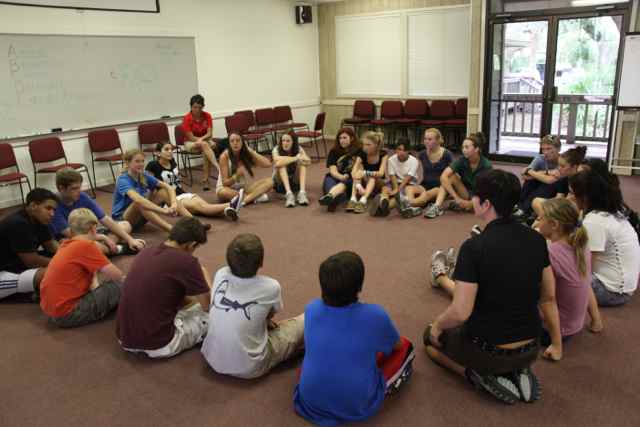
Montessori groups are often structured by shared interests rather than students’ ability levels, and a significantly less amount of class time is spent in one-directional lectures. These are both elements that aid in forming closer relationships among students while engaged in work time. The Montessori work environment provides continual opportunities to participate socially and create community instead of delineating factions between class and social time. Group and class discussion and exploration are integral components of the Montessori classroom and serve as safe experiences for students to express their questions, concerns, and opinions amongst both trusted instructors and peers.
Our final piece of evidentiary support comes from a more general look at wisdom and how it is attained in a recent New York Times article, “The Science of Older and Wiser.” The ultimate aim of any educational journey is arguably to achieve wisdom, as wisdom is not only the possession of knowledge but the practice of applying knowledge as well as “maintaining positive well-being and kindness in the face of challenges” (Korkki).
In developing a socially equipped and happy student, we look to a few of the major tenets of wisdom offered by Professor Ursula M. Staudinger, including: “self-insight; the ability to demonstrate personal growth; self-awareness; and an understanding that priorities and values, including your own, are not absolute” (Korkki). Laying the groundwork for this type of wisdom is a foremost objective of our program and of a Montessori adolescent education because these are the skills necessary to live happily and contribute positively to a greater community. The social factor is at the root of our program, guiding the academic development since we see the two as absolutely inseparable.
The students within the Village Gate Middle School program take part in a heroic journey of self-reflection and discovery based upon Joseph Campbell’s universal archetypes. The journey requires students to recognize their personal challenges and to see how they not only influence their own lives but how these challenges affect the community as well.
The heroic journey recognizes the natural desire for each student to venture away from the comforts of home and into a larger setting, this being the call; however, this developmental construct also acknowledges that a right of passage must be undertaken to first ready oneself for this transition. Although the adolescent impatiently desires to enter the new setting upon receiving the call, it is the role of the “threshold guardian” to create an environment where the developing youth can test him or herself safely and to know when each trial has been met before incrementally opening each gate upon the way.
We must not forget our roles as the threshold guardians for our children. It is the role of the threshold guardian to help them recognize not only themselves but also the water that they swim within. Equipped with an understanding of the water and how they swim will enable them to find success and happiness no matter how big or small a pond they find themselves. This is the pursuit of the Montessori adolescent education: to provide an opportunity for our children to not only recognize their place within the greater community but to trust themselves to confidently forge their own path within it.
Montessori Leadership / June 2015 / p 14