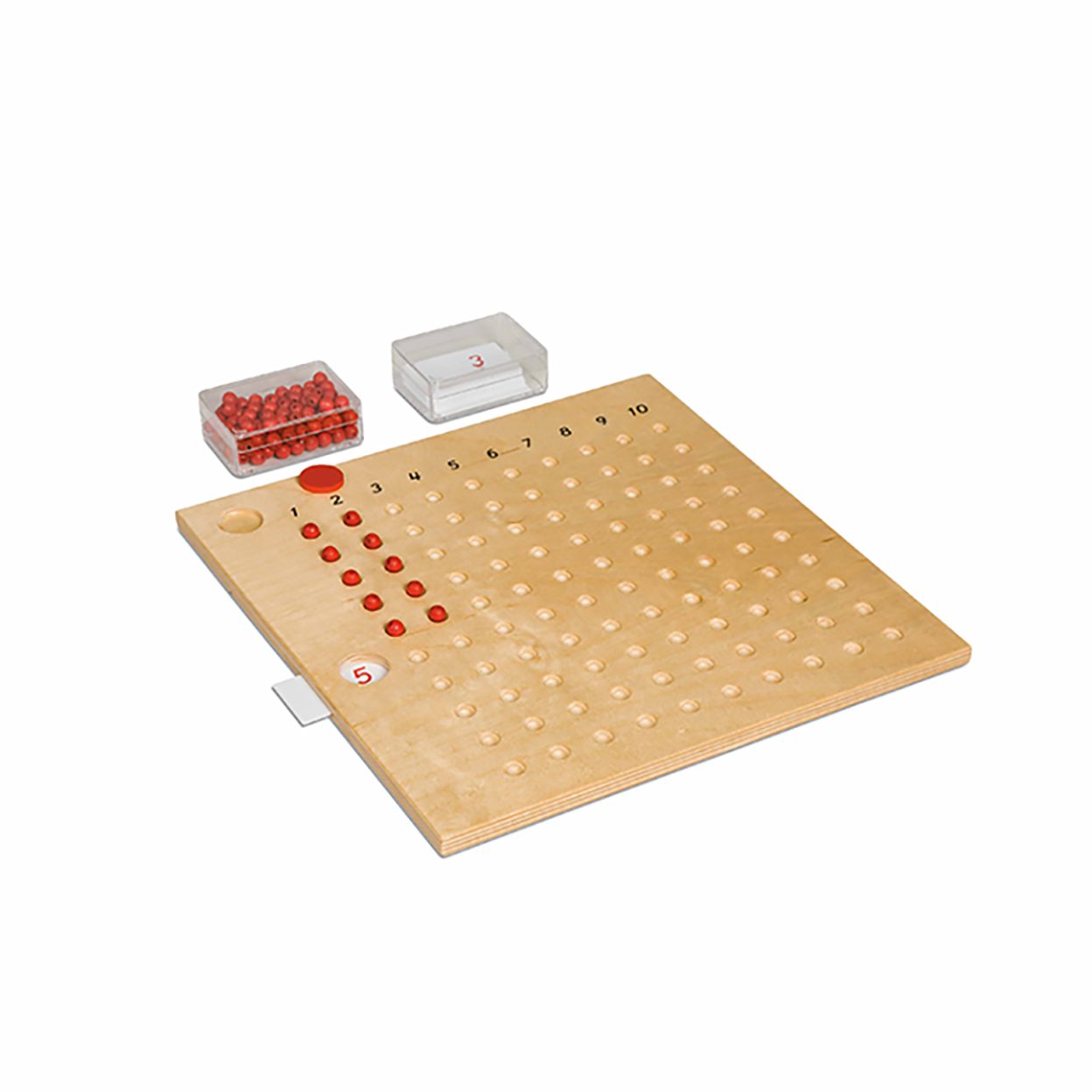
 The Multiplication Checkerboard is one of the most popular materials in most elementary Montessori classrooms.
The colorful checkerboard materials are a step up the ladder of abstraction in the Montessori math curriculum.
Think back to your own years in school. Did you ever really understand what is going on in long-multiplication? Oh, you probably memorized your multiplication tables [like 7 x 6 = 42] and learned to solve long multiplication problems on paper [520 x 84], but did anyone ever show you that multiplication is nothing but adding the same number together with a given number of times? 7 X 7 is nothing more than 7 + 7 + 7 + 7 + 7 + 7 + 7.
In their first steps into multiplication, the children will have done similar work with the Golden Beads and Stamp Game. The simple multiplication board is a somewhat more abstract way of helping young children be able to understand short multiplication. Here you can see 5 X 2.
The Multiplication Checkerboard builds on the children’s prior work with the more concrete math materials.
You can see how the material resembles a checkerboard, but there is a clear logic to its design. Along the bottom, beginning on the right, you can see a green square under which the symbol 1 is printed. Next to it, on the left, is a blue square, under which the symbol 10 is printed. Next comes a red square labeled 100, and we begin again with a green square to the left labeled 1000 (units of a thousands). The sequence to the left continues 10,000, 100,000, and 1,000,000. When we go up one row, we begin with a blue square representing units of ten. The sequence continues along that row, building from the right to the left.
The colors green, blue, and red represent the units, tens, and hundreds place values, just as they have been color coded in the earlier materials and number cards. Ten thousand would be blue (in Montessori math, tens are always blue), and a hundred thousand would be red. This consistency in color coding is a great aid in helping children to see the logic in the progression of concepts.
The colored bead bars used to represent the numbers 1 to 9 also use the same color scheme used in earlier exercises to represent the same values as the Bead Bars and Bead Cabinet found in all Montessori classrooms.
In the following photos, let’s see how a child would solve the problem:
13,258
X 32
_____
The multiplican is placed on the bottom, and the multiplier is placed along the side.
In this problem, the multiplican is 13,258, and the multiplier is 32.
On the bottom row, the child builds the multiplican:
In the lowest row (multiplying by units), the child sets out two 8-bead-bars in the lower right green square (units). She then lays out two 5-bead-bars in the blue square to the left (tens). She continues multiplying the multiplican (13,258) by two, placing two 2-bead-bars in the (red) hundreds square, two 3-bead-bars in the (green) thousands square, and two 1-bead-bars in the (blue)
ten-thousand square.
Now she needs to multiply the multiplican (13,258) by three in the next row up that represents multiplication by tens. She places three 8-bead bars in the units square in the second (tens) row, three 5-bead-bars in the (blue) tens square, three 2-bead-bars in the red (hundreds) square to the left, three 3-bead-bars in the (green) thousands square, and three 1-bead-bars in the (blue) ten-thousand square (see Figure 2.)
Now the child begins to carry forward. There are several ways this can be done, but with multiplicans of 4-digits or more, a common short cut is to slide the bead bars in the tens row each one square to the left and then merge them down.
The last step is to exchange bead bars that total a number greater than 9. For example, in Figure 3, we see that the units column totaled 16. Then the child removes the two 8-bead bars, adds 1 to the tens column, and places a 6-bead bar in the units column to represent the remainder.
The tens column now has a total of 35, so the child carries 3 over to the hundreds column to the left and places a 5-bead bar in the tens column to represent the remainder (see Figure 4).
In the hundreds column, we now have 22, so the child carries 2 to the thousands column to the left, and the remainder is 2 (see Figure 5).
Now in the thousand columns, we have 14, so the child carries 1 over to the ten thousand columns and has 4 left (see Figure 6). She continues this process, and arrives at the answer: 13,258 X 32 = 424,256.
Children may solve pre-printed problem cards, think up their own problems, or roll a special dice to come up with new problems to solve at this first level of multiplication. They gradually move up to multiplying large numbers—even up to the millions!
Below is an example of a child solving the problem 214 X 3 =?
She sets up the checkerboard with beads representing the numbers in her problem.
Now the board is ready for her to do some exchanging. We always start with the ‘units’ place, so her first exchange comes with those beads in the green square (see Figure 8).
If she knows that 3 X 4 = 12, she can simply do the exchange.
If she has not yet memorized this answer, then she can count the beads to come up with the answer.
With the checkerboard, the number 12 would be shown with a 1 in the tens place (blue square) and a 2 in the units place (green square). She writes down her work as she goes along to complete the process.
Tomorrow’s Child/ Jan 2019 / Pg 17
.