 As an educator and parent, I saw a need for children to have an outlet to explore and develop emotional and social sensitivity. We created ClayMatesTM in a direct response to this need as we now live in an age of overwhelming distractions from media, technology, and entertainment, we see a generation of children who are losing touch with authentic social connection, self-reliance, empathy, compassion, and creative problem solving; all of which can translate into feelings of social separation and anxiety.
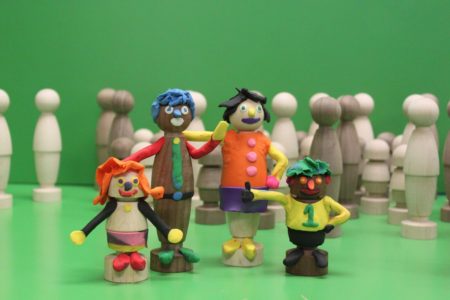
ClayMatesTM help quiet these distractions and open new doors to creativity and expression by nurturing positive connections and personal strengths in children. The non-gender-specific figures and colorful, tactile properties of clay engage children to make creative choices as they design their figures and naturally engage in imaginary role-play.
As a toy, ClayMatesTM inspires creation and expression while building the child’s fine and gross motor skills and executive planning skills. As an educational tool, ClayMatesTM are an easy-to-use platform for encouraging complex social and emotional conversations with children at home, in the classroom or in a therapeutic setting. ClayMatesTM are a hands-on, self-directed activity that promotes mindfulness and emotional intelligence. Children place clay on the wooden figures to create physical features to bring characters to life. Educators will find ClayMatesTM help them observe social cognition, emotional intelligence as well as guide without any preconceived outcomes and create an environment that supports age-appropriate social and emotional exploration and growth.
ClayMatesTM Inspire Self-awareness through Social Context and Emotional Response
When ClayMatesTM are introduced to the classroom, therapeutic, and family settings, the results are immediately observable. Using ClayMatesTM, children begin by building a figure of themselves, revealing each child’s perception of her or his own self in the world. Then, the children create figures that represent others in their lives. These two steps are the building blocks for observation, to help children in the process of social and emotional cognition.
As imaginary role-play becomes fluid, we can introduce a host of social context or scenarios for children to explore in their play—from helping around the house to experiences of bullying, to classroom behavior, even how to say “I’m sorry.”
By observing the children’s social and emotional response and problem-solving in their ClayMatesTM play, educators can engage them further in an age-appropriate contextual conversation around the possible solutions or responses to events and issues in their lives.
Here are two examples of ClayMatesTM play that demonstrate the ease and enormous potential they offer:
Example #1. Enacting a Social Scenario with ClayMates: Bullying
In a group of 5 children, each child builds a different figure: the victim, the bully, the bystander, the teacher, and the parent. This creates a social scenario in which each child role-plays and observes how the words and actions of the five ClayMatesTM unfold in the group. As educators, this type of prepared learning environment provides an open-ended dialog that explores the children’s observations and emotions about bullying, the emotional and social responsibility of different roles, some possible solutions, authentic feedback, and the opportunity for social and emotional growth.
Example #2. Developing Emotional Vocabulary with ClayMates
As our emotional vocabulary develops and expands, we, as individuals, learn to engage with our self and others with more understanding, patience, and acceptance of diverse thoughts and feelings. ClayMatesTM is an effective tool for building this vocabulary through role-play with directed emotional context.
We can attach to the bottom of every ClayMate figure one of 12 color-coded discs associated with 12 different emotions. Initially, we introduce the basic emotions such as anger–RED, sadness–BLUE, fear–PURPLE, yellow–HAPPY and integrate them into a social scenario. Each child then role-plays their ClayMate figure’s designated emotion. At first, all participants know who is performing which emotion. Each child acts out and experiences their own assigned emotion and observes the other participants doing the same. As students become more comfortable with this role-play, they are assigned an emotion “secretly” so that only they know what it is, and other participants try to figure it out. This exercise deepens the children’s sense of different emotions: both how to express them and how to relate and respond to others’ emotions.
As a fun, flexible, and expressive toy and tool, ClayMatesTM builds a foundation of social and emotional awareness so that children can develop authentic and meaningful connections, recognize social and emotional cues, and strengthen their capacity to problem solve and meet challenges with resilience. ′
Matt Johnson is married with two adult children and has worked with children for over 35 years as a gymnastics instructor, mentor, and advocate. As an instructor he has help students realize their physical and mental potential. As a mentor, he has supported students in building character, self-esteem and achieving personal goals. As an advocate, he has been outspoken in support of responsible coaching practices, resiliency in athletics and the idea of empowering children to be confident, competent, contributors who are self-sufficient, with skills for coping in life. Matt is a board member of SPARKindness and is the chairperson for their resilient athlete program. SPARK is a community-based organization that provides educational opportunities to families that focuses on understanding diversity, inclusion, resiliency, recognizing the difference and addressing social and emotional issues that affect families and the community. Matt also works with teens and adults as a personal trainer and life coach. Where he support clients in goal setting, recognizing their potential and helping to navigate the obstacles to success.
ML/ September 2018/ pg 27