by Christoph Simon, Ph.D & Christine M. A. Lapierre, Ph.D. | Science, TC May 2021
 from Tomorrow’s Child Magazine – May, 2021 | by The Montessori Foundation
We are all scientists at heart. Do you remember how curious you were as a child when you were growing up? You would question your parents and teachers about how things worked in your environment, sometimes unceasingly. When you had your queries answered, you were joyful and, consequently, more motivated to come up with additional questions to examine. In reflecting about this natural tendency in yourself, you could now appreciate the interests of young children today as parents and as teachers, when they inquire about how and why certain phenomena are the way they are in their environment. The variety and number of questions they ask demonstrate to us that they are budding scientists and need to have their fascinations addressed genuinely, in order to not lose that capacity as they grow older.
Maria Montessori stated that children are natural scientists and that we can nurture that inquisitiveness and enthusiasm with thoughtful, caring replies. As an avid scientist herself, cultivated from her studies as a physician, Maria Montessori indicated that science and math were her favorite subjects. Consequently, she encouraged teachers and parents to bring to the attention of young children the real names of objects in their environment and not be concerned that the words would be too difficult for them. As children mastered their language and acquired new vocabulary, all words had the same intricacies for them. Montessori also advised adults to introduce children to all the sciences, in a manner that would respect the children’s level of understanding. What happens if, as parents and teachers, you are hesitant about teaching science and do not know the answers to the children’s questions?
You may think that it is too difficult, that you don’t understand it, and that you don’t have the abilities to converse with children about science. You may have a little voice in your head that tells you that discovering new knowledge about science is just not something you are capable of doing. While topics about biology and botany may come easier for you, because you studied it in school or university, many people shy away from delving into the ‘hard’ sciences (e.g., physics and chemistry) with children. When children sense this fear of science in adults, they can adopt these feelings as their own and become reticent about exploring their environment. However, there are a number of ways that you can embrace science and enjoy it. Christoph has some great solutions on how to lower this barrier of being fearful of science.
First of all, science is everywhere around us. Therefore, you can make science more relevant to the children’s everyday experiences. For example, everyone needs energy. We, and other animals, get it from our food. Plants get it from the sun and use some of it to make food for us. The plants can turn into coal and oil, which still contains some of that energy that they got from the sun. We can burn these things to make heat, steam, and electricity, which can do work.
A related example is heat. You can explain to children that it is the disordered movement of atoms or molecules. This helps explain how water goes from ice, which is a solid, to liquid water, to steam, which is a gas, as water is heated up. First the molecules are arranged in a neat orderly way (ice), then they start moving around but still stick together (liquid water), then finally they move so much that they fly apart (steam). Children can act that out by being close together for ice, farther apart and moving for liquid water, to moving around the room rapidly, for gas. Other examples are the concepts of electricity and magnetism. Children can learn about them using simple, everyday objects. The child can rub balloons to create static electricity, and fridge magnets can demonstrate magnetism. In both cases the children can see that objects don’t need to touch each other to have an effect on each other.
If your understanding is not perfect, it is still acceptable. You can acquire the spirit of being comfortable with not knowing about everything. Instead, you can be transparent by telling children that you are not sure about a response, and you can do the research together to seek the answers. In science, there are always open questions. When you deepen your understanding of how things work, you develop a mindset that is wonderful for children to see: like the children, it is fine to not know. You can be like children, open-minded. Instead of becoming discouraged, you can learn that it is enjoyable to learn new things. It will change the way you view the world. On a cautionary note, we would like to emphasize that it is important not to give children incorrect information. As an alternative, it is valuable to say to the children, “I am not sure.” They will realize that adults do not know everything, and we are all learning together. Everybody can learn at their level. Even experts in science do not know everything. Taking this stance, we can all teach science to young children. like Montessori, that children have a natural scientific mindset. They want to explore new phenomena to them, learning about them repeatedly under different conditions to really understand how they work. This would be what changes, what remains the same, what is important and what is coincidental. We encourage you to take the plunge and begin exploring new facets of science to convey to the attention of young children. It will bring them joy.
References
Montessori, M. (1972). The secret of childhood. New York: NY: Random House Publishing Group. Montessori, M. (1995). The absorbent mind. New York: NY: Hold Paperback.
Christine M. A. Lapierre, PhD enjoys being a parent and is passionate about the Montessori philosophy. She holds a PhD in adult learning and sees everyone as a lifelong learner. Being a MACTE trained early childhood teacher, she believes strongly in bringing Montessori principles to teams, businesses, and other organizations. She can be reached at clapierr@ucalgary.ca.
Christoph Simon, PhD is a happy father of twins currently attending a Montessori elementary school. He is a professor of physics at the University of Calgary, where he studies applications of quantum physics to information technology and neuroscience. He can be reached at csimo@ucalgary.ca.
by Christoph Simon, Ph.D & Christine M. A. Lapierre, Ph.D. | Mathematics, MFA, Science
Christoph: I am a physics professor, so I was naturally interested in trying to teach science and math to my twin boys as early as possible. My wife has a PhD in physics, too, so she shared this interest. I didn’t just want to transmit content knowledge, although that is definitely important to me, but also the scientific way of thinking. I will elaborate on that in the examples below. I feel that science provides a unique, often interesting (and even fun), perspective on the world, and I wouldn’t want my children to miss out on that.
My efforts in this respect were significantly enriched by my discussions with Christine, who is an experienced Montessori early childhood teacher. Our conversations started with a fortuitous encounter in a campus parking lot several years ago and have continued ever since. Thanks to my professional background, I was also able to make suggestions for themes and concepts to incorporate into a Montessori classroom.
Christine: I am a Montessori early childhood teacher, and I was really interested in how Christoph could integrate science into his everyday activities at home. I shared with him how Montessori classrooms honor Maria Montessori’s deep belief that science, as well as mathematics, are core areas of learning for young children. I learned from Christoph new concepts in science that can be a basis for any Montessori parent and Montessori classroom.
Christoph: Overall, the most striking discovery for me has been how ready children really are for scientific knowledge and concepts, even at a very early age. For example, when they were three and a half years old, I explained to them how the earth goes around the sun, while also rotating around its axis, which causes day and night. I used fruit (an apple and a mandarin) to demonstrate. To my surprise and delight, they understood this perfectly and were very happy to demonstrate it multiple times later on.
Christine: The solar system is a standard topic in Montessori preschools. It was great to see how Christoph was able to introduce it to his children. Parents are encouraged to teach the solar system, with the sun and the planets, to their children using objects that they can find at home. They can also show their children pictures of the planets, discussing with them how they are different from each other.
Christoph: I talked with my children early on about seemingly more advanced topics too. For example, we talked about how all matter is made out of atoms, and how these atoms form larger structures called molecules. They were interested in drawing simple molecules, such as water and oxygen, and even more complicated ones such as the different kinds of sugar.
Christine: Atoms and molecules are somewhat new concepts for the Montessori early childhood classroom. Yet, they are foundational to science. The way in which Christoph explained it to his children can be an example for all of us, whether parent or teacher, and we can teach it with confidence.
Christoph: My children were very interested to learn that heat is the disorderly movement of these atoms and molecules. We discussed phase transitions, such as freezing/melting and evaporation/condensation from this perspective. For example, freezing means that the water molecules arrange themselves in an orderly fashion, while evaporation means that they fly apart. This is fun to act out. For a solid, the children sit in an orderly arrangement. For a liquid, they move around but stay close to each other. For a gas, the children run all around the room.
Christine: A Montessori parent can conduct an experiment with children to teach phase transition using simple materials. You would use an ice cube to show that water can be a solid, a cup of water to show how water is a liquid, and a water kettle that boils water, releasing water vapor, to show that water can also be a gas.
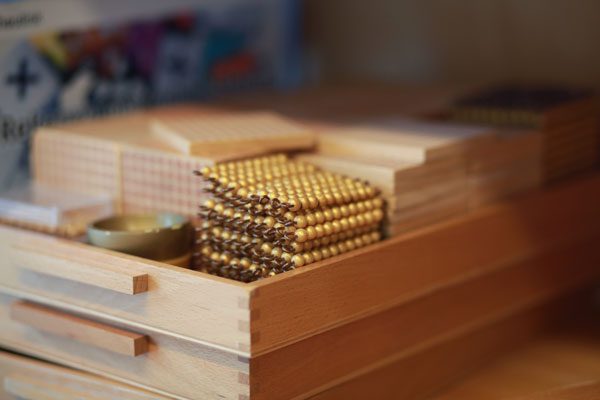
Christoph: When our boys were about five, my wife and I were inspired to make counting beads for them by what I had seen in a Montessori classroom. We made single beads, rows of ten (stuck together), and squares of a hundred. This was the time when they started to get a weekly allowance and wanted to figure out what toys they would be able to afford. They quickly became really proficient at doing these calculations with the beads. This example really demonstrated the importance of motivation to me. It also showed that they were completely capable of learning practical mathematics when given appropriate tools.
Christine: The Golden Beads are a wonderful math material to use with children. As Christoph mentioned, parents can make their own basic ones at home. They can work with their children on everyday activities requiring math, such as counting how many toys the children have, how many different building blocks they have, and what ages they are.
Christoph: There were many opportunities to talk about the scientific mindset. Also around age five, a friend of theirs claimed that he could run faster than a car. They wanted to know how they could decide if that was really true. I suggested asking him to show them. They did that, but he responded that he had done it only once. After some discussion, they concluded that it was probably not true.
In the language of science, we would say that if a result is not reproducible, then it is probably not valid. This (and similar experiences with them) makes me think that the scientific way of thinking is really quite natural for kids, and they just need a moderate amount of encouragement and guidance to develop it consciously. My main contribution was the suggestion to ask for a demonstration, i.e. basically to do an experiment. I think that they not only did that for this particular instance, but they also remembered it as a good general principle when faced with (maybe dubious) claims.
Christine: We can all learn from Christoph about how to introduce the scientific mindset to children. Parents who are courageous to do so, can follow Christoph’s line of thinking. Once parents begin to introduce scientific concepts and to do experiments with their children, they will be inspired to do more with science. As Maria Montessori discovered, children are natural scientists.
Christoph: As they grow older, we talk about increasingly sophisticated topics, for example the concept of probability. In 2018, when they were almost seven, we spent a fair amount of time watching the soccer World Cup. Before a game, we would talk about what we thought was the chance that team A (say Germany) would beat team B (say South Korea). For example, we might decide that the chance was 80 percent in this case because Germany is usually a really strong team. But then, in the game, something unexpected might happen: South Korea might score the first goal. We would talk about how that changed our estimate for the probability of winning, and we might agree that now the probabilities were more like 50/50. Another goal by South Korea might convince us to make another update to our probability estimate, maybe 80 percent in favor of South Korea now. Then, as the game time ran out, our estimate of the probability of South Korea winning would become closer and closer to 100 percent, until it reached 100 percent (certainty) at the final whistle. These concepts (a priori probabilities and updates to probabilities based on new information) are sometimes thought of as quite advanced. But they also seem to be quite natural for the human mind. At least these two seven-year-olds had no difficulty with them at all, when there was a real-life and fun example such as an exciting soccer game.
Christine: While the mention of probabilities may make a parent reticent to talk about it with their children, Christoph demonstrates how his children grasped the concept very quickly in the discussions about soccer. Taking a topic that is close to the children, such as sports, can enhance their understanding of how we come to conclusions about everyday life.
We can all learn from Christoph about how to introduce the scientific mindset to children. Parents, who are courageous to do so, can follow Christoph’s line of thinking.
Christoph: I realize that different parents and teachers will have different comfort levels introducing and discussing concepts such as these. From my experience, I would say that at least one doesn’t have to worry about the children; they seem to be ready. It is also OK to still learn things oneself. They have now reached an age where I often can’t answer their questions perfectly, without some support (say some specifics about black holes, to give a recent example). I think the fact that I also still have to learn new things is a good lesson for them. Sometimes, in simpler cases, we might look up the answer together. There are times I will get back to them after having organized my answer a bit. I am also learning a lot from them now, such as all kinds of facts about animals on land and in the sea.
My wife and I really liked what we learned from Christine about Montessori schools, and we decided to enroll our boys in one starting with lower elementary (first grade). I am happy to report that they are thriving there. They do quite complex projects, sometimes alone, sometimes in teams, on a wide range of topics (outer space, different animals, but also ancient Rome etc.). They are learning lots of great skills, such as organizing their time, working constructively with others, and presenting their results to their peers. As an academic, I feel that they are already developing many of the skills that are essential for graduate students later on. But I am sure that the same skills are also valuable for many other careers. Most importantly, they are excited about learning new things every day.
Christine: We hope that from this dialogue interested parents can see how they can introduce more science and mathematics to their children at home, in support of what they are learning at school.
Christoph: This has been a lot of fun. The more my kids responded positively to these ideas, the more I was motivated to introduce new concepts to them in concrete ways.
Christine: It can be thrilling to learn something new and then teach it to your children. In essence, you are learning alongside them. ¢
Tomorrow’s Child / October 2019 /pg. 18