
Eco-Literacy: Getting to Know the Natural World on a First-Name Basis
There is no description, no image in any book that is capable of replacing the sight of real trees and all of the life to be found around them in a real forest. How often is the soul of man – especially in childhood – deprived because he is not allowed to come in contact with nature.” – Maria Montessori
Montessori schools have made a conscious effort to take their students outside, from the earliest days when an inner-city courtyard was the best that could be done, to get some fresh air and sunlight. As Montessori education spread to suburban and rural locations, greater use of the outdoors became possible, and students at many contemporary Montessori schools observe wildlife, engage in hands-on life-science lessons, or raise vegetables on campus.
Mountaintop Montessori in Charlottesville, Virginia has offered a number of ways for students to work outdoors over the years and has recently seen programs from various phases in the school’s history come together to create exponentially greater opportunities for students to grow in their knowledge of, and connection to, the natural world.
As is so often the case, Mountaintop’s early environmental education projects flowed from faculty members’ willingness to share their areas of expertise with the students. Estra Roell, who guided lower elementary students for twenty years at the school, came to share a weekend interest in birdwatching with Alma Scheible, who was her classroom assistant at the time. They installed the first bird feeder on our campus just outside their classroom’s windows. Soon, they discovered that watching birds made for a wonderfully concrete way for students to learn about how animals adapt in their environments and why the health of those environments is crucial to the animals’ survival.
Having learned to identify types of beaks and feet, students understand how birds meet their needs for food and shelter and how local populations of shrubs, trees, insects, worms, and birds are all interrelated. Mountaintop embarked on its first environmental education project in partnership with Audubon International in 1999 and achieved certification through their program for schools in 2001. In 2002,Estra published an article in Tomorrow’s Child on the benefits that working with Audubon had brought to our students, stating, “We have achieved many of the goals we established at the beginning of our involvement in the program, but our progress doesn’t stop with certification as a Cooperative Sanctuary. We see our stewardship as a permanent, ongoing project and hope to maintain our relationship with Audubon International well into the future.”
Over time, we’ve seen more and more evidence that the real, meaningful work of maintaining and expanding our sanctuary gives students the kinds of experiences they need to have early in life to build not only appreciation and knowledge of the natural world but also an understanding of their role in it and commitment to being lifelong, active stewards of it. Biennial recertification with Audubon gives adults on campus an opportunity to reflect on this. Our most recent recertification took place in the spring of 2010, and in it we reported on some exciting developments and considered how they related back to the essential theme of educating students to become eco-literate citizens of their local and global communities.
Cornerstones of a Montessori Approach to Eco-literacy: Montessori’s Keen Understanding of Human Development
Dr. Maria Montessori, trained as a physician, used her scientific background to develop an innovative approach to understanding child development. This approach divides the child’s life into four six-year stages, which together span birth to age twenty-four. Within each stage, the first three years are a time of great change and growth for the child, followed by consolidation during the second three years. Through the first three stages, adults support the child’s development by observing, determining what support is needed, and giving appropriate guidance and challenge. The fourth stage constitutes young adulthood. Since Mountaintop serves 200 students, including toddlers, preschool/ kindergarten-aged children, elementary students, and adolescents, we see each of Dr. Montessori’s planes of development every day. Over time, our students develop a kinship with the natural world by building on early sensorial experiences, moving into productive work in the outdoors, and ending with the ability to make decisions and take action with optimism and confidence founded on those early successes.
1st plane | Toddler & Children’s House | Ages 0 to 6 | Preschool & Kindergarten
From birth to age six, children are soaking everything in, constructing an understanding of the world through their senses. So, the 1st plane of development is called the “absorbent mind” phase. During this phase, children develop all the essential skills necessary for survival: to eat, to move, and to communicate. They are driven to refine those skills to meet their needs independently. The Toddler and Children’s House ages are the most critical periods for bonding with the world and developing what entomologist E.O. Wilson calls “biophilia” – an affinity for the living world. During these formative years, our main objective is to cultivate empathy between the child and nature through direct experiences with plants and animals and complementary stories, songs, and seasonal celebrations.
2nd plane | Elementary | ages 6 to 12 | grades 1 to 6
From six to 12 years, children are hard at work making sense of the world around them. In this 2nd plane, we say they have a “reasoning mind.” They are making connections, discovering reasons and starting to become familiar with the essentials of human knowledge. Elementary children are natural explorers, inclined to collect specimens; explore the woods and streams; observe amphibians, insects, and birds; hike trails; plant gardens; compost and recycle; tend animals; and, ultimately, make the connection that human beings need to live in harmony with the earth. Upon experiencing the living and non-living forces of nature, they easily draw the conclusion that all things, natural and man-made, are interdependent.
3rd plane | Middle School | ages 12 to 15 | grades 7 to 9
The complicated years of 12 to 18 are a time of physical growth, intense emotions, and refinement of beliefs and values. During these years, young people seek both independence and community. Adolescents practice the skills they need to participate in society and make themselves ready to contribute to the wider world as individual adults. As Montessori children enter adolescence, their personal relationship with nature becomes a catalyst for social action on behalf of the environment. This devotion to the world around them provides context for studying the challenges facing our world today. These young adults emerge from their Montessori years understanding the unique relationship between human technology and nature’s gifts. The Mountaintop student feels empowered to make positive and purposeful contributions to local and global environmental efforts out of genuine understanding and experience.
Our whole curriculum is organized to serve these planes of development, with children working in mixed-age groups but sharing the same characteristics and needs. Planting an area outside their classroom with carefully chosen shrubs and flowers and seeing them attract the insects and birds found in our area is one long-standing example of eco-literacy lessons attuned to the children’s development at our school. Other examples are found in programs we have developed more recently at Mountaintop.
An Organic Approach to Prepared Environments:
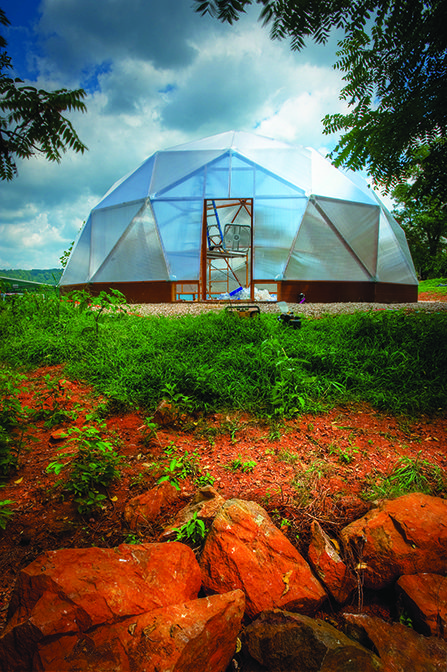
Spaces where children engage in outdoor work are prepared as carefully as the Montessori classrooms. These spaces should be suited to the needs of the children who will use them and should promote the students’ growing independence. Our goal is that outdoor learning spaces be simple, beautiful, and orderly. There are a number of challenges faced in achieving this. Time is needed for plants to mature. Many hands of all sizes are needed to care for living, growing, outdoor learning spaces. Financial hurdles to achieving prepared environments for teaching eco-literacy can be substantial as well, but a new garden or greenhouse for student use is an attractive project for fundraising, and even a modest grant can be leveraged into huge progress for a school that has other essential elements in place. Mountaintop’s recent addition of an 850 square foot geodesic dome greenhouse is an example of how much can be done with minimal school resources.
In 2005, we launched a cooking program as a way to extend the wildly popular food preparation exercises of the children’s house practical life curriculum into the elementary years. Students began taking turns working in the kitchen with an adult and their classmates in each of our elementary classrooms and were thrilled to have a homemade meal one day each week. This program was extended to our middle school classroom in 2008, which set the stage for a big leap forward for the cooking program and its relationship to our efforts to teach eco-literacy. With our growing middle school program in mind, the school had sought, and been awarded, grant funding for the significant infrastructure needed for eco-literacy programs. When it came time to bring the new infrastructure to life, the middle school students, true to form, surprised the adults with some wonderful but unexpected particulars. That year, some students in the class delved into the planning and creation of meals they were proud to share with classmates and invited adult guests, while others clearly thrived on researching and planning for the addition of a greenhouse to our campus.
At the time our middle school class included only seventh and eighth graders, and two students who were in their final year of the program convinced the middle school guide and administration of the wisdom of adding a ninth-grade year to the program so that they could stay on to see the project through to completion! The grant funds were used to purchase a cleverly designed kit from Growing Domes. A parent who is a contractor served as the job foreman, preparing the site and supervising the many parents and students who donated their time to put it together.
When the greenhouse was opened at the start of the 2009-2010 school year, students, parents, and staff were excited to see it begin to fill with living things. The first plants grew vigorously in the growing conditions it provided, but no one was fully prepared for just how profound an impact this new feature would have on our program. The students’ enthusiasm for cooking skyrocketed with the opportunity to plan meals made from the produce growing in the greenhouse. The success of this garden-to-table program quickly propelled action on several related fronts. The local United Way’s annual Day of Caring brought fresh volunteer troops to campus to construct the 2300-gallon water tank that would provide the greenhouse’s thermal mass over the winter. In subsequent months, middle school science lessons gave students an opportunity to learn the chemistry, and botany and zoology they needed to successfully populate the tank with a harmonious balance of plants, fish, and decomposer species in the spring. Plans for a new, extensive garden space adjacent to the greenhouse evolved rapidly, along with a revamping of our summer program to focus on gardening and cooking. In its first year, Mountaintop’s Summer of Ecological Experience and Discovery, known as SEED, has begun to spread eco-literacy to families and schools across our community by sharing our own students’ successes in these areas with many more students, whose schools are not able to provide such experiences for them during the school year.
Achieving a Full Complement of Materials:
High-quality learning materials are essential to students’ experiences outdoors just as they are in the classroom. In a Montessori school serving a broad range of ages, this means having plenty of sturdy garden tools in a variety of sizes, and field guides and other resources for students at different levels. Again, donations from foundations, individuals, and businesses that see eco-literacy as an important topic in education have been critical to our success. Seed companies, local garden centers and market gardeners, and university-level agricultural research stations have donated supplies. Education grants from Virginia’s Department of Environmental Quality have been obtained, and working with the local 4-H chapter on particular projects has helped as well. Small expenditures for student-made bee boxes, rain barrels, and worm composting bins are far outweighed by the value of the practical life and science lessons gained in building them.
Masterful Adult Guidance:
The guidance offered by experienced, trained adults is as important to students’ work in the outdoors as it is in the classroom. Alma Scheible, the longest serving member of our faculty has been involved with a host of eco-literacy efforts in her 24 years at Mountaintop. Over time, her role has grown from sharing her own passion for birdwatching with staff members and students in one classroom of first, second, and third graders to serving as a resource for the entire student and staff population. In recent years, most of Alma’s time has been allocated to guiding groups of students of all ages, who not only maintain our bird sanctuary’s many feeders, nesting boxes, and water features, but grow food, plan, budget, and prepare meals for their entire class. Experience has taught Alma how much the students are able to do for themselves and for each other. Her guidance always leaves room for them to make important discoveries on their own. Professional development for classroom faculty and for those who specialize in teaching eco-literacy has been obtained through a local permaculture organization as well as through organizations such as the Natural Learning Initiative and Vermont Wilderness School.
Schedules Designed for Flow:
This is arguably where a Montessori school’s eco-literacy learning opportunities are most markedly different from the schoolyard gardening and other eco-literacy efforts underway at numerous public schools and traditional independent schools around the country. The schedules in a Montessori learning community include long blocks of uninterrupted work time, during which students are exercising freedom with responsibility: making choices; working with peers; engaging in lessons with guides; and experiencing concentration and flow. Weed-ing the vegetable garden or maintaining shrubs in one of the bird gardens presents numerous opportunities for discovering mysteries that beg to be solved: nibbled (or gobbled) vegetation; animal tracks or scat; a nest with eggs in it; or a colony of insects. When these moments arise, students at Mountaintop are able to head to the ecology resource room to gather information from specimens and field guides. They compare their observations of the mystery item to pictures, descriptions, geographic data, and other relevant information. They narrow down the possibilities. They make more observations of the scene and so on until they discover the answer. If they’ve discovered a garden pest, they can determine what action they need to take to minimize the damage. On other occasions, they can just satisfy their curiosity about an interesting find. Either way, they’ve experienced a valuable process.
This often happens at Mountaintop, because the students’ schedules are designed to be flexible and to encourage them to see things through from beginning to end. The confidence and in- depth knowledge they gain from these experiences are critical to our goal of empowering them to face the environmental challenges of the future. A traditional educational setting is typically focused on very near-term goals, such as the need to cover specific content that is required for students to move on to the next level and uses a more rigid schedule to ensure timely progress toward those goals. We, too, have a curriculum to cover but prefer to take a longer view of when topics are learned to allow for individual student interests and the inevitable magic that happens along the way if you let it.
The Big Picture
With commitment and sustained effort, over time, all of these factors have combined to enable us to provide a steady diet of tangible experiences that foster students’ attachment to the world around them. Through their work in the garden, greenhouse, and kitchen, students at Mountaintop become confident, determined, ecoliterate leaders, rather than fretful recipients of dire but abstract messages about far-off endangered animals and shrinking habitats or the suspect origins and poor quality of food available to so many in our communities.
Adult efforts are focused on creating a natural laboratory on our 10-acre campus and supporting the students’ exploration of a rich variety of green, inviting, safe spaces to encourage curiosity, observation, critical thinking, and intellectual growth. Knowing that, without due care, even well intentioned environmental education can leave children feeling hopeless and distanced from the vibrant ecosystems and flora and fauna right outside their back doors, we are steadfast in offering real experiences in nature that give them a sense of their own power to have a positive effect on the future.m
Resources:
- www.auduboninternational.org
- Contact Audubon International through their website to learn more about their partnership programs. In addition to the program for schools, Audubon offers programs designed to help businesses, golf courses, hotels and resorts, neighborhoods and municipalities conserve resources and support wildlife.
- www.ecoliteracy.org
- The Center for Ecoliteracy’s Resources page lists a number of helpful publications. At Mountaintop, we found that Big Ideas: Linking Food, Culture, Health, and the Environment, helped us to articulate the natural synergy between our students’ practical life lessons in cooking and their lessons in disciplines such as botany, geography, history, and economics.
- www.naturalearning.org
- The Natural Learning Initiative, led by Robin Moore at NC State, offers design services and conducts research and offers workshops on the importance of unstructured time spent in natural spaces to the healthy development of children.
Learn more about the geodesic dome as an efficient structure for housing a beautiful, productive outdoor learning space. The greenhouse at Mountaintop was purchased from this provider: www.growingspaces.com
Tomorrow’s Child/ Sept 2010/p22